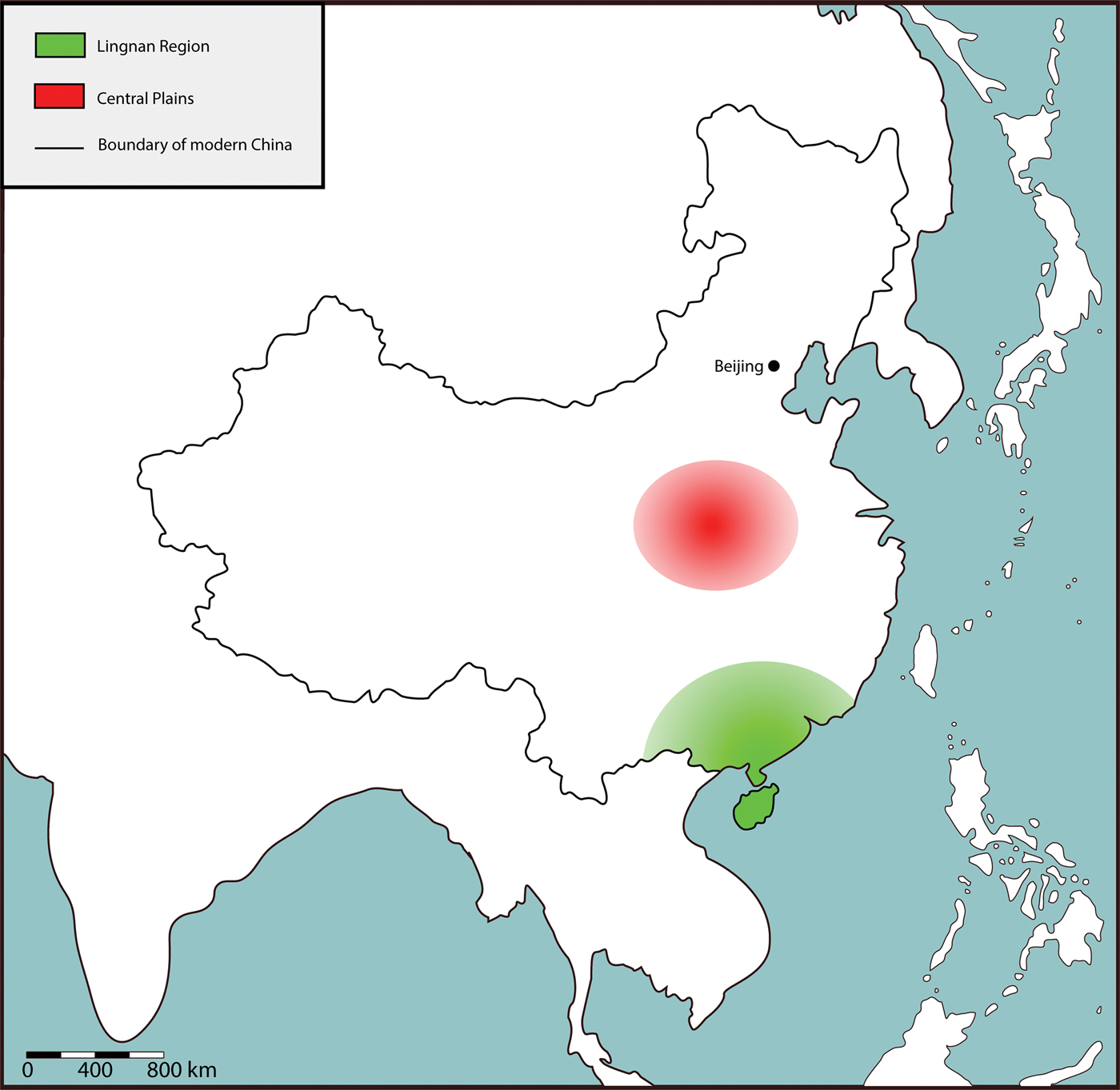
Lingnan, comprising Guangxi, Guangdong, and Hainan province, is located in south China, bordering the South China Sea, and is strategically situated on a passageway between central China and Southeast Asia (Fig. 1). In the last two decades, the recognition of an independent Lingnan Bronze Age culture that reached its high point 800–300 bc has challenged the perception of early historical sources describing Lingnan as an undeveloped wilderness inhabited by barbarian tribes (Allard Reference Allard1997; Higham Reference Higham1996; Li Reference Li2006; Yang Reference Yang2011). What is more, new evidence regarding the involvement of early Lingnan communities in exchange networks with central China, south China and Southeast Asia, as well as the existence of local craft centres producing a number of distinctive products, has been revealed (Higham Reference Higham1996; Qiu Reference Qiu2008). Despite this, there exists only a rudimentary understanding of the socio-politics and economics of early Lingnan. This is mainly the result of the fragmentary archaeological record and research characterized by typological classifications, the latter aimed at establishing chronologies and delineating archaeological cultures, rather than painting a clear socio-economic picture of the region.
Location of Lingnan and the Central Plain in present-day China. (Map: Nina Demandt.)

Ceramics have been found widely distributed over the river valleys of Lingnan, and they played a major role in both daily life and funerary rituals. Since the Early Neolithic (c. 5000–4000 bc), communities had been using ceramic vessels impressed with geometric patterns, while slowly adapting traditional production techniques to accomplish stronger and thinner vessels (Peng Reference Peng2008, 62). During the Early Bronze Age (eighth–twelfth centuries bc), a new type of ceramic material started to circulate: proto-porcelain. Proto-porcelain represents the intermediate stage between hardware and porcelain, was made of kaolin clay and was fired at a temperature of 1100–1200°C (Lu Reference Lu2015). The first production and consumption of proto-porcelain in Lingnan seems to have been limited to the Dongjiang valley of Guangdong province and converged with signs of specialized ceramic production and social differentiation (Lou Reference Lou2010; Zhao Reference Zhao2014). This makes us wonder about the nature and development of socio-economic complexity in this region, as well as the relationship between craft production, labour organization and leadership. How was ceramic production organized, and who was in charge of the production and distribution of proto-porcelain? Proto-porcelain was also not a local invention, but part of a package of technological knowledge imported from neighbouring Bronze Age polities that included a special type of kiln, called ‘dragon kiln’ (Qin Reference Qin2014; Zheng Reference Zheng2012). Thus, making proto-porcelain required unique technological knowledge and skills, as well as the investment of community resources into specialized kilns and labour. Ceramic production, however, did not take place in an isolated ‘production setting’, but was the result of particular learning processes that were culturally bound and socially embedded in a community (Gosselain Reference Gosselain and Stark1998). In other words, it is believed that the value of proto-porcelain was socially constructed, not only through its production process, but also through its consequent consumption. It is, therefore, also important to interrogate the different contexts in which proto-porcelain was used and elaborate on consumer behaviour that was associated with its use. These considerations lead to a second set of questions: What processes of value creation made proto-porcelain a socially valued object? What kind of benefits did the possession of proto-porcelain encompass?
To answer these questions, this paper will first examine the utilitarian and visual characteristics of proto-porcelain; secondly, describe the finding context of proto-porcelain; and thirdly, discuss possible use-contexts of proto-porcelain products. It will be argued that the value creation of proto-porcelain was as much the result of specific technological choices, such as the use of locally available raw materials and elaborate firing technologies, as that of aesthetic and communicative considerations such as the appliance of glaze and particular decoration motifs. This socially constructed symbolic and technological value made proto-porcelain a suitable medium for the simultaneous expression of different social roles that might have included its use as serving ware in community rituals as well as its involvement in politico-economic strategies of elite groups. By focusing on proto-porcelain production and distribution, this study can generate a new understanding about Lingnan communities and their economy, while also enlightening us about specific socio-economic developments in the Dongjiang valley. Bronze Age communities in Lingnan are thought to be stratified chiefdoms (Higham Reference Higham1996) and can be ranked as intermediate or middle-range societies. Therefore, they can also serve as a useful case study to understand larger patterns of economic cooperation and specialization, tendencies towards socio-political complexity and the degree of affiliation between craft specialists and local elites.
Ceramic change and production organization
Early on, archaeologists observed variability in ceramic forms and decorations, and how these variations reflect changes on a temporal and geographical scale (Clarke Reference Clarke1970; Van der Leeuw Reference Van der Leeuw1976). In the last decades, the organization of ceramic production has also been seen as a fruitful avenue for archaeological research because it can provide us with essential information on the economy, craft specialization and sociopolitical processes in ancient societies (Dean Reference Dean2015; Duistermaat Reference Duistermaat and Hunt2016; Gorgues et al. Reference Gorgues, Rebay-Salisbury and Salisbury2017; Hruby & Flad Reference Hruby, Hruby and Flad2007). Today, archaeological traditions focusing on ceramic change and production can be divided into ceramic ecologists, typological approaches, and a third group that uses behavioural approaches and concepts of the social theory of technology (see Costin Reference Costin, Maschner and Chippindale2005; Duistermaat Reference Duistermaat and Hunt2016; Garcia Rosello Reference Garcia Rosello2008, for detailed discussion). These theoretical approaches differ in the way they envision the relationship between technological knowledge, the act of ‘producing’, and society. Ceramic ecologists, for example, mainly focus on identifying ‘constraints’ or ‘external triggers’, such as environment, function, economy, and even evolution (Neff Reference Neff and Schiffer1992). In other words, ceramic ecology emphasizes the role of natural environment and, to a lesser extent, the functional contexts in the formation process of ceramics (Arnold Reference Arnold1985; Matson Reference Matson1965; Rice Reference Rice1996; Santacreu Reference Santacreu2014, 129). Typological approaches, on the other hand, distinguish production types based on a limited number of variables such as scale, intensity, output, mode of production, etc. (Costin Reference Costin and Schiffer1991). A third group of scholars oppose these materialistic views on technological change and stress how ceramic change is not exclusively the result of ecological or functional adaptations. Instead, technology is seen as socially constructed and pottery is considered to participate actively in everyday life experiences (Duistermaat Reference Duistermaat and Hunt2016; Gosselain Reference Gosselain, Roddick and Brower Stahl2016; Jervis Reference Jervis2014; Roux Reference Roux2003).
The organization of production systems, which include potters’ decisions about resource acquirement, production methods, workshop usage and product distribution, is shaped by a complex network of variables,Footnote 1 which can inform us about processes on a local, regional and inter-regional scale (Costin Reference Costin and Schiffer1991; Duistermaat Reference Duistermaat and Hunt2016). Based on the interpretation of production context, a useful distinction made by Earle (Reference Earle1981) is between attached specialists, who produce status goods specifically for an elite, versus independent specialists, who produce commodities and services for a variety of consumers. Recent studies, however, have noted that goods can vary widely in their form, use and social value, and have the potential of performing different social roles in communities (Costin Reference Costin2016; Hruby & Flad Reference Hruby and Flad2007). Also, power structures involved in craft production were more complex than an elite versus commoner stratum, and several social groups, performing various roles, could be involved simultaneously. Therefore, Earle's dichotomous distinction cannot grasp the complexities of consumption patterns and production organizations or meaningfully explore the relationship between craftsmen and those who control the distribution of products. Instead, some scholars have suggested alternative categories that are neither strictly independent nor strictly attached, such as ‘embedded’ specialists (Ames Reference Ames, Douglas and Feinman1995; Janusek Reference Janusek1999), and elite specialists (Inomata Reference Inomata, Hruby and Flad2007; Spielman Reference Spielman, Costin and Wright1998; Reference Spielman, Wells and McAnany2008). Embedded specialists are defined as being fluid in terms of their time commitment, their social class and their degree of attachment (Ames Reference Ames, Douglas and Feinman1995, 174). Elite specialists were ritual practitioners and/or political leaders who solely possessed the ritual knowledge and technological skill to produce craft products.
Nature and value construction of ceramic craft goods
Identifying and categorizing craft goods according to their physical features and archaeological context is necessary to uncover their inherent social and/or symbolic meanings. Categories that often make an appearance in these discussions are ‘prestige goods’ and ‘necessities’. Traditionally prestige goods are defined as objects that are manufactured from rare or non-local materials and are usually ‘costly’ because of the skills and knowledge required to create and obtain them (Vaughn Reference Vaughn2006). Moreover, the control of production and exchange of prestige goods is seen as important to the maintenance and display of rank differences and political relationships by elites (Peregrine Reference Peregrine1991; Trubitt Reference Trubitt2000). This is as opposed to necessities, which are practical objects used by all individuals within a society, and possess no special symbolic content or technological skill. However, the ways producers and consumers engage with crafted objects is more complex than this dual distinction based on political and economic use. Some scholars have argued that there exists a continuum in elaboration between domestic and social valuables and that certain craft goods can act simultaneously as a prestige good and as an utilitarian object (Hruby & Flad Reference Hruby and Flad2007; Spielman Reference Spielman2002). An interesting category suggested by Bernier (Reference Bernier2010) is that of ‘intermediate goods’. Although these goods did not constitute the most prestigious objects and could be made of various materials locally available, they possessed symbolic value that was socially constructed. In this way, they could be used simultaneously as vehicles for ideology by the political elite as well as in household-level strategies for the general urban population (Bernier Reference Bernier2010).
Ceramics, in particular, have the potential to express a multiplicity of meanings and to move between political, economic and religious realms. Spielman (Reference Spielman2002), for instance, argues that ceramic vessels used as serving bowls in domestic contexts may have also played a role in communal ceremonial contexts. Similarly, Callaghan (Reference Callaghan and Costin2016, 281) has studied how ceramic containers were used as serving ware in ritual gatherings, gifted by elites to materialize political relations or social debt and, in some instances, were transformed into alienable possessions from which individual and groups derived their authority. Furthermore, ceramic vessels are often involved in the domestic and communal consumption of food and may appear as tableware or items of display at ceremonial events and feasts (Twiss Reference Twiss and Twiss2007; Urem-Kotsou & Kotsakis Reference Urem-Kotsou, Kotsakis, Renard and Mee2007). Feasting is strongly associated with ritual activity and can either reinforce sociopolitical differentiation or enhance cooperation and social integration (Twiss Reference Twiss2012). The usage of ceramic vessels in these contexts transforms them into a suitable medium for reflecting different social relations and identities. Thus, the potential of ceramic vessels to portray different roles in society makes it critical firstly to recognize the different contexts in which the ceramics under discussion may have appeared, and secondly to analyse how they may have functioned in these specific contexts.
Recently, it has been recognized that the processes underlying value construction are key to understanding the function of craft goods (Costin Reference Costin2016; Hruby & Flad Reference Hruby and Flad2007; Marakami Reference Marakami2016). Often raw materials are seen as critical for attributing value and meaning to an object. In particular, scarcity and the geographic distance that needs to be travelled to acquire these materials are said to contribute to the creation of socially valued goods. On the other hand, Bhan et al. (Reference Bhan, Vidale and Kenoyer1994) have argued that certain crafts whose raw materials were relatively common or easy to obtain can also be considered as prestige goods because of the complex character of technologies involved. In particular, goods that involve elaborate pyro-technological processes fall into this category. For instance, Arretine ware, a type of Roman fine ware with a red glossy slip, stood out among other ceramics, due to its high quality and distinctive firing process, despite being made with plain, local clays (Bhan et al. Reference Bhan, Vidale and Kenoyer1994, 143). Similarly, Harappan stoneware bangles were made with locally available clay sources, but were distributed in restricted contexts and were unique due to the complex nature of their manufacturing technology (Blackman & Vidale Reference Blackman, Vidale and Jarrige1992). In these cases, the objects gained value through the production process and the physical properties resulting from that process.
The investment of complex technology has implications for the final properties of the product and creates both typical utilitarian characteristics as well as visual characteristics. According to Skibo and Schiffer, changes in production technology are the result of functional constraints imposed by the final properties or performance characteristics of pottery (Gille Reference Gille1978; Skibo & Schiffer Reference Skibo and Schiffer2008). These performance characteristics can be envisioned as utilitarian, such as thermal shock resistance, heating/cooling effectiveness, etc., as well as visual and communicative, such as texture and colour. Besides choices related to raw materials and technological skills, the addition of decoration motives and marks, and the integration of ritual or religious knowledge into different steps of the production process can also assist in creating socially valued goods (Hruby Reference Hruby, Hruby and Flad2007; Spielman Reference Spielman2002). Finally, finished goods can gain additional value when they are circulated in different use-contexts, for instance when they are exchanged in prestige-good networks, or when they are used in rituals or communal ceremonies.
Bronze Age Lingnan and its ceramics
Chinese chronicles, such as the Shiji (Records of the Grand Historian), describe the inhabitants of early Lingnan as ‘uncivilized’ Yue barbarians, and ponder about the strangeness of their customs as opposed to those of the ‘civilized’ states located in the Central Plain (middle and lower regions of the Yellow River) (Fig. 1). Recently, however, archaeological research has shown that during the Bronze Age this region was originally populated with small communities that featured stilt-style architecture and pit burials; were familiar with rice cultivation, animal husbandry, and bronze working; and were also engaged in the making of stone objects and fishing (Higham Reference Higham1996; Yang Reference Yang2011). The material culture of these Bronze Age communities was mainly characterized by ceramic and bronze utilitarian goods, stone tools including shouldered axes, and a small group of prestige goods such as bronze vessels and weapons, as well as hard-stone and jade ornaments. Although the northern border of Lingnan is framed by the Wuling range, comprising five mountain ranges, these communities were not isolated, but were part of a cultural interaction sphere which connected a range of regional cultures in south China (for more information about the archaeological cultures of southern China during the Bronze Age, see Shelach-Lavi Reference Shelach-Lavi2015).
Four types of ceramics have been found in Bronze Age Lingnan: sand-tempered pottery, stamped pottery, glazed stoneware and proto-porcelain. Sand-tempered pottery first appeared in the early Neolithic, is rather crude and mostly decorated with cord marks (Shen Reference Shen2003). Stamped pottery, on the other hand, first appeared in the Early Neolithic and was mostly stoneware that required a higher firing temperature, and was usually paddle-impressed with geometric designs (Shen Reference Shen2003). Proto-porcelain appeared during the Early and Middle Bronze Age, and the origin of this term stems from a debate about the position of a type of glazed stoneware found at Shang period sites (1046–1400 bc) across China. Although this type of stoneware was fired at a higher temperature and had a lower water absorption degree than other ceramics, it did not possess the typical qualities of porcelain, which are a white translucent body, a very thin glaze and a water absorption degree between 0.16 and 0.5 per cent. Therefore, the name proto-porcelain was first suggested in the 1960s and is today commonly used all over China.Footnote 2 Proto-porcelain has been found in the lower basin of the Yellow River, including Shaanxi, Henan, Hebei, Shandong and Shanxi province, in the lower basin of the Yangtze River, including Hubei, Hunan, Jiangxi, Anxi, Jiangsu and Zhejiang province, and in the southern provinces of Fujian and Guangdong.
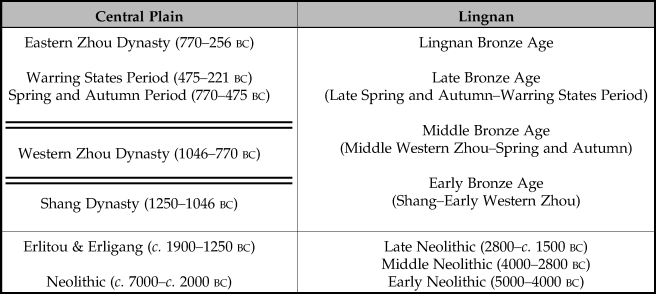
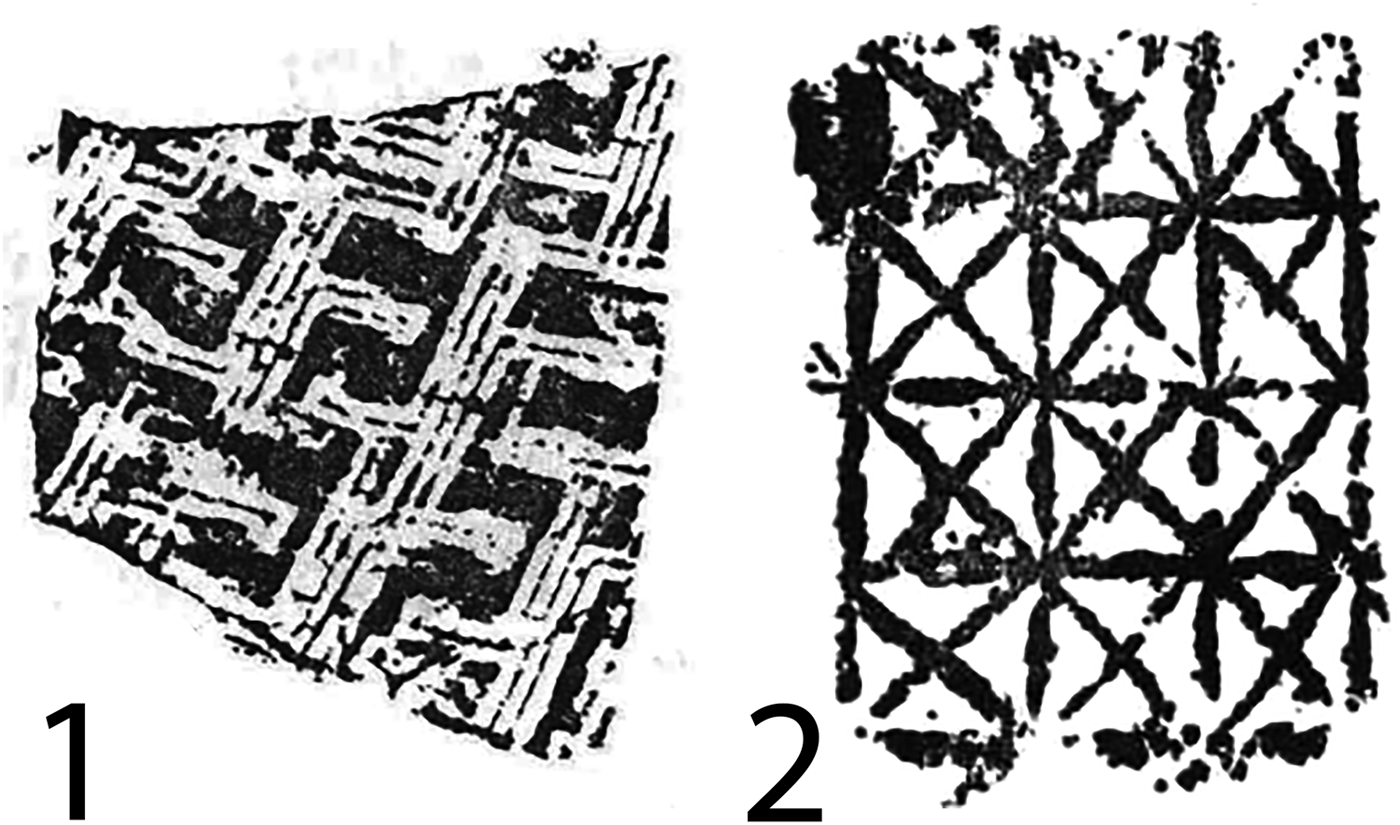
Concerning the Lingnan Bronze Age, archaeologists generally use a chronological framework that mirrors the cultural sequence of early states in the Central Plain (Table 1), in particular sites that are associated with the Shang and Zhou.Footnote 3 The use of these terms may seem confusing, since Lingnan did not belong to the direct influence sphere of the Central Plain, but the chronology of the Lingnan Bronze Age is still a work in progress and is largely based on comparative regional research. Although this paper will adhere to this chronology, to emphasize the independent nature of the regional development in Lingnan it will use the divisions Early, Middle and Late Bronze Age (Table 1). In addition, it should be noted that the presence of specific decoration motifs on geometric ceramics has also been used to delineate chronological stages of the Bronze Age and later periods in south China (Peng Reference Peng1987). Today for Lingnan (not including southwest Guangxi) most scholars agree on the following periodization: 1) ‘Kui‘ or ‘double f‘ patterned pottery dominated from the eighth until the third century bc; 2) ‘Mi’ patterned pottery dominated from the third to the first century bc (Li Reference Li2006; Yang Reference Yang2011; Yu Reference Yu2014; Fig. 2). Nonetheless, this periodization is still under debate, and a number of sites have been found containing both Mi and Kui ceramics.
Chronological chart showing the cultural sequence of the Central Plain and Lingnan. (After Higham Reference Higham1996; Liu & Chen Reference Liu and Chen2012; Shelach-Lavi Reference Shelach-Lavi2015; Yang Reference Yang2011.)

Main decoration types of stamped ceramics: (1) Kui pattern;(2) Mi pattern. (After Qiu Reference Qiu2008.)

The archaeological record of the Dongjiang valley
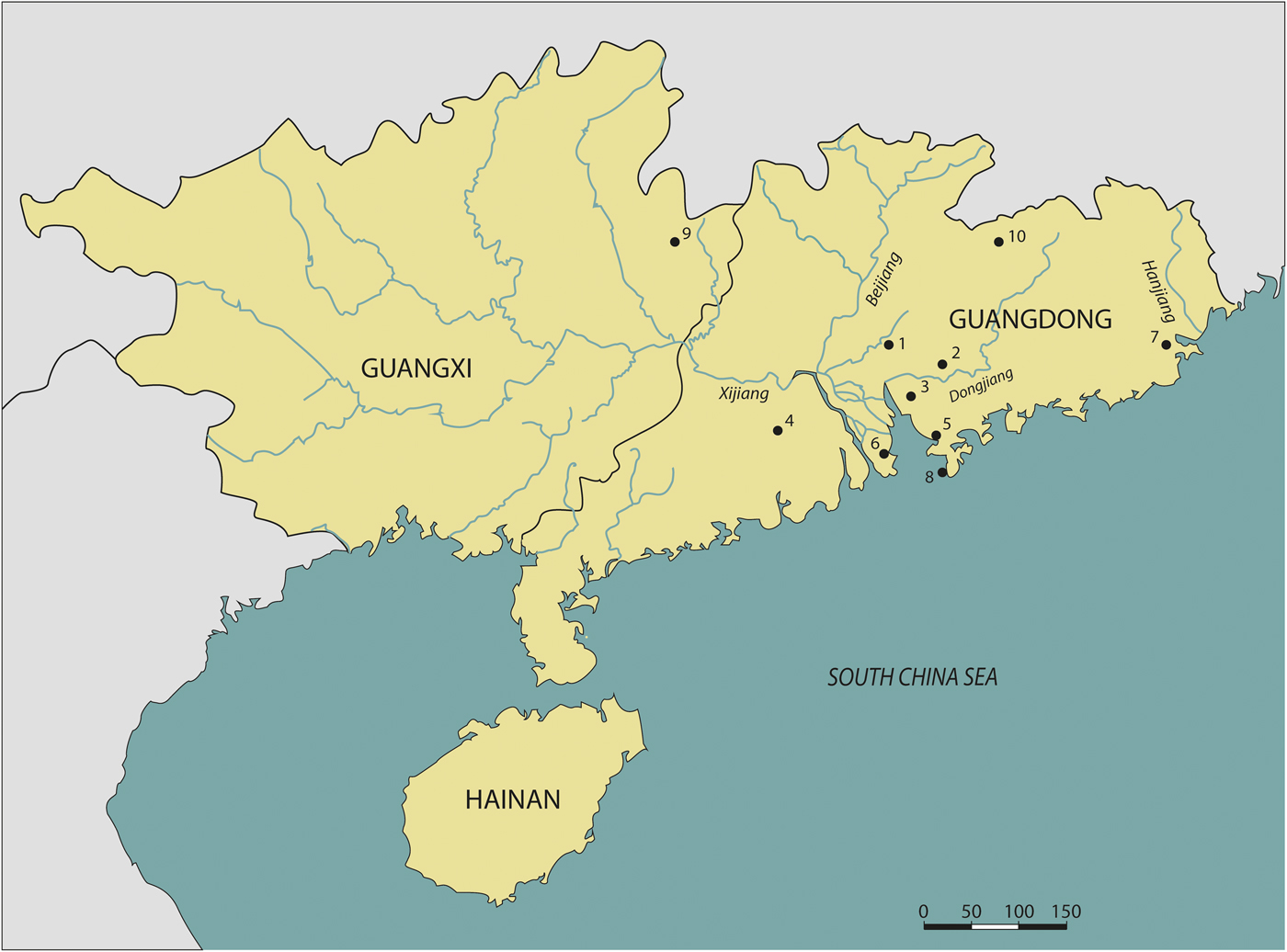
The Dongjiang valley, which is part of the Pearl River Delta in Guangdong province, south China (Fig. 3), has a favourable geographic position, being interspersed amongst low mountains and hills, and includes the cities of Huizhou, Dongguan and Shenzhen, and the Zengcheng district in Guangzhou. Compared to other regions in Lingnan, a higher number of Bronze Age sites have been found in this valley (Yang Reference Yang2007; Zhao Reference Zhao2014). These include large-scale burial complexes and kiln sites, as well as a small number of settlement sites and ritual caches. The dating of these sites is mainly based on the types of geometric ceramics uncovered, 14C dating (in particular Henglingshan) and stylistic comparisons with bronze and ceramic vessels found at other dated sites.
Map of the Lingnan region and the locations mentioned in the text. (1) Guangzhou, Zengcheng District: Xigualing, Fufuling; (2) Huizhou, Boluo District: Meihuadun, Yingang, Henglingshan, Xibushangling, Longxiyingang, Suguang,Wowei-ao; (3) Dongguan: Zhuguling; (4) Yunfu, Luoding District: Beifushan; (5) Shenzhen: Wubeiling; (6) Zhuhai; (7) Jieyang: Miantouling; (8) Hong Kong: Lamma Island; (9) Hezhou; (10) Heyuan, Heping District. (Map: Nina Demandt; scale in km.)

Three sites have evidence of proto-porcelain production: Meihuadun, Yingang and Xigualing. Meihuadun, located in Boluo district in Huizhou, is dated to the Middle Bronze Age (Guangdong & Boluo 1998; Yang et al. Reference Yang, Li, Yang and Wu1997). One dragon kiln has been found here, and although the fire chamber and kiln end have collapsed, it is estimated to have been 15 m long. Other finds were glazed stoneware belonging to the Kui-patterned category, proto-porcelain, animal figurines and production tools, including stamps and anvils. At Yingang, also located in Boluo district in Huizhou, four dragon kilns have been excavated, the longest being 10 m (Gu et al. Reference Gu, Li and Deng1998; Zheng & Gu Reference Zheng and Gu2000). This site was continuously occupied from the Middle until the Late Bronze Age. During this last period, there was a dramatic increase in quality and quantity of the pottery, with finds of daily-use utensils belonging to the Mi-patterned category, proto-porcelain, animal figurines, anvils and tiles. Finally, Xigualing is a Late Bronze Age production site, located in Zengcheng district (Mo & Li Reference Mo and Li1964). At this site, two dragon kilns have been uncovered that seem to have been built in different periods. This site contains a large number of Mi-patterned hardware, glazed wares, animal figurines and tools made of ceramics, bronze and iron. Although no proto-porcelain has been found at Xigualing, this production site also used dragon-kiln technology to manufacture similar ceramic products to the other two kilns.
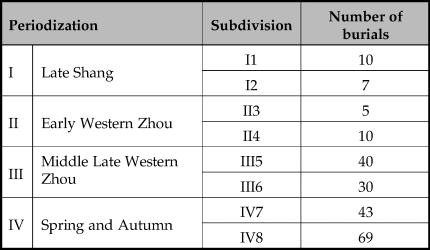
In addition, one settlement site, Zhuguling, and two large tomb sites, Fufuling and Henglingshan, should be mentioned. The Zhuguling site, situated in Dongguan, has a total surface of 16,000 sq. m and is dated to the late Bronze Age. Up to now 1200 sq. m have been excavated and remains of three water wells, post-holes, bronzes, stone tools, proto-porcelain and ceramic utensils have been uncovered (Zhao Reference Zhao2014). No detailed excavation report has yet been published for this site. Fufuling, in Zengcheng, covers an area of 15,000 sq. m with 525 tombs ranging in time from the late Neolithic until the Ming Dynasty (Zhang Reference Zhang2011; Reference Zhang2015). The majority of tombs belong to the Middle Bronze Age period and contain bronzes, jades, stamped ceramics and proto-porcelain. For this site, there is also no detailed excavation report available as yet. At Henglingshan, located on a hill in Boluo district, 302 tombs spread over 8500 sq. m have been excavated (Cheng Reference Cheng2016; Guangdong 2005; Guo Reference Guo2006; Wu et al. Reference Wu, Wu, Li, Li, Luo& Z and Qin2014). At this site, 110 tombs are dated to the Early Bronze Age and 182 to the Middle Bronze Age and differences in tomb location, size, and grave goods indicate tendencies towards social differentiation (Table 2). Tombs that were constructed on higher parts of the hill generally were larger and contained a larger assemblage of prestige goods, including proto-ceramics, jades and bronzes, than those located lower.
Periodization and number of burials of the Henglingshan site. (After Guangdong 2005).

The nature of social complexity and the institutionalization of leadership in Lingnan is not well understood. The lack of evidence for monumental architecture and elite residences has forced archaeologists working in Lingnan to base their interpretations on materials uncovered in tombs and some rare historical references. The discovery of tomb complexes with rich burials containing bronzes and jades, such as those of Henglingshan and Fufuling, implies that a stratified society with an elite class that could invest surplus in the building of tombs, as well as the acquirement/production of status goods, already existed during the Middle Bronze Age (Cheng Reference Cheng2016; Guo Reference Guo2006). Additionally, some contemporary historical sources written in the Central Plain have references about early kingdoms thought to be located in Lingnan, such as the Fulou kingdom (Zeng Reference Zeng1994). Qiu Licheng (Reference Qiu2008, 358) believes these kingdoms were ruled by local lords or kings and featured a hierarchical system with specific social rules and rituals.
Features and functions of proto-porcelain in the Dongjiang valley during the Bronze Age
Production process of proto-porcelain
The proto-porcelain found in Lingnan displays the three main characteristics of proto-porcelain found in south China: firstly, it is made of china clay or kaolin; secondly it is covered by a layer of vitric glaze; and thirdly, it has a firing temperature between 1100°C and 1200°C (Lu Reference Lu2015, 355). Until now only the proto-porcelain vessels found at Henglingshan have been studied in detail. In addition, samples of the Meihuadun kiln site and the Wubeiling site in Shenzhen have been analysed. The production process of proto-porcelain can be divided into five stages: 1) selection and extraction of raw materials; 2) paste preparation; 3) shaping; 4) decoration; 5) drying and firing (Lou Reference Lou2010).
WDXRF (Wavelength Dispersive X-ray Fluorescence) and INAA (Instrumental Neutron Activation Analysis) of 38 hardware samples from Henglingshan, Yingang and Meihuadun has revealed substantial variations in their chemical compositions, which indicates that raw materials might have been collected locally (Wang et al. Reference Wang, Chen and Cheng2004). X-ray fluorescence analysis of proto-porcelain samples from Henglingshan (periods three and four) and Meihuadun has revealed that paste recipes in the Dongjiang valley were continuously adapted with a gradual decrease in the use of aluminium and an increase in the use of silicone over time (Wu et al. Reference Wu, Li, Wu, Deng and Zhu2005, 449). Unfortunately no results are available for the Yingang kiln site. When comparing the chemical composition of proto-porcelain on an interregional scale, it should first be noted that other regions in China, in particular Shanxi, Henan, Hebei, Shaanxi, Jiangxi and Zhejiang province, usually reveal vessels with a low aluminium content (around 15 per cent) and high silicone content (70–80 per cent) (Wu et al. Reference Wu, Wu, Li, Li, Luo& Z and Qin2014). The situation in Henglingshan, Yingang and Meihuadun, however, is the opposite of this, with a higher aluminium content (around 25.6 per cent) and a lower silicone content (less than 70 per cent) (Wang et al. Reference Wang, Chen and Cheng2004; Wu et al. Reference Wu, Li, Wu, Deng and Zhu2005; Reference Wu, Huang and Zhang2012).
Glaze recipes derived from the ash-glazing tradition popular in Bronze Age Southern China and the composition of Henglingshan, Yingang and Meihuadun glazes were similar to those of Jiangxi, Zhejiang and other regions (Wu et al. Reference Wu, Zhang, Wu, Li, Li, Deng and Jiang2011; Reference Wu, Wu, Li, Li, Luo& Z and Qin2014; Zheng & Gu Reference Zheng and Gu2000). Two types of glazes can be distinguished: one composed of calcium, potassium and magnesium resulting in the greenish glaze found on most vessels; and one composed of calcium and a higher iron content (higher than 5 per cent) resulting in a blackish green glaze. This characteristic black glaze appeared on the earliest glazed stoneware found at Early Bronze Age sites of the Fubin culture located in the Hanjiang valley of Guangdong (Zheng Reference Zheng2012).
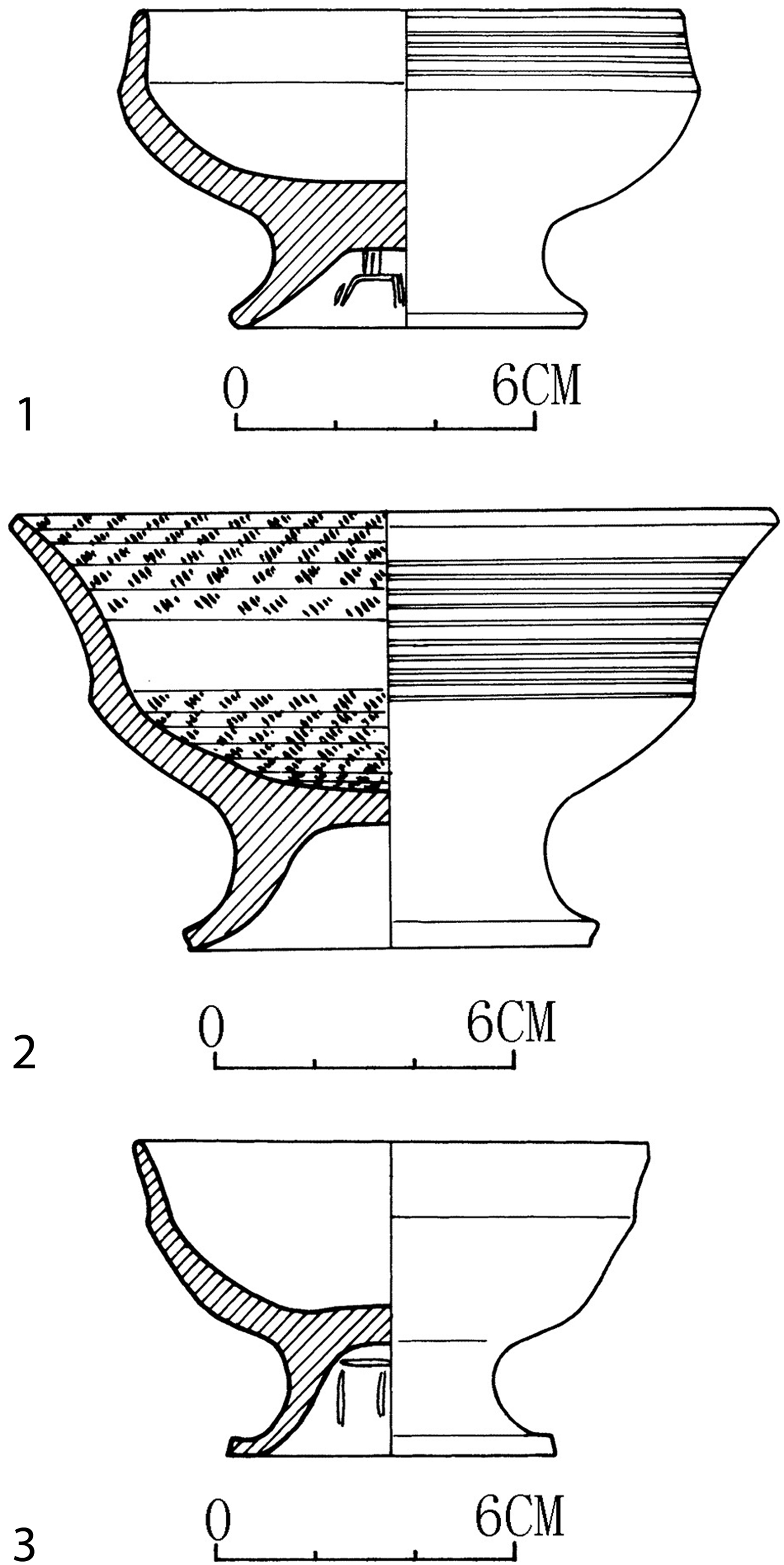
Most proto-porcelain vessels were firstly shaped by the coiling method and traces of the slow wheel indicate they were finished off by wheel throwing. Most vessels are decorated with concentric lines, called the bowstring pattern, and/or small indentions, called the fine-toothed comb pattern (Fig. 4). Of particular interest is the fact that vessels were decorated both inside and outside, with usually more elaborate patterns on the inside. This in contrast to proto-porcelain vessels found in other regions, such as Zhejiang, Jiangxi and Fujian, which rarely feature patterns on the inside (Qin Reference Qin2014; Wang Reference Wang2010). In addition, all vessels were incised by markings, usually on the bottom part or stem of the vessel, before they were fired (Fig. 4). This practice is commonly seen on geometric stamped ceramics and proto-porcelain in south China and most scholars believe it is related to signs of different labour units (Guangdong 2005).
Main Decoration patterns of the Dou vessels found at Henglingshan. (1) Bowstring pattern; (2) Bowstring + toothcomb pattern; (3) Undecorated. (Guangdong 2005, figs. 706.2, 695.1, 697.1.)

Proto-porcelain was fired in a special type of kiln, called ‘dragon kiln’. Dragon kilns are rectangular structures constructed on an inclined surface of a slope or hill and made up of a fire chamber, kiln bed and smoke-extraction chamber. The kiln works according to the cross-draught principle, in which the heat combustion is drawn sideways through the kiln rooms by the use of a chimney. In this way, the temperature could be raised quickly and the reduction atmosphere could be kept stable. In addition, the temperature inside the kiln could be heightened and reduced rather quickly due to the thin kiln walls. These advantages make dragon kilns suitable for producing glazed stoneware and porcelain. Ultimately, it is believed that this type of kiln was created in southern China due to environmental factors, such as the humid climate, composition of southern clays, and hilly topography; economic factors, such as increasing the efficiency of stoneware production; and practical factors, as ceramics required a dry and closed space (Zhou Reference Zhou2012).
Finding context of proto-porcelain
Determining the presence of proto-porcelain is problematic because it cannot be distinguished directly from other ceramics by the naked eye and needs to be analysed chemically. Therefore, there is a high possibility that a large number of proto-porcelain vessels have not yet been identified. According to our current knowledge, proto-porcelain consumption seems to have been mainly concentrated in the Dongjiang valley, where it has been found in Huizhou, Dongguan and Zengcheng, at the Meihuadun, Yingang, Henglingshan, Fufuling and Zhuguling sites.
Proto-porcelain has been found in 64 of the 322 tombs of Henglingshan, mainly belonging to the Middle Bronze Age period. These tombs are rectangular pit graves with between 0 and 25 grave goods, including bronzes, jades, whetstones, spindle whorls, stamped ceramics and proto-porcelain. In total 111 proto-porcelain vessels have been found that range in number from one to six. Based on differences in the amount and type of grave goods, Cheng Ling (Reference Cheng2016) has ranked these tombs into five levels and although proto-porcelain is found in all categories, higher-ranking burials include more vessels with more decorations (Table 3).
Ranking of Henglingshan burials into five levels. Number of burials containing proto-porcelain are in brackets. (After Cheng Reference Cheng2016, 38.)

Besides Meihuadun, Yingang and Henglingshan, a large number of Bronze Age sites have been found in Boluo district of Huizhou, but until now proto-porcelain has been identified only at one burial site, Xibushangling (Cui Reference Cui2003). In addition, it is possible that two settlement sites in Boluo, Longxiyingang and Sugang, also have evidence of proto-porcelain (Yang Reference Yang2007). A number of vessels found at these sites are very similar to Henglingshan and Meihuadun, but have not yet been chemically analysed. Also, at the moment we only know of two other contemporary sites in the Dongjiang valley where proto-porcelain has been discovered, Zhuguling and Fufuling, but, unfortunately, detailed excavation reports of these sites are not yet published. From a short excavation report of Tomb M511, dated to the third century bc, however, it seems that the finding context of proto-porcelain in Fufuling might be quite similar to that of Henglingshan, with the discovery of proto-porcelain vessels in combination with stamped ceramics and jades (Zhang Reference Zhang2011).
Outside the Dongjiang valley, proto-porcelain is found at tombs of the Middle Bronze Age at the Wubeiling site in Shenzhen and Lamma Island in Hong Kong, but no detailed information is available about the tomb content of these sites (Zhao Reference Zhao2014). During the late Bronze Age, proto-porcelain is found in some tombs in Jieyang, Heyuan (Heping district) and Yunfu (Luoding district) in Guangdong province, and Hezhou in Guangxi province, together with status goods such as bronzes (Qiu & Mao Reference Qiu and Mao1986; Qiu et al. Reference Qiu, Liu, Chen, Wu and Huang1992; Zhang Reference Zhang1993). For example, at Beifushan M1 in Luoding district one proto-porcelain cup was found among 98 bronze grave goods. The proto-porcelain of these tombs has not been analysed and no assumptions about their provenance can be made.
Function of proto-porcelain
Proto-porcelain grave goods have been found in large numbers in tombs all over south China and are usually copies of ritual bronzes and instruments popular in the Central Plain and Chu state (Wang Reference Wang2017). Although the structure and production methods of bronzes differ greatly, in terms of size, shape, and decoration, proto-porcelain goods are often exact copies of bronzes. Proto-porcelain seems to have been used as a replacement material for bronze for two main reasons: firstly, proto-porcelain had one of the desired qualities of bronzes—impermeability—and could perform similar functions to bronze vessels used for pouring and serving; secondly, the technology was easier to grasp and proto-porcelain as a material was easier to acquire than bronze because the raw materials for proto-porcelain were widely available in south China (Zhao & Sun Reference Zhao and Sun2009). Compared to the proto-porcelain found in contemporary tombs in Hunan, Jiangxi, Fujian and Zhejiang, the vessels in Lingnan have a limited distribution, and are smaller in number and variation.
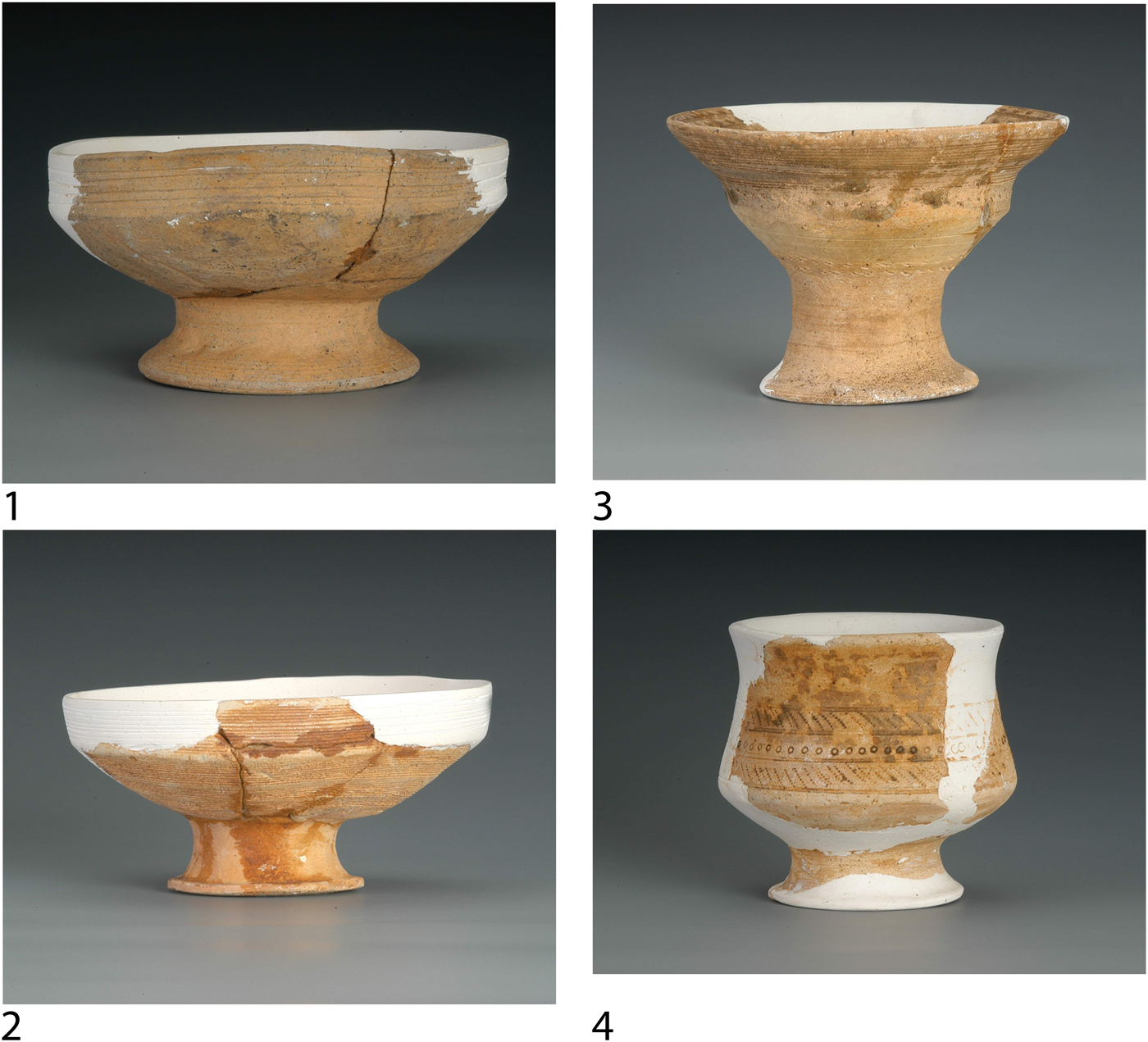
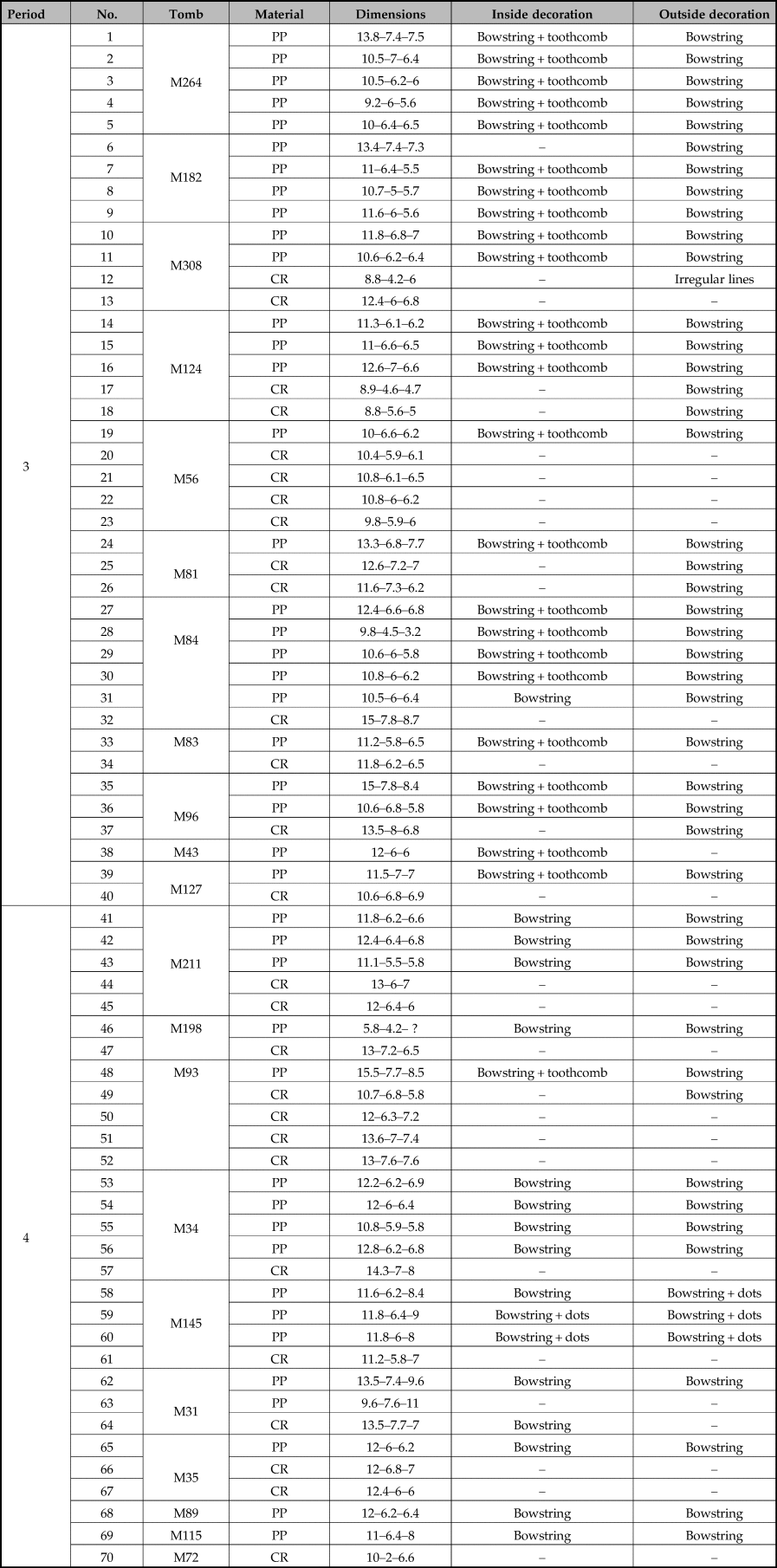
The proto-porcelain goods unearthed at Henglingshan are all vessels for pouring and serving food and are always found together with stamped or undecorated ceramics. Furthermore, these vessels are often found in groups of two, three or four together with similar ceramic vessels, which might indicate they were sets. Among the found vessels, the Dou vessel, which is a circular bowl on a stem with a round foot, is most common (Fig. 5). Based on historical sources from the Central Plain, it is known that Dou vessels were used foremost for serving food and secondly as ritual vessels. For example, the Shijing or Book of Odes, dating from the Zhou until the Spring and Autumn period, mentions the use of Dou vessels for serving fruit to guests by the Chu. The Confucian Analects, on the other hand, record that Dou vessels in the Central Plain also appeared in ritual contexts and that their use was governed by officials. We have no sources about the use of Dou vessels in Lingnan, but from archaeological excavations it is known that ceramic Dou vessels have been a burial gift since Neolithic times (Lou Reference Lou2010) and appear quite frequently at sites in southern Guangdong and Hong Kong (Yang Reference Yang2007). Therefore, the practical purpose of ceramic Dou vessels cannot be denied. However, proto-porcelain Dou vessels (and other types of proto-porcelain vessels as well) found at Henglingshan differ in appearance from ceramic Dou vessels. Firstly, most vessels are covered with a light-green glaze, and secondly, while most ceramic Dou vessels are undecorated, proto-porcelain Dous are decorated with patterns made up of concentric circles, dots and small engravings both inside and outside. Moreover, burials with more grave goods tend to include larger sets of Dou vessels with more beautiful patterns on the inside than burials with fewer grave goods (see Table 4). This could indicate that proto-porcelain might have been involved in other use-contexts than ceramic vessels.
Ceramic vessels found at Henglingshan. (1) Ceramic Dou vessel (T0606.58); (2) Proto-porcelain Dou vessel with straight wall (T0104.95); (3) Proto-porcelain Dou vessel with curved wall (T0505.103); (4) Proto-porcelain cup (T0104.107). (Guangdong 2005, figs. 710.4, 704.7, 706.3, 710.4.)

Overview of 70 Dou vessels unearthed at Henglingshan and their features. Proto-porcelain = PP; Ceramics = CR. (After Guangdong 2005.)

As a next step, evidence concerning the use of proto-porcelain in habitation contexts should be considered. As a rule Bronze Age settlement sites in Lingnan are quite rare, and the main ones for the Dongjiang valley are Longxiyingang and Sugang in Boluo, Wowei-ao in Huiyang and Zhuguling in Dongguan (Yang Reference Yang2007; Zhang Reference Zhang2009). These sites usually contain stone tools and ceramic vessels such as Dou and Guan (a type of tall, round-bellied pot). Zhuguling is the only settlement site where proto-porcelain has been uncovered. Unfortunately, no excavation report is available for this site. At the other sites no proto-porcelain has been identified yet; therefore it is not possible at the moment to make any assumptions about the use of proto-porcelain at habitation sites.
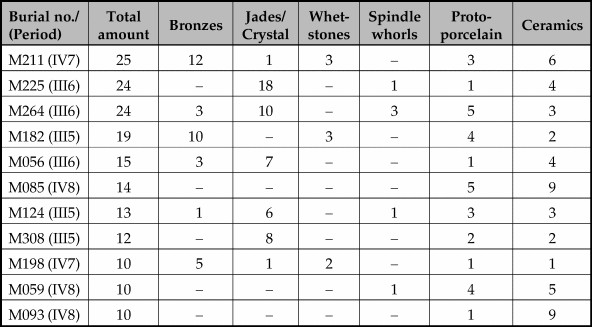
Although proto-porcelain is found in all types of graves, its occurrence with prestige goods such as bronzes and jades should be noted (see Table 5). The majority of these bronzes are weapons, including dagger-axes, spears, short swords and arrowheads, and tools, such as axes, scrapers, chisels, etc. In addition, two bronze bells (M182) and a cauldron (M201), called ‘Ding’, that stands upon four legs with two opposed handles and was a vessel for serving food, have been found. Although the style and shape of these bronzes are representative of ritual bronzes used in the Central Plain, chemical analysis has revealed a high tin content which indicates a regional origin (Guangdong 2005,462–8). Thus, the presence of locally produced northern-style vessels and instruments at Henglingshan suggests their use as prestige goods. In the Central Plain, these types of objects were not only an important part of the ritual system, but their number in the burial assemblage increased depending on the status of the tomb owner. It seems, however, that the Lingnan elites did not use them in the same contexts: they did not follow the rule system that controlled the number of vessels, and sound tests have excluded musical use of the bronze bells (Guangdong 2005, 469). These bronze objects, therefore, seem to be prestige goods that had a limited distribution and were in demand for their ‘exotic’ appearance and might have been used in local rituals for display.
Burial assemblages of richest Henglingshan burials. (Guangdong 2005.)

Discussion
Based on current archaeological evidence, proto-porcelain seems to have been mainly produced and consumed regionally in the Dongjiang communities and only sparsely reached other regions in Guangdong. When looking at production localities, for instance, Meihuadun, Yingang, and Xigualing were strategically located near river banks and might have mainly supplied ceramic products to close localities such as Henglingshan, and possibly Fufuling and Zhuguling. These sites are not only situated within a radius of 35 km of the three kiln sites, but also feature similar ceramics. The proto-porcelain found at Henglingshan, in particular, has the same chemical composition as those of Meihuadun (Wu et al. Reference Wu, Li, Wu, Deng and Zhu2005). Although no elite architecture or administrative artefacts have been uncovered, the kiln sites in the Dongjiang valley seem to be physically separated from other activity areas, and an archaeological survey has excluded the existence of associated agricultural settlements. Findings of tools unrelated to craft production and settlement remains on the kiln sites further indicate that potters worked and lived at these production loci. The technological know-how necessary for using dragon kilns and producing proto-porcelain seems to have been centralized and, as far as we know today, was only available at Meihuadun and Yingang (and possibly Xigualing). This spatial segregation could indicate the presence of attached specialists who specifically produced for an elite class and controlled the production and distribution of proto-porcelain goods. However, this possibility should be tested against the process of value construction and to what degree the final proto-porcelain product and its use-contexts reflect the characteristics of prestige goods, intermediate goods and/or necessities.
Although proto-porcelain was made from locally available materials and copied traditional shapes of utilitarian vessels, the use of complex pyro-technological processes induced both typical utilitarian and visual characteristics that differed from other ceramic categories. Considerations about the intended use-contexts of proto-porcelain may have influenced these technological choices. Utilitarian performance characteristics playing a role in the production process and eventual consumption of proto-porcelain are permeability and strength. Dispersive X-ray Fluorescence (EDXRF), INAA, X-ray Diffraction (XRD) and firing temperature analysis of Henglingshan ceramics have revealed the potters’ intentions to improve the technical characteristics of proto-porcelain (Wang et al. Reference Wang, Chen and Cheng2004; Wu et al. Reference Wu, Wu, Li, Li, Luo& Z and Qin2014). More specifically, changes in paste recipes that gradually contained a lower aluminium content, and firing temperatures that evolved from lower than 900°C up to over 1200°C, took place from the first to the fourth period. Visual and tactile performance characteristics include surface colour, texture and decoration. It appears that in the Dongjiang valley a local decoration type combining bowstring and fine-toothed comb patterns was developed specifically to highlight the inside of proto-porcelain vessels, whereas other types of ceramics featured bowstring patterns, geometric impressed decoration or were undecorated. The difference between decorated proto-porcelain Dou vessels and the mostly undecorated ceramic Dou vessels can be noted in this regard. Furthermore, the continued efforts of craftsmen aimed at accomplishing a higher degree of translucency and better glaze quality (Wu et al. Reference Wu, Wu, Li, Li, Luo& Z and Qin2014), eventually reaching the level of porcelain, could also indicate the importance of these visual characteristics for conveying information about social status or identity. Proto-porcelain as a finished product was an impermeable ceramic product and its decorative motifs, as well as translucent, glazed appearance, had a distinctive communicative quality. In other words, it was probably a highly visible object and immediately recognizable by all members of society. This excludes its use as a daily utensil, but would make it a suitable medium for expressing identity and social status. The fact that proto-porcelain vessels found at Henglingshan were deliberately gifted in certain amounts and combinations further strengthens this point.
To clarify how craftsmen could create products with specific technical, aesthetic and social values, it might be worthwhile to compare the manufacturing process of proto-porcelain with that of other types of ceramics produced in the Dongjiang valley. The situation in the Dongjiang kilns is interesting in that different types of ceramics, including proto-porcelain, geometric hardware and sandy pottery, were produced simultaneously. What is more, findings of decoration tools, production tools and permanent firing structures, e.g. kilns, provide direct evidence of spatial co-occurrence of different ceramic-processing activities, such as clay shaping, surface treatment and firing. In other words, despite obvious differences in the production methods of different types of ceramics, they all seem to have been manufactured at the same location. This scenario is not limited to Lingnan, but seems to be common at other Bronze Age kiln sites across southern China (Qin Reference Qin2014). A closer look at the production process of stamped geometric and proto-porcelain products reveals that the stages of clay preparation and surface treatment differed. Wang and Chen (Reference Wang and Chen2005) have analysed and compared the chemical composition of these two types of ceramics through INAA and WDXRF, and concluded that both paste recipes contained different raw materials. When it comes to surface treatment, using rounded ceramic stamps,Footnote 4 geometric hardware vessels were impressed with a number of decoration patterns. Proto-porcelain, on the other hand, was mostly inscribed with a number of patterns and required extra production steps to prepare and apply the glaze. Only at two stages of production—shaping and firing—did the production sequences of geometric hardware and proto-porcelain overlap. The majority of ceramic and proto-porcelain vessels were firstly formed through the coiling technique and finished off by wheel technology. Inside the dragon kiln, they were fired together, as is evidenced by the co-occurrence of both types of ceramics in the same stratigraphic layers inside the kiln room and the excavation of sherds of proto-porcelain and hardware sticking together at Meihuadun. The differences in the sintering degree of both ceramics are probably related to variations in batches and different firing positions inside the kiln. Thus, production steps that were essential for accomplishing the final appearance of specific vessels, and created typical utilitarian and visual characteristics differed between stamped ceramics and proto-porcelain. Reasons for the simultaneous firing of different material categories may be related to economic considerations, and it might be possible that dragon kilns were a type of shared firing structure between craftsmen responsible for different products.
Compared to regular ceramics, proto-porcelain might have been a type of prestige good because it had a more limited distribution and more numerous appearance in high-status burials, while stamped and undecorated ceramics seem to have been mostly utilitarian goods that were widely distributed in both settlement and burial settings, and were a common category of grave goods for all members of society. For example, at Henglingshan 57.7 per cent of all grave goods are ceramics, and only 23 out of 214 tombs did not contain any ceramic goods (Zhao & Sun Reference Zhao and Sun2009). A similar situation exists at the kiln sites, where the majority of ceramic products that were manufactured were geometric hardware, and only a small proportion was proto-porcelain. For example, at Meihuadun this is only 1.41 per cent of the total artefacts (Guangdong & Boluo 1998).
On the other hand, although limited in quantity and quality, proto-porcelain Dou vessels also appear in graves with a lower social status. This indicates their possession was not only restricted to the higher echelons of society and other social levels were also allowed to possess these vessels. This situation does not conform with coercive power structures or the typical definition of prestige goods, but indicates instead other possible use-contexts that may have fostered social integration and cooperation. For instance, is it possible that proto-porcelain vessels were used at special events, such as community rituals and/or feasts? Recent studies have stressed the importance of mechanisms promoting cooperation, such as reciprocity, reputation, retribution and rewards, in the development of socio-political complexity, as opposed to coercive elite power (Carballo Reference Carballo2013; Stanish Reference Stanish and Carballo2013). Stanish (Reference Stanish and Carballo2013, 88), for instance, has argued that one very effective way to create and maintain cooperative labour organizations is to embed the production process in set schedules, defined by political ritual, conducted in periodic feasts and sanctioned by taboo or customary law. In this way the possession and usage of proto-porcelain vessels might have been a reward through which other social groups could participate in periodic feasts and broadcast group identity. Another possibility is that the lower-ranking burials that contained proto-porcelain vessels belonged to the labour group associated with them. Guo Lixin (Reference Guo2006), for instance, explains the differences in burial assemblages at Henglingshan as the result of gender and labour differentiation. Based on whether or not graves included spindle whorls, bronze weapons or bronze farming tools, she distinguished a labour division in which women were responsible for weaving, men for defence, and both men and women were engaged in farming activities. According to this reasoning, a fourth labour category linked to the possession of ceramics and proto-porcelain could have been present. These people might have been in charge of preparing food or the production of ceramics.
Conclusion
The previous discussion has shown that proto-porcelain vessels were socially valued and symbolically charged. Their features can be characterized as followed: 1) local provenance; 2) a ‘communicative’ appearance due to their glaze and specific decoration patterns; 3) a standardized process of highly skilled production; 4) more restricted distribution and consumption compared to other ceramic products; 5) confinement to prescribed uses. Moreover, proto-porcelain does not fit entirely in the category of prestige goods or necessities, and might have belonged to a set of items that was enrolled in various contexts and intermingled with different social groups. For instance, the presence of proto-porcelain vessels in lower-status burials might have been the result of processes related to labour differentiation and/or cooperation in the form of community rituals, while their occurrence with prestige goods in high-status tombs might indicate politico-economic strategies of elite groups. Furthermore, within the category of proto-porcelain, stylistic and quantitative variation can be observed. This seems to be in line with Bernier's category of ‘intermediate goods’ that possess a strong symbolic meaning expressed by decoration, figurative representations, or by the contexts in which they were used (Bernier Reference Bernier2010, 10).
Based on our current knowledge of the Dongjiang communities and their ceramic workshops, craft specialists made both utilitarian and intermediate goods that were used by different social classes, including the elite class. Moreover, the construction of large dragon-kilns at centralized locations and the employment of craftsmen who grasped the complex technology and symbolic knowledge required for proto-porcelain production seems unlikely without some type of elite investment or control. Therefore, in terms of production organization the following two scenarios can be envisioned. First, craft specialists were attached to ritual and/or political leaders who rewarded economic cooperation through public rituals and the limited distribution of intermediate goods. The second scenario poses the possibility of a labour division in which elite craftsmen and attached craftsmen participated in different stages of the production process. This could explain the simultaneous production of ceramics and proto-porcelain and the differences in their production stages. The possession of esoteric knowledge necessary for producing objects that were critical for ritual performance, such as proto-porcelain, may have enhanced the prestige of these elite specialists.
On a more general level, this case study has not only shown us the importance of carefully reconstructing the value of craft products, but also highlighted how socially ingrained considerations about utilitarian, visual and symbolic characteristics underlie production modes and consumption behaviour. Furthermore, it seems consumers may have selected certain material objects according to their understanding of socially and culturally created values, along with their interests, practical capacities and specific situations or contexts (Marakami Reference Marakami2016, 60). Certain objects, in particular ceramics, have the potential to be involved in different use contexts. Technological knowledge, although essential for the production of craft goods, is only one aspect of the total value of an object, and is meaningless when it is not coherent with predefined social structures.
Finally, it should be noted that, due to the limited evidence concerning Bronze Age settlements and ritual activities, as well as the lack of detailed descriptions and chemical analysis of a large number of proto-porcelain vessels unearthed in Lingnan, at present it is still difficult to reconstruct the use-context of proto-porcelain completely and more research is needed in the future. In addition, a more comprehensive study of the ceramic industry in Lingnan during the Bronze Age, its development in time and its connections to other regions in southern China, is needed. In particular, the evolution of regional decoration motifs and stylistic variations between proto-porcelain vessels and different ceramic types could be a fruitful avenue for future studies. As this paper has shown, ceramics and their production organization do deserve our attention, because the technological and socio-political conditions underlying their value creation and consumption can elucidate patterns of organized craft specialization and socio-political complexity in middle-range societies.
Acknowledgements
I am very grateful for the thoughtful comments and constructive suggestions of the anonymous reviewers that were involved in the publication process of this paper. I would also like to thank Nina Demandt for drawing the maps used in this study.