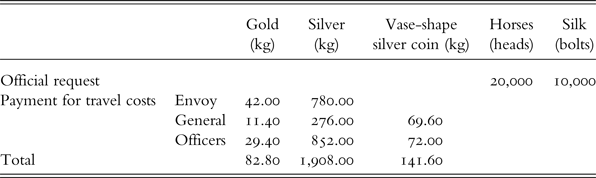



In East Asia, the tenth to the fourteenth century was a period of unprecedented economic prosperity as well as most devastating wars. The beginning of the period saw the reunification of most of China under the Northern Song and the rise of a new empire of conquest, the Khitan Liao. A century on, the Liao empire was no more and the Song had lost the old Chinese heartland to another upstart empire, the Jurchen Jin. Through these great political transformations in Chinese territories, the Koryŏ kingdom (918–1392) in Korea enjoyed lasting stability and prosperity, until in the course of the thirteenth century, the Mongol conquest of East Asia ended the period of flourishing. This article presents the monetary history of Koryŏ in the context of East Asian transformations.
Richard von Glahn has used the term ‘black hole’ to capture the gulf between the dynamic, commercialised economy of the Song and the again commercialised yet very different structure of the Ming and Qing periods (von Glahn Reference Von Glahn, Smith and von Glahn2003, p. 35).Footnote 1 By placing the focus on the ‘black hole’ period, this investigation offers a perspective on the political and economic landscape of ‘China among equals’, with the states of Song, Koryŏ, Liao and Jin as the major players. The analysis of monetary policies and currency circuits for their economic as well as for their cultural functions reveals the ongoing processes of negotiating legitimacy and zones of influence in a world of equal powers, a unique period in East Asian history.
The monetary history of Koryŏ begins with a period of retrenchment, the return to non-metallic monies as a means of cutting exchange with the Liao empire. From the turn of the tenth to the eleventh century, a tri-metallic system was introduced, with iron and copper-based coinage complemented by standardised silver ingots. The cast coins and the ingots stand out for establishing monies that can be characterised as national. Rather than a coin authorised and dated by reign titles, as had been standard since the Tang dynasty, the inscriptions on the Koryŏ coins identify them as a national money. Using these coins, Koryŏ participated in the long-distance trade systems of East Asia and beyond during the eleventh century. While Chinese states, for reasons not yet fully understood, never standardised and controlled silver as a currency, Koryŏ switched to fully standardised silver ingots from the early twelfth century onwards. The ingots, which were cast in the shape of vases, played an important role in the transition towards silver as the standard money in long-distance trade and as a reserve. In the thirteenth century, the Mongol conquest destabilised the currency system of East Asia by enforcing the use of paper money in domestic trade and draining silver from the Chinese as well as the Korean system.
This article consists of three sections. The first presents the historical background of Koryŏ in East Asia with a focus on economic interaction and political relations. The second explores the monetary history of Koryŏ through the period of stability from the tenth to the early thirteenth century. The third and final section analyses the destabilisation brought about by paper currency and the massive economic downturn that ended the medieval efflorescence of the region.
I
The Koryŏ dynasty 918-1392 covers the period in which several powers existed alongside each other in East and Northeast Asia. The cultural and political centrality of China was replaced with a regional order that has been termed ‘China among equals’ (Rossabi Reference Rossabi1983). The empire that naturally assumed that its son of heaven represented the centre of all human civilisation had become another country that had to negotiate bilateral relations, and was likewise treated as an allied, neutral or hostile player like any other.
The Koryŏ dynasty was founded in 918, in a period of deepening division and uncertainty in the realm of the formerly powerful Tang dynasty of China. Since the second half of the ninth century, the control over much of northern China had slipped from the Tang government to regional lords. With the end of the Tang in 907, numerous contending regional states emerged. Although the Northern Song (960–1126) reunited the empire half a century later, the new dynasty was considerably reduced in territory and in political standing.
Through the following centuries, Northeast Asian history was shaped by the successive rise of three steppe powers, the Khitan, the Jurchen and the Mongols. The new empires of conquest were a constant threat to Song China and Koryŏ Korea. The Khitan rulers founded a dynastic state named Liao in 916. In 926, the Khitan armies defeated joint Jurchen and Song forces and conquered Parhae/Bohai (渤海, founded in 669), the state that ruled over Manchuria and adjoining regions of eastern Siberia. Subsequently, the Liao empire extended into the North China Plain.
The military confrontation between the Song and Khitan Liao states led to the Convenant of Chanyuan (澶淵之盟) of early 1005. Song China in fact bought peace along its northern borders by acknowledging the Liao as equals in defining the relation between the two rulers as between ‘brothers’ and the commitment to annual payments of 200,000 bolts of silk and 100,000 liang of silver. The payments were later raised to 300,000 bolts of silk and 200,000 liang to include peace on the borders with the Tangut state of the Western Xia (西夏, 1038–1227). The amount of silk presumably placed no major strain on production capacities, while the annual drain of 7.5 tons of silver constituted a burden on the Song fiscal system (Shiba Reference Shiba and Evin1970, p. 8).
The Koryŏ kingdom achieved a different outcome against the upstart empire to their west (Rogers Reference Rogers and Rossabi1983, pp. 151–72).Footnote 2 The conquest of Parhae that made the Liao immediate neighbours of Koryŏ also pitted the Korean kingdom in deep animosity against them. Koryŏ considered Parhae as an ancestral land because it had been founded by a member of the royal line of the Koguryŏ (高駒麗) kingdom and its territory included the Manchurian part of old Koguryŏ. Besides, the realm had been an important trade partner for horses and silk. To cut all exchange with the Liao, King Taejo (r. 918-43) banned the circulation of all coin in Koryŏ in 942, because the Liao used metallic money. The ban was upheld until 996.Footnote 3 Diplomatic overtures were rejected. A Liao mission that included a gift of 50 camels reached the capital city Kaesŏng in 942 was rebuffed by banishing the Liao envoys to an island, and demonstratively starving the camels to death.Footnote 4 Prior to this confrontation, some trade in camels and horses against hemp cloth, lacquered objects and porcelain had existed between the two states. After the symbolic death of the camels, all came to a standstill.
The Liao mounted three invasions in 993, 1009 and 1018. In the first, the able diplomat Sŏ Hŭi (徐熙, 942–998) secured retreat without battle by the promise of a break of relations with Song China against the cessation of former Koguryŏ territory between the Taedong and the Yalu rivers. In 1009, the Khitan army took the capital, but retreated for fear of a counterattack. In 1018, Koryŏ appealed for military help from the Song, to no effect.Footnote 5 In the event, the Koryŏ armies achieved an annihilating victory. Barely a few thousand of the Liao army of about 100,000 men returned (Franke Reference Franke and Rossabi1983, p. 116). Koryŏ was established as the strongest military power of the region (Rogers Reference Rogers1959, p. 21).
In regional politics, the fact that the stalemate was resolved in Koryŏ's favour carried major implications. Shortly after the Song accepted humiliating conditions that would have been unthinkable in earlier ages, offering a kind of tribute, Koryŏ held forth against the upstart player in Northeast Asia. The world order that formerly centred on the Middle kingdom had become decentralised.
During the period of sanction policy, commercialisation and prosperity advanced in the domestic economy, especially in the southern regions, creating a need for smaller denominations for minor purchases by growing numbers of wealthy landowners. Rice and cloth served as the means of exchange.Footnote 6 The sanctions may have had beneficial effects on agricultural development, as farming innovation to increase the productivity of limited agricultural land was encouraged. In the early eleventh century, early-ripening rice varieties were introduced and planted as cash crops. Rice and textile production provided the state with the means of building increasing military strength (Jang Reference Gukjong1989, p. 127; Jun Reference Seong Ho2014; Ho Reference Ping-Ti1956, p. 203). At the same time, living standards improved, a development reflected in increasing economic participation of peasants and artisans as well as the wealth of the numerous Buddhist temples.
In the late eleventh century, the Jurchen unified and became the new power on Koryŏ's northern borders. In the first years of the twelfth century, Koryŏ subdued the Jurchen along a now defined and fortified border. Jurchen expansion continued, but respected Koryŏ's borders. The Jurchen ruler founded a dynasty in 1115 and conquered the Liao empire in 1121. For this purpose, the Jin entered an alliance with the Song. In 1125, they broke the alliance and two years later conquered the North China Plain. The Song had to abandon their capital Kaifeng and all territory north of the Huaihe. The dynasty rallied as the Southern Song with the capital at Hangzhou. Much reduced in territory, the Song continued to flourish economically. The Jurchen monarchs quickly adapted to ruling an agrarian empire. Their capital Yanjing (now Beijing) became an important urban centre, and the state of some 30 million inhabitants economically successful.
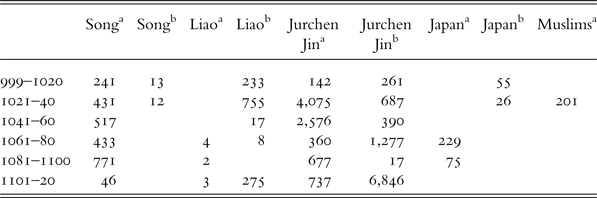
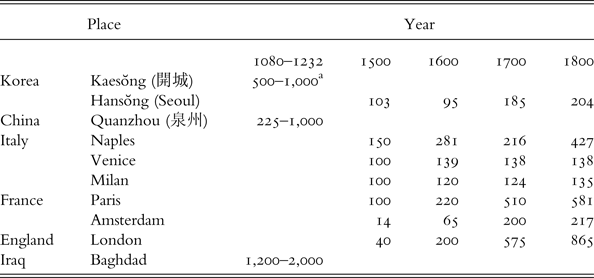
The middle Koryŏ period (996–1271) was a time of internal stability, economic growth and unprecedented expansion in trade. Population estimates are not available, but very considerable total numbers are reflected in the military records. The Koryŏ army, which drafted men from the age of 16, had regular forces of 600,000.Footnote 7 Kaesŏng became a world city in terms of its urbanisation and in its trade network. In 1232, just before the Mongol invasion, the city had up to 100,000 households, implying a population of around 500,000-1,000,000.Footnote 8 The main groups of foreign merchants in the city came from the Jin and the Song, while long-distance maritime trade also brought visitors from the Muslim Middle East and from Japan. Table 1 shows recorded numbers of foreign merchants who visited Kaesŏng.
Foreign merchants at Kaesŏng, 921–1200

aMerchants
bRefugees
Source: Koryŏ-sa, Koryŏ-sajeolyo.
The aggregate figures per decade show considerable fluctuation. The importance of the trade with the Jurchen in their homelands to the northwest of Korea and later with the Jin empire is apparent. Song merchants came from Quanzhou (泉州), and the coasts of Jiangnan (江南), Fujian (福建) and Guangzhou (廣東), while Muslim merchants arrived from Quanzhou. In trade with the Jin, horses were the most important item, while a large range of goods were imported from and via China, including cultural objects such as books, and products from Southeast Asia and beyond.
Koryŏ participated in two major trade circuits, the overland trade with the western steppe neighbours, and overseas trade with Song China. With the Liao and the Jurchen, the exchange consisted mainly in horses, cattle and furs against silver objects and porcelain. The interest in this trade was strategic, for horses were important for the cavalry and for speedy communications. The Song trade included onward links with the Muslim trade network along the coasts of Southeast Asia, India and the Middle East. Imported goods from South and Southeast Asia, such as cloves, camphor, incense, asafetida, sandalwood and myrrh, are testimony to far-flung trade networks (Clark Reference Clark1991, p. 65; Ptak Reference Ptak1993). In 1019, for example, 200 merchants from Quanzhou and Fuzhou (福州) visited the court and brought regional specialties, medicine, incense and other goods.Footnote 9 At that time, Koryŏ was in a position to guarantee overseas trade and stabilise the international monetary system: Korean merchants based at Kaesŏng were in the position of middlemen between Jurchen and Song circuits, easing trade without the two parties having to enter into direct contact (Breuker Reference Breuker2010, p. 235).
Trade with the Jin involved luxury items, such as precious objects made from silver and gold, ginseng, silk, intricately patterned damask, with oxen, horses, deer, furs and dogs remaining the main import goods (Tao Reference Tao1976, p. 14). In the relatively small trade between Korea and Japan, Koryŏ exported precious objects made from silver and gold as well as ginseng, while import goods were saddles, swords, mirrors, murex, seaweed, mercury, ink-stones and arrows.Footnote 10
The trade with the Song was the most important, and continued unaffected by the break in diplomatic relations in 996. Confucian books and Buddhist scriptures played a role of great cultural value that deepened cultural links with Chinese written culture and enhanced Koryŏ's civilisatory standing. Beyond cultural goods, Koryŏ exported high-quality paper, ink, jade green celadon porcelain, ginseng and medicinal goods. In addition, there was some onward trade in Jurchen goods, including furs and antlers. Koryŏ imported silk, medicinal products, books, musical instrument and transmission trade goods from Southeast Asia such as ivory, gold and silver objects, furs, pine nuts, paper, pens, books and ink.Footnote 11
Koryŏ's elite furthered Confucian learning and promoted Buddhism. King Sŏngjong (成宗, r. 982–98) founded the National Academic Institute for the Study of Confucian Texts and Chinese History,Footnote 12 which expanded his government's claim regarding the flow of Confucian learning as well as its ability to conduct diplomatic negotiations (Kracke Reference Kracke1947).Footnote 13
Cultural contacts with Song China were so close as to form a common cultural sphere. This is most visible in strikingly similar cultural expressions, such as paintings of the Amitābha Buddha (Pan Reference Weigan1994, p. 359; Ide Reference IDE and Kim2003, p. 38). Occasionally, cultural artefacts were directly exchanged, thus a temple in Fuzhou is reported to have possessed three bronze images of the Buddha that were of Korean origin.Footnote 14
In some cases, religious contacts furthered trade. The son of King Munjong (文宗 r. 1046-83) became a monk and is known by his title State Preceptor Taegak (大覺國師 1055–1101) or his courtesy name ŬŬich'ŏn (義天). During a visit to Hangzhou (杭州), the leading city of the Lower Yangzi region, he was accompanied by merchants. His exchange with the Song official eventually eased perceived grievances against trade with Korea and led to an imperial edict which authorised ‘superintendents of merchants shipping from Hangzhou, Minzhou and Guangzhou to issue permits for traders to go to Korea for commercial purposes and to bring in foreigners whose object is trade’ (Vermeersch Reference Vermeersch2008, p. 23). This opened overseas trade avenues with Minzhou in Shandong, Hangzhou in the Lower Yangzi region and Guangzhou in southern China.
In reality, East Asia in the period was a system of contending states, yet tradition postulated a centralised world as the natural and harmonic world order. Grappling with this dilemma, the Koryŏ elite developed a belief system in terms of the Mandate of Heaven that had been passed on to the Koryŏ dynasty. This development of a new status and self-confidence is reflected in several symbolic measures. King Kwangjong (光宗, r. 949–975) renamed the capital city ‘The Imperial Capital Kaesŏng’ (皇都開城), claiming for his throne the title of ‘emperor’, which had first been used by the first emperor of the Qin (秦始皇帝, r. 246–221 bc). He followed this move towards imperial greatness by gathering the cultural elite at the capital as a sign of equality with any other continental empire.Footnote 15
Populations of the world's largest cities, 1080–1800 (unit: thousand)
aThe population was originally recorded as 100,000 households; a Japanese survey reported that the population of Kaesŏng was 1,000,000 individuals. Advisory Body to the King 朝鮮總督府, 調査資料第十一輯 (1925, p. 11); Modelski (Reference Modelski2000–3); Ring et al. (Reference Ring, Salkin, Berney and Schellinger1996, p. 116).
Sources: Koryŏsa chŏlyo 1232. 6. KRSC 16:15a. Clark (Reference Clark1991, p. 76); Maddison (Reference Maddison2001, p. 54); McEvedy and Jones (Reference Mcevedy and Jones1978, p. 171); Kwŏn and Shin (1977).
The period of stability and prosperity ended in the thirteenth century, when the rise of the Mongols brought a new era of destabilisation. The onslaught on Koryŏ began in 1231, when the Mongols mounted their first invasion. In 1233, the Jin fell to a Mongol–Song alliance, with the result that the Song empire entered into a long period of war on its northern and western borders. Koryŏ suffered five further Mongol invasions that forced the kingdom into an alliance in 1270. In 1271, Kublai Khan proclaimed the Yuan dynasty, and the Song were finally conquered in 1279.
Kublai Khan mounted two invasions against Japan, which Koryŏ had to support with naval forces and troops. In the second invasion of 1281, the combined Yuan–Koryŏ force lost 3,500 vessels off Hakata Bay in a typhoon. The campaign's failure was a loss to Kublai Khan and severely sapped Koryŏ's resources.
The Mongol wars caused terrible bloodshed across Asia. Slaughter during military campaigns was destructive, while plundering, disruption of economic systems, requisitioning and other forceful measures were the indirect cause of the greatest numbers of deaths. Population losses of the Jin were most severe, while Koryŏ and the realm of the Southern Song also suffered staggering losses. For China, demographic estimates of the late Jin give a population of over 30 million, while the Southern Song exceeded 100 million. The Yuan dynasty in a larger territory ruled over a mere 60 million people.
During the period of flourishing, the Koryŏ dynasty operated in a world of shifting alliances and powers. In the process, Koryŏ gained a ‘national consciousness among equals’ with a claim to the mandate of heaven (Rogers Reference Rogers and Rossabi1983; Breuker Reference Breuker2010). The stance of independent self-confidence and military strength is reflected in the monetary policy of the period.
II
The oldest monies in East and Northeast Asia were textiles and grains. These were still in use as common mediums of exchange in the tenth century. According to the Song-Shi (宋史), regular markets were held in Koryŏ where people traded using rice and cloth as monies.Footnote 16 A travel account by Sun Mu (孫穆), a Song official who visited Koryŏ in 1103, presumably referring to Kaesong, describes morning and evening markets, which women attended with willow baskets and small measures to fix the price of goods measured in rice and millet.Footnote 17 In the neighbouring Liao, textiles similarly remained the common medium of exchange. The Liaoshi (遼史) records that Hu Qiao (胡嶠), a Song military official who spent seven years in the Khitan empire during the mid tenth century, was surprised to see cloth being the medium of exchange in everyday transactions in the Liao capital.Footnote 18 The Jin cast coins and also used Song's coin in external trade, while hemp cloth was the most common money used in everyday transactions (Tao Reference Tao1976, p. 7; von Glahn Reference Von Glahn2010).
The beginnings of metallic money in Koryŏ have been shrouded in mystery due to a misinterpretation of sources. The Munhŏn pigo (文獻備考), quoting from a Song work, records that Chinese coins had entered Koryŏ, but were not circulated as money and that Koryŏ began casting its own coins ‘after the Chongning period (崇寧, 1102–1106)’.Footnote 19 This entry was used in the introduction of medieval Korean currency to Western numismatics in the late nineteenth century and became the general consensus (Ichihara Reference Ichihara1913).
In fact, however, the shift to metallic money was earlier as well as more complicated. As mentioned above, King Taejo proclaimed a ban on the use of metal coins in order to cut trade relations with the Liao. This measure suggests that metal coins circulated to some extent, certainly in the border trade. In the mid tenth century, records mention trade with the Jurchen on Koryŏ's northern border, with silver goods and silk being exchanged for horses.Footnote 20 Korean silver metallurgy of the period was highly advanced and the casting of ingots for the purpose of trading with the Jurchen appears probable, constituting beginnings of the formation of a silver currency.Footnote 21
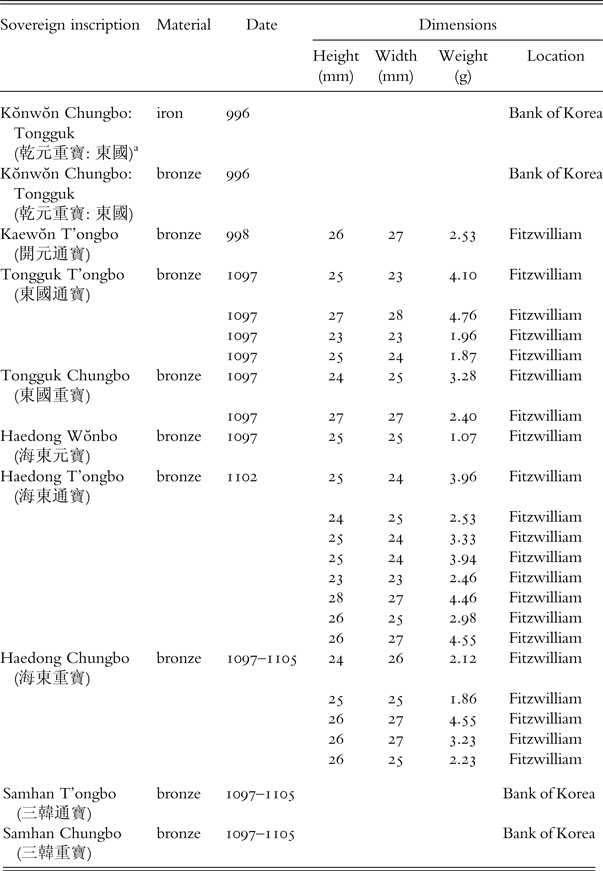
Mintings of iron and bronze coins with sovereign inscriptions in Koryŏ
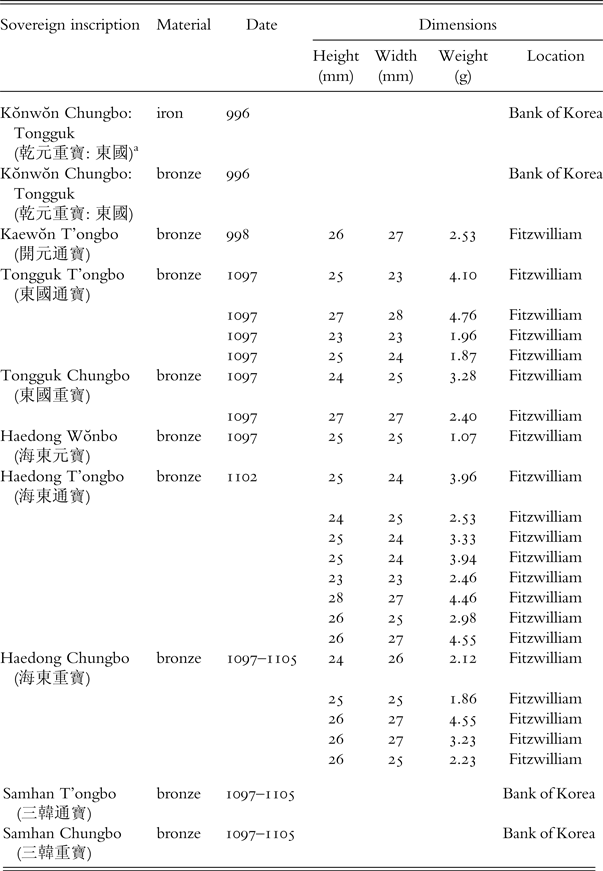
Note: ‘Fitzwilliam’ indicates the Fitzwilliam Museum, Cambridge.
aOn the verso is the inscription tongguk or ‘eastern country’ referring to sovereignty over the peninsula. The inscriptions haedong or ‘eastern sea’ and samhan ‘three states’ also carry the same implication of sovereignty (Mandel Reference Mandel1972, p. 9).
From the late tenth century, Koryŏ created a hybrid currency system to serve its needs in different trade networks. Bronze coinage probably started in the period between 976 and 982.Footnote 22 The early organisation of minting is undocumented. The Koryŏ History records that ŬŬich'ŏn, the erudite monk and royal prince, returned from Song China in 1097 and immediately established the Mint Bureau (Chujŏn togam 鑄錢都監), headed by the Treasurer of the Mint Bureau (Chujŏn'gwan 鑄錢官). The last record of the minting bronze coins dates to 1101, when 150,000 strings of cash were cast.Footnote 23
In 996, three years after the establishment of diplomatic relations with the Liao empire, the Koryŏ government began to mint iron coins. As the Liao used iron coins, the choice of this metal reflects the fact that the introduction of coinage served the purpose of the steppe trade. The circulation of iron coinage in the northern zone was thus maintained by both the Song and Koryŏ.Footnote 24
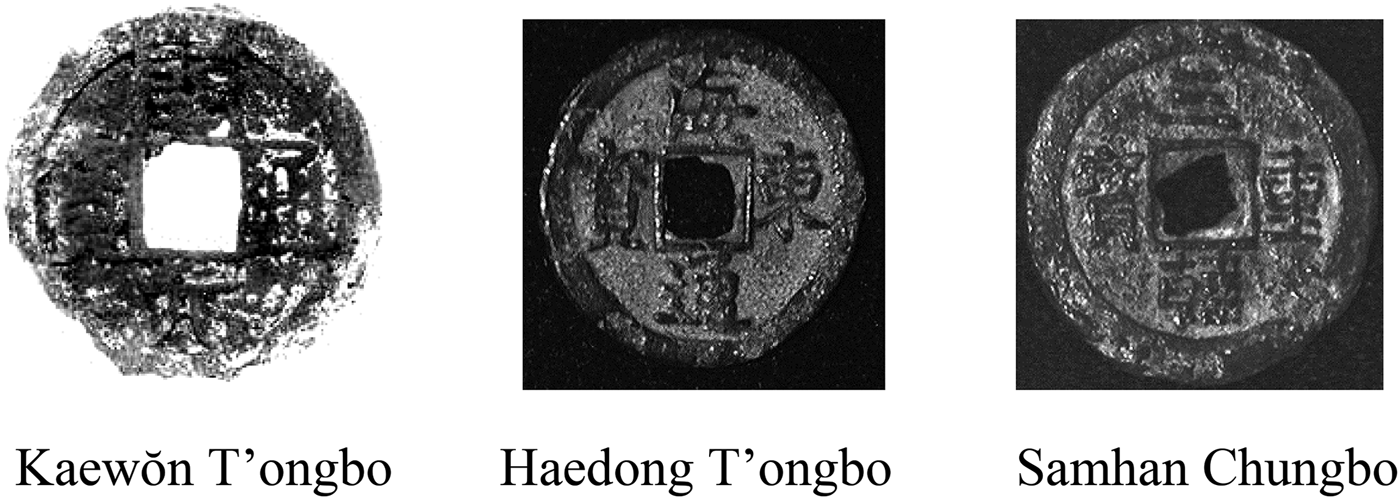
As far as we can establish, the iron coins carried no inscription. The bronze coins had the standard shape of East Asian coins. They were cast round discs with a square hole in the centre and an inscription that usually consisted of four Chinese characters. The inscription, however, did not adhere to the common usage established by the Tang dynasty (681–907). Since the Tang period, Chinese coins carried two characters that identified the denomination and two further characters of the reign title. Denominations were the standard coin tongbao (通寳 ‘circulating coin’) and occasionally heavier coins of a higher denomination, such as zhongbao (重寳 ‘heavy coin’) or dangshi (當十 ‘standing for 10’). The reign title was a means to identify the period in which they were cast. The standard had been established by the famous Tang coin kaiyuan tongbao (開元通寳) that was cast during the Kaiyuan period of the Tang (712–56) in such great numbers as to circulate far beyond the borders of the empire.
A single Korean coin reported in the early twentieth century carried inscriptions on both sides. The obverse carried the four characters kŏnwŏn chungbo (乾元重寳) and the reverse Dongguk (東國). A heavy Tang coin cast in 759 carried the same four characters on one side. Since cast coins cannot be altered, the coin cannot have been recast preserving the Tang inscription. Most probably, the coin was a heavy denomination cast by the Koryŏ mint in the late tenth century.Footnote 25 The inscription on the reverse side is unusual. Koryŏ mints did not adopt the system of reign title but introduced two characters that identified the country rather than the identity of the reigning dynasty, an example of monetary authority independence not found in writings on monetary history prior to the seventeenth century. Free from political influence, the currency can thus be described a national one (Rogers Reference Rogers and Rossabi1983).
The early twelfth-century catalogue of coins entitled Quanzhi 泉志 (Coinage) by Hong Zun (洪遵 1120–74) records three types of Koryŏ coins in two denominations that use three names to identify the country of Korea. These are: tongguk (東國, literally ‘eastern country’), haedong (海東, literally ‘east of the sea’) and samhan (三韓 ‘Three Han’). The first can be read neutrally as the ‘eastern country’, but due to the parallelism with the ‘central countries/middle kingdom’ (zhongguo 中國) it can equally well be understood as a claim to equality with China or even as the eastward shift of the mandate of heaven and the centre of civilisation.Footnote 26
Haedong (海東) also has an innocuous reading of ‘east of the sea’, while it can also be understood as a refusal to acknowledge the Liao conquest of Parhae/Bohai (渤海) (No Reference Breuker1999; Breuker Reference Breuker2010). Samhan (三韓) is the earliest name of states on the Korean peninsula that is recorded in the Shiji (史記), a seminal work of the first century bce that established historiography in East Asia. The use of the ancient name to identify the country ruled by the Koryŏ dynasty was a claim for a direct line of tradition.
Koryŏ mints did not adopt the system of reign title but introduced a system that identified the country beyond the identity of the reigning dynasty. The coins thus carried a claim that can be described a national (Rogers Reference Rogers and Rossabi1983).
Koryŏ bronze coins
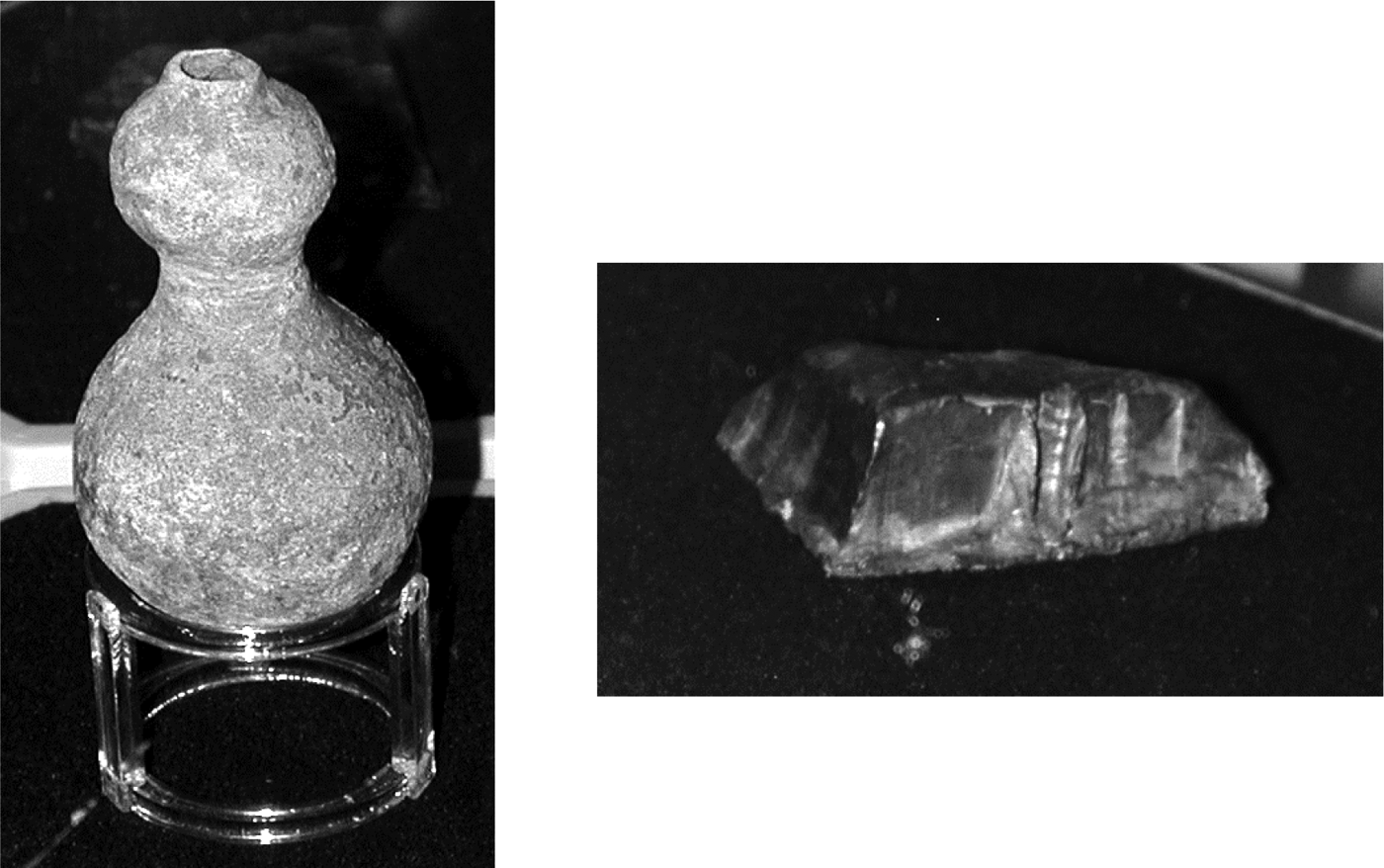
In 1101, silver currency (銀甁) was first issued. Based on ŬŬich'ŏn's advice, the king officially declared the ‘silver vase’ (ŭnbyŏng 銀甁) with a cast government seal as the only valid money and banned all other silver currency. The silver-to-copper ratio in the new currency was 80 per cent silver to 20 per cent copper.Footnote 27 A variant name of the currency was hwalgu (闊口) as the shape was reminiscent of Koryŏ on the map.Footnote 28
Small silver vase (so ŭnbyŏng 小銀甁) currency and silver ingot (K. swaeŭn 碎銀)
The silver vase currency circulated for nearly two centuries until 1287, when the Koryŏ court was pressurised into introducing Yuan fiat money. Although the amount of vases issued is undocumented, the currency became important in external trade as well as in domestic transactions. The latter is reflected in the fact that taxes became payable in silver. Besides, Koryŏ silver technology was exported to the Jin according to records of 1102.Footnote 29 For roughly 150 years from the early twelfth to the mid thirteenth century, silver was the main currency of Koryŏ.Footnote 30
The silverisation of the Koryŏ monetary system has to be analysed in the context of East Asian monetary transformations. Until the mid tenth century, the de facto East Asian currency was the Chinese bronze coin: it was used in 90 per cent of all international transactions in East Asia. Moreover, the Chinese bronze coin also served as principal reserve currency throughout the region. However, its dominance eroded through a gradual shift to silver as a parallel money. From the early twelfth century onward, silver became increasingly important in state reserves, as governments sought to diversify their portfolios and merchants kept trading in the silver zone (Peng Reference Shiba and Evin1994, p. 489).
The disintegration of monetary unity under the Southern Song was the main factor in the erosion of copper coins as the leading currency. After the loss of the northern territories in 1125, the Song mint cast only meagre amounts of bronze coins, perhaps merely 2 to 3 per cent of the total output during the Northern Song. For domestic purposes, the Southern Song increasingly relied on paper money from 1161 onwards. The government, however, never created a single countrywide paper currency system. In addition, all paper currency continued to be denominated in strings of cash coins. At the same time, silver in fact became the high-value reserve that the Song government held to back its fiat money (von Glahn Reference Von Glahn2007).
As a standardised, highly stable currency, the Koryŏ silver vases also played a role in the silverisation process. In contrast to the disintegrating and increasingly unstable monetary system of the Southern Song, Koryŏ created a countrywide currency system based on silver that dominated both public finance and large-scale private international trade.
The military strength and political weight of Koryŏ Korea played a pivotal role in its sovereign and effective monetary policy. The victory over the Liao created the security and prosperity for the expansion of international trade. The overseas exchange in turn was the impetus to adopt a silver currency that again contributed to monetary stability. While silverisation is of particular interest in global economic transformation, it should be pointed out that bronze coins and other monies remained common in small-scale transactions. At the same time, the monetisation of the domestic market was important for basic economic stability, especially for food security.
III
Capturing gold and silver was a major goal in Mongol warfare that raged across much of the Asian continent through the thirteenth century. In East Asia, Mongol invasions began early in the century. The Western Xia were conquered in 1226, the Jin empire lost its northern territories in 1211 and capitulated in 1234, the Dali kingdom followed in 1253 and the Southern Song finally succumbed in 1279. Korea was not conquered but suffered six further invasions between 1231 and 1281. The Mongol campaigns and conquests caused a silver shortage that upset credit and trade in the Yellow Sea region and caused fundamental changes to the monetary systems. A ‘silver famine’ affected Koryŏ from the pillage of the first Mongol invasion in 1231, and deepened with each further invasion and the forced participation in the invasions of Japan. By the late thirteenth century, most silver had drained out of the country to the Mongol Yuan. The effect becomes visible by comparison with Japan, which had not minted metal coins since the late tenth century. In the period before and after the failed Mongol invasion of 1274 and 1281, Japan was divided into a large number of autonomous domains. Nevertheless, Japan now became a hub of money circulation despite widespread smuggling, piracy and counterfeiting as large amounts of bronze coins were imported from China (von Glahn Reference Von Glahn1996, p. 89). The silver famine in Korea exhibited parallels with debasement that destroys the firewall of ascertained intrinsic value based on weight and purity.
The shortage and debasement of the vase-shaped silver money exacerbated economic difficulties and accelerated the dynastic change from Koryŏ to Chosŏn. Moreover, the southern Koryŏ coast was plagued with pirate attacks throughout the fourteenth century. As a result, the population in the southern provinces declined and trade dwindled, causing an even greater shortage of silver and again adversely affecting the urban economy. Drained of silver, the silver currency was gradually abandoned, giving way to a shaky monetary system.
Records of pillaging by the Mongol army in the first campaign (1231)
Source: Koryŏsa chŏlyo 1231.08.29.
The turning point was the establishment of a paper currency regime in the Yuan empire in 1275. The notes imitated the paper money of the Jin: unlike Song paper notes they carried no expiration date (Peng Reference Shiba and Evin1994, p. 465). The new paper money differed from the commercial notes of Koryŏ and Song that were fully convertible with metallic currency. Inflation ensued (von Glahn Reference Von Glahn1996, p. 51). From 1275, with the accession to the throne of King Ch'ungyol (忠烈王), who was married to Kublai Khan's daughter, the Yuan took control of Koryŏ's monetary system and forced a change from vase-shaped silver coinage to Yuan paper money. Accepting the vassal state, Koryŏ lost not only political as well as monetary sovereignty. In addition, pressures from the Yuan caused an additional economic drain. In 1277, the Yuan court ordered Koryŏ to start gold mining, mobilising 11,446 gold diggers who produced 265.875 grams of gold over 70 days, a pitiful average of 0.0026267 grams of gold per day per man.Footnote 31 The massive and unproductive mobilisation of labour had serious consequences for food production, which resulted in an inflation of grain prices (Yi Reference Kanghan2007, pp. 31-3). Vagaries of the weather combined with governmental neglect also played a part. In 1287, Koryŏ experienced a disastrous famine in Chŏlla Province, while the royal family took no measures but indulged in lavish court life.Footnote 32
In the same year, a Yuan envoy demanded a ban on monetary silver currency in order to promote the circulation of Yuan paper money. Doubting the viability of paper money, the Koryŏ government proposed to issue a smaller silver currency, the so ŭnbyŏng (小銀甁 ‘small silver vase’), that would reduce cost. On orders of the Yuan, Koryŏ had to replace all gold and silver with Yuan paper money and ban the use of metallic money in trade between the two states. Footnote 33 The forced circulation of paper money did not result in raising the value of vase-shaped silver currency. Instead, inflation accelerated due to the spread of counterfeit silver currency mixed with copper. As the value of silver bullion skyrocketed, silver ingots appeared as a measure of value (Figure 3, swaeŭn 碎銀 ‘broken silver’). The Yuan paper currency destroyed the vase-shaped silver currency that constituted the only standardised silver currency throughout East Asia before the Japanese silver mining boom (Kobata Reference Kobata1965). The value of Yuan paper money depreciated soon after the first notes were issued in 1287. In 1289, the Yuan court ordered Koryŏ to revive silver mining, to little avail.Footnote 34
In fact, the devaluation of the silver vase-shaped currency began before the introduction of paper money. Records prior to the first Mongol invasion, dating to 1039 and 1132, state the value of one silver vase as equal to 128 bolts of cloth.Footnote 35 During the period of the invasions, cloth, the common money in small, everyday transactions, gained value against the silver currency. Eventually, the Koryŏ court declared cloth as single fiat money.Footnote 36
By 1328, the value of the old, best-quality silver vases had dropped to 10 bolts of cloth. In 1331, the Koryŏ court officially declared the vase-shaped silver currency abolished, to be replaced with a new, smaller, higher-quality ‘small silver vase’ (so-ŭnbyong).Footnote 37 Its value was set at 15 bolts of cloth but the amount issued was insufficient. This new currency circulated until the late fourteenth century. It was officially abolished in 1401.Footnote 38
The Yuan period saw a decline in the urban economy. The great centres of maritime commerce had been located in or near grain-producing regions. The Yuan government redirected the Chinese grain flows northwards to its capital (Schurmann Reference Schurmann1956, pp. 14–15). The Koryŏ economy was stifled by the Yuan monetary policy and suffered from raids by Japanese pirates who plundered the agriculturally rich south of the country. The fourteenth century rise in piracy coincided with fraying social cohesion, visible in growing corruption and abuses by influential groups, especially the Buddhist monks.
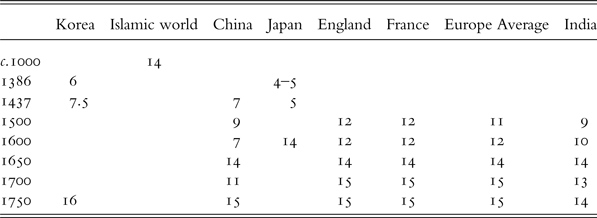
Ratios of silver to gold in the period of proto-globalization (eleventh to eighteenth century)
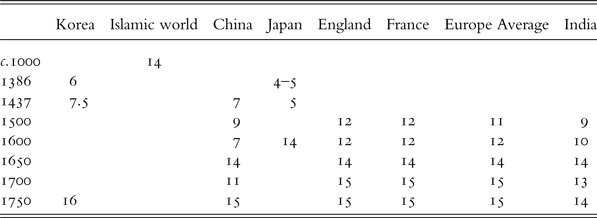
Sources for Korea: Tongsa kangmok 16; Mingshi; Chosŏnjŏn; Pibyŏnsa tŭngnok, Chŏngjo shillok (正祖實錄), 14 (1790. 10/03), 46:102.
Sources for China: von Glahn (Reference Von Glahn1996, p. 128); Broadberry and Gupta (Reference Broadberry and Gupta1996).
Sources for Japan: Yamamura and Kamiki (Reference Yamamura, Kamiki and Richard1983, pp. 354–6); von Glahn (Reference Von Glahn1996, p. 128).
Sources for Europe: Craig (Reference Craig1953, pp. 413-17); Braudel and Spooner (Reference Braudel, Spooner, Rich and Wilson1967, p. 459); Broadberry and Gupta (Reference Broadberry and Gupta1996).
IV
This survey of the monetary history of Koryŏ from the eleventh to the thirteenth century discussed the closely interrelated political, military and commercial histories in East Asia, especially in coinage and in the circulation of precious metals. From the eleventh century, East Asia entered a period of relative stability that was based on diplomatic parity. Over the following centuries, the Song were diminished by the Liao, who were conquered by the Jin, who proceeded to conquer the northern part of the Song, and eventually all fell to the Mongols. While monetary systems in China were subject to abrupt changes in sovereignty, Koryŏ enjoyed monetary stability and continuity until 1287.
Koryŏ monetary history can be divided into three phases. During the first century of the dynasty, Koryŏ was at war with the Liao. While the Liao promoted metallurgy and minted coins from the Tianzan (天贊 922–6) to the Jingheng (京亨 979–83) periods, Koryŏ pursued a policy of sanctioning trade with the enemy and of protecting its metal reserves. During the ban on metallic coins, rice and cloth served as commodity monies, ensuring price stability in a phase of sustained growth of the rural economy.
The second phase began after the victory over the Liao in 1018. Backed by military strength, the government now issued iron, bronze and silver currencies, which were introduced to facilitate international trade. The intrinsic value of the metallic currencies in conjunction with state issuance provided monetary stability.
The third phase is that of the late Koryŏ, when the country came under the influence of the Mongol Yuan. The destabilising effect brought about by the introduction of Yuan paper money demonetarised the economy.
The Ming (1368–1644) that replaced the Yuan was a Chinese dynasty, but its rulers remained oriented towards the steppe. Geopolitical control so as never to show any weakness towards steppe peoples again was the preponderant concern that overruled commercial development and a more maritime orientation (Smith Reference Smith2004, p. 280). This imperative may explain why late imperial China never attempted turning silver, which had long become the high-value money, into a standardised currency. At the same time, possibly for the same reason of disregard for commercial prosperity, counterfeiting of the cast copper-based currency was left unchecked. The Korean dynasties of Koryŏ and Chosŏn pursued a different monetary policy. They minted money based on the intrinsic metal value while suppressing counterfeiting. The Japanese monetary system remained outside the main systems until the metal wealth of the country became important with the exports of silver in the sixteenth century.
The Koryŏ ‘silver vase’ currency, which circulated for three centuries, partly bridges the ‘black hole’ in East Asian monetary history from the Late Tang to the Ming period. The monetary history of Koryŏ has not been adequately explored and deserves further investigation. Tracing the uses of silver as a good, a money and a currency across East Asia provides a new perspective on the global exchange of silver. Correlating the circulation of the silver currency of Koryŏ with issues of sovereignty and political power helps in gaining an understanding of domestic and regional dynamics.
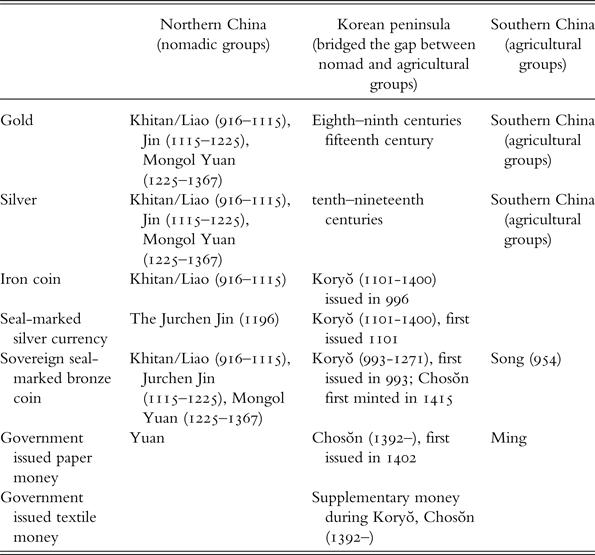
The development of the monetary system in East Asia (916–1392)
Sources: see text.