1. INTRODUCTION
In 2017 the United States (US) sent political shock waves around the world by announcing its intention to withdraw from the 2015 Paris Agreement.Footnote 1 Even as multilateral climate negotiations were weakening, by the end of the year a new treaty-based international organization created and led by India – the International Solar Alliance (ISA) – became a legal entity. On 30 November 2015, on the sidelines of the United Nations Framework Convention on Climate Change (UNFCCC)Footnote 2 Conference of the Parties (COP) in Paris (France), India and France jointly launched the ISA to boost solar energy in developing countries.Footnote 3 An alliance of 120 countries came together on the basis of a shared understanding that developing countries need technology, capacity building, and public finance to take solar energy to scale. By late 2016, a little less than a year after the initial announcement, the Ministry of External Affairs (MEA) of the Government of India – India's foreign ministry – opened the Framework Agreement on the Establishment of the International Solar Alliance (ISA Framework Agreement) for ratification.Footnote 4 On 6 December 2017, upon the submission of instruments of ratification by 15 countries, the ISA formally entered into force and acquired the status of a treaty-based international organization.
Motivated by the absence of any specific international body to address global solar deployment, India conceived of the ISA as a coalition of countries rich in solar resources which could address energy needs and provide a platform for collaboration to close identified gaps in solar deployment.Footnote 5 It was envisaged as a partnership organization consisting of countries located between the Tropic of Cancer and the Tropic of Capricorn. These developing, solar-rich countries have poor energy access, abundant sunshine and large agrarian populations, and face major gaps in solar manufacturing.Footnote 6
The ISA marks the first instance in which the treaty-making process was led by India and backed primarily by poor and developing countries in Asia and Africa. Because developing countries have typically not been at the forefront of international treaty making, the creation of the ISA invites empirical investigation and analysis. The ISA also witnessed an unusually quick ratification process: it took 386 days to enter into force from the day it was opened for signature.Footnote 7 India's leading role in the launch and operationalization of the ISA demonstrates how local interests and concerns, such as scaling up domestic renewable energy targets, become intertwined with international, transnational, and regional interests, such as making solar energy affordable for the poor in all ISA member countries. Going forward, the ISA could have geopolitical implications as developing countries, or solar-rich countries, attempt to recalibrate global rules for solar energy deployment based on their specific needs.
With the growing focus on empirical legal research,Footnote 8 scholars have called for additional study of the conditions under which international law is produced, including the actors and mechanisms involved.Footnote 9 According to Ginsburg and Shaffer, there are ‘relatively few ethnographies of international law and organizations’,Footnote 10 and there is a need to investigate each step of the international legal process.Footnote 11 The focus of this article, therefore, is on the question of how international law is produced. Using a case study approach, the article explores the creation of the ISA as a treaty-based international organization. Raising these questions is useful for understanding the creation of international agreements, especially when steered by a developing country. As such, the article illuminates India's role in constructing international law.Footnote 12
The organization of this article is as follows. Section 2 presents the methodology, followed in Section 3 by a brief background to the ISA, its governance structure, and the scope of its activities. Section 4 sets up the theoretical framework underlying the article's main analysis of the political economy of international treaty making. Section 5 unpacks the treaty-making process of the ISA and explains the key empirical findings of this research. Section 6 concludes.
2. METHODOLOGY
This article integrates document analysis and qualitative interviews to reveal the social and political life of the main legal text of the ISA, the Framework Agreement.Footnote 13 In doing so, the article relies on the proceedings of the meetings of the International Steering Committee (ISC) and the Interim Administrative Cell (IAC) of the ISA, as well as elite stakeholder interviews. The time period of the analysis runs from mid-2014 (the early inception of the ISA) until March 2018 (the ISA's Founding Conference). The proceedings of all these meetings have been captured in detailed reports which are available to the public on the official ISA website.Footnote 14 I conducted a qualitative content analysis of these documents in order to understand the official narrative describing the creation of the ISA.Footnote 15
I complemented the document analysis with semi-structured interviews in order to understand how key stakeholders viewed the creation of the ISA. When selecting individuals for interviews, I used a non-random purposive sampling technique and strove for a range of stakeholders across the policymaking spectrum so as to offer a cross-sectional analysis. The interviews were aimed to elicit the professional and expert opinions of relevant stakeholders in India who were closely involved in the treaty-making process.Footnote 16 The list of interviewees includes: (i) senior officials of the ISA; (ii) diplomats, in this case officers from the Indian Foreign Services (IFS), including two former Foreign Secretaries of India; (iii) bureaucratic officers of the Indian Administrative Services (IAS); (iv) senior-level members of think tanks and non-governmental organizations (NGOs); (v) members of the private sector, industry, and media; and (vi) other foreign diplomats and officials.Footnote 17 The Indian government officials whom I interviewed have held key positions in various ministries: the MEA, the Ministry of Environment, Forests and Climate Change (MEFCC), the Ministry of New and Renewable Energy (MNRE), and the Prime Minister's Office. I conducted a total of 21 interviews between July and September 2018 and between June and August 2019.Footnote 18
This two-pronged methodological approach offers several advantages. Firstly, document analysis allows a deep and contextualized understanding of the official process that led to the establishment of the ISA. Secondly, stakeholder interviews provide an additional layer of granularity in understanding what happened behind the scenes. A significant limitation of this research is the risk of bias associated with interviews conducted primarily with Indian stakeholders. At the same time, since one focus of my research is to understand India's role in international rulemaking, the perspectives offered by key Indian officials and stakeholders are invaluable. Additionally, the interviewees include both French and American officials who provide an outsider's viewpoint on India's efforts. The document analysis provided additional insights into the opinions of key stakeholders from countries other than India, thereby providing a more comprehensive view of the overall process.
3. BACKGROUND TO THE INTERNATIONAL SOLAR ALLIANCE
On 30 November 2015, during the United Nations (UN) climate talks in Paris, the ISA was launched as a joint initiative of India and France to boost solar energy in developing countries. India and France issued a declaration with the stated objectives of reducing the costs of finance and technology for the deployment of solar energy, formulating financial instruments and mobilizing investment in solar power generation, and paving the way for good technologies for solar generation and storage.Footnote 19 The ISA was proposed as a multi-country partnership organization with membership from countries rich in solar resources between the two tropics.Footnote 20 Two provisional bodies played a critical role in shaping the contours of the ISA: the ISC and the IAC.
The ISC was created to provide ‘necessary guidance, direction and advice’ to establish the alliance, and it was kept open to interested countries.Footnote 21 The first meeting of the ISC was held on 1 December 2015, the day after the launch event. The major ideas and opinions to emerge from the inaugural meeting were that the ISA should (i) find a niche for itself, (ii) avoid duplication of efforts, (iii) undertake tangible projects and programmes over time, and (iv) leverage and promote private sector involvement.Footnote 22 These ideas formed the guiding principles for the work of the ISC between December 2015 and February 2018.Footnote 23
Another key decision to emerge from the inaugural ISC meeting was the formation of the IAC, with an overarching aim to facilitate the establishment of the ISA and ensure its transformation from a de facto to de jure body – a legal, intergovernmental organization.Footnote 24 The IAC was set up within the MNRE of the Indian government and was responsible for the interim management of the ISA.Footnote 25 The IAC mandate was to (i) finalize the Framework Agreement in consultation with member countries; (ii) initiate action for implementing activities from India's contribution to the ISA; (iii) engage in discussions with institutions and international organizations, and explore prospects for collaboration; and (iv) firm up an action plan for the ISA in consultation with member countries.Footnote 26 The IAC remained in operation for a little over a year, with a total of eight meetings between February 2016 and March 2017, and then ceased to exist once the ISA entered into legal force.Footnote 27 Meetings were attended by members of the IAC,Footnote 28 representatives of other countries and special invitees, which included representatives from multilateral organizations, NGOs, financial institutions, and the private sector.
On 15 November 2016, about a year after the launch of the ISA, the Government of India opened the Framework Agreement for signature during the UNFCCC Conference in Marrakesh (Morocco). The ISA identified and invited 121 prospective member countries (UN members located between the Tropics of Cancer and Capricorn) to join the ISA by signing and ratifying the Framework Agreement. On 6 December 2017, 30 days after submission of the instruments of ratification by 15 countries, the Framework Agreement formally entered into force and the ISA acquired the status of an international organization.Footnote 29 At the time of writing the ISA has 86 signatory countries, and 68 member countries have signed and ratified the Framework Agreement.Footnote 30
The Framework Agreement has a total of 14 articles. ISA members take coordinated actions through its work programmes and voluntary activities, which are aimed at better harmonizing and aggregating demand for, inter alia, solar finance, solar technologies, innovation, research and development, and capacity building.Footnote 31 While membership is open to countries lying fully or partially between the two tropics, UN member states located beyond the tropics can also join the ISA as ‘partner countries’.Footnote 32 Other regional or international organizations that have the potential to help the ISA in achieving its objectives can join as a ‘partner organization’.Footnote 33 The UN, including its organs, is identified as a ‘strategic partner’ of the ISA.Footnote 34
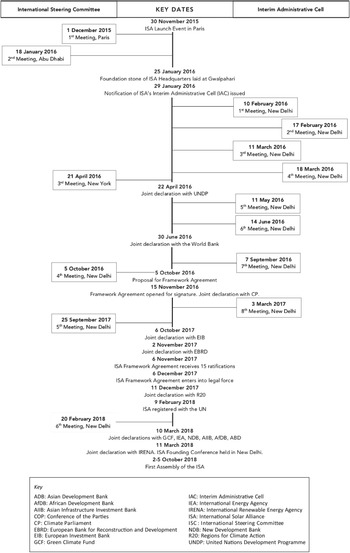
Going forward, the seat of the ISA will be in India.Footnote 35 Its governance structure will consist of an Assembly and a Secretariat.Footnote 36 The Government of India will support the ISA by hosting its Secretariat for an initial period of five years; thereafter it is expected to generate its own resources and become a self-financing entity.Footnote 37 The first Assembly of the ISA was held on 3 October 2018 in New Delhi (India).Footnote 38 Section 5 of this article details the timeline of the creation of the ISA, which includes developments that emerged from the meetings of the ISC and IAC (see Figure 1 below for a snapshot of the timeline).Footnote 39
Chronology of the International Solar Alliance
Source: Author's own analysis

One of the stated goals of the ISA is to reduce the costs of finance and technology for immediate solar energy deployment.Footnote 40 Interestingly, however, the Framework Agreement imposes no targets or legally binding obligations on member countries for either financial or technology transfers. Instead, the ISA aims to be a facilitator of technology, knowledge, and finance.Footnote 41 The ISA's collaborations with various transnational actors appear mainly to leverage the technical expertise, financial capacity, and global networks of its partner organizations in order to scale up solar energy deployment in member countries. India's insistence, then, that the ISA be a treaty-based international organization raises questions about its motivation for steering the treaty-making process. What are the reasons for the present legal form of the ISA, especially when the treaty text contains no binding legal commitments? If the ISA member countries are to take actions on a ‘voluntary basis’Footnote 42 then is not the ISA better described as a soft law instrument?Footnote 43 Why did India open the Framework Agreement for signature and ratification by other countries when the bulk of the work is to be implemented by non-state actors? The following sections will break down the treaty-making process and attempt to unpack the reasons behind the decision to make ISA a treaty-based international organization.
4. THEORETICAL FRAMEWORK
There is a growing literature on global energy governance.Footnote 44 This case study complements other studies of international energy organizations.Footnote 45 While much of the early work on international energy cooperation focuses primarily on two organizations – the International Energy Agency (IEA)Footnote 46 and the Organization of the Petroleum Exporting Countries (OPEC) – global energy markets are changing and becoming entwined with concerns over climate change. As developing states become major sources of energy demand, the domestic politics within states will grow in importance.Footnote 47 Dissatisfaction with existing regimes could lead these states to seek alternative venues to secure energy supplies while also reinforcing their sovereignty.Footnote 48
Against this backdrop the ISA offers a unique opportunity to examine the decision making behind the creation of a treaty-based international organization focused on expanding solar energy in the developing world. Drawing on the political economy approach in the study of international law,Footnote 49 a key objective of this case study is to identify the actors, institutions, and processes that led to the establishment of the ISA as a legal entity, with particular emphasis on the central role of India. Van Aaken and Trachtman write:
Any understanding of international cooperation through law must be infused with respect for the practical, State-based, political process by which formal cooperation occurs, and it must include a mechanism by which States would determine to create organizational structures which facilitate cooperation. It must develop a perspective on the interaction between multiple domestic political processes, and it must develop a theory of the creation of international organizations.Footnote 50
This article examines why the ISA was created as a treaty-based international organization, who were the main actors driving the treaty-making process, and what motivated their choice of legal form.
International agreements typically have three core design elements: (i) a formal treaty rather than soft law, (ii) mandatory dispute resolution procedures, and (iii) monitoring mechanisms.Footnote 51 The choices that states make in drafting international agreements determine the force and credibility of their commitments.Footnote 52 A treaty, unlike a non-binding accord or a soft law instrument, is considered to be the most effective instrument for cooperation as it is more likely to induce compliance.Footnote 53 The ISA is a puzzling case as it contains no explicit or implicit compliance mechanisms, either by way of dispute resolution or monitoring mechanism. It includes only one of the three elements mentioned above – a formal treaty, which in this case is the Framework Agreement.
On the face of it the ISA has the makings of a ‘climate club’ – an exclusive group of solar-rich countries geared towards cooperating on reducing the costs of finance and technology for the massive deployment of solar energy in member countries. According to a recent conceptualization of soft law instruments for climate change cooperation, a ‘climate club’ brings together groups of countries and non-state actorsFootnote 54 to work on a specific climate issue.Footnote 55 Climate clubs typically start small and build cooperation through incentives such as club goods (exclusive benefits for members), conditional commitments (promises of increased climate action provided others join the club), or side payments (monetary compensation for joining the club).Footnote 56 This club approach to climate diplomacy has stemmed in part from the extreme complexities associated with bargaining among the numerous and diverse countries involved in the UNFCCC.Footnote 57
Yet, the ISA is not merely a small, informal coalition of enthusiastic countries. It operates under a formal treaty text that has been ratified by 68 member countries. An added peculiarity of the ISA Framework Agreement is that there is no obvious mutual dependence among the prospective member countries. The solar-rich countries, which form the bulk of the ISA membership, are primarily poor and developing countries that need funding and access to technology to undertake large-scale solar energy deployment. Without any explicit provision for financial or technology transfer in the Framework Agreement, it is difficult to understand why countries would perceive any advantages in joining the agreement. Moreover, with no compliance mechanisms built into the treaty design, it would be difficult to ascertain the effectiveness of the international agreement going forward.
Why then did India insist on a treaty-based organization when the Framework Agreement did not contain any legal obligations for ISA member countries? Some scholars have underscored the importance of trade-offs between form and substance in agreement design in order to grasp why states use or avoid legality.Footnote 58 An empirical inquiry into the political forces behind the treaty-making process would be needed in order to understand fully the choice of form and substance in the treaty design of the ISA. Moreover, the creation of the ISA must also be understood in light of the UN climate change talks in Paris. In 2015, after almost two decades of negotiations, the Paris Agreement reached a compromise between the legal form of the instrument as a whole and the legal character of the provisions.Footnote 59 The Paris Agreement is a legal instrument – a treaty under international law – but its provisions have varying degrees of normative force.Footnote 60 Therefore, the climate change negotiations at Paris sought to design a hybrid instrument with bottom-up elements to promote participation (the parties’ nationally determined contributions (NDCs)) and a top-down process to promote ambition and accountability.Footnote 61 The dynamic interplay between the hard, soft and non-law elements is a unique feature of the Paris Agreement,Footnote 62 and it can be argued that the legal form of the ISA was influenced by the realities of the climate change negotiations.
In the following section I detail the ISA treaty-making process and examine the empirical evidence. India's leadership role in the process was a key factor affecting the legal form of the ISA, which I describe as ‘soft law in a hard shell’. On the demand side, India was interested in leading the creation of a new international organization in an as-yet ungoverned space with unclear rules of engagement. By bringing together solar-rich countries under the ambit of the ISA, India successfully steered the interests of these developing nations towards a common goal: to increase the deployment of solar energy and bring energy security to their people. On the supply side, however, it was easier to find consensus between countries when the international agreement did not contain legally binding provisions. The transaction costs of adding more countries and non-state actors were significantly reduced by keeping the treaty terms non-binding and flexible. In addition, the presence of non-state actors since the early days of the treaty-making process was further responsible for the flexibility built into the substantive provisions of the Framework Agreement. Finally, as a new kind of grouping not dominated by western powers, the ISA illustrates the preference of developing countries for legally binding institutions as opposed to legally binding obligations.
5. UNPACKING THE ISA: POLITICAL ECONOMY OF TREATY MAKING
This section takes an in-depth look at the ISA treaty-making process through an analysis of official ISA documents and stakeholder interviews. The timeline for the process can be divided into two phases: pre-Paris and post-Paris. The pre-Paris phase, or the period of conceptualization, lasted from June 2014 to November 2015. The post-Paris phase, or the period of operationalization, lasted from December 2015 to March 2018. An empirical analysis of the two phases reveals three key factors that affected the legal form of the ISA: (i) India's leadership role, (ii) the presence of non-state actors in the treaty-making process, and (iii) the value of legal form for developing countries.
5.1. Pre-Paris: Period of Conceptualization
The present case is not the first time that a developing country has floated the idea of an international organization, although it is the first time that India has done so. Almost all the interviewees unanimously attributed the initial idea for the alliance to Prime Minister (PM) Modi. Several interviewees noted that PM Modi was of the belief that if oil producing countries could have a resource-based alliance in OPEC, then countries endowed with solar power could come together as solar-rich countries.Footnote 63 However, India's leadership role in the creation and operationalization of the ISA cannot be understood apart from the international climate change negotiations under the UNFCCC, as well as India's own domestic solar energy ambitions.
India's new leadership role
At the domestic level the genesis of the ISA is owed to two key factors. Firstly, the Paris Agreement had changed the game: NDCs made climate action voluntary and across the board. India's negotiating position during the multilateral climate talks had emphasized issues of equity and differentiation.Footnote 64 India was instrumental in constructing and propagating the principle of common but differentiated responsibility in the early years of the climate negotiations,Footnote 65 which is the basis for India's insistence on the historical responsibility of developed nations for climate change, as well as its reluctance to avoid any legally binding climate mitigation commitments.Footnote 66 Many interviewees involved in those negotiations noted that they had become prolonged and fractious, that India was losing its influence on rulemaking and was perceived as a spoiler.Footnote 67 China had become far more influential than India.Footnote 68 By 2015, however, the Modi government had shifted the Indian foreign policy agenda to seek leadership in global governance, staking its claim among other major powers in global politics.Footnote 69 In this respect India's engagement with climate change became particularly important for its aspirations as a rising power.Footnote 70 With the ISA, PM Modi wanted India to take a clear leadership position in climate diplomacy. According to one interviewee, ‘the PM had a view that he wants to be a leader – with one sixth of the world's population and a fragile ecology, he did not want India to appear unwilling [to undertake climate action]’.Footnote 71 As another interviewee put it, ‘India is not a pushover in climate change negotiations … the PM wanted the image of India to change without compromising on our interests’.Footnote 72
Secondly, a change in government in mid-2014 brought the issue of climate change to the fore as no previous administration had. The Modi government undertook a holistic rethinking of domestic programmes with climate change implications, and solar energy was central to its clean energy ambitions.Footnote 73 The National Action Plan on Climate Change (NAPCC), announced in 2008, provided the initial policy framework for climate action in India. Under the broad ambit of the NAPCC the National Solar Mission (NSM) – India's flagship solar policy – was launched by the Government of India in 2010 to create an enabling policy framework for the deployment of 22 gigawatts (GW) of solar power by 2022.Footnote 74 In 2015, under the leadership of PM Modi, India set an ambitious domestic goal of 175 GW of installed renewable energy capacity by 2022, of which 100 GW was to come from solar power – nearly a fivefold increase of its earlier goal.Footnote 75 To put these numbers in perspective, India's current installed capacity is 360 GW, of which renewable energy sources account for 80 GW.Footnote 76 In addition, the government is targeting nearly USD 100 billion in renewable energy investments, including foreign direct investment (FDI), over the next five years under the recently launched ‘Make in India’ programme.Footnote 77 The importance of India's ambitious domestic solar energy policies to the ISA was confirmed in the interviews conducted for this article.
From 2012 to 2015, the business models and frameworks for energy efficiency and promotion of renewables moved from the subsidy-based approach to the demand aggregation approach.Footnote 78 Most of the early action in these sectors was based on government subsidies as the high costs of renewable energy and energy-efficient technologies were a major barrier to their large-scale adoption.Footnote 79 However, India experimented with a new business model based on aggregation of demand coupled with bulk procurement in two sectors: light-emitting diode (LED) bulbs and photovoltaic (PV) solar electricity. Both sectors met with early success as the country's large and growing market was able to effectively absorb the new technologies and the initial high costs of these technologies, while at the same time prices decreased with increasing volumes.Footnote 80 This success, especially in the PV market, gave impetus to the idea that this kind of ‘Indian business model’ (based on demand aggregation and bulk procurement) could benefit other developing countries.Footnote 81
A key lesson was that the size of the Indian market could be leveraged to enhance the adoption of low-carbon technologies while simultaneously reducing their prices and strengthening the markets for these technologies in other developing countries.Footnote 82 Interviewees across government, industry, and academia noted that the formation of the ISA represents the first time that India realized the power of its own markets. They attested to the fact that solar energy markets in India were primed to achieve economies of scale and to contribute to domestic goals regarding energy access, job creation, and income growth. It was this template that PM Modi wanted to extend to countries that had the potential, but not the means, to harness solar energy. As one interviewee observed, ‘[the ISA] was the first instance where the government has talked about looking at climate change as a business opportunity’.Footnote 83
Moreover, as solar energy became cheaper, it took centre stage in global conversations about clean energy. Therefore, the ISA was conceived as a ‘market-making’ mechanism,Footnote 84 which could direct the flow of finance and technology towards solar-rich countries. The ISA would help to aggregate independent solar projects into larger tenders, allowing developers to benefit from economies of scale. It would also facilitate an industry-funded insurance scheme to encourage banks to lend to projects that might otherwise be overly risky. Interestingly, even those who were sceptical about the future of the ISA acknowledged that the reason for its creation lay in the enormous market potential of solar energy:
Flow of capital into renewable energy is being driven by economics – it is not happening because of a legal regime or global arrangements. The shift is taking place despite the fact that there is no solid international legal foundation. Solar (energy) is becoming much, much cheaper.Footnote 85
Although PM Modi is credited with envisaging India's leadership in solar energy, it would be hard to ignore China's role in lowering the price of solar energy worldwide by exporting inexpensive solar panels.Footnote 86 China is conspicuous in its absence from the ISA. China has participated in four out of the six ISC meetings, but it has yet to sign the Framework Agreement. From the Indian perspective, ISA leadership is a way of distancing itself from China's position on climate change. The ISA is perceived as a collaborative and inclusive effort; according to a former US climate change negotiator, ‘India's tone with the ISA is much better than that of China, which is now left alone on climate action’.Footnote 87 Several interviewees involved in the early negotiations for the ISA expressed reservations about China's involvement, explaining that it could either overpower or derail the ISA agenda. As it stands, the ISA burnishes India's clean energy credentials on the international stage while affirming its commitment to the multilateral order. According to one interviewee, the ISA ‘was beneficial in two ways: first, it signalled that India was serious towards contributing to a successful Paris COP [(Conference of the Parties)], and, second, it was an instance of a strong developing country initiative’.Footnote 88
Bringing allies on board
The government's efforts to build this new alliance intensified in the months leading up to the Paris COP. In the words of one interviewee, ‘Paris was an opportune moment for India to announce this [International Solar Alliance] on the world stage’.Footnote 89 The Indian government solicited ideas from organizations working on climate policy, who suggested different templates for cooperation on solar energy.Footnote 90At around the same time internal research within different ministries confirmed the importance of solar energy to the Official Development Assistance (ODA) provided by India to African countries.Footnote 91 According to one interviewee, this was an early indicator that a multilateral alliance conceived around solar energy could stand a chance.Footnote 92 According to interviewees within the foreign ministry, however, two important issues remained before the ISA could be set up as a new international organization: it was necessary, firstly, to secure cooperation from other countries and, secondly, to avoid direct competition with an existing institution.
It was important for India to garner support from other countries because the credibility of the ISA could have seriously diminished if it were perceived to be a single-country effort. As one interviewee noted, ‘for an international organization to be credible, it has to be reflective of the interests of more than one or two countries’.Footnote 93 At around the middle of 2015, Piyush Goyal – then India's energy minister – began holding meetings with local mission heads of eligible ISA countries, letting them know about India's plans to steer such an international organization. He held three interactions leading up to the Paris climate talks and a fourth in the months after.Footnote 94 Before the first meeting of the ISC, preliminary proposals on the activities and governance structure of the ISA had been circulated to all prospective member countries.Footnote 95 According to several interviewees within the government, these informal discussions generated a fair amount of interest among developing countries around collaboration on solar energy. One interviewee, who was closely involved in the climate change negotiations, reported that India's domestic commitment to solar energy was crucial in providing other developing countries with the assurance to come on board the new alliance.Footnote 96 Even though the exact form of the ISA was undefined at that moment, India's domestic efforts signalled a level of seriousness about wanting to create a collaborative global platform for increasing the deployment of solar energy in member countries.
In addition to bringing interested countries on board, India also fostered a partnership with France to announce this new alliance. According to several interviewees within the government, this partnership emerged as a result of French outreach before the Paris COP. France was conducting extensive outreach with the Indian government prior to the Paris climate talks and it was immediately attracted to the ISA idea. From the Indian government's perspective, support from a P5 countryFootnote 97 could prove to be ‘a big advantage’ in furthering India's efforts at building a new international organization.Footnote 98 As the host country, France's decision to work with India to organize the launch event could set the stage for a successful COP. As one interviewee put it:
The French viewed it as a win-win where launching the ISA along with India – one of the major players during the climate talks – could either be considered a minor success if the main negotiations [on the Paris Agreement] were to fail, or a major one for setting a positive tone for a successful agreement at Paris.Footnote 99
Once the decision to announce the ISA during the Paris climate talks was on track, the MEA (the Indian foreign ministry) did the legwork of organizing the launch event. This included major diplomatic efforts and outreach activities to bring other countries on board. Invitation letters were jointly sent from PM Modi and President François Hollande of France. The launch was a high-profile event attended by more than 70 countries, including 33 heads of state and prominent figures such as the UN Secretary General, Ban Ki-moon, and US Secretary of State, John Kerry.Footnote 100 Maintaining the momentum of the successful launch, the first meeting of the ISC was held the very next day and attended by representatives of 21 prospective ISA member countries. Although France was the co-sponsor of the ISA, its role beyond the launch event was nominal. The operational responsibilities were carried out mainly by the Indian government.Footnote 101 This division of labour between the two governments was evident during subsequent ISC meetings in which the Indian Co-Chair led the meetings, expressing ‘deep gratitude’ to France for its continued cooperation and support,Footnote 102 while the French Co-Chair stressed the importance of the ISA for the implementation of the Paris Agreement.Footnote 103
Establishing and maintaining an identity outside the UNFCCC process was crucial for the ISA, as was differentiation from other similarly situated organizations in the clean energy landscape, particularly the International Renewable Energy Agency (IRENA) and the International Energy Agency (IEA). While there has been little systematic comparison between IRENA, the IEA, and other international energy organizations, several scholars have noted that the IEA responded negatively to the creation of IRENA as the IEA itself was keen to capitalize on the growing global interest in renewables.Footnote 104 Therefore, the ISA made conscious efforts to differentiate itself from these two organizations by focusing squarely on solar energy and emphasizing its action-oriented profile. This is a particularly important distinction from IRENA, which has a research-oriented profile and produces statistics on the state of renewable energy around the world. According to an interviewee closely involved in the early ISA negotiations, assuring both of these organizations that the ISA did not overlap with their objectives was a strategic manoeuvre.Footnote 105 India's diplomatic efforts included outreach to representatives of both IRENA and the IEA in order to keep them abreast of ISA developments. Their support was crucial to kickstart ISA activities and is evidenced by their participation as observers in the very first ISC meeting.Footnote 106 The ISA maintains a clear stance that it will not duplicate or replicate the efforts of other organizations,Footnote 107 but will instead establish networks and develop synergies with them and supplement their efforts in a sustainable and focused manner.Footnote 108
From a long-term perspective, therefore, the ISA successfully raised the profile of solar energy in the world energy mix and reinforced India's image as ‘climate change-sensitive’.Footnote 109 As one interviewee explains, ‘[f]or India, the ISA could be viewed as a culmination of three interests: the need to increase solar goals; the need to create a clean future at [the] Paris COP; and the need to meet electricity demand that is yet to be created’.Footnote 110 To accomplish these objectives, India announced an ambitious domestic solar energy programme, forged a global alliance on solar energy cooperation, and created a new leadership space in global energy governance.
5.2. Post-Paris: Period of Operationalization
Following the positive reception of the ISA launch, India decided to up the ante on operationalizing the newly announced alliance as an international organization. According to a senior diplomat, the ‘persuasion came after Paris’.Footnote 111 It was only after the Paris climate talks that India argued for the ISA to acquire legal form as a treaty, and the MEA was tasked with figuring out the nuts and bolts of setting up a new treaty-based international organization.Footnote 112
Participation by non-state actors
At the first ISC meeting two key decisions emerged with regard to the operations and work of the ISA. Firstly, the ISA would position itself as ‘a credible organization with no duplication of work’;Footnote 113 secondly, it would plan to ‘suitably accommodate corporate sector and non-Member countries’.Footnote 114 The French Co-Chair stressed that countries should start work on a collaborative framework within the ISA, along with the private sector, which would lead to ‘delivering solutions, accelerating action’.Footnote 115 Meanwhile, the MNRE was made responsible for the day-to-day operationalization of the ISA.
A close look at the participant data from the meetings of the ISC and IAC reveals that non-state actors and private sector entities were a part of the deliberations about the ISA from the outset. During the course of its operationalization the ISA partnered with several organizations that could help it to achieve its objectives.Footnote 116 The ISA currently has 31 partner organizationsFootnote 117 and 10 corporate partners,Footnote 118 which include several non-state actors such as multilateral and regional development banks, intergovernmental organizations, financial institutions, and private actors.Footnote 119
The main objective of the IAC meetings was to ‘quick-start ISA activities’.Footnote 120 In order to facilitate investment for the solar energy projects and programmes in prospective ISA member countries, the IAC established early contacts with non-state actors and private sector entities, such as the New Development Bank, SoftBank Group, and ENGIE.Footnote 121 The second ISC meeting featured presentations by the UN, the World Bank, Exim Bank of India, New Development Bank, YES Bank, SoftBank Group, and the Asian and Pacific Centre for Transfer of Technology (APCTT)Footnote 122 on different aspects of cooperation for achieving ISA objectives.Footnote 123 By the third ISC meeting, four months after the launch event, the ISA had laid the foundation stone of its headquarters and started to engage with professional bodies, think tanks, and the corporate sector for developing its programme of activities.Footnote 124 At the fourth ISC meeting an international expert group with representatives from the World Bank, Terrawatt Initiative (TWI),Footnote 125 the Council on Energy Environment and Water (CEEW),Footnote 126 the Confederation of Indian Industry (CII),Footnote 127 and the Currency Exchange Fund (TCX)Footnote 128 led deliberations on a future roadmap for a Common Risk Mitigation Mechanism (CRMM) – an instrument for removing risk and reducing the financial cost of solar projects in ISA member countries.Footnote 129
Before entering into legal force on 6 December 2017 the ISA had already launched three work programmes in consultation with member countries and partner organizations.Footnote 130 By the time the ISA held its Founding Conference in March 2018, it had introduced a total of five work programmes.Footnote 131 As an interviewee noted, ‘[t]here was work going on without any formal legal structure. Different stages of work were being presented at the International Steering Committee meetings. All this demonstrates a gradual building of trust and overcoming initial scepticism’ around the ISA.Footnote 132
Legal form
Issues of legal form emerged only during the months after the Paris climate talks. The decision on treaty form and the drafting of the treaty text were marked by difficult diplomatic negotiations within the ISC and the IAC. An early draft of the Framework Agreement of the ISA was circulated at the first ISC meeting in December 2015 and placed before the IAC for input from prospective ISA member countries.Footnote 133 In March 2016, by the fourth IAC meeting, Piyush Goyal, India's energy minister, urged members to ‘speed up the activities’ in order to ‘develop the shape and form of [the] ISA in a legally established manner’.Footnote 134 Minister Goyal also held consultative discussions with resident diplomatic missions of 73 prospective ISA member countries in New Delhi on 6 April 2016, in which he sought further input on the Framework Agreement.Footnote 135 Based on the several ISC and IAC meetings, as well as feedback received from prospective member countries, it was decided that the Framework Agreement would: (i) outsource the finance and administrative functions of the ISA to the UN or its organs in order to maintain its agility and action-orientation; and (ii) rely on non-mandatory, voluntary contributions from ISA members.Footnote 136 This appears to reflect the major concerns raised by developed countries during the negotiations for a treaty text. For instance, Guy-Cedric Werlings, ISA Focal Point from France, remarked that ‘the core principle of [the] ISA is to create a buyer's market by creating bigger volumes and a participatory approach’.Footnote 137 The US called for the ISA to be ‘a nimble organization, based on voluntary membership, in which projects and activities are more valued than dues and voting rights’.Footnote 138
Ultimately, the first draft of the Framework Agreement was prepared jointly by India and France based on input received in previous ISC meetings.Footnote 139 On 5 October 2016, during the fourth ISC meeting, the draft Framework Agreement was presented. It was decided that it would be circulated to prospective ISA member countries for comment, after which the revised draft would be opened for signature.Footnote 140 Feedback was sought through the network of ISA national focal points, French and Indian missions in prospective member countries, and also through missions of prospective countries in New Delhi and Paris.Footnote 141 The IAC produced a revised version of the Framework Agreement, which was circulated to all members for comment on 26 October 2016. The final draft of the Framework Agreement was presented for signature on 15 November 2016 at COP 22 in Marrakesh (Morocco). On 6 November 2017 the minimum threshold of 15 countries ratified the Framework Agreement, and on 6 December 2017 the ISA entered into force. According to several interviewees, the greatest achievement of the ISA was to gain legal force in a short period of time, and to consistently signal ongoing work throughout this process of signature and ratification.
PM Modi, observing the positive response of developing countries to the ISA, insisted on a treaty-based organization so that it would be ‘difficult to wipe away the success’.Footnote 142 While creating such an organization required a more tortuous process, the decision to take this route was cemented by the Indian government's view that this legal form would ensure a long-term commitment by sovereign governments. Moreover, the threshold for treaty ratification was kept very low – 15 countries – and several interviewees within the foreign ministry believed that this would be a very realistic goal. Another crucial determinant for the legal form of the ISA appears to be the fact that IRENA is also a treaty-based organization.
Some interviewees argue that there was no deep thinking behind the decision to make the ISA a treaty-based organization. Others noted that countries viewed the organizational question through different lenses: France sought private sector involvement,Footnote 143 and the US did not want a treaty-based structure.Footnote 144 Yet, other interviewees pointed out that India insisted on a formal legal structure and, in so doing, wished to make a political statement. The final choice of form appears to have been driven by concerns of legitimacy, especially with regard to bringing predominantly poor and developing countries on board. As a result, the treaty text reads more like ‘a political document that is easy on language and low on legalese’,Footnote 145 while the ‘obligations were not kept onerous in order to encourage more countries to join’.Footnote 146 A standardized legal treaty-based organization was preferable so that these governments understood exactly what the organization does, what their benefits and liability would be, and, most importantly, ensure long-term value of the organization and its activities.Footnote 147
A core interest for India all along was to ensure the legally binding nature of the institution, which explains the design of the ISA: firstly, the ‘hard’ legal form of a treaty; secondly, the ‘soft’ legal terms with opt-in and non-legally binding obligations. This choice of form, which I describe as ‘soft law in a hard shell’, is motivated by twin concerns of ensuring legitimacy through legal form and flexibility by way of the legal terms.
Interestingly, even as the ISA brought states together through the ratification process, it associated itself early with non-state actors. Shidore and Busby have argued recently that the ISA might exert limited geopolitical influence because of India's limited capacity to provide financial support, and its low levels of technological prowess in solar energy.Footnote 148 However, the primary force behind the implementation of the ISA mission may ultimately derive from multilateral organizations, financial institutions, and subnational actors and networks. As a consequence, India's perceived weaknesses in financial and technological power could be overcome by the host of allies working alongside the ISA. As a former Indian diplomat put it, the ISA exemplifies a kind of ‘flexible multilateralism’.Footnote 149 According to another interviewee, ‘we wanted a lean organization that works fast and doesn't have too much bureaucracy’.Footnote 150 The ISA therefore relies on the faculties and capabilities of its partner organizations, which are the primary research and technical partners leading the charge on operationalizing the ISA through both programmatic support and capacity building. According to an interviewee:
A full multilateral system was not being envisioned. [The] ISA works like an opt-in or club-like alliance that doesn't require everyone to sign up. Striking that balance between giving it the flavour of something that has a clear statist hook, but also providing the flexibility of a docking station where countries could plug in based on their specific solar interests was why this legal form was chosen.Footnote 151
The final design of the Framework Agreement was chosen to avoid the pitfalls of both a top-down arrangement, in which it would be hard to forge consensus across countries, and a bottom-up model, which could degenerate into a coalition of leading solar countries neglecting the majority of nations. Instead, the ISA was envisaged as a platform for attracting both finance and technology related to solar energy deployment in the developing world. Formalizing the institution brought a degree of seriousness that would make its dealings with other institutions more structured and predictable, allowing finance and technology to flow into projects more easily.Footnote 152 Going forward, as one interviewee notes, ‘the value [of the ISA] would be to demonstrate replicable financial models or technologies for increasing the uptake of solar energy across member countries’.Footnote 153 Ultimately, a defining feature of the ISA is its blend of top-down and bottom-up approaches, as reflected in the contrast between its statist approach to ratification and its reliance on non-state actors during operationalization.
6. CONCLUSION
The goal of this study of the ISA is to explain the decisions behind the creation of a new international agreement and the resulting choice of a treaty-based organization. In doing so, this article delves into the political forces behind the treaty-making process and finds that the degree of formality of the ISA, which I describe as ‘soft law in a hard shell’, is explained by three motivations. Firstly, India's leadership in the treaty-making process, viewed against the backdrop of its global rulemaking ambitions, ensured the ‘hard’ treaty form of the new organization. The permanence of the institution is a clear indication of India's desire to leave a mark in the international arena. Secondly, none of the member states that ratified the Framework Agreement wanted a new international organization with a large bureaucracy. Therefore, the focus was on creating ‘soft’, non-binding, flexible treaty terms which could rely on other non-state actors, such as multilateral development banks, financial institutions, and other regional or subnational entities. Thirdly, the preference of developing countries for a ‘hard’ legal form, but one without onerous obligations, cemented the treaty-based structure of the ISA and its use of ‘soft’ treaty terms to involve participating organizations in its implementation.
It remains to be seen where the ISA will fit within the climate change regime complex and what it will mean for Indian leadership in global climate governance. As one interviewee observed, ‘[the ISA] has been a canter, if not a gallop, but definitely not a walk’.Footnote 154 First impressions from this case study reveal the importance of multilateralism for India, even as she accepts – slowly, but surely – the blurring of developed versus developing country commitments on climate change, and the increasing role of transnational, non-state actors in driving climate action.