Introduction
The success of a natural enemy, such as a parasitoid, as a biological control agent depends mainly on its ability to find suitable hosts (Doutt & DeBach, Reference Doutt, DeBach and DeBach1964; Godfray, Reference Godfray1994). Parasitoid searching behaviour can be divided into three discrete steps: host habitat location, host location and host acceptance (Fatouros et al., Reference Fatouros, Dicke, Mumm, Meiners and Hilker2008). When searching, parasitoids use numerous cues, including sound, electromagnetic radiation, shape, colour and odour. However, it is thought that chemical cues may play a major role in almost every step of the host location process (Vinson, Reference Vinson1976). Parasitoids may use chemical cues from either their herbivorous host or the host's food plant, and they may use these chemical cues for both long- and short-range host location. Host-derived cues are more reliable but less detectable, whereas plant-derived cues are more detectable but less reliable in indicating herbivore host presence. Foraging parasitoids are thus faced with a reliability–detectability dilemma (Vet & Dicke, Reference Vet and Dicke1992). Parasitoids have evolved different strategies to overcome this dilemma, one of which is the use of herbivore-induced plant volatiles (HIPVs) (Vet & Dicke, Reference Vet and Dicke1992). Plants can modify the volatile profile emitted in response to herbivore feeding or insect egg deposition (Meiners & Hilker, Reference Meiners and Hilker1997; Dicke & van Loon, Reference Dicke and van Loon2000; Hilker et al., Reference Hilker, Kobs, Varama and Schrank2002; Hilker & Meiners, Reference Hilker and Meiners2011). These HIPV blends can attract natural enemies of the herbivore, acting as indirect plant defences (Dicke, Reference Dicke1999; Kessler & Baldwin, Reference Kessler and Baldwin2001; Hilker & Meiners, Reference Hilker and Meiners2006). The selective exploitation of HIPVs by parasitoids when locating their herbivorous hosts has been documented for different species (Dicke & van Loon, Reference Dicke and van Loon2000), particularly those that attack folivorous larvae. For example, Turlings et al. (Reference Turlings, Tumlinson and Lewis1990) found that Cotesia marginiventris females were more attracted to maize plants damaged by Spodoptera exigua than to undamaged plants. Similarly, Cotesia flavipes wasps preferred sorghum or grass plants infested by Sesamia nonagrioides or Busseola phaia larvae compared with non-infested plants (Obonyo et al., Reference Obonyo, Schulthess, Gerald, Wanyama, Le Ru and Calatayud2008).
Fopius arisanus is a solitary egg–pupal endoparasitoid that attacks several species of tephritid fruit flies, particularly those in the genus Bactrocera. Currently, F. arisanus is known to parasitise 21 fruit fly species, and can develop in at least 18 species (Quimio & Walter, Reference Quimio and Walter2001; Rousse et al., Reference Rousse, Harris and Quilici2005, 2006; Montoya et al., Reference Montoya, Suárez, López and Cancino2009). This parasitoid, indigenous to the Indo-Australian region, was introduced to Hawaii at the end of the 1940s, and later in 2002 into French Polynesia, to control Bactrocera dorsalis (Vargas et al., Reference Vargas, Leblanc, Putoa and Eitam2007). It then rapidly became the predominant parasitoid of B. dorsalis in Hawaii (Wong et al., Reference Wong, Mochizuki and Nishimoto1984; Vargas et al., Reference Vargas, Stark, Uchida and Purcell1993), and also the predominant parasitoid of Ceratitis capitata in Hawaii (Vargas et al., Reference Vargas, Peck, McQuate, Jackson, Stark and Amstrong2001) and Bactrocera tryoni in French Polynesia (Vargas et al., Reference Vargas, Leblanc, Putoa and Pinero2012). These successful introductions suggest that F. arisanus has potential for augmentative biological control of fruit flies, alone or in combination with other control methods (Harris et al., Reference Harris, Bautista, Spencer and Tan2000). For this reason, it has been introduced to other tropical regions for the control of several species of fruit flies (Wharton et al., Reference Wharton, Gilstrap, Rhode, Fischel and Hart1981; Baranowski et al., Reference Baranowski, Glenn. and Sivinski1993; Ovruski et al., Reference Ovruski, Aluja, Sivinski and Wharton2000). Fopius arisanus was introduced into Mexico in 1954 to control Anastrepha fruit flies; this attempt was unsuccessful owing to the lack of establishment (Ovruski et al., Reference Ovruski, Aluja, Sivinski and Wharton2000). From the standpoint of the ‘new associations’ concept (Hokkanen & Pimentel, Reference Hokkanen and Pimentel1984) a second introduction was made in 1998 (Zenil et al., Reference Zenil, Liedo, Williams, Valle, Cancino and Montoya2004; Montoya et al., Reference Montoya, Suárez, López and Cancino2009), which is still being evaluated.
The biology of F. arisanus is well known (Rousse et al., Reference Rousse, Harris and Quilici2005), but few studies related to its chemical ecology have been carried out. As in other parasitoid species, chemical cues seem to play an important role during host location behaviour in this wasp. Wang & Messing (Reference Wang and Messing2003a) studied the host location behaviour of F. arisanus using coffee fruits infested by C. capitata eggs. They found that the presence of host-related cues increased the parasitoids’ searching time. Altuzar et al. (Reference Altuzar, Montoya and Rojas2004) reported the attraction of F. arisanus to volatiles emitted from non-infested fruits. This attraction is stronger if fruits are infested with tephritid fruit flies (Rousse et al., Reference Rousse, Chiroleu, Veslot and Quilici2007). However, it is not clear whether the greater attraction to infested fruits is because of the presence of kairomones left by the host or by synomones induced by the fruit fly oviposition. In the present study, we first investigated the specificity of F. arisanus responses to fruits infested with Anastrepha species. Second, we examined whether fruit volatiles attractive to F. arisanus are induced as a result of fruit fly oviposition. Finally, we investigated whether F. arisanus females are able to discriminate between the oviposition-induced volatiles from a host egg parasitised by conspecifics and volatiles from an unparasitised host egg.
Materials and methods
Insects
The fruit flies and parasitoids used in this study were obtained from colonies established at the MOSCAFRUT mass-rearing facility (SAGARPA-IICA) located in Metapa de Domínguez, Chiapas, Mexico. The parasitoid strain was imported from Hawaii in 1998, where it had been reared on C. capitata eggs (Bautista et al., Reference Bautista, Mochizuki, Spencer, Harris and Ichimura1999). Parasitoids used for experiments were reared from Anastrepha ludens eggs placed in pieces of papaya, Carica papaya, at 22 ± 2 °C, 60–80% relative humidity (RH) and an L12:D12 photoregimen as described elsewhere (Montoya et al., Reference Montoya, Suárez, López and Cancino2009). The eggs of A. ludens were obtained from adults reared on an artificial diet in accordance with established protocols (Domínguez et al., Reference Domínguez, Artiaga-López, Solís, Hernández, Montoya, Toledo and Hernández2010). After emergence, females and males were placed in 30 × 30 × 30 cm wood and screen cages to allow mating, and were sustained with water and honey dispensed on cotton wool. Parasitoid females were placed individually into a plastic container 5 cm high × 4 cm internal diameter (release cylinder) and allowed to acclimate to the conditions (24 ± 2 °C; 65 ± 5% RH) in the wind tunnel room for at least 1 h prior to use. In all experiments female wasps were 7–10 days old and had had no oviposition experience before being used in the bioassays.
Odour sources
Fruits of two species were used: mango (Mangifera indica cv. Ataulfo) and guava (Psidium guajava cv. Media china). Mango fruits were obtained from local orchards near Tapachula and guava fruits were bought in local markets. The first experiment was performed using mango infested by A. ludens and guava infested by A. striata. It is common to find these two insect–host associations under natural conditions in Chiapas (Aluja et al., Reference Aluja, Guillén, de la Rosa, Cabrera, Celedonio, Liedo and Hendrichs1987). To obtain egg-infested fruits, ten mated fruit fly females (8–21 days old) of each species were placed inside a glass cage (30 × 30 × 30 cm) with five fruits, either mango or guava. The females were observed continuously and only two individuals were allowed to oviposit per fruit. After oviposition females remained on fruits until they left freely. After that, all fruits were placed in a plastic container and kept under 23 ± 2 °C and 70 ± 10% RH. Because it was not feasible to know with certainty whether egg deposition occurred, fruits were dissected 15 days after infestation (i.e. after experiments) to look for the presence of Anastrepha spp. larvae.
Bioassays
Bioassays were performed in a clear Plexiglas wind tunnel 120 × 30 × 30 cm, long, high and wide, respectively. A fan was used to pull air, filtered by activated charcoal, through the tunnel at a speed of 0.4 m s−1. Illumination was provided by four fluorescent tubes mounted 60 cm above the wind tunnel, giving a light intensity of 2380 lx. Green cardboard dots 10 cm in diameter were placed on the tunnel floor to provide an optomotor reference for flying wasps. Fruits of each treatment (mango or guava, infested or non-infested) were placed inside a polyethylene bag situated outside the wind tunnel. Filtered air (1 litre min−1) was passed through the bag and the odour was conducted into the wind tunnel by means of Tygon tubing (0.4 cm internal diameter, Saint-Gobain, Akron, OH). The end of the tube was connected to a hole (0.7 cm) in the centre of the visual target from which odour emanated at a flow rate of 0.6 litres min−1. The visual target stimulus consisted of a Styrofoam sphere, 8 cm in diameter, painted in yellow acrylic paint (Comex Group, Mexico). The sphere was hung in the centre of the wind tunnel, 16 cm from the upwind end. The colour and size of visual target were selected because of known attractiveness for F. arisanus females (Vargas et al., Reference Vargas, Stark, Prokopy and Green1991; Pérez et al., Reference Pérez, Rojas, Montoya, Liedo, González and Castillo2012).
Each observation began by placing the release cylinder on a 12-cm-high platform at the downwind end of the tunnel, whereby one parasitoid was released and observed for 5 min. Specifically, we recorded the zigzagging upwind flight towards the target stimulus, and the landing on the target after this flight. If the parasitoid did not take off or did not show zigzagging upwind flight after 5 min, the test was stopped, and the insect was considered to be a non-responding individual. Hereafter, the term ‘attraction’ is used to indicate the zigzagging upwind flights, and the term ‘landing’ is used when female parasitoids stayed on the target for over 10 s. Parasitoids were used once. In all experiments, except for experiment 3, the responses of parasitoids to odour sources were evaluated in single-choice tests. All bioassays were performed between 08:00 and 14:00 h at 24 ± 2 °C, 65 ± 5% RH.
Specificity of the responses of F. arisanus
In the first experiment, the responses of F. arisanus to infested and non-infested mango and guava fruits were evaluated in single-choice tests. As described above, mango was infested by A. ludens, and guava by A. striata. The ages of infested fruits were: 0 (<24 h), 1, 2, 3 and 8 days after egg deposition. The 8-day treatment was included because at that point the fruit is expected to harbour second instar larvae, an unsuitable host stage for this parasitoid species. Five replicates of each treatment were made daily in a random order and the experiment was repeated on different days until 45 replications per treatment were completed.
In the second experiment, the responses of F. arisanus to volatiles from guava fruits infested with A. ludens were investigated in single-choice tests. Although guava is not the most favoured natural host of this fly species, in some areas is possible to find A. ludens attacking guavas (Hernández-Ortiz, Reference Hernández-Ortiz1992). The female response to non-infested and infested guavas (0, 1, 2, 3 and 8 days after egg deposition) was evaluated in single-choice tests. Five replicates were performed daily in a random order and the experiment was repeated on different days until 45 replications per treatment were completed.
Are the volatiles that affect the responses of F. arisanus induced by Anastrepha egg deposition?
In the first experiment, we evaluated whether the parasitoid responses to volatiles are due to the presence of eggs inside the fruit or due to mechanical damage of fruits by females during oviposition. Three different treatments were used: guavas exposed to fertile A. ludens females; guavas exposed to sterile A. ludens females; and guavas with mechanical damage. Sterile fly females have the same oviposition behaviour as fertile ones, but they do not lay eggs (López-Muñoz, Reference López-Muñoz2004). In the first two treatments, five guavas were placed inside a glass cage with ten female flies (fertile or sterile). Each fruit was pierced by two females only, as previously described. In the third treatment, guavas were mechanically damaged to resemble damage caused by oviposition. As the ovipositor length of A. ludens is 3.2 to 5 mm (Hernández-Ortiz, Reference Hernández-Ortiz1992), mechanical damage was achieved by piercing guava fruits up to six times to a depth of approximately 4 mm using an entomological pin to simulate a fly's oviposition puncture. Fruits were placed in a plastic container and kept under 23 ± 2 °C and 70 ± 10% RH for 3 days. After that, they were used for bioassays. The bioassays were conducted in single-choice tests. Five replicates were made daily in a random order and the experiment was repeated on different days until 45 replications per treatment were completed.
In the second experiment, we investigated whether the eggs of A. ludens are attractive to F. arisanus females. The eggs were obtained by placing a Petri dish containing a wet cloth, inside a wooden cage containing about 500 A. ludens females. The Petri dish was placed on the floor cage and left there for 24 h. About 1000 eggs were deposited per Petri dish during the exposure time. Three different treatments were used: infested guavas (1 day after egg deposition); eggs oviposited on a Petri dish containing a wet cloth; and control (Petri dish containing only a wet cloth). Each fruit was oviposited by two females as described above. The fruits, the Petri dish containing the eggs, or the control were placed in a polyethylene bag, and its volatiles introduced into the wind tunnel as described above. The bioassays were performed in single-choice tests. Five replicates were made daily in a random order and the experiment was repeated on different days until 20 replications per treatment were completed.
Are F. arisanus females able to discriminate volatiles from fruits with unparasitised eggs vs. parasitised eggs by conspecifics?
In this experiment, the responses of F. arisanus females to fruits harbouring unparasitised eggs vs. fruits with parasitised eggs were evaluated in single-choice and dual-choice tests. Guavas were infested following the same protocol as described above. To obtain eggs parasitised by F. arisanus, one day after fly infestation, guava fruits were exposed to a group of 20 wasps (7–10 days old) inside a cage. The parasitoids were observed and it was possible to determine that eggs of the five fruits were parasitised, as wasps clearly exhibited the egg-laying behaviour described by Wang & Messing (Reference Wang and Messing2003a). All fruits (parasitised and unparasitised) were kept under 23 ± 2 °C and 70 ± 10% RH for 3 days after fruit fly egg deposition. After that, they were used for bioassays.
The single-choice test was done as described for the previous experiments. In the dual-choice test, fruits of each treatment (infested and unparasitised guavas vs. infested and parasitised guavas) were placed separately inside a polyethylene bag located outside the wind tunnel. The procedure already described in the bioassay section was followed. Two visual target stimuli, which consisted of two yellow Styrofoam spheres, were placed 10 cm apart in the corners of the upwind end of the tunnel. Wasps were released individually on a platform and their behaviour was observed. Only females that were attracted to and landed on one of the visual targets were recorded. Females landing on other parts of the wind tunnel were not included in the analysis. To avoid positional bias, the odour sources were rotated after every observation. Five replicates were made daily in a random order and the experiment was repeated on different days until 45 replications per treatment were completed.
Statistical analysis
In experiments using single-choice tests, a log-likelihood ratio contingency table analysis was used to test whether attraction or landing response differed among treatments. A Fisher's exact test was applied when counts were low. When significant effects were found, odds ratios were calculated to make comparisons between treatments. In the case of the dual-choice experiment, a chi-square test was used to detect differences in the attraction response. Log-linear models were used to compare the effect of fruit species or fruit fly species on the response of the parasitoid.
Results
Specificity of the responses of F. arisanus
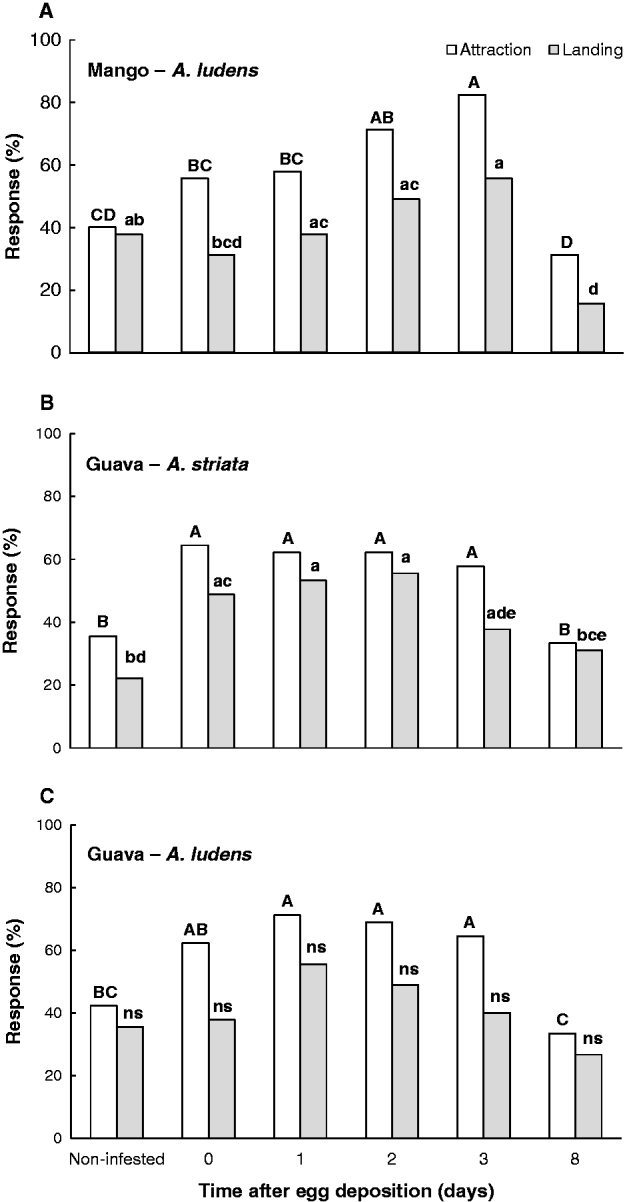
Mango fruits infested by A. ludens eggs of 2 and 3 days after deposition were significantly more attractive to naïve F. arisanus females compared with both non-infested fruits or fruits infested by larvae (G = 34.3; df = 5; P < 0.001) (fig. 1A). When using guava infested by A. striata eggs, the parasitoid showed a significantly higher preference for the fruits harbouring eggs (0 to 3 days post-infestation) than non-infested fruits or fruits infested by larvae (G = 18.5; df = 5; P < 0.002) (fig. 1B). The landing behaviour of parasitoids was influenced by the treatment. The wasp landed more often on mango fruits infested by A. ludens eggs (G = 19.8; df = 5; P = 0.001) or guava fruits infested by A. striata eggs (G = 16.9; df = 5; P = 0.005), than on non-infested fruits or fruits infested by larvae (figs 1A and 1B).
Attraction and landing response of naïve Fopius arisanus females towards non-infested and infested fruits. (A) Mango fruits infested by Anastrepha ludens; (B) guava fruits infested by Anastrepha striata; (C) guava fruits infested by Anastrepha ludens. Bars capped with different uppercase letters denote statistical differences between treatments in attraction response. Bars capped with different lowercase letters denote statistical differences between treatments in landing response (P < 0.05).

The response of F. arisanus to guava fruits infested with A. ludens was similar to previous experiments (Fig. 1C). Infested fruits of 0, 1, 2 and 3 days after egg deposition were significantly more attractive for the parasitoid than non-infested fruits or fruits infested by larvae (8 days post-infestation) (G = 22.2; df = 5; P < 0.001). However, there was no significant difference in landing response between treatments (G = 9.8; df = 5; P = 0.08).
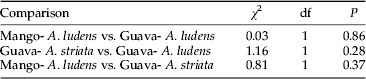
We performed an additional statistical analysis (chi-square test) using the whole set of results to determine if there was an effect produced by fly species, fruit species, or the combination fly species/fruit species, on the attraction of F. arisanus. We found that none of these factors influenced parasitoid attraction (table 1). This result suggests that parasitoids were attracted to the odour source, independently of the fly species or fruit species used.
Statistical comparisons of the attraction response of the parasitoid Fopius arisanus combining the fly species, fruit species and the association fly species/fruit species.

Are the volatiles that affect the responses of F. arisanus induced by Anastrepha egg deposition?
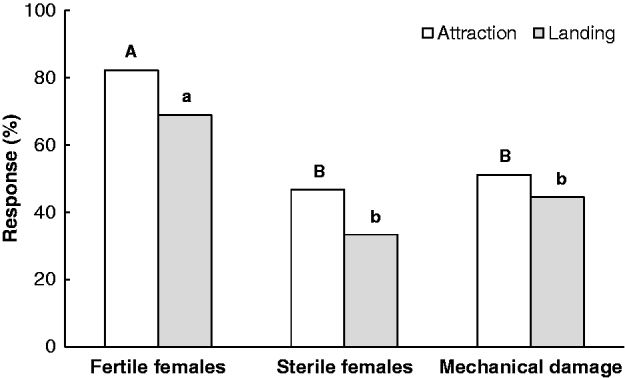
In the first experiment, naïve F. arisanus females were more attracted to guava fruits exposed to fertile females of A. ludens, i.e. fruits harbouring eggs, than to guava fruit exposed to sterile females (no eggs) or fruits with mechanical damage (G = 15.0; df = 2; P < 0.001; fig. 2). There were significant differences between treatments in the landing response (G = 12.2; df = 5; P = 0.002). Parasitoids landed more often on guava fruits exposed to fertile females than on both guava fruits exposed to sterile females and fruits with mechanical damage (fig. 2).
Attraction and landing response of naïve Fopius arisanus females towards guava fruits exposed to fertile and sterile Anastrepha ludens females, and fruits with mechanical damage. Bars capped with different uppercase letters denote statistical differences between treatments in attraction response. Bars capped with different lowercase letters denote statistical differences between treatments in landing response (P < 0.05).

In the second experiment, 80% of the parasitoid females were attracted to volatiles from infested guava fruits (1 day after egg deposition), whereas only 5% of females were attracted to volatiles from A. ludens eggs alone (G = 12.8; df = 1; P < 0.003). None of the females were attracted to the Petri dish containing a wet cloth (control). No females landed on the Petri dishes containing eggs or on control Petri dishes.
Are F. arisanus females able to discriminate between volatiles from fruits with unparasitised eggs vs. eggs parasitised by conspecifics?
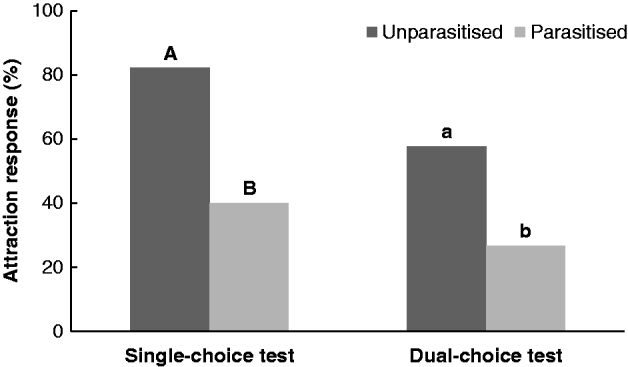
In the single-choice test, fruits with unparasitised eggs were more attractive to F. arisanus females than fruits with eggs parasitised by conspecifics (G = 17.6; df = 1; P < 0.001) (fig. 3). Likewise, parasitoid females landed more often on fruits with unparasitised eggs than on fruits with parasitised eggs (G = 13.2; df = 5; P = 0.0003). In dual-choice tests, F. arisanus females were more attracted to fruits with unparasitised eggs than fruits with parasitised eggs (χ2 = 5.16; df = 1; P = 0.023). Also, females landed more often on fruits with unparasitised eggs than on fruits with parasitised eggs (table 1).
Attraction response of naïve Fopius arisanus females towards guava fruits with Anastrepha ludens eggs both unparasitised and parasitised by conspecifics. Bars capped with different uppercase letters denote statistical differences between treatments in a single-choice test (P < 0.05). Bars capped with different lowercase letters denote statistical differences between treatments in a dual-choice test (P < 0.05).

Discussion
In a previous study we found that size, shape and hue of visual targets in combination with fruit odours might play a role in the host location behaviour of naïve F. arisanus females (Pérez et al., Reference Pérez, Rojas, Montoya, Liedo, González and Castillo2012). In the case of the chemical cues, the present study showed that egg deposition of A. ludens and A. striata in mango and guava fruits induces the release of volatile compounds that attract naïve F. arisanus females. The volatile compounds seem to be released independently of type of fruit and the fruit fly species used. We also found that F. arisanus females may discriminate between unparasitised and parasitised hosts from a distance. As far as we know, this is the first study that evaluates the behavioural responses of F. arisanus females using infested fruits by Anastrepha spp. in a wind tunnel. Current knowledge about the infochemicals mediating the host location of F. arisanus is limited, with only a few studies published. Based on a field study, Liquido (Reference Liquido1991) suggested that the rate of parasitism of F. arisanus on Bactrocera dorsalis was influenced by the fruit odours in which eggs are allocated, rather than the density of the host population. Wang & Messing (Reference Wang and Messing2003a) reported that the presence of host-associated cues on coffee berries infested with eggs of C. capitata increased the parasitoid's residence time during foraging behaviour of F. arisanus. In wind tunnel bioassays, Altuzar et al. (Reference Altuzar, Montoya and Rojas2004) found that this parasitoid was attracted to odours emitted by non-infested guava and orange fruits. They suggest that F. arisanus females use the fruit volatiles during host location. Finally, Rousse et al. (Reference Rousse, Chiroleu, Veslot and Quilici2007) performed some experiments with Bactrocera zonata and F. arisanus under semi-natural conditions. They found that parasitoid attraction was significantly higher for infested mango and orange fruits than for those that were not infested. They also reported that wasps did not discriminate between fruits infested with eggs and fruits infested with larvae, as both were equally attractive to F. arisanus; this contrasts with the results of our study, in which fruits infested with eggs were more attractive than fruits infested with larvae. Our results are consistent with those of Liquido (Reference Liquido1991) and Altuzar et al. (Reference Altuzar, Montoya and Rojas2004) in the sense that they point out that fruits mediate the behavioural response of F. arisanus to hosts. However, our findings go further, as they demonstrate that parasitoid females prefer fruits exposed to fertile A. ludens females (i.e. harbouring eggs) than fruits exposed to sterile females of A. ludens, fruits with mechanical damage, or fruits with larvae. Our results therefore suggest that host searching of this parasitoid is guided by volatiles emitted by fruits specifically in response to the egg deposition of fruit flies. In addition, the fact that Anastrepha eggs are laid inside the fruits and that in general insect eggs do not emit odours (Fatouros et al., Reference Fatouros, van Loon, Hordijk, Smid and Dicke2005) support our interpretation that F. arisanus females use oviposition-induced volatiles during host foraging. In fact, we found that A. ludens eggs are not attractive per se to F. arisanus females. Several authors have reported that substances that can elicit the herbivore-induced volatile production can be found in oral or oviduct secretions (Meiners & Hilker, Reference Meiners and Hilker1997; Colazza et al., Reference Colazza, Fucarino, Peri, Salerno, Conti and Bin2004; Fatouros et al., Reference Fatouros, van Loon, Hordijk, Smid and Dicke2005). We have not yet identified the volatile elicitor, but based on the lesser response of parasitoids towards fruits exposed to sterile females compared with fruits exposed to fertile females, i. e. harbouring eggs, it is possible that elicitor may be linked with the egg surface.
The induction of volatiles in response to herbivore oviposition has only been documented in four tritrophic systems, in all cases involving phyllophagous insects, and to our knowledge there are no reports with carpophagous insects. Thus, the results documented in the present study are the first to report the induction of volatiles released in response to the oviposition by a herbivorous insect in fruits. In the first case, Meiners & Hilker (Reference Meiners and Hilker1997) studied the chemical cues mediating the interaction between the egg parasitoid Oomyzus gallerucae, its host the elm beetle, Xanthogaleruca luteola, and the elm, Ulmus minor. They found that O. gallerucae females were attracted to volatiles from elm leaves that carried host eggs, but not a combination of odours of eggs and damaged leaves (without eggs). Thus, their results suggested that egg deposition onto elm leaves induces an emission of volatiles that attract the parasitoid. Subsequently, Hilker et al. (Reference Hilker, Kobs, Varama and Schrank2002) reported that egg deposition in the pine sawfly, Diprion pini, induced the pine, Pinus sylvestris, to release volatile compounds that were attractive to the egg parasitoid Chrysonotomyia ruforum. Later, Colazza et al. (Reference Colazza, Fucarino, Peri, Salerno, Conti and Bin2004) found that the egg parasitoid Trissolcus basalis was attracted to synomones emitted by leguminous plants (Vicia faba and Phaseolus vulgaris) induced by feeding and oviposition activity of the true bug Nezara viridula. Recently, Pashalidou et al. (Reference Pashalidou, Huigens, Dicke and Fatouros2010) reported that the wasp Trichogramma evanescens is arrested by chemical cues from Brussels sprout plants induced by singly laid Pieris rapae eggs.
Host discrimination ability by parasitoids is mediated by host marking pheromones left by females during oviposition, by physical or chemical changes induced by the parasitoid's progeny or by changes in the host hemolymph (Nufio & Papaj, Reference Nufio and Papaj2001). Most of these marking pheromones are detected by contact chemoreceptors (van Lenteren, Reference van Lenteren, Nordlund, Jones and Lewis1981), yet host discrimination could be also mediated through olfactory stimuli (van Baaren & Nénon, Reference van Baaren and Nénon1996). Although marking pheromones reduce egg wastage they do not prevent searching time wastage, which may be an important factor for parasitoids that attack concealed hosts (Hoffmeister & Roitberg, Reference Hoffmeister and Roitberg1997). Host discrimination at a distance has been documented in the parasitoid Cotesia rubecula and its hosts Pieris rapae or Pieris brassicae (Fatouros et al., Reference Fatouros, van Loon, Hordijk, Smid and Dicke2005). Previous studies have found that F. arisanus is highly efficient in foraging behaviour and host discrimination (Quimio & Walter, Reference Quimio and Walter2001; Montoya et al., Reference Montoya, Suárez, López and Cancino2009) and these characteristics ensure an exhaustive exploitation of the available resources (Wang & Messing, Reference Wang and Messing2003a,b). In the present study, we found that in both single-choice and dual-choice bioassays, naïve F. arisanus females were more attracted to guava harbouring unparasitised eggs than to fruits infested with eggs parasitised by conspecifics. Thus, host discrimination at a distance may be advantageous to this species, as they may avoid ‘wasting efforts’ in searching previously exploited patches (van Lenteren, Reference van Lenteren, Nordlund, Jones and Lewis1981). However, our results do not rule out the possibility that F. arisanus females may also recognise parasitised host by using contact chemical cues. In this way, Wang & Messing (Reference Wang and Messing2008) reported that naïve females of F. arisanus attack eggs previously parasitised by conspecifics, whereas experienced females exhibit perfect host discrimination behaviour. They described that discrimination is performed by females through direct examination (using their ovipositor) of marks left on the surface or inside eggs.
In conclusion, our main findings indicate that oviposition of the fruit flies A. ludens and A. striata on mango or guava fruits induces the release of volatiles that are attractive to naïve F. arisanus females. Thus, the greater attraction of F. arisanus to infested fruits is due to synomones induced by the fruit fly oviposition and not by the presence of kairomones left by the host. Furthermore, this parasitoid is capable of discriminating between unparasitised and parasitised hosts via olfactory cues. The chemical identification of the oviposition-induced synomones and the underlying mechanisms that induce the release of volatiles are still under investigation.
Acknowledgements
We are grateful for the technical assistance of Florida López (PROGRAMA MOSCAFRUT), Armando Virgen, Sandra Rodríguez and Gustavo Rodas (ECOSUR), and the statistical advice of Javier Valle Mora (ECOSUR). We also thank Stacy Philpott (University of Toledo) and Ailsa Winton (ECOSUR) for reviewing an earlier draft of the manuscript. The Consejo Nacional de Ciencia y Tecnología (CONACYT) of Mexico provided economic support to JP through a doctoral scholarship. The present manuscript comprises a portion of a thesis submitted by JP in partial fulfilment to obtain the doctoral degree at El Colegio de la Frontera Sur.