1. Introduction
In Western concert art music, the audience’s participation in the presentation of a musical work has traditionally been restricted to a staid listening experience within a proscenium setting in which performers interpret the scoring of a composer. While acoustic and electroacoustic composers from the twentieth century onwards such as Christian Wolff, Pauline Oliveros and George Lewis have explored ways to break down barriers between composer, performers and the audience within the social practice of concert-going and production, recent years have seen the development of interactive computer systems that provide a means for a broadly participatory practice that also transgresses these traditional boundaries, yet does so through the mobilisation of the audience’s electronic devices or sensor technologies.Footnote 1 With such participatory musical works and their concomitant systems, audience members are provided with the possibility of recognising the effects of their input and can therefore make choices that impact the aesthetic experiences in real time. As audience members engage with each other through the musical software, they give rise to an internal discourse that articulates a politics of aesthetic preference. On first glance, this language appears to recall Jacques Rancière’s ‘politics of aesthetics’, a term that is geared more towards describing the complex ways in which aesthetics, or more precisely the aesthetic regime of art, ‘promises’ a model for breaking down real political and social structures, yet ultimately ‘cannot satisfy’ this promise (Rancière Reference Rancière2010: 115, 133). However, I am using ‘politics of aesthetic preference’ here as a descriptor of a process whereby individuals and groups can have influence on one another within participatory musics as they are produced. This politics is most easily recognisable through groups being generated by either mimesis or pre-planned and coordinated action, and subsequently negotiating and vying to determine the shape and experience of the musical work. I argue that the structure of this interaction can be usefully conceptualised as a simulacrum of the Habermasian public sphere – or, even more precisely, as a constituted public with an internal politics.
In 1962, Jürgen Habermas published his influential The Structural Transformation of the Public Sphere (Habermas Reference Habermas1962). In this seminal text, Habermas outlines the historical and legal development of the conceptual bourgeois public sphere in eighteenth-century Europe and describes the promises of said ideal sphere (Habermas Reference Habermas1989). More importantly, this public sphere operates as a space in which individuals – through rational discourse – are able to negotiate political differences and subsequently implement agreed-upon policy through democratic means. While the public sphere as a concept pertains specifically to the historical period that Habermas analyses, and was developed so as to reveal some ‘element of truth and emancipatory potential … despite its ideological misrepresentation and contradictions’, his work has had wide-ranging implications and influence on approaches in communication theory and political theory that involve elements of publicity and consensus during political negotiation (Calhoun Reference Calhoun1992b: 2).
In section 2 of this article, I lay out in detail how, through the theory of musical semiology, participatory musics can be understood as a constituted space through which meaningful information is transmitted among participants. Tracing work on participatory music and art from Thomas Turino and Claire Bishop, respectively, and drawing upon Kofi Agawu’s and Jean-Jacques Nattiez’s work on musical semiology, I theorise the ways in which musical signs accrete into a musical discourse, which then circulates within the space of the concert-going public and fuels a politics of aesthetic preference. In the case of algorithmically mediated, participatory computer music in particular, the clarity of structure that a computer music system provides can serve as a model through which to consider the means by which participatory musical practices reify the aforementioned politics of aesthetic preference within a concert-going and musically participating public.
In section 3, I then apply this theory by critically examining the politics of aesthetic preference evidenced in TweetDreams, a work by Luke Dahl, Jorge Herrera and Carr Wilkerson that is algorithmically generated from the inputs of the audience by a computer system of their own design.Footnote 2 Though the theoretical observations in this article have implications for participatory musics in general, the choice of TweetDreams is predicated on the clear nature by which audience-provided participatory gestures and inputs are constrained, shaped, and operated upon by the same codes and protocols that are defined at the outset by the computer music system and then circulated back out to the audience. Audience members provide input data to TweetDreams via a personal device and the system generates sounds and visuals in return. Observing this outcome, participants are able to recognise how their inputs impact the presentation of the musical work and can thus submit new inputs based on their aesthetic preferences. Based on the theoretical underpinnings provided in section 2, I demonstrate how the participatory algorithmic computer music work TweetDreams, and participatory music more generally, behaves as a simulacrum of the Habermasian public sphere, which consequently raises further questions on how power is structured within the space, and what it means when audience members step outside of it.
2. A Theory of Political Aesthetic Preference in Participatory Music
2.1. Participation and imitation in music
Critical to determining the politics of aesthetic preference that has been laid out in the introduction of this article is the nature of participatory music and, in so far as a musical work allows for audience participation, whether and how musical ideas spread from one person to another within this setting. Thomas Turino, in Music as Social Life, succinctly defines ‘participatory performance’ in opposition to ‘presentational performance’, that is, the typical format of the ‘proscenium western concert art music setting’ (Turino Reference Turino2008: 26). Turino’s definitions are clear in their attempt to delineate differences between musics in which a social group creates a musical experience together, examples of which could be protest musics or Pauline Oliveros’s Sonic Meditations and presentational music such as a William Grant Still symphony or a Céline Dion concert. His chief mission in his book was to explore the social and experiential aspects of participatory settings; yet, there is well-established criticism of the argument that presentational performance should be differentiated from participatory music, as the act of listening also involves participation. Claire Bishop, for example, in her historical and theoretical reading of participatory artworks in Artificial Hells, terms ‘passive spectatorial consumption’, that is, presentational performance to Turino, a ‘mythic counterpart’ to participatory art due to the spectator’s role in how the work is perceived (Bishop Reference Bishop2012: 275). This argument can also be concluded from musical Peircean semiological theory, which will be treated in detail later, where the esthesic process (i.e. where a spectator apprehends or analyses the trace/work) is theorised as part of the semiological tripartition through which a sign is understood and thus becomes part of constructing the musical symbol.
Nevertheless, participants – in the sense that the audience members are involved in the production of the work as it occurs – have agency with which to impact the aesthetic experience of the work, and while all music has a social function, the musical fragments within the social interaction of participatory musics and improvised musics more generally can behave in an autopoietic fashion and mimetically circulate. Indeed, all participants who are engaged in the creation of any musics most often listen to other participants or performers before and while playing, and are thus able to take on replicable musical ideas, imitate them, manipulate them and respond to them if they so desire.
In jazz improvisation, for example, performers’ appropriation of and response to musical elements from co-improvisors serves as a concrete example of a pattern of imitation, manipulation and response within musical works. In her book Saying Something, Ingrid Monson points to jazz musicians as broadly considering ‘improvisation as musical conversation’, a thought she elaborates on later through a pointed interview with Ralph Peterson: ‘when you get into a musical conversation one person in the group will state an idea or the beginning of an idea and another person will complete the idea … So the conversation happens in fragments and comes from different parts, different voices’ (Monson Reference Monson1997: 73–8). Jazz is often performed and embedded within different social relationships and modes of musical production from Western concert art music. However, the general idea of a ‘musical conversation’, response or imitation of musical events can be found in a range of musics (Davidson and Good Reference Davidson and Good2002; Sawyer Reference Sawyer2006). This includes computer-mediated participatory music settings such as Sang Won Lee’s recent work Crowd in C, where participants are pushed to browse, express approval towards and copy each other’s input ‘melodies’ (Lee, Willette, Koutra and Lasecki Reference Lee, Willette, Koutra and Lasecki2019: 115).
The trope of a ‘musical conversation’ has a long-standing history within discourses on music, which includes musics that are entirely written out or deterministic.Footnote 3 However, Monson’s study shows that in improvised musics conversations, imitations and responses are constructed in real time, and Lee’s Crowd in C explicitly encourages these processes. In other words, the conversations occurring within these less deterministic forms of music are not necessarily hegemonically prescribed by the author or structure of a participatory, improvised or collaborative work but rather negotiated between the participants. This replicability of concrete musical ideas points to a musically semiotic function where some meaning of such units is mutually understood and transmitted, which has been theorised by other scholars as a system of semiology and discourse for music.
2.2. Musical semiotics and discourse
Musical discourse emergent through musical semiosis is key to determining how a political discourse arises within a participatory work of music. I use semiotics in this article in a Peircean sense; for example, ‘something which stands to somebody for something in some respect or capacity’ (Peirce Reference Peirce1932: 135), which is complicated by a triadic system that Jean-Jacques Nattiez calls upon in his framework for musical semiology in Music and Discourse (Nattiez Reference Nattiez1990).Footnote 4 According to Nattiez, the complicated process of communicating through symbols – whether it be through a semantic language or not – is obscured by the structure of a ‘semiological tripartition’ (ibid: 10–16). To demonstrate some of the epistemological complications involved in this semiological tripartition, Nattiez explains that it is the result of a poietic process, which is the ‘process of creation’ of the symbolic form (e.g., a musical work), and an esthesic process, which is where those receiving the symbol ‘construct meaning’ from the third leg of the tripartition, ‘the trace’ (ibid.: 11–12). The trace is the physical and material embodiment of the symbolic form (e.g., the sound produced by performers of the music, or perhaps the score), and the esthesic process is achieved through an analysis of the trace’s properties (in the case of music, e.g., listening or formal analysis). For Nattiez, the form of analysis applied to any part of the semiological tripartition poses immense epistemological problems for associating a musical fragment or a whole work with any particular, specific meaning, as the esthesic process can generate multiple interpretations, even to the same individual at different times. However, according to Nattiez, communication – even that which is obscured by the semiological tripartition – is always understood through the ‘specific features of the symbolic’ (ibid.: 11–15). Since ‘the trace’, the poietic process and the esthesic process are inscribed with ‘specific features’, and the processes put to use on the trace have their own form, Nattiez’s theory implies that the potentialities of intrinsic and extrinsic meanings are also limited (ibid.: 107–29). At the same time, however, he argues that musical symbolism is ‘polysemic’ – or rather, that the meanings are ‘multiple, varied and confused’ (ibid.: 37, 237–8). It is within the esthesic process that all apprehension of music can constitute a participatory process and is not, contra Turino, necessarily formally bifurcated into performances that are either participatory or presentational. Instead, participatory music should be seen as a real-time and recursive engagement by audience members who are conducting the poietic process that forms the trace at the same time that they are engaging in the esthesic process.
Kofi Agawu, while drawing from a Saussurian semiological tradition where the sign is split into a dyadic signifier and a signified (as opposed to the Peircean triad discussed previously), makes an argument that is nevertheless useful when considering the short interventions of poiesis and esthesis that participants engage in during a participatory work: smaller musical units with limited meanings, he posits, can potentially agglomerate into larger structures that reflexively generate discourse within the form of a work. In terms of how these musical signs accrete into a larger musical discourse, Agawu describes the latter as having three different ‘senses’ that he mobilises to construct his theory (Agawu Reference Agawu2009: 7). His first sense of musical discourse is that of music ‘as a sequence of events’, that is, musical events ordered in time and logically related (ibid.). That these smaller musical units are ordered in time, logically and sequentially, ultimately manifests the larger musical structures in his second sense, where music accumulates ‘accretions of those smaller meaningful utterances’ (ibid.: 7–8). Agawu makes it clear how these two definitions apply to music: motives may accumulate into phrases and, in the case of the sonata form, those phrases build into a period, exposition and so forth. He also insists that a theory of musical form is not necessarily required for these accretions to exist, even as some musical works may inscribe themselves within the norm of a particular form. Nattiez similarly highlights this accretion in his discussion of intrinsic meaning, where musical moments or events are understood as referring back to previous musical moments, or even foreshadowing the realisation of future ones (Nattiez Reference Nattiez1990: 111–18). This referring back to and foreshadowing of musical moments is what Agawu describes in his third sense, where ‘discourse entails acts of metacriticism. The musical composition comments on itself at the same time that it is being constituted in the discourse of the work’s internal commentary’ (Agawu Reference Agawu2009: 8).
For both Nattiez and Agawu, there exists an extrinsic non-semantic musical discourse, where a work is situated within a historical, political, cultural, etc. context, and therefore comments on aspects of composing, or the poietic process contained within said context. For example, extrinsic aesthetic and formal commentary on traditional musical forms can also be seen in the works of Florence Price, who in her Symphony in E minor ‘subtly infuses the traditional form [of the symphony] with characteristically black musical techniques as well as including a traditional African-American dance, the Juba as the third movement of the symphony, rather than a minuet and trio or scherzo’ (Farrah Reference Farrah2007: 76).
To circle back to the example I gave earlier of musical conversations and imitation with musical semiotics now in mind, the musical units of a participatory work offered by participants construct the musical work in time and form the basis for a constitutive discursive process. These ‘smaller … utterances we call events’, poietically contributed by members of a participatory musical setting, signify said member’s or – in the case of an organised group – members’ preference for the musical trace’s meaningful direction, upon which the esthesic process is based (Agawu Reference Agawu2009: 7–8). It is not necessary for the musical events generated in this setting to be extrinsically referential or semantically specific in their meaning; it only matters that the events be meaningful. As members of a participatory musical setting negotiate the direction of the work during the work, the poietic process becomes an internally discursive and informal political process. I argue that this political process is very much analogous to Habermas’s public sphere as laid out initially in The Structural Transformation of the Public Sphere and resonates with other scholars’ further development and revisions of Habermas’s initial propositions. More precisely, it is perhaps best understood not as the public sphere, but as a space that can behave like it.
2.3. The public sphere and publics in participatory music
Audiences within participatory music settings behave as a coherent public, especially with regard to the internal discourses that arise within the participatory experience and, due to an emergent politics based on these discourses, the generation of what amounts to a negotiated aesthetic experience. Habermas succinctly defines the public sphere as a space where ‘private individuals come together as a public’ (Habermas Reference Habermas1989: 27). More importantly, this space is where ‘the public’ comes together to ‘engage [the public authorities themselves] in a debate over the general rules governing relations in the basically privatised but publicly relevant sphere of commodity exchange and social labour’ (Habermas Reference Habermas1989: 27). Notably, Habermas primarily describes the nature of the public and the space within which it operates in the context of the historical and legal developments in eighteen-century Germany, France and England. Further, he depicts this public sphere in its idealised and normative form, which a number of scholars have since criticised and supplemented with deeper examinations of how ‘a public’ operates differently from ‘the public sphere’ (Calhoun Reference Calhoun1992a).
Since the publication of Habermas’s treatise, the public sphere has been most commonly conceptualised to the layperson as the space in which debate about policy issues regarding all facets of society is conducted. As a consequence, the public sphere is typically seen as a totality. Habermas’s theory, though, has important implications for conceiving of subsets of, and bodies external to, ‘the public’ and their intrinsic qualities and operations in the present – especially as the historical, bourgeois public sphere was a non-ideal entity that ultimately failed to be fully inclusive. Scholars such as Nancy Fraser and Michael Warner have laid out the ways in which the public sphere has systematically excluded women and the LGBTQ+ community, and how the hegemonic, bourgeois public sphere circles back and subsumes the private individual without offering it real political agency. Yet, both Fraser and Warner also use these examples to describe how different subsets of the polity can form overlapping or external counterpublics and publics (Fraser Reference Fraser and Calhoun1992; Warner Reference Warner2002).
In his book Publics and Counterpublics, where he explores how certain publics, especially queer publics, were excluded from participation in the public sphere, Warner seeks to more clearly define the difference between the public and a public:
The public is a kind of social totality. Its most common sense is that of the people in general … A public can also be a second thing: a concrete audience, a crowd witnessing itself in visible space … Such a public also has a sense of totality, bounded by the event or by the shared physical space. (Warner Reference Warner2002: 65–6)
He further defines the qualities of a public as:
1) Self-organised … 2) A relation among strangers … 3) Speech within a public is both personal and impersonal … 4) Constituted through mere attention … 5) The social space created by the reflexive circulation of discourse … 6) Acting historically according to the temporality of their circulation … 7) Poetic world making. (Warner Reference Warner2002: 67–114)
Most of these qualities are self-explanatory, but Warner’s seventh point merits further discussion. In essence, Warner argues here that the discourses in a public are inscribed within social, political and linguistic conventions and that these conventions are critical to delineating the boundaries of a public (ibid.: 114). Beyond the constituent characteristics that Warner lays out for a public, the space of a public in many ways behaves like the totality (e.g., the public) that seems to contain it, most notably in that a public ‘is a space of discourse organised by discourse’ and that certain kinds of publics can ‘enter the temporality of politics and adapt themselves to the performatives of rational-critical discourse’ (ibid.: 68, 124).
There are many ways in which participatory music events (and indeed music events and concerts in general) hold the qualities Warner lays out here. Attendees of concerts self-organise by choosing to attend the event; most concerts are not private affairs and are open to the public and therefore create relations among strangers; attention is necessary for participation. Yet, in contrast to a concert where audience members do not participate in the poietic process, participants are also invited to respond to other, and each other’s, musically expressive ideas; and the internal musical discourses that emerge from intrinsic or extrinsic referents constitute Warner’s ‘poetic world making’ and self-recognition for ‘historical acting’ (ibid.: 65–6). As was made clear earlier in this article, these internal discourses are generated inherently through the accretion of smaller musical units within a participatory music event. When said event is contextualised within the framework of a public, it becomes clear that one often overlooked facet of participatory music is the inherent politics of this poietic process.Footnote 5
3. Analysis
3.1. TweetDreams background
In order to better understand the ways in which a participatory work of music rises to the level of a public and generates a politics of aesthetic preference, I will now analyse Dahl, Herrera and Wilkerson’s TweetDreams, a computer music system that the authors term a ‘multi-user instrument’ but that is, importantly, also a temporally bounded participatory music experience (Dahl, Herrera and Wilkerson Reference Dahl, Herrera and Wilkerson2011: 1). Earlier in this article I have argued that a participatory musical experience involves the spectator engaging in a poietic process that forms the trace while simultaneously engaging in the esthesic process. The demonstration of this argument follows through both an analysis of video recordings of live performances of TweetDreams, so as to connect individual or group intention and discourse with the signified musical result, and a close study of the particular computer code that generates the musical and visual portions of the work. Further, in order to discuss specific loci of political–aesthetic power within the work, I will also aim to make visible the protocols and structures that constrain and mediate user participation and the users’ perceived aesthetic results.
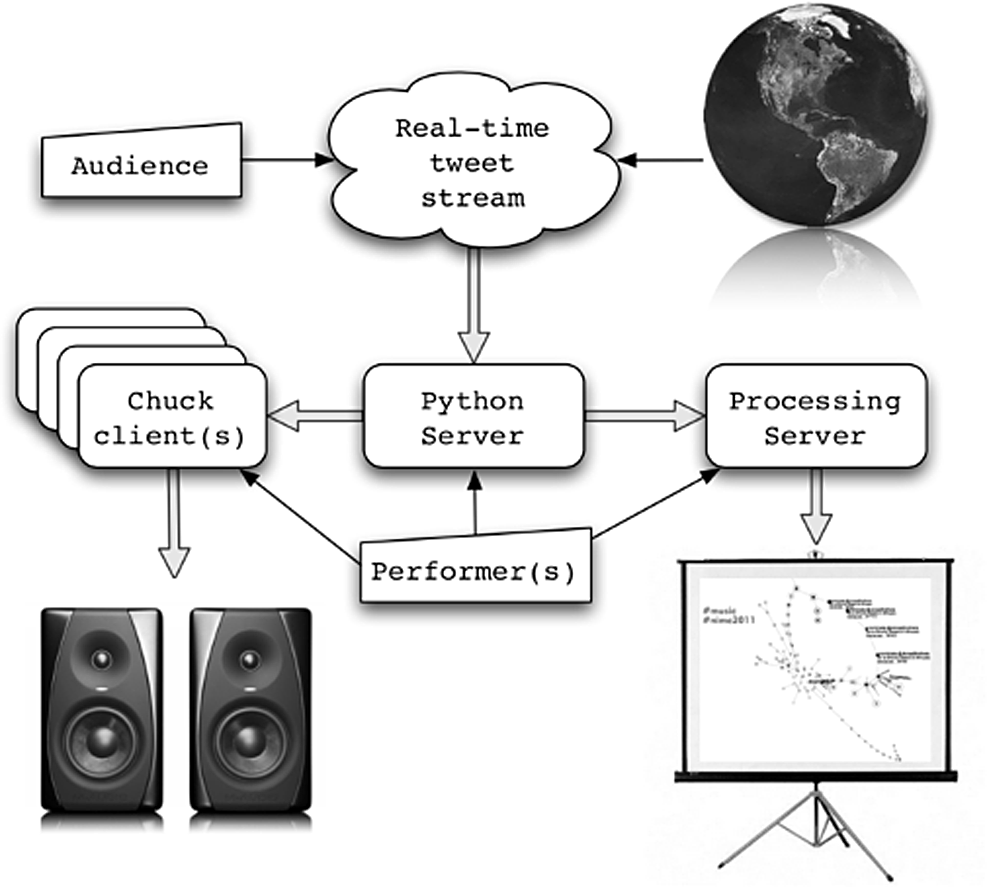
Luke Dahl, Jorge Herrera and Carr Wilkerson first presented TweetDreams in 2010 in Milan, at the Milano Torino International Music Festival. The software was developed at the Center for Computer Research in Music and Acoustics (CCRMA) at Stanford University. TweetDreams uses three different programming languages in its program architecture, two of which are widely employed by software developers – Python and Java – and one of which was more recently developed at Princeton University, principally by Ge Wang: ChucK (Wang Reference Wang2008). The textual input and sound synthesis system is executed entirely within ChucK and Python, while the visual rendering is left to a Processing server written in Java (Dahl et al. Reference Dahl, Herrera and Wilkerson2011: 1). All the communication between the component systems is conducted through the Open Sound Control (OSC) protocol (Figure 1).
TweetDreams software architecture from Dahl et al. (Reference Dahl, Herrera and Wilkerson2011).

During the piece, performers control the different servers that mediate the experience of the work. The work generates music and visuals based on data that is streamed from keyword searches (principally hashtags) through Twitter’s application programming interface (API), with the principal goal of deriving textual data from audience participants for sound synthesis. The data is scraped from search terms pre-set by performers who determine what tweets are scraped from the broader, public Twitter stream, in addition to a hashtag the live audience can tweet at and which is announced to the performance space, locally binding it. These performers also manage how TweetDreams is ‘musically and graphically rendered’ during the work and choose when to progress it on to new formal sections (Dahl et al. Reference Dahl, Herrera and Wilkerson2011: 1).
Sound is synthesised by taking in tweets, relating them to one another through text-comparison and generating melodies with six time-steps (Dahl et al. Reference Dahl, Herrera and Wilkerson2011: 2). Each of these time-steps may or may not contain a note (those that do not contain a rest), and the notes are scale degrees drawn from a prescribed array of pitches. Initially, the software generates a ‘node’ for each of the pre-set texts that serve as a visual and musical invitation at the beginning of a performance. The melodies for these nodes are generated randomly based on performer-prescribed scale systems and sample sets. Subsequent tweets are then related to these original nodes. When a new tweet is being parsed for sound synthesis, it is textually compared to extant nodes and, if not sufficiently unique, attached to the node with which it has the closest textual relationship in order to form a ‘tree’ (Herrera Reference Herrera2013a, Reference Herrera2013b). ‘Mutations’ are executed on the node via transposition or the swapping of note positions within a melody’s six time-steps (Dahl et al. Reference Dahl, Herrera and Wilkerson2011: 2).Footnote 6 The tweet is broadcast visually in the venue for the audience to see and the music generation algorithm plays back the short, synthesised time-step-melody, which is related on multiple levels to earlier nodes in its tree through the system’s delay effect. This delay effect, quite like an echo, is generated from the program’s iteration over all the previous, related time-step melodies within a tree. During the iteration, each subsequent step through the nodes on the tree gradually has its output amplitude decreased. Some parameters of these melodies are interactively managed during the performance, while others are pre-set beforehand (Dahl et al. Reference Dahl, Herrera and Wilkerson2011: 3).
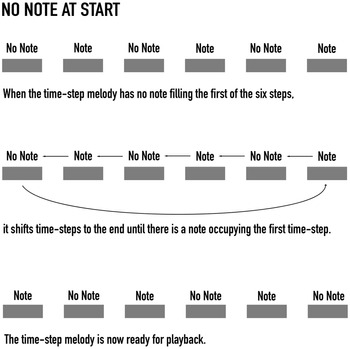
In addition, the authors of TweetDreams have hardcoded some constraints into their software. For example, if the transpositions being randomly imposed on a single step of a time-step melody become too disjunct, the program will flatten the melodic content into a more relatable range. Further, if the entire melody is transposed too high or too low, the program will return the melody towards a general centre of the audible range. Finally, the program also forces the first of the six time-points to produce a sound by shifting the order of the time-steps until it finds a time-step with a ‘note’ within the generated container (Dahl et al. Reference Dahl, Herrera and Wilkerson2011: 2–3) (Figure 2).
Example of the algorithmic process that ensures that the first time-step in TweetDreams’ time-step melody contains a note.

Dahl et al. note the participatory nature of TweetDreams but also describe the work and system as related to prior ideas for a ‘collaborative musical experience’ expressed by Tina Blaine and Sidney Fels and those for a ‘multi-user instrument’ proposed by Sergi Jordà (Blaine and Fels Reference Blaine and Fels2003; Jordà Reference Jordà2005: 4; Dahl et al. Reference Dahl, Herrera and Wilkerson2011: 1). Jordà’s ‘multi-user instrument’ merits particular attention here, as it constitutes an abstracted object rather than an experience or piece of music, which can be ‘played by a variable number of performers’ (Jordà Reference Jordà2005: 23–4). A multi-user instrument does not necessarily engender a participatory experience (e.g., a concert of piano for four hands still has the audience sitting in the hall and listening). This delineation between the participatory (or collaborative) musical experience and a multi-user instrument is important for the particularities of the politics and discourses possible within a participatory experience when it is mediated through a multi-user instrument. Performing participatory music on a multi-user instrument, after all, circumscribes politically and musically expressive possibilities since participants cannot play or join on an instrument of their choice, but rather are limited by material or encoded restrictions. Since TweetDreams as a computer music system is framed as a multi-user instrument, the multi-user instrument’s algorithmic processes ultimately determine the aesthetic shape of TweetDreams as a musical work. This, in turn, poses questions about the extent to which users are able control their inputs so as to aesthetically shape the direction of the work.
3.2. Analysing politics in TweetDreams
Because so much of TweetDreams is aesthetically – and intentionally – prescribed by its system, it would seem that tweeters in the audience have especially limited capacities to impact the aesthetic experience of the piece, as they are only able to guess the mechanism by which tweets are associated – and therefore attached to particular nodes – and then attempt to replicate those associations by submitting tweets that hijack the associative portion of the program’s algorithm. Meanwhile, the performers have comparably greater control with regard to the aesthetic experience of the piece, either through pre-sets or changes to settings that are executed during the performance, like the public tweet terms being taken in for association and synthesis. But again, this control is in large part dependent on whether they feel comfortable changing aspects of the given codebase, which could be entirely contingent on their own expertise with the constitutive programming languages.
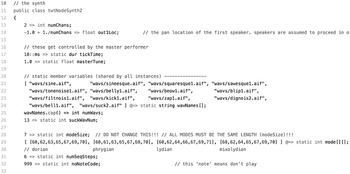
For example, when initially installed, the settings for the synthesiser only grant 14 different types of sounds and provide for only four different kinds of church modes from which notes are selected and assigned to time-step melodies. Further, every single mode must have the same number of distinct pitches, so using an octatonic scale and the chromatic field would not be allowed (Herrera Reference Herrera2012). These kinds of hardcoded choices, or alternatively the kinds of choices that must be pre-set before a performance, certainly make performing the work easier out of the box, but they also limit the participatory frame for both the audience and the performers, and relegate much of the aesthetic–political power of the work to its authors (Figure 3).
Example code from Herrera (Reference Herrera2012).

Despite these inherent systemic constraints, TweetDreams’s audience members have opportunities to signify their aesthetic preference in response to others’ own significations. As shown by Dahl et al.’s explanation of TweetDreams along with an examination of the codebase, tweets are scraped from the stream of a hashtag that is given to the audience prior to a performance, which audience members utilise in their own tweets in order to interact with the musical work. The audience can also choose to tweet at the keywords that are variably selected by the performers as the performance of TweetDreams progresses. Because tweets are displayed onscreen, and the program iterates over and plays back all of the previous, related tweet-melodies in a tree, the sonic representation of any single tweet indexes itself, both visually at the front of the hall and audibly in the parent tree. Within the broader audiovisual complex, the circulation of these indexed signs generates a local, internal musical discourse.
For example, across the three publicly available videos of TweetDreams performances, the work formally begins with an invitation to tweet. The piece then develops as participants begin tweeting at the software and the performers input variable keywords. In a performance at Transitions, an event held in 2010 at CCRMA, the initial invitation was broadcast to the audience with a prioritised locally bound hashtag of #ccrma through a series of introductory tweets (Dahl, Herrera and Wilkerson Reference Dahl, Herrera and Wilkerson2010) (Video Example 1). The very first audience-provided tweet of ‘#ccrma badeep doop’ – a humorous, onomatopoeic textual reference to the sounds of the opening tweets – was instantly related to one of the introductory tweets ‘hello #ccrma’, as the cosine-similarity algorithm associates these two tweets closely since they are both short and include the hashtag text ‘#ccrma’ [0:45] (Dahl et al. Reference Dahl, Herrera and Wilkerson2010). The music generated by this associated time-step melody was short due to the brevity of the messages and the responsive tweet was textually descriptive of the sounds being generated by the computer music system, which were synthesised by brief ADSR envelopes of sine tones with some reverberation.
More interestingly, the next incoming tweet had one audience member react to another of the introductory tweets, which was ‘Tweet Dreams Are Made of These #ccrma’ (Dahl et al. Reference Dahl, Herrera and Wilkerson2010). This new response to the original introductory tweet – ‘tweet dreams are made of cheese #ccrma’ (0:47) – was particularly closely associated, considering that there was only one word differentiated in this longer message (Dahl et al. Reference Dahl, Herrera and Wilkerson2010). Here, audience members could begin to concretely observe the ways in which the computer music system associates tweets, as the tweets were visually represented on the screen concurrently with the playing of their associated, synthesised sounds. With this associative process, any sonified output can be seen as indexed to a visually accompanying text and time-step melody as echoes propagate up the time-step-melody’s tree of nodes. This propagation of echoes up the time-step-melody’s tree is demonstrated at 1:21, when the message ‘#ccrma all the time all the way’ was associated with ‘#ccrma all the way!!!’, back to ‘hello #ccrma’, and finally to the original node in the tree, ‘Tweet Dreams Are Made of These #ccrma’, with each time-step melody in the associative chain being played back (Dahl et al. Reference Dahl, Herrera and Wilkerson2010).
This example very clearly shows how individual tweets are indexed to a particular sound, and how the relationship between these tweets also forms a chain of sonically signified meaning, which mirrors Agawu’s ‘accretions of those smaller meaningful utterances we called events’ in the music (Agawu Reference Agawu2009: 7–8). Further, audience members can signify meaning, both musically and textually, through the associative framework that Dahl et al. set up. This can be achieved either through simply tweeting whatever they like, to generate an independent node or tree branch, or specifically referencing other participants’ already submitted tweets in order to set off an intended chain of time-step melodies. Since participants are able to express themselves both through text and through music, and therefore poietically generate a musically indexed discourse, TweetDreams takes a form similar to the Habermasian public, in that the public interactions by audience members negotiate the aesthetic shape of the musical work. While these interactions could be seen as merely demonstrating the audience’s reaction to the displayed, humorous texts of other members of the audience, and therefore relegate the musical experience as secondary to the social and textual dimension, TweetDreams nevertheless manifests the potential for such recognition and engagement with framed musical choices.
4. Conclusion
As demonstrated in this article, participatory music intrinsically contains a particular semiology through which the participants are able to shape the aesthetic direction of the work. Further, the technological development of personal computing devices and algorithmic computer music systems that take advantage of device inputs has opened up new modes of musical production. TweetDreams, as both a participatory musical experience and a multi-user instrument that produces musical fragments indexed to semantically associated texts, serves as a fitting example to demonstrate the potential for an audience to intentionally and interactively signify meaning and therewith to behave as a public.
However, the observation that the participating audience and the structure of TweetDreams form a public, and that this public circulates discourse and therefore formulates an internally coherent politics of aesthetic preference, poses many further questions with regard to the kinds of politics possible within participatory music, and in TweetDreams more specifically. First, politics here inherently implies a system of power structure, as one aesthetic preference has the potential to subsume all others. To this end, one must ask where political power lies within TweetDreams and other participatory algorithmic computer music works. For starters, the authors of the work maintain an immense amount of control over the aesthetic experience of the work with the design of their multi-user instrument, as has been shown through their description of the work and an analysis of the code base. Indeed, Dahl et al. argue for the goal of restricted audience control quite clearly by citing Tina Blaine and Sidney Fels’s ‘design criteria’ for ‘the creation of collaborative interfaces for musical experience’, where novice onboarding needs balancing with virtuosity (Blaine and Fels Reference Blaine and Fels2003: 129). In the case of TweetDreams, the design goal restricts the expressive range and therefore limits the discourse possible within the work, while reserving much of the political power within the work’s public to the authors who structure the space via the program. Similarly, the performers maintain a significant amount of political power within TweetDreams through their control of the search terms utilised by the program. This aesthetic control can be amplified if the performers change the plethora of the program’s built-in variables, the pre-selected sound-sample files, or the possible musical modes that feed into the time-step melodies. Finally, musically and technologically trained participants could potentially recognise the subtleties of the system and adapt their inputs with greater facility and choice accordingly, leaving the untrained with the least power to wield.
More interesting for the internal politics of the work, though, is how audience members can organise and impact the aesthetic experience despite their limited means of interaction. While participants in TweetDreams may not be able to control aspects of timbre or change the modes available to the time-step melody, they can choose to associate their tweet with particular trees of time-step melodies by matching the content of the text closely to the already displayed tweets which relate to the desired tree. Not only that: because conversation itself tends to be repetitious in both form and content, and because new time-step melodies are generated based on the association of nodes through text-comparison, textually conversing participants end up unifying the aesthetic result of their musical outputs – as was humorously shown in the ‘Transitions’ performance (Tannen Reference Tannen1987; Dahl et al. Reference Dahl, Herrera and Wilkerson2010). With enough members of the audience organised into a coherent body – either through prior agreement, or through an organic group formation (e.g., mimesis or conversation) – participants could flood TweetDreams with the sounds of a particular tree of melodies, at least until the audience coalesced around a change. In a hypothetical, generalised acoustic participatory work, imitated musical gestures and fragments circulating between participants could take the place of TweetDreams’s clear, textually and sonically mapped inputs and form the basis for group impact on aesthetic result. Given that within the audience as a public, multiple groups and individuals with different goals could potentially compete – or cooperate for that matter – to shape the aesthetic experience, it becomes clear how TweetDreams and participatory music in general contain an internal politics of aesthetic preference.
Recent research supports the possibility for this kind of meaningful competition of semiotically significant units among concert-goers. Jutta Toelle and John A. Sloboda, for example, have analysed survey data collected from audience members who participated in recent workshops and concerts supported by the Art Mentor Foundation Lucerne’s CONNECT project (Toelle and Sloboda Reference Toelle and Sloboda2019). Most pertinently, Toelle and Sloboda argue that their ‘data shows how quickly participants feel that power relationships in a performance situation are contested’ and that they ‘found that participants experienced a mixture of group feelings and personal emotions, of being active and of being a recipient of instructions, of interacting with the music, of being a part of a community and of feeling empowered’ (ibid.: 21). In Lee et al.’s ‘The Effect of Social Interaction on Facilitating Audience Participation in a Live Music Performance’, the authors found, based on their analysis of data-mined inputs from Lee’s interactive music work Crowd in C, that audience members were more likely to edit their musical inputs after encountering a ‘popular’ melody as rated by the audience’s ability to ‘heart’ a melody they like (Lee et al. Reference Lee, Willette, Koutra and Lasecki2019: 115).Footnote 7 Both of these studies suggest that there is a form of local politics at play that shapes the musical experience during participatory works, whether computer based or not.
Yet, there remain deeper questions of how power is laced through the actualising and constructive process of the work in time and how it emerges as internal to each work and the situated particularities of the audience, composer and performers. Earlier questions posed, as they relate to the choices audience members are offered, complicate how much power is really passed over to the audience when the work has authors and performers, and whether design protocols meant to make audience onboarding quick and easy offer limited expressive options. Beyond these questions is the role of refusal as a political choice – where audience members may be opting not to engage with the participatory setting for a multitude of reasons – and how far musical signs are truly impacting audience decisions.Footnote 8 The reality that audience members may refuse to engage, so much so that a participatory work collapses from lack of engagement, brings this theorised, consensus-based politics of aesthetic preference into proximity with a Rancièrian dissensus (Rancière Reference Rancière2004, Reference Rancière2010). This poses significant philosophical quandaries for musicians and theorists who idealise participatory works in emancipatory or democratising terms. Nevertheless, some power is shared, so such participatory works can serve as a future focal point for social and cultural investigation, in addition to offering a formal, social and political space of play for audiences and artists alike.
Acknowledgements
This article would not have been possible without the keen reading and comments offered by Judith Lochhead, Patrick Müller, Luke Dahl, Margaret Schedel, Daniel Weymouth, Matthew Barnson and Anne Schult. I would also like to thank Sang Won Lee for the helpful clarifications on his work. Finally, I am grateful to the two anonymous reviewers for their insightful remarks and suggestions and to the editorial staff at Organised Sound for their patience.