
I. INTRODUCTION
In the year of 2000, Mughrabi entered the new field of nano-structured and ultra-fine grain (UFG) materials with the highly influential paper “On the grain-size dependence of metal fatigue: Outlook on the fatigue of ultrafine-grained metals”, Reference Mughrabi, Lowe and Valiev1 which started a line of enquiry that eventually turned into a long-term program of research in many laboratories worldwide. Based on the wide knowledge about the fatigue behavior of conventional metals and alloys and on the very limited information available about the processing-structure-properties relations of currently emerging UFG materials, he introduced basic concepts that underlined the field of research in fatigue of these materials as a whole. He has not only highlighted the most significant challenges and opportunities for the anticipated research on the effect of grain refinement by severe plastic deformation (SPD) on fatigue properties but also predicted key trends that dominated the overall progress in the field for years. The specifically accentuated topics included the influence of the cyclic slip mode, cyclic hardening/softening, cyclic saturation, cyclic stress–strain behavior, cyclic strain localization associated with persistent slip bands or shear bands, dislocation distributions and dislocation mechanisms, and fatigue damage: trans- versus intergranular fatigue crack initiation, fatigue crack propagation, and fatigue life. Among the conclusions drawn, he suggested that materials other than copper (such as planar-slip alloys, (precipitation-hardened) light metal alloys, and carbon steel) and titanium (and its alloys) would appear to be more promising in enhancing fatigue performance. This was then confirmed in numerous detailed investigations of the response of pure copper, Reference Kunz, Lukas and Svoboda2–Reference Vinogradov and Hashimoto4 alpha-brass, aluminum Reference May, Dinkel, Amberger, Höppel and Göken5,Reference Höppel, Kautz, Xu, Murashkin, Langdon, Valiev and Mughrabi6 and its nonheat treatable Reference May, Dinkel, Amberger, Höppel and Göken5,Reference Patlan, Higashi, Kitagawa, Vinogradov and Kawazoe7 and precipitation hardened alloys, Reference Chung, Kim, Kim and Kim8–Reference Chen, Ma, Stoica, Liaw, Xu and Langdon11 copper alloys, Reference Vinogradov, Ishida, Kitagawa and Kopylov12–Reference Xu, Wang, Zheng, Zhu, Li, Huang, Jia and Du14 titanium and its alloys, Reference Vinogradov, Stolyarov, Hashimoto and Valiev15–Reference Zherebtsov, Salishchev, Galeyev and Maekawa17 interstitial-free Reference Niendorf, Canadinc, Maier, Karaman and Sutter18 and stainless steel with low stacking fault energy promoting planar slip, Reference Ueno, Kakihata, Kaneko, Hashimoto and Vinogradov19 etc. Although very incomplete, this list of cited papers represents a broad variety of studies performed in the past two decades on ultrafine-grained materials manufactured by SPD. The advantages of significant grain refinement have been documented for light-weight Al and Ti alloys in numerous publications, Reference Höppel, Kautz, Xu, Murashkin, Langdon, Valiev and Mughrabi6–Reference Vinogradov, Washikita, Kitagawa and Kopylov9,Reference Rhee, Lapovok and Thomson20–Reference Niendorf, Canadinc, Maier and Karaman25 whereas Mg alloys remain among the least studied ones to date.
Magnesium is the lightest of all the structural metals. The density of magnesium is only 1.7 g/cm3—65% of the density of commonly used aluminum alloys (2.7 g/cm3) or 40% of that of titanium alloys (4.6 g/cm3).
Reference Mouritz26
Having an outstanding specific strength, high damping capacity, and recyclability, magnesium alloys are attractive for weight-sensitive applications in load-bearing components in the automotive and airspace industries. Despite these impressive properties, there are well-known problems with the applications of Mg alloys. Besides low corrosion resistance, these problems include relatively low engineering strength, short fatigue life, poor deformability, toughness, and creep resistance compared with Al alloys.
Reference Joost and Krajewski27–Reference Hirsch and Al-Samman30
Because of these issues, the uptake of Mg alloys by industries has been rather sluggish.
Reference Joost and Krajewski27
The fundamental reason for not achieving the desired mechanical properties of magnesium alloys is associated with the limited number of slip systems in the hexagonal close packed (hcp) crystal lattice. At low homologous temperatures, the dislocation slip is possible in the most closely packed direction
 $\left\langle {11\bar 20} \right\rangle$
, or 〈a〉 slip, on basal (0001), prismatic
 $\left\{ {10\bar 10} \right\}$
, and pyramidal
 $\left\{ {10\bar 11} \right\}$
planes.
Reference Yoo31,Reference Lou, Li, Boger, Agnew and Wagoner32
However, even when all basal and nonbasal 〈a〉 systems are activated, they provide only four independent slip systems while the accommodation of arbitrary homogeneous deformation in polycrystalline aggregates requires activation of at least five independent deformation modes according to the von Mises–Taylor criterion.
Reference Taylor33
Besides, none of these systems can accommodate plastic deformation perpendicular to the basal plane. Since the 〈c + a〉-slip in the second-order pyramidal system has a very high critical resolved shear stress (CRSS) at ambient temperatures, twinning is activated in Mg as an additional accommodation mechanism to satisfy the von Mises–Taylor criterion.
Reference Yoo31,Reference Lou, Li, Boger, Agnew and Wagoner32
In magnesium, the most easily activated twinning modes are
 $\left\{ {10\bar 12} \right\}$
extension and
 $\left\{ {10\bar 11} \right\}$
-type compression twinning.
Reference Christian and Mahajan34
The twinning on
 $\left\{ {10\bar 12} \right\}$
plane is associated with extension along the c-axis and reorientation of the lattice by 86.3°. The
 $\left\{ {10\bar 11} \right\}$
compression twinning results in contraction along the c-axis and tilting of the lattice by 56°. Due to the polar nature of twinning, a specific twinning system is favored by only one direction of loading, i.e., tension or compression.
Reference Christian and Mahajan34
Therefore, magnesium responds anisotropically to mechanical loading, and plastic deformation of polycrystalline magnesium leads to the development of pronounced texture. The interplay between two main deformation modes—dislocation slip and twinning—is quite complicated and is not fully understood.
Reference Yoo31
This complexity is further exacerbated by the strong textures that are developed in magnesium alloys during thermo-mechanical processing.
The property which responds sensitively to all these factors is fatigue. Good fatigue performance in combination with high deformability and corrosion resistance is crucial for prospective industrial applications. Reviewing the fatigue properties of Mg alloys, Potzies and Kainer Reference Potzies and Kainer35 have proposed two different approaches to improve the fatigue behavior of Mg alloys: (i) surface modification toward hardening of the surface layer and corrosion protection and (ii) improvement of the bulk microstructure to decelerate crack initiation by avoiding casting defects. In the present communication, we will overview the second approach with the focus on the effect of severe plastic deformation on fatigue.
Xiong and Jiang Reference Xiong and Jiang36 and Dallmeier et al. Reference Dallmeier, Huber, Saage and Eigenfeld37 provided a survey of experimental data available on the strain controlled fatigue properties of Mg alloys. It was noticed that, while the effects of loading conditions (e.g., strain/stress amplitude, strain/stress ratio, loading rate, and mean stress) have been studied in considerable detail (if not comprehensively), the effect of microstructural factors (such as grain structure, texture, and second phases) on the low- and high-cycle fatigue (LCF and HCF) behavior of Mg alloys is far from being understood. Undoubtedly, the fatigue behavior of Mg alloys depends on all these factors explicitly or implicitly. The improvement of fatigue properties through microstructure control is quite tricky because it is challenging to identify the microstructural factors, which influence the fatigue performance the most among many others. Reference Matsuzuki and Horibe38 Moreover, the conventional processing schemes involving rolling or pressing give rise to a strong crystallographic texture where the c-axis of the majority of the grains is oriented perpendicular to the longitudinal axis of the working sample. The strong texture leads to a pronounced tension–compression asymmetry in the deformation cycle, Reference Hasegawa, Tsuchida, Yano and Matsui39–Reference Lin and Chen42 which is detrimental to fatigue performance. The most obvious reason for this effect is the tensile mean stress resulting from this yield asymmetry.
As an alternative to the “classical” deformation methods, severe plastic deformation (SPD) techniques have gained popularity over the recent years as an efficient vehicle for modifying the microstructure and the strengthening of metallic materials by grain refinement. Reference Valiev, Estrin, Horita, Langdon, Zehetbauer and Zhu43 As has been supposed in Ref. Reference Estrin and Vinogradov44, complex light alloy systems, such as multiphase wrought Mg alloys, are very responsive to the improvement of fatigue performance by SPD processing. This is achieved through improvement of the as-cast structure and rearrangement of secondary phases producing a finer and more uniform distribution of strengthening particles. The emerging consensus is that a transition from twinning to slip dominated flow occurs with decreasing grain size so that deformation modes other than basal slip 〈a〉 can be activated more easily in Mg alloys with micro- and nano scale grain size. Reference Koike45–Reference Figueiredo, Poggiali, Silva, Cetlin and Langdon48 It is therefore expected that fine grain size will result in higher ductility along with higher strength. Reference Koike45 Indeed, an impressive ductility enhancement was observed in Mg alloys subjected to equal channel angular pressing (ECAP)—the SPD technique which has gained the greatest popularity so far. Reference Zúberová, Kunz, Lamark, Estrin and Janeček49–Reference Figueiredo, Cetlin and Langdon53 For example, for a pure magnesium and pure Mg–0.9 wt% Al alloy, Yamashita et al. Reference Yamashita, Horita and Langdon54 have found that elongation to failure increased up to 15% when grain size was reduced from 400 to 17 μm by ECAP. Mukai et al. Reference Mukai, Yamanoi, Watanabe and Higashi55 applied the ECAP technique to AZ31B alloy to further reduce the grain size to 1 μm. A remarkable increase in tensile elongation up to 40% at room temperature has been noticed for this alloy after ECAP annealing. Simultaneous improvement of strength and ductility (together with enhancement of high-cycle fatigue and corrosion resistance) in Mg alloy ZK60 by grain refinement was reported earlier. Reference Orlov, Raab, Lamark, Popov and Estrin56–Reference Vinogradov, Orlov and Estrin58 In these studies, processing by integrated extrusion and ECAP was used to refine grains in the alloy ZK60 from the average grain size d ≈ 70 μm down to d ≈ 2 μm. Reference Orlov, Raab, Lamark, Popov and Estrin56,Reference Orlov, Ralston, Birbilis and Estrin57 Similarly, enhanced strength and ductility were reported recently for a Mg–Zn–Zr–Ca alloy with a fully recrystallized sub-microcrystalline grain structure (d ≈ 0.77 μm) fabricated by high pressure torsion (HPT) followed by rapid annealing. Reference Zheng, Bhattacharjee, Shibata, Sasaki, Hono, Joshi and Tsuji59 HPT to five turns of the as-extruded alloy ZK60 performed at room temperature results in a heterogeneous microstructure with the average grain size, d ≈ 0.7 μm, and 95% high angle grain boundaries. Reference Torbati-Sarraf, Sabbaghianrad, Figueiredo and Langdon60 The observed improvements in the properties were attributed to the combined effect of grain refinement and texture variation although the effect of texture was not disclosed in detail. Reference Orlov, Raab, Lamark, Popov and Estrin56,Reference Vinogradov, Orlov and Estrin58 Besides, the SPD techniques provide a great deal of flexibility for the texture control. Indeed, the texture in Mg alloys can be considerably changed by SPD, for example, by simple shear deformation via ECAP Reference Mukai, Yamanoi, Watanabe and Higashi55,Reference Agnew, Mehrotra, Lillo, Stoica and Liaw61,Reference Agnew, Horton, Lillo and Brown62 or accumulative back extrusion. Reference Asqardoust, Zarei Hanzaki, Abedi, Krajnak and Minárik63,Reference Fatemi, Zarei-Hanzaki and Cabrera64 Furthermore, it was demonstrated that the ductility of Mg alloys (AZ31 as an example) after ECAP can be significantly improved without considerable grain refinement by texture modification. Reference Mukai, Yamanoi, Watanabe and Higashi55 However, similarly to the outcomes of Ref. Reference Matsuzuki and Horibe38, Zúberová et al. Reference Zúberová, Kunz, Lamark, Estrin and Janeček49 found that it was difficult to rationalize the relation between the grain size, the ultimate tensile strength, and the fatigue resistance in the case of hot-rolled and ECAPed AZ31 alloy. A similar problem is faced in the present work on the example of the alloy ZK60 as will be discussed below. Vinogradov et al. Reference Vinogradov, Patlan, Suzuki, Kitagawa and Kopylov13 have demonstrated that integrated SPD processing involving direct extrusion combined with two ECAP passes resulting in the total equivalent strain of 5.4 is effective for improving the HCF performance of the ZK60 alloy: the HCF endurance limit in axisymmetric push–pull fatigue testing reached 160 MPa, which is a very high value for this class of alloys. A variety of modern SPD techniques have been developed in the past two decades Reference Estrin and Vinogradov65 with the aim of improving the mechanical properties including fatigue. Among them, multiaxial isothermal forging (MIF) Reference Yurchenko, Stepanov, Salishchev, Rokhlin and Dobatkin66–Reference Miura, Yang and Sakai69 has long been recognized as a cost-effective and industrially scalable method for manufacturing large-size billets with microcrystalline structures. However, the potential of this method has not been fully explored in application to Mg alloys as yet.
To gain a better insight into the fatigue phenomenon in wrought Mg alloys fine-grained by SPD, the present overview is aimed at summarizing the available data on low- and high-cycle fatigue properties of the alloy ZK60 after different SPD treatments and at relating these data to the microstructure.
II. EXPERIMENTAL PROCEDURE
Considering the alloy ZK60 (nominal composition Mg–6Zn–0.5Zr, in wt%) as a typical representative of a class of wrought Mg alloys, different processing schedules have been examined in the present work in an attempt to refine the grain microstructure and improve the properties of this alloy. One part of as-supplied material was processed by MIF. The second part was manufactured by ECAP and the third involved a combination of the above two. The billets with dimensions 70 × 70 × 170 mm3 were MIF-processed at 673 K from a hot-pressed 90-mm-diameter rod in T6 condition. On the second step, MIF was performed at 573 K. During processing, the billet experienced six deformation cycles on each step involving a sequence of settings and drawings with axis changing as described in Ref. Reference Nugmanov, Sitdikov and Markushev67. The total true strain imparted on a working billet was of 4.2 and the last deformation cycle was ended by oil cooling. ECAP was performed on a die set with round channels intersecting at 120°. The initial as-cast material was homogenized at 603 K for 10 h and subsequently at 733 K for 7 h. It was then pressed through the die two times via route Bc at 523 or 593 K. The specimens processed at a higher temperature (593 K) were additionally subjected to two MIF operations at 573 K. The coarse grain hot pressed alloy was used as a reference material.
The specimens for mechanical testing were cut by spark erosion in the longitudinal direction of the working billets. The uniaxial tensile tests were performed using the conventional I-shaped specimens with a gauge length of 10 mm on the Kammrath & Weiss screw-driven testing machine under constant crosshead velocity corresponding to a nominal strain rate of 1 × 10⁻⁴ s−1. For the fatigue test, the subsize specimens with a cross-section of 2 × 2 mm2 and a gauge length of 5 mm were used. All specimens for mechanical testing were mechanically polished to a mirror-like surface finish. The Instron Electropuls 1000 electro-mechanical testing machine operating in a symmetric push–pull cycling (R = −1) mode was used for the tests at ambient temperature. For the HCF, the tests were performed in the stress control mode at the constant stress amplitude Δσ/2 at 10 Hz frequency, while for the LCF the total strain control mode at 0.2 Hz frequency was implemented using a dynamic clip-on extensometer with the 5 mm interprobe distance.
The microstructural observation was carried out using a field emission gun scanning electron microscope (SEM) Zeiss SIGMA (Carl Zeiss GmbH, Jena, Germany) equipped with the EDAX/TSL EBSD detector (EDAX Inc., Mahwah, New Jersey).
III. RESULTS
A. Microstructure
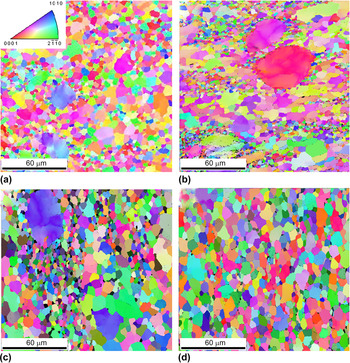
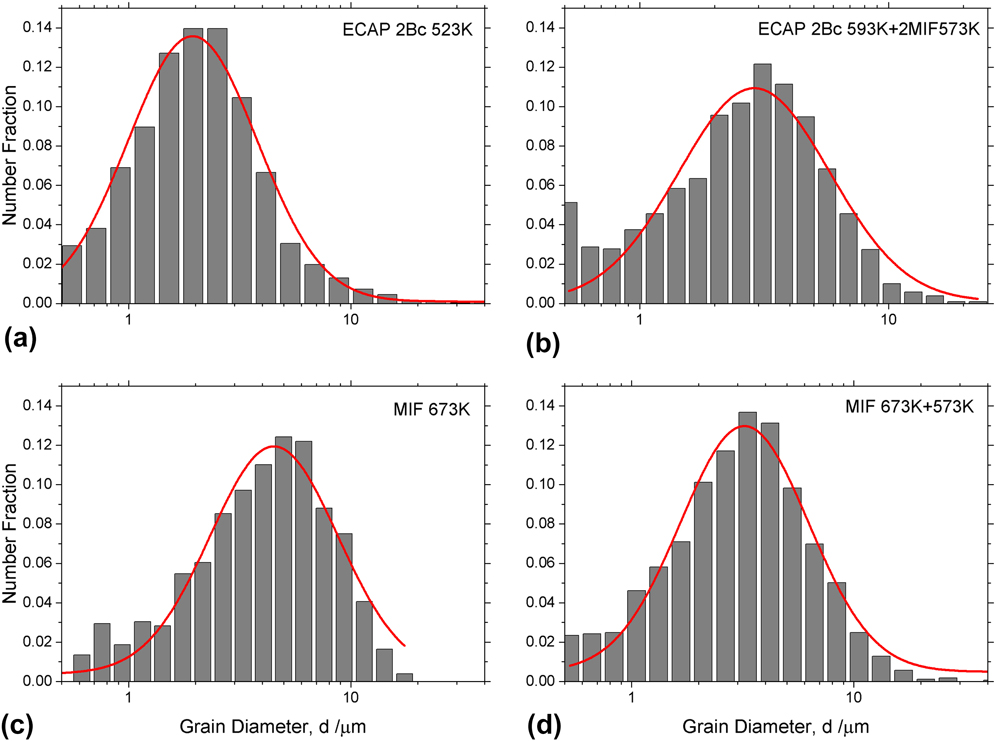
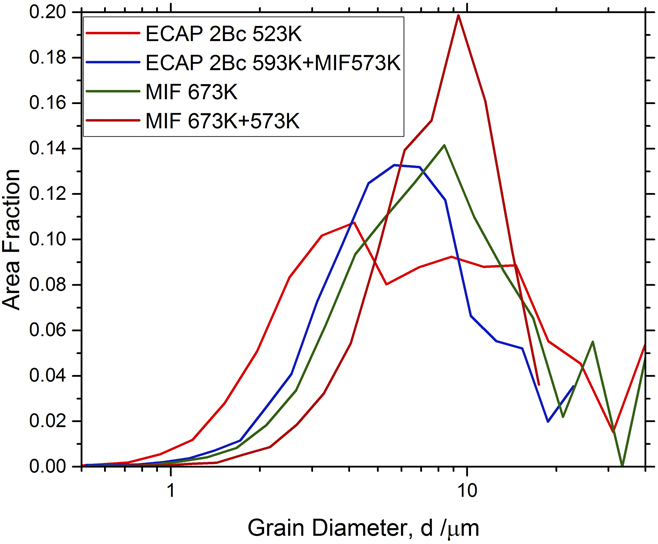
The grain structure of some differently SPD manufactured ZK60 alloys is shown in Fig. 1 representing typical EBSD orientation maps obtained on longitudinal sections of the specimens in inverse pole figure colors. The differences in the microstructure, which are evidently seen in this figure, arise from different processing methods used. It is well understood that the most important parameters in the Mg extrusion process influencing grain refinement are working temperature and equivalent strain imparted onto a workpiece. Reference Kainer70 The influence of both these factors on mechanical properties has been systematically investigated in Refs. Reference Shahzad and Wagner71–Reference Liu, Dong, Zhang, Yao, Zhai and Ding74. It is reasonably found that regardless of the processing scheme used, the ultimate strength and yield strength increase with decreasing processing temperature. Reference Yurchenko, Stepanov, Salishchev, Rokhlin and Dobatkin66,Reference Miura, Yu and Yang75 Table I shows that in conformity with the existing trends of SPD processing, Reference Estrin and Vinogradov65 the grain size decreased with increasing strain imparted onto a workpiece during either extrusion, ECAP, MIF, or a combination of these techniques. However, unlike cold SPD, which is commonly used in the processing of many fcc and bcc metals and alloys, deformation processing of magnesium requires hot or warm conditions, where continuous dynamic recrystallization (cDRX) governs the microstructure evolution and grain refinement. Reference Miura, Yang and Sakai68,Reference Wang, Wang, Chang, Wu and Zheng76 The EBSD analysis of correlated misorientations shows reasonably that recrystallized grains are delineated by high angle grain boundaries (HAGBs). For the typical microstructures represented in Fig. 1, the alloy ECAPed for 2 Bc passes at 523 K has of 64 ± 6% of HAGBs (a). After ECAP performed at 593 K and subsequent MIF at 573 K, the fraction of HAGB was of 72 ± 4%, Fig. 1(b). After 6 MIF operations performed at 673 K, the fraction of HAGB was of 75 ± 4%, Fig. 1(c), while 6 MIF operations at 673 followed by additional 6 operations at 573 K gave rise to the fraction of HAGBs over 80%, Fig. 1(d). The details of microstructure evolution and grain refinement associated with cDRX during thermomechanical treatment of Mg alloys can be found in numerous publications, e.g., Refs. Reference Miura, Yu and Yang75 and Reference Homma, Kunito and Kamado77–Reference Al-Samman and Gottstein79. Figure 2 shows the grain size distributions for differently manufactured alloys. The histograms, obtained from EBSD maps of 150 × 300 μm, are plotted in terms of the frequency of observations or the number fraction. Typically for recrystallized microstructures, the observed distributions obey the log-normal law originating naturally from the nucleation and growth mechanism. Reference Shimizu80,Reference Bergmann and Bill81 The nonlinear curve fit by the log-normal function is shown in Fig. 2 for comparison with the experimentally obtained distributions. Depending on deformation temperature and ram speed, the DRX process can be incomplete at modest equivalent strains or temperatures giving rise to the heterogeneous grain structure distribution consisting of relatively large grains intermixed with arrays of much finer grains, Figs. 1(a) and 1(b). A few coarse grains, which are clearly visible, Figs. 1(a) and 1(b), do not affect the shape of the frequency histograms in Fig. 2. The bimodality of grain size distribution and significance of coarse grains in the microstructure can be better seen in terms of the area fraction of grain distributions shown in Fig. 3. The wide distribution with a relatively large variance is noticed for the ECAPed materials. This kind of bimodal structure with coarse grains embedded into a fine-grain matrix, which is naturally observed during hot/warm deformation of many Mg alloys (particularly those with the initial coarse grain structure in the as-cast homogenized or hot pressed and annealed conditions), Reference Figueiredo and Langdon82 has been often a goal of SPD processing when the enhanced ductility is of concern. Mughrabi and co-authors have emphasized the importance of bimodal grain size distribution for improvement of LCF properties of UFG metals due to extra ductility associated with easily deformable coarse grains. Reference Mughrabi and Höppel83,Reference Höppel, Korn, Lapovok and Mughrabi84 Furthermore, excellent superplastic elongations were achieved in the cast AZ31 and ZK60 alloys processed by ECAP with a back-pressure under conditions producing a bimodal grain structure. Reference Lapovok, Estrin, Popov and Langdon85,Reference Lapovok, Cottam, Thomson and Estrin86 However, the idea of structural bimodality may even be counterproductive for high cycle fatigue properties, which are known to benefit strongly from a uniform grain size distribution. Reference Estrin and Vinogradov44
EBSD inverse pole figure maps showing the grain structure of differently processed ZK60 alloys: (a) ECAP, 2Bc passes at 523 K, (b) ECAP, 2Bc passes at 593 K + MIF at 573 K, (c) MIF, 6 operations at 673 K and (d) MIF, 6 operations at 673 + 6 operations at 573 K (the color key shown in the inset of (a) is valid for all of the shown EBSD-maps).

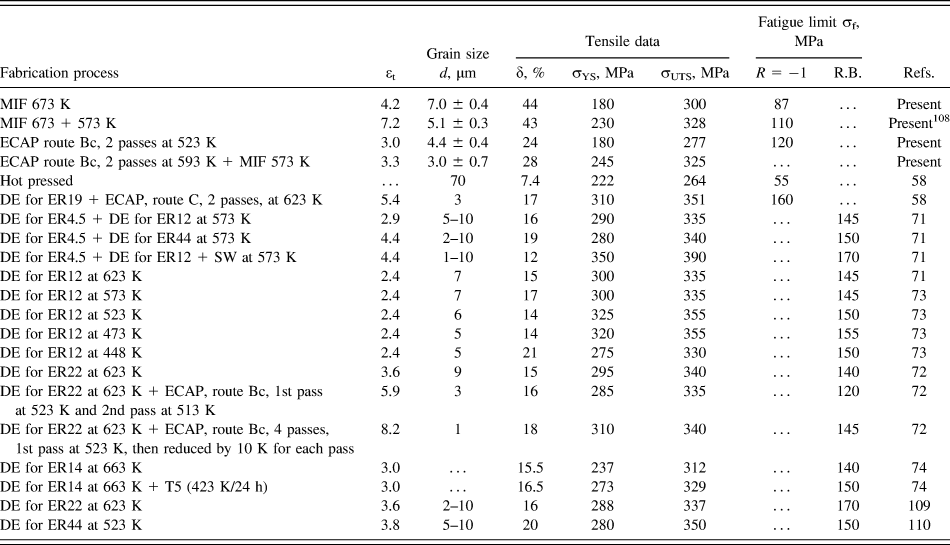
Mechanical properties of magnesium alloy ZK60 subjected to different thermo-mechanical processing schedules.

DE—direct extrusion, SW—swaging; ER stands for extrusion ratio, R = −1 for symmetric push–pull and R.B. for rotating beam tests; εt—the total equivalent strain, d—grain size; δ—the elongation to failure, σYS—the yield strength, σUTS—the ultimate tensile strength, and σf—the conventional fatigue limit at N = 1 × 10⁷ cycles; missing data are marked by ‘…’.
Grain size distributions for differently manufactured ZK60 alloys: (a) 2 Bc ECA-passes at 523 K; (b) 2 Bc ECA-passes at 593 K + MIF at 573 K; (c) MIF at 6673 K; (d) MIF at 673 K + MIF at 573 K. Solid lines represent the results of curve fitting by a log-normal distribution.

Grain size distribution evaluated by the area fraction method for differently manufactured ZK60 alloys.

The area fraction of these larger grains is gradually reduced and the bimodal distribution is transformed into an array of fine recrystallized grains with increasing strain. Finally, a uniform distribution of fine grains having micrometre dimensions is achieved, e.g., Figs. 1(c) and 1(d), after MIF at 673 K and 673 K + 573 K deformation steps, respectively. Then, the grain size stabilizes and does not decrease with further deformation. These results are consistent with the discussion in Ref. Reference Figueiredo and Langdon82 and experimental observations showing that nonbasal slip is activated more easily in the grain interiors of a magnesium alloy when the grain size is decreased. Reference Jain, Duygulu, Brown, Tomé and Agnew87,Reference Razavi, Foley, Karaman, Hartwig, Duygulu, Kecskes, Mathaudhu and Hammond88 This stage was not reached in the present investigation in ECAPed alloys, Figs. 1(a) and 1(b), exhibiting a bimodal distribution after 2 passes ECAP, Fig. 1(a), and subsequent MIF, Fig. 1(b). One can see that considerably different microstructures have been produced by SPD and the effect of the microstructure on the resultant properties can be traced.
The texture evolution during ECAP, Reference Agnew, Mehrotra, Lillo, Stoica and Liaw61,Reference Ding, Chang and Kao89,Reference Agnew, Stoica, Chen, Lillo, Macheret and Liaw90 extrusion, Reference Ma, Liu, Wu, Ding and Zhu91,Reference Pekguleryuz, Bettles and Barnett92 or MIF Reference Nugmanov, Sitdikov and Markushev67,Reference Nugmanov, Sitdikov and Markushev93–Reference Nugmanov, Sitdikov and Markushev95 processing of Mg alloys has been described in great detail in the abundant relevant literature. It has been systematically observed by many authors that the final ECA pass exerts a profound effect on texture. This is particularly true for Mg alloys where a single fiber texture develops with the maximum pole intensity located at nearly 45° from extrusion direction (ED) toward transverse direction (TD), i.e., where the basal planes—the dominant slip planes in magnesium—are aligned with the shear plane of the ECAP die Agnew. Reference Agnew, Horton, Lillo and Brown62,Reference He, Pan, Qin, Liu and Li96 Compared to ECAP, MIF offers more “degrees of freedom” in texture control. During hot MIF, the texture evolves in such a way that the initial strong fiber texture gradually reorients with accumulated strain: the basal plane rotates from about 0° in the initial state to about 90° to the compression axis at high strains. Reference Yang, Sun, Xing, Miura and Sakai97 The details of texture development during MIF processing of the present alloy ZK60 are given in Ref. Reference Nugmanov, Sitdikov and Markushev93. Crystal rotation during deformation reduces the relative intensity of the fiber texture: the maximum intensity of the texture decreased by a factor of 2 or more from about 12 in the initial state to about 5.3 after the second step MIF at 573 K. The nonuniform distribution of Mg–Zn excess phases and precipitates retained in the present alloy, even after hot MIF. Reference Nugmanov, Sitdikov and Markushev94
B. Tensile properties
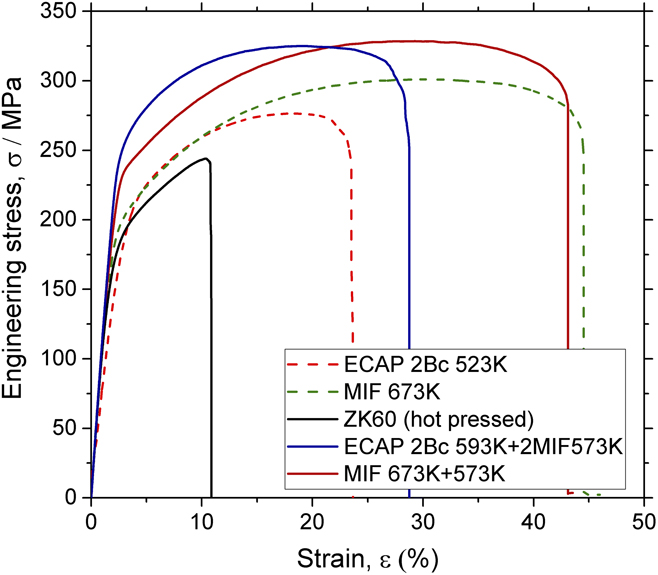
Figure 4 shows a set of stress–strain curves corresponding to differently manufactured alloy ZK60 specimens. Comparing the results with literature data presented in Table I, one can see that while ECAP gives rise to only a modest improvement in both strength and ductility comparable to previously reported data, multistep MIF improves the tensile ductility substantially up to 40% of the total elongation—the level which has not been achieved by other methods so far for this class alloys to the best of author’s knowledge. The present results corroborate the opinion that the bimodality recipe cannot generally be regarded as a panacea for low ductility malaise of SPD-processed materials in general and of Mg alloys in particular. Indeed the best ductility has been achieved in the material with most uniform microstructure. We, however, should notice that the effect of re-distribution of secondary phases on ductility was not considered here. The yield stress, σy, and the ultimate tensile strength, σUTS, increased concurrently to the values, which are typical of this alloy after SPD. In combination with outstanding ductility, this yields a novel remarkable balance of its mechanical properties. Furthermore, based on enhanced tensile properties, one can anticipate better fatigue performance in both low-cycle fatigue (LCF) and high-cycle fatigue (HCF) regimes.
Tensile stress–strain curves for the reference coarse-grain and fine-grain ZK60 alloy obtained by different SPD-processing schedules.

C. Fatigue behavior
As has been emphasized by Mughrabi, Reference Mughrabi, Lowe and Valiev1 a traditional fatigue improvement strategy is based on the following couple of empiric correlations: (i) the higher the strength under monotonic loading, the higher is the endurance (fatigue) limit in HCF and (ii) the higher the monotonic ductility, the longer is the fatigue life in LCF Reference Suresh98 (see also reviews Reference Estrin and Vinogradov44,Reference Höppel, Mughrabi and Vinogradov99 specific for ultra-fine grained metals). Following this strategy, SPD through a combined extrusion and ECAP processing gave rise to a remarkable improvement in the fatigue limit in the HCF regime in the ZK60 alloy, Reference Vinogradov, Orlov and Estrin58 Table I. Wu et al. Reference Wu, Stoica, Liao, Agnew, Payzant, Wang, Fielden, Chen and Liaw51 have described for the AZ31B alloy that the LCF life resulting from combining effects of grain refinement and texture can be enhanced through ECAP. However, no discussion on LCF properties has been extended in Ref. Reference Vinogradov, Orlov and Estrin58 whereas no data on the HCF properties have been reported in Ref. Reference Wu, Stoica, Liao, Agnew, Payzant, Wang, Fielden, Chen and Liaw51. The enhancement of both strength and ductility of MIF-treated Mg alloys, Fig. 4 and Table I, is a factor that is considered promising to promote the improvement of their fatigue properties in both LCF and HCF regimes.
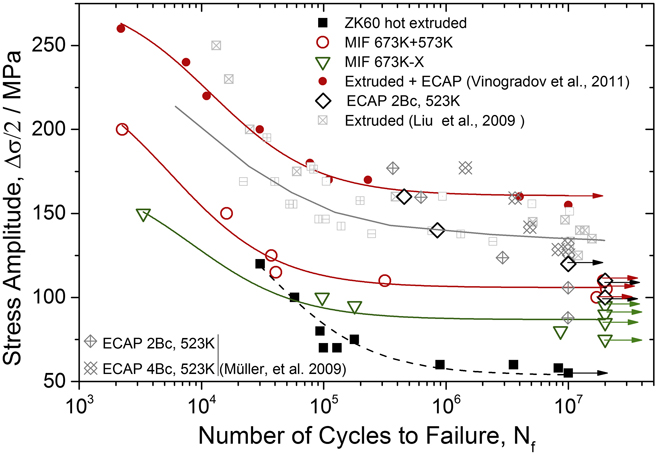
Results of HCF fatigue tests are summarised in a Wöhler plot in Fig. 5. The plot clearly shows that rather poor fatigue performance of Mg ZK60 in the initial hot extruded state tremendously improves after SPD either by extrusion to high extrusion ratios (ER), MIF, ECAP, or by a complex processing method including a combination of the above schemes. The highest endurance limit of 160 MPa achieved in axisymmetric push–pull fatigue testing after integrated extrusion and ECAP is about three times larger than that of its initial hot pressed coarse grain counterpart. Reference Vinogradov, Orlov and Estrin58
S–N fatigue curves for the reference coarse grain and fine-grain ZK60 alloy obtained by different SPD-processing schedules. Gray symbols correspond to literature data obtained in rotating-bending testing, see Table I.

The alloy ZK60 exhibits a well-defined fatigue limit, which is typical to many other hcp metals such as Ti and its alloys as well as some cast and wrought Mg-alloys including those after ECAP. Reference Kulyasova, Islamgaliev, Zhao and Valiev100 This is however not always the case in Mg alloys. For example, Kunz and Fintová Reference Kunz and Fintová101 did not observe an evident knee on the S–N curve of the ECAPed UFG AZ91 alloy which showed a continuous decay of the S–N curve up to 107 axial push–pull cycles.
In Table I, the present results on tensile and fatigue properties of the alloy ZK60 are compared to those available in the literature for alloys of the same nominal chemical composition but after different types of thermo-mechanical processings. Note that the fatigue tests in most formerly reported investigations were conducted in the ‘rotating beam’ mode. Reference Shahzad and Wagner71,Reference Müller, Janeček, Yi, Čížek and Wagner72,Reference Liu, Dong, Zhang, Yao, Zhai and Ding74 It should be pointed out that although the ‘rotating beam’ test mode is practical for rapid engineering estimates, there are several issues associated with this type of loading (see discussion in Ref. Reference Vinogradov, Orlov and Estrin58). The main known deficiencies of the method include (i) the gradient of the stress/strain across the specimen cross-section and (ii) the inapplicability of the method in cases where plastic deformation is appreciable, which is likely the case for most of Mg alloys having very low CRSS values for dislocation slip and twinning in favourably oriented grains. Indeed, during the uniaxial symmetric push–pull test, the stress state in the sample cross-section is uniform. By contrast, during the ‘rotating beam’ test (also called ‘rotating bending’) the stress state varies from tension to compression across the sample’s cross-section. Reference Manson and Halford102,Reference Duggan and Byrne103 This gradient is extremely important in Mg alloys exhibiting the well-known asymmetry of their mechanical response with respect to tension and compression. Thus, in ‘rotating bending’ tests, the bending moment is calculated using elasticity approximations. However, when the magnitude of the bending stress is high enough to cause plastic flow even locally in some grains, the elastic bending equation yields considerably overestimated stress amplitudes, and hence the fatigue life appears to be longer. Reference Manson and Halford102–Reference Esin104 In contrast, the stress amplitude can be precisely measured and controlled during the uniaxial push–pull test hence giving the accurate figure of fatigue life. Furthermore, probability considerations are also usually taken into account in the fatigue design when axial and flexural loading modes are compared. The fatigue failure is correlated with the ‘weakest link’ (e.g., the largest defect such a coarse secondary phase particle), and one can assume that the ‘weak links’ are uniformly distributed in the tested volume. In the rotating-bending mode, only the outer surface adjacent layer of the specimen is exposed to the maximum stress. The probability to find the largest defect in these areas is therefore lower than in axial loading where the whole volume is under maximum stress. One more drawback of the rotating-bending tests is the strong specimen size effect, which is not that significant for the case of axial load control. Reference Manson and Halford102,Reference Duggan and Byrne103 In the present work, the subsize specimens of 2 × 2 mm cross-section were tested along with several round shaped specimens of 5 mm diameter for comparison. No size effect was noticed for fatigue life under stress controlled testing conditions. The above-discussed issues make it difficult to quantitatively compare the experimental results across studies using different loading modes. However, the consensus exists that the fatigue resistance estimated from the rotating-bending tests is considerably greater than that from the uniaxial push–pull tests at the same nominal stress amplitude level. Several practical approaches to correlate fatigue lives and endurance limits evaluated by different test modes were proposed in Refs. Reference Manson and Halford102–Reference Esin104. However, the correction factors ranging between 0.89 and 0.71 were more or less substantiated experimentally for steel only, due to a reasonably large experimental database available, and are not directly applicable to the Mg alloy of interest. Thus, although care has to be exercised to compare the results of axial and rotating-bending tests quantitatively, the common trends are seen: it is obvious that SPD processing results in a superior HCF performance of the investigated alloy. The endurance limit of MIF-processed alloys (including the combination of ECAP and MIF) is between 90 and 120 MPa which is still smaller than 160 MPa obtained in the alloy fabricated by direct extrusion integrated with ECAP Reference Vinogradov, Orlov and Estrin58 but it is quite comparable with other data available (bearing in mind all reservations given above regarding the ‘rotating-bending’ tests).
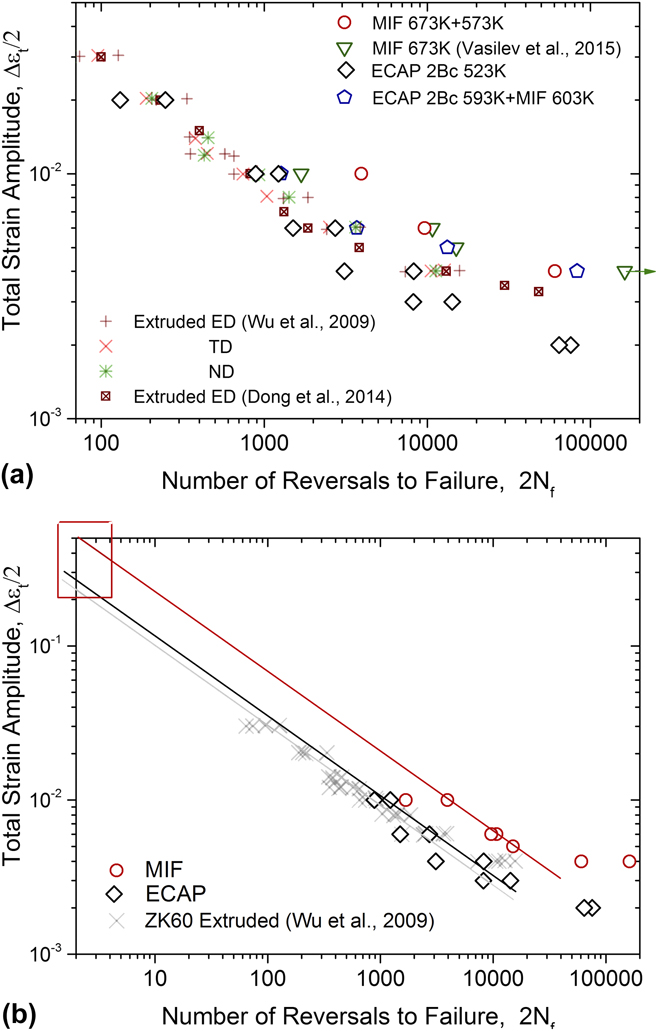
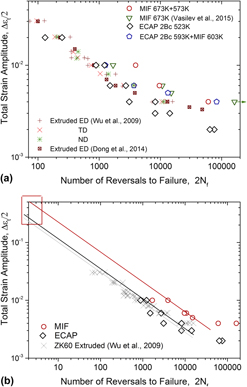
The LCF diagram is represented in Fig. 6 for the alloy ZK60 as the number of reversals to failure 2N f versus the applied total strain amplitude Δεt/2 in log–log coordinates. Present results are again compared with those available in the literature for nominally the same alloy. One can notice a remarkable improvement in fatigue life in the LCF regime after SPD. The observed positive effect of SPD is not as large as that observed in the alloy AZ91. Reference Kunz and Fintová101 However, it appears to be in line with general expectations Reference Mughrabi, Lowe and Valiev1 arising from the results of tensile tests which showed dramatic enhancement of ductility after SPD processing.
LCF fatigue diagrams; (a) the number of reversals to failure as a function of the applied total strain amplitude; literature data for the extruded alloy are shown for comparison; (b) the same diagram in extended coordinates; data are grouped with respect to the processing method used. The knee visible at smallest strain amplitude corresponds to the transition to high cycle regime.

All in all, it can be concluded that alloy ZK60 processed by hot-to-warm SPD via MIF possesses an excellent combination of high tensile strength, outstanding ductility, and enhanced fatigue properties in both low- and high-cyclic regimes.
IV. DISCUSSION
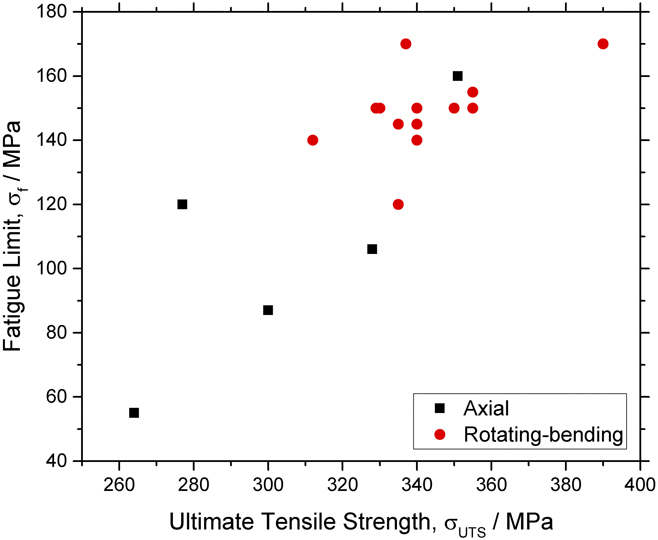
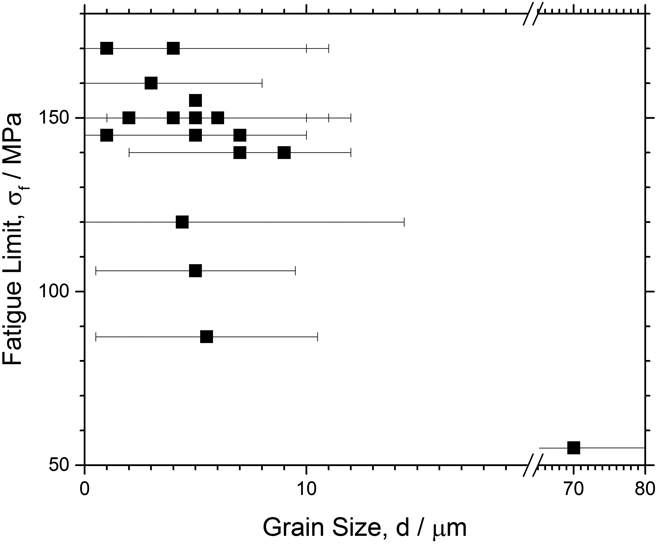
A time-proven strain-life approach dominates the phenomenological fatigue design philosophy to the present day which has been outlined by Mughrabi and his co-authors in application to ultra-fine grain materials. Reference Mughrabi, Lowe and Valiev1,Reference Höppel, Zhou, Mughrabi and Valiev3,Reference Höppel, Kautz, Xu, Murashkin, Langdon, Valiev and Mughrabi6,Reference Höppel, Mughrabi and Vinogradov99 According to this methodology, in the LCF regime, the plastic strain component is dominant in the hysteresis loop. Therefore, the fatigue life is determined by ductility at short lives. As opposed to this, at long fatigue lives, the elastic strain amplitude is more significant than the plastic component, and the fatigue life is dictated by the fracture strength so that the fatigue limit increases with strength. Hence, the HCF strength and the LCF endurance of SPD processed ZK60 alloy appear to correlate with tensile strength and tensile ductility as it is assumed by the Basquin and Coffin–Manson relations, respectively. Figure 6(b) shows that good correlation between the tensile elongation at break and fatigue ductility does exist in the case studied: the intercept of the linear fit of experimental data for three groups of differently processed specimens with the total strain amplitude axis corresponds reasonably to the tensile ductility though it is undoubtedly not identical to it. However, the linear relation between the tensile strength and the fatigue limit, which is regularly reported for structural alloys including lightweight ones, Reference Estrin and Vinogradov44 is not evident, Fig. 7. In fact, only a general trend toward increasing fatigue strength with increasing monotonic strength can be noticed. Furthermore, it is noteworthy that no correlation can be found between the conventional fatigue limit and grain size as illustrated undoubtedly in Fig. 8. This is not uncommon in conventional coarse grain fcc metals and alloys with relatively high stacking fault energy and wavy slip behavior where the endurance limit is not affected by the grain size. Reference Lukas and Kunz105 However, in the regime of very small grain sizes, the situation is different, and the grain size dependence of fatigue limit is often observed. Reference Vinogradov106 In this regard, insightful results were obtained by Klemm. Reference Klemm107 Using ultrafine grain nickel as an example, he concluded that the grain-size dependence of cyclic behavior is not observed for grain sizes in excess of approximately 4 μm, and a Hall–Petch type dependence of cyclic stresses on grain size is seen at smaller grain sizes. It was unequivocally demonstrated that grain size effects are observed only when the dislocations travel over mean glide paths that are comparable to the grain size. This result suggests that when dislocations travel only over small distances compared to the grain size, they do not “feel” the grain boundaries, and hence the grain size has little or no effect on the cyclic response. However, when the grain sizes are small enough, the grain boundaries represent the main obstacle for dislocation motion and the grain-size dependent response can be anticipated in the cyclic behavior, see Ref. Reference Mughrabi and Höppel83. In other words, the grain size dependence is reasonably not expected when grain boundaries are not the main obstacles for dislocation motion, which is very likely the case in the complex Mg alloys where moving dislocations can interact with mechanical twins and secondary phases and precipitates. Thus, it can be concluded that the grain size alone cannot account for the remarkable changes in the properties profile of Mg alloys after SPD. This conclusion holds at least as long as the grain size is of the order of 2–5 μm or greater, which is typically attained in warm SPD processing involving DRX in Mg alloys, as has been discussed in the Introduction. Experimental data on fatigue of sub-microcrystalline Mg alloys are still scarce and looking for conclusions to be drawn with regard to the effect of extreme grain refinement on mechanical properties, in general, and fatigue, in particular. The effects of texture, size and distribution of primary and secondary phases plays an important, if not a key role, and where the cumulative effect of solution strengthening and precipitation strengthening may supersede the effect on the grain size or texture in the overall mechanical response.
Correlation between the ultimate tensile strength and conventional fatigue limit corresponding to 107 number of cycles for two groups of data obtained in either axial or rotating-bending loading. Only a trend can be noticed.

Scatter-plot representing the conventional fatigue limit in ‘dependence’ on grain size of the SPD processed ZK60 alloy. Large scatter of grain size data is explained by either insufficient information on the grain size distribution or the limited quality of micrographs available for the analysis by “naked eyes” in the literature cited in Table I.

V. SUMMARY AND CONCLUSIONS
In summary, taking a typical multiphase Mg ZK60 alloy as a representative of a class of wrought alloys, the effect of microstructure refinement on monotonic tensile and cyclic fatigue properties has been overviewed. It has been shown that the SPD technique offers a variety of processing schemes to tailor the microstructure and mechanical performance of these alloys in a wide range.
Specifically, the tensile and fatigue performance of magnesium alloy ZK60 fine-grained during ECAP, multiaxial isothermal forging or a combination of these two has been evaluated. The advantage of the MIF process for Mg alloys requiring hot-to-warm deformation conditions is its high upscaling capacity on one hand and its flexibility in texture control on the other. The alloy ZK60 fine-grained by MIF or by MIF combined with ECAP demonstrated remarkably improved both the HCF endurance limit and LCF life in axisymmetric push–pull fatigue testing if compared not only with its coarse-grain counterpart, but also with the commercially extruded alloys. The observed enhancement of fatigue properties is related to the significant increase of ductility and ultimate tensile strength as a result of microstructure modification by hot severe plastic deformation. However, the full potential of achieving favourable combinations of grain refinement, texture, and distribution of primary and secondary phases has certainly not been explored to the full extent. A better understanding of the specific mechanisms underlying the response of complex Mg alloys to cyclic loading may lead to microstructures and textures optimised with respect to the fatigue performance and to the overall improvement of mechanical properties.
The important topics, which are left unattended or insufficiently covered in the present study and literature survey, include the detailed effect of texture on LCF and HCF performance, cyclic stress–strain behavior, Bauschinger effect, and asymmetry of the cyclic hysteresis and its effect on fatigue life, fatigue crack growth, and the effect of environment on fatigue crack initiation and propagation. Although some experimental efforts have already been made, the scarcity of data in the literature is obvious and it calls for further research.
ACKNOWLEDGMENTS
This manuscript could not have been completed without cooperation from my colleagues—professors Y. Estrin (Monash University, Australia), D. Orlov (Lund University, Sweden), and H. Miyamoto (Doshisha University, Japan). Special thanks go to Prof. M. Markushev and his team (Ufa Institute for Metals Superplasticity Problems, Russia) who performed SPD-processing of the materials for this study as well as to my colleagues from Togliatti State University (Russia)—Prof. D.L. Merson, M. Linderov, and E. Vasilev who carried out a large part of experimental work included in this overview. Financial support from the Russian Science Foundation through the grant-in-aid No. 15-19-30025 is gratefully appreciated.