1. Introduction
The anchovy family Engraulidae is a well-defined assemblage within the clupeoid fishes that includes 17 extant genera and about 150 species (e.g. Grande & Nelson, Reference Grande and Nelson1985; Peng & Zhao, Reference Peng and Zhao1988; Whitehead, Nelson & Wongratana, Reference Whitehead, Nelson and Wongratana1988; Lavoué, Miya & Nishida, Reference Lavoué, Miya and Nishida2010). Most anchovies are extremely abundant marine planktivorous carnivores that form very large schools along the coasts of tropical to warm temperate regions around the world (e.g. Whitehead, Nelson & Wongratana, Reference Whitehead, Nelson and Wongratana1988). These fishes are usually small- to moderate-sized (10–20 cm), although some species reach up to 40 cm (e.g. Roberts, Reference Roberts1978; Allen, Midgley & Allen, Reference Allen, Midgley and Allen2002). Because of their abundance, anchovies play a central role in the ecology of tropical and subtropical near-shore environments. Several anchovy species occur exclusively in the freshwaters of Asia and South America. Bloom & Lovejoy (Reference Bloom and Lovejoy2012) demonstrated that the numerous South American freshwater anchovies, including the miniature Amazonsprattus scintilla, form a natural assemblage and are the product of a single transition from marine to fresh water that led to a broad diversification of trophic habits and size ranges. Anchovies are of immense economic and commercial importance; according to the FAO Fisheries Department (e.g. 2013), some anchovy species are among the most harvested fishes of the world; the Eastern Pacific anchoveta Engraulis ringens is by far the most harvested.
The phylogenetic position of anchovies within the Clupeoidei has been extensively debated using both morphological (e.g. Nelson, Reference Nelson1970; Grande, Reference Grande1985; Di Dario, Reference Di Dario2002, Reference Di Dario2009; Miyashita, Reference Miyashita2010) and molecular (Lavoué et al. Reference Lavoué, Miya, Saitoh, Ishiguro and Nishida2007, Reference Lavoué, Miya, Musikasinthorn, Chen and Nishida2013; Li & Orti, Reference Li and Orti2007; Wilson, Teugels & Meyer, Reference Wilson, Teugels and Meyer2008; Bloom & Lovejoy, Reference Bloom and Lovejoy2014) evidence. Molecular studies concur in suggesting that engraulids represent the sister taxon of the remaining clupeoid lineages (e.g. Lavoué et al. Reference Lavoué, Miya, Saitoh, Ishiguro and Nishida2007; Wilson, Teugels & Meyer, Reference Wilson, Teugels and Meyer2008; Bloom & Lovejoy, Reference Bloom and Lovejoy2014).
The monophyletic status of the Engraulidae is well supported by several anatomical features. As pointed out by Nelson (Reference Nelson1984), a combination of characters of the head produces a gestalt that makes anchovies recognizable at a glance within the clupeoids. Some of these features are directly related to the oblique (posterior) inclination of the suspensorium (see Di Dario, Reference Di Dario2009), a feature traditionally considered as synapomorphic for anchovies (e.g. Whitehead, Reference Whitehead1963, Reference Whitehead1972; Grande, Reference Grande1985; Grande & Nelson, Reference Grande and Nelson1985), and to the consequent posterior extension of the gape of the mouth beyond the eye. Another character defining the engraulid body plan is the anterior projection of the mesethmoid in advance of the vomer to support a paired rostral organ (Nelson, Reference Nelson1984). More recently, Stephens (Reference Stephens2010) evidenced the role of the expanded orbital reticulum of the cephalic lateralis system, formed by orbital, infraorbital and preoperculomandibular canal branches anostomosed over a dorsal portion of the eye, as a potential further synapomorphy of the Engraulidae.
The genera of the Engraulidae have been arranged into two subfamilies, Coiliinae and Engraulinae, based on morphological grounds (e.g. Grande & Nelson, Reference Grande and Nelson1985). Such a division has an evident biogeographic meaning because the Coiliinae is an entirely Old World group occurring in the Indo-Pacific, whereas the Engraulinae comprises the cosmopolitan Engraulis and eight New World genera plus the Indo-Pacific genera Stolephorus and Encrasicholina. The latter genera occupy a basal position within the subfamily, with Stolephorus diverging first followed by Encrasicholina (e.g. Jordan & Seale, Reference Jordan and Seale1926; Nelson, Reference Nelson1970, Reference Nelson1983; Grande & Nelson, Reference Grande and Nelson1985). The limits and composition of these subfamilies have been confirmed by recent molecular studies (e.g. Lavoué, Miya & Nishida, Reference Lavoué, Miya and Nishida2010; Bloom & Lovejoy, Reference Bloom and Lovejoy2012). However, even if the engrauline intrarelationships are now properly understood (e.g. Bloom & Lovejoy, Reference Bloom and Lovejoy2012), the relationships between coiliine genera and species are partially unknown because of insufficient taxon sampling.
The fossil record of anchovies is extremely meagre (Whitehead, Reference Whitehead1963; Grande & Nelson, Reference Grande and Nelson1985) and their scarcity as fossils is very anomalous, particularly considering their present abundance. Fossil anchovies are exclusively known from Neogene deposits, thereby resulting in a broad gap in their record. Phylogenetic considerations clearly suggest that anchovies should have been present at least since Cretaceous time, when other crown clupeoids were certainly in existence (e.g. Taverne, Reference Taverne2007; Figuerido, Reference Figuerido2009). The goal of this paper is to describe the earliest fossil of the family Engraulidae. The fossil was collected from the Lower Eocene laminated micritic limestone of the Pesciara Cave site of the Monte Bolca locality, NE Italy, and was found during the re-examination of the clupeoid fishes of Monte Bolca (Marramà & Carnevale, Reference Marramà and Carnevale2015, in press). The affinities of this Eocene engraulid are also discussed, as well as its palaeobiogeographic significance.
2. Locality
The specimen was collected from the Pesciara Cave site of the Monte Bolca locality in the eastern part of the Monti Lessini, a few kilometres from the village of Bolca in the Verona province, NE Italy. This locality has been celebrated for its exquisitely preserved fossils, particularly fishes, for several centuries. The fish fauna of Monte Bolca is one of the most important ichthyofaunistic fossil assemblages, and its Pesciara Cave is one of the most extensively exploited sites. A recent census of the fish diversity of Monte Bolca estimates that slightly less than 240 taxa have been described and many others remain to be described (see Bannikov, Reference Bannikov2014; Carnevale et al. Reference Carnevale, Bannikov, Marramà, Tyler, Zorzin, Papazzoni, Giusberti, Carnevale, Roghi, Bassi and Zorzin2014). Overall, palaeontological and sedimentological data concur in suggesting that the deposits of Monte Bolca originated in a tropical coastal region with heterogeneous physiography characterized by fluvial systems, coastal lagoons and seagrass beds surrounding reef zones and influenced by the open sea (see Carnevale et al. Reference Carnevale, Bannikov, Marramà, Tyler, Zorzin, Papazzoni, Giusberti, Carnevale, Roghi, Bassi and Zorzin2014). Landini & Sorbini (Reference Landini, Sorbini and Cherchi1996) included the fish taxa of Monte Bolca into three ecological groups: the sand/seagrass bed assemblage; the true coral assemblage; and the perireefal and pelagic assemblage. Clupeoid fishes were considered as members of the perireefal and pelagic assemblage.
The geology of the Pesciara Cave has been investigated by several authors (e.g. Fabiani, Reference Fabiani1914; Sorbini, Reference Sorbini1968; Barbieri & Medizza, Reference Barbieri and Medizza1969; Dal Degan & Barbieri, Reference Dal Degan and Barbieri2005; Papazzoni & Trevisani, Reference Papazzoni and Trevisani2006) that primarily referred the fish-bearing limestone to the ‘Calcari Nummulitici’, an informal Eocene unit that is widely distributed in NE Italy. The sedimentary succession of the Pesciara Cave site consists of a rhythmic alternation of biocalcarenite–biocalcirudite with abundant benthic fossils and laminated partly fish-bearing micritic limestone (e.g. Papazzoni et al. Reference Papazzoni, Carnevale, Fornaciari, Giusberti, Trevisani, Papazzoni, Giusberti, Carnevale, Roghi, Bassi and Zorzin2014). The taphonomic and sedimentological features of the fossiliferous strata and the ecological spectrum of the fossil assemblage are indicative of a stagnation deposit with a poorly oxygenated bottom (see Seilacher, Reif & Westphal, Reference Seilacher, Reif and Westphal1985).
The dating of the fish-bearing strata has been determined based on large benthic foraminifers and calcareous nannoplankton that suggest a late Cuisian (late Ypresian, slightly less than 50 Ma; Papazzoni et al. Reference Papazzoni, Carnevale, Fornaciari, Giusberti, Trevisani, Papazzoni, Giusberti, Carnevale, Roghi, Bassi and Zorzin2014) age.
3. Materials and methods
The specimen described here was found among undescribed material tentatively referred to the genus Clupea in the collection of fossil fishes from Monte Bolca of the Museo Civico di Storia Naturale di Verona (MCSNV). The fossil consists of a well-preserved complete articulated skeleton preserved on the surface of inframillimetrically laminated micritic limestone. The specimen was examined using a Leica M80 stereomicroscope equipped with a camera lucida drawing arm, and measurements were taken with a dial caliper to the nearest 0.1 mm. All counts and measurements follow Grande (Reference Grande1985) and Whitehead, Nelson & Wongratana (Reference Whitehead, Nelson and Wongratana1988); osteological terminology mostly follows Ridewood (Reference Ridewood1904) and Grande (Reference Grande1985). All extinct taxa are highlighted with a dagger (†) preceding their name.
4. Systematic palaeontology
Subdivision TELEOSTEI sensu Patterson & Rosen, Reference Patterson and Rosen1977 Superorder CLUPEOMORPHA Greenwood, Rosen, Weitzman & Myers, 1966 Order CLUPEIFORMES sensu Grande, 1985 Suborder CLUPEOIDEI sensu Grande, 1985 Family ENGRAULIDAE Gill, 1861 Genus †Eoengraulis gen. nov.
Type species. †Eoengraulis fasoloi gen. et sp. nov. from the Pesciara cave site, Monte Bolca locality, NE Italy; late early Eocene.
Diagnosis. A small-sized engraulid with elongate and laterally compressed body; head length contained about four times in standard length (SL); nine branchiostegal rays; 40 preural vertebrae; 17 pairs of pleural ribs; pleural ribs – preural vertebrae ratio 0.42; seven supraneurals; dorsal-fin origin at about mid-length of the body, slightly behind the pelvic-fin origin; dorsal fin with about 16 rays; anal-fin origin slightly behind the base of the last dorsal-fin ray; anal-fin with 19 rays; pelvic fin with seven rays; small needle-like pre-pelvic scutes.
Etymology. The name is derived from the Greek words Ēōs (meaning dawn or sunrise) and Eggraulis (meaning anchovy); hence, a primitive anchovy representing the earliest known member of the family.
†Eoengraulis fasoloi sp. nov. Figures 1–3
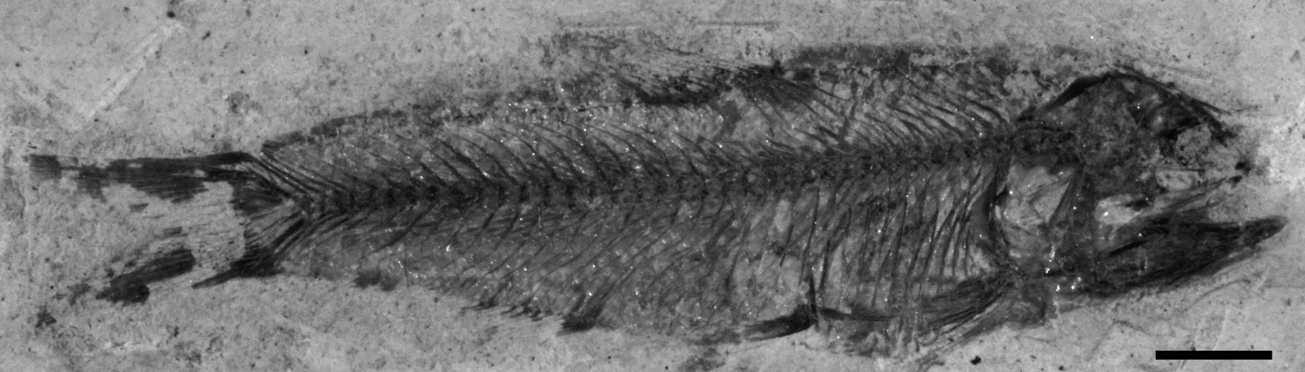
Holotype. MCSNV T.54, nearly complete well-preserved articulated skeleton, lacking part of the head and the caudal skeleton; 42.5 mm SL (Fig. 1).
†Eoengraulis fasoloi gen. et sp. nov. from the Eocene succession of Monte Bolca, Italy. Holotype, MCSNV T.54, right side, lateral view. Scale bar 5 mm.

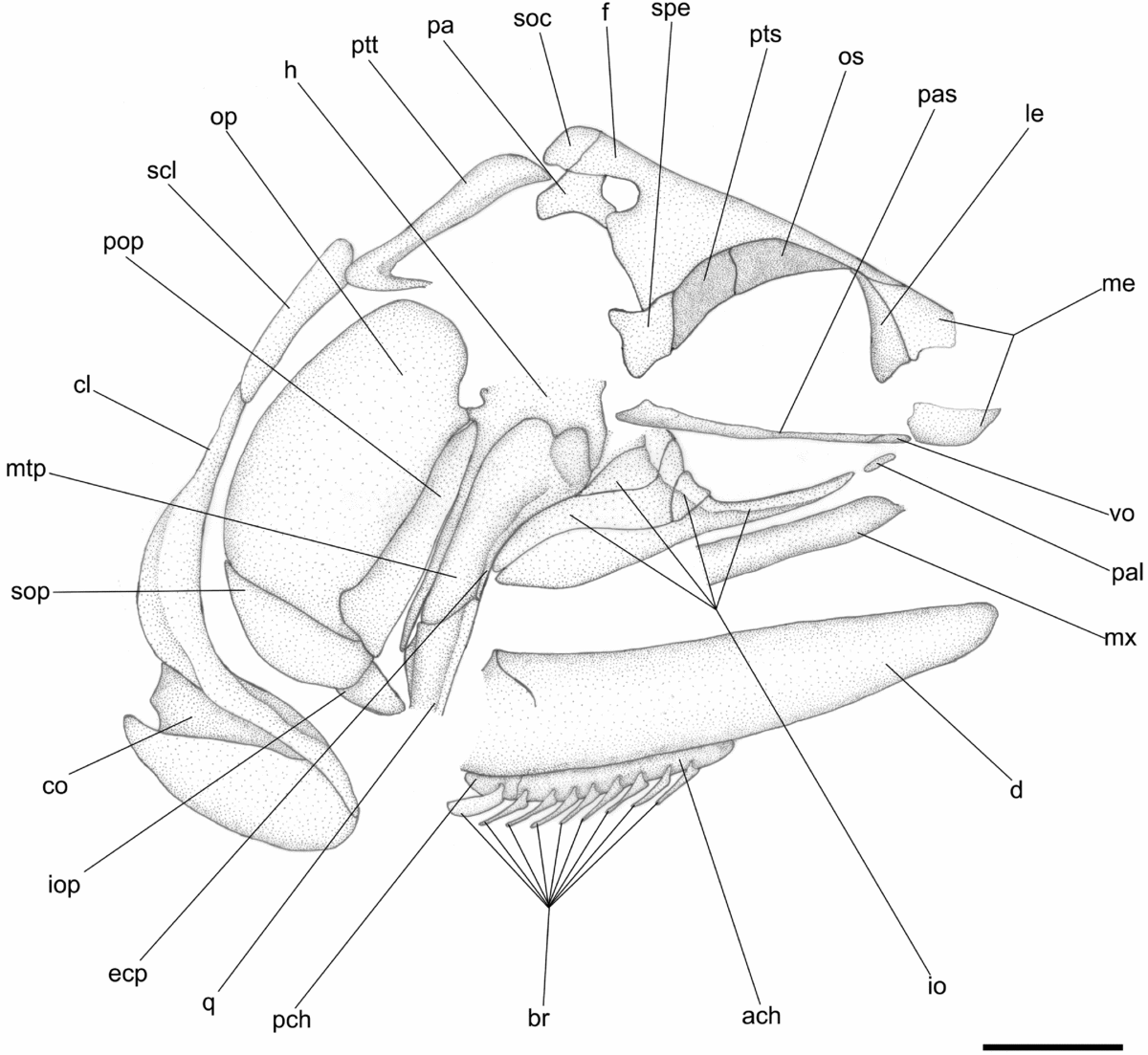
†Eoengraulis fasoloi gen. et sp. nov. Reconstruction of the head, right side, lateral view. Scale bar 1 mm. Abbreviations: ach – anterior ceratohyal; br – branchiostegal rays; cl – cleithrum; co – coracoid; d – dentary; ecp – ectopterygoid; f – frontal; h – hyomandibula; io – infraorbital bones; iop – interopercle; le – lateral ethmoid; me – mesethmoid; mtp – metapterygoid; mx – maxilla; op – opercle; os – orbitosphenoid; pa – parietal; pal – palatine; pas – parasphenoid; pch – posterior ceratohyal; pop – preopercle; pts – pterosphenoid; ptt – posttemporal; q – quadrate; scl – supracleithrum; soc – supraoccipital; sop – subopercle; spe – sphenotic; vo – vomer.

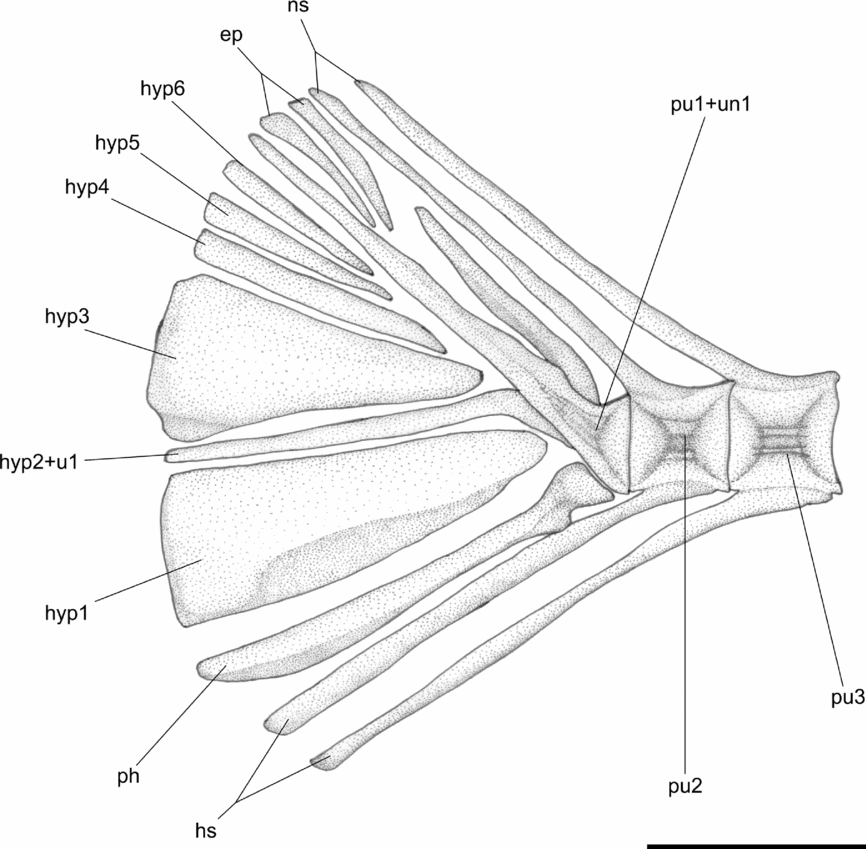
†Eoengraulis fasoloi gen. et sp. nov. Reconstruction of the caudal skeleton, right side, lateral view. Scale bar 1 mm. Abbreviations: ep – epural; hs – haemal spine; hyp – hypural; ns – neural spine; ph – parhypural; pu – preural centrum; u – ural centrum; un – uroneural.

Type locality and horizon. Pesciara Cave site, Monte Bolca locality, NE Italy; late early Eocene, late Ypresian, late Cuisian, c. 50 Ma (see Papazzoni et al. Reference Papazzoni, Carnevale, Fornaciari, Giusberti, Trevisani, Papazzoni, Giusberti, Carnevale, Roghi, Bassi and Zorzin2014).
Diagnosis. As for the genus.
Etymology. Named in honour of the Italian biologist Professor Aldo Fasolo in recognition of his outstanding contribution to vertebrate neuroanatomy.
Measurements (as percentage of SL). Head length = 26.8; head depth = 22.1; snout length = 4.2; orbit diameter = 5.2; maximum body depth = 29.2; caudal peduncle length = 13.4; caudal peduncle depth = 11.8; predorsal length = 47.1; preanal length = 65.9; prepectoral length = 28.2; prepelvic length = 43.3; dorsal-fin base length = 15.1; and anal-fin base length = 19.8.
Description. The body is elongate and laterally compressed; its greatest depth, slightly opposite to the dorsal-fin origin, is contained more than three times in SL (Fig. 1). The head is compressed and moderately elongate; its length is contained slightly less than four times in SL. The orbit is large; its diameter is contained about three times in head length. The snout is prominent and almost pointed (pig-like; e.g. Whitehead, Reference Whitehead1963, Reference Whitehead1972), projecting beyond the anterior tip of the lower jaw. The lower jaw is long, relatively slender and underslung; its articulation is located well behind to the vertical through the posterior border of the orbit. There is no evidence of jaw teeth; these were probably minute or completely absent in origin. The caudal peduncle is moderately developed and longer than deep. The caudal fin appears to be deeply forked. The dorsal-fin origin is located slightly behind the mid-point of the body. The anal-fin origin is located at about the level of two-thirds back the SL, behind the posterior end of the dorsal fin. The pelvic fin inserts slightly before the vertical through the base of the first dorsal-fin ray.
The head skeleton is only partially complete (Fig. 1); however, the overall morphology of the neurocranium, jaws, suspensorium, opercular bones and infraorbital series is consistent with that of other engraulid fishes (e.g. Ridewood, Reference Ridewood1904; Chapman, Reference Chapman1944; Moona, Reference Moona1960, Reference Moona1968; Yáñez-Arancibia & Ruiz, Reference Yáñez-Arancibia and Ruiz1978; Grande, Reference Grande1985; Grande & Nelson, Reference Grande and Nelson1985; Di Dario, Reference Di Dario2009). One of the most striking features of the general aspect of the head is the vertical extent of the orbital region, due to the large size of the orbits.
The neurocranial structure is partially recognizable (Fig. 2); both the ethmoid and otic regions are largely incomplete and their osteological configuration is difficult to interpret. The frontals are the largest bones of the skull roof, occupying c. 60% of the total neurocranial length; posteriorly, these bones are laterally expanded; the posterior margin of each of these lateral expansions surrounds the relatively small temporal foramen. The temporal foramen is also bounded by the parietal and supraoccipital. The parietal is small and irregular in shape; anteriorly, it articulates with the frontal and posteromedially with the supraoccipital. The supraoccipital is a median dome-like bone. The sphenotic is subquadrangular in outline and characterized by irregular margins. The orbitosphenoid and pterosphenoid form the dorsal and posterior walls of the orbit, respectively. The anterior process of the orbitosphenoid appears to be absent (see Ridewood, Reference Ridewood1904). The parasphenoid is slender, dorso-ventrally compressed and nearly straight. The vomer is very short and toothless. The mesethmoid projects in advance of the vomer and is only partially preserved; however, based on the morphology of its preserved portion and the outline of the impression of the rest of the bone, it is reasonable to hypothesize that it was large and prominent in origin, probably to support a paired rostral organ (Nelson, Reference Nelson1984). The lateral ethmoid is large and columnar, forming the anterior border of the orbit; it articulates dorsally with the frontal and anteriorly with the mesethmoid.
Of the bones of the circumorbital series, only the first four infraobitals can be recognized (Fig. 2). The thin and delicate supraorbital, nasal and antorbital cannot be determined. The first infraorbital is by far the largest of the series, occupying nearly all the ventral wall of the orbit; its posterior process is strongly developed with a lanceolate outline, and it articulates for most of its length with the greatly elongate posterior process of the third infraorbital so that the small and subrectangular second infraorbital is completely enclosed between these two bones. The fourth infraorbital is partially complete; it has a short and triangular posterior process.
The jaws are inadequately preserved (Fig. 2). The premaxilla and supramaxillae are not exposed. The maxilla is largely incomplete; it appears to be elongate, slender and nearly straight. The dentary is long and characterized by a moderately developed coronoid process. The morphology of the posterior portion of the anguloarticular, including its articulation with the quadrate, is not clearly recognizable.
Overall, the suspensorium (Fig. 2) is inclined obliquely forward, primarily in relation to the forward inclination of the head of the hyomandibula and the consequent (presumed) backward inclination of the articular head of the quadrate. The hyomandibula has a broad main body and a very long and narrow vertical shaft that articulates distally with the posterior margin of the quadrate; the broad proximal body of the hyomandibula bears a short opercular process and a vertically oriented lateral laminar process (sensu Di Dario, Reference Di Dario2009). Only the dorsal portion of the quadrate can be recognized; this portion is rather compressed anteroposteriorly, suggesting that the original outline of this bone was similar to an isosceles triangle, as in extant engraulid fishes (see Di Dario, Reference Di Dario2009); moreover, this bone has a laminar outgrowth that projects anterodorsally beyond its dorsal border. The metapterygoid is considerably enlarged dorso-ventrally, with its posterodorsal margin reaching the level of the opercular process of the hyomandibula; because of the overall oblique inclination of the suspensorium, the anterior margin of the metapterygoid projects in advance of the anterior margin of the quadrate. There is no evidence of an autogenous ectopterygoid, thereby suggesting that it could be fused to the metapterygoid as in several extant engraulid genera (Grande & Nelson, Reference Grande and Nelson1985). The endopterygoid is not exposed in the fossil, probably being hidden by the overlying infraorbital bones. What appears to be a small portion of the palatine can be recognized in front of the anterior tip of the first infraorbital.
The preopercle is laminar, relatively narrow and quadrangular in outline; its main axis follows the inclination of the hyomandibula, to which it articulates along its anterior margin for most of its length. The opercle is large and subrectangular in outline, with a gently rounded and smooth posterior margin. The interopercle is very small and almost triangular in outline. The subopercle is thin and laminar; dorsally it is overlapped by the ventral portion of the opercle.
The hyoid bar is only partially exposed (Fig. 2); it is robust and supports nine laterally flattened branchiostegal rays, eight of which articulate with the anterior ceratohyal; the posterior-most branchiostegal ray, which is the largest, seems to articulate with the posterior ceratohyal.
The vertebral column consists of 40 (19+21) vertebrae, including the first preural (urostylar) centrum. Most of the centra are slightly constricted in the middle and nearly subrectangular in outline, higher than long, and become gradually more massive posteriorly. The neural pre- and postzygapophyses and the haemal postzygapophyses are slightly expanded; the interzygapophysal articulation (see Di Dario, Reference Di Dario2002) is recognizable in the caudal vertebrae. The neural spines are slender; in the abdominal region some of the contralateral neural spines are not fused into a single unit. The abdominal vertebrae bear short and delicate parapophyses. There are 17 pairs of slender and elongate pleural ribs that articulate with the parapophyses. The pleural ribs – preural vertebrae ratio of †Eoengraulis fasoloi is 0.42. All the pleural rib pairs but the last reach the ventral border of the body. There are slender epineurals along the entire vertebral column, from the third (or fourth) vertebra backward; these insert on the bases of the neural arches of the abdominal vertebrae, becoming free and proximally bifurcated in the caudal region. The epicentrals are slender and moderately elongate; these intermuscular bones are exclusively associated with the abdominal region and articulate with the parapophyses near the articular head of the pleural ribs. There are 15 or 16 epipleurals that apparently articulate with the parapophyses, in close association with the proximal ends of the pleural ribs and epicentrals, extending ventrally to about the distal end of the anterior pleural ribs; in the caudal region, the epipleurals are free and nearly horizontal.
The overall structure of the caudal skeleton is consistent with that of other clupeoid fishes (Fig. 3). The first preural centrum is fused to the first uroneural and bears a nearly full spine (see Grande & Nelson, Reference Grande and Nelson1985). There are six hypurals, all autogenous except the second, which is fused to the first ural centrum. The first hypural is slightly larger than the third. The third hypural has a moderately developed notch at the posteroventral corner. The posterior margin of the fifth and sixth hypurals is approximately in line with that of the lower hypural elements. The parhypural is autogenous and apparently lacks a parhypurapophysis. The second ural centrum is not recognizable. Two epurals are clearly distinguishable. The caudal fin contains not less than 19 (10+9) principal fin rays, plus four dorsal and six ventral procurrent rays. Due to inadequate preservation, it is not possible to determine the presence of a peg on the proximal end of the uppermost ray of the hypaxial caudal lobe (see Grande, Reference Grande1985; Grande & Nelson, Reference Grande and Nelson1985).
There are seven short and narrow supraneurals (Fig. 1); these are regularly separated from each other by a moderately broad space. The dorsal fin inserts over the 14–15th vertebra and contains about 16 rays apparently supported by a similar number of pterygiophores. Proximal and middle pterygiophores seem to be fused and the morphology of the distal pterygiophore is difficult to determine. The first dorsal-fin pterygiophore is remarkably expanded and characterized by rounded margins; it is by far the largest element of the series. There is a well-developed dorsal-fin stay (sensu Weitzman, Reference Weitzman1962). A spine-like dorsal scute appears to be absent; however, it is not possible to determine whether such a structure was originally present or not.
The anal fin (Fig. 1) contains 19 rays supported by an equal number of pterygiophores. There is a short anal-fin stay, as long as the posterior-most anal-fin pterygiophore.
The robust posttemporal is partially preserved (Fig. 2); its anterodorsally directed dorsal limb is large and strongly ossified with a slightly rounded posterior margin; the short ventral limb is nearly horizontal and poorly preserved. The supracleithrum is long and characterized by a broad dorsal end. The cleithrum is crescent shaped, with a moderately large flange developed at about mid-length of the bone along its posterior margin. The coracoid is robust, subtriangular in outline and has a relatively elongate posterior tip. The scapula cannot be determined. The pectoral fin inserts low along the body flanks and contains about 20 rays.
The pelvic fin (Fig. 1) contains seven rays. The basipterygia are elongate and narrow, roughly triangular in outline and notably pointed anteriorly.
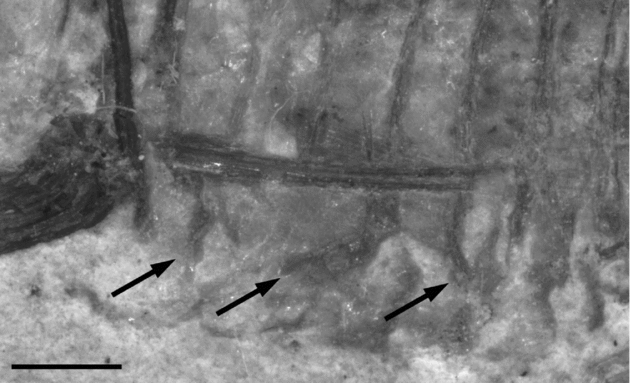
There are two (or perhaps three) small needle-like pre-pelvic scutes (Fig. 4) that are similar to those characteristic of the extant genera Encrasicholina and Stolephorus (e.g. Whitehead, Nelson & Wongratana, Reference Whitehead, Nelson and Wongratana1988; Lavoué, Konstantinidis & Chen, Reference Lavoué, Konstantinidis, Chen and Ganias2014). The pelvic scute is rather large and supports two well-developed ascending limbs that are adjacent to the ninth pair of pleural ribs.
†Eoengraulis fasoloi gen. et sp. nov. Abdominal region of the body, right side, lateral view. Arrows indicate needle-like pre-pelvic scutes. Scale bar 1 mm.

The body is partially covered by moderately large, rounded and deciduous cycloid scales (Fig. 1).
5. Discussion
The skeleton of anchovies provides a unique set of characters that clearly indicate that the species of the family Engraulidae form a monophyletic group. These fishes have been traditionally perceived as a natural group within the clupeoids, mostly because of their peculiar, prominent pig-like snout usually projecting beyond the anterior tip of the lower jaw and the long, slender and underslung lower jaw with the articulation in most cases situated well beyond the posterior margin of the eye. These features make anchovies very easy to recognize based on external morphology alone (Ridewood, Reference Ridewood1904; Whitehead, Reference Whitehead1963, Reference Whitehead1972, Reference Whitehead1985; Grande, Reference Grande1985; Grande & Nelson, Reference Grande and Nelson1985). The prominent, pig-like snout is the product of a relative enlargement of the mesethmoid that projects in advance of the vomer in order to support a paired rostral organ (Nelson, Reference Nelson1984), whereas the distinctive configuration of the lower jaw of anchovies is primarily due to the oblique backwards inclination of the suspensorium; both these features confer a unique aspect to the head of anchovies (Grande & Nelson, Reference Grande and Nelson1985). Additional possible engraulid synapomorphies have been identified in the cephalic lateralis system (Stephens, Reference Stephens2010), hyobranchial apparatus (Nelson, Reference Nelson1970), outer retina (Heß et al. Reference Heß, Melzer, Eser and Smola2006) and the mitogenome (Lavoué, Konstantinidis & Chen, Reference Lavoué, Konstantinidis, Chen and Ganias2014).
The morphological analysis of the single specimen documented here revealed a set of features that unquestionably indicates that †Eoengraulis is a member of the family Engraulidae, including the presence of a prominent snout with the mesethmoid projecting beyond the vomer and an obliquely inclined suspensorium (Grande & Nelson, Reference Grande and Nelson1985). †Eoengraulis exhibits the series of morphological features of certain components (quadrate, hyomandibula, metapterygoid) of the obliquely inclined suspensorium identified by Di Dario (Reference Di Dario2009) as diagnostic of engraulids, including the anterior margin of the metapterygoid located anterior to the quadrate; quadrate and ventral limb of the hyomandibula not separated by the metapterygoid; posterodorsal margin of the metapterygoid in line with the opercular process of the hyomandibula; and quadrate anteroposteriorly compressed and bearing a laminar outgrowth emerging along its anterior margin. Moreover, †Eoengraulis has extremely well-developed infraorbitals 1 and 3 with greatly elongate posterior processes characterized by a relatively large area of articulation between each other, as well as a high pleural ribs to preural vertebrae ratio; both these features appear to be diagnostic of the Engraulidae (see Di Dario, Reference Di Dario2009).
Whitehead (Reference Whitehead1972) divided the Engraulidae into two subfamilies, the Engraulinae and the monotypic Coiliinae. Such a subdivision was made to separate the peculiar rat-tailed anchovies of the genus Coilia from the other members of the family. Grande (Reference Grande1985) considered this division as artificial because most of the Old World anchovy genera are more closely related to Coilia than to other anchovies. Nelson (Reference Nelson1983) provided osteological evidence (ramifications of preopercular and temporal sensory canals; first epibranchial with fused toothplate; caudal skeleton with first preural and first ural centra) indicating that the New World anchovies plus the cosmopolitan Engraulis and the Indo-Pacific Encrasicholina form a well-defined monophyletic group. Grande (Reference Grande1985) expanded the list of synapomorphies of this group, adding the loss of the dorsal scute, and Grande and Nelson (Reference Grande and Nelson1985) demonstrated that the genus Stolephorus is the nearest relative of this group, forming with them the Engraulinae (Engraulidae of Grande & Nelson, Reference Grande and Nelson1985). The monophyly of the Engraulinae is supported by several synapomorphies (Grande & Nelson, Reference Grande and Nelson1985) such as: an oval egg; a nearly full spine on the first preural centrum; epurals usually two; first two supraneurals in close proximity; fused ecto- and metapterygoid; and presence of a gap in the tooth row of the dentary. Moreover, all the genera of the Engraulinae lack post-pelvic abdominal scutes. The arrangement of pre-pelvic abdominal scutes is more heterogenous within this group however because Stolephorus and Encrasicholina possess a small number (less than nine) of needle-like scutes emerging along the belly and bearing extremely reduced ascending limbs. Pre-pelvic abdominal scutes are totally absent from the remaining engrauline genera. The loss of pre-pelvic scutes supports the phylogenetic position of Encrasicholina and Stolephorus within the Engraulinae, with the former representing the sister taxon of the New World genera (Amazonsprattus, Anchoa, Anchovia, Anchoviella, Cetengraulis, Jurengraulis, Lycengraulis and Pterengraulis) plus Engraulis.
The monophyly of the genera of the Coiliinae (Coilia, Lycothrissa, Papuengraulis, Pseudosetipinna, Setipinna and Thrissina (=Thryssa, see Kottelat, Reference Kottelat2013)) is supported by at least three morphological features (e.g. Grande, Reference Grande1985; Grande & Nelson, Reference Grande and Nelson1985), including the loss of the peg on the proximal end of the uppermost ray of the hypaxial caudal-fin lobe, the posterior margin of the fifth and sixth hypurals not in line with that of the lower elements of the series and the absence (or remarkable reduction) of the posteroventral notch in the third hypural.
The phylogenetic hypotheses proposed by Grande & Nelson (Reference Grande and Nelson1985) have been recently confirmed by molecular studies (e.g. Lavoué, Miya & Nishida, Reference Lavoué, Miya and Nishida2010; Bloom & Lovejoy, Reference Bloom and Lovejoy2012; Lavoué et al. Reference Lavoué, Miya, Musikasinthorn, Chen and Nishida2013), which identified a number of unique amino acid and nucleotide substitutions (Lavoué, Konstantinidis & Chen, Reference Lavoué, Konstantinidis, Chen and Ganias2014).
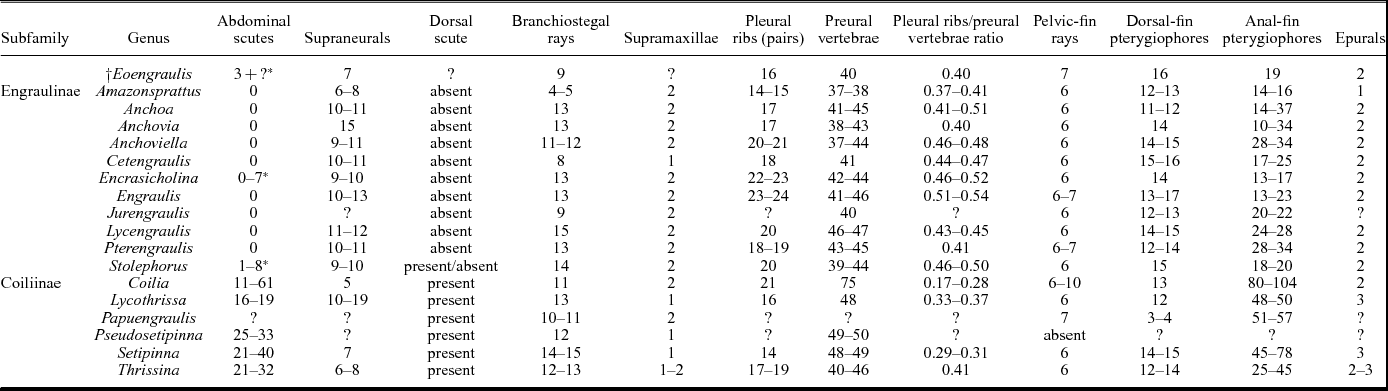
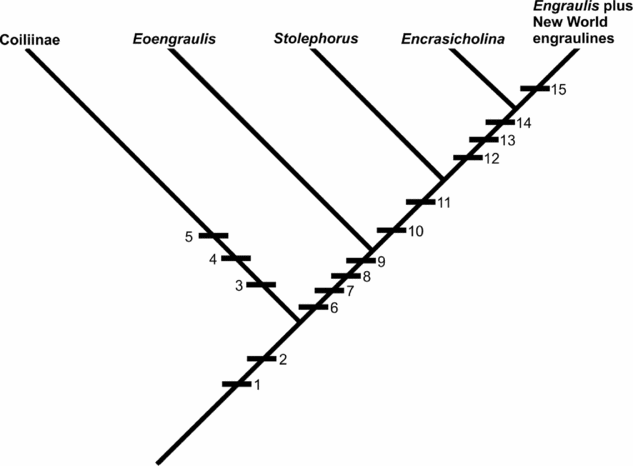
†Eoengraulis exhibits a unique combination of meristic (Table 1) and morphological features that support its separate status within engrauline anchovies. As discussed above, †Eoengraulis is characterized by a few needle-like pre-pelvic scutes exhibiting a condition shared only with the extant engrauline genera Stolephorus and Encrasicholina. As a matter of fact, the possession of small and needle-like pre-pelvic scutes uniquely observed in Stolephorus, Encrasicholina and †Eoengraulis constitutes a further synapomorphy of the Engraulinae; the subsequent complete loss of pre-pelvic scutes is distinctive for the more derived engraulines Engraulis and the New World genera (see Lavoué, Konstantinidis & Chen, Reference Lavoué, Konstantinidis, Chen and Ganias2014). †Eoengraulis also has several other engrauline features such as the possession of a nearly full spine on the first preural centrum, two epurals and fused ecto- and metapterygoid. At least two of the skeletal synapomorphies of the Engraulinae identified by Grande & Nelson (Reference Grande and Nelson1985) – first two supraneurals in close proximity and presence of a gap in the tooth row of the dentary – are not shared by †Eoengraulis, suggesting that this Eocene genus might represent the sister-taxon of all other engraulines. The putative sister-group relationship of †Eoengraulis and extant engrauline genera is therefore supported by at least four osteological features that suggest that †Eoengraulis should be regarded as a stem-Engraulinae (see Fig. 5).
Synopsis of selected morphological features used to discriminate the genera of the Engraulidae. Data from Landini & Menesini (Reference Landini and Menesini1978), Nelson (Reference Nelson1983), Roberts (Reference Roberts1984), Grande (Reference Grande1985), Grande & Nelson (Reference Grande and Nelson1985), Peng & Zhao (Reference Peng and Zhao1988), Whitehead, Nelson & Wongratana (Reference Whitehead, Nelson and Wongratana1988), Di Dario (Reference Di Dario2009), and Da Silva, Severi & De Castro (Reference Da Silva, Severi and De Castro2010).* Needle-like pre-pelvic scutes only.

Cladogram showing hypothetical relationships of †Eoengraulis within the Engraulidae. Character states are: (1) pig-like snout; (2) obliquely inclined suspensorium; (3) loss of the peg on the proximal end of the uppermost ray of the lower caudal fin lobe; (4) strong reduction or absence of the notch on the posteroventral corner of the third hypural; (5) posterior margin of hypurals 5 and 6 not in line with that of the lower elements of the series; (6) possession of needle-like pre-pelvic scutes; (7) nearly full spine on the first preural centrum; (8) two epurals; (9) fused ecto- and metapterygoid; (10) first two supraneurals in close proximity; (11) gap in the tooth row of the dentary; (12) unique arrangement of the sensory canals; (13) first epibranchial fused to a toothplate; (14) first preural and first ural centra fused; and (15) loss of pre-pelvic scutes.

6. Concluding remarks
In their review of the fossil record of anchovies, Grande & Nelson (Reference Grande and Nelson1985) recognized only two genuine fossil engraulids based on articulated skeletal remains: †Engraulis tethensis from the Messinian Mesaoria Group of Cyprus and †Engraulis macrocephalus from the Plio-Pleistocene Vrica section, near Crotone, Calabria, southern Italy (Landini & Menesini, Reference Landini and Menesini1978). More recently, indeterminate representatives of the family Engraulidae have been documented by Tiwari & Bannikov (Reference Tiwari and Bannikov2001) from the Upper Bhuban Formation, Surma Group, Mizoram, India, extending the record of anchovies back to early Miocene time. Skeletal material referred to Engraulis japonicus has been reported from Pleistocene deposits of Japan (Yabumoto, Reference Yabumoto1988; Yokoyama et al. Reference Yokoyama, Shiba, Koizumi and Miyazawa2013). Fossil otoliths of the family Engraulidae are also restricted to Neogene deposits; the oldest representatives of the otolith record have been described from the lower Miocene succession of New Zealand (Schwarzhans, Reference Schwarzhans1980). Extant anchovy species appeared during Pliocene and Pleistocene time in both the Atlantic (Stinton, Reference Stinton1985) and Pacific (e.g. Fitch, Reference Fitch1966, Reference Fitch1967; Ohe, Reference Ohe1981, Reference Ohe1983) oceans, and conspicuous assemblages of engraulid otoliths have been reported in the Plio-Pleistocene succession of the Tropical Eastern Pacific (e.g. Landini, Carnevale & Sorbini, Reference Landini, Bianucci, Carnevale, Ragaini, Sorbini, Valleri, Bisconti, Cantalamessa and Di Celma2002; Landini et al. Reference Landini, Bianucci, Carnevale, Ragaini, Sorbini, Valleri, Bisconti, Cantalamessa and Di Celma2002; Carnevale et al. Reference Carnevale, Landini, Ragaini, Cantalamessa and Di Celma2011). Overall, both the otoliths and skeletal remains seem to document a late Miocene – Pliocene diversification of Atlantic and Pacific engrauline genera (Anchoa, Engraulis). The timing of this diversification coincides with that of other pelagic and coastal epipelagic vertebrates (see Santini, Carnevale & Sorenson, Reference Santini, Carnevale and Sorenson2013) and possibly occurred in response to a reorganization of planktonic communities triggered by the so-called late Miocene – early Pliocene biogenic bloom, leading to an increase in nutrient richness in marine ecosystems (e.g. Cortese et al. Reference Cortese, Gersonde, Hillenbrand and Kuhn2004).
The description of †Eoengraulis fasoloi provides a substantial improvement to our knowledge of the evolutionary history of anchovies, documenting the presence of crown engraulids (stem engrauline) during early Eocene time. However, phylogenetic considerations suggest that the origin and early history of the group must be searched for in Cretaceous deposits. Recent phylogenetic studies of clupeoid intrarelationships (e.g. Lavoué, Miya & Nishida, Reference Lavoué, Miya and Nishida2010; Lavoué et al. Reference Lavoué, Miya, Musikasinthorn, Chen and Nishida2013) considered the Engraulidae as the sister taxon of all other clupeoids. Clupeoids were possibly in existence since Albian time (Figuerido, Reference Figuerido2009) and representatives of the family Clupeidae (crown clupeoids) are known since Campanian time (e.g. Taverne, Reference Taverne2007) suggesting that the origin of engraulids necessarily dates back at least to Late Cretaceous Period.
The very poor fossil record of anchovies has been discussed by several authors (David, Reference David1943; Whitehead, Reference Whitehead1963; Grande & Nelson, Reference Grande and Nelson1985). According to Grande & Nelson (Reference Grande and Nelson1985), the anomalous scarcity of fossil anchovies is primarily due to ecological reasons since these fishes occur in high-energy environments not conducive to fossilization, such as near-shore marine biotopes, estuaries, coastal lagoons and rivers.
Taking into account the interrelationships among engraulid lineages (Fig. 5; e.g. Grande & Nelson, Reference Grande and Nelson1985; Lavoué, Miya & Nishida, Reference Lavoué, Miya and Nishida2010; Bloom & Lovejoy, Reference Bloom and Lovejoy2012) the Eocene occurrence of the Engraulinae clearly implies that its sister group, the coilines, was certainly present at that time, suggesting that both of these anchovy lineages were already in existence from at least early Eocene time. Such a hypothesis seems to be consistent with the time-calibrated mitogenomic phylogeny proposal by Lavoué et al. (Reference Lavoué, Miya, Musikasinthorn, Chen and Nishida2013) of a latest Cretaceous origin of the two lineages and a late Paleocene – early Eocene intra-lineage diversification. Lavoué et al. (Reference Lavoué, Miya, Musikasinthorn, Chen and Nishida2013) also proposed that anchovies originated in the tropics in the precursor of the present Indo-West Pacific region, the current centre of maximum marine diversity. The region of origin of the two engraulid lineages was not discussed in that study. During Eocene time, the Monte Bolca area was located along the northern margin of the western Tethys, a region characterized by remarkably high diversity (see Carnevale et al. Reference Carnevale, Bannikov, Marramà, Tyler, Zorzin, Papazzoni, Giusberti, Carnevale, Roghi, Bassi and Zorzin2014), representing a precursor and a 50 Ma analogue of the modern Indo-West Pacific region (see Renema et al. Reference Renema, Bellwood, Braga, Bromfield, Hall, Johnson, Lunt, Meyer, Monagle, Morley, O'Dea, Todd, Wesselingh, Wilson and Pandolfi2008). In this context, it is reasonable to hypothesize that the earliest phases of diversification of engrauline anchovies probably occurred in the western Tethys as documented by †Eoengraulis.
Acknowledgements
We are grateful to Walter Landini (Dipartimento di Scienze della Terra, Università di Pisa) and Sébastien Lavoué (Institute of Oceanography, National Taiwan University) for useful suggestions and a critical review of the manuscript, and to Federica Giudice for the improvement in English. Roberto Zorzin and Anna Vaccari (both at MCSNV) provided access to fossil material under their care and logistic support. Thanks are also due to Marco Pavia and Simone Colombero (both at the Dipartimento di Scienze della Terra, Università degli Studi di Torino) for the photographs. Jean Gaudant (Muséum National d'Histoire Naturelle, Paris) and James C. Tyler (National Museum of Natural History, Smithsonian Institution, Washington) provided valuable critical reviews of this manuscript. This work was supported by grants (ex-60% 2013) to GC from the Università degli Studi di Torino.