INTRODUCTION
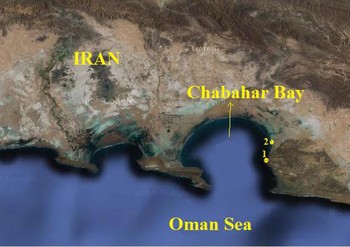
Chitons are an ancient molluscan lineage with a generally conservative appearance and grazing habit (Ernisse, Reference Ernisse2004). Most Chitons (Polyplacophora) live in the intertidal zone and shallow water, but some species dwell in rather deep water. Chitons are distributed in all oceans from the Polar regions through to the tropics. Despite the larger number of molluscan species recorded from Chabahar Bay (e.g. Ashja Ardalan, Reference Ashja Ardalan1993; Samaei, Reference Samaei1994) and the Iranian coasts of the Persian Gulf (e.g. Kosuge, Reference Kosuge1998; Hosseinzadeh et al., Reference Hosseinzadeh Sahafi, Daghoghi and Rameshi2001), there is no record of Acanthopleura vaillantii de Rochebrune, 1882 in Chabahar Bay. This is the first time that this species of the class Polyplacophora is recorded in Chabahar Bay (Figure 1).
Study site of Chabahar Bay.

MATERIALS AND METHODS
Specimens for this study were collected at two stations on rocky bottoms in the intertidal zone of Chabahar Bay in June 2009. Living specimens were collected by hand. Chitons were fixed and preserved in 75% ethanol and transferred to the laboratory of the Iranian National Centre for Oceanography, Chabahar. Identification was based on the literature and comparison with well identified specimens from other regions.
SYSTEMATICS
MATERIAL EXAMINED
Twelve chiton specimens (live sample) collected at Chabahar Bay (25°21′53″N 60°36′32″E – 25°21′30″N 60°36′90″E), 23 June 2009.
DESCRIPTION
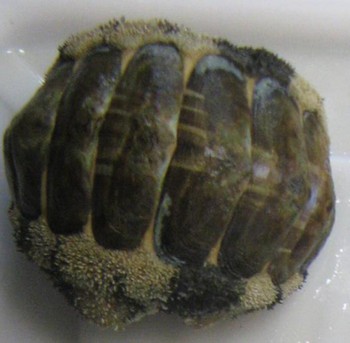
Characteristic features of Acanthopleura vaillantii have been presented by Kaas & Van Belle (Reference Kaas and Van Belle1988), Brooker (Reference Brooker2003) and Dinapoli & Janssen (Reference Dinapoli and Janssen2009). This species has an elongate oval body with a large size (50 mm length) and is moderately raised. Valves are beaked and solid. Head valve is semicircular and slope convex. Intermediate valves are rectangular with a blunt apex. Lateral areas are flat and hardly marked. The tail valve is almost semicircular and as wide as the head valve. Tegmentum is blackish brown. There are traces of small, rounded knobs in some specimens (Figure 3). Girdle is dark with irregular dark brown bands.
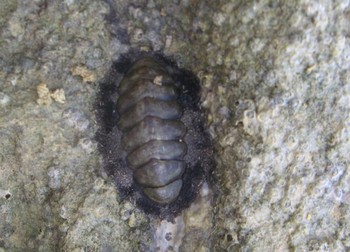
Acanthopleura vaillantii on rocky substrate in Chabahar Bay.

Dorsal view of Acanthopleura vaillantii valves to show details of tegmentum sculpture.

HABITAT
This species was collected in the intertidal zone, on rock platforms and a boulder beach.
DISTRIBUTION
This species lives in the north-western Indian Ocean: Persian Gulf and Oman (Kaas & Van Belle, Reference Kaas and Van Belle1988); Strait of Hormuz (Tadjalli-Pour, Reference Tadjalli-Pour1974); the mainland Yemen and Socotra Island (Dinapoli & Janssen, Reference Dinapoli and Janssen2009); the Red Sea (Strack, Reference Strack1993); Egypt, Suez Canal (Dinapoli & Janssen, Reference Dinapoli and Janssen2009). The range of this species is herein extended eastward to Chabahar Bay.
REMARKS
Ferreira (Reference Ferreira1986) and Schwabe et al. (Reference Schwabe, Sirenko and Seeto2008) synonymized Acanthopleura vaillantii de Rochebrune, 1882 with A. gemmata de Blainville, 1825. However, Kaas & Van Belle (Reference Kaas and Van Belle1988) and Strack (Reference Strack1993) did not agree that these species are conspecific, because there is a large gap in the distribution between the populations of the north-western Indian Ocean (= A. vaillantii) and those of the eastern Indian Ocean (= A. gemmata) (Dinapoli & Janssen, Reference Dinapoli and Janssen2009), and there are differences in the girdle and tegmentum (Kaas & Van Belle, Reference Kaas and Van Belle1988).
ACKNOWLEDGEMENTS
We wish to thank Dr Enrico Schwabe (Bavarian State Collection of Zoology, Germany) for his kind help in species identification and providing valuable reprints.