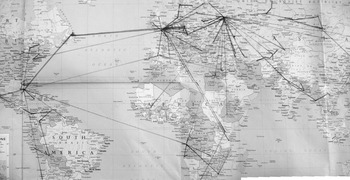
At the Mayibuye Archives, housed at the University of the Western Cape, South Africa, scholars wishing to familiarize themselves with the documents pertaining to the life and work of the writer and antiapartheid activist Alex La Guma (1925–85) would have the chance to unfold a tabletop-sized map of the world, crisscrossed by long strokes of black marker (fig. 1).Footnote 1 It is a map on which the South African intellectual inscribed his airborne journeys, with flight trajectories bridging the distance between London and Dar es Salaam, Moscow and Bamako, Havana and Luanda. In the almost two decades after 1966, when he left South Africa for the uncertainty of exile, until his premature death in 1985, at a time when few people could boast such wide-ranging itineraries, La Guma's globe-trotting and careful visual record of his travels reveal an ethos of openness toward the world and engagement with other cultures.
Map of La Guma's travels, UWC–Robben Island Museum Mayibuye Archives, MCH118-1-8-3.

Yet what is the right term to account for this mobility and the accompanying inclusiveness it reveals? Afropolitanism—the keyword structuring this section of PMLA—and the larger umbrella of its cognate, cosmopolitanism, present themselves as the most obvious choices. However, in this article I suggest that Afro-Asianism, especially the version that privileged internationalist solidarity and networks linking up leftist intellectuals in the Third World, is a more appropriate label to describe La Guma's and some of his contemporaries’ notion of connectedness. To outline its conceptual contours, I draw on cultural material from the Cold War period. Intellectuals who embraced it engaged in a process of counterworlding—to borrow and expand the meaning of a term coined by Gayatri Spivak—placing themselves within a network of like-minded thinkers, artists, movements, and allied states, thereby giving epistemological heft to the African perspectives they espoused.Footnote 2 Taking La Guma's nonfiction texts as an anchoring point, I look at the ways in which Afro-Asianists narrated their position in the world and their conception of writing and authorship that bolstered this form of connectedness.
Terminology is historically determined, and the ideological fault lines created by the global Cold War exacerbated the divisive ways in which even seemingly transparent words with clear referents—like astronaut and cosmonaut—were deployed and weaponized by the superpowers and their allies. In the new millennium there has been a resurgence of scholarly interest in cosmopolitanism, a term variously used to describe a mindset that embraces difference, envisioning people as citizens of the world; an orientation that finds ethical and aesthetic fulfillment in international exchanges; or a practice of communities that enables coexistence, defying narrow-mindedly conceived national identities.Footnote 3 Likewise, Afropolitanism is a relatively new term describing the culture-straddling ethos of some contemporary African diasporas. Yet, looking retrospectively at the Cold War years, the choice of terms that described openness toward other cultures reflected specific ideological positions. At that time, cosmopolitanism was countered by internationalism, even if both laid claim to an inclusive and equitable humanism.
In his travelogue A Soviet Journey, La Guma uses the term cosmopolitan only once, to refer to a self-complacent British tourist he encounters on his first flight to Moscow: “He had the air of the cosmopolitan despite his clerk-on-vacation look, and he spoke in Russian to the stewardess with ease, which made me feel the novice I was” (66). The restraint is likely deliberate, because socialist states and numerous leftist activists were distancing themselves from the term. During Stalin's rule, Soviet authorities had waged a campaign against cosmopolitanism—a campaign with highly problematic anti-Semitic overtones—which castigated those in favor of bourgeois, Western values as betrayers of the socialist cause.Footnote 4 Skepticism toward cosmopolitanism as the most appropriate terminology for ethical cross-cultural engagement persists today. For instance, Timothy Brennan suspects that, behind equalitarian narratives, cosmopolitanism disguises economic interest and middle-class values (81). Mindful of historic nuance yet interested in retaining the positive aspects of the term cosmopolitan, Christopher J. Lee has proposed the term “fugitive cosmopolitanism” to describe La Guma's and his peers’ brand of engagement with other cultures (“Anti-Imperial Eyes” 3). The term acknowledges the instability and precarity of life in exile, as well as the richness of the transnational cultural and political interactions such a lifestyle offered (3–4, 24).
Amplifying the centrality of African perspectives while cherishing the engagement with other cultures, the recent term Afropolitanism both addresses and circumvents some of the problems that have plagued cosmopolitanism.Footnote 5 Having shot to prominence with Taiye Selasi's 2005 article “Bye-Bye Babar,” it originally pointed to a contemporaneous form of identity. “You'll know us by our funny blend of London fashion, New York jargon, African ethics, and academic successes,” declares Selasi, pointing to the ethnic mixing, multilingualism, and cultural hybridity that characterize a generation of “Africans of the world.” Achille Mbembe expanded the purview of the term by addressing different forms of mobility, to and from Africa and across the continent, registering immersion into other African cultures and dispersion across the world (27–28). This conceptualization of Afropolitanism includes the experiences of artists and thinkers living in other countries on the African continent. The South African writer Es'kia Mphahlele spent several years not only in France and North America but also in Nigeria, Kenya, and Zambia, and La Guma visited Mali, Angola, Ethiopia, and Zambia in addition to Asian countries such as Vietnam, Mongolia, North Korea, and India.
These are not the expected migration trajectories to London, Paris, or New York. Some African artists and intellectuals chose to turn to other countries on the continent or, during the Cold War, oriented themselves toward countries from the Eastern Bloc or other Third World nations, forging solidarities that until relatively recently scholars have neglected. For instance, the Mauritanian-born filmmaker Abderrahmane Sissako's moving documentary film Rostov-Luanda resists the pull of Western metropolises, choosing instead a journey through Angola and then further afield to postreunification Berlin, where the narrator-filmmaker attempts to reinvigorate an acquaintance—and a complementary worldview—he had acquired in the 1980s in the Soviet Union.Footnote 6 Selasi acknowledges a more complex dispersion of African diaspora from the 1960s to the 1980s, observing that “Cold War politics produced unlikely scholarship opportunities in Eastern Bloc countries like Poland, as well.” In the rest of this article I examine the complexity of migration patterns created by the ideological fault lines and the tensions inherent to Afropolitan identities during the Cold War. La Guma's writings comprehend an archive of diasporic experiences that do not move vertically between the Global South and the economic, political, and cultural hubs in the Global North.Footnote 7 Instead, La Guma built and consolidated bridges between what were then known as the Second World and the Third World. As a result, his writings showcase worldviews that do not fit comfortably under the rubrics of cosmopolitanism or even Afropolitanism, revealing instead the features of Afro-Asian and tricontinental internationalism.Footnote 8
To better grasp these geographic connections and associated epistemic systems, let us return to the map with which I started. Beyond the wide scope of La Guma's travels, what strikes one is the constellation of points of departure: a handful of cities—like miniature sunbursts—are the travel nodes through which other parts of the world became accessible to the South African writer. The flights are not evenly distributed among the major travel hubs or around the globe. Instead, the map tells a story of webs of political and cultural connections during the Cold War. The hubs on La Guma's map are not always the expected ones. If one anticipates that the old colonial metropolises (Paris, London) and the bustling American cities (New York, Chicago) will feature prominently, this expectation is only partly fulfilled. His flights threaded again and again through London, Moscow, and Havana, making visible an ideological embroidery that propelled to the foreground new power hubs and networks. During the Cold War one did not travel from New York to Pyongyang or from Moscow to Johannesburg. In an ideologically compartmentalized world, to access specific countries one had to pass either through allied travel nodes or through ostensibly neutral countries. On La Guma's map, London, Moscow, and Havana are the gateways through which a specific configuration of Afro-Asian internationalism is accessed. Thus, to reach Tashkent or Beirut—cities where he attended conferences of the Afro-Asian Writers Association (AAWA)—La Guma had to fly through Moscow. To get to Lusaka—where the African National Congress (ANC) had offices—he flew from Havana via Luanda, or from London via Nairobi. Toronto was accessible from Havana, where La Guma spent the last years of his life (1978–85) as ANC representative to Latin America, but Washington, DC, despite being closer to the Cuban capital, had to be reached via London. La Guma's map, like all maps, flattens time, and as a result it would be very difficult to figure out when exactly each journey took place or even the direction of travel.Footnote 9 While one needs to draw on both biographical detail and knowledge of Cold War geopolitics, reading this map in conjunction with La Guma's nonfiction writings reveals his conception of Afro-Asian internationalism.
La Guma's career, journeys, and political commitments are best understood against the background of the global Cold War and its geopolitic fault lines, and the brand of Afro-Asianism La Guma embraced is equally informed by them. As Rossen Djagalov observes, “[a]lthough partially institutionalized through organizations such as the Non-Aligned Movement (NAM), the Cairo-based Afro-Asian People's Solidarity Organization (AAPSO), the Havana-based Organization of Solidarity with People from Africa, Asia and Latin America (OSPAAAL), and others, Third-Worldism was an immensely heterogenous phenomenon” (5).Footnote 10 Consequently, La Guma's form of Afro-Asianism represented only a sliver of the diverse ideological positions subsumed by Third-Worldism. Marxism-Leninism provided an important ideological grounding for La Guma's political vision since his youth, and the later development of close ties with cultural and political entities in the Soviet Union and Cuba intensified this stance. La Guma followed in the footsteps of black intellectuals who were active in the Comintern or were sympathizers of the Soviet Union.Footnote 11 The son of a member of the communist party, he became an active antiapartheid activist and a leading figure in the South African Coloured People's Organization (SACPO) by the early 1950s, just as his career in journalism and fiction writing was also taking off.Footnote 12 Following banning, prison terms, and house arrest under the apartheid regime, in 1966 La Guma and his family left South Africa on an exit visa and settled in London, where he became active within the ANC structures in exile.Footnote 13 His spouse, Blanche La Guma, who had trained as a midwife, was equally politically engaged and came to play an important role in the Federation of South African Women, the ANC, and the South African Communist Party (SACP). Once in London, invitations to conferences in socialist countries, as well as participation in events organized by organizations with an Afro-Asian or tricontinental agenda, contributed to his views regarding internationalist solidarity. As Lee has pointed out, essays such as “Paul Robeson and Africa” (1971), “Vietnam: A People's Victory” (1973), and “Cuba and Africa” (1984), as well as several short stories, demonstrate La Guma's “concerns for global liberation struggles, decolonization, and postcolonial uncertainty” (“Anti-Imperial Eyes” 23).
Whether directly or indirectly, the organizations for which La Guma worked became conduits for his reflections on the relation between cultural production and politics. On the one hand, during his first two years in Britain he worked for the Transcription Centre in London, an organization that produced and broadcast radio programs, films, and other publications promoting the works of African writers, musicians, and visual artists. As Peter Kalliney has argued, the Transcription Centre, like the Congress for Cultural Freedom, promoted an idea of artistic autonomy, kindred in spirit to modernist suspicion of political involvement.Footnote 14 In mid-1967 it was revealed that the Transcription Centre was funded by the Central Intelligence Agency through the Farfield Foundation, part of the larger anticommunist ideological operation built around the Congress for Cultural Freedom, with the aim to win “hearts and minds” abroad. La Guma subsequently steered clear of institutions that could have been sponsored by Western political entities and simultaneously distanced himself from an apolitical understanding of the function of the writer.Footnote 15
On the other hand, after arriving in London in 1966, La Guma continued his political activity on behalf of the Coloured People's Congress and increasingly dedicated himself to forwarding the aims of the ANC and the SACP. In tandem with his devotion to the antiapartheid cause, he developed an Afro-Asian, and later tricontinental, perspective predicated on the close relation between cultural production and political transformation. His increasing involvement in the AAWA during the rest of his life also brought him closer to the leftist (and Soviet-supported) perspective that writers were cultural workers, akin in their transformative role to other working-class citizens. He was part of the South African delegation at the 1967 AAWA conference in Beirut. At the AAWA's 1970 conference in Delhi, he received the Lotus award for writing from the hands of Indira Gandhi. In 1976 he began his term as assistant editor of the journal Lotus: Afro-Asian Writings, a venue in which several of his short stories had been published. In 1979, at the Luanda conference of the association, he was elected secretary general. The AAWA had started as a putatively Non-Aligned institution, inspired by the 1955 Bandung Asian-African conference. However, under the guise of representation by its Central Asian republics and financial and logistical support for a worthy cause, the Soviet Union infiltrated the organization and imposed its perspective on cultural and political decisions.Footnote 16 As a result, La Guma's conception of internationalist solidarity went beyond connections with fellow decolonizing nations and included the Soviet Union as both the ideal of socialist transformation and an important partner in the fight against imperialism. These were networks that subscribed to the idea that culture and politics had to be conceptualized together.
Therefore, the solidarities La Guma sketches out in his writings are firmly rooted in Afro-Asian connections, yet his definition of Afro-Asianism differs from that implicit in the 1955 Bandung conference.Footnote 17 On the one hand, numerous political leaders at Bandung representing newly independent and aspiring states had been wary of the Soviet Union, perceiving it as another rising imperial power along with the United States of America.Footnote 18 La Guma, on the other hand, understood Afro-Asianism to comprise connections with the Central Asian republics of the Soviet Union. This vision of an interconnected world informed by the matrix of Afro-Asianism is legible in La Guma's travelogue A Soviet Journey (1978), which he penned following a six-week visit in 1975, at the invitation from the Union of Soviet Writers (Lee, “Anti-Imperial Eyes” 29).Footnote 19 His guided journey—he was attentively chaperoned by a translator and allowed to see only positive aspects of the Soviet Union—takes his readers to Kokchetav in Northern Kazakhstan, a place so remote from his previous peregrinations that he indulges his “rare explorer” sensation by sending a telegram to his wife, Blanche. “[T]he cable never arrived, and I might have been at the Mountains of the Moon,” he concludes (La Guma, Soviet Journey 136). The evocation of space exploration (and indirectly the space race) is a narrative device that marks the distance between Kazakhstan and an African intellectual's imaginary of the globe yet simultaneously allows him to establish a network of Afro-Asian and tricontinental connections:
Kokchetav. I had never heard of Kokchetav until I was in Alma-Ata. I had been to Bamako in Mali, and seen the war zone around Hanoi and Haiphong; I had been in Santiago, Chile, a few months before they killed Allende, and had seen the ruins of old Panama that the pirate Henry Morgan burned; and it had been amusing sailing down the Panama Canal eating from the lunch boxes of Colonel Sanders’ Kentucky Fried Chicken (by courtesy of the Panama Canal Company), but never had I heard of a town called Kokchetav. It didn't have a romantic sounding name, like Samarkand or Bukhara or Chikunda, South Africa, although I have never been to Chikunda, South Africa. (136)
If colonial narratives incorporated the colonized population and their land within an imperial view of the globe through a process of worlding, La Guma proposes a countermovement, where apparently far-flung places in the Soviet Union are narratively articulated into a constellation of Third World solidarities. The Central Asian republics of the Soviet Union and Siberia were unfamiliar both to the South African writer and to his readers; yet by repeatedly comparing them with well-known Third World places and completely unfamiliar South African topographies, a coconstruction of the world takes place. Bypassing Western perspectives, the Third World and the Second World jointly produce a new vision of the globe. Kokchetav is given meaning by its connection to a network of emblematic Third World places and nations that had fought both old and new forms of imperialism. Particularly relevant for the articulation of a global coalition of anti-imperialist forces is the war in Vietnam, which La Guma described elsewhere as a war of American imperialist aggression. Likewise, the Panama Canal zone represented the hope of enduring beyond successive waves of imperialism, from the struggle between Spanish and British colonialism, when the British government sanctioned the privateer Henry Morgan's plunder of Spanish colonies by appointing Morgan lieutenant governor of Jamaica, to the promise of the canal's independence from American imperialism in the 1977 treaty outlining the future handover of the waterway to the Panamanian people. The role of the United States as a hemispheric and global imperial power became even more prominent in La Guma's writings after his move to Havana in 1978, where La Guma headed the ANC mission.
If the Afropolitan ethos has some apolitical, classist, and consumerist aspects, as critics have pointed out, the version of Afro-Asianism supported by La Guma and fellow artists associated with the AAWA likewise presents problems. The Soviet internationalism that undergirded Afro-Asianism was not fully benevolent. While it provided support for leftist liberation movements, it also contributed to the expansion of the Soviet sphere of influence. Forms of internal colonialism (toward the Central Asian component republics), as well as imperialism exercised within the Eastern Bloc and other parts of the globe, were troubling features of Soviet internationalism.Footnote 20 As I have argued elsewhere, “the Cold War was the cultural and political configuration generated by the rivalry between two imperial powers [the United States and the Soviet Union], with sometimes similar and other times different modes of operation” (At Penpoint 11).Footnote 21 Understanding this context of competing imperialisms can make legible the cultural choices available to Third World intellectuals. Solidarity with leftist intellectuals from the Second and the Third Worlds is the only strategy La Guma considered efficient for global decolonization. Therefore, he perceived the Soviet republics in Central Asia and the Caucasus (previously incorporated into the Russian empire) as a model for decolonization and socialist progress.
Despite these problematic aspects, his writings offer insights into a worldview shared by fellow leftist Third World intellectuals, which not only affected the policy produced by the organizations to which they belonged but equally shaped a take on writing and cultural production that has been largely eclipsed in the aftermath of the global Cold War and the triumph of Western cultural models and analytic frameworks.Footnote 22 As I mentioned above, La Guma conceived of cultural production as fully immersed in social and political transformation: “Culture and politics nourish one another and constitute the kernel of cultural revolution,” the writer observed in his 1983 speech to the AAWA (Lee and La Guma 276). As Lee has pointed out in the essay that accompanied the republication of this speech, La Guma was not singular in upholding this view; he shared it with Black revolutionaries like Frantz Fanon and Amilcar Cabral (271). To this list of leftist Black thinkers and artists one may add his fellow South African Mongane Wally Serote, the Kenyan novelist Ngũgĩ wa Thiong'o, and the Senegalese filmmaker and prose writer Ousmane Sembène.
Mindful of diverse forms of cultural imperialism, La Guma denounced writing models derived from Western cultures and the stumbling blocks that new forms of domination and local conflicts set in the path of Third World countries’ cultural development. At the AAWA's seventh conference, held in Tashkent in 1983, twenty-five years after the founding event was held in the same Uzbek city, La Guma delivered his speech as secretary general of the association. He laid out several tasks for members and member organizations:
In connection with future activities of the Association, it is our opinion that more effort must be made to assist the writing community of both continents to enter the circle of Afro-Asian solidarity and anti-imperialist commitment. While we have stimulated activities in many regions, there are still gaps, which must be filled. The influence of neocolonialism still prevails; disillusionment with prevailing authority and the sense of “individualism” among some writers still prevails. Equally, fratricidal strife and communal antagonism is still a blight on the scene in some areas which must be eradicated as the task of all cultural workers. It behooves our Association to agitate among writers to devote their efforts to bridging the gap between peoples.
(Lee and La Guma 281)
The rhetoric of La Guma's speech might have a stilted ring to our ears, laden with leftist Cold War–era turns of phrase emphasizing the need for “agitating,” or reducing “fratricidal strife,” as well as comparative constructions with vague referents suggesting that nominally postcolonial states were still undergoing processes of decolonization. Nonetheless, his speech outlines the convergence of Afro-Asian and tricontinental cultural objectives, based on a shared history of colonial and neocolonial exploitation.
While La Guma does not address specific modes of writing and genres in this speech, he points an accusing finger at the ethos of individualism as one obstacle preventing the totality of African and Asian artists from joining forces. Individualism, which other artists and scholars also associated with modernist writing and inward-looking exploration, was seen as a selfish dissociating perspective, preventing writers from functioning as citizen-artists and contributing to the transformation of society. According to La Guma, it was a hallmark of destructive imperialist literature, which celebrated violence and war, was overtly anti-Soviet, and, if followed, resulted in self-damage inflicted on cultures already plundered by colonialism (277). In several previous publications La Guma held up instead the model of Maxim Gorky and other (socialist) realist writers whose humanist commitment to Soviet culture set an example for Afro-Asian writers.Footnote 23 The choice of mode of writing and the relation between literary form and subject matter were some of the most debated topics during the Cold War. Deciding to write in a modernist or realist vein was not a purely aesthetic decision; instead, the choice was encumbered by preexisting ideological positions. By the 1970s and 1980s realism and modernism had accrued a mythology that was largely determined by what I have called elsewhere the aesthetic world systems created by the two superpowers during the Cold War (At Penpoint, ch. 2). Aside from the capitalist world system that has been influencing the literature produced, circulated, and canonized across the world, during the Cold War the Soviet Union and the socialist bloc generated a distinct economic system, exchange market, and associated aesthetic system. This aesthetic system mandated a close relation between politics and cultural production, because conscientized readers would putatively become more productive citizens.
La Guma's views on art and politics may appear dated today, yet they constitute an archive of ideas relevant to contemporary forms of activist art. Similarly, Afro-Asian internationalism belongs to the past configurations of Cold War–era leftist solidarity, yet, in a newly polarized world, it might generate renewed interest for those rejecting contemporary forms of imperialism. In recent years the AAWA, which had declined in the late 1980s and ceased to operate by the early 1990s, was revived with a tricontinental scope under the name of the Writers Union of Africa, Asia, and Latin America. Its journal Lotus was also brought back into circulation in 2016 (Halim, “Afro-Asian Third-Worldism”). This revitalized interest in Afro-Asian and tricontinental solidarity attests to a thirst for cultural venues and networks that bypass Western institutions. As Hala Halim has argued, the original AAWA and its journal Lotus represented a “decidedly anti-Eurocentric project of comparatism” (“Lotus” 565). Revisiting the archive of documents pertaining to La Guma's career and the AAWA offers more than an exercise in literary history; its documents can inform new Global South approaches while also destabilizing stale modes of thinking about artistic solidarities. Finally, given La Guma's dedication to fighting imperialism, his oeuvre can help write a new disciplinary history for postcolonial studies.