Over the past decades, language attrition has typically been investigated from the same theoretical perspectives as other areas of bilingualism. In particular, it seems to be intrinsically linked to second language acquisition research and has seen similar developments in theoretical underpinnings (Sorace, Reference Sorace, Cornips and Corrigan2005). As such, explanations for attrition are often sought in the realms of simplification, generativism or psycholinguistics (Schmid, Reference Schmid2002; Köpke and Schmid, Reference Köpke, Schmid, Schmid, Köpke, Keijzer and Weilemar2004).
However, one of the oldest theoretical frameworks found in attrition research, that of the regression hypothesis (Jakobson, Reference Jakobson1941), has not been so widely investigated. The regression hypothesis makes predictions about the order of attrition based on the order of acquisition, and suggests that those linguistic features that are acquired late are the first to attrite. Regression has not received the attention it deserves in L1 attrition research, possibly due to the fact that the concept plays no major role in second language acquisition research.
In this paper, an attempt is made to investigate the regression hypothesis in more detail on the basis of the L1 attrition of Dutch in an immigrant population in Anglophone Canada. The theoretical foundations underlying the regression hypothesis are explored, followed by a discussion of the Dutch language system and two features of Dutch in particular: plural inflection and diminutive formation. Findings with respect to the acquisition and attrition of these two features are subsequently presented.
1. The regression hypothesis
Comparisons of different language systems in flux have traditionally been popular in linguistic research, as “the study of language during its unstable or changing phases is an excellent tool for discovering the essence of language itself” (Slobin, Reference Slobin and Macnamara1977, p. 185). Only when fluctuating language varieties are compared can constraints that govern all these unstable phases be classified. In other words, it is when things go wrong that a window on the grammar in the speaker's mind can be provided, allowing insights into how language functions when things “are not quite right” (see Corder, Reference Corder1967). Various fluctuating language systems, such as varieties arising from historical language change, language contact and pidginization and creolization (Slobin, Reference Slobin and Macnamara1977) have been investigated in this tradition. It is the comparison between language acquisition and language loss which has traditionally received most attention, however, since “symmetry in the construction and dissolution of language may tell us more about the structure and storage of language” (de Bot and Weltens, Reference Bot, Weltens, Seliger and Vago1991, p. 38). In particular, such research has been guided by the question whether sequences and patterns found in language erosion are the reverse of those observed in language acquisition. This idea is captured in the regression hypothesis.
The basic tenet of the regression hypothesis is that language loss is the mirror image of acquisition (Jakobson, Reference Jakobson1941). In other words, features that develop late in childhood are lost early. Should regression hold true, such mirror symmetries can be explained in two ways. The first of these explanations is linguistic in nature: the language system has characteristics that cause its construction and dissolution to result in similar outputs; there are constraints which govern both attrition and acquisition and cause their intermittent stages to show similarities. An example of such a constraint could be the output condition “be quick and easy” (see Slobin, Reference Slobin and Macnamara1977), which implies that a message should never be longer than strictly necessary to understand. That in turn typically restricts messages of acquirers and attriters alike and in similar ways.
The other possible explanation can be found in the structure and organization of human memory. General theories of memory and forgetting have suggested that the human mind is structured in such a way that it first forgets information that was learned last. According to this view, language is stored in layers in the brain and the topmost layer, the most recently acquired knowledge, is most vulnerable to attrition (for an overview of theories of forgetting in relation to attrition, see Ecke, Reference Ecke2004).
1.1 Testing the regression hypothesis
A considerable amount of research on language attrition implicitly bases itself on regression. The very fact that methods and findings from second language acquisition are almost invariably transposed to attrition (see Keijzer, Reference Keijzer2004) suggests that insights into loss can be based on what we know from acquisition. An example in point are generative approaches to language, where it is generally assumed that language development evolves around concepts such as [±interpretable features]. Here, those parts of language that can be formed purely on the basis of the syntax component (autonomous syntax), that is, uninterpretable features, are relatively easy to process. A correct use of interpretable features, on the other hand, relies on an interaction between the syntax module and the semantic interface, and as such is more demanding for the human language faculty (see Tsimpli, Sorace, Heycock and Filiaci, Reference Tsimpli, Sorace, Heycock and Filiaci2004). Generative approaches to erosion subsequently assume that processes similar to those that govern language development also play a role in attrition. However, a principled hypothesis to back up these intuitions is currently lacking and hypotheses coming from the generative tradition are therefore not precise enough.
Given the fact that studies on language loss are often implicitly based on regression, it is puzzling that so few explicit investigations exist. Studies that have taken the regression hypothesis as their vantage point can be grouped under two headings. First, there are studies that have compared language acquisition in relatively young children to language loss in aphasia patients (cf. Caramazza and Zurif, Reference Caramazza, Zurif, Caramazza and Zurif1978; Grodzinsky, Reference Grodzinsky1990; Avrutin, Haverkort and van Hout, Reference Avrutin, Haverkort and Hout2001; Bastiaanse and Bol, Reference Bastiaanse and Bol2001; Kolk, Reference Kolk2001). None of these studies have resulted in conclusive evidence about the tenability of the regression hypothesis, which in turn can be ascribed to the problematic comparison of young children and aphasics: not only is acquisition gradual as opposed to the sudden loss in aphasia, but it also affects the whole language system rather than part of it, as seen in aphasics (see de Bot and Weltens, Reference Bot, Weltens, Seliger and Vago1991, pp. 39–40). What is more, linguistic and cognitive development typically go hand in hand in children, but the general cognitive abilities of aphasia patients are not typically impaired. Instead, in the latter case, the language faculty is selectively affected.
It may be better to test the regression hypothesis with a form of language breakdown that is less localized and hence more predictable: language attrition in healthy emigrants. A handful of studies have used this set-up and here too a two-way division can be made between studies that have compared L1 acquisition and attrition (Jordens, de Bot, van Os and Schumans, Reference Jordens, Bot, Os and Schumans1986; Jordens, de Bot and Trapman, Reference Jordens, Bot and Trapman1989; Håkansson, Reference Håkansson1995; Schmid, Reference Schmid2002) and those that have looked at L2 acquisition and compared it to L2 breakdown (Cohen, Reference Cohen1986; Hedgcock, Reference Hedgcock1991; Kuhberg, Reference Kuhberg1992; Hansen, Reference Hansen1999a; Hayashi, Reference Hayashi1999). Both types of studies have produced mixed results, however, possibly due to inconsistencies in data collection methods, which make it hard to compare and generalize findings (Schmid, Reference Schmid2004). In addition, the majority of these studies have compared attrition to language development in young children (no older than 4;0–5;0), but previous work on attrition has not revealed great losses; non-pathological language attrition appears to be characterized by subtle and relatively minor changes instead (Hansen, Reference Hansen2001). It is therefore unlikely that attriters will regress to the stage where their linguistic repertoires resemble those of young children.
2. Developmental sequences
Given the stability of the mature L1 system and the relative subtlety of changes in L1 attrition, it can be assumed that the tenability of the regression hypothesis may be better tested using more advanced stages of L1 acquisition than has previously been done. From the age of 5;0 onwards, children's verbal repertoires may increasingly resemble the adult model, but a number of aspects continue to be problematic for children where mature native speakers do not experience any difficulty. On a more theoretical level, advanced L1 acquisition can be described in terms of residual optionality. Pre-theoretically, this notion has been interpreted as the existence of two or more variants of a given structure which are identical in meaning and also show clear correspondences in form (Sorace, Reference Sorace, Doughty and Long2003, p. 135). An example of optionality would be the two forms in (1).
- (1)
a. I told him that I liked him
b. I told him I liked him
Although optionality can be found in all grammars, including mature ones, it is especially prevalent in developing systems (Sorace, Reference Sorace, Doughty and Long2003, p. 138). It is here that standard and non-standard forms occur alongside each other for some time before one wins out. When one form is predominantly used at the expense of the other, optionality is reduced to the low levels that characterize mature, native systems.
Schematically, advanced stages of acquisition can be explicated by means of implicational hierarchies. Such hierarchies can clearly illustrate the layered nature of language development, with the last acquired feature occurring to the far right. Hierarchies thus show that one feature builds on the mastery of an earlier feature: feature B cannot be acquired before feature A is in place. An example of an implicational hierarchy, here for simple past tense, is given in (2) below. It indicates that weak past tense inflection precedes strong past tense marking in children.
(2) weak past tense inflection < strong past tense inflection
Despite individual differences in children's linguistic development, which may distort the general picture, implicational hierarchies are useful in an investigation of regression because they provide clear and testable predictions about the order of attrition: whereas acquisition takes place from left to right along the hierarchy, attrition is expected to move from the right to the left. While feature B is still in place, feature A must still be present in the speaker's repertoire too.
2.1 Developmental sequences in Dutch
As is typical in L1 development, the acquisition of Dutch also largely follows clearly discernible patterns. Two language domains of Dutch in particular show clear developmental sequences: morphology and syntax. Keijzer (Reference Keijzer2007) therefore analyzed the acquisition and attrition of 15 morphological and syntactic features: five noun phrase morphological features; five features from verb phrase morphology, and five syntactic features. Within noun phrase morphology, the focus was on plural inflection, agentive formation, article selection, adjectival inflection and diminutive formation. The five verb phrase morphological features under investigation were simple present tense inflection, simple past tense inflection, past participle inflection, auxiliary selection and future tense formation. Finally, from syntax, the five features of negation, passive constructions, V2, subordination and discontinuous word order were selected. Because of space limitations, the present paper focuses on the two noun phrase morphological features of plural inflection and diminutive formation.
Sequences in Dutch noun phrase morphology: plural inflection
Dutch has two competing and productive plural suffixes: -s and -en (/-ᵊn/) (Booij, Reference Booij2002, p. 21). Which of the two allomorphs is selected depends on the morpho-phonological make-up of the noun and on prosodic factors: the suffix -s is attached to unaccented syllables that end in a sonorant (e.g. wortel – wortel-s “carrots”), while -en is reserved for accented syllables (e.g. boek – boek-en “books”). The latter suffix occurs most frequently and has therefore been called the default plural marker (Booij, Reference Booij2002, p. 24).Footnote 1 In addition, Dutch has a set of 15 nouns that end in the unproductive plural suffix -eren (/ᵊrᵊn/), as in kind – kind-eren “children”. Most strikingly, Dutch has a great number of irregular plurals, which are characterized by lengthening and/or ablauting of the stem vowel: schip – /sχip/ – schepen /‘s χ eipᵊn/ “ships” (Booij, Reference Booij2002, p. 28).
The acquisition of plural inflection typically starts early in Dutch children, presumably caused by the high frequency of plurals in the input (Snow, Smith and Hoefnagel-Höhle, Reference Snow, Smith and Hoefnagel-Höhle1980, p. 551) as well as the fact that plural markers are typically attached to concrete entities (Schaerlaekens, Reference Schaerlaekens1977, p. 166). Clear developmental sequences can be observed with respect to plural inflection (cf. Extra, Reference Extra1978, p. 59). Initially, and continuing up to 2;1, Dutch-speaking children do not overtly mark the plural morphologically, producing forms like *allemaal twee schoen-Ø “all two shoe”. This stage is then followed by a period (roughly between 1;11 and 2;5) in which children do mark the plural form, but do not yet distinguish between -s and -en, the former typically being overgeneralized. Finally, a third stage is reached around 4;0, where the context-appropriate plural suffix is selected. After this stage, it still takes some time before irregular plurals find their way into the child's repertoire. The pattern of plural development is summarized in the implicational hierarchy in (3).
(3)


On the basis of this hierarchy, the regression hypothesis would predict an early erosion of irregular plurals, leading to analogical leveling of the vowel mutations. In addition, it would predict that the -s suffix will be overgeneralized in attrition.
Sequences in Dutch noun phrase morphology: diminutive formation
Dutch diminutive markers are very frequent and Dutch diminutive formation is perhaps one of the best-documented cases of allomorphy. Five diminutive allomorphs can be distinguished: -tje, -je, -etje, -pje and -kje. The distribution of these allomorphs depends on the phonological properties of the stem to which the allomorphs are attached (Booij, Reference Booij2002, p. 175). When the stem-final element is an obstruent, -je is selected, as in hark – hark-je “rake”; -etje follows sonorant consonants which are preceded by a short vowel with primary or secondary stress, for example in tor – tor(r)-etje “bug”; -kje appears after /η/ unless it is overridden by the selection criteria for -etje: koning – konin-kje “king”; -pje is found after /m/, boom-pje “tree”, but not when the -etje selection criteria apply. Finally, -tje is selected in all other contexts, exemplified in tafel – tafel-tje “table” (Booij, Reference Booij2002, p. 69). Due to its high frequency, -tje is often considered the underlying diminutive suffix (de Houwer and Gillis, Reference Houwer, Gillis, Gillis and Houwer1998, p. 38). Dutch diminutive formation is highly productive and diminutive suffixes can be attached to everything from nouns through verbs to prepositional phrases, creating forms like dut “to nap” – dut-je “nap”, but also onder ons “between us” – onderons-je “private chat” (Booij, Reference Booij2002, p. 89). Dutch diminutives are employed for a large range of functions. The basic meaning of diminutive forms is “small”, although not so much in a physical as in an evaluative sense. Other possible interpretations include endearment, contempt, unimportance, individuation and intensification (see Booij, Reference Booij2002, p. 107).
Diminutives are attested early in child Dutch, because, like plurals, they are frequent in the input and usually denote concrete entities (Schaerlaekens, Reference Schaerlaekens1977, p. 157). Still, it takes a relatively long time before children start using diminutives contrastively with their base forms (de Houwer and Gillis, Reference Houwer, Gillis, Gillis and Houwer1998, p. 38) and non-target-like use of allomorphs has been reported in the speech of children as old as 7;0 (Gillis and de Schutter, Reference Gillis and Schutter1997). Children pass through clearly discernible stages in their use of diminutives (cf. Extra, Reference Extra1978, p. 60). During the first, zero marking stage, children typically use the base form of a word. Diminutives occurring in this phase are unanalyzed, such as Sneeuwwit-je “Snow White” (Schaerlaekens, Reference Schaerlaekens1977, p. 155). The second stage is characterized by the first productive diminutive forms, which occur alongside uninflected forms. The first productive allomorphs to emerge at this stage are -tje and -je. The other allomorphs, notably -kje and -pje, do not surface until much later. This may be due to a vocabulary gap: older children may be substantially better than younger ones at correctly attaching -kje and -pje to stems because they have acquired a “critical mass of words” that end in either /η/ or /m/ and which thus select -kje and -pje (Snow et al., Reference Snow, Smith and Hoefnagel-Höhle1980, pp. 550–551). Furthermore, while most diminutives are used according to the adult model at this stage, e.g. hond-je “doggy”, other forms are idiosyncratic, e.g. toen-tje “small then” (Schaerlaekens, Reference Schaerlaekens1977, p. 156). During the third stage, a gross overgeneralization of diminutives can be observed. It has been reported that 90% of all nouns occur in the diminutive form during this phase. As such, it is clear that children do not linguistically distinguish between small and large entities at this point (Schaerlaekens, Reference Schaerlaekens1977, p. 156). In the fourth, and final, stage the proportion of diminutives is brought down again. It is in this last phase that children start using diminutives in a target-like fashion. There is a general consensus that children reach this stage between 2;7 and 2;11 (Schaerlaekens, Reference Schaerlaekens1977, p. 156). This sequence is illustrated in the hierarchy in (4) below.
(4)
In terms of regression, it can be hypothesized that it is the final stage which will be subject to attrition: attriters are likely to lose intuitions about context-appropriate distribution of the least frequent diminutive allomorphs, notably -kje and -pje.
3. The study
3.1 Participants
To investigate the tenability of the regression hypothesis, three groups of subjects were included in the research design: 45 Dutch emigrants (first-generation) in Ontario, Canada, 45 matched control subjects in the Netherlands and, finally, a group of 35 children between the ages of 13 and 14 in the Netherlands. These populations are discussed in turn below.
Forty-five Dutch emmigrants (mean age: 66.4) were contacted in the greater London area in Ontario, Canada. They were found through various organizations, such as Dutch churches, Dutch-Canadian societies and the Dutch vice-consulate, all based in London. A number of selection criteria applied, the most important of which were that subjects were at least 15 years old upon emigration (to rule out incomplete L1 acquisition) and that they should not be language professionals, such as language teachers or translators. This resulted in a group of 21 male and 24 female participants, whose stay in Canada ranged from 21 to 57 years (mean length of stay: 43.5 years).
These immigrants were compared to a control group of 45 Dutch adults in the Netherlands (mean age: 66.2) who were identified through personal contacts as well as through advertisements in appropriate media. They were matched to the subjects in Canada on a one-to-one basis on the extralinguistic variables of gender, age, educational level, and region of birth and upbringing. In some cases, the control subjects were siblings of the Dutch-Canadians. Fewer selection criteria applied to this group, but they too could not be language professionals.
Finally, a group of 35 second graders of an intermediate-level secondary school were included in the research design.Footnote 2 They were either 13 or 14 years old (mean age: 13.9). Since attrition has been reported to be a subtle phenomenon (especially in those subjects who migrated at a post-puberty stage), regression is only likely to show parallels in relation to advanced stages of language development. The children attended three different schools spread through the Netherlands and there was an approximately even distribution between male and female students (20 and 15, respectively). The most important selection criterion that applied to this group of language users was that all participants were monolingual Dutch speakers, defined as their home language being the same as the language spoken at school.Footnote 3 The expectations concerning the adolescents included in the design were that they had virtually completed their language development, but that they might nevertheless show optionality where mature native grammars do not.
3.2 Materials and procedure
The test battery employed for this investigation presented a combination of controlled language tasks, self-assessment measures and a narrative to elicit free spoken data (cf. Keijzer, Reference Keijzer2004). Only the language tasks and the narrative are discussed here.
To tap into syntactic proficiency, subjects were given a grammaticality judgment task (see Keijzer, Reference Keijzer2007, pp. 171–177). For morphology, including plural inflection and diminutive formation, a modified wug test was used. The wug test was first created as a measure of internal morphological rules in young Anglophone children through the constructs of sentence completion and nonsense (or nonce) words (Berko, Reference Berko1958). The nonce word design can provide evidence about rule productivity. Inflection was originally elicited through visual cues: children were mostly presented with a picture of a fantasy creature and were told the name of the creature (“this is a wug”). The subsequent picture contained two such creatures, and the child was encouraged to, for instance, pluralize the name he or she had just learned (“Now there is another one. There are two of them. There are two . . .”). In the present study, a modified version was used: no pictorial support was provided, since no young children were included as in the original test format. Instead, sentences to be completed were presented both orally and in written form. Subjects were then asked to complete the sentence by inflecting the nonce word, exemplified in (5).
(5) You can have one trag, but if there are two of them, you have two . . .Footnote 4
In addition to these specific tasks, subjects were also asked to watch a clip from the silent Charlie Chaplin movie Modern Times and were asked to retell what they had just seen. In that way, free spoken data were elicited that could be compared to the controlled language task data.
4. Results
4.1 Plural inflection
Plural inflection in the wug test
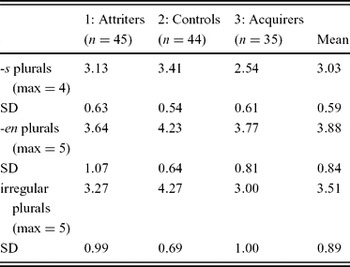
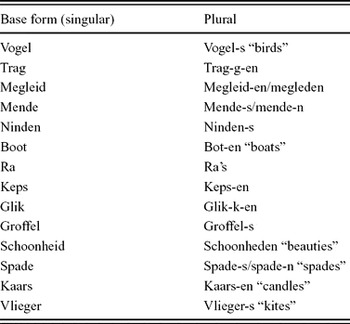
The wug test contained 14 items that elicited plural inflection (the items used are listed in the appendix, Table A).The maximum score on this part of the test was thus also 14. Table 1 summarizes the mean scores per group, divided into -s plurals, -en plurals and irregular plural forms.
Mean scores on the plural inflection wug task (n = 124).

The differences between the three conditions were found to be significant (Wilks’ Lambda = .559, F (6,238) = 13.338, p < .001, η2 = .25). This medium effect was found for each of the three plural allomorphs (p < .001 for the -s ending and irregular plurals, and p < .01 for pluralizations in -en). In the case of both -en plurals and irregular plural forms, the Dutch Canadians obtained significantly lower scores than the controls (p < .01 and p < .001, respectively). In addition, the children's scores were lower than those of the control subjects (p < .05 for -en plurals; p < .001 for irregular plural forms). In forming -s plurals, the children produced significantly lower scores than both adult groups (p < .001 in both instances), but no significant difference was found between the subjects in Canada and the control group in the Netherlands. Thus, the performance of the acquirers and attriters was similar with respect to both -en and irregular plurals, but differed with regard to plurals that end in -s.
The Dutch Canadians were found to produce more -s overgeneralizations than the other two groups, e.g. *glik-s for the expected glik(k)-en, or *trag-s rather than trag(g)-en. Across the board, however, by far the most deviations involved an overgeneralization of -en where the context required -s, exemplified in *groffel-en, both in the learners and emigrants. On the basis of its phonotactic properties (see section 2.1), this nonsense item was expected to pluralize in groffel-s. Regularization of irregular plural forms did not occur and typically only involved one noun: the plural of schoonheid “beauty” was frequently realized as *schoonheid-en rather than the standard schoonhed-en.
Occasionally and seemingly triggered by the surface form of the word, zero inflection was found in the plural. For example, the nonsense word keps was typically left uninflected, presumably because the final -s was already perceived as the plural marker. Based on the properties of this stem, however, keps-en was expected. Although these deviations were found in all three groups, they were especially prevalent in the data of the attriters and acquirers.
Plural inflection in the free spoken data
Despite the deviations in the formal wug test, virtually no interferences were attested in plural inflection in the free spoken data that were produced as part of the film retelling task. Only one Dutch Canadian subject produced a deviant plural form: kinder-s for kind-eren “children”. Even this, however, may have been a dialectal variant rather than a true “mistake”.
4.2 Diminutive formation
Diminutive formation in the wug test
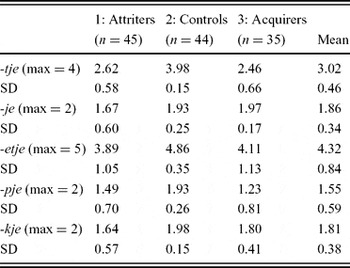
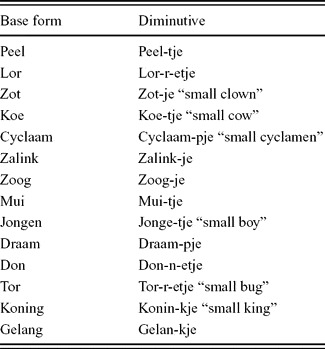
The wug test contained 15 items that elicited diminutive inflection (the items used are listed in appendix, Table B), which amounted to a maximum score of 15 on this part of the test. Table 2 presents the mean scores for each group.
Mean scores on the diminutive formation part of the wug test (n = 124).

The difference between the three conditions was significant (Wilks’ Lambda = .546, F (10,234) = 8.279, p < .001, η2 = .26), for all five diminutive allomorphs (p < .001 in all cases, except for diminutive allomorphs -je and -kje, where p < .005). This constituted a medium effect. For all allomorphs, the Dutch Canadians produced more deviant forms than the control subjects (p < .005 in all cases, except for -je, where p < .05). In addition, the children produced fewer standard forms than the subjects in the control group (p < .001 for -tje and -pje; p < .005 for -etje; p < .05 for -kje), but the performance of the attriters and acquirers did not differ significantly. One notable exception is -je, where the children outperformed the Dutch Canadians (p < .01). In fact, the children achieved the highest score of all groups on diminutives that end in -je and did not differ significantly from the controls with respect to this feature either. The Dutch Canadians’ score fell below that of the controls and the children.
Thus, all subjects, especially those in the Dutch Canadian and child groups, revealed deviations with respect to diminutive inflection, which mostly involved the selection of a deviant diminutive suffix, almost invariably the default -tje. For example, they typically produced forms like *cyclaam-tje for the standard cyclaam-pje “small cyclamen”.
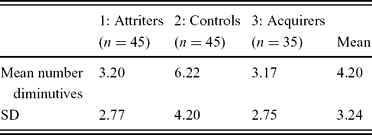
Diminutive formation in the free spoken data
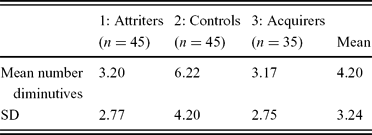
Diminutives were not very frequent in the free speech of the three groups of subjects, but did occur consistently (see Table 3). There was a significant difference in the number of times the three conditions employed diminutive forms in their narratives: F (2,122)= 11.811, p < .001, η2 = .19). In particular, the attriters used fewer diminutives than the controls (p < .001), as did the children (p < .005). The attriters and acquirers, on the other hand, did not differ from one another.
Mean number of diminutive occurrences in the free spoken data (n = 125)
Correct diminutive formation does not appear to be a problem in free speech, as only three deviant diminutive forms were attested. One of these was found in the narratives of the Dutch Canadian group and two were found in the speech of the controls. All deviations are presented in (6a–c), with the intended forms in brackets.
(6)
5. Discussion
Some evidence for the regression hypothesis was found on the basis of the results from plural inflection and diminutive formation, as parallels were observed between the attriters and acquirers. However, these two features were not the only ones under investigation; 13 other morphological and syntactic aspects were included in the original analyses (see section 2.1). Of these, seven revealed mirror symmetries between the attriters and acquirers, similar to the ones pointed out in more detail above. For noun phrase morphology, in addition to plural inflection and diminutive formation, agentive formation and article selection also produced significant parallels between the Dutch Canadians and the children. The same was true for verb phrase morphological aspects of simple past tense, past participles and future tense. Finally, two syntactic features (negation and passive constructions) also elicited similar performances on the part of the emigrants and learners (for more details, see Keijzer, Reference Keijzer2007, pp. 255–269). That implies that the features of adjectival inflection (noun phrase morphology), simple present tense and auxiliary selection (verb phrase morphology) and V2, subordination and discontinuous word order (syntax) did not reveal any mirror symmetries between the emigrants and adolescents.
These outcomes suggest that regression may be more prevalent in the area of morphology than in syntax. The two syntactic aspects that revealed mirror symmetries, negation and passives, themselves contain a large morphological component: Dutch negative participles are often merged, as in niet een “not a” into geen “no”. In addition, to form the passive, the verb is also inflected to form the past participle: from hij draagt “he carries” to hij wordt gedragen “he is carried”. The syntactic aspects under investigation that deal solely with word order (V2, subordination and discontinuous word order) did not show any parallels between the acquisitional and the attritional processes. As these aspects are acquired earlier than negation and passives, however, this outcome may in itself be congruent with the regression hypothesis.
The fact that evidence for the regression hypothesis was found is not enough for it to serve as an explanatory framework for first language attrition. It is not sufficient to merely note parallels in the order of language learning and unlearning; it is important to provide an explanation for this pattern. In other words, the question is no longer “whether regression is operative in the loss of grammatical structures, but rather when and under what conditions its predictions hold true, and what the causal mechanisms are”, as was pointed out with respect to L2 attrition almost a decade ago (Hansen, Reference Hansen1999a, p. 150). The mirror symmetries between the emigrants and learners themselves indicate internal restructuring. In other words, there must be constraints within the language system that cause parallels in its construction and dissolution and that causes optionality in both grammars. How these constraints are classified depends on the linguistic theory chosen.
Generative approaches, for example, would argue for UG-constrained grammars. All language systems, at all stages of development, share universal characteristics. At no point do grammars, either in child language or in dissolution, become rogue or wild grammars. Because language systems move within these constraints, they are bound to show parallels (Keijzer, Reference Keijzer2007, pp. 17–20). Although intuitively plausible, it remains extremely difficult to operationalize Universal Grammar. There is no agreed set of principles that characterize UG (Tomasello, Reference Tomasello2004). The range of UG-sanctioned material is vast, and to hypothesize that the outcome of acquisition and attrition is still governed by UG rather than resulting in rogue or wild grammars lacks precision. As a consequence, UG-constraints cannot lead to specific predictions about regression (MacWhinney, Reference MacWhinney1998, p. 201).
Another explanatory framework for regression is a usage-based approach to language. Important constructs to explain regression here are item-based learning and entrenchment. Children are thought to construct their language systems on the basis of particular items that they use to bootstrap information. Using principles of analogy, they are able, at a later stage, to transfer this information to novel contexts. Features that are acquired well and have thus become ingrained in the mind, usually at an early stage, become entrenched. Attrition too, is then thought to take place on an item-specific basis, which explains why regression is never an all or nothing phenomenon. Entrenched features are then described as close to impossible to dissolve (Keijzer, Reference Keijzer2007, pp. 22–29).
A relatively recent theoretical underpinning that could also be used to explain regression patterns is Dynamic Systems Theory (DST). DST views attrition and acquisition as two sides of the same coin: language is dynamic and every language user passes through stages of growth and decline throughout his or her life (de Bot, Reference Bot, Köpke, Schmid, Keijzer and Dostert2007). Although it is hard to predict the changes from one point to another because of all the dynamic variables that are involved, there are certain set points to which the language system is drawn, so-called attractor states. As these occur in both language attrition and acquisition, similarities are likely to show up (Keijzer, Reference Keijzer2007, pp. 29–36). As DST has its origin in the natural sciences and mathematics, not enough is known yet about its application to language to warrant clear predictions about the reasons for regression.
The implications that follow from the results of this study mainly involve the subtleties of the language system in development. Language attrition is not an all or nothing phenomenon and does not affect the ability to use the L1, but optionality occurs which is not present in mature native grammars. Significant in this respect is that parallels are revealed between attrition and advanced stages of acquisition. In that light, it is surprising that Dutch children as old as 13;9 (mean age) still appear to have some degree of optionality in their grammars. The language acquisition literature does not generally report this, although there are recent studies into the narrative capacity of advanced L1 learners that show similar optionality when compared to adult native speakers, notably in the work by Carroll and von Sutterheim (e.g., Reference Carroll, Stutterheim and Ramat2003).
6. Conclusion
This study has provided one of the most consistent findings with regard to the regression hypothesis so far: nine of the 15 features investigated revealed mirror symmetries between the attriters and acquirers at the time of testing. Given the set-up of the study, this outcome suggests that regression is a much more subtle phenomenon than has previously been assumed and, with that, that language acquisition continues for much longer than is generally reported.
The outcome that regression does obtain adds explicit evidence to the implicit studies that use regression as their basis (see section 1.1). The paper has also argued for the fact that regression patterns themselves are mere indications that similar constraints are at work in different developmental language systems, but that regression does not constitute a theoretical framework in itself. How these constraints are then interpreted depends on the selected linguistic theory. Perhaps the next step is to firmly place regression in an existing theoretical framework. This is desirable because in that way regression can help to uncover exactly what constraints underlie linguistic systems and with that can help solve part of the puzzle of language.
Appendix
The plural forms elicited in the wug test.

Note. To see the difference between analyzed and unanalyzed uses of morphology, there were a number of items in the wug test that were real words (such as Vogel-s “birds”), next to the nonce words. All real words items are glossed.
The diminutive forms elicited in the wug test.