Introduction
Persistent loneliness may pose a serious concern in older adults since it is related to poorer physical health (Luanaigh and Lawlor, Reference Luanaigh and Lawlor2008), impaired cognitive functioning (Wilson et al., Reference Wilson2007), increased mortality (Luanaigh and Lawlor, Reference Luanaigh and Lawlor2008; Holwerda et al., Reference Holwerda2012), and particularly depression (Alpass and Neville, Reference Alpass and Neville2003; Adams et al., Reference Adams, Sanders and Auth2004; Cacioppo et al., Reference Cacioppo, Hughes, Waite, Hawkley and Thisted2006b; Cohen-Mansfield and Parpura-Gill, Reference Cohen-Mansfield and Parpura-Gill2007). Prevalence rates of loneliness in older adults are high with estimates around 25% (Adams et al., Reference Adams, Sanders and Auth2004; Stek et al., Reference Stek, Vinkers, Gussekloo, Beekman, van der Mast and Westendorp2005).
Feeling lonely is a subjective experience that is distinct from objective social isolation. Social isolation relates to social integration indices such as no (longer) being married, living alone, or the number of contacts with friends and family members. Feelings of loneliness however refer to a discrepancy between the individual's desired and actual social relations, either in quantity or quality (Peplau and Perlman, Reference Peplau and Perlman1982). Therefore, loneliness is not equivalent to social isolation: socially isolated persons do not always feel lonely and lonely people are not necessarily socially isolated (de Jong Gierveld and Havens, Reference de Jong Gierveld and Havens2004).
Subjective loneliness has been consistently and strongly related to the presence of depressive symptoms in older adults. Loneliness is two to three times more prevalent in older adults with a depressive disorder than in nondepressed elders (Adams et al., Reference Adams, Sanders and Auth2004; Stek et al., Reference Stek, Vinkers, Gussekloo, Beekman, van der Mast and Westendorp2005). Several cross-sectional studies of older persons have shown that loneliness is one of the most important determinants of depressive symptoms (Alpass and Neville, Reference Alpass and Neville2003; Adams et al., Reference Adams, Sanders and Auth2004; Cacioppo et al., Reference Cacioppo, Hughes, Waite, Hawkley and Thisted2006b; Cohen-Mansfield and Parpura-Gill, Reference Cohen-Mansfield and Parpura-Gill2007).
This strong association between depression and loneliness raises questions about the distinctiveness of both constructs. Factor analytic studies provide evidence for their conceptual difference by showing that items from depression and loneliness rating scales load on separate factors (Cacioppo et al., Reference Cacioppo2006a). Accordingly, from a clinical perspective, it becomes clear that both phenomena appear to be related but separate entities: although depression is common in lonely older adults, almost half of the depressed elders do not report feeling lonely (Stek et al., Reference Stek, Vinkers, Gussekloo, Beekman, van der Mast and Westendorp2005).
Yet the exact nature of the relationship is poorly understood. The above-mentioned studies were all performed in pooled samples of older adults with and without depressive symptoms. To our knowledge, no single study has yet been conducted in a sample consisting exclusively of older adults with depressive symptoms. The consequences of co-occurring loneliness and late life depression are therefore unknown.
The perspectives of lonely older persons with depressive symptoms on this matter have not been addressed either. The only qualitative study performed on this subject in a pooled sample suggests that deeper insight into older persons’ illness perceptions may have a considerable potential to improve depression management. This study implied that older persons view loneliness as a precursor to depression and that it might be less stigmatizing to express feelings of loneliness than to disclose depressive symptoms (Barg et al., Reference Barg, Huss-Ashmore, Wittink, Murray, Bogner and Gallo2006). We consider the absence of any mention of loneliness in depression guidelines a significant omission.
Current research does not yet provide a comprehensive understanding of the consequences of co-occurring loneliness and late life depression or offer recommendations for the prevention and treatment of depression in lonely older persons. Therefore, more insight into the complex association between depression and loneliness, and in particular the perspectives of older persons themselves, is needed. The present study uses both quantitative and qualitative methods to answer the following research questions: (1) are feelings of loneliness in older persons with depressive symptoms associated with more serious mental health consequences? And (2) how would older persons with depressive symptoms and loneliness experience these feelings?
Methods
Design
This study was conducted as part of the “Lust for Life”-trial, aimed at preventing and treating depression in older adults by implementing a stepped care intervention program. This program was implemented in 18 general practices and one home care facility in the Netherlands. These practices and the home care facility were randomized into four clusters following a stepped-wedge randomized-cluster design. Although starting moments were phased, the intervention program was implemented in all clusters by the end of the study. Enlisted older persons with depressive symptoms were recruited by screening. They then completed a baseline and entered a waiting period for the intervention program to be implemented in their cluster. Subsequently, they were invited for an intake session to discuss participation in the interventions when depressive symptoms persisted. All subjects were followed up from baseline.
For the current study, a mixed-methods approach was used to provide a more comprehensive view on the close connection between depressive symptoms and loneliness than either quantitative or qualitative methods can provide on their own. Quantitative methods are appropriate to relate subjects’ objective mental health to the presence of loneliness. Qualitative methods are suitable to gain an understanding of older adults’ perceptions of emotional distress and perceived needs. In the present study, both methods were integrated to verify and corroborate findings from different approaches about this single phenomenon (triangulation) and to elaborate on or clarify the results of one method by means of the other (complementarity). The VU University Medical Centre Ethical Review Board approved of the study (No. 2010/084).
Recruitment
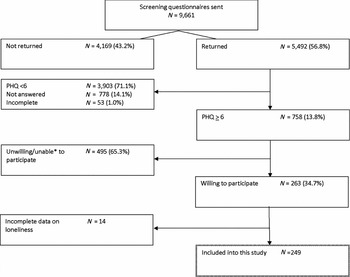
Subjects were recruited from 18 participating general practices and a home care facility in the Netherlands (Figure 1). All enlisted persons of 65 years and older (N = 9,661) were informed about the intervention program and invited to fill in a screening questionnaire for depressive symptoms, the self-report Patient Health Questionnaire-9 (PHQ-9; Spitzer et al., Reference Spitzer, Kroenke and Williams1999). The questionnaire was returned by 5,492 persons (56.8%), of whom 758 (13.8%) scored above the predefined cut-off score of 6. Four hundred and sixty three persons refused participation and 32 persons were excluded (9 had insufficient mastery of the Dutch language, 3 moved outside the research area, and 18 could not be reached). Data on loneliness were missing for 14 subjects, leading to a final sample of 249 persons for the current study.
Recruitment of subjects. * 29 subjects were excluded for reasons of the insufficient mastery of the Dutch language (n = 9), deceased/could not be reached (n = 18), or moving outside the research area (n = 2).

Data collection
Quantitative data collection
After screening assessment and obtaining written informed consent, subjects were invited to complete a baseline structured telephone interview and fill in a written questionnaire. Written follow-up measurements took place every three months after baseline for two years.
Qualitative data collection
Qualitative data reported on in this paper were obtained from semi-structured interviews to gain a deeper insight into subjects’ experiences of emotional distress and reasons for accepting or declining the “Lust for Life”-intervention program, reported on elsewhere (van Beljouw et al., submitted). Therefore, interviews were performed after the intake session had taken place and subjects had decided on accepting or declining the program. A convenience sample of all cluster three subjects eligible for intake (PHQ ≥ 6, n = 38) were invited by telephone to participate in the interviews after the goal of the research had been explained to them. Twenty six subjects agreed to being interviewed, six persons refused participation, five could not be interviewed within the time frame of this study, and one subject could not be reached. Two respondents did not provide recent data on loneliness and were therefore excluded from the current analyses. Of the 24 remaining interviewed subjects, 5 refused and 19 accepted the intervention program. Interviews were conducted at the subjects’ homes by two researchers (MH or IvB) within 5 weeks after the intake session took place, and lasted between 31 and 92 minutes.
Measurements
Quantitative measurements
Feelings of loneliness were measured by the validated De Jong Gierveld Loneliness Scale (De Jong-Gierveld and Kamphuis, Reference De Jong-Gierveld and Kamphuis1985), citing 11 statements such as “I miss having people around,” that can be rated on a 3-point rating scale. A cutting score of ≥3 was used to distinguish not lonely from lonely people (van Tilburg and de Jong Gierveld, Reference van Tilburg and de Jong Gierveld1999). A second cutting score was used to distinguish severe loneliness from no or mild feelings of loneliness by splitting sum scores at the median. This cutting score of ≥9 was in accordance with the cut-off reported by Van Tilburg and De Jong Gierveld (Reference van Tilburg and de Jong Gierveld1999) to distinguish severely lonely persons from not/mildly lonely individuals.
Background characteristics were gathered by means of written questionnaires. For mental (ill-) health, diagnoses of past and current (in the past 2 weeks) major depressive disorder and dysthymia as well as the age of onset and number of previous depressive episodes were assessed by the Mini International Neuropsychiatric Interview (MINI; (Sheehan et al., Reference Sheehan1998), a short structured diagnostic interview conducted by telephone by trained research staff. Current dysthymia was only explored when a current depressive disorder was absent. For symptom severity, scores on the Patient Health Questionnaire-9 (PHQ-9; Spitzer et al., Reference Spitzer, Kroenke and Williams1999) during screening were reported. Feelings of anxiety were derived from two items from the Medical Outcomes Study Short Form 36 (SF-36; Ware and Sherbourne, Reference Ware and Sherbourne1992). Since higher scores were related to less feelings of anxiety, scores were inverted to facilitate interpretation. Self-rated quality of life was measured with Cantril's Ladder (Cantril, Reference Cantril1966).
Qualitative measurements
Qualitative semi-structured interviews started with an open question about the most important reason(s) for accepting or declining the intervention program. To fully capture older persons’ perspectives and beliefs, we consequently asked subjects about their self-perceived emotional problems in a semi-structured way. Subjects’ own terminology to describe their emotional distress (e.g., feeling “gloomy,” “lonely,” or “anxious”), was adopted by the interviewer in subsequent questions on self-perceived causes of emotional problems and need for care.
Data analysis
Quantitative data analysis
Simple and multiple logistic regression techniques were used to determine which mental health factors were associated with severe loneliness, adjusting for age, sex, and educational level. Determinants with a nonlinear relationship (PHQ-scores, number of depressive episodes) were divided into quartiles. SPSS version 20 was used for all analyses.
Qualitative data analysis
Semi-structured interviews were digitally recorded and transcribed verbatim. Transcripts were read and reread and a coding tree was built around key themes such as “perception of current emotional distress” using Atlas.ti 5.2. Within the key themes, different levels of codes were constructed (e.g., “type of emotional distress” or “cause of emotional distress”), each consisting of several sub-codes (e.g., “mood-related problems,” “feelings of loneliness,” and “feelings of anxiety or worrying”). Interviews were independently coded by two researchers (MH and IvB), and discussed until consensus was achieved. Data saturation was reached since no new themes emerged from the interviews.
Coded interviews were scrutinized for underlying themes and associations between themes by applying grounded theory approach (Strauss and Corbin, Reference Strauss and Corbin1990). Emerging themes were compared between not/mildly lonely subjects and severely lonely persons. This distinction was based on recent scores on the De Jong Gierveld Loneliness Scale (De Jong-Gierveld and Kamphuis, Reference De Jong-Gierveld and Kamphuis1985), collected during a regular follow-up measurement within 6–15 weeks around the semi-structured interview. To minimize subject burden in validation procedures (Barbour, Reference Barbour2001), subjects checked and – if applicable – added to an oral summary of the discussed themes provided by the interviewer at the end of the interview. Coauthors attended regular team meetings in which original data, (sub-)codes, and results were presented and discussed (Tong et al., Reference Tong, Sainsbury and Craig2007).
Results
Sample
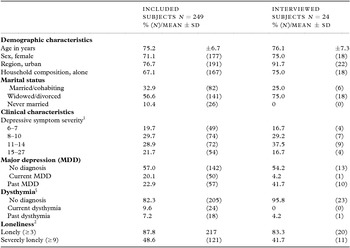
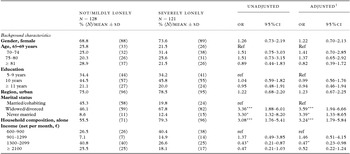
Results from quantitative analyses were based on data from all included subjects (n = 249); qualitative results were derived from semi-structured interviews with a subsample of 13 not/mildly lonely and 11 severely lonely individuals. Demographic and clinical characteristics of both samples are shown in Table 1. Feelings of loneliness were highly prevalent among older adults with depressive symptoms: 87.8% (n = 217) perceived loneliness. Almost half of all subjects felt severely lonely (48.6%, n = 121). Table 2 shows differences in background characteristics between not/mildly lonely and severely lonely persons.
Demographic and clinical characteristics of included (left) and interviewed (right) persons (by means of semi-structured interviews)

1Measured with the PHQ-9, range 0–27.
2Measured with the Jong Gierveld Loneliness Scale; loneliness at baseline shown for all included respondents, and for interviewed subjects within 6–15 weeks around the interview.
§Numbers do not add up to 100% due to missing values (n = 2).
Differences in background characteristics between subjects who feel not/mildly lonely versus those who feel severely lonely (N = 249); results from simple and multiple logistic regression analyses.

†p < 0.10, *p < 0.05, **p < 0.01, ***p < 0.001.
1Adjusted for age, sex, and educational level (if applicable).
Mental health consequences of co-occurring loneliness and depression
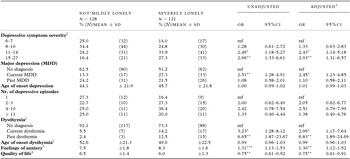
Table 3 shows the results of logistic regression analyses comparing subjects with depressive symptoms and severe feelings of loneliness to not/mildly lonely individuals on several personal and clinical factors. Qualitative information was used to elaborate on or add to these findings.
Differences in mental health characteristics and perceived need for care between subjects who feel not/mildly lonely versus those who feel severely lonely (N = 249); results from simple and multiple logistic regression analyses

†p < 0.10, *p < 0.05, **p < 0.01, ***p < 0.001.
1Adjusted for age, sex, and educational level.
2Measured with the PHQ-9, range 0–27.
3Measured with the SF-36 anxiety items, range 3–12 (scores were inverted, so that more severe feelings of anxiety correspond to higher scores).
4Measured with the Cantril's Ladder, range 0–10.
§Numbers do not add up to 100% due to missing values (n = 2).
Older people with depressive symptoms who were severely lonely suffered from worse mental ill-health than not/mildly lonely older adults. Severe loneliness was associated with more severe depressive symptoms, a current major depressive disorder, a current or past dysthymic episode, and more feelings of anxiety. Also a lower self-rated quality of life was related to perceiving severe feelings of loneliness.
The association between loneliness and worse mental ill-health also became apparent from the qualitative data. When asked whether subjects experienced emotional problems, a wide range of symptoms and complaints was described. Although all subjects scored above the cut-off score of six on the Patient Health Questionnaire, indicative of the presence of depressive symptoms, several not/mildly lonely persons mentioned other problems than a depressed mood such as having trouble sleeping or feelings of anxiety. Yet mood-related problems were acknowledged by all subjects who felt severely lonely.
Further, about three-quarters of the severely lonely persons also perceived their emotional distress as (highly) burdensome. For instance, a 74-year old male (resp#14) stated: “At this age, I really don't like having to struggle through all those years to come by myself.” In contrast, only a minority of older not/mildly lonely persons described their emotional problems (if present in their opinion) as hindering. For example, an 81-year old female (resp#11) said: “Sure, I have my ups and downs. But that is part of life, isn't it? You don't need to be upset by that.”
Experience of loneliness and depressive symptoms
Three major themes emerged from the in-depth interviews about older persons’ experiences of depressive symptoms and severe loneliness: (1) the self-perceived relationship between depressive symptoms and loneliness; (2) self-perceived causes of severe loneliness; and (3) self-perceived needs to alleviate emotional distress.
The relationship between depressive symptoms and loneliness
Most severely lonely persons attributed their depressive symptoms to feeling lonely or to limitations of their social network. A 74-year old female (resp#21) explained: “Well yes, I am alone. I have lost my husband, I have lost my parents. I don't have anyone. That also makes me gloomy”. Or, as a 79-year old female (resp#7) stated: “I feel sad pretty often, because I think: darn, I'm alone, but they [my children] won't call.” Although feeling lonely was also perceived as the cause of their depressive symptoms by a minority of not/mildly lonely older adults, most of them mentioned other reasons. They referred to a wide variety of aging-related circumstances such as physical constraints, grief over the loss of loved ones, losing their homes by moving to retirement housing, or no longer being able to fulfill (volunteer) work.
Self-perceived causes of severe loneliness
Severely lonely persons with depressive symptoms attributed their feelings of loneliness to external rather than internal factors. Changes in or perceived shortcomings of their social networks were regarded as logical causes of their loneliness. Severely lonely subjects referred to the loss of others due to illness, death, divorce, moving away, or to infrequent contact with children. For example, a 74-year-old male (resp#14) commented: “I am actually disappointed in people. [. . .] Also in my own children. I hardly ever see them. [. . .] It makes me sad, as the world around you has become so small.” Or, as a 79-year-old female (resp#7) said: “I used to have nice friends, but unfortunately I have lost them. I always have to do everything by myself.” Some others mentioned external factors that maintained their feelings of loneliness, e.g., limited mobility or having little money to spend on activities. An 86-year-old female (resp#17) explained: “I used to have a lot more social contacts. [. . .] But I couldn't visit them, and they can not come to me, they are all becoming old. We are all in the same boat.”
Two older severely lonely adults pointed to personal characteristics that limited them in engaging in or seeking new social contacts, such as constantly bringing up their own diseases in conversations with others or having a low self-esteem: “[I do] not have such a strong self esteem anymore. And also having very little social contact. So these things reinforce each other a little.” (a 66-year-old male, resp#24).
Self-perceived needs to alleviate emotional distress
The majority of not/mildly lonely older adults perceived an important role for themselves in alleviating their emotional distress, by expressing a need to learn new skills to handle emotional problems or to exchange experiences with other elders with the same problems. For example, a 75-year old female said: “Well, some kind of tool to pick myself up a little. [. . .] Like: think about that, or try to do that. . .” (resp#3). The majority of severely lonely persons however disclosed more passive needs for care. They mainly expressed the need to be listened to. This need could be fulfilled by someone they confided in, who was not necessarily a professional. For instance, a 73-year old woman (resp#12) stated: “Because you don't have anyone to talk to. Or to tell your story to. That I regret. That is something that I would really like.” Only one person expressed a need to talk to a professional care giver: “. . . to be able to talk to someone about that. [. . .] The therapeutical conversation. To see how someone else looks at that. From a more professional perspective” (a 66-year-old male, resp#24). The need to meet other (like-minded) elders to share common interests or activities with was only mentioned by two severely lonely persons.
Discussion
This is the first study examining the consequences of co-occurring loneliness and depression in a sample exclusively consisting of older adults with depressive symptoms in detail. Our unique mixed-method findings showed that severe loneliness is a serious concern in older people with depressive symptoms, given its high prevalence and worse mental ill-health. From older persons’ perspectives, it became clear that depressive symptoms were seen as a logical consequence of severe loneliness. Severely lonely persons furthermore perceived little command in the experience and possible solutions to their feelings of loneliness: the causes of loneliness were attributed externally to perceived deficits in their social networks and they mainly expressed the need to be listened to.
The mental health consequences of co-occurring loneliness and late life depression had not been studied before in a sample consisting exclusively of older persons with depressive symptoms. We found that a worse mental ill-health was more frequently seen in severely lonely older adults with depressive symptoms compared to not/mildly lonely depressed persons. Our findings are underlined by trends observed in studies using pooled samples of older adults with and without depression, showing a linear relation between loneliness and depression severity (Alpass and Neville, Reference Alpass and Neville2003; Adams et al., Reference Adams, Sanders and Auth2004; Cacioppo et al., Reference Cacioppo, Hughes, Waite, Hawkley and Thisted2006b; Cohen-Mansfield and Parpura-Gill, Reference Cohen-Mansfield and Parpura-Gill2007). The exact nature of the association between loneliness and depression is yet poorly understood, although it does seem clear from factor-analytic studies that they are related but distinct phenomena (Cacioppo et al., Reference Cacioppo2006a). Although older persons themselves perceived (severe) loneliness as a gateway to depression, as has been reported previously (Barg et al., Reference Barg, Huss-Ashmore, Wittink, Murray, Bogner and Gallo2006), results from existing longitudinal studies on the direction of this association remain diverging (Heikkinen and Kauppinen, Reference Heikkinen and Kauppinen2004; Cacioppo et al., Reference Cacioppo, Hughes, Waite, Hawkley and Thisted2006b; Cacioppo et al., Reference Cacioppo, Hawkley and Thisted2010). Our cross-sectional data are not suitable to provide answers to this question.
Our quantitative results have shown that severely lonely persons with depressive symptoms perceived little command in the experience and possible solutions to their emotional distress. Feelings of loneliness were attributed externally to perceived deficiencies in their social networks due to (aging-related) losses of loved ones and limited contact with family members, especially with children. This finding that important fractured relationships are perceived as precipitating loneliness as people age is in line with previous research (McInnis and White, Reference McInnis and White2001; Smith, Reference Smith2012). Growing older is inevitably accompanied by losses of important other people, but the way this is dealt with underlines an important difference between lonely and not lonely older persons. Kirkevold et al. (Reference Kirkevold, Moyle, Wilkinson, Meyer and Hauge2013) note that the ability to cope with losses by moving on and staying connected to others is more frequently seen in not lonely older persons, while lonely individuals appear to be more often paralyzed by the loss of important relationships. Also, not lonely older persons try to deal with infrequent contact with children by not depending too heavily on them but to focus on social relationships outside of their families. In contrast, lonely elders feel disappointed in their children and their limited contact is perceived as an important cause of loneliness (McInnis and White, Reference McInnis and White2001; Kirkevold et al., Reference Kirkevold, Moyle, Wilkinson, Meyer and Hauge2013), as also confirmed by our findings. Lonely persons rather wait for others to connect with them, instead of taking matters into their own hands.
The most important clinical implication derived from our findings is that it could be of great value to enquire about (severe) feelings of loneliness when discussing depressive symptoms with older adults in the doctor's office. Terminology could be adapted more to older persons’ illness perceptions by acknowledging the important role of loneliness in the onset and existence of current depressive symptoms. This might in turn increase older persons’ willingness to accept depression treatment since most severely lonely elders with depressive symptoms view their loneliness as the most significant problem and their treatment might, therefore, require a tailored approach. Since our results suggest that severely lonely persons are less inclined to seek help, it might especially tempt those with mild feelings of loneliness into accepting treatment. It should be noted however that this recommendation applies to older persons with mild to moderate depressive symptoms; it seems less applicable to the treatment of persons with severe depression.
The consequences of our findings for current depression guidelines however remain unclear.
It is unknown whether lonely older persons with depressive symptoms are willing to discuss their severe loneliness in the doctor's office, whether they perceive a need to alleviate these feelings and whether the recommendation to address feelings of loneliness actually improves depression treatment uptake and outcomes. Furthermore, addressing loneliness in older persons with depressive symptoms alone might not be sufficient to improve the initiation and management of depression treatment. It is unclear whether interventions aimed at alleviating loneliness might have a considerable potential to treat or prevent depressive symptoms in older persons. Future research is needed to provide an answer to these questions.
This is the first study of the mental health consequences of co-occurring loneliness and late life depression in older adults with depressive symptoms. The combined approach of qualitative and quantitative methods allowed for a thorough examination of this subject from different perspectives. However, our study also has its limitations. As can be expected, results are only based on the perspectives of subjects who willing to be screened and gave informed consent to participate in the study. Also, measurement bias cannot be ruled out in the assessment of depressive symptoms by a validated self-report questionnaire such as the PHQ-9. Further, due to time constraints, purposive sampling for the semi-structured interviews was less feasible, leading for instance to a limited number of male subjects who were interviewed since depression occurs less frequently in males. Also, although perceived loneliness is associated with personality characteristics, especially neuroticism (Cacioppo et al., Reference Cacioppo2006a; Luanaigh and Lawlor, Reference Luanaigh and Lawlor2008), we were unable to relate respondents’ personality traits to their perceived feelings of loneliness (or control for them) since this information was not collected in the original study.
In conclusion, our findings underline the importance of paying considerable attention to (severe) loneliness in older adults with depressive symptoms, given its high prevalence and serious consequences. Addressing loneliness in the doctor's office may provide an opportunity to better adjust to older persons’ depression perceptions and might therefore improve care utilization.
Conflict of interest
None.
Description of authors’ roles
I. van Beljouw carried out the study, carried out and coded the semi-structured interviews, performed the qualitative and quantitative analyses, and wrote the paper. M. Heerings carried out and coded the semi-structured interviews, performed qualitative analyses and cowrote the paper. E. van Exel, H. van Marwijk, and M. Stek had the original idea for the study, designed the study, obtained the grants, helped in the analyses and interpretation of the data, supervised the project, and cowrote the paper. H. Comijs supervised the project, helped in the analyses and interpretation of the data and cowrote the paper. J. de Jong Gierveld helped in the analyses and interpretation of the data and cowrote the paper. All authors approved the final version of the manuscript.
Acknowledgments
This work was supported by The Netherlands Organisation for Health Research and Development (grant number 60.61900.98.353).