INTRODUCTION
Political parties and candidates need funding to communicate their message to potential voters and for expenses such as campaign rallies, advertising, salaries and stationery and yet, the impact of money in politics in African elections is under-studied. Although access to money is not the only determining factor in winning an election, well-resourced candidates and parties can engage with more voters. Candidates with membership in wealthier political parties or those that are independently wealthy can afford campaign expenditures such as candidacy fees, paraphernalia, and gifts for voters, placing them in a better position to win elections.
Although there is a growing literature on party finance (Teshome-Bahiru Reference Teshome-Bahiru2009; Pottie Reference Pottie2010; Dombo Reference Dombo and Mendilow2012; Sanches & Bértoa Reference Sanches and Bértoa2019), most contemporary research on money and politics in African elections has narrowly focused on the role of patronage and clientelism politics as failures of the political system and not in connection with political finance. The study of political corruption, which includes vote buying, is essential, but it does not adequately address the challenges that less resourced political parties and their candidates face when campaigning for office. For example, Nugent (Reference Nugent, Basedau, Erdmann and Mehler2007: 252) argues that direct vote buying in the second wave of democratisation became a ‘second best strategy’ as incumbent parties found better strategies such as giving constituencies specific gifts to stifle opposition. The newer strategies employed since the third wave of democratisation transformed political campaigns into a transaction. As a result, African voters have grown to expect more material gifts in exchange for their votes and politicians with an ability and willingness to distribute largesse do better. For example, the famous social media activist and losing Senate candidate in Kenya's 2017 election, Boniface Mwang Mwangi,Footnote 1 shared that voters would often ask what he was buying them with the campaign funds he was raising. During the 2018 campaign season in Zimbabwe, at a rally in a peri-urban suburb, Epworth, I observed one ruling party official who officiated a campaign rally empty-handed getting booed down by angry voters demanding gifts. Stories like these are not uncommon across African elections; they highlight how the role of money in politics is not fully understood beyond arguments about clientelism. This oversight is in part because of the difficulty of tracking money in politics. Scholars who study money in politics believe that money can ‘influence the broader character of an emerging democrac,’, and an influx of private money from individuals or foreign organisations can undermine democratic growth (Butler Reference Butler2010). While agreeing with this general premise, this paper furthers the arguments that show how the lack of public funding for elections in Zimbabwe and other African countries is harmful to democratic growth.
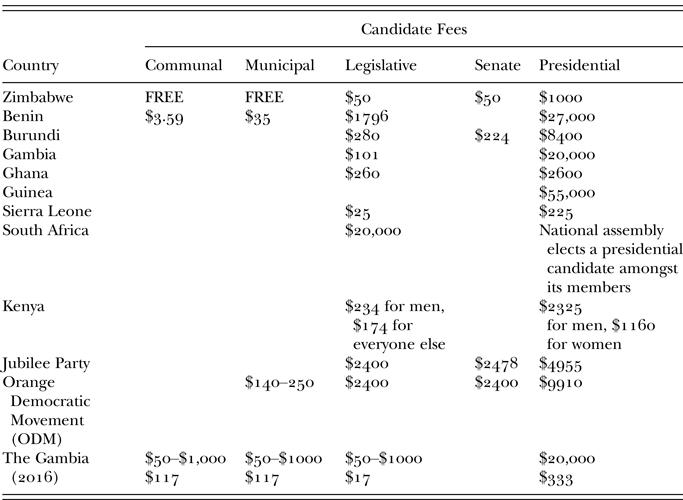
Democracy hinges on citizens’ ability to select the best possible candidates out of a subset of citizens willing to represent them in office. Because democracy is inherently an expensive process, the rising cost of elections globally limits candidate choices available to voters. Even in established democracies such as the USA, voters are shocked by the high cost of elections. Americans spent an estimated $6.6 billion in the 2016 elections, and the UK spent an estimated $200 million in their 2015 elections (Thompson Reference Thompson2012). In Africa, election expenditure is equally staggering: in 2013, Zimbabwe spent $420 million, and Nigeria spent an estimated $627 million (Institute for Legislative Studies 2015); in 2014, South Africa spent an estimated $117 million (Aggrey Reference Aggrey2016); in 2017 the Kenyan election cost almost $1 billion. As in Nigeria, Kenyan candidates with links to big businesses received the most funding. Spending limits set by the election commission did nothing to curb spending, which included helicopter rides for candidates in the ruling party and a few in the opposition. A 2014 report revealed that individuals with political connections owned over 50% of Kenya's wealth (Nzioka & Namunane Reference Nzioka and Namunane2014); these same individuals invested heavily in the 2017 election in favour of the winning party (Kiboro Reference Kiboro2017). In nearly every country the fees for candidacy are relatively high, considering that the majority of the world's poorest are African. Registration fees for candidates and political parties range from $225 in Sierra Leone to over $55,000 in Guinea. In Zimbabwe, the nomination fees for presidential candidates increased by 100% from $500 in 2013 to $1,000 in 2018. In the Gambia, former President Jammeh introduced a law that increased candidate fees more than 100%; fees for presidential candidates went up to $20,000 thereby disadvantaging poor candidates, the majority of whom earn less than $280 a year (Johnson Reference Johnson2015). During the 2017 election in South Africa, the opposition party, The Economic Freedom Fighters (EFF), appealed in court for exemption against the $45,000 registration fees for political parties, arguing that these fees are not within reach of their membership.
This paper contributes to the growing literature on the role of campaign money in developing countries with a focus on implications to opposition politics. I argue that uneven access to party finances and constraints on funding affect opposition parties and, by extension their candidates, weakening democratic consolidation (Arriola Reference Arriola2011). More specifically, when competing against long-serving ruling parties, opposition challengers with fewer resources face more robust campaigns as dominant parties can monopolise media access, engage in vote-buying and politicise public benefits to their advantage. In particular, this essay shows that dominant parties such as Zimbabwe's ruling party, the Zimbabwe African National Union-Patriotic Front (ZANU-PF), are those parties that have been in power for three or more election cycles. While an increasing number of African countries have managed to pass Huntington's two-turnover test (Huntington Reference Huntington1993) of peaceful transitions of power during elections, Zimbabwe's democratic growth has been stagnant. Since 1999 opposition parties in Zimbabwe, especially the main opposition, the Movement for Democratic Change (MDC), have been victims of brutal tactics by the ruling ZANU PF. Additionally, the monopoly of ruling parties over state resources blurs the line between the state and party.
Beyond Zimbabwe, in South Africa, Botswana, Zambia, Rwanda and Cameroon, opposition parties are struggling with different levels of political openness. Dominant explanations of opposition weakness suggest that ruling parties rely on vote buying, neopatrimonialism and clientelism, strategies that produce an uneven electoral playing field and strengthen incumbency advantage politics (Van de Walle Reference Van de Walle2007; Lindberg & Morrison Reference Lindberg and Morrison2008; Arriola Reference Arriola2009; Vicente & Wantchekon Reference Vicente and Wantchekon2009; Young Reference Young2009). On the one hand, some scholars argue that African politicians will blatantly offer money in exchange for votes (Vicente & Wantchekon Reference Vicente and Wantchekon2009; Bratton et al. Reference Bratton, Bhavnani and Chen2012) and, on the other hand, scholars argue that, instead of offering voters hard cash, politicians promise to deliver gifts, goods and services to voters who support them. Young (Reference Young2009) on clientelism in Kenya and Zambia found that although patronage politics are strong, vote buying in terms of a vote for a direct cash exchange is very rare. Yet, African voters expect more personal gifts and attention from their representatives than do voters in more developed democracies (Basedau et al. Reference Basedau, Erdmann and Mehler2007; Carlson Reference Carlson2010). Missing from the discussion by Young and other clientelism scholars is the impact of access to the money needed to fund political activities on democratisation.
The involvement of donors in African elections, as LeBas (Reference LeBas2013) found, complicates the political finance narrative. Across Africa and in many developing countries democracy projects have been heavily funded by outsiders. Foreign aid, even in the best of political circumstances, cannot meet all the needs of political parties. Most countries, including Zimbabwe, have electoral funding laws that make it difficult for foreign donors to fund campaigns directly, especially those whom they feel might favour regime change. Thus, money received by the opposition, as in the case of Zimbabwe's Movement for Democratic Change (MDC), tends to be remitted via third-party civil society organisations. In the end, only a fraction of the targeted funding is used for campaign finance as the majority is used to cover the costs of operating civic organisations. Additionally, donor funding is irregular and mitigated by factors ranging from domestic policies in donor countries to regulations in receiving countries.
Building on existing literature on money in politics and drawing from extensive interviews with politicians, citizens and government workers, news reports and court cases, between the 2013 and 2018 elections in Zimbabwe, I argue that limited public financing for political parties and their candidates limits the breadth of candidates available for voters to choose from and results in the continued candidacy of long-term politicians. In countries where public funds are only made available to incumbents this serves as some form of incumbency advantage-extra, an added benefit to their already existing benefits. Additionally, low public campaign funding results in the election of candidates who are not motivated to deliver public goods because of their ability to fund their elections independently. When candidates fund themselves, or when one party abuses their control over public funds to support their election, they are less likely to feel beholden to the public that elected them into office. Therefore the low financing of opposition candidates, who unlike the ruling elites are often not independently wealthy, explains the dominance of ‘big men’ in African politics.
RESEARCHING CAMPAIGN FINANCE
Alexander Heard, a pioneering scholar of money in politics, encountered numerous challenges that persist today. Heard (Reference Heard1962: 3) wrote, ‘There are no convenient, dependable data on the sources and uses of political money; a student must forage far and wide to find materials with which to work. In consequence, any extensive study of money in elections is necessarily a cooperative venture.’ This reality is further complicated by the fact that political and government elites are unwilling to share information on their sources of funding. Funding often comes from third-party donors who have varied incentives for both donating and subsequently sharing the data. With this in mind, the best way to source political finance data from individual politicians is by assuring them a great deal of anonymity.
An attempt to study money in politics in any context is messy; the situation is messier in African politics where issues of corruption and donor money confound and make the sources of money unclear. Ruling parties often control channels for public funding, including money collected from taxes. They also tend to control private funding, such as money from international donors. Effectively, Africa's ruling elites have access to money that is not publicly recorded. A paradox emerges in which the high cost of sustaining political parties is prohibitive, yet political parties have the most critical and expensive responsibility in a modern democracy: ‘to prepare and select candidates for parliamentary and presidential elections and then to support them into positions of leadership and government’ (Barnet Reference Barnet2017). Another way to think of this is that no one would disagree that politics requires money; yet, the majority of citizens would prefer not to think about money in politics.
For this project, I conducted 10 survey interviews with current members of Parliament and former parliamentary candidates in Zimbabwe between August 2016 and February 2017. I contacted participants through a list of current members on the Zimbabwe parliament website, think-tanks such as Kubatana, and relied on personal contacts to reach members who did not have current contact information available publicly. The initial list included over 40 candidates (winners and losers) from the 2013 election from the three political parties: the ruling ZANU PF, the main opposition MDC-T and the second opposition MDC-W (M). Thirty politicians responded positively to the initial contact, but only 10 were willing to participate in the interviews; five high-ranking government officials responded with a firm refusal, and the rest never responded, or I was unable to get their contact information. For the 2018 election, I repeated the process and included in my analysis five independent candidates who gained prominence as the election progressed.
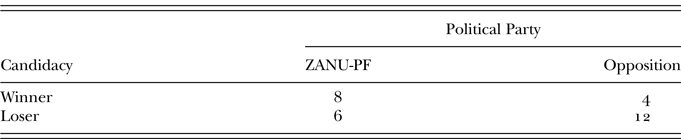
The final database of politicians interviewed had 30 individuals, as shown in Table I. Respondents included six losing ZANU PF youth league urban challengers; two MDC-T Youth-League candidates, an incumbent who retained their seat and a challenger who lost; two incumbent ZANU PF candidates who retained their seats; and three incumbent MDC-T candidates who retained their seats. I also interviewed the MDC-T-US chairman, ZANU PF UK chairman, activists and government officials.
Interviewed parliamentary candidates by party and election result.

Respondents who provided an email address received a survey before a phone conversation. Most respondents expressed concern that email is not secure, it takes too much time, and the data required to use email are expensive. While email is standard procedure, I bring it up as caution that African politicians may not be amenable to responding to email requests. All but one of the respondents chose to either engage in a conversation over encrypted text-messaging Whatsapp or phone calls. The interviews took place over several months between the 2013 and the 2018 elections. The survey had 10 questions on party ID, receipt of party funds during the 2013 election, expenditures and party processes for funds disbursement. The phone interviews were semi-structured but based on the initial interview. Interviews lasted between one and three hours. Most respondents answered the majority of questions. However, none of the respondents provided a definitive answer to how much they spent on their campaign, opting to give a range of figures. They operate in a very uncertain political environment, and because, as one respondent explained, they are all vying for the same pots of money, it would not be prudent to share his sources with rivals.
In addition to conducting interviews, I was in the field during the 2013 and 2018 elections. I spent a total of 10 months in Zimbabwe, attending rallies, election meetings with civil society organisations and watching state media news in real time. In heavily policed states such as Zimbabwe and other sensitive political environments, scholar observations and ethnographic work are equally necessary and perhaps more feasible than conducting interviews and collecting survey data. Most responders were unwilling to write anything down or respond to online surveys, arguing that if their responses landed in the wrong hands, they might get into trouble. Members of the ruling party who agreed to be interviewed only did so on condition that we met in very secluded areas where they were unlikely to meet anyone they knew or other party representatives.
A BRIEF REVIEW OF PUBLIC FUNDING SINCE INDEPENDENCE
The current public funding laws only provide funds for parties that win at least five percent of the vote. Since 2000, only the ruling party ZANU PF and the opposition MDC-T have been eligible to receive public funding. These laws criminalise sourcing funds from international donors. Politicians are underfunded and often resort to ‘overt and covert methods’ to sustain their political aspirations (Masunungure Reference Masunungure2011). The ruling party's guaranteed access to unlimited state funds is the biggest impediment to Zimbabwe's nascent democracy because opposition parties face tremendous financial challenges.
Since gaining independence in 1980, Zimbabwe has been governed by a single dominant party.Footnote 2 ZANU PF operates and manages state resources as though the party and the central government are one entity when, in fact, the constitution guarantees the separation of party and state. An example of the troubling nature of this state-party relationship is the creation of the Ministry of Political Affairs in 1987 headed by war hero Maurice Nyagumbo. It received millions of tax-payer dollars (Z$49,417,000 in 1980) to fund its activities, which primarily involved policing of party members. These funds were only disbursed to ZANU PF members, much to the chagrin of the opposition parties who argued that the ruling party used this ministry to discriminate against smaller political parties (Hatchard Reference Hatchard1993). In 1988–89, Nyagumbo was at the centre of a scandal known as Willowgate. While the scandal was not tied directly to the Ministry of Political Affairs, there was a public concern that officials in the ministry would use their position to solicit funding for ZANU PF. This is a clear example of the ruling party using state resources to fund private political activities; a benefit denied to the opposition, thereby severely disadvantaging them in elections.
In Zimbabwe, parties receive the majority of their funding from member donations and subscriptions or the state. Although it is illegal for political parties to receive foreign funding, it is generally believed that all the parties in Zimbabwe including ZANU PF receive this (Moore Reference Moore2005). When I asked politicians about foreign funding, they would chuckle and respond as Mr Tendai Biti (2017 Int.) did, ‘anyone who does not think that there is donor money is fooling themselves’. The reality that donor funds make up the bulk of campaign finance in Africa and not funding from citizens underscores the need for additional research on money and politics in Africa.
The high cost of elections in Zimbabwe is also a result of the highly inflated economy. Zimbabwe experienced the worst hyperinflation between 2005 and 2008. In 2009, prices stabilised after the introduction of the multi-currency system. However, dependency on the US dollar, and cash shortages resulting in prices being rounded up to the nearest dollar, have kept the cost of living above the regional average (Polgreen Reference Polgreen2012). It is not surprising that Zimbabwean elections are among some of the costliest in the region. The 2013 election cost over $400 million, surpassing earlier estimates of $200 million by then Finance Minister Tendai Biti. In the period leading up to the 2018 election the ruling party was desperate for money because the national debt had gone up to over US$6 billion from just under US$4 billion in 2017. The government tightened public access to US dollars, allowing ruling elites to print local currency at will (Ndakaripa Reference Ndakaripa2020). The opposition does not have access to national reserves and was thus further disadvantaged in the election.
DONOR AND PRIVATE FUNDING
Party membership subscriptions
Members of both the ruling party and opposition emphasised the importance of citizen funding for their local level campaigns. It is the job of party leaders and elected officials to raise money for the party. Annual member subscriptions and private member donations are the most direct source of political funding from citizens. Although the Zimbabwean economy has been in freefall since the early 2000s, political parties, in particular ZANU PF, have been successful at extracting money from poor voters (Table II).
The high cost of running for office in Africa.

Like other dominant parties in the region, ZANU PF has perfected strategies for getting money from voters to fund their activities. The small payments by members ranging from $1 to $10 are not insignificant for parties operating in weak economies. Long-serving parties such as ZANU PF, the ANC and BDP have stronger organisational structures; therefore, they have a better capacity to raise funding compared with opposition parties.
Membership fees range widely across Africa from a low of $0.20 to join Kenya's Jubilee party of over 7 million members to $30 for South Africa's COPE party. In Zimbabwe, party membership cards for most political parties are sold for US$5–8 for a five-year cycle. Both ZANU PF and MDC members are expected to pay a monthly membership fee of $1. Higher-ranking members often pay more; on average, members of parliament and councillors pay membership fees of $75 and $35, respectively. During the first two decades after independence, ZANU PF membership cards were hot sellers. Nearly every rural villager had a ZANU PF party ID card. The majority of urbanites, including those who were not loyal to the ruling party, also carried a party card as an additional layer of protection from political violence. The dual purpose of ZANU PF membership cards generates more income for the ruling party.
Opposition supporters in rural areas reported that they do not feel comfortable to carry a membership ID card or to publicly declare their support for the MDC-T and other opposition parties. Unlike the opposition, ZANU PF credits member subscriptions and individual donations for their financial success. An MDC-T MP from a rural constituency in Manicaland reported that very few of his constituents could afford membership subscriptions because of the $1 fee. In 2016, the leading financial newspaper reported that the major political parties were facing serious economic challenges. These challenges had an acute impact on the MDC's ability to collect subscriptions, which had declined by over 60% (R. Ndlovu Reference Ndlovu2016). In an interview with me, a member of the opposition advisory board reported that the MDC-T is facing severe economic hardship, forcing them to mortgage their headquarters to acquire a US$100,000 loan. In 2020, the MDC created an online platform (MDC 2020) to encourage members to pay dues online. The move to online systems alleviated some of the financial hardship facing the party, but not by much.
Although most opposition politicians struggle to generate income from membership dues, those in rural areas are hardest hit by low subscription rates. An MDC-T official interviewed for this study explained that for their party, 60% of the funds from regional subscriptions is sent to the national office in the capital city, Harare, while the remaining 40% pay for local office expenses and campaign expenditures. They further explained that candidates without adequate funds are forced to rely on national party campaign materials that disadvantage them at the polls. For example, in the 2013 elections, MDC-T candidates who could not afford to print their regalia independently used the standard party t-shirt featuring party President Morgan Tsvangirai. Whereas MDC-T national leadership argued that a single design standard t-shirt set a tone for unity across party ranks, junior MPs disagreed. Those who lost attributed their loss to the lack of personalised paraphernalia. Indeed, when asked to identify their district candidates for MP, local residents in rural areas could not do so. Political candidates with personalised campaign material had better name recognition and were more likely to win the election compared with candidates with poor access to financial resources.
Starting in 2000, as support for the opposition grew and ZANU PF control in rural areas weakened, the ruling party began forcing rural villagers to purchase party membership. In the run-up to the contentious 2008 election, villagers in hotbeds of political strife purchased membership cards to use as passes when entering no-go areas and to prove their loyalty to the ruling party. Those in need of food aid purchased the party membership card because ZANU PF leveraged party membership for food. In the months leading up to the 2018 elections, the politicisation of food aid by the ruling party became more rampant. For example, just a few weeks before the election, at a solidarity march for President Emmerson Mnangagwa, election observers witnessed ZANU PF youth leaders regulating donor-funded food and agricultural inputs. In multiple instances, aid was redirected to a ZANU PF's politician's home where he redistributed it only to those loyal to ZANU PF. Before her ousting from the party, Grace Mugabe routinely confiscated wares from urban vendors to redistribute to rural voters in ZANU PF bases (Zimbabwe Daily 2016).
ZANU PF benefits disproportionately from forcing rural villagers to pay unspecified residency taxes. In conversation, a local herdsman in a village outside Harare revealed that he is tasked with collecting $5 annually per household from villagers. His local ward has 56 households, and most years he has a 100% pay rate. Villagers are often threatened with the loss of property, particularly their farming land, should they refuse to pay the taxes. These monies are channelled to ZANU-PF by the local council office. ZANU-PF reportedly uses the funds to pay for campaign rallies. Access to these funds gives ZANU PF an unfair advantage over the opposition, which, unlike ZANU PF, cannot use state institutions to sustain their political purse. In past elections, ZANU PF came under scrutiny for purchasing vehicles for their candidates at an estimated cost of $20 million and again in 2017 for spending over $60 million on new campaign vehicles and other regalia (News 24 2017). In my conversations with Nick Mangwana (2017 Int.), then Chairperson of the ZANU PF-UK, he argued that ZANU PF does not abuse state funds; instead, it earns revenue from business investments, party subscriptions and private donors. He refused to reveal details about the funding available from each source.
Time spent with primary candidates before the 2018 election revealed that not all ZANU PF candidates are benefiting from the party's large purse. In a primary election in a rural Marondera council, a popular but poor newcomer lost to a very unpopular wealthy incumbent. In the weeks leading up to the election, it became clear that the newcomer had a good following and was attracting attention in Marondera. Realising that he was failing to deliver a message that resonated with voters, the wealthy candidate went to his farms and threw a big party, and he invited local leaders, their families and all their friends. He told them the party was a sample of the wealth he would bring back home. Villagers caught between the idealism of one candidate and what appeared to be more tangible promises chose the successful farmer. Further fieldwork observations revealed that youth candidates from both the ruling and opposition parties who ran for office in Harare in 2013 complained that voters have become accustomed to rich politicians who can spoil them. One candidate complained that voters ‘will use you and still vote for the candidate of their choice on election day but it is hard not to try and give them anything because they will think you are not making an effort’ (Female MDC-YOUTH Candidate 2016 Int.). Both voters and politicians are caught in a transactional, operational mode that inevitably increases electoral costs.
Beyond buying cheap party paraphernalia, citizen donations do not generate much funding for politicians. When asked if they have donated or would consider donating to a political party, the majority of respondents said no. I also used informal social media polls to gather broader opinions from Zimbabweans on Twitter and Facebook. Such polls generate conversation among cross-sections of people who might not otherwise interact offline. Many respondents said they would not give money to politicians because they believe politicians to be corrupt; others believed that politicians are already wealthy, and some said they did not expect a return in terms of development on their investment. When politicians entered the online conversations, they were unafraid to tell citizens that the reason why they do not see service delivery is that they are not willing to engage financially. In 2016, Eddie Cross, MDC-T former treasurer, wrote a letter on his blog to MDC-T supporters abroad arguing that the MDC-T had failed to defeat ZANU PF because of poor financial support from MDC-T members living abroad. He wrote:
I am fed up with the broader Community in Zimbabwe and the Diaspora. Appeals for funding are just ignored or denied. It should not be necessary for us to make such appeals – people should be approaching us and asking how can we help? (Cross Reference Cross2016).
Cross's appeal echoed that of young politicians and activists who argue that the cost of democracy in Zimbabwe is too high. A youth candidate who ran for office under the female quota attributed her loss to party finance politics that resulted in the decision to move her candidacy from Harare where she resides to a small town where she grew up but has not resided in her adult years (Female MDC-YOUTH Candidate 2016 Int.). The party defended their actions by arguing that the overall cost of running a relatively unknown in rural areas was lower than placing them in an urban area. The decision was made in spite of the candidate's evidence that she had a better chance in areas where she had spent years building a strong network of supporters. The party further explained that if the candidate was able to self-fund her campaign, they would allow her to run in an urban area. Without access to private funding, she was forced to follow the party line, which ultimately weakened the opposition.
UNEVEN PLAYING FIELD IN THE 2013 AND 2018 ELECTIONS
ZANU PF's access to financing serves as a form of extra incumbency advantage during elections. The line between what belongs to the state and what belongs to ZANU PF is often blurry. The party often starts up major projects with false claims to benefit the larger society, but frequently, the beneficiaries are a small group of party affiliates. For example, ZANU PF's youth wing under the leadership of Mugabe's nephew, 53-year-old Patrick Zhuwao, engineered the employment of over 10,000 ‘youth deployment officers’ under the guise of youth employment. The project cost an estimated $20 million a month to maintain (Kriger Reference Kriger2012). Youth from this programme effectively serve as campaign agents during elections and informants for the ruling party.
Another example of diversion of funds is related to the abuse of diamond revenue. In 2009, Zimbabwe discovered one of its largest alluvial diamond deposits (estimated yield US$1.7 billion) at Marange, in the east of the country. In 2016, former president Robert Mugabe announced that an estimated US$15 billion from diamond revenue was missing (The Herald 2016). ZANU PF privatised the control of diamond revenue by placing its management under the ZANU PF controlled Minister of Mines which in turn worked closely with security forces. This decision undermined the authority of the then Minister of Finance, MDC's Tendai Biti, who complained in his fiscal review in 2011 that diamond revenue was not being used for national development and instead was benefiting a few. In our interview, Mr Biti said that at the time the government had less than $200 in their coffers as millions of dollars from mineral export revenue had been redirected to ZANU PF's private accounts.
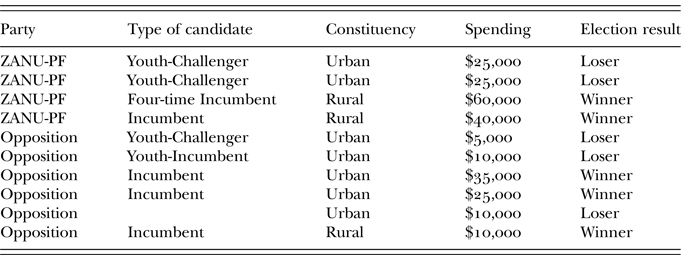
During the 2013 election period, ZANU PF benefited from access to diamond revenue even as the country itself struggled financially in the last two decades. Tendi (Reference Tendi2013) and Zamchiya (Reference Zamchiya2013) provide an extensive analysis of elite party behaviour during the Reference Tendi2013 elections. They find that ZANU PF held more than twice the number of rallies than the MDC participated in because of their access to state-subsidised transportation. I add to their analysis by providing further analysis of the role of money at the local levels in both the 2013 and 2018 elections (Table III).
Interviewed Zimbabwean parliamentary candidates by party, constituency type and campaign spending.

Rally costs range from small costs for regalia, food and entertainment to more significant transportation and publicity materials expenses. Parties spend at least a couple of million dollars on funding rallies in the pre-election campaign period. During the 2013 election, ZANU PF organised 13 rallies across the country; the MDC had a more modest plan with at least eight rallies organised in urban centres across the country. Major parties held smaller gatherings in the last three months leading up to an election. At every ZANU PF rally attendees had their choice of regalia, homeware and other gifts. In 2013, it was quite common for an individual to leave a ZANU PF rally with at least three t-shirts, a hat, flashlight and, in some cases, such as at Victoria Falls, teacups. The ZANU PF youth teams had access to the latest technology, including sound systems, which allowed the party to hire top musicians who drew huge crowds to their rallies. Grace Mugabe donated tons of food at rallies together with clothes confiscated from cross-border traders (Zimbabwe Daily 2016). According to party officials from the MDC and ZANU PF rallies cost on average US$20,000.
Political parties are often unwilling to open up about their sources of funding. When I inquired with the then ZANU PF-UK Chairpersons regarding party benefactors, they refused to say; instead, they insisted that the party had many business interests within Zimbabwe and abroad. At one rally leading up to the 2018 election, Grace Mugabe claimed that she had managed the party's finances, allowing them to invest in thousands of yards of material that was sold to various party branches around the country, generating an income in the millions. Every branch office for ZANU PF received a new vehicle with party symbols. In 2013 and late 2017, party symbols also included large images of both Mugabes. After the 2017 coup, the party invested in new regalia featuring the face of Emmerson Mnangagwa. The upgraded 2018 regalia included Mnangagwa's trademark – a scarf of the Zimbabwean flag. Whereas the 2018 rallies were weak in food and regalia distribution, ZANU PF compensated with giant billboards of Mnangagwa's photograph all around the country.
The ruling party benefits from their access to state resources in multiple ways, including government-funded travel and housing for the executive; the president and his cabinet and their families are covered by the government as part of their official expenditures. ZANU PF leaders often conflate private travel with public duties. The national airline is often used as a charter plane for the ruling families, allowing them to cover more campaign ground. In contrast, the opposition must pay out of their own pocket for all their travel expenses. This unevenness weakens democracy by restricting political participation to those with resources to fund their campaigns.
STRATEGIES FOR WEAKENING THE OPPOSITION
In 1992 the ZANU PF government passed the Political Parties Finance Act, the first official attempt towards finance regulation since independence. The ACT entitled any ‘political party with more than 15 parliamentary seats to receive annual financial assistance from the state’ (Hatchard Reference Hatchard1993). Although the government argued that this ACT made provisions for every political party to access government funding, this was not the case. From 1992 until 1999, only ZANU PF was legally eligible to receive public funding. During the 1992 general election, ZANU won 80% of the vote and secured 97.5% of the parliament seats. The ZANU/ZAPU merger in 1986 established the ruling party as an unbeatable force, and Zimbabwe United Movement's (ZUM) limited local support was unlikely to oust ZANU PF. However, ZUM posed a significant threat to ZANU PF because they garnered support among urbanites vehemently opposed to the one-party state proposal.
A former ZANU PF MP who was actively involved in the 1992 election recalled that the move to exclude opposition parties from receiving funds for their political activities was a conscious move to weaken a growing opposition. He further revealed that ZANU PF was aware of the urban uprisings in other countries such as Ghana and was unwilling to take the chance that ‘Tekere might become successful in mobilising urbanites and leading to a revolution’ (Former MP from the 1990s, 2016 Int.). In addition to the political crisis created by the one-party state proposal, ZANU PF worried about the deteriorating economic conditions that were causing unrest among urbanites. They feared that increased tensions in urban areas would result in a win for ZUM in urban areas, weakening ZANU PF's power.
NO FUNDING FOR SMALL PARTIES OR INDEPENDENT CANDIDATES
Political Finances Act and the 1995 elections to 2000
During the 1995 general elections, ZANU-PF remained the only party eligible for state party funding because they used their majorities in parliament to manipulate the rules governing public financing of political parties. Between 1992 and 1997, under the Finance Act, the ZANU PF-dominated parliament allocated over Z$32 million per year (US$1 = 12.5 Zimdollar) for party funding (Chikuhwa Reference Chikuhwa2004). Thus, ZANU PF had campaign funds available to them well before the official campaign season began. The Finances Act made campaigning expensive and strategically tricky for the smaller opposition parties and independent candidates such as Margaret Dongo. To date, the Act excludes independent candidates from receiving state funding. In 1995, after she quit the ruling party, after successfully challenging ZANU PF in court over accusations of rigging elections, Dongo became the first Independent woman to win a parliamentary seat. In 1995, to fund her court appeal, Dongo sought funding from a local human rights organisation, the Justice and Peace and the Legal Resources Foundation (LRF). Independent candidates are the worst affected by draconian funding laws, and Dongo's success is an exception and not the rule. Very few independent candidates have run successful campaigns. Those who do are often accused by the ZANU PF government of being Western-funded regime change agents.
Among the six opposition parties that contested in the 1995 parliamentary elections, only ZANU-Ndonga won two seats. The opposition parties bemoaned their inability to secure state funding for their campaign activities as the main reason for their poor electoral performance. They struggled to get financial support from independent organisations such as the Justice and Peace and the Legal Resources Foundation (LRF), who funded Dongo's appeal case but denied the registered parties funds (M. Ndlovu Reference Ndlovu2016).
Opposition parties remained unsatisfied with the regulation of party finance laws. In July 1997, Reverend Abel Muzorewa's United Parties (UP) filed a complaint against the Funding Act arguing that the continued funding of the ruling ZANU PF by the Treasury disadvantaged other parties. In response, the presiding judge, Justice McNally said: ‘The more I think of it [Finance Act], the more I cannot see its relevance, the criterion (of funding by seats) is unreasonable’ (Chikuhwa Reference Chikuhwa2004). The Supreme Court gave ZANU PF another judicial defeat, ruling that the allocation of funds based on seats in parliament was too high a threshold and instead the law should be implemented based on the proportion of votes attained. Later that year, without consulting other stakeholders in the electoral process, the ZANU PF-dominated government unilaterally amended the Party Finances Act, introducing a 5% threshold of votes received in the previous election for a party to be eligible for public funding. The amendment attempted to weaken the opposition, which at the time was dominated by independent candidates who had defected from ZANU PF. After the 1995 election only two opposition parties, ZANU-NDOGA (5.99%) and ZUM (6.94%), were eligible for state funds. None of the independent candidates received any funding, further weakening the opposition movement. These examples tell a story of the persistence of dominant party hegemony in political finance that continues today.
THE 2001 POLITICAL FINANCE ACT
As a result of the 1997 Supreme Court decision, the Political Parties Financial Act was modified officially, in 2001, to say that parties that received at least 5% of the vote would receive public funding for their activities from the government (Sithole Reference Sithole2001), and the law was expanded to criminalise the receiving of foreign donations. The amendment introduced a new funding formula, under which only ZANU PF and MDC were eligible to benefit from government funding. The negative impact of this law was most detrimental for independent candidates who have little chance of gaining 5% of the total vote because the majority of their votes come from their single district constituencies. This law disadvantages smaller parties because, without access to state funds, they cannot get their message across to voters; without the votes, they remain ineligible for state funding. The persistence of defunding or underfunding small parties weakens democracy. Each election season since the early 1980s has been marred by consistent inequalities in the party process.
In 2000, the government disbursed an estimated Z$65 million to be shared between ZANU PF and MDC. While the Treasury disbursed to ZANU PF their $30 million share earlier in 2000, the MDC received their money in November 2000 after they filed an appeal seeking the court to intervene with the Treasury on their behalf. Under the Political Parties Finance Act (2000), MDC was eligible to receive state funding because their party had attained 47% of the vote and 57 seats out of 120, thereby surpassing the legal 5% threshold for public funding.
In January 2000, Mr Simba Makoni, then Minister of Finance in charge of disbursing party monies, published a notice in the local newspaper stating that the amount available for party financing that year was ZW$65 million (Financial Gazette 2000). Mr Makoni explained that because the MDC had failed to submit their application on time, ZANU PF was the only party eligible to receive their share of public financing (Mendilow Reference Mendilow2012). This legislative move was unconstitutional because under the Political Parties Finance Act parties are not required to submit a separate application to get access to public funding. The request for an application by the ZANU PF Minister of Finance was a weak effort by the ruling party to manipulate regulations to deny MDC their share, forcing the MDC to once again go to the courts to settle the matter.
Since 2001, the Morgan Tsvangirai MDC-T opposition faction has received their share of the public funding.Footnote 3 In 2012, the government reportedly released US$8 million to ZANU PF and MDC-T to share proportionally according to their seats in parliament and in the Senate. A candidate for one of the smaller parties who ran for office in 2013 bemoaned the funding regulations. He said that these regulations, coupled with limits on donations from individual donors and the criminalisation of foreign funding, made it virtually impossible for candidates like himself to participate. In response to queries that the law is unfair, a ZANU PF affiliated lawmaker argued that these laws are there to ‘reward hardworking political parties’ (Two ZANU PF lawmakers 2016 Int.). The future of opposition politics hangs in an uneasy balance as ZANU PF continues to make gains in parliament, thereby diminishing the proportion of funding available to the opposition parties.
FOREIGN FUNDED ELECTIONS
Under the 2001 Finance Act, the government criminalised and prohibited parties from receiving foreign funding. Foreign funding includes money from foreign governments and the Zimbabwean diaspora. The Political Parties (Finance) Act 6(1) states ‘No political party, member of a political party or candidate shall accept any foreign donation, whether directly from the donor or indirectly through a third person.’
The 2001 party finance clause was targeted at weakening opposition parties, especially the MDC which at the time relied heavily on support from the Zimbabwean diaspora around the world. The MDC vocally opposed this move. David Coltart, the former Education Minister, argued that
The MDC believes that it is hypocritical of ZANU(PF) to ban foreign funding at this juncture, a move which is designed to hamper the growth of a young political party such as the MDC. The MDC believes that political parties should be required to present to Parliament annual accounts audited by an international firm of chartered accountants which should indicate the precise amount of foreign and local donations and to what purposes such donations have been applied. (Coltart Reference Coltart2001)
In 2001, the MDC presented multiple proposals to parliament arguing for a more streamlined process for parties to receive foreign funding, but they failed to pass. A more concerning element of the ban is that it prohibited Zimbabweans who reside abroad from making donations to any party.
The law was probably framed with the explicit goal of limiting MDC's access to funding from their base in the diaspora.
In the decade between 1999 and 2010, more than a third of the Zimbabwean population left the country in response to the failing economic and political conditions. Many of those who left were MDC members or said that they would have supported the MDC in an election; they had also emigrated from areas where MDC was winning with huge margins since the 2000 elections. ZANU-PF was aware that the MDC was receiving donations from the diaspora (Dendere Reference Dendere2015). In the past, ZANU-PF was very vocal in their opposition to diaspora participation in politics in terms of voting and funding parties; their position has since shifted as they have begun to rely on their diaspora party units for funding. Former ZANU-PF-UK chapter Chairperson Nick Mangwana publicly announced that his constituency sends generous funding to the mother party for political activities. I was also active in US-based pro-ZANU PF WhatsApp groups that mobilised and raised funds for the 2018 election. The ZANU-PF diaspora actively recruits and fundraises for their members who return home to run for office. When Zimbabweans in the diaspora show public support for the opposition or return home to run for office as opposition candidates, ZANU-PF labels them as western puppets, and in more extreme cases they are accused of treason. That said, over the last decade, the MDC diaspora party chapters have become more openly courageous in showing financial support for the party back home, which has enabled the MDC to continue to exist.
In 2004, ZANU PF introduced the Non-Governmental Organizations (NGO) act. The bill replaced the colonial Private Voluntary Organizations Act, No. 63 of 1966 (the ‘PVO’ Act). Ian Smith first introduced the PVO to curtail the activities of a growing black civil society during the liberation struggle. The post-independence bill added more restrictions on governance and democracy-promoting organisations. For example, it prohibited NGOs from receiving or seeking foreign funding under the Political Parties Finances Act, Chapter 2:11, Clause 1 (Government of Zimbabwe 2004): ‘No local non-governmental organization shall receive any foreign funding or donation to carry out activities involving or including issues of governance.’ As the government tightened opposition parties’ restrictions, civil society stepped in to provide additional support for the pro-democracy movement. By introducing a bill limiting funds for civil society, the government was interfering with civil society organisations’ ability to function. It further restricted any organisation's registration if its principal objectives involved or included issues of governance. These include ‘the promotion and protection of human rights and political governance issues’. To date, opposition parties rely heavily on technical and operational support from civil society. Opposition activists are often physically brutalised by the government, and it falls on NGOs to provide funds for medical attention and, in more extreme cases, safe houses. These restrictions weakened opposition activity, especially in harder to penetrate rural areas where opposition benefited from civil society networks to access voters.
ZANU-PF's decision to restrict foreign funding for political parties and civil society was disingenuous on two fronts. First, ZANU-PF itself receives political funding from foreign donors. Second, ZANU-PF relied on foreign funding at its founding; thus, it was well aware of the importance of outside funding for new parties. In many respects, foreign funding helped usher democracy on the African continent, particularly for Southern African countries such as South Africa, Zimbabwe, Zambia and Mozambique which gained independence late and often through protracted wars of liberation. While there is no actual documentation of foreign funding, speeches by various officials suggest that without foreign aid, liberation would not have been won. For instance, in 1997, then Africa National Congress (ANC) treasurer-general Makhenkesi Stofile said in a speech at the ANC national conference, ‘The ANC had largely depended on friendly countries and institutions for its funds. Most of these donors were in foreign lands …’ (inside-politics.org. 2013). The same was true in Zimbabwe where black freedom fighters received training abroad in North Korea, Russia and Cuba and often sought refuge in friendly countries supportive of their democratic agenda. During the 2013 election, after the Zimbabwean government withdrew their request for aid from the United Nations, they turned to the ANC in South Africa for financial support which reportedly extended a $100 million loan. ZANU PF continues to benefit from these collaborations with partners across the continent and in Asia but denies the same access to opposition parties, perhaps because they are aware of the positive impact that it could have on regime change.
THE IMPACT OF FINANCE ON THE 2008 AND 2013 ELECTIONS
In 2008, ZANU-PF lost the presidential race for the first time. ZANU PF's loss in 2008 can be attributed to the party's weak financial position, which made it impossible for their candidates to buy votes using food donations or other perks. In the aftermath of the election and during his run-off campaign, President Mugabe lashed out at his members and voters for their failure to see beyond party perks in mobilising for the 2008 vote.
The period of hyperinflation preceding the 2008 election evened the electoral playing field. Just a few months before the election, inflation was at a record-breaking 79,600,000,000% per month, and food shortages were rampant (Gstraunthaler et al. Reference Gstraunthaler, Thurner and Coomer2011). Subsequently, the Zimbabwean government and by extension ZANU-PF was broke. The ruling party was unable to provide food incentives to voters, and there were reports that people in the rural areas had resorted to eating monkeys and other wildlife. By the end of the year, the majority of parliament members had not received pay, forcing parliament to shut down prematurely.
The economic crisis temporarily dampened ZANU PF's ability to campaign effectively, since giving out patronage was greatly encumbered because the state was poor. Without patronage, ZANU PF could not buy votes and, most importantly, they resorted to violence. Although violence is an expensive tool, ZANU PF was willing to use their last available state resources against citizens to keep Mugabe in power. The poorly resourced MDC-T lacked the means to protect the public vote. As the violence on their supporters in urban areas and against rural voters in ZANU PF strongholds intensified, Tsvangirai withdrew from the election.
The 2008 run-off election which gave Mugabe over 90% of the vote was rejected, forcing ZANU PF into a three-way coalition government of national unity (GNU) with the opposition. Under the GNU between 2009 and 2013, the economy recovered significantly, reinforced by a stabilised political situation and revenue from newly discovered diamond deposits in the eastern region. Conservative estimates of the annual diamond revenue put it at US$6 million. Bolstered by access to diamond revenue ZANU-PF leaders withdrew Zimbabwe's requests for election financial aid from the United Nations and other international agencies. Officially, ZANU-PF and MDC-T each received US$80 million to fund their election activities. Unofficial reports suggest that ZANU PF used additional funds from the diamond revenues to influence voters in rural areas.
After the 2013 election, opposition officials I spoke to claimed that ZANU PF had a total campaign budget of US$100 million. They claimed that the ruling party broke party finance laws and secured funding from foreign governments, including China. ZANU-PF could provide substantial funding for their candidates: urban candidates received $25,000 each, and rural candidates received $15,000. MDC-T candidates were given $10,000 for urban contenders and $5,000 for rural contenders. Each of ZANU-PF's 300 plus candidates was gifted a new vehicle.
The MDC-T with a smaller budget was only able to provide vehicles for some of their candidates. ZANU PF candidates had additional financing to manufacture t-shirts and other paraphernalia featuring their faces, while MDC-T candidates used a universal t-shirt featuring the party leader's face. While candidates from both parties complained that the resources were not sufficient, ZANU PF members reported successfully reaching the majority of their constituencies. ZANU PF won the 2013 election with a supermajority of over 70%; their 2013 wins were higher than the party's performance at Independence in 1980. The opposition parties, especially MDC-T, blamed their loss on inadequate financing.
The peaceful environment during the 2013 election was an improvement on the violent 2008 campaign season that left hundreds dead and thousands displaced. When I interviewed voters at the polling stations in 2013, one man said it was ‘too peaceful such that it was scary’. The voters' views affirmed both the presence of peace and the general anxiety people felt about a possible return of ZANU PF dominance. Voters in rural areas erroneously credited ZANU PF not the MDC-T for the improved economy. Meanwhile, urbanites erroneously assumed that given their excellent performance under the GNU, MDC-T would win the election with huge margins. While the MDC-T had invested the majority of their time in government under the GNU leading robust ministries such as the Education and Finance, ZANU PF strategically used their control of other critical and lesser-known ministries to siphon diamond revenue for their party. In 2013, ZANU PF enticed young voters by introducing loan schemes under the Ministry of Youth Development, Indigenization and Empowerment. Funds from this ministry were disbursed only to those youths who could prove loyalty to ZANU PF. It was revealed in May 2017 that over US$40 billion from the Youth Development Fund could not be accounted for (Langa Reference Langa2017). This is a story about corruption in government and the ruling party using its control of particular state ministries to fund their campaigns. Disproportionate access to state funds made possible by the fact that even during the GNU the ruling party had control over crucial ministries advantaged ZANU PF in the 2013 election.
Analysts predicted that the financial situation in 2019 would be worse than in 2008 because there were no industries and or local currency. In August 2016, the ZANU PF governor introduced ‘Bond Notes’, a temporary currency that he argued would ameliorate the financial crisis. This has not worked; cash shortages remained rampant; the minimum daily cash allowance in 2016 was set at US$50 or ZW$300 but these figures changed often, and many were unable to access the promised cash. ZANU PF reportedly purchased campaign vehicles worth US$60 million for their country-wide tours. As of May 2017, no political parties had received their state funding. Therefore, although the economic conditions supported an opposition win, ZANU PF's access to substantial campaign financing reduced that possibility.
CONCLUSION
Access to millions of dollars alone will not guarantee that a candidate will win an election. A sizeable number of first-time social media favourite candidates in Zimbabwe and Kenya's most recent elections raised significant campaign funds, but they all lost to party-affiliated candidates. Because running for office costs money, poor access to funding disadvantages candidates who cannot escape these costs. In Zimbabwe, poor access to funding contributes to opposition weakness; opposition candidates spend more time looking for funding instead of campaigning on issues that are important to them and their constituencies. The ruling party's unrestricted access to and use of state resources functions as an incumbency advantage-extra that furthers the unevenness of the playing field, exacerbating already existing problems of corruption and patronage politics.