Introduction
Obsessive-compulsive disorder (OCD) is a common and often disabling psychiatric disorder with a prevalence ranging between 0.5–2%Reference Fontenelle, Mendlowicz and Versiani1 in the general population. OCD can be quite heterogeneous in clinical presentation, comorbidity, course, outcome, and treatment response.Reference Lochner and Stein2 Attempts have been made to identify homogenous subtypes of OCD, based on clinical phenotypes such as age at onset.Reference Jaisoorya, Janardhan Reddy and Srinath3, Reference Taylor4 The age at onset of OCD is believed to be bimodal,Reference Geller, Biederman, Jones, Shapiro, Schwartz and Park5 with males far outnumbering females in the peak before puberty. The other peak occurs in early adulthood, ie, between 20 and 30 years of age. The majority of patients develop symptoms before 25 years of age, and less than 15% develop symptoms after 35 years of age.Reference Rasmussen and Eisen6 Juvenile-onset OCD has been studied extensively and is characterized by male preponderance, greater comorbidity with tics and Tourette’s syndrome, and a higher familial loading.Reference Taylor4, Reference Narayanaswamy, Viswanath, Veshnal Cherian, Bada Math, Kandavel and Janardhan Reddy7
There have been few studies on the prevalence and clinical correlates of OCD in older adults, ie, beyond the fourth decade of life. Trollor et al Reference Trollor, Anderson, Sachdev, Brodaty and Andrews8 found the prevalence of OCD to be less than 1% in the middle-aged (45–65 years) and geriatric populations (>65 years). They observed that the prevalence of sub-syndromal symptoms, which impair quality of life, might be much larger in these groups. The prevalence of OCD in the elderly could be much higher than what is reported because OCD that manifests at a young age may persist into later ages because it often runs a chronic, unremitting course.Reference Marcks, Weisberg, Dyck and Keller9–Reference Reddy, D'Souza and Shetti11
Studies on OCD in the elderly have reported clinical and phenomenological differences. It has been seen that women outnumber men in the geriatric population.Reference Klenfeldt, Karlsson and Sigstrom12 Kohn et al Reference Kohn, Westlake, Rasmussen, Marsland and Norman13 found that younger patients had more concerns about acquired immuno-deficiency syndrome (AIDS) and paperwork, whereas older persons had more concerns about sins and religiosity. Obsessive fear of forgetting names, an uncommon symptom in youngsters, has also been described in the elderly.Reference Jenike14 These studies, however, included elderly people who developed OCD earlier in their lives. Though onset of OCD in the fifth decade or later has been reported in literature,Reference Weiss and Jenike15 “late-onset” OCD is not well characterized.Reference Klenfeldt, Karlsson and Sigstrom16, Reference Nestadt, Bienvenu, Cai, Samuels and Eaton17 It has sometimes been described in the context of organic conditions. Structural brain lesions involving the frontal regions and basal ganglia have been most commonly reported.Reference Weiss and Jenike15, Reference Swoboda and Jenike18 Neurological disorders in the elderly, such as dementiaReference Frydman, Ferreira-Garcia, Borges, Velakoulis, Walterfang and Fontenelle19 and Parkinson’s disease,Reference Agarwal, Biswas and Sadhu20 may also present with OC symptoms.
To the best of our knowledge, only 2 previous studies have systematically studied late-onset OCD. Grant et al,Reference Grant, Mancebo, Pinto, Williams, Eisen and Rasmussen21 using 30 years age as the cut-off for late-onset, found that 11.3% of their sample (n=293) had a late-onset of OCD. This group had a significantly shorter duration of illness; less severe obsessions, with lower prevalence of contamination, religious, and somatic obsessions; and better response to cognitive-behavioral therapy. This group did not differ from those with illness onset before age 30 years in comorbidity, insight, depressive symptoms, quality of life, or social functioning. More recently, Frydman et al Reference Frydman, do Brasil and Torres22 reported 8.6% (n=1001) of their sample as having late-onset OCD. Compared to young-onset OCD, the late-onset group in this study had a significantly greater number of females and longer duration of subclinical symptoms. Significant trauma after the age of 40 years and pregnancy were found to be predictors of late-onset OCD.
Significant differences have been found between juvenile- and adult-onset OCD,47 but the late-onset group has been understudied. We report here findings from a comparative analysis of clinical and demographic characteristics of 3 groups of patients: juvenile (<18 years), adult (18–39 years), and late (≥40 years) age at onset of OCD.
Method
We reviewed the data of 802 consecutive patients who consulted the specialty OCD clinic of the National Institute of Mental Health and Neurosciences (NIMHANS), Bangalore, India, between January 2004 and January 2012. The NIMHANS Ethics Committee approved the study. A post-graduate resident in psychiatry, using the OCD clinic workup proforma, evaluated each patient registered at the clinic in detail, assisted by a senior resident. Senior consultants of the clinic routinely train residents to evaluate patients with OCD, with various instruments. The OCD clinic workup proforma includes sociodemographic data and various clinical variables, including age at onset of OCD, duration of illness, duration of untreated illness, presence or absence of precipitating factors, detailed history of present illness, presence of comorbid disorders, family history of OCD or other major psychiatric disorders, and treatment details. The diagnosis of OCD was made according to the Diagnostic and Statistical Manual of Mental Disorders, Fourth Edition, Text Revision (DSM-IV TR) criteria.23 In addition, all patients were evaluated with the Mini International Neuropsychiatric Interview (MINI Plus)Reference Sheehan, Lecrubier and Sheehan24; the Yale–Brown Obsessive-Compulsive Scale (Y-BOCS), which includes symptom checklist, severity rating scale, and item-11 for insightReference Goodman, Price and Rasmussen25, Reference Goodman, Price and Rasmussen26; and the Clinical Global Impression scales (CGI).Reference Guy27 The Y-BOCS checklist assesses both past and current symptoms. In conducting the analysis, we considered a symptom as present, irrespective of whether it was reported as current or past. A consultant psychiatrist of the OCD clinic confirmed diagnosis and associated features by reviewing all the available information.
Family history of OCD in first-degree relatives was determined by obtaining history from the proband (index patient) and at least one immediate family member (usually parents and/or siblings) by asking questions from the OCD section of the MINI. Although the MINI does not have a section regarding tics, we used the MINI KID tic disorders section since the questions to elicit tics do not really differ across age groups. We assessed precipitating factor by asking the patients if they recalled any significant life event (eg, illness, trauma, bereavement, etc) prior to the onset of their illness that could have contributed to or related to onset of illness. Wherever possible, the information was also corroborated from an immediate family member. The event was considered a precipitating factor if it was temporally related to onset of illness (usually within 6 months) and the patient admitted that the event might have contributed to the onset. We did not proceed with detailed analysis of the precipitating factors because our assessment was clinical and no formal instrument was employed. Patients scoring≤2 on item 11 of the Y-BOCS were classified as having good insight, and those scoring >2 were classified as having poor insight.
There is no consensus definition for age at onset of OCD. Some studies have defined it as the beginning of OCD symptoms,Reference Rosario-Campos, Leckman and Mercadante28 while others have defined it as the age at which the patient met diagnostic criteria for OCD.Reference Grant, Mancebo, Pinto, Williams, Eisen and Rasmussen21 The latter would be difficult to establish retrospectively. Hence in this study, we defined age at onset as the beginning of distressing OC symptoms as remembered by the patient and/or the family member. A similar definition has been employed in previous studies.Reference Narayanaswamy, Viswanath, Veshnal Cherian, Bada Math, Kandavel and Janardhan Reddy7, Reference Frydman, do Brasil and Torres22 There is also no consensus on the delineation between early-onset and late-onset OCD. Late-onset OCD has been defined as onset at ≥30 yearsReference Grant, Mancebo, Pinto, Williams, Eisen and Rasmussen21 or ≥40 years.Reference Frydman, do Brasil and Torres22 The mean age at onset in our sample was 21.7±9.1 years, which is similar to that reported worldwide.Reference Rasmussen and Eisen29 Onset of OCD after 35 years is unusual.30 We therefore employed age cutoff of 40 years, similar to the criterion employed in a recent study,Reference Frydman, do Brasil and Torres22 to ensure that the late-onset group is truly representative of late-onset illness. Hence we divided our sample of 802 patients into 3 groups based on age at onset, namely juvenile-onset (<18 years), adult-onset (18–39 years), and late-onset (≥40 years). We compared the sociodemographic and clinical profiles of these 3 groups.
Statistical Analysis
Categorical variables were compared using the Chi-square test, and the continuous variables were compared using analysis of variance (ANOVA). All the analyses were carried out on Statistical Package for Social Sciences (SPSS) version 15.0. For univariate analysis, we applied Bonferroni correction for multiple comparisons (49 comparisons) and set the p-value at p≤0.001 (0.05/49). Multinomial logistic regression was conducted using variables with p≤0.10 in univariate analysis to test their association with age at onset groups. A p-value of≤0.05 was considered significant for regression analysis.
Results
Of the 802 patients, 300 (37.4%) had juvenile-onset, 460 (57.4%) had adult-onset, and 42 (5.2%) had late-onset of illness.
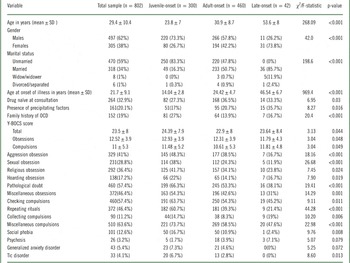
The 3 groups differed significantly from each other with respect to gender, marital status, and family history (Table 1). The difference between the groups showed significant linear-by-linear association, with the late-onset group having a higher proportion of females (p<0.001), a greater likelihood of being married (p<0.001), and a negative family history of OCD (p<0.001). Mode of onset of OCD (acute/insidious), drug naïve status at consultation, presence of precipitating factors, CGI-severity, insight (good/poor), and comorbid illnesses did not differ significantly (ie, at p<0.001) between the groups.
Comparison of sociodemographic, clinical, and symptom profiles between juvenile-onset, adult-onset, and late-onset OCD

Note: This table shows results of comparative analysis only for those variables that differed at a p-value<0.10. Statistical comparisons in this table are between 3 different age groups; data on the total sample are provided to give a perspective of the sample as a whole.
On symptom profile, there was significant difference between the groups with respect to sexual obsessions, aggressive obsessions, and pathological doubts, as well as repeating compulsions (Table 1). There was significant linear-by-linear association for sexual obsessions (p<0.001), aggressive obsessions (p<0.001), and pathological doubts (p<0.001), as well as for repeating (p<0.001) compulsions. These showed a decrease in frequency with increasing age at onset. The 3 groups also differed with respect to miscellaneous obsessions and compulsions. There were no statistically significant differences in contamination-, somatic-, religious-, hoarding-, and symmetry-related obsessions, and washing, checking, counting, collecting, and ordering compulsions.
Regression Analysis
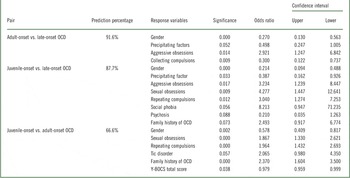
The following variables were included in multinomial regression analysis, as they reached a significance level of p≤0.10 in univariate analysis (Table 1): gender; presence of precipitating factors before the onset of illness; family history of OCD; Y-BOCS score; aggressive obsessions; sexual obsessions; religious obsessions; pathological doubts; hoarding; checking compulsions; repeating compulsions; collecting compulsions; and comorbid diagnosis of social phobia, generalized anxiety disorder, psychosis, and tic disorder. As the miscellaneous obsessions/compulsions category includes a heterogeneous category of symptoms, they were not included in the regression analysis.
Multinomial logistic regression with pair-wise analysis revealed the following (Table 2):
1. Late-onset vs. adult-onset: Late-onset OCD was significantly associated with female gender, collecting compulsions, and absence of aggressive obsessions.
2. Late-onset vs. juvenile-onset OCD: Late-onset OCD was significantly associated with female gender; presence of precipitating factors; and absence of aggressive obsessions, sexual obsessions, and repeating compulsions.
3. Juvenile-onset vs. adult-onset OCD: Juvenile-onset OCD was significantly associated with male gender, positive family history of OCD, higher Y-BOCS total scores, and presence of sexual obsessions and repeating compulsions.
Logistic regression for predicting “age at onset” group based on the significant variables from univariate analysis

Discussion
We analyzed the clinical and sociodemographic profiles of a large consecutive sample of OCD patients with juvenile-, adult-, and late-onset OCD. The mean age of our sample was around 29 years, with 5.2% having late-onset OCD and 37.4% having juvenile-onset OCD. The prevalence of late-onset OCD in our sample is lower than the 8–11 % reported by previous studies.Reference Grant, Mancebo, Pinto, Williams, Eisen and Rasmussen21, Reference Frydman, do Brasil and Torres22 Grant et al Reference Grant, Mancebo, Pinto, Williams, Eisen and Rasmussen21 used a lower cut-off age of 30 years to define late-onset OCD, which might have led to the high prevalence of late-onset OCD in their sample. However, Frydman et al Reference Frydman, do Brasil and Torres22 used a cut-off similar to that in the present study and reported a larger prevalence (8%). As both samples were drawn from hospital settings from different sociocultural backgrounds, the difference in help-seeking pattern of the populations could explain the slightly divergent findings.
Interesting group differences were noted in sociodemographic and clinical profiles among patients stratified by age at onset of illness. Most notable was the change in gender distribution of patients from juvenile- to late-onset OCD. While in the juvenile-onset group the ratio of males to females was 2.75, this actually reversed in the late-onset group, with the female to male ratio being 2.82. In the adult-onset group, the ratio indicated marginal preponderance of males (1.16). On logistic regression, gender came out as a significant predictor of differences between juvenile-onset and late-onset OCD, and between adult-onset and late-onset OCD. Female preponderance in the late-onset OCD is a notable finding that has been reported in 2 previous studies.Reference Nestadt, Bienvenu, Cai, Samuels and Eaton17, Reference Frydman, do Brasil and Torres22 An increase in the incidence and prevalence of most psychiatric disorders has been reported in postmenopausal women.Reference Rasgon, Shelton and Halbreich31 Onset or exacerbation of OCD symptoms with other reproductive life cycle stages—premenstrual phase, pregnancy, and post-partum—has been reported.Reference Frydman, do Brasil and Torres22, Reference Williams and Koran32 These findings suggest a plausible role of hormonal changes in the expression of OCD across the lifespan. Interestingly, a correlation between high serum estradiol levels and perseveratory behavior has been demonstrated in rats.Reference Olvera-Hernández, Chavira and Fernández-Guasti33 Further systematic examination of these findings is warranted.
A larger proportion of patients was married in the late-onset group, as is expected according to social norms. Patients in the late-onset group had lower family history of OCD. Presence of precipitating factor was also a significant predictor of differences between juvenile-onset and late-onset OCD. Unfortunately, we did not use any instrument to systematically record precipitating factors. Therefore, our data on the nature of precipitating factors are not robust. Further, the mere presence of a significant life event prior to symptom onset does not imply an etiological role. However, this preliminary finding does suggest that the role of psychosocial and environmental factors needs to be more comprehensively studied in future research. In a previous study, trauma and pregnancy were associated with late-onset OCD.Reference Frydman, do Brasil and Torres22
It is noteworthy that the contamination fears and need for symmetry along with compulsions of washing, checking, and ordering were similar between the groups. Certain phenomenological differences were also found between the 3 groups. There was a decreasing prevalence of sexual obsessions, aggressive obsessions, pathological doubts, and repeating compulsions with increasing age at onset of illness. In multivariate analysis, symptoms usually classified under the “forbidden thoughts” dimension, such as sexual and aggressive obsessions, differentiated the late-onset group from the other 2 groups. Developmental conflicts related to adolescence may lead to a higher frequency of these symptoms in the younger onset population. Collecting compulsions were more common in the late-onset compared to the adult-onset group, suggesting that hoarding may be more common in the late-onset group. There was no significant difference in the prevalence of collecting compulsions between the juvenile-onset and the other 2 groups. There has been conflicting evidence regarding hoarding behavior and age at onset of illness. Some studies suggest that hoarding, either as a symptom of OCD or compulsive hoarding, has an early age at onsetReference Samuels, Bienvenu and Riddle34, Reference Ayers, Saxena, Golshan and Wetherell35 and rarely has an onset after the third decade of life.Reference Ayers, Saxena, Golshan and Wetherell35 However, other studies have found that hoarding behavior increases markedly with age.Reference Samuels, Bienvenu and Grados36, Reference Steketee and Frost37 The frequency of collecting compulsions in our sample is numerically higher in the juvenile-onset group compared to the adult-onset group and then increases again in the late-onset group, which suggests a complex relationship with age at onset. We employed the DSM-IV-TR23 criteria in our study where hoarding symptoms are part of OCD, while the fifth edition of the DSM classifies hoarding disorder as a separate diagnosis. One could argue that collecting compulsions are part of hoarding disorder, rather than OCD, as per the new classification. However, we inferred the presence of hoarding symptoms based on the presence of collecting compulsions in the Y-BOCS symptom checklist, which may not be able to differentiate between hoarding disorder and hoarding behavior secondary to other obsessive-compulsive symptoms.
There was a difference in age at clinical presentation between the 3 groups (Table 1). The phenomenological differences between the 3 groups could be attributed to age at presentation rather than age at onset. However, we assessed for presence of lifetime obsessive-compulsive symptoms. Hence, the age at assessment may have had a limited influence on the clinical presentation stratified by age at onset. Further, longitudinal studies have observed a remarkable stability of symptom dimensions throughout the lifespan.Reference Mataix-Cols, Rauch and Baer38, Reference Rufer, Grothusen, Mass, Peter and Hand39
Rates of comorbidity were comparable in the 3 groups. While in the juvenile- and adult-onset groups it was around 60%, for the late-onset group it was 52%; the difference did not reach statistical significance. Depression (35.9%) and dysthymia (16.7%) were the most common comorbidities in the late-onset group, as in the other 2 groups.
Conclusion
In conclusion, our study suggests that late-onset OCD is characterized by female preponderance, lesser likelihood of a family history of OCD, and more likely to be precipitated by environmental stressors. Phenomenologically, sexual and aggressive obsessions, pathological doubts, and repeating compulsions occur at a lower frequency in late-onset OCD. The roles of gender and environmental stressors in illness expression need to be further studied in the context of OCD. Systematic research is required to understand whether late-onset is associated with unique clinical, family-genetic, neuropsychological, and neurobiological correlates.
There are a few limitations to our study. First, although the sample size is large (n=802), the number of late-onset patients was only 42, and this might limit the generalizability of comparative analysis. Second, the findings report the cross-sectional assessment of patients that might be influenced by recall bias. Longitudinal assessments may help shed light on important aspects such as course of illness and treatment response patterns. Third, we report here findings from an analysis of clinic database records. Different raters reported the ratings, as a part of routine clinical care. Nevertheless, a consultant from the OCD clinic confirmed all the ratings. Further, our sample is from a specialty OCD clinic, which may not be generalizable. Finally, we did not have details of precipitating environmental factors preceding the onset of illness. It is possible that factors such as trauma, personal/family problems, loss, and illnesses may contribute to the manifestation of late-onset OCD.
Disclosures
Eesha Sharma has nothing to disclose. Shyam Sundar has the following disclosure: National Institute of Mental Health and Neuro Science, researcher, grant. Kandavel Thennarasu has nothing to disclose. Y. C. Janardhan Reddy has the following disclosures: Lundbeck, speaker, honoraria; Department of Science & Technology, researcher, grant; Department of Biotechnology (DBT), India, researcher, grant; Indian Council of Medical Research (ICMR), India.