


Understanding how government policies shape political attitudes and behaviors is central to the study of regime dynamics. Elites often implement social policies that have economic benefits in order to garner popular support for regime survival.Footnote 1 For policies to induce regime support, however, a key assumption that social policies change political attitudes and behaviors has to be met. It remains unclear whether social policies are the silver bullet that bolsters regime legitimacy.
A recent survey of the literature suggests that the effects of social policy on mass political attitudes are mixed (Campbell Reference Campbell2012). Even if the policy does enhance citizens’ regime support, it might also increase citizens’ entitlement expectations and government's financial obligations, potentially burdening the regime in the future. In addition, most scholars have focused on the relationship between social policies and regime support for the national government, but few have studied social policies’ effects at the level of local governments—the locus of much social spending.
Specifically, previous studies have mostly evaluated the effects of broad political and economic changes on political attitudes in regions such as Eastern Europe and the former Soviet Union,Footnote 2 Peru,Footnote 3 Eastern and Western Germany,Footnote 4 and China.Footnote 5 The expansion of social spending has been found to be a common strategy used by the regime to generate political support in Latin America,Footnote 6 Africa,Footnote 7 and the Middle East and North Africa (MENA).Footnote 8
Although these studies link government policies and political attitudes, some key questions remain unanswered. First, how does a specific policy shape mass political attitudes? Most existing studies examine broad reforms encompassing a set of policies. Evaluating the effect of one specific policy among others is challenging when multiple mechanisms, driven by different policies, become conflated during the process of attitude formation. Second, what are the causal mechanisms between policies and political attitudes? One school of thought emphasizes the extent to which policy benefits, particularly material transfers, shape mass preference. In contrast, public opinion scholars identify the importance of elite influence and state indoctrination through media. Few have evaluated how these two mechanisms interact to affect responses to a specific policy; however, determining how policy benefits and elite influence affect mass preference is critical, largely because they generate different implications for the effectiveness of social policies on regime survival. Finally, none of these studies investigate policy effects on different levels of government, even though the literature suggests that citizens’ trust varies across levels of government (Hetherington Reference Hetherington2005; Li Reference Li2004; Saich Reference Saich2007; Tang Reference Tang2005).
In this article I evaluate the effects of one social policy on political attitudes in China and report three findings. The policy of interest is the abolition of school fees for all students in the nine-year compulsory education system (i.e., primary school and junior high school), which has been in effect in China since 2006. Taking advantage of two national surveys, one conducted before and one after the policy was implemented, as well as the temporal and spatial variation in policy implementation, I use a differences-in-differences (DID) approach to show that the policy has significantly increased citizens’ preferences for government financing of compulsory education. In other words, when the Chinese government removed school fees, citizens came to expect that the government would pay for education. The magnitude of the policy effect is striking, particularly for rural residents: Their preference for government financing grew from 32 to 38 percentage points, depending on the model specification, which represents a 90% to 108% increase from the level of preference before the policy implementation.
To determine the effect of this policy on political attitudes, I investigate two specific mechanisms—policy awareness and policy benefit—through which the abolition of school fees shaped political attitudes. I contend that policy awareness, not the benefit itself, drives the growing preference for government responsibility. This finding is consistent with a recent study of water privatization in Argentina, in which the authors find that government propaganda had a stronger effect than the actual benefit in shaping mass preferences regarding privatization (Di Tella, Galiani, and Schargrodsky Reference Di Tella, Galiani and Schargrodsky2012).
Finally, I also show that policy awareness has enhanced Chinese citizens’ trust in the central government, but not in local governments. This asymmetric effect on trust stems primarily from two factors: the decentralization of public goods provision and a bias in media reporting. Specifically, although the central government initiated the education policy in question, Chinese citizens consider local governments primarily responsible for providing education. Meanwhile, media reporting highlighted both the policy's benefit and the central government's fiscal contribution to the policy. Because citizens do not observe whether the central government's intergovernmental transfers were sufficient to compensate local governments for the loss of revenue (from the abolished school fees), citizens tend to give more credit to the central government for good policy outcomes.
This article contributes to the studies of social policy and regime support. Social policies have been used to garner political support in many countries and will likely remain an important strategy in the future. I suggest that decentralizing the provision of public goods and services in a controlled-information environment is a crucial strategy whereby the central government can effectively garner political support. The importance of media influence is also consistent with studies that emphasize government control over the flow of information for regime stability.Footnote 9 Finally, I also show that the policy may not benefit all layers of government, which raises doubts about this strategy's sustainability for long-term regime legitimacy.
Yet the case under investigation could be unique: China is a single-party nondemocratic regime with a highly decentralized provision of public goods and services and a high degree of state media control. However, many countries in Latin America and the MENA region have sought to stabilize their regimes by simultaneously expanding social spending and attempting to control the media. Future research could inform how variations in the decentralized provision of public goods and services and in state media control affect regime support across countries.
In the context of China studies, this article sheds light on China's recent political developments. Researchers have long been interested in the sources of regime support in China.Footnote 10 Government performance is one important source of political legitimacy (Weatherford Reference Weatherford1992). Zhao (Reference Zhao2009) argues that performance legitimacy is particularly critical for the Chinese Communist Party (CCP) because of potential lacunas of legitimacy within the political system. Because achieving persistent high economic growth has become a challenging task, Chinese leaders have shifted their policy focus dramatically in the last decade toward the provision of public goods and services in the name of “Creating a Harmonious Society.”
Social policies (minsheng zhengce) initiated by the central government are a key component of this strategy, but research on these policies’ impact on political attitudes in China is in its early stages (Dickson, Shen, and Yan Reference Dickson, Shen and Yan2013; Michelson Reference Michelson and Yang2012; Saich Reference Saich2008). I show that this strategy has only enhanced political trust in the central government, but these social policies are costly and potentially unsustainable. For instance, the Chinese government may experience difficulty fulfilling the expenditure mandates should its fiscal revenues stagnate. Additionally, this strategy has increased rural residents’ perceptions of their entitlement to public goods and services, so the Chinese central government can no longer neglect the provision of public goods in rural areas as it has in previous decades. Finally, the funding of central government's social policy initiatives through intergovernmental transfers could gradually shift the political ownership of these policies from the local to the central government, implying that, in the future, the central government may be subject to more blame for ineffective policies.
The structure of this article is as follows. In the next section, I present two theoretical pathways by which social policy influences political attitudes and I contextualize them in China's institutional environment. Following the theoretical section, I present the data and empirical results in three parts. I show that a recent education policy has increased Chinese citizens’ preference for greater government financing of compulsory education, demonstrate that policy awareness is the driving force behind the surge of mass demand, and provide evidence that the policy has fed an asymmetry between trust in the central and in the local government.
SOCIAL POLICY AND POLITICAL ATTITUDES
Social policy yields two effects: a policy benefit effect, which provides economic benefits to the beneficiaries, and a policy awareness effect, in which the government uses media to inform citizens about the policy. In what follows, I theorize how these two mechanisms influence political attitudes and then contextualize the theoretical discussion in the case of China.
Effects of Policy Benefit and Policy Awareness on Political Attitudes
Economic self-interest is a core mechanism through which policy benefits influence political attitudes (Pierson Reference Pierson1994). This line of reasoning can be traced to the long-standing studies of economic voting and vote buying.Footnote 11 In the context of postcommunist regimes, scholars suggest that the beneficiaries of an economic policy would support the policy and have a favorable view of the incumbent government. For example, Miller, Hesli, and Reisinger (Reference Miller, Hesli and Reisinger1994) found evidence that perceiving improvements in individual economic conditions correlates with preferences for greater individual responsibility for one's well-being among Soviet and post-Soviet citizens. Conversely, Duch (Reference Duch1993) showed that a negative assessment of recent economic performance after the collapse of the Soviet Union led individuals to support market reform. Tucker (Reference Tucker2006) found evidence of conditional economic voting by examining a number of post-communist countries during the transition period.
Despite these findings that policy benefits increase support for the government, several studies show that policy benefits are not always sufficient to shape political attitudes (Lynch and Myrskyla Reference Lynch and Myrskylä2009; Morgan and Campbell Reference Morgan and Campbell2011; Soss and Schram Reference Soss and Schram2007). Campbell (Reference Campbell2012) attributed the mixed results to other mechanisms driving political attitude formation, such as early political socialization, partisanship, and ideology.
In this article, I argue that policy awareness is an important alternative mechanism in shaping political attitudes. Elites can inform citizens about the costs or benefits of a policy through media campaigns. In turn, citizens—influenced by politicians’ positive or negative spin—form preferences about the policy and the incumbent government. This process occurred in authoritarian Brazil, where political awareness was effective in generating policy support (Geddes and Zaller Reference Geddes and Zaller1989). They found that an individual citizen's political information about a specific policy indicated the degree to which he or she had been exposed to persuasion and framing by the elites. If elite messages are unified in endorsing the policy, a citizen is more likely to accept the elite persuasion and support the policy and the government.
Furthermore, promoting policy awareness is an important governmental strategy to generate policy support, because it affects the political attitudes of the general population. A far-reaching media campaign exposes many individuals, whether or not they are targeted by the policy or quality for its benefit, to priming and persuasion by elites.
I contend that the effect of policy awareness on the untargeted population is particularly important in nondemocratic regimes for two reasons. First, media freedom is limited in nondemocratic regimes, and most citizens are exposed to elite messages primarily through state media outlets. Hence, these elite messages often form the most accessible and salient information in their memories. Second, in nondemocratic regimes media reports on a particular policy are consistently one-sided, leaving little room for policy debate. Consequently, most citizens have little opportunity to evaluate policy alternatives. The coherence of the elite message reinforces citizens’ support and shapes their preferences.
Social Policies and Political Attitudes in China
Both policy benefit and policy awareness could influence citizens’ support of a social policy and the incumbent government. The extent to which these two mechanisms affect political attitudes varies depends on the institutional environment in a country. In this section, I contextualize these two mechanisms within China's public goods provision and state media control.
In China, the provision of public goods and services has been largely decentralized to local governments. This decentralization was further institutionalized through the 1994 tax-sharing scheme reform, which stipulates that local governments are responsible for financing the provision of many public goods. A 2002 World Bank report found that local governments shoulder nearly 70% of the financial costs for the provision of public goods and services in China (World Bank 2002).
Education provision since the 1980s offers a good example of decentralization in China. The principle of decentralizing the provision of education was formally announced in 1985 in the Chinese Communist Party's (CCP) “Decision on the Reform of the Educational Structure,” which mandated that local governments should be responsible for pre-tertiary education (primary and junior high school) provision. The details of the 1985 decision were later promulgated in the 1986 “Compulsory Education Law of the People's Republic of China.” Notably, the language in both the 1985 decision and the 1986 law failed to specify how various levels of subnational governments were to share this responsibility. Hence, many upper tier subnational governments (provincial and prefecture) further decentralized the provision of pre-tertiary education to lower level governments (county or even township). In 2002, the State Council issued a policy declaring the county-level government primarily responsible for financing pre-tertiary education.Footnote 12
Thus, local governments’ financial commitments to education provision are key to the quality of local education, and the benefit of any education policies hinges on the degree to which local governments implement them. Studies have shown a variation in local politicians’ efforts to implement central government initiatives (Edin Reference Edin2003; O’Brien and Li Reference O’Brien and Li1999). Although the central and provincial governments make intergovernmental transfers to help county governments implement this new policy, the transfers have not always filled the fiscal gap created by the elimination of school tuition and fees from local budgets.
Meanwhile, policy awareness is created through state media reporting, which is more likely to endorse the central government than the local governments. Scholars have asserted that the CCP often uses media to shape Chinese citizens’ preferences to maintain state legitimacy (Stockmann Reference Stockmann2009; Stockmann and Gallagher Reference Stockmann and Gallagher2011; Tang Reference Tang2005). Although well-educated Chinese citizens can resist elite influence to some extent (Chen and Shi Reference Chen and Shi2001; Kennedy Reference Kennedy2009), a recent study offers new evidence that state-controlled media can still mitigate citizens’ negative perceptions of local corruption, controlling for education (Zhu, Lu, and Shi Reference Zhu, Lu and Shi2013). Specific to the school fees abolition, state media outlets have reported the policy as an achievement of the central government. Although successful implementation of this policy requires substantial effort by local governments, state media often credit the central government for its success.
Because the policy benefit is an outcome of local governments’ policy implementation and policy awareness stems from state media reporting, I argue that the Chinese central government is poised to benefit from social policy initiatives regardless of the success or failure of policy implementation. If a social policy is not well implemented at the local level, residents receive few policy benefits. Then citizens blame the local government because they hold it responsible for providing public goods and service, even though the implementation failure may be caused by insufficient transfers from upper levels of government. Conversely, if the policy is implemented successfully and local residents benefit, they credit the central government more than the local government, because state media tend to favor the central government, which initiated the policy and provides fiscal transfers to the local government.
POLICY EFFECT ON PREFERENCES FOR GOVERNMENT RESPONSIBILITY
This section briefly describes the background of the new education policy, the data gathered, and the empirical strategy used to analyze that data. I first present evidence that a recent change in education policy has increased Chinese citizens’ preference for compulsory education to be financed by the government. I focus on political attitudes toward government responsibility not only because they reveal citizens’ expectations for their government but also because similar attitudes have been studied in former communist regimes (Finifter and Mickiewicz Reference Finifter and Mickiewicz1992; Miller, Hesli, and Reisinger Reference Miller, Hesli and Reisinger1994). I investigate the mechanisms driving this preference in the next section.
The Policy Abolishing School Fees in Compulsory Education
In 2006, the Chinese central government initiated an institutional reform that effectively eliminated school fees (xueza fei)Footnote 13 for all students enrolled in compulsory education.Footnote 14 To fund this policy change, the Chinese central and provincial governments made intergovernmental transfers to local governments. Unlike previous unfunded mandates, this reform institutionalized financing through fiscal transfers from the central government.
One estimate of total spending from all levels of government for this policy is 36 billion RMB (approximately 4.5 billion USD) in 2006 when the reform was initiated, 73 billion RMB (approximately 9.7 billion USD) in 2007, and 101 billion RMB (approximately 14.3 billion USD) in 2008.Footnote 15 The central government covered a significant share of the costs of providing education, contributing 41.6% of the costs in 2006, 50% in 2007, and 58.8% in 2008. However, the level of intergovernmental transfers varies by province. For example, the central government pays for 80% of costs of education provision in the western region and 60% in the central region. Provincial governments in the east generally bear a larger share, if not all, of the total costs.
The policy benefit to households with children enrolled in compulsory education also varies by region. Fan and Fu (Reference Fan and Fu2009) found that the abolition of tuition fees saved 140 RMB (18 USD) per year for each primary school student and 180 RMB (23 USD) per year for each junior high school student in the western and central rural areas. Another report estimated that this policy saved 289 RMB (37 USD) per student each year, accounting for 13.8% of the net family income in rural areas in 2006.Footnote 16
Because the cost of living varies by region, the welfare enhancement resulting from the elimination of school fees differs for individuals across the country. In general, this policy yields greater welfare enhancement for rural residents than urban residents for two reasons. First, school fees account for a smaller share of family income in urban households because they earn higher incomes than those in rural areas. Second, a greater share of education spending by urban residents is directed toward areas other than tuition and fees.Footnote 17 Hence, the abolition of school fees has limited welfare enhancement for urban residents.
Data
The data came from two waves of a national survey titled “Chinese Attitudes toward Inequality and Distributive Injustice.” The 2004 survey has 3,267 observations,Footnote 18 and the 2009 survey has 3,029 observations.Footnote 19 Respondents were drawn from a sample of the national adult population aged 18–65. The 2009 survey revisited almost all of the sampling units from the 2004 survey.Footnote 20 These surveys were designed by a team of scholars from academic institutions in both the United States and China,Footnote 21 who used a spatial sampling strategy to overcome the weaknesses of sampling based on household registration data, which overlooks migrants (Landry and Shen Reference Landry and Shen2005). The surveys included a battery of questions probing citizens’ attitudes toward income inequality and preferences regarding government policies. These questions offered researchers a rare opportunity to track changes in political attitudes over time and to explore the causal mechanisms underlying these changes.
Identification Strategy
Because the policy was implemented between the 2004 and 2009 surveys, one starting point for this study was a comparison of the survey responses before and after its implementation. Of course, a shift in public opinion over the course of five years could have resulted from other factors than the education policy. Thus I applied a differences-in-differences (DID) approach, which enabled identification of the causal effect of the policy after accounting for the difference between groups and across time.
The treatment is the implementation of the policy to abolish school fees, and geographic location determines a respondent's exposure to the treatment. The variation in treatment intensity across time and space derives from the phased-in implementation process set by the Chinese central government. In the first phase, the policy was implemented in the rural areas of the western region in 2006; in the second phase, the policy was extended to the rural areas of the central and eastern regions in 2007; and in the third and final phase, the policy covered students in urban areas across the entire country in 2008.
The 2004 survey was conducted before the first phase was implemented in 2006; hence, no respondents were “treated” in the 2004 survey. The 2009 survey was conducted after the last phase of this policy was implemented in 2008; therefore all the respondents appear to be “treated” in the 2009 survey. Because of the variation in the timing of policy implementation, however, survey respondents received “treatments” of different intensity at different times, depending on where they lived. I conceptualized those (urban) respondents who were exposed to the policy in 2008 (Phase 3) as the “control” group because they experienced weaker policy intensity, both in terms of time and economic benefit.Footnote 22 Conversely, I conceptualized those (rural) respondents exposed to the policy in 2006 (Phase 1) and 2007 (Phase 2) as two “treatment” groupsFootnote 23 because they experienced greater policy intensity in terms of duration and welfare enhancement than did the control group.
Empirical Results
To measure individual preference for government responsibility in financing compulsory education, I analyzed the following survey question:
To what degree do you think the government and the individual should pay for the financial costs of primary and secondary education?
(1) the individual alone; (2) primarily the individual; (3) the government and the individual equally; (4) primarily the government; (5) the government alone.
Responses indicating that government should be the only or primary source of financing for compulsory education were coded as 1; all other responses were coded as 0. The descriptive statistics of this variable, shown through a 2×2 table (see Table A1 and Figure A1 in the Online Appendix), provide evidence that the abolition of school fees corresponded with an increase in citizens’ preferences for government responsibility from 2004 to 2009.Footnote 24 To formally analyze the causal effect of this policy on public opinion, the DID can be estimated in the following probit modelFootnote 25 :
 \begin{eqnarray}
\Pr \left( {Y_{ijt} = 1} \right) &=& {\rm \Phi }\bigg(\alpha _j + \rho T_{it} + \gamma D_{ijt} + \delta \left( {D_{ijt} \times T_{it} } \right)\nonumber\\
&&+ \, \sum {\beta_h}\, X_{ijt} \bigg)\end{eqnarray}
In this model, Yijt is the dichotomous measure of the survey response for individual i in province j at time t. Tit is dummy coded as 1 for respondents surveyed in 2009, and 0 otherwise. Dijt is a dichotomous measure of the treatment, coded as 1 for respondents who lived in areas where the policy was implemented in Phase 1 or Phase 2, and 0 for respondents who lived in areas where it was implemented in Phase 3. Xijt is a vector of variables measuring personal characteristics such as age, gender, education attainment, marital status, party membership, household income, and residential registration (hukou) status.Footnote 26 I used province fixed effects (α j ) to capture the unobserved characteristics of policy implementation and economic conditions. In the following analysis, I used clustered standard errors at the county level to account for the correlation of public opinion within each sampling unit.
In this DID model, the key parameters of interest are the estimates of the interaction term, δ, which capture the policy effect after accounting for between-group differences (γ) and over-time differences (ρ) from 2004 to 2009. To accommodate two treatment groups (Phases 1 and 2) and one control group (Phase 3), I divided the data into two models. In the first model, δ1, 3 denotes the treatment effect when comparing respondents in Phase 1 (2006) and Phase 3 (2008). In the second model, δ2, 3 denotes the treatment effect when comparing respondents in Phase 2 (2007) and Phase 3 (2008).
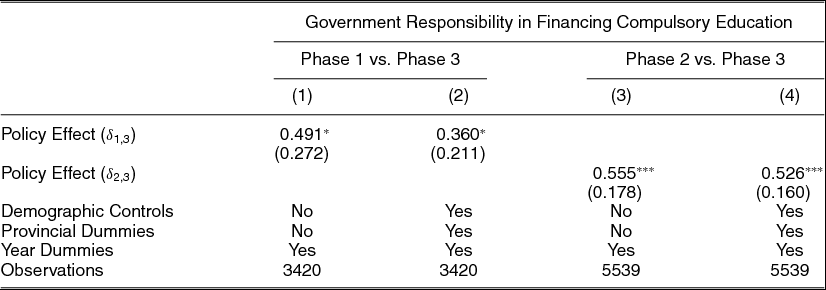
Table 1 reports the estimation results of Equation (1), which show a consistent positive policy effect on citizens’ preference for government responsibility. The estimates of δ1, 3 and δ2, 3 are statistically significant both with or without controlling for personal characteristics. I simulated the marginal effect of this policy, finding that it increases a citizen's preference for government responsibility by 0.32 (standard error of 0.05) based on the model specification in Column 2.Footnote 27 This simulation result suggests that the policy increases the preferences of individuals living in western rural areas for government responsibility by 32 percentage points over that of individuals in urban areas. This represents a 90% increase in the level of mass preference in 2004. Similarly, I found that the policy increases the preference for government responsibility by 0.38 (standard error of 0.02) based on the model in Column 4, or a 108% increase over the 2004 level.
The Policy Effect on Demand for Government Responsibility

Notes: These are probit results. The analyses are based on 10 multiple-imputed datasets. Clustered standard errors at the county level are reported in the parentheses. I do not report the estimates for demographic controls, which include age, gender, education attainment, marital status, party membership, household income level, and residential registration (hukou) status. I also do not report the estimates for constants, provincial dummies, and year dummies. *** p < 0.01, ** p < 0.05, * p < 0.1.
To test the robustness of these results, I investigated several alternative explanations. One could argue that the policies implemented before 1990 have a long-lasting impact on citizens’ preferences for government responsibility. Exploring the generational effect by restricting the analysis to certain age groups, I found that the estimates of δ1, 3 and δ2, 3 become weaker and statistically insignificant only for respondents aged 60 and above; however, the larger standard errors of the estimates could result from a smaller sample of those over age 60. Notably the estimate for individuals who live in rural areas is negative and significant. This result is consistent with a legacy of a rural—urban divide created by the government's earlier provision of fewer public goods and services to rural residents; consequently, rural residents may demand less from the government (Han Reference Han2012).
Another concern in using the DID framework is the potential violation of the common trend assumption. For example, the preference for government-funded education may have increased in some provinces because of a general increased demand for economic redistribution or because of lingering negative economic conditions following the financial crisis of 2008. To evaluate this possibility, I used Equation (1), the DID framework, to estimate the policy effect on other government policies. Table A2 in the Online Appendix shows little empirical evidence that citizens prefer greater government responsibilities in other policy areas such as broad-based economic redistribution, financing college educations, health care, pensions, and employment.Footnote 28
One may still question the DID results because of program-induced migration: Did individuals migrate from the control group to the treatment group in order to receive the policy benefit? My assumption that they did not do so likely holds in this case because only 2.4% of the respondents in the 2009 survey reported a recent relocation for education, and those moves could have occurred for any level of education. In addition, when I restricted the analysis to nonmigrants, the policy effect was stronger (see Columns 1 and 2 in Table A3 in the Online Appendix). These results reflect the situation in China in which only local residents with the proper household registration status benefit from many local public goods and services.
Meanwhile, the endowment effect serves as an alternative explanation to rising demand for government responsibility. According to this explanation, individuals who received the benefits will support the policy, and those who did not will be less supportive of it. If this argument were true, the effect in the sample should be identified only when the respondents are entitled to benefit from the policy. To evaluate this alternative claim, I divided the sample into two groups—those with children under 18 in the household and those without—and reanalyzed the data using Equation (1). The estimates of policy effect, δ1, 3 and δ2, 3, remain consistent with the main results (Columns 3–6 in Table A3 in the Online Appendix).
Finally, the literature finds economic well-being to be a strong predictor of support for redistribution policies. Note that the main analysis includes a variable indicating household annual income, but its estimates are not statistically significant in part because Chinese citizens place a high value on education regardless of their income levels. I used two strategies to account for the income effect on the DID estimates. First, to evaluate the heterogeneity of treatment effect by income groups, I divided the sample by annual family income above and below 10,000 RMB and reestimated the model. As shown in Table A4 (Columns 1–4) in the Online Appendix, the estimates for δ1, 3 and δ2, 3 are all positive and statistically significant in three of four models.Footnote 29 Second, I included subjective measures of individual economic well-being as additional control variables. Table A4 (Columns 5–8) shows that, although the estimates of retrospective and prospective economic well-being demonstrate the expected signs, they are not statistically significant. More importantly, the estimates of policy effect, δ1, 3 and δ2, 3, remain consistent with the main results.
THE MECHANISMS OF POLICY EFFECT: POLICY BENEFIT AND POLICY AWARENESS
What is the mechanism behind citizens’ rising expectations for government responsibility? In this section, I show that policy awareness, not policy benefit, is the main mechanism. The strategy that distinguishes the effect of policy awareness from that of policy benefit relies on two variables: respondents’ awareness of the policy implemented in their localities and their entitlement to its benefits.
First, most Chinese citizens’ policy awareness derives mainly from national media outlets, which made the initial policy announcement; this awareness was then reinforced by local media outlets that continue to report on the policy once it is implemented in the area. Among all the respondents surveyed in 2009, only 76% were aware of policy implementation in their localities.Footnote 30 One concern about this finding is that some respondents may have unobserved characteristics that both foster greater exposure to political information and influence the formation of their preferences. I addressed this concern by controlling for respondents’ exposure to domestic media in the extended model.
Second, only respondents with children enrolled in school at the compulsory level directly benefit from the policy I examine. Thus, policy entitlement determines the treatment of policy benefit. To identify a respondent's policy benefit, I used the age of the respondent's children at the time of the survey. In China, children normally enroll in primary school between the ages of 6 and 7 and finish junior high school between the ages of 15 and 16; thus, for respondents to be entitled to the benefits of this policy, their children must be between 6 and 16 years old. Although neither wave of the survey contained a question allowing me to identify the exact age of the children in the household, I deduced policy entitlement from questions identifying how many children in respondents’ households are under the age of 18. Overall, 49% and 45% of the respondents had one or more children under the age of 18 in the 2004 survey and 2009 survey, respectively.
One drawback to this measure is that it also includes households with children in senior high school (between ages 15 and 18) or in preschool (below age 6), thus creating measurement error. Furthermore, the survey question excludes cases in which grandparents raise grandchildren in rural areas while the parents are migrant workers in the cities. Therefore, as an alternative measure of policy entitlement, I relied on another survey question that asks respondents the number of children supported by their household income: 62% and 64% of the respondents reported financial support of children in the 2004 survey and 2009 survey, respectively.Footnote 31
Exploring the variations in policy awareness and policy benefit, I estimated the following probit model by using the pooled sample of 2004 and 2009 observations:
 \begin{eqnarray}
\Pr \left( {Y_{ikt} = 1} \right) &=& {\rm \Phi }\Bigg(\theta _k + \rho T_{it} + \gamma PA_{ikt} + \omega PB_{ikt}\nonumber\\
&& +\, \varphi \left( {PA_{ikt} \times PB_{ikt} } \right) + \sum{\beta _h} X_{ikt} \Bigg)\\[-15pt]
\nonumber
\end{eqnarray}
In this model, Yikt is the same dichotomous outcome variable used in the estimation of Equation (1) for respondent i in county k at time t; θ k is a vector of county dummy variables to capture the unobserved county characteristics that could influence political attitudes; andTit is a dummy variable indicating 2009 respondents. PAikt is a dichotomous variable for policy awareness, coded 1 for respondents aware of the policy and 0 otherwise. PBikt is an ordinal variable for policy benefit, which could be the number of children under 18 in the household or the number of children supported by family income. Xikt is a vector of variables for personal characteristics, which are the same as those specified in Equation (1). In this model, the marginal effect of policy awareness is estimated by γ + φ × PBikt , and the marginal effect of policy benefit is estimated by ω + φ × PAikt .
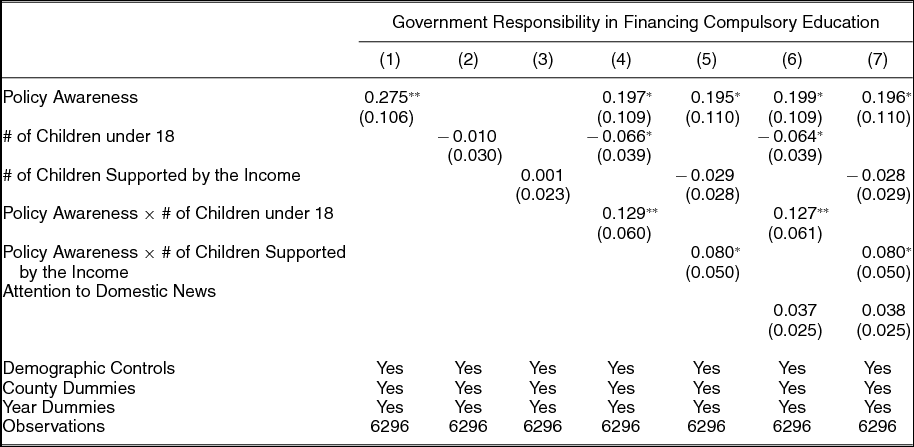
Table 2 reports the estimation based on Equation (2). As shown in Column (1), the estimate for policy awareness is positive and statistically significant. That is, awareness of this policy has a positive effect on citizens’ preference for greater government responsibility in financing education even when they are not benefiting from the policy. The estimate for the interaction term is positive and statistically significant at least at the 0.1 level (Columns 4−5). Thus, these models indicate that the effect of policy awareness is strengthened by the policy benefit. Meanwhile, the estimates for the policy benefit are mixed. In models excluding policy awareness (Columns 2 and 3), the estimates of the policy benefit are small and not statistically significant. If we take the interaction term into account, the marginal effect of the policy benefit becomes positive. This set of results is consistent with the theoretical argument that when the policy benefit is relatively small and varies by individual, those benefiting from the policy have a favorable view of the policy only when they are aware of its existence.
The Effects of Policy Benefit and Policy Awareness on Demand for Gov. Responsibility

Notes: These are probit results. The analyses are based on 10 multiple-imputed datasets. Clustered standard errors at the county level are reported in the parentheses. I do not report the estimates for demographic controls, which include age, gender, education attainment, marital status, party membership, household income level, and residential registration (hukou) status. I also do not report the estimates for constants, county dummies, and year dummies. *** p < 0.01, ** p < 0.05, * p < 0.1.
One concern associated with the specification in Equation (2) is that the policy awareness variable could suffer from omitted variable bias because certain factors may drive a person's exposure to political information. One such factor is the exposure to state media. The intensity of the elite message increases when a person is highly exposed to state media, which may have an effect on both policy awareness and views on government policies.
To address the potential bias resulting from an omitted variable, I included a variable that measures exposure to state media as a proxy for the intensity of the elite message in Equation (2). This variable is based on the frequency of obtaining news from domestic media outlets, such as newspapers, radio, and TV programming, which respondents self-report in the survey. The variable is coded from 1 to 4, with a higher number indicating a higher frequency of obtaining news from domestic media outlets. Columns 6 and 7 in Table 2 report the results based on this new specification. The estimates for policy awareness barely change in these alternative models after controlling for media exposure; likewise, the estimates for interaction terms also reveal little change. Hence, my primary results remain robust after accounting for the intensity of the elite message through domestic media.
THE POLICY'S EFFECT ON REGIME SUPPORT
The previous sections have shown that the new education policy has increased Chinese citizens’ preference for greater government responsibility in financing compulsory education, particularly among rural residents. Implementing the policy is costly, and the Chinese government has put itself in a position from which it will be hard to retreat, even in times of fiscal austerity. Nonetheless, the cost of the policy could be justified as a means of maintaining regime legitimacy. To explore the effects of the policy on regime support, I investigated citizens’ trust in the government. I first show that the policy has increased trust in the central government, but not in local governments. I then explore this asymmetric policy feedback effect.
Asymmetric Trust in Government
Existing studies of regime support in China have used citizens’ trust in the government as the main dependent variable (Li Reference Li2004; Shi Reference Shi2001; Tang Reference Tang2005); this measure has also been widely used to study regime support in other countries (Levi and Stoker Reference Levi and Stoker2000; Miller Reference Miller1974; Mishler and Rose Reference Mishler and Rose1997). The 2009 survey measured the level of Chinese citizens’ trust in the central, provincial, and local levels of government. This article focuses on trust in the central and local governments because provincial governments, which are on the intermediate level, have fewer implications for regime support. Because the questions about trust in the government were asked only in the 2009 survey and not in the 2004 survey, the following analysis is based on these questions from the 2009 survey:
To what degree do you trust the following organization . . .. Central Government?
(1) Completely Distrust; (2) Somewhat Distrust; (3) Trust; (4) Completely Trust
To what degree do you trust the following organization. . ..Municipality/County Government?Footnote 32
(1) Completely Distrust; (2) Somewhat Distrust; (3) Trust; (4) Completely Trust
The patterns of responses to these trust questions in the 2009 survey are consistent with previous surveys on trust in the Chinese government: Chinese citizens express a high level of trust in the government, and the degree of trust in the central government is higher than in the local government. In the 2009 survey, 92% of the respondents indicated that they “trust” or “completely trust” the central government. Meanwhile, 74% of the citizens expressed similar attitudes about local government. Although some may argue that these responses have upward biases similar to those in authoritarian regimes, these biases cannot explain why there is a systematic difference in trust between different levels of government.
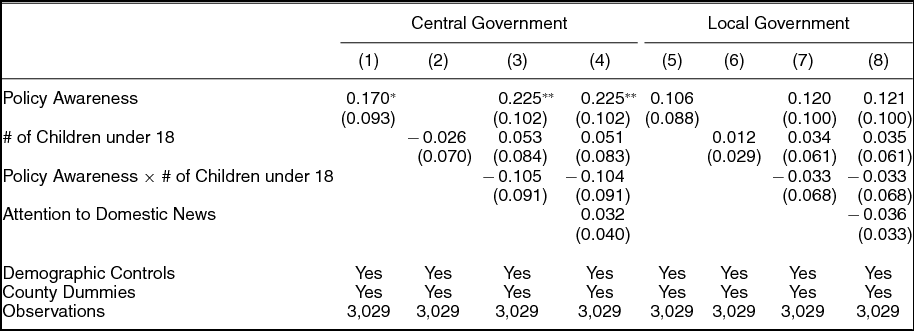
I used an ordered probit model to analyze the effects of policy awareness and policy benefit on citizens’ trust in governmentFootnote 33 (see Table 3). First, policy awareness increases trust in the central government, and the marginal effect is statistically significant (Column 1).Footnote 34 However, policy benefit has little impact on trust in the central government (Column 2). In the interaction of policy awareness and policy benefit (Column 3), the marginal effect of policy awareness actually decreases a little when the respondents are entitled to receive the benefits from this policy.
The Effects of Policy Benefit and Policy Awareness on Trust in Government

Notes: These are ordered probit results. The analyses are based on 10 multiple-imputed datasets. Clustered standard errors at the county level are reported in the parentheses. . I do not report the estimates for demographic controls, which include age, gender, education attainment, marital status, party membership, household income level, and residential registration (hukou) status. I also do not report the estimates for constants and county dummies. *** p < 0.01, ** p < 0.05, * p < 0.1.
At first glance, it is puzzling that policy benefit reduces the positive impact of policy awareness in this interaction model, despite the increasing demand for government responsibility. However, the policy benefit varies across individuals, and some respondents who are entitled to it may recognize the limitations of this policy more than those who are not entitled to it. Consequently, the effect of policy awareness on regime support is smaller when a person is entitled to the benefit. Notably, the estimate for the interaction term is not statistically significant, so that regime support still stems mainly from policy awareness. Substantively, simulation results show that the policy enhances trust in the central government by 3 percentage points (standard error of 0.94) for respondents with no children under 18 and by 2 percentage points (standard error of 0.98) for respondents with one child under 18. This effect is substantively significant given that 92% of the respondents indicate they “trust” or “completely trust” the central government already.
Second, I found no evidence that either policy awareness or benefit increases citizens’ trust in local governments.Footnote 35 The sizes of the estimates in these models are small and not statistically significant (Columns 5–7). Although the estimates for policy awareness and policy benefit have the correct signs, they are much smaller than those in the models that analyze trust in the central government, and they are not statistically significant. Taken together, these results offer evidence that the education policy has generated trust in the central government but not in local governments.
One could argue that this analysis suffers from omitted variable bias, because those paying attention to domestic news tend to have higher levels of trust in the government and are more receptive to the CCP's positive spin. I therefore controlled for respondents’ attention to domestic news in the regressions (Columns 4 and 8 in Table 3), but this variable had little impact on the interpretations of policy awareness and policy benefit in my main model. In both models, the estimates for the main variables barely change after controlling for respondents’ news exposure. Another potential confounding factor is the concomitant abolition of agriculture taxes in China, which also could generate regime support. However, the variable identifying rural residents captures the potential effect of theabolition of agriculture taxes, and the estimates are not statistically significant in all models.
Note that the policy awareness variable is a self-reported dichotomous measure that reflects neither the intensity of nor the bias in local media reporting. Therefore, I conducted a content analysis of the major provincial newspapers sponsored by the propaganda department in each province to determine the intensity of citizens’ exposure to news. The provincial-level newspaper is a good place to observe local media bias for two reasons. First, each province has only one major daily provincial newspaper, which is widely circulated locally. Many municipality or county newspapers are not dailies, and some counties do not even have their own newspapers. Second, local reporting on government policy falls under the supervision of the provincial governments’ propaganda departments, which receive guidelines from the central government's propaganda ministry.Footnote 36 However, regional variation exists in the degree to which a provincial propaganda department follows the central government's guidelines. Shih (Reference Shih2008) carried out a content analysis of provincial newspapers to understand how provincial factions signal their loyalty to the central government. Similarly, I argue that analyzing the content of provincial newspapers can reveal variations in both intensity and bias in reporting by the local government on the education policy—factors that have shaped Chinese citizens’ trust in various levels of governments.
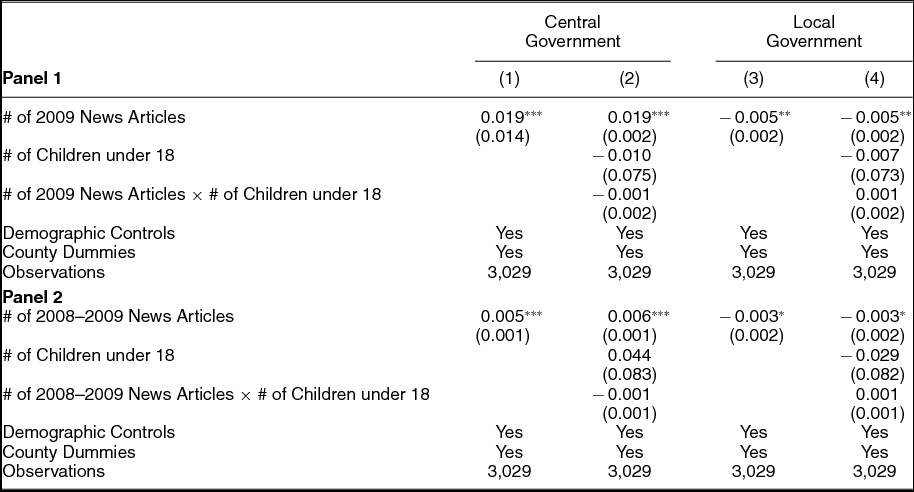
I measured the news exposure intensity by counting the number of articles reporting on the policy, which varied across provinces.Footnote 37 The average number of articles was 17 (standard deviation of 28) in 2009 and 21 (standard deviation of 47) in 2008.Footnote 38 Panel 1 in Table 4 reports estimation results based on the total number of news articles in provincial newspapers in 2009 when the survey was conducted.Footnote 39 These results echo the previous findings. On the one hand, the estimates of the intensity of news reporting are positive and statistically significant in models measuring trust in the central government. On the other hand, the estimates are negative and statistically significant in models measuring trust in local governments. In the second panel of Table 4, I extend the analysis to include articles from 2008, because news reporting on the education policy was more frequent in 2008 than in 2009. The results are consistent with the models using the 2009 analysis. All these results are robust when controlling for personal characteristics and inclusion of county fixed effects that account for unobserved local characteristics.
News Exposure Intensity and Trust in Government

Notes: These are ordered probit results. The analyses are based on 10 multiple-imputed datasets. Clustered standard errors at the county level are reported in the parentheses. I did not report the estimates for demographic controls, which include age, gender, education attainment, marital status, party membership, household income level, and residential registration (hukou) status. I also did not report the estimates for constants and county dummies. *** p < 0.01, ** p < 0.05, * p < 0.1.
Assigning Credit and Blame to Governments
To this point, I have shown that policy awareness engendered by media reporting has enhanced citizens’ trust in the central government, but not in local governments. I have argued that this asymmetric effect on trust stems from both the decentralization of education provision and state media bias, which induce Chinese citizens to give more credit to the central government for good policy outcomes. To evaluate this claim, I investigated how positive and negative local education experience affected citizens’ trust in different levels of governments.
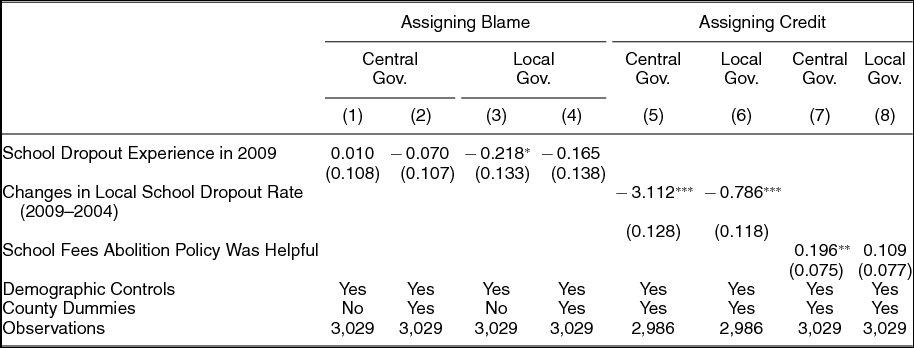
Both the 2004 and 2009 surveys contain a question asking respondents whether anyone in the immediate or extended family had dropped out of school in the past three years because of tuition costs; 13% of respondents reported in 2004 that they did, in contrast to only 4% in 2009.Footnote 40 Using this question as an indicator of negative education experience, I found some evidence that citizens blame the local government rather than the central government for the underperformance of local education provision. Specifically, Column 1 in Table 5 shows that this negative education experience has no impact on Chinese citizens’ trust in the central government, but Column 3 suggests that it undermines citizens’ trust in the local government. Including county fixed effects to account for unobserved county characteristics (Columns 2 and 4) still yields no evidence that citizens blame the central government for negative education outcomes. The coefficient estimate for the local government remains negative, but is of smaller magnitude and has a p-value of 0.232.
Trust in Government and Assignments of Credit and Blame by Citizens

Notes: These are ordered probit results. The analyses are based on 10 multiple-imputed datasets. Clustered standard errors at the county level are reported in the parentheses. I do not report the estimates for demographic controls, which include age, gender, education attainment, marital status, party membership, household income level, and residential registration (hukou) status. I also do not report the estimates for constants and county dummies. *** p < 0.01, ** p < 0.05, * p < 0.1.
Conversely, how does a positive education experience affect citizens’ trust in government? I used two strategies to answer this question. First, the survey results indicated that the school dropout rate decreased from 2004 to 2009. To evaluate changes in the quality of local education, I constructed a variable measuring the average changes in dropout rates in each surveyed locality. Specifically, I averaged the reported experiences of local school dropouts in 2004 and 2009 in each survey location and calculated the difference by subtracting the average local school dropout rate in 2009 from that in 2004.
On average, the change from 2009 to 2004 is −10.1 percentage points (standard deviation of 16.3). Using this variable as the indicator of positive education experience in a locality, I then evaluated its impact on trust in different levels of government. Columns 5 and 6 in Table 5 show two results. First, the estimates are negative and statistically significant for both models of trust in central and local governments. Substantively, these results mean that when the average local school dropout rate decreases, citizens trust both central and local governments more. In other words, citizens give credit to both central and local governments for an improvement in the provision of local education. Second, the estimate for this indicator is four times larger in the model on central government trust than in the one on local government trust. That is, citizens give far more credit to the central government than the local government for the reduction in the local school dropout rate.
I used another question in the 2009 survey as the indicator of positive education experience—the perceived positive impact of the policy abolishing school fees on respondents’ family welfare.Footnote 41 This variable was coded 1 if the respondent reported that the policy was extremely or very helpful for family welfare, and 0 otherwise. Overall, only 7% of the respondents reported the policy to be extremely or very helpful. Using this measure as the indicator of positive education experience, Columns 7 and 8 in Table 5 show that the magnitude of the estimate for this indicator in the model of trust in the central government is almost twice as large as the one in the model of trust in local governments. Furthermore, the estimate of this indicator is statistically significant in the central government model only, not in the local government model.
Overall, these results suggest that citizens experiencing positive education provision give more credit to the central government than to local governments. In addition, the earlier analysis offers some evidence suggesting that citizens tend to blame local, not central, government for poor education outcomes. Consequently, an asymmetry in the assignment of credit and blame produces different policy effects for trust in the central and local governments in China.
Considering all the results reported in this section, one might conclude that the education policy has achieved the Chinese government's intended goal only to a very limited extent. The results in Tables 3 and 4 suggest that the policy enhances trust in the central government but not in local governments.
I would argue instead that the policy serves the purpose of maintaining regime support by strengthening asymmetric trust in different levels of government, whether or not this effect is intended by the central government. Cai (Reference Cai2008) contends that divided state power in a multilevel government structure helps China maintain stability despite numerous instances of social unrest. Similarly, by improving its performance legitimacy among citizens relative to local governments, the central government could avoid blame for some governance problems. The central government claims credit for a policy even when the credit should be shared among various levels of government. This strategy partly explains why Chinese citizens tend to petition the upper levels of government about local grievances (Cai Reference Cai2008; Li Reference Li2013). Thus, the education policy has helped the Chinese central government achieve its intended purpose of regime support.
CONCLUSION
Although numerous studies claim that social policies are key to regime survival, this article depicts multifaceted effects of policies on political attitudes. The recent abolition of school fees in China has significantly increased Chinese citizens’ preference for government responsibility in financing compulsory education, particularly among rural residents. The increased preference is driven by policy awareness, not policy benefit. Yet, the new policy bolstered citizens’ trust only in the central government but not in local governments.
One could argue that the study reported in this article might have a limited scope condition because the institutional environment in China—a single-party nondemocratic regime with high decentralization of social policy and high media control—is unique. Yet many one-party regimes in Latin America and Africa as well as monarchies in MENA have attempted to expand social spending while controlling the media as a means to bolster regime survival. The implications of this article could shed light on social policies and regime legitimacy.
In China, the success of the policy awareness mechanism hinges on state media control. In societies where state media control is relatively weak, the positive effect of policy awareness of a particular social policy might not be as strong as in the Chinese case. Furthermore, consistent with the existing literature, this article finds that the actual policy benefit has a mixed effect on political attitudes. The findings of this article cast doubt on the effectiveness of using social policies to garner political support.
The Chinese government has achieved mixed success in its attempt to use this policy to maintain regime legitimacy. The policy has enhanced citizens’ trust in the central government, but has had little effect on trust in local governments. It remains an open question whether this strategy is sustainable in the long run. For example, expanding access to the internet challenges state media control. Excessive credit claiming by the central government could undermine local governments’ incentives to provide public goods and services.
Additionally, although the policy may help the central government maintain regime legitimacy, it has also engendered greater expectations of entitlements. One potential consequence is that the rise of citizen demand may harm the Chinese government in the future, because any failure to fulfill this rising expectation may undermine the government's legitimacy. In particular, if the government were to experience severe fiscal constraints caused by external economic shocks, the inability to fund social policies such as the one discussed in this article may create a backlash that challenges regime stability.
Finally, the decentralization of public goods provision has helped diffuse criticism of the central government on governance issues, but the increase in the central government's transfers and credit claiming in the last decade has forced the central government to take more direct responsibility in public goods provision. Although the central government receives most of the credit for perceived policy success, it will have to shoulder at least some of the blame for any perceived failures as this re-centralization process proceeds.
Online materials
To view online material for this article, please visit http://www.xiaobolu.com/researchpapers/Social_Policy_China_Online_Appendix.pdf



Comments
No Comments have been published for this article.