IntroductionFootnote 1
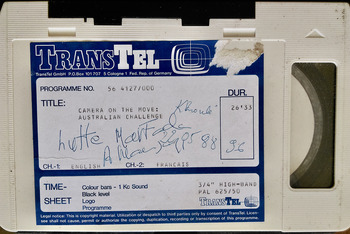
Figure 1 shows a videotape, photographed in the collections of the Radiodiffusion Télévision Sénégalaise (RTS) in Dakar, Senegal. It beautifully encapsulates many of the terms and conditions of the processes of digitization of public broadcasting archives beginning at the turn of the twenty-first century in Francophone West Africa.Footnote 2
Photograph of a 3/4-inch over-recorded TransTel videotape
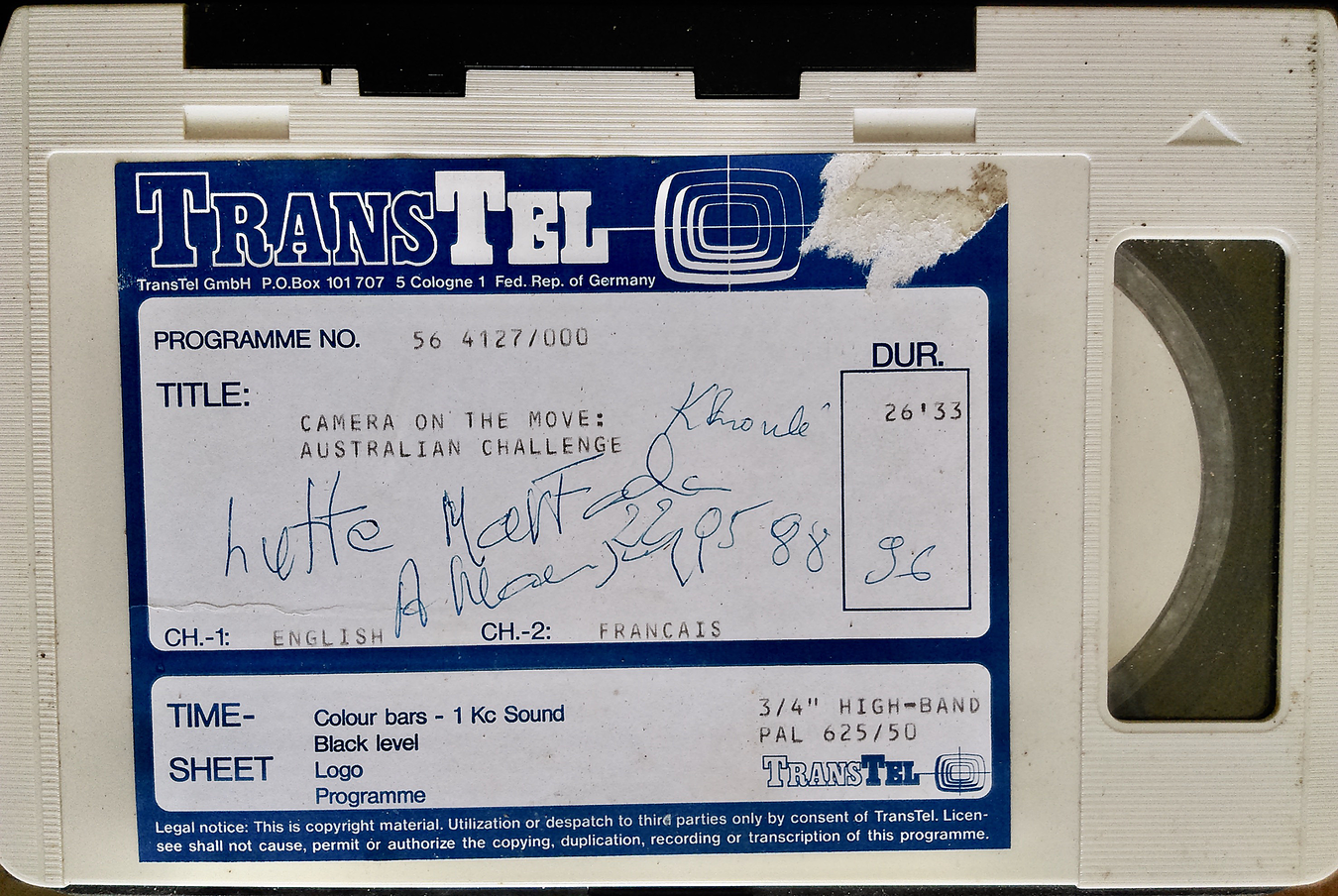
Indeed, both the pictured object and its label give us multiple details. It is a 3/4-inch videotape, produced for high-band in PAL 625/50. It was provided by TransTel GmbH, an organization headquartered in Cologne, but the programme it records was seemingly made in Australia and is available in English and French, through two distinct audio channels. The programme has an identification number and a legal notice makes clear it falls under copyright law. We do not know its exact date but it must have been made before 1988 because on 22 May of that year, a wrestling match was recorded over it. Wrestling is a very popular sport in Senegal and the over-recording was probably done in Khoulé, an inner suburb of Dakar.
Also traceable are a number of agents, human and non-human, domestic and foreign. We can identify a technological artefact, a Senegalese public structure, a German limited liability company, Australian and Senegalese programmes, two European languages and one African (Wolof), normative and organizational aspects (broadcasting standards, metrologies, copyright law), and manuscript inscriptions. That particular tape is therefore a good metaphor for the complex circulations constitutive of the national broadcasting archives in West Africa, just as it is for the centrality of technologies and negotiations involved in their preservation and access – in a nutshell, of knowledge and power.
This article seeks to show how analyzing the situation of audiovisual archives – their physical state and preservation in the digital age and the problems they raise – leads us to confront the past for several reasons. First, as technological objects these mnemonic tools carry elements of the past (documents) to which they provide access (sources and resources), thus justifying their place in a historiographical undertaking. Secondly, since their technical nature and contents are the product of a circulatory history, the past must be taken into account when choosing technical options and devices for their digitization. It must be noted that these options are themselves embedded in pre-existing networks related to a long history of cooperation in broadcasting. Finally, because the conservation of this subject involves a reconfiguration of past technological and memorial fractures, it offers new possibilities for national audiovisual legacies, including the virtual repatriation of digitized archives from other countries, especially the former colonial power. I shall deal with the subject of repatriation later in this article.
Audiovisual Archives and West Africa’s Past
In an article discussing the contours and modes of production of “L’histoire nouvelle” first published in 1978, Jacques le Goff in his quest for total history stressed the need to take into account all documentary traces left by societies.Footnote 3 Inspired by Michel Foucault’s notion of document/monument, he explained that history was in the middle of a documentary revolution broadening its scope beyond traditional historical sources, notably by enrolling archives concerning ordinary everyday realities.Footnote 4 Reflecting in the same book on the historical present and its exclusion from the domain of history, Pierre Nora argued that:
It is the fact of decolonization that has brought about the arrival, in the field of our Western historicity, of societies called “without history,” which slumbered in the silence of colonial oppression or were [simply] ethnological. (…) [In consequence] our own history was revealed to be ethnological at the same time as ethnological societies became conscious of their own historicity.Footnote 5
Helped by the release of archive collections and the development of new information and communication technologies since the turn of the twenty-first century, this epistemological shift has taken on a new intensity in recent years, mainly at the hands of post-positivist historians and archivists with postmodern sensitivities.Footnote 6 Recent scholarly literature has focused on the sparseness, scattering and subjectivity of colonial and post-colonial archival collections and sites, as well as the need to historicize them.Footnote 7 This research brings to light also the disrupted and uncertain nature of the archival material itself as constitutive of its historiographical value. As Luise White points out, “the fissures in record-keeping and the unlikely spaces in which records are kept and not kept tells a story of its own, of governance by fits and starts and false starts (…).”Footnote 8
Notwithstanding the fact that these rich reflections apply to them fully, audiovisual archives have been largely omitted. The existing literature mainly treats them either simply as sources or from a purely aesthetic perspective, investigating the relationship between moving images, culture, and politics (e.g. visual anthropology or media studies). In the information and communication sciences, including archival science, such material has been only marginally discussed, audiovisual records being considered from a documentary or semiotic perspective, in other words in their substance and structure – never more than alluding to the problem of their preservation.Footnote 9
In Africanist historiography in particular, audiovisual archives are most often referred to as mere media, useful for recording oral source materials. It is obviously true that they are the material containers of the spoken word and provide alternative archival approaches to those associated with written culture, thereby challenging ethnocentric bias in historical research. However, my aim here is to argue that they make up also for the paucity of sources for contemporary history. In Nora’s metaphor they help turn our attention from the memory of sites to sites of memory. Footnote 10
Besides constituting relevant sources, audiovisual archives can indeed be observed as culturally determined and organized sites of memory, even though in themselves they do not constitute memory.Footnote 11 Their sites are made up of multiple technical objects too which, as Madeleine Akrich has pointed out, mediate our relationships with reality.Footnote 12 Audiovisual records are above all mediated forms of memory encapsulated in videotapes, film rolls, or sound recordings – and that were – or were not – made into heritage items as part of a colonial and post-colonial state.
Social studies of science can be useful to help understand audiovisual archives as material artefacts susceptible to archaeological examination.Footnote 13 On this point, Paul Wenzel Geissler and Guillaume Lachenal have some interesting thoughts. They were the editors of Traces of the Future: An Archeology of Medical Science in Twenty-First Century Africa, and according to them this consists in being “attentive to their transformations in time and to the processes that brought them to us (or not).”Footnote 14 An archaeological engagement with that specific archival group meets the dual concerns of historians and is particularly relevant to the history of Africa since 1960 – i.e. post-independence. First of all, there is the epistemological question of what constitutes relevant material that can be mobilized for researching the African past and secondly, the methodological demand to examine closely the material aspects and cultures of preservation and accessibility of archives. Engaging with this archival group is also an invitation further to historicize the material substance of sites of memory, as well as to examine the relationship between technologies of memory and the technical systems that make their materiality possible – a relationship which underpins current projects for digitizing public broadcasting archives in West Africa.Footnote 15
Circulations
The history of broadcasting in the entire region is too rich and complex for the scope of this article.Footnote 16 However, it is useful to recall it briefly in order to understand why, as its product, broadcasting archives are an instructive window for research on the history of West Africa and are particularly informative to historians both as sources and traces.
The histories of empire and broadcasting in West Africa have for contingent reasons been intertwined. Radio, introduced in the first half of the twentieth century, was developed to meet military needs as well as to foster cultural uniformity of the colonies, especially the Afrique Occidentale Française (AOF). The subsequent development of televisual infrastructure, just as those States achieved independence, was influenced by multiple factors including great political instability during the period of regional restructuring. That resulted in the staggering of the projects over two decades, from 1963 to 1983.Footnote 17 Competition among the new nations to launch television services, combined with the necessity of foreign technical and financial aid, led to both close technical cooperation with the former colonial administration and French industry and, against the backdrop of the Cold War, the emergence of new networks of cooperation and alliances. From that perspective the region’s broadcasters cannot be understood as simple products of western-transfer, as André-Jean Tudesq analyzed, but rather as contact zones and circulatory localities “constituted within a history of circulation and entanglements between heterogeneous networks of people, objects and knowledge practices.”Footnote 18
Central to those circulations was the flow of programmes – that the new states were barely able to produce – and the technical hardware, beginning with the transceivers and microwave equipment on which national broadcasting networks are based.Footnote 19 They also enrolled a multitude of other things needed to produce and broadcast programmes, such as mobile television reporting sets, videotapes and VCRs. Such flows had a significant impact, especially since imported technological objects sometimes intrinsically entailed the adoption of the technologies incorporated in them. France, for example, principally by using credit allotments in all its former West African colonies except Ahmed Sékou Touré’s Guinea, successfully imposed Séquentiel Couleur à Mémoire (SECAM) over its competitor systems, the German Phase Alternating Line (PAL), and the US’s National Television System Committee (NTSC).Footnote 20 That also resulted in the entanglement and complex superposition of heterogeneous layers of aid-related technologies in the archive collections of the broadcasters. For example, as Figure 1 reminds us, even though Senegal had adopted SECAM, it could still receive programmes in PAL from the German programme bank TransTel.
It must be noted too that exported programmes were not necessarily produced in the national language of the exporting country. Many programme banks, like TransTel, were indeed multilingual. Moreover, intellectual property regimes notwithstanding, cassettes were often re-used to overcome a shortage of blank videotapes. Through studying the technological layers, it is possible to throw light on the different ways in which foreign aid could be negotiated or bypassed.
Endangered Traces of the West African Broadcasters
Unfortunately, these artefacts, so important for our archaeological method, are today under threat. Broadcasters’ collections have largely been ignored, suffering the vicissitudes of complicated governance since independence, including pillage and wilful destruction or damage. In Senegal for example, documents borrowed by journalists were often negligently never returned at the RTS.Footnote 21 Similarly, in Togo, the national broadcaster Radio Lomé had to seek police help to recover material illegally taken by former hosts.Footnote 22 In Côte d’Ivoire, the archives of the Radiodiffusion Télévision Ivoirienne (RTI) were ransacked during the 2010–2011 civil war.Footnote 23
Nevertheless, the threat to their physical integrity is due primarily to material effects: natural decay, shelf-life and obsolescence of recording and playback devices, and thus to the difficulties of preserving these different materials. Analogue audiovisual archives, as technical objects, are indeed particularly vulnerable to wear and tear such as scratches and oxide loss. They are vulnerable too to biochemical damage such as “vinegar syndrome,” mould, or fungus damage. Climate plays a key role here, with heat and humidity being the main factors causing physical and chemical deterioration and the development of microorganisms. In view of the fact that cultural and political frontiers coincide with economic and technological divides, such attacks by the forces of nature, where geography determines destiny, suggest that West African states are at a disadvantage in being asymmetrically confronted with processes of natural decay, further jeopardizing the possibility of an equitable preservation of audiovisual heritage.Footnote 24
Moreover, the ever-shortening shelf-life of audiovisual technology is an increasing threat to the survival of these archives since, as Bertrand Gille pointed out, “techniques are always interdependent. (…) It is therefore indispensable that there be a certain coherence and a certain compatibility between them.”Footnote 25 That factor is all the more important for audiovisual archives since, compared to other documentary forms, they have a particular need for technical mediation. A manuscript for example exists as an object, and, even if we are not able to decipher it or understand it, its content still remains visually accessible. In the case of audiovisual archives, however, visualization is impossible without technical mediation – for example a VCR. The radical dependence of audiovisual archives on associated devices, which themselves are dependent on technical systems, renders them particularly vulnerable to technological rupture. Such rupture could result from technological change such as that from film to video or from the blending of heterogeneous technologies such as SECAM and PAL resulting from multiple sources of foreign aid. The same might occur when switching from one technical system to another, as in the case of the transition from analogue to digital.
The Case of the RTS
In Francophone West Africa all public broadcasters are confronted with these material problems, with slight variations according to national context.Footnote 26 The RTS for example is located on the peninsula of Dakar, at the entrance of the city centre in the Triangle Sud, and is particularly exposed to sea air which is both very humid and loaded with iodine. In storage rooms, only the temperature is controlled as humidity control devices are too expensive. The premises are cramped – a mere sixty square metres – so that boxes have be stacked, which makes the necessary ventilation difficult. Because of that, much material has already been irretrievably lost and significant deterioration continues, with “vinegar syndrome” attacking acetate audiotapes and moulds affecting polyester videotapes.
These collections include documents crucial to the history of Senegal and, indeed, of the whole region because of the transnational character of RTS’s collections. Its Radio Archives cover the period from 1956 onwards, comprising the collections of the six successive organizations that managed public radio – Radio Inter-AOF (1956–1959), Radio Mali (1959–1960), Radio Sénégal (1960–1965), Radiodiffusion Nationale du Sénégal (1965–1973), Office de Radiodiffusion Télévision Sénégalaise (1973–1992), and finally RTS (1992–present). They represent approximately 30,000 hours of programmes covering the main genres of news, reports and magazines on various recording material. The archives therefore document the history of radio broadcasting and its infrastructure in Senegal. They also throw light on the political and institutional history of the country because they follow the successive transformations of the organizational structures.Footnote 27 About 50 percent of programmes cover politics, 35 percent culture and sport, while 10 percent address economic matters and 5 percent deal with history. Most were initially imported from France although some came from other countries, including the US. Imports were slowly supplanted by local productions, after their beginning in 1952 in Saint-Louis, which contain particularly valuable series including recordings of traditional music and religious chants.
Unfortunately, however, the Television Archives do not go back before 1983 as for various reasons which I will not go into here, nothing was saved for the first ten years. The surviving collections, comprising ORTS and RTS programs, include about 14,000 items and approximately 70,000 hours of programmes. As with the Radio Archives, the main genres are represented, in similar proportions. Those archives document the history of Senegal as a state, along with many aspects of everyday life so that they are particularly valuable as a source for historical and social science research. They too include imported programmes, mainly from France but also Germany, Canada, and the Soviet Union, but in-house productions have progressively come to constitute the majority. The domestically produced material contains particularly valuable series such as the “Grand Griots” interviews covering oral memory, as well as recordings of conversations with its specialists. Regrettably, many of them have been badly damaged for lack of good conservation.
The problems of decay of analogue media and, just as importantly obsolescence of playback and recording devices, lie at the origin of the digitization projects undertaken by the region’s public broadcasters since the 2000s. Their definition and implementation are dictated by the composition and material organization of their collections, since it is the media and formats that determine the technical devices selected. That corroborates the observation that technique extends political action in general, and in a postcolonial context in particular, in space and time.Footnote 28 The region’s broadcasters remain dependent on material imports from decades ago, when they were first establishing their infrastructure. The socio-technical networks too in which processes revolve are part of a history of technical cooperation in broadcasting that began well before the advent of digital technologies. They contribute to the transformation of independence from a historical event into a never-ending historical period, as Lachenal has put it.Footnote 29
Digitizing for Safeguarding – Present, Future
Independently, and prior to the advent of digital technologies, an international effort had already started in the 1970s to preserve audiovisual heritage. Indeed it lay behind the adoption of the Recommendation for the Safeguarding and Preservation of Moving Images by UNESCO in 1980 and it was through that Recommendation that audiovisual archives were officially recognized as heritage.Footnote 30 By the early 2000s the acceleration of natural decay and the arrival of digital technologies triggered a new wave of proclamations and intentions, with the final emergence of preservation programmes in support of digitization.Footnote 31
In that context, where conservation is synonymous with digitization, digital technologies are presented as a way of separating documents from their fragile media supports, making them virtual and accessible by anyone, anywhere. However, digitization is not synonymous with dematerialization; on the contrary it poses considerable material problems. The new technologies introduce new risks, for example possible loss of integrity including misuse and signal damage from compression-decompression, the introduction of additional mediation when light variations and sound frequencies are translated into binaries, the multiplication of formats and media, or compatibility problems between systems. While constituting a necessary step in the preservation of audiovisual archives, digital technologies are not therefore a panacea, as they too are subject to obsolescence. Indeed, the shelf-lives of the new media, formats, and languages are being continuously reduced. Insofar as the migration of audiovisual documents from analogue to digital requires real-time processing, their temporal nature remains unchanged.Footnote 32 Then again, the cost of new material infrastructure means digital technologies produce new inequalities. As mentioned above, in West Africa such problems are further compounded by the digital divide – and by climate. A 2007 review of the state of the audiovisual archives in the UEMOA showed that they remained in an advanced state of decrepitude.Footnote 33
In 2005 a large-scale digitization project was launched and Francophone national broadcasters were progressively equipped with software – called Archivage Interactif Multimédia Evolutif (AIME) – specifically conceived for the digitization and indexing of moving images.Footnote 34 The project was funded by the Organisation Internationale de la Francophonie (OIF) and implemented by the Conseil International des Radios et Télévisions d’Expression Française (CIRTEF), in collaboration with the International Federation of Television Archives (FIAT/IFTA) and the French Institut National de l’Audiovisuel (INA). However, by 2015, for the whole region the project had succeeded in digitizing a mere 40,000 hours of analogue videotape archives out of an estimated 355,000 hours.Footnote 35 In 2014 as a continuation of AIME, Capital Numérique was launched as a more ambitious project targeting audiovisual archives beyond broadcasting heritage. That project was placed under the joint responsibility of OIF and the African, Caribbean and Pacific Group of States (ACP), with the support of the European Union.Footnote 36 In keeping with the prerequisite set by the ACP Group, in addition to actors of La Francophonie (INA and CIRTEF) it involves African partners including UEMOA, Côte Ouest Audiovisuel, which is a consortium of the region’s public broadcasters; and the Imagine Institute, Ouagadougou.
Governance and the Perpetuation of Asymmetries
Having won the OIF-ACP-UEMOA tender, INA’s involvement in Capital Numérique was organized on three fronts.Footnote 37 First, it was to provide technical support for implementing the fourth version of AIME and developing its web application, called “Archibald,” conceived as a collection of the digitized archives of broadcasters equipped with AIME. It must be noted that this platform is hosted on CIRTEF’s server, itself hosted on the servers of the Radio-Télévision Belge Francophone (RTBF) in Brussels. Secondly, it was to provide legal support in drafting the directive to establish an audiovisual legal deposit regime in UEMOA. That directive came into force on 1 December 2018 and should be transposed by member states into national laws by 2020.Footnote 38 INA also intervened to train training staff, for writing and editing projects based on AIME digitized archives.
In fact, this institution holds a significant proportion of West Africa’s audiovisual heritage as part of the former colonial power and has always been present in the region. In addition to the export of programmes it has since 1976 provided training to journalists and technicians, in line with the ORTF (1964–1974) and previously the “studio-école” of the Office de Coopération Radiophonique (OCORA, 1962–1969). In the light of the two multilateral projects AIME and Capital Numérique, the reconstitution of the cooperation networks has reinforced bilateral relations between France, the former colonial power, and the West African states. In 2014 therefore, the INA was instructed to evaluate the collections of the Office de Radiodiffusion Télévision du Mali (ORTM) and received an additional 15,000 Euros.Footnote 39 In the absence of strong intergovernmental and multipartite mechanisms for managing the audiovisual heritage, which would have allowed redistribution of conservation costs across nations, that was likely to cause tension. In Togo for instance, as the Director of Radio Lomé Pitalounani Telou explained, INA “wanted to send the cassettes [to France], but the State did not agree to the transfer this national heritage for political reasons. [Especially when] INA has more archives on Togo than Togo itself.”Footnote 40
In addition to the reconfiguration of older networks, the situations of expertise – the confluence of problematic situations (i.e. damaged archives) and specialized knowledge (i.e. in audiovisual preservation) – also give rise to problems in as much as they constitute a necessary step in the definition of safeguarding and digitization plans (SDPs). The difficulties include the unclear limit between mandated and instituting expertise, or, in the case of INA, between instituting and processing expertise – the latter being defined by Robert Castel as an inseparability of expertise-diagnosis and treatment.Footnote 41 INA is therefore both umpire and player, formulating remedies that it must itself execute, thereby also generating substantial income for the French state. For example, the institution is currently engaged in the implementation of the directive mentioned above to the drafting of which it contributed.Footnote 42
The question of expertise is all the more crucial in West Africa where no SDP has so far been defined. Moreover, the inventories from the 2000s are very uneven. The most recent data from the region was collected as part of a UEMOA study for the establishment of the audiovisual legal deposit system, entrusted in 2014 to four regional experts including Hamet Ba from RTS.Footnote 43 However, that study is very variable from one broadcaster to another, mainly because of the time constraint – four weeks to cover eight countries.Footnote 44 The identification of their contents poses specific problems too in the definition of priorities for safeguarding, implementation of processing chains, and estimation of costs – a decisive element for lobbying policy-makers. The volume of the archives is considerable, while their technical diversity makes them difficult to appraise accurately, so that it is not easy to decide what to select, whether rights are held over what is selected, whether a programme has already been digitized elsewhere, and so on.
How Asymmetrically Defined Projects Fail
Beyond the difficulties of evaluation, Capital Numérique is said to have no tangible implications to date for the broadcasters’ archives services in spite of the fact that its regulatory front led to a policy decision – the adoption of the directive establishing an audiovisual legal deposit regime in the UEMOA.Footnote 45 AIME itself has had mixed results. At the RTS only 5,000 hours were digitized in nine years, because there the focus was on indexing, for which there were too few staff. The difficulty of filling in the numerous database fields, with legal and technical data not necessarily available, hindered the whole process and caused recurring software failures. In view of the constant technical and material difficulties it was finally decided to stop the work, and the Archibald platform was never installed. Furthermore, if a server for storing the digitized archives was financed by the OIF, the lack of a power inverter to protect it from continuous power outages resulted in the loss not only of the equipment buy also of the 2,000 hours of real-time digitization work.Footnote 46 The RTS TV Archives also have their own technical problems in maintaining digitization – especially converting the numerous historical 3/4-inch videotapes, as only one functioning VCR is available.Footnote 47 In the context of a chronic manpower shortage no suitable personnel are available to do the work in any case. It is telling that the 3/4-inch videotape storage space has thus earned the sobriquet “wall of problems.”Footnote 48 Technical failure being the norm rather than the exception, the socio-technical assemblage is full of ruptures and thus breaks down.Footnote 49
The lack of political support has only added to the difficulties. One consequence is the lack of professionals trained in audiovisual archiving, for which there are no specific training courses. The Cheikh Anta Diop University’s Ecole des Bibliothécaires, Documentalistes et Archivistes (EBAD) in Dakar, the main training school for archivists in the region since 1967, is considering setting up a specialized Master’s programme, but for now offers only a single module on the subject in its core curriculum.Footnote 50 Another consequence of that lack of support is the general lack of technical resources, which explains for example the Radio Archive’s choice to digitize its historical audio tapes as MP3 files for lack of storage space on its two 500 gigabyte- and 2 terabyte- external hard drives. That was in spite of the proscription of that format for archiving because of lossy compression and the fact that in 2017 it was abandoned by its creator the Fraunhofer Institute.Footnote 51
The constraints have resulted in a drastically curtailed selection of programmes for conservation, favouring French and Wolof language programmes to the detriment of the five other national languages – Diola, Mandinka, Pulaar, Serer, and Soninke. Furthermore, the archives of the two zonal television broadcasters (Tambacounda and Ziguinchor) and the twelve regional radio sites (Bakel, Diourbel, Fatick, Kaolack, Kédougou, Kolda, Linguère, Louga, Saint-Louis, Tambacounda, Thiès, Touba and Ziguinchor) have not been digitized in spite of the fact that they are particularly valuable.Footnote 52
Finally comes the financial question. The economic model of the RTS, for example still relies significantly on revenues levied on electricity bills, a technique still used in 1980s West Africa and described by Akrich as a way of forcing solidarity among individuals.Footnote 53 However, that approach could not provide the investments needed in hard and soft infrastructure. The possibility of commercializing audiovisual archives online would appear to be an attractive solution to generate resources, but because of the deficiencies outlined above would be very complex to implement.Footnote 54 In addition, the transition to Digital Terrestrial Television (DTT) which, like the other UEMOA national broadcasters, the RTS has undertaken, further renders the already fragmented socio-technical assemblages even more vulnerable. It further results in a difficult coexistence between digitized material and broadcasting techniques still partly based on analogue technology.Footnote 55
The transition to DTT, which has to be completed in 2020 in order to meet international agreements, will eventually come to an end. When it does, the multiplicity of the programmes that will be needed to broadcast in the increased number of channels might revive discussions about the integrity of the region’s audiovisual heritage, as well as the establishment of new infrastructures facilitating the collection and preservation of audiovisual archives by changing the possibilities for repatriation of the resources of the past.
Foreign Digitized Traces
The problem of the dispersal of cultural heritage as a consequence of colonization, widely debated in academic literature, has been reopened thanks to the new possibilities of virtual repatriation in the light of digital technologies.Footnote 56
In the case of Francophone West Africa’s audiovisual heritage, much of the archival material is in France. INA, heavily involved in projects to safeguard material, holds numerous documents in its collections which were recorded in the region. Many have already been digitized through the national SDP and are accessible via various sites, such as the controlled reading rooms of the Ina THEQUE in Paris and in the French regions, and the Internet sites of Ina MEDIAPRO and Ina.fr, professional and public.
Particularly relevant for the purposes of this article, Ina.fr offers access to 43,000 hours of video archives, of varying content including news, reports, and magazines. Many of the documents, particularly in its newsreel collection (from 1945 onwards Pathé-Journal and then Actualités Françaises) and televised news, were produced before and during the independence of the West African states – such as the footage filmed in February 1960 during the signature of the SORAFOM Convention. The signatories were Hubert Maga, Prime Minister of the Republic of Dahomey, and Jean Foyer, French Secretary of State in charge of relations with the Community, and the occasion was Dahomey’s regaining control of its national radio. There is also footage of President Léopold Sédar Senghor taking the oath, filmed in December 1963.Footnote 57
However, this public version, not geo-limited and therefore accessible to anyone online in West Africa, poses a number of problems of accessibility. For one, certain documents are accessible in their full version only to Ina Premium subscribers, so the service is not free of charge. Another problem is that the architecture of Ina.fr, organized in themes, dossiers, or frescoes, significantly complicates identification and therefore consultation of documents, as their attribution by subject is random. For example, a document on the independence of Senegal might be found in the dossier “Decolonization” under the heading “History and Conflicts,” or in “African Decolonization of 1960” or simply “Politics;” or in the dossier “Actualités Françaises” under the heading “Programmes,” or in the dossier “Léopold Sédar Senghor” under the heading “Personalities,” or again in the “Independences” fresco in the dossier “Fresco” in the section “Web Creations.” Regrettably, Ina.fr’s search engine does not direct the user to all headings. The enrichment provided for the same document in fact varies substantially depending on the access path. Because of terminological choices made during indexing, a search term in Ina.fr’s search engine might give many results or none, thereby producing a combination of documentary noise and silence. Footnote 58
In consequence, the ease with which a document may be found depends on the user’s knowledge of INA’s collections, the architecture of its website, and West African history.Footnote 59 Without implying that there is nothing good about serendipity in archival research, the possibility of supply meeting demand is severely compromised by inadequate and unbalanced indexing – a problem directly linked to the biased colonial lexicon of the INA enterprise. The inadequate indexing also includes omissions and historical inaccuracies.Footnote 60 All of this serves further to underline Schwartz and Cook’s assertion that “archivists are major players in the business of identity politics,” because of “the large footprints they are themselves leaving on the archival record,” not to speak of the “micro aggressions” felt as the user is forced into the straight-jacket of cultural hierarchies and institutional narratives.Footnote 61 Those problems perhaps at least partly explain the infrequent consultation of the documents in both France and West Africa, in spite of their being theoretically freely accessible.Footnote 62
From Restitution to Digitization – As a Conclusion
As sources on Africa but geographically outside it, these digitized archives are nonetheless invaluable historiographic and memorial sources, both for academics and the general public.Footnote 63 The documentary series “Afrique[s]. Une autre histoire du XXe siècle” by Elikia M’Bokolo and Philippe Sainteny for the commemoration of the fiftieth anniversary of independence is an excellent example.Footnote 64 The fact that the series could not have been made without overwhelming recourse to INA archives shows the extent to which African states, including UEMOA, are sorely lacking in moving images on that crucial period of their history.
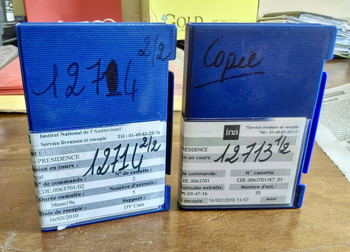
For all that, broadcasting archives have not been integrated into official demands for restitution of cultural heritage, and no organized and traceable institutional responses are found to INA’s activities.Footnote 65 Nevertheless, according to what the actors reported in interviews, requests to retrieve copies have been addressed in isolation by West African governments and organizations. Senegal, notably, was obliged to do so on the death of President Senghor in 2001.Footnote 66 However, the process has had little success. Legal conditions and tariff modalities, in some cases up to 800,000 FCFA per minute, have been a particular hindrance. The National Archives of Senegal for example, when organizing the exhibition for the AOF centenary in 1995, had already given up on the use of historical audiovisual material.Footnote 67 As a consequence, scientific and museographic projects continue to be imperilled, although a number of copies were handed over for the fiftieth anniversary in 2010.Footnote 68 There is no official information on this particular point, but I have been able to ascertain that Senegal received a mere one hour and forty-seven minutes of (incomplete) recordings (Figure 2).
Photograph of the two DVCAM cassettes received by the RTS in 2010 (Dakar, June 2018, photograph by the author)

Besides, internal documents of INA that I have been able to consult show that a paltry thirty-five hours of audiovisual recordings have been handed over to all of Francophone Sub-Saharan Africa – a ridiculously small amount considering the size of the collections.Footnote 69 The policy is very different from that for Algeria for example, for copies of INA documents recorded in Algeria prior to 1962 were transmitted to the Établissement Public de Télévision Algérienne (EPTV) in 2007, with the associated rights – even if commercialization is allowed only within Algeria.Footnote 70
Ever since 1991 UNESCO has defined the audiovisual heritage of a country as including “moving images and/or recorded sounds created or released within [the country] or by or with nationals of [the country]” – a definition which embraces the multi-inalienability of these archives.Footnote 71 In 2016 INA launched a special offer (“Offre Privilège”) for African television channels to acquire rights on these archives at what were presented as especially attractive rates. In fact, INA already earns substantial revenues through the sale to West African states of its digitized archives and expertise, and their “special offer” therefore seems rather in opposition to the idea of the sharing of historical resources.Footnote 72
Beyond legal, ethical, and historiographical questions, the restitution of audiovisual archives to West African public broadcasters, who sorely lack resources and means, could help in the safeguarding of their collections. At the RTS for example, it could help financially with the transfer of the digitized archives from external hard drives to Linear Tape-Open (LTO) supports – a strategy that has been adopted but which is very expensive to implement.Footnote 73 Confronted everywhere with the deterioration of their analogue heritage and the constitution of a new digital heritage, broadcasters generally finance the transfer of their collections and renewal of their equipment by commercializing their digitized archives. Once we admit that the heritage and digital divides are products of the same historical processes, the digitization of the broadcasting archives of the region cannot be dissociated from the restitution and sharing of digitized audiovisual resources pertaining to their past.