Introduction
Deterioration in memory and communication abilities are prominent and distressing features of dementia that impact on both the person with dementia and the caregiver. Such deterioration has been associated with behavioral disturbances and reduced quality of life in people with dementia, and with increased stress and burden and reduced quality of life in family and professional caregivers (Avila et al., Reference Avila, Carvalho, Seral and Miotto2004; Vasse et al., Reference Vasse, Vernooij-Dassen, Spijker, Rikkert and Koopmans2010). In a recent study aimed at identifying the needs of family caregivers, education-related needs were predominantly concerned with the acquisition of effective communication skills and the optimal management of cognitive and behavioral disturbances (Rosa et al., Reference Rosa2010). Although professional caregivers typically consider offering memory advice to be part of their role, they also report having little or no knowledge of memory rehabilitation strategies (Cross et al., Reference Cross, Broomfield, Davies and Evans2008).
There is a clear need for assistance aimed at providing both professional and family caregivers with strategies to support memory and communication function in dementia. However, cognitive rehabilitation approaches are often overlooked within the framework of a largely medical approach to dementia. As a result, there is a paucity of research-based education programs addressing memory and communication difficulties.
This project addresses the need for such a program using a knowledge-translation approach analogous to that recommended by Draper et al. (Reference Draper, Low, Withall, Vickland and Ward2009). Key features of this approach include: the careful selection of relevant research-based information; appropriate adaptation and clear presentation of the information for the target audience, with a focus on practical skills; wide and continuing dissemination of knowledge via accessible media; and interaction among clinicians, researchers, educators, consumers and policy-makers to facilitate sustainable changes in practice. This paper describes the process by which such a team from neuropsychology, speech pathology, nursing, and psychogeriatrics has collaborated with aged care service providers and consumers at home to translate research-based knowledge into practice via a DVD-based education program designed to help caregivers optimize residual memory and communication function in people with dementia.
The starting point for the development of this program was a consideration of the cognitive and communicative difficulties commonly observed in dementia, and of the available evidence for strategies that might compensate for areas of difficulty or facilitate the use of relatively preserved skills.
Supporting memory and cognition in dementia
It is well established that memory comprises distinct systems which appear to be differentially affected in dementia. Declarative (or explicit) memory includes episodic and semantic subsystems. People with dementia typically experience progressive impairment in the acquisition and retention of new information or events, referred to as a deficit in episodic memory (e.g. Albert, Reference Albert, Craik and Salthouse2008). Deficits in semantic memory, encompassing general knowledge of people, objects, word meanings, and other concept-based knowledge, can be observed in dementia, but normally to a lesser extent than in episodic memory, and often at a later stage of the disease (Patterson et al., Reference Patterson, Nestor and Rogers2007). There appears to be a temporal gradient to the memory loss in both the episodic and semantic subsystems. That is, although most people with dementia experience significant difficulty in encoding, retaining and recalling new information after a delay, their memory for more remote information (e.g. memories from childhood or young adulthood) is generally intact, particularly in the early and middle stages of dementia (Albert, Reference Albert, Craik and Salthouse2008).
The use of external memory aids or environmental adjustments (e.g. labels, calendars and planners) to compensate for impairments in the declarative memory system is well established in the field of neurorehabilitation. External memory aids take advantage of environmental cues to prompt memory, provide a high degree of retrieval support, and reduce the demand for self-initiated prospective memory. Preliminary positive effects have been demonstrated for the use of external memory aids as a compensatory strategy for people with dementia, particularly when the person is trained to adequately utilize the aids (e.g. Clare and Woods, Reference Clare and Woods2004).
In contrast to deficits in declarative subsystems, most people with dementia show relative preservation of non-declarative (or implicit) memory processes (see van Halteren-van Tilborg et al., Reference van Halteren-van Tilborg, Scherder and Hulstijn2007). Implicit memory includes procedural learning (e.g. skills and habits), priming, and classical conditioning. These learning processes do not require conscious recollection of information; instead, learning is expressed through performance or behavior.
Due to the relative preservation of procedural memory in most types of dementia, improvement in everyday memory abilities has been reported when training skills and routines that involve the performance of an action or motor behavior. People with dementia appear to be better able to learn information that requires an accompanying action (Bird, Reference Bird2001; Avila et al., Reference Avila, Carvalho, Seral and Miotto2004). The motor component of a task is believed to make it more memorable, as it enriches the encoding experience and often involves the manipulation of concrete objects. There is further evidence that people with dementia are able to maintain or relearn activities of daily living (e.g. setting the table, preparing a meal) with appropriate environmental support and active regular practice (Josephsson et al., Reference Josephsson, Bäckman, Borell, Bernspång, Nygård and Rönnberg1993; Zanetti et al., Reference Zanetti2001; Sabat, Reference Sabat2006). Furthermore, this practice may be more effective if it is spaced or distributed across learning sessions (e.g. Sohlberg et al., Reference Sohlberg, Ehlhardt and Kennedy2005), and if it is performed within a familiar context (e.g. van Halteren-van Tilborg et al., Reference van Halteren-van Tilborg, Scherder and Hulstijn2007).
The performance of tasks that are supported by implicit memory, such as habits or routines, can also be assisted by maintaining consistency in daily activities and in the person's environment (de Vreese, Reference de Vreese, Neri, Fioravanti, Belloi and Zanetti2001). Consistency in practice and environment will reduce the reliance on the compromised episodic memory subsystem. For instance, it is often recommended that frequently used items be kept in a consistent and visible location (Bourgeois and Hickey, Reference Bourgeois and Hickey2009). The use of routine locations for specific objects also provides visual cues for recall.
Deficits in executive functioning and attentional control in dementia may impact on cognitive performance, and have also been associated with impairment in the performance of activities of daily living (e.g. Gallo et al., Reference Gallo, Schmidt and Libon2008). Executive functions encompass a collection of cognitive abilities that are essential for successful performance of independent goal-directed behavior and engagement in social activities, including planning and organization, switching from one task/idea to another, initiating or inhibiting behavior, holding and manipulating information in mind (i.e. working memory), and self-monitoring. Although people with mild dementia are usually able to perform simple sustained attention tasks adequately, difficulties are often observed with more complex attentional tasks (i.e. dividing attention between concurrent tasks and selectively attending to a stimulus in the context of competing demands) (e.g. Lonie et al., Reference Lonie2009). Impairments in executive functions and attentional abilities increase with dementia severity (Bourgeois and Hickey, Reference Bourgeois and Hickey2009).
The planning and performance of complex or multi-step tasks can be effectively supported by breaking tasks into individual sub-components or steps, giving instructions one at a time, and using short simple sentences (Small and Gutman, Reference Small and Gutman2002; Bourgeois and Hickey, Reference Bourgeois and Hickey2009). The use of simple verbal prompts and demonstration of task sub-components has been found to improve performance of activities of daily living in people with dementia (Josephsson et al., Reference Josephsson, Bäckman, Borell, Bernspång, Nygård and Rönnberg1993). Similarly, the provision of graded assistance by care staff, from least assistance possible (verbal prompts, demonstration) up to partial and then complete physical assistance, has been shown to increase functional independence in people with mild, moderate and severe dementia (Engelman et al., Reference Engelman, Mathews and Altus2002). Finally, attentional difficulties should be considered when supporting task performance by avoiding multiple-task conditions (van Halteren-van Tilborg et al., Reference van Halteren-van Tilborg, Scherder and Hulstijn2007), and reducing environmental distractions (e.g. turning off the TV, talking to the person in a quiet environment). In a study by Small and Gutman (Reference Small and Gutman2002), caregivers ranked the elimination of such distraction as an effective compensatory technique when interacting with people with dementia.
Supporting communication in dementia
Deficits in semantic memory, executive function (including working memory) and attention also affect communication in dementia. Difficulties with word-finding, auditory comprehension and conversation are particularly prominent (see Caramelli et al., Reference Caramelli, Mansur, Nitrini, Stemmer and Whitaker1998, for review). Conversation is often characterized by off-topic or seemingly irrelevant utterances, increased repetition of ideas, lack of coherence, reduced length of utterance, and poor topic management (Caramelli et al., Reference Caramelli, Mansur, Nitrini, Stemmer and Whitaker1998). People with dementia can also show a decreased ability to take into account the conversational partner's knowledge and perspective (Hamilton, Reference Hamilton, Giles, Coupland and Coupland1991). The combination of these difficulties often means that the communication partner has to take greater responsibility for managing the conversation.
Where semantic memory is affected, word-finding, verbal fluency and naming difficulties are commonly reported (Caramelli et al., Reference Caramelli, Mansur, Nitrini, Stemmer and Whitaker1998). Regardless of whether the word-finding difficulty is the result of degraded representations, or difficulty with access or retrieval, it will have a significant impact on the person's ability to express meaning. Experimental studies of cueing of picture naming in dementia have shown mixed results for the provision of phonemic and semantic cues. However, supplying the person's first name (when naming pictures of famous people) or giving multiple-choice cues have been successfully used to compensate for word retrieval difficulties (Delazer et al., Reference Delazer, Semenza, Reiner, Hofer and Benke2003). Multiple-choice cues have also been found to be more facilitative than phonemic cues for people with more severe deficits (mean Mini-mental State Examination score of 13) (Purves and Small, Reference Purves and Small2006).
Difficulties with working memory, attention and cognitive slowing have a negative effect on auditory comprehension in dementia. A number of possible strategies have been investigated to facilitate comprehension. First, auditory comprehension may be supported by reducing cognitive demands, via a reduction in syntactic complexity. Reducing the number of clauses or propositions per sentence has been found to improve performance on comprehension tasks for people with dementia (e.g. Kemper et al., Reference Kemper, Anagnopoulos, Lyons and Heberlein1994; Rochon et al., Reference Rochon, Waters and Caplan1994). While some investigators suggest that this improvement may result from a corresponding reduction in sentence length (Tomoeda et al., Reference Tomoeda, Bayles, Boone, Kaszniak and Slauson1990), others have found that simply reducing the number of words does not improve comprehension (Rochon et al., Reference Rochon, Waters and Caplan1994). On the basis of performance on picture-to-description matching tasks, Kemper et al. (Reference Kemper, Anagnopoulos, Lyons and Heberlein1994) demonstrated that comprehension is facilitated by a combination of simple syntax and high-frequency words. These results indicate that auditory comprehension in dementia can benefit from a reduction in syntactic complexity or a combination of syntactic simplification and reduced sentence length.
Repetition has also been found to facilitate auditory comprehension in dementia. Results from experimental studies show increased accuracy for sentence comprehension following a single verbatim or paraphrased repetition (from 72.1% to 91.8%), and further improvements following a second repetition (to 96.1%), though a reduction in syntactic complexity may also contribute to the benefit of paraphrased sentences (Small et al., Reference Small, Kemper and Lyons1997). Rephrasing, repetition and further explanation of ideas are useful not only to facilitate comprehension in older adults (Kemper and Harden, Reference Kemper and Harden1999), but have also been found to encourage responsiveness in people with dementia (Hendryx-Bedalov, Reference Hendryx-Bedalov1999).
Comprehension and responsiveness of people with dementia in conversation can also be influenced by the types of questions asked by the communication partner. Analysis of both conversation samples and caregiver rankings indicate that using single-choice or yes/no questions can be effective in encouraging a successful exchange of information (Ripich et al., Reference Ripich, Ziol, Fritsch and Durand1999; Small and Gutman, Reference Small and Gutman2002). Alternatively, if the goal is to encourage an exchange without specific informational requirements, open-ended questions are considered more appropriate (Tappen et al., Reference Tappen, Williams-Burgess, Edelstein, Touhy and Fishman1997).
Speech rate modification has been proposed to reduce cognitive demands and thereby facilitate comprehension for older people with and without cognitive deficits. However, empirical evidence indicates that neither slowing speech rate (e.g. Tomoeda et al., Reference Tomoeda, Bayles, Boone, Kaszniak and Slauson1990) nor the use of a faster than normal rate (Pashek and DiVenere, Reference Pashek and DiVenere2006) is of benefit in dementia. A related strategy that has found support in cognitive rehabilitation studies is to leave sufficient time between information units to compensate for slowed cognitive processing (see Clare and Woods, Reference Clare and Woods2004, for review).
Deficits in complex attention also negatively affect comprehension and participation in conversation for people with dementia. Similar to the impact of attention on other cognitive tasks in dementia, difficulties with comprehension increase in situations with complex attentional demands. Therefore, reducing competing attentional demands, such as environmental distractions, is considered by caregivers to be an effective strategy to improve communicative interactions with people with dementia (Small and Gutman, Reference Small and Gutman2002).
Some aspects of communication, however, remain relatively well preserved in most types of dementia, including sensitivity to, and meaningful use of, nonverbal communication (Hubbard et al., Reference Hubbard, Cook, Tester and Downs2002). Comprehension of spoken language can be enhanced for people with dementia by incorporating nonverbal communicative strategies, such as the use of meaningful gestures to accompany speech, as demonstrated by Pashek and DiVenere (Reference Pashek and DiVenere2006). Sensitivity to emotional expression is also usually relatively well preserved, even into the severe stages of the disease (Vitaliano et al., Reference Vitaliano, Young, Russo, Romano and Magana-Amato1993).
Research suggests that both disruptive or problem behavior and responsiveness in communication can be linked to the tone (including vocal quality, pitch, and loudness) or communicative style of the conversational partner (Edberg et al., Reference Edberg, Nordmark Sandgren and Hallberg1995; Hendryx-Bedalov, Reference Hendryx-Bedalov1999). In particular, investigations have shown that people with dementia respond negatively to negative communicative tone. The use of critical emotional expression or harshness has been found to predict increased negative behaviors (Vitaliano et al., Reference Vitaliano, Young, Russo, Romano and Magana-Amato1993), increased vocally disruptive behaviors (Edberg et al., Reference Edberg, Nordmark Sandgren and Hallberg1995) and reduced responsiveness in conversation (Hendryx-Bedalov, Reference Hendryx-Bedalov1999). In contrast, caregivers who exhibited patience and used a soft tone were able to facilitate responsiveness (Hendryx-Bedalov, Reference Hendryx-Bedalov1999) and reduce disruptive behavior (Edberg et al., Reference Edberg, Nordmark Sandgren and Hallberg1995).
Finally, the desire to communicate is retained in most cases of dementia. It is therefore important to continue to regard communication attempts as meaningful and potentially interpretable in the light of additional contextual and nonverbal clues (e.g. Sabat, Reference Sabat1994), and any caregiver education on communication must reflect this.
Caregiver education and intervention
Educational interventions for family caregivers can have positive effects on caregivers' well-being and quality of life, role satisfaction and knowledge, as well as reducing burden and depression (e.g. Pinquart and Sörensen, Reference Pinquart and Sörensen2006; Nelis et al., Reference Nelis, Quinn and Clare2007). Furthermore, educational training for professional caregivers has been demonstrated to increase knowledge and skills surrounding the trained material (Ripich et al., Reference Ripich, Wykle and Niles1995; Irvine et al., Reference Irvine, Ary and Bourgeois2003) and can reduce the use of antipsychotics to manage behavior (Nelis et al., Reference Nelis, Quinn and Clare2007). Interventions focusing on knowledge-based strategies may also benefit the care recipient, as suggested by reported improvements in psychological well-being and behavior, and delayed placement in residential care (Nelis et al., Reference Nelis, Quinn and Clare2007).
Effective cognitive rehabilitation strategies and interventions have been established and are common in neurological populations; however, due to the challenges of rehabilitation in the context of progressive neurological decline, there is little cognitive intervention research in the area of dementia. Given the progressive deterioration observed in most cases of dementia, using compensatory strategies to enhance and build upon preserved skills is important for everyday functional abilities. Further, interventions should include relatively simple strategies that can realistically be applied by caregivers (Cross et al., Reference Cross, Broomfield, Davies and Evans2008). Strategies to facilitate communication with people with dementia are recommended in existing educational materials (e.g. Ripich et al., Reference Ripich, Wykle and Niles1995; Alzheimer's Australia Vic, 2006), but the empirical basis for these is not presented.
In a review designed to develop empirically based and clinically relevant practice parameters in relation to dementia management, Doody and colleagues (Reference Doody2001) recommended that short-term educational programs be directed towards both professional and non-professional caregivers. They found that short-term, structured educational programs that require active participation were well liked by caregivers and appear to demonstrate the broadest effects in terms of positive outcomes for both caregivers and care recipients (see also Pinquart and Sörensen, Reference Pinquart and Sörensen2006). Training caregivers is a cost-effective method ensuring that intervention can be provided in context and that gains can be maintained in a naturalistic environment.
Methods
Translation of research into caregiver strategies
The research literature on memory, cognition and communication in dementia highlighted major areas of difficulty but also identified relatively preserved abilities. In translating research findings from these fields into practical strategies for caregivers, the goal was to compensate for the deficits and harness the relative strengths, in order to support continued participation by people with dementia in everyday activities and interaction.
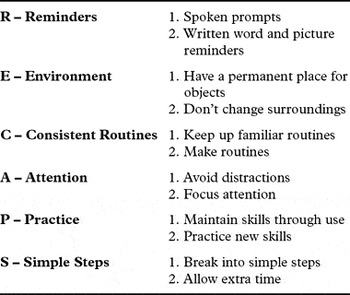
The examination of research evidence on the support of memory and cognition in dementia revealed the following key themes: the use of memory cues; the role of active practice in tapping residual procedural memory in the learning and maintenance of skills; the importance of consistency in environment and activities; and the need to reduce attentional and cognitive demands. A set of memory support strategies was compiled to reflect these themes in the context of everyday life (see Table 1). The strategies were organized around the mnemonic device “RECAPS” to facilitate retention by caregivers.
The RECAPS memory strategies

The literature on communication in dementia underlined the effects of cognitive decline on the linguistic expression and comprehension of meaning, but also noted the relative preservation of communicative abilities involving nonverbal information, and the continued desire to communicate. The available research evidence on the facilitation of communication with people with dementia yielded a set of techniques which could be grouped under the following key themes: assistance in focusing attention; consideration of nonverbal aspects of communication; reduction of complexity and working memory demands; compensation for cognitive slowing; the use of prompts and cues to assist retrieval and comprehension; the need for active listening and decoding of the person's message; and conditions to foster participation in conversation. The resultant set of strategies to maximize successful communication between people with dementia and their caregivers is shown in Table 2. These communication support strategies were structured under the mnemonic device “MESSAGE” for ease of presentation and learning.
The MESSAGE communication strategies

Presentation in an education program
Having selected and structured the sets of strategies for memory and communication support, the next step was to adapt them for presentation to caregivers in an engaging and accessible way. A DVD was chosen as the appropriate medium, and a script was prepared for each of the two domains, with a focus on the transmission of the necessary knowledge and skills, set in realistic contexts of home and residential care. The final script incorporated suggestions from experienced professional and home caregivers, whose comments were sought in order to enhance the appropriateness and applicability of the DVD content for its intended consumers.
For purposes of demonstrating each of the strategies and techniques, actors were engaged to play the roles of people with dementia and their caregivers. Their preparation for these roles included coaching for realism in the portrayal of care recipients, with the aid of documentary clips showing people at varying stages of dementia. Clinical advice was also provided on set throughout production. The dialogues scripted to exemplify the communication strategies were based on authentic examples of speech in dementia. To add an interactive, participatory element for the learner, “trigger” video interactions were included, depicting either the use or non-use of the recommended strategies, and prompting the viewer to pause the DVD and consider the effects on the care recipient's behavior. Each trigger video was followed by a brief review from a discipline specialist in order to highlight the effect of use or non-use of the strategies in each interaction.
Results
The outcome of this knowledge translation process is a DVD-based education program focusing on compensatory strategies to assist with memory function and facilitative strategies to help maintain communicative function. The program is intended for use both by family and professional caregivers, either individually or as the basis for group training sessions. The DVD comprises separate segments on memory (20 minutes) and communication (30 minutes), with overall content as follows: (1) background information on the nature and importance of memory and communication in everyday life; (2) explanation of common patterns of difficulty and preserved ability in memory and communication across the stages of dementia, presented by discipline specialists who combine the roles of researcher, educator and clinician in their respective fields; (3) an explanation of each RECAPS and MESSAGE strategy, illustrated by acted vignettes demonstrating the use of the suggested techniques in everyday life; and (4) additional scenarios to encourage viewers to consider the application of the strategies, accompanied by commentaries from the discipline specialists. To aid revision and retention of the content, the DVD is supplemented by a summary booklet (see Appendix 1, published as supplementary material online attached to the electronic version of this paper at http://www.journals.cambridge.org/ipg), and by posters, display cards, and lanyard cards showing brief reminders of the RECAPS and MESSAGE strategies.
Through collaborative partnerships with aged care and dementia-specific service providers, controlled trials of the program are being conducted with staff and residents in residential aged care facilities, and with family caregivers and people with dementia living at home. Initial feedback from participating caregivers in both settings has been positive.
Discussion
The RECAPS and MESSAGE program incorporates characteristics of effective caregiver education highlighted by Cross et al. (Reference Cross, Broomfield, Davies and Evans2008) and Doody et al. (Reference Doody2001) in that it is a short, structured program presenting simple, knowledge-based strategies that can be realistically applied both by professional and non-professional caregivers. Importantly, the strategies presented have a basis in empirical research.
The development of the RECAPS and MESSAGE program addresses the recommended criteria for translating knowledge from dementia research into practice, as outlined by Draper et al. (Reference Draper, Low, Withall, Vickland and Ward2009). The project has at all stages involved collaboration and interaction among discipline specialists, aged care and dementia-specific service providers, professional and family caregivers, and care recipients with dementia. It has entailed the identification and selection of relevant research-based knowledge from several discipline areas, and the presentation of this in a clear, practical format with an emphasis on providing caregivers with skills that will enable them to optimize residual memory and communication abilities in people with dementia.
Further development of the materials will incorporate consumer feedback from the evaluation of the research edition, and will focus on web-based dissemination to allow unlimited access to the information and skills presented. This approach has the potential to lead to widespread and sustainable changes in practice in these important aspects of dementia care.
Conflict of interest declaration
Nancy A. Pachana is a Deputy Editor of International Psychogeriatrics.
Description of authors' roles
Helen Chenery, Michael Humphreys, Nancy Pachana, Cindy Gallois, Anthony Angwin, David Copland, Gerard Byrne, Desley Hegney, Rosemary Baker, Erin Smith and Leander Mitchell contributed to study design and materials development, and edited the paper. Erin Smith and Megan Broughton conducted the literature review. Erin Smith, Megan Broughton and Rosemary Baker wrote the paper.
Acknowledgments
We gratefully acknowledge the funding for this project provided by the J.O. and J.R. Wicking Trust (managed by ANZ Trustees) and the National Health and Medical Research Council. We warmly thank Blue Care and Alzheimer's Australia (Qld) for their collaboration in this project, and Triny Roe for her role in the DVD production. We are grateful to all who have provided valuable feedback on the materials, and we also acknowledge assistance by Kyra Hucker, Kate Vearncombe, Jennifer Henderson and Polly Warburton.
Supplementary material (available online at http://www.journals.cambridge.org/ipg)
Appendix 1 (pdf 1.51 MB): Summary booklet, MESSAGE Communication strategies in dementia and RECAPS Memory strategies in dementia