


Introduction
Human-animal interactions are an important part of captive animal welfare. The captive animal is wholly dependent on their caregiver for their essential needs, including food and water, shelter and environment, and the availability of companionship. The human-animal interaction and resulting animal welfare is influenced by the human’s understanding and acceptance of animal welfare, and their relationship with animals in general (Balzani & Hanlon Reference Balzani and Hanlon2020; Sinclair et al. Reference Sinclair, Lee, Hötzel, de Luna, Sharma, Idris, Derkley, Li, Islam, Iyasere, Navarro, Ahmed, Khruapradab, Curry, Burns and Marchant2022). This is of particular importance on intensive farms because there are often hundreds or thousands of animals dependent on few caregivers at a given moment, depending on the species farmed. Previous research has investigated the factors affecting farmers’ perspectives of animal welfare, which include age, gender, culture, knowledge, economic status, and management, among others (Balzani & Hanlon Reference Balzani and Hanlon2020; Hötzel et al. Reference Hötzel, Nogueira, Hargreaves-Méndez and Stadnick2025). However, other research further shows that the sociocultural setting of the farmer in their relationship with their work and how they view themselves is also important to assess attitudes and farming practices regarding animal welfare (Vigors et al. Reference Vigors, Wemelsfelder and Lawrence2023). Therefore, to understand farmers’ perspectives, it is essential to view the farmer in their environment (e.g. specific country or farming system).
Despite progress in animal welfare research, the global uptake of better welfare practices on farms is still relatively low (Balzani & Hanlon Reference Balzani and Hanlon2020). Hansson and Largerkvist (Reference Hansson and Lagerkvist2014) state that farm animal welfare only matters when it is of importance to humans. Research has shown that farmers work to a different definition of animal welfare compared to advocates or scientists, and weigh aspects of welfare differently (Tuyttens et al. Reference Tuyttens, Vanhonacker and Verbeke2014). Farmers have been shown to weigh health as the most important factor of animal welfare (Tuyttens et al. Reference Tuyttens, Vanhonacker and Verbeke2014; Hötzel et al. Reference Hötzel, Nogueira, Hargreaves-Méndez and Stadnick2025), perhaps because that is most easily related to performance, which is economically critical for farmers. The animal species is also a consideration; there have been relatively few studies on broiler chicken farmers compared to dairy or pig farmers (Tuyttens et al. Reference Tuyttens, Vanhonacker and Verbeke2014; Balzani & Hanlon Reference Balzani and Hanlon2020; Vigors et al. Reference Vigors, Wemelsfelder and Lawrence2023). This may be due to the short lifespan of broiler chickens. There can be thousands of animals on the farms, making it difficult to build relationships with the animals, compared to the longer lifespan of cattle and pigs, where there is more opportunity and handling interactions in which to develop relationships.
Although there are many factors that influence animal welfare on farms, farmers and stock people are in direct contact with the animals and make decisions that impact the animals daily (Kauppinen et al. Reference Kauppinen, Vainio, Valros, Rita and Vesala2010; Hansson & Lagerkvist Reference Hansson and Lagerkvist2014). Reasons for improving animal welfare also differ around the world (Sinclair et al. Reference Sinclair, Lee, Hötzel, de Luna, Sharma, Idris, Derkley, Li, Islam, Iyasere, Navarro, Ahmed, Khruapradab, Curry, Burns and Marchant2022). Jo et al. (Reference Jo, Nasrullah, Jiang, Li and Bao2022) found that broiler chicken farmers in Northeastern China were interested in improving animal welfare, however this interest stemmed from an economic over a compassion motivation. In another study in China, researchers found that egg producers more commonly used the term animal welfare compared to broiler chicken farmers, however all participants had heard of animal welfare and had some knowledge of it (Yang et al. Reference Yang, Dwyer, Vigors, Zhao and Langford2024). Yang et al. (Reference Yang, Dwyer, Vigors, Zhao and Langford2024) also found that farmers were concerned with how genetics influenced broiler welfare, and at certain times when welfare may be more at risk, such as breeding, catching, transport and slaughter.
As farm animal welfare interest grows in Asia, there is a current movement to improve animal welfare through various new projects (such as Animals Don’t Speak Human [https://animalsdontspeakhuman.org/], Welfare Matters [https://www.welfarematters.org/], Global Food Partners [https://globalfoodpartners.com/], and many more). Recent research has documented that farmers in Indonesia use antibiotics in large quantities, often without prescription from a veterinarian (Karuniawati et al. Reference Karuniawati, Hassali, Ismail, Taufik and Suryawati2021), which is contributing to anti-microbial resistance (AMR). One way to reduce disease without resorting to over-use of antibiotics is to improve animal welfare (Dawkins Reference Dawkins2017). However, farm animal welfare is rarely a topic of research in Indonesia (Wilcox et al. Reference Wilcox, Sandilands, Mayasari, Asmara and Anang2024). Understanding farmers’ attitudes towards, and knowledge and beliefs about, animal welfare can help bridge the gap between what we know about best animal welfare practices and the implementation of those practices around the world (Hötzel et al. Reference Hötzel, Nogueira, Hargreaves-Méndez and Stadnick2025). Understanding the challenges farmers face when considering animal welfare could help advocates and scientists to develop strategies to improve farm animal welfare.
This research aims to explore the knowledge and understanding of chicken welfare of people working on broiler chicken farms in West Java, Indonesia, and how these opinions are influenced by factors, such as age, job role and education. We also explore farmers’ key concerns regarding on-farm chicken welfare and production.
Materials and methods
Ethical status
The study was approved by the Ethics Committee at Universitas Padjadjaran (25/UN6.KEP/EC/2024) and informed consent was obtained from all subjects involved in the study.
Methodology Study 1: Perspectives
Design
A survey design was used, where 59 questions and statements were created in English and translated into the national language; Bahasa Indonesia. The questions and statements were checked for meaning and clarity by two native Bahasa Indonesia speakers. The survey presented questions and statements in various formats, including yes and no answers, multiple choice, questions about an image with multiple choice answers, and 6-point Likert scale responses from strongly agree to strongly disagree or do not know (Table S1; Supplementary material). The questions and statements were divided into topics to assess different aspects of animal welfare, including perception of pain in animals, knowledge of animal welfare, ability to identify welfare concerns in broiler chickens, and knowledge of welfare indicators in broiler chickens. The survey was developed and tested on two farmers for clarity and meaning, and then the wording was revised to ensure that the respondents understood the intended meaning of the questions.
Participants
Participants were recruited during visits to 14 farms across West Java, Indonesia; two researchers visited all farms as part of a larger study on broiler chicken welfare (described in Wilcox et al. Reference Wilcox, Anang, Asmara, Mayasari, Siahaan and Sandilands2025). The participants either worked directly on those farms or for the farm company. Recruitment of participants on farms focused on those working hands-on with the chickens, although not exclusively, and they were selected by the farm manager on the day of the farm visit. The criteria for participant selection were people that either worked directly with chickens or had an influence on their husbandry (for example, in a decision-making, organisational or financial capacity), working in West Java on commercial broiler chicken farms with a holding capacity of > 20,000 chickens per house.
The sample of participants consisted of 38 people, 36 of whom were male and two were female and their education level varied from primary school to Master’s degree level education.
Materials
Four topics were investigated to gain an insight into the participants’ understanding, knowledge, belief and attitudes of animal welfare. ‘Perception of pain in animals’ was measured to gain insight into how participants perceive animal pain, aiming to understand if they consciously view animals as sentient. A scoring system was used (see Table S1; Supplementary material), where high scores indicated they do believe chickens feel pain, and lower scores that they do not feel pain (Sinclair et al. Reference Sinclair, Lee, Hötzel, de Luna, Sharma, Idris, Derkley, Li, Islam, Iyasere, Navarro, Ahmed, Khruapradab, Curry, Burns and Marchant2022).
Knowledge of animal welfare was investigated to understand what participants understand by the term animal welfare (in Bahasa Indonesia the term is ‘kesejahteraan hewan’). Participants were initially asked a yes/no question if they knew about animal welfare and were then asked to describe animal welfare with an open-ended response, followed by a multiple-choice response of what they would include in the topic of animal welfare, from animal health, animal happiness, mental health, and animal suffering.
To measure the ability of the participants to identify welfare concerns of broiler chickens in a practical way, the participants were asked about scenarios with multiple-choice answers to identify indicators of welfare concerns. For example, a multiple-choice response to the question ‘which of these are signs that a chicken may be sick’. Five questions in this category aimed to identify if the participant could identify signs that a chicken may have poor welfare.
Six questions measured whether the farmer could identify the welfare indicators of footpad dermatitis (FPD) and hock-burn (HB), and what they thought were the causes and preventative measures for these welfare indicators (Nielsen et al. Reference Nielsen, Alvarez, Bicout, Calistri, Canali, Drewe, Garin‐Bastuji, Gonzales Rojas, Schmidt, Herskin, Miranda Chueca, Padalino, Pasquali, Roberts, Spoolder, Stahl, Velarde, Viltrop, Winckler, Tiemann, de Jong, Gebhardt‐Henrich, Keeling, Riber, Ashe, Candiani, García Matas, Hempen, Mosbach‐Schulz, Rojo Gimeno, Van der Stede, Vitali, Bailly‐Caumette and Michel2023; Wilcox et al. Reference Wilcox, Sandilands, Mayasari, Asmara and Anang2024). The participants were also asked about their perceived control over the welfare of the chickens.
Procedure
Two researchers visited the farms between November 2023 and June 2024. The researchers stayed at each farm for two days collecting data on the farm operations and chicken welfare as part of a wider project. The farm managers had been contacted prior to the farm visit to confirm the activities and had agreed to take part. On arrival at the farm the details of the project were explained to the manager, and the researchers asked for three to four (as was available in the timeframe) participants to complete the survey. The participants were surveyed at a convenient time throughout the two-day period. Surveys generally took place in a communal office with one researcher sitting next to the participant with the survey on a tablet they could both see. They talked through the questions together in Bahasa Indonesia whilst the researcher entered the responses directly onto the tablet, and the participant could confirm the written response by looking at the tablet. Each survey took 20 min to complete.
After the farm visit the responses were translated into English by one of the researchers who was fluent in both Bahasa and English. The responses were anonymised and were compiled into a master dataset. After the data collection was complete, the responses were scored as per the scoring system detailed in Table S1 (see Supplementary material).
Data handling and analysis
The results from study 1 were scored numerically as per the scoring system (shown in Table S1; Supplementary material). The responses for each participant were scored and categorised into four outcomes: perception of pain in animals; knowledge of animal welfare; ability to identify welfare concerns in broiler chickens; and knowledge of welfare indicators in broiler chickens. These scores were analysed in IBM SPSS® Statistics Software to assess if age, role, years of experience and education influenced the four outcomes. Non-parametric tests were used due to small sample sizes; years of experience and age were correlated with scores of perception of pain in animals, knowledge of animal welfare, ability to identify welfare concerns in broiler chickens, and knowledge of welfare indicators in broiler chickens scores were carried out using Spearman’s Rank tests. A series of Kruskal-Wallis tests were used to identify the main effect of education level and job role the outcome scores. Secondly, a simple content analysis (Weber Reference Weber1990) of the information was carried out to gain a deeper understanding of the responses from the four outcome categories, and the responses are described in four sections.
Study 2: Open-ended questions
Design
A set of 59 mixed-response questions was developed to understand the management of the farm and the context of the chickens that were being studied as part of a wider project on broiler chicken welfare in West Java. Most of these were questions about the status of the farm, including for example, the number of chickens, breed, weight, feed, dimensions of the houses, number of houses, and management protocols such the light routine, how litter is provided, numbers of feeders and drinkers available. The results from this information have been published in Wilcox et al. (Reference Wilcox, Anang, Asmara, Mayasari, Siahaan and Sandilands2025). However, there were four open-ended questions which were not included in the previous publication and are better suited to discuss in the context of farmer perspectives and are therefore included here. These questions were: (1) Do you have any concerns about animal husbandry; (2) Do you have any concerns about animal production? (3) What is the standard operating procedure (on your farm) when you find a sick or injured bird? (4) What the standard operating procedures (on your farm) for disposing of dead birds? The responses to these questions were analysed using a simple content analysis approach, and the results are presented here.
Participants
During visits to the 14 farms, the farm managers specifically were surveyed about the farm management, husbandry and SOPs, therefore there were 14 participants in this survey. This was at a separate time within the two-day visit from the surveys described in study 1, and the results from study 1 are not linked to study 2, however 11 participants were included in both surveys.
The demographic of the participants were 13 males and one female, working as farm managers (12) and house supervisors (2) (Table 1). Detailed demographic information was not collected for the purpose of this survey, because the aim was to obtain information about the management of the farm. However, for the 11 participants that were also included in survey 1, the mean (± SD) age of the participants was 36 (± 12) years old, with a mean of 10 (± 9) years’ experience working on broiler chicken farms.
Summary of participants surveyed for perspectives on broiler chicken welfare from 14 farms in West Java, Indonesia. In Indonesia the equivalent levels of education are; SD = primary school, SMP = high school, SMA = A levels, SMK = vocational course equivalent to A Levels, D3 = diploma, S1 = undergraduate degree, S2 = Master’s degree

Table 1. Long description
The table shows the number of participants in each job role including vet, owner, farm manager, area/ general manager, assistant manager, technical service, stock people, supervisor/ head of house, and sales and admin. For each of these groups the number of participants, mean age and mean years of experience and education level is provided.
Materials
In the analysis, the four questions were divided into two categories, handling dead and sick animals, and husbandry and production concerns. This was retrospective as the results of the grouped questions presented similar topics. The questions relating to handling dead and sick animals were aimed at understanding the protocols in place to either dispose of dead birds or to cull birds, or to establish if such protocols were in place. The questions about concerns relating to production and husbandry were to find out if there were issues related to broiler chicken farming that had previously not been addressed by the researcher.
Procedure
Data collection took place in-person on farms by two researchers. On arrival at the farms, the farm managers were surveyed about the farm operations and procedures. Surveys usually took place in an office room or communal space. These questions were asked in an informal conversational manner, with the responses being typed directly onto a tablet during the discussion. Discussions took place in the national Indonesian language, Bahasa Indonesia. After the survey was complete any additional comments from the farm managers were added to the Excel® sheet. The information was later translated from Bahasa Indonesia to English by the primary researcher, who was present during the survey and fluent in both Bahasa Indonesia and English. All of the text that had been typed was translated. Analysis of the data was carried out on the translated English responses; however, the original Bahasa Indonesia responses were continually consulted to reduce loss of meaning.
Data handling and analysis
After the farm visit the survey responses were compiled into a master Excel® spreadsheet and anonymised using randomly generated codes for each survey. The responses to the four questions were read multiple times in Bahasa Indonesia and then in English, common topics were highlighted and subjects that were similar were compiled in a simple content analysis. This uncovered topics relating to biosecurity, culling practices, and environmental concerns which are described and discussed.
Results
Study 1
Descriptive results of study 1 are summarised in Table 2. Statistical analysis was used to assess correlations and effects between the independent variables (i.e. participant information) on the dependent variables (survey outcome scores), shown in Tables 3 and 4. There was a significant positive effect between education and knowledge of welfare, as level of education increased knowledge of welfare scores also increased, the main differences were those without a university degree averaged between 2.5 and 3.6 for knowledge of animal welfare, with an overall mean of 3.1, but those with a university degree averaged 5 with an undergraduate degree and 5.3 with a Master’s degree. All other tests were not significant. The job role of the participants did not have a significant effect on the outcome (Table 4)
Descriptive results from a survey of broiler chicken farmers in West Java, showing mean (± SD) scores in four categories of questions regarding their perspectives of broiler welfare. The maximum score per category is shown in brackets. The first line of results shows all participants combined; further rows are broken down by job role within the farm

Table 2. Long description
The table shows the mean scores for each outcome category per job role, the outocme categories are perception of pain in animals, knowledge of animal welfare, ability to identify concerns in broiler chickens and knowledge of welfare indicators in broiler chickens. The results show the mean scores per job role group and the standard deviation for each.
The effect of participant age and years of experience working on broiler chicken farms on the perspectives of broiler welfare in four categories, with scored outcomes analysed using Spearman’s Rank, with rho values (rs) and P-values shown (n = 38). All results were not significant (P > 0.05)

Table 3. Long description
The table shows the outcome of a Spearman’s rank analysis of the survey outcome scores by participant age and years of experience. None of the results were significant.
Statistical analysis of the effect of participant level of education and job role with scored outcome categories of broiler chicken welfare using Kruskal Wallis. *Values were considered significant where P < 0.05

Table 4. Long description
The table shows the results of a Kruskall Wallis test analysing outcome scores for each category of survey questions by participants split by education and job role. The results show a signifincant positive effect of education on knowledge of welfare. All other results were not significant.
.
Perception of pain
One hundred percent of participants answered ‘yes’ to the question ‘can chickens feel pain?’, and 100% of participants answered agree or strongly agree to the statement ‘chickens feel pain like humans feel pain?’ This is a strong indication that the participants do believe chickens feel pain, and in a way they can relate to. For the questions ‘do chickens feel pain like …cats?’ and ‘…fish?’ the answers were more varied, with seven participants answering ‘neutral’ to if chickens feel pain like cats (the remaining agree or strongly agree), and five participants answered ‘disagree’ to if chickens feel pain like fish, and 12 neutral, with the remaining agree (15) and strongly agree (6). The statement ‘chickens feel pain like fish’ was removed from scoring, because the meaning of the responses was unclear: if in agreement that chickens feel pain like fish, does that equate to supporting chickens feel pain or not, because other research shows people more strongly agreed that chickens feel pain compared to fish (Sinclair et al. Reference Sinclair, Lee, Hötzel, de Luna, Sharma, Idris, Derkley, Li, Islam, Iyasere, Navarro, Ahmed, Khruapradab, Curry, Burns and Marchant2022).
Thirty-five participants agreed or strongly agreed that medicine can be used to reduce pain for chickens, with one participant responding ‘disagree’ and two ‘neutral’. The respondents that answered neutral and disagree had answered ‘yes’ to both ‘can chickens feel pain?’ and ‘can they feel pain like humans?’, therefore it is possible that the wording was ambiguous and participants misunderstood the statement (e.g. they may have thought it was asking from an on-farm practical perspective), or they may think that medicine is ineffective for chickens.
To investigate if chickens’ pain could be linked to emotions, participants were asked if they agreed with the following statement: ‘I believe a potentially painful experience, such as breaking a wing bone, could affect the emotions of chickens, for example make a chicken feel sad’. All participants either strongly agreed (12), agreed (23) or answered neutral (3). This is an indication that the participants may believe chickens are sentient. In this category of questioning, after having determined and discussed what foodpad dermatitis (FPD) is, and looking at an example picture of it, participants were also asked, ‘do you think that FPD is a problem for the chicken?’ Twenty-eight participants said it was an important problem for the chicken, seven responded it was a small problem, one was unsure and two said it was not a problem. The responses were similar for the same question asked regarding hock burn (HB), where 26 participants thought it was an important problem, four said small problem, five answered not a problem, and three were unsure.
Knowledge of animal welfare
Of the 25 participants (65%) who said they did understand animal welfare, each held different concepts of animal welfare. Some concepts were related to the Five Freedoms (Fraser & Broom Reference Fraser and Broom1996), where participants mentioned having plenty of feed and water available, and comfort was frequently mentioned, e.g. Participant 1: “a situation where the animal is comfortable in the environment, and they have enough food and water”, Participant 2: “feeling comfortable, eating, drinking and sleeping enough”. These types of general comments were common. Other words that were commonly used were ‘treated well’ and ‘care’. One of the participants stated directly that they knew about the Five Freedoms, however at least five other participants also listed some of the Five Freedoms (without directly mentioning the framework). Some of them also mentioned factors relating to animal behaviour, such as Participant 19 stated that “chickens with good welfare look active, have a good appetite and can show behaviours like playing”. Two participants also mentioned that welfare includes when an animal dies, participant 7 stated “animal welfare is the freedom of chickens, when they die not in pain”, and participant 24 “get good treatment in accordance with the animals’ behaviour, even until the chicken dies”. The responses varied and often encompassed different aspects of animal welfare, however there were several common words in the responses as illustrated in Table 5.
The responses (with the number of responses and percentage shown in brackets) to the question ’do you know about animal welfare?’, from a survey of 38 broiler chicken farmers in West Java

Table 5. Long description
This table shows a breakdown of the key words used to describe animal welfare, and the responses in a multiple choise question regarding what is included in animal welfare. Responses to key words include words such as comfort, care, feed. Multiple choice were, for example animal health, animal suffering.
Five out of the seven people that said they did not know about animal welfare also did not respond to the question ‘describe animal welfare’, however they did choose appropriate responses in the multiple-choice question (Table 5).
Ability to identify welfare concerns
When questioned about chickens’ behaviour in different circumstances, participants consistently ticked appropriate responses, shown in Table 6.
Responses and percentage of responses to multiple-choice tick-box response questions in a survey of 14 broiler chicken farmers in West Java, Indonesia

Table 6. Long description
Table shows the responses to questions regarding chicken behaviour, such as ’what does a chickn do when it is hot?’ and the number of particicpants which ticked each multiple choice response and the percent of participants that ticked that response, e.g. panting, drink more.
When participants were presented with two images of broiler chickens in a house, and two statements ‘the chickens are normally distributed across the floor’ for the non-normal distribution the responses were; strongly agree (1; 3%), agree (9; 24%), neutral (3; 8%), disagree (23; 60%), strongly disagree (2; 5%). For the same question showing an image of chickens evenly spread across the floor, the responses were; agree (25; 66%), strongly agree (10; 26%), neutral (2; 5%), disagree (1; 3%); the majority of participants responded as expected. However, the answers to these questions are not absolute and responses could depend on the participants varying experiences.
Knowledge of welfare indicators in broiler chickens
This category of questions focused on understanding the participants’ knowledge around causes of poor welfare, and the participants’ role in preventing or improving poor welfare. There were six questions in this category, including questions such as ‘what causes the dark patch on the chicken’s foot?’ with an image of severe FPD and a list of multiple-choice answers where the participant could tick as many answers as relevant from a list of: wet litter, heavy bodyweight, laying for a long time, genetics, feed, fighting with other chickens, dirty litter, age, sharp litter, hot weather, cold weather, humid climate, none of these, unsure. The questions and responses for this section are shown in Table 7.
Questions responses (the number of responses and percentage are shown in brackets) to understand the knowledge of welfare indicators in broiler chickens in a survey of 38 people working on broiler chicken farms in West Java. Information on appropriate responses from Nielsen et al. (Reference Nielsen, Alvarez, Bicout, Calistri, Canali, Drewe, Garin‐Bastuji, Gonzales Rojas, Schmidt, Herskin, Miranda Chueca, Padalino, Pasquali, Roberts, Spoolder, Stahl, Velarde, Viltrop, Winckler, Tiemann, de Jong, Gebhardt‐Henrich, Keeling, Riber, Ashe, Candiani, García Matas, Hempen, Mosbach‐Schulz, Rojo Gimeno, Van der Stede, Vitali, Bailly‐Caumette and Michel2023) and Wilcox et al. (Reference Wilcox, Sandilands, Mayasari, Asmara and Anang2024)

Table 7. Long description
Table showing the responses to survey questions ’why is there a dark mark on this chickens foot’, ’what causes this dark mark to occur?’, and similar questions regarding hockburn. The table shows the responses and number and percent of participants giving that response, and the appropriate response to the questions.
1 Many participants said the foot is dirty, which is because of how the word in Bahasa Indonesia ‘kotor’ is used, and can be used in a different way to how the word ‘dirty’ is used in English.
2 Farmers commented that when rice husks from glutinous rice crops (as opposed to standard rice crops) was used, the litter was sharper and could cause more cuts to the skin.
Study 2
Concerns regarding husbandry and production
This section combines the results from two open-ended questions, ‘do you have any concerns about animal husbandry?’ (n = 11) and ‘do you have any concerns about animal production?’ (n = 11). Some respondents did not provide answers for all the questions, therefore there are differing sample sizes. The main categories that were revealed in these conversations were concerns about water, disease and sourcing litter (Table 8), with more detailed information explored below.
The responses (number of responses and percentage shown in brackets) to the question ‘Are there any concerns about animal husbandry and production?’ From a survey on 14 broiler chicken farms in West Java

Table 8. Long description
Table showing the responses to concerns of the farmers about animal husbandry and production, and the number and percent of respondents who mentioned each response. Responses include concerns about water, disease, sourcing litter and extreme weather.
Water and disease
Concerns related to water included sourcing water, dirty and cloudy water, and having to use acidifier in the water due to excessive alkalinity. Two of the participants commented that in the dry season the water sources often dried out, and they had to buy water for the farms. One participant responded that they did not have a water filter, and that they believe this contributed to an increase in Escherichia coli in the chickens.
The participants that were concerned about disease highlighted E. coli and respiratory problems were the main issues, and one participant mentioned Newcastle Disease. Other diseases mentioned throughout discussions included Gumboro (Infectious Bursal Disease) and Marek’s disease. On one farm there was a recent outbreak of Gumboro disease, which had caused mass mortality of chickens.
On ten occasions participants stated that litter was difficult to obtain. One participant mentioned litter was becoming more expensive, another mentioned there was growing competition for rice husks from other industries, and others mentioned poor farming conditions resulting in a lack of supply of rice husks. On one of the farms this had led to an innovation (learnt from an excursion to Brazil) whereby litter was fermented between cycles, which reduced the need to buy in so much new litter each growing cycle. The participant was positive about the results of fermenting litter, since it appeared to be effective at keeping the litter dry and beneficial for the chickens’ health. Another farm manager had recently started using woodchip mixed into the rice husks, however they were unsure how beneficial that was for the chickens.
Specific random events
The participants described some recent specific conditions that may have contributed to poor welfare that they were concerned about. On one farm there had been a power outage and problems with the generator, which meant there was no power and the blowers were off for 1 h when the average outdoor temperature ranged between 28–32ºC. During this time 700 chickens died, and the repercussions led to many more deaths in the following hours, resulting in significant losses and suffering. Although this is an unusual event, it highlights issues with power supply and (a lack of) preparedness in case of such circumstances.
Another participant stated that many chickens died during the thinning process, where some of the chickens are harvested at an earlier date, and they were worried the rest of the chickens would not make it to the final harvest date. They were not sure why that had happened on this occasion and stated it was unusual. Several of the participants also mentioned fluctuating and extreme temperatures which were contributing to increased mortality.
Standard operating procedures for sick and dead birds
Two questions were asked regarding the culling methods and disposal of sick and injured birds on the farms. Some of the key factors affecting animal welfare during this study were related to biosecurity and lack of culling procedures.
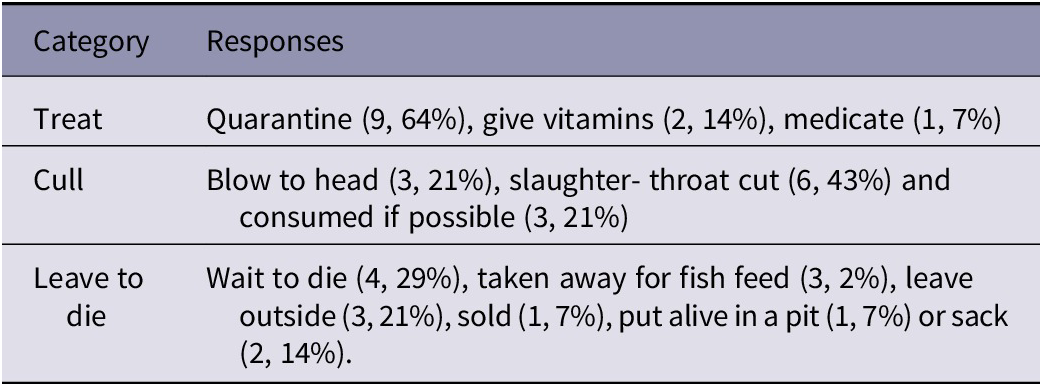
When asked the question ‘what is the standard operating procedure when you find a sick or injured bird’ there were a variety of responses (Table 9). Most (9) farm managers mentioned quarantine in the first instance, where quarantine referred to a specific section of the chicken house being reserved for sick chickens; this was usually a physical barrier using wire with a wooden frame which restricts movement of the chickens in that section from mixing with the rest of the flock, but would not effectively stop the spread of pathogens by water, ground, or airborne vectors. Participant 1 said “if there are just a few [sick birds] we separate them. If there are a lot then we would control the temperature, give them vitamins and medicine”.
Number and percentage of responses to the question, ‘What is the standard operating procedure for sick birds on your farm?’ From a survey of 14 farm managers on broiler chicken farms in West Java (n = 14)

Table 9. Long description
This table shows the responses to the question ’what is the standard operating procedurefor sick birds on your farm?’ and the responses include treating, culling or leave to die, with the number and percent of participants response to each.
Other responses included culling the sick or injured chickens; several methods of culling birds were described. Some of these can be described as blunt force, e.g. one participant described they would “hit the bird against a pole to kill them if necessary”, another said they “selected or quarantined, given medicine, or culled in sacks or hit and put in hole”. Others described slaughtering them (with a knife) on-farm for consumption by farm workers; one participant described “the ones eaten are the healthier or larger ones”, “we would hit them on the head; if possible we would eat them, or if not we put them in a bag and wait for them to die”. These quotes show the lack of preparedness for the everyday situation on broiler chicken farms, where sick and injured chickens need to be culled in an effective and humane way to alleviate animal suffering as much as possible. The lack of standard operating procedures for culling of sick and injured chickens is a concern for animal welfare.
Some participants said sick chickens sometimes recover or become healthy again if left outside, for example, participant 12 said “we would put them in quarantine, or if it was bad then take them outside to get fresh air, or sometimes slaughter them to eat them”. Taking them outside and leaving them for a while was common (only mentioned in three of the surveys, however often observed on the farm visits), however it is unclear if this has any beneficial effect on the chicken’s health and ability for the farmer to sell the chicken. This is an important biosecurity issue where sick chickens can mix with wild birds potentially spreading disease.
When the participants were asked what the standard operating procedures are for disposing of dead birds on the farm, the majority of participants (6) said they bury them in a pit. That was described as directly putting them in a hole and pouring disinfectant or a bioactive ingredient on them. The second most common response (5) was for dead chickens to be taken away and used (uncooked) as fish feed by local catfish farmers. One participant said they feed the uncooked dead chickens to their own fish on-site, or cook some for use as dog food for their own dogs (participant 5). Another participant mentioned that day-old chicks that had died would be buried (participant 8).
The farm managers were asked how many chickens were rejected when the company came to collect them for slaughter, however all except one of the farmers said there were no rejections. The collecting company took them all, and where some mentioned that not all were taken, they were given or sold to local people, or could be sold to different buyers, including wet markets. Participants stated that almost any chickens that are still alive can be sold, therefore there is little incentive for the farmers to cull sick animals.
Discussion
Survey scores
Participants working as veterinarians scored highest for the perception of pain in animals, knowledge of animal welfare, and knowledge of welfare indicators in broiler chickens. However, technical service, area managers and assistant managers scored highest for ability to identify welfare concerns in broiler chickens, although overall there were no significant differences related to job role. This could be due to the small sample size and wide variation in the dataset.
There is a lack of training provided for stock people and farm managers regarding broiler chicken welfare, and this is reflected in the results. Training on what animal welfare is, specifically learning about indicators of good and bad welfare for broiler chickens, would be a useful investment to improve knowledge of stock people and those working directly with the chickens on a day-to-day basis. Training of trainers has been shown to be an effective method for educating abattoir workers in animal welfare (Descovich et al. Reference Descovich, Li, Sinclair, Wang and Phillips2019), and both online and on-farm training have also been effective for improving knowledge of animal welfare for farmers (Michaelis et al. Reference Michaelis, Schubbert, Gieseke, Cimer, Zapf, Lühken, March, Brinkmann, Schultheiß and Knierim2022). In other areas of the poultry industry in Indonesia, the organisation, Global Food Partners, has been training egg producers in cage-free egg production systems, using a demonstration farm to provide training, advice and guidance on how to change from battery cage systems to better welfare cage-free systems; this method has shown success at helping farmers to improve animal welfare (Hartcher et al. Reference Hartcher, Nuggehalli, Yang, Catalina, De Luna, Agus, Ito, Idrus, Rahayu, Jattuchai, Descovich, Lane and Sinclair2023), and could be a suitable method to train broiler farmers to improve welfare. In a survey of 240 Chinese broiler chicken farmers, 70% of respondents said the most common reason to implement animal welfare measures was to increase profitability of farming (Jo et al. Reference Jo, Nasrullah, Jiang, Li and Bao2022). If farmers can observe for themselves a productive farm that can provide higher animal welfare using transferable Standard Operating Procedures (SOPs), whilst also being economically profitable, this could increase interest and uptake of better welfare systems.
All the participants agreed that chickens can feel pain in a similar way to humans, although fewer participants agreed that chickens feel pain in the same way as fish; this could be an indication that they perceive fish to feel pain differently (or less). More information is needed to investigate how the participants feel about fish pain. Worldwide public responses to a question about the emotions of different farmed animals revealed similar results where people agreed more strongly that chickens feel pain, than fish feel pain (Sinclair et al. Reference Sinclair, Lee, Hötzel, de Luna, Sharma, Idris, Derkley, Li, Islam, Iyasere, Navarro, Ahmed, Khruapradab, Curry, Burns and Marchant2022). Farmers’ perceptions of pain in animals, often relating to painful procedures, has been one of the more commonly studied topics in farmer animal welfare perspectives. In a global systematic analysis of farmer perspectives of animal welfare, older farmers and those with more relevant experience were more likely to be empathetic with their animals and were more likely to minimise painful procedures than younger, less experienced farmers (Balzani & Hanlon Reference Balzani and Hanlon2020). In the current results these findings were not supported: age and years spent working with broiler chickens did not influence the outcome scores. This could be due to a small sample size, however, further and more specific research into perceptions of pain in animals would be needed to investigate this in detail.
Overall, the results showed that most participants believe chickens can feel pain, that chickens are affected by painful experiences, and that indicators of welfare (specifically FPD and HB) are a problem for the chickens themselves. This is in line with current research which supports that chickens can feel pain and are affected by it (Mikoni et al. Reference Mikoni, Guzman, Fausak and Paul-Murphy2022; Schuck-Paim et al. Reference Schuck-Paim, Alonso, Verkuijl, Hegwood and Hartcher2025). An important question that remains to be asked is, does believing chickens can feel pain affect the farmers’ husbandry and management (and therefore welfare) of the chickens?
Regarding the causes of FPD and HB, most answers were appropriate (Wilcox et al. Reference Wilcox, Anang, Asmara, Mayasari, Siahaan and Sandilands2025), which indicates that the participants are aware of these welfare problems, and they are also aware of appropriate measures that could help to prevent and reduce these problems. Here, it is important to note the difference between knowledge versus behaviour, which may be restricted (Kauppinen et al. Reference Kauppinen, Vainio, Valros, Rita and Vesala2010; Platto et al. Reference Platto, Zhu, Guo, He, Hu, Valros and Irwin2020). For example, stock people may not have access to funds to order more litter, or they may feel uncomfortable asking their supervisors for more resources. Specific animal welfare training for different job roles may be beneficial to see improvements implemented (e.g. at management level understanding of how money can be spent for maximum benefit to improve welfare, compared to at stockman level where training on signs of poor welfare could be useful).
Culling practices
A lack of standard culling practices is a significant concern for animal welfare and could be the cause of prolonged animal suffering on these broiler farms. Sick, small and injured chickens were commonly put into a quarantine area, where they waited until they died or were taken for slaughter; this causes significant suffering and culling can be used to reduce suffering (Baker-Cook et al. Reference Baker-Cook, Torrey, Widowski, Turner, Knezacek, Nicholds and Schwean-Lardner2021; Nielsen et al. Reference Nielsen, Alvarez, Bicout, Calistri, Canali, Drewe, Garin‐Bastuji, Gonzales Rojas, Schmidt, Herskin, Miranda Chueca, Padalino, Pasquali, Roberts, Spoolder, Stahl, Velarde, Viltrop, Winckler, Tiemann, de Jong, Gebhardt‐Henrich, Keeling, Riber, Ashe, Candiani, García Matas, Hempen, Mosbach‐Schulz, Rojo Gimeno, Van der Stede, Vitali, Bailly‐Caumette and Michel2023). The quarantine pens were within the chicken house, and chickens were separated by standard partitions of wire mesh with a wooden frame, which is likely to be ineffective at preventing disease spread by water or airborne vectors. In the UK, the culling of animals on farms is regulated by legislation, and cervical dislocation is the most common practice (Clarkson et al. Reference Clarkson, Paraskevopoulou and Martin2023). The main reasons reported in the USA and UK for culling birds on broiler chicken farms is to alleviate pain and suffering, disease management, or production management (Baker-Cook et al. Reference Baker-Cook, Torrey, Widowski, Turner, Knezacek, Nicholds and Schwean-Lardner2021; Clarkson et al. Reference Clarkson, Paraskevopoulou and Martin2023). Indeed, methods of emergency culling on-farm have different levels of efficacy and require training and practice to ensure it is carried out correctly, resulting in a quick death (Baker-Cook et al. Reference Baker-Cook, Torrey, Widowski, Turner, Knezacek, Nicholds and Schwean-Lardner2021). The participants on the farms visited had not received any training regarding culling of chickens, and this may explain their lack of confidence in carrying out effective culling, and training on this could be a simple way to significantly improve animal welfare and to reduce suffering.
Participants were reluctant to cull animals because even sick and injured birds could be sold for slaughter, which shows, unsurprisingly, that they place economic value above chicken welfare. The poultry industry in Indonesia is competitive, with fluctuating feed prices and reduced meat prices due to oversupply (Nugroho Reference Nugroho2020; Utami Reference Utami2024), therefore the culture is one of survival, rather than best practices. Changes are needed to stabilise the industry if animal welfare is to be able to thrive in this environment, alongside sustainability, environmental concern and public safety. Indeed, these economic challenges also affect other aspects of chicken farming, including waste disposal and biosecurity. Higher standards are unlikely to be upheld unless these practices are enforced through corporate or government measures, or if there is clear economic advantage, for example, exporting products at a higher price.
Waste disposal and biosecurity
When discussing with participants how dead chickens are disposed of, most respondents said that they buried them (i.e. put them into a hole in the ground) or gave them to fish farmers to be used as fish feed. This could be a concern for zoonotic disease, on the other hand this also makes use of a by-product, if the risks are mitigated by, for example, cooking the chickens first. In Bangladesh, Rimi et al. (Reference Rimi, Sultana, Muhsina, Uddin, Haider, Nahar, Zeidner, Sturm-Ramirez and Luby2017) reported that chicken litter and faeces were used untreated on open land as fertiliser, or sold as fish feed, and although they did not mention using carcases as fish feed, the authors discuss how the use of chicken faeces on fish farms could spread disease to wild bird populations. Akter et al. (Reference Akter, Ghosh, Biswas, Das, Chisty, Sagor, Das Gupta, Uzzaman, Karna, Talukdar and Chowdhury2025) also found that broiler chicken houses in Bangladesh had low biosecurity scores due to improper carcase and waste disposal, and they mentioned feeding dead birds to other animals although they did not mention what species. Although disease is unlikely to transfer between bird and fish taxa, the use of diseased bird carcases on fish farms brings the disease out into the environment and increases the risk of disease dispersal and possible mutation. Farmers may be concerned about the effect of zoonotic disease outbreaks in terms of loss of income, both on individual farms and nationally, as found from surveys conducted in Vietnam (Houghton et al. Reference Houghton, Nguyen, Syndicus and Nguyen2025).
Similar issues were found in Egypt, where they also found management practices with low biosecurity and poor disposal of dead chickens and waste litter (Eltholth et al. Reference Eltholth, Mohamed, Elgohary and Elfadl2016). As found in Bangladesh, disposal of dead chickens was reportedly not controlled, with farmers leaving chickens in bushes or open fields and feeding them to pets (Rimi et al. Reference Rimi, Sultana, Muhsina, Uddin, Haider, Nahar, Zeidner, Sturm-Ramirez and Luby2017), and researchers in Egypt reported dead chickens being left in rivers (Eltholth et al. Reference Eltholth, Mohamed, Elgohary and Elfadl2016); disposal of waste from chicken farms appears to be a problem around the world and must be addressed because it contributes to soil and water contamination (Akter et al. Reference Akter, Ghosh, Biswas, Das, Chisty, Sagor, Das Gupta, Uzzaman, Karna, Talukdar and Chowdhury2025). There is a biosecurity tool developed specifically for farms, which includes a questionnaire quantifying the biosecurity level of a farm in detail (Gelaude et al. Reference Gelaude, Schlepers, Verlinden, Laanen and Dewulf2014); such tools could be useful for evaluating the impact of broiler farms and the industry as a whole, on the environment.
Training of those working in the poultry industry could improve animal welfare and has been deemed a priority in the poultry industry (Rioja-Lang et al. Reference Rioja-Lang, Connor, Bacon, Lawrence and Dwyer2020). The current results show key areas for training to improve animal welfare include culling practices, biosecurity, and best practices.
Water and litter sourcing
Water on farms is essential for drinking, cleaning and cooling (Drastig et al. Reference Drastig, Palhares, Karbach and Prochnow2016). Key concerns from participants about water sourcing included lack of clean water, alkaline water, and water sources drying out in the dry season. This is a cyclical issue related to the previous topic discussed, because poor waste disposal can also cause contamination of water sources, which could contribute to disease on the farms (Amaral Reference Amaral2004). Location of the farms could be a consideration of this, because farms in Indonesia often use natural water sources for water supply, for example, either ground water via a bore hole, or water from rivers, therefore treatment of water before use on the farm is essential. Several of the participants mentioned putting acidifiers into the water, which can help to reduce disease; organic water acidifiers have been shown to have a beneficial impact for weight gain and feed conversion ratio (Hayat & Srinongkote Reference Hayat and Srinongkote2012). Participants also stated that further filtration and use of chlorine in water is common to prevent disease outbreaks. Water is an essential nutrient, and in broiler production chickens consume around two times as much water as feed (Raut et al. Reference Raut, Biswas, Taylor-Bowden, Kilonzo-Nthenge, Pokharel, Tabler, Nahashon and Maharjan2025), however this is often overlooked in terms of how the chemical and microbiological content of the water affects the growth, health and performance of the chickens (Mohamed et al. Reference Mohamed, Khalil, Soliman and El-Sabrout2025; Raut et al. Reference Raut, Biswas, Taylor-Bowden, Kilonzo-Nthenge, Pokharel, Tabler, Nahashon and Maharjan2025). More detailed planning and assessment of water sources of broiler chicken farms in West Java could reduce water shortages and costs related to poor water quality and access.
Participants stated that it was difficult to source rice husks for litter substrate throughout the data collection period, due to extreme weather causing poor rice harvests (Salman et al. Reference Salman, Yassi and Bahsar-Demmallino2017), and some stated increasing competition from other industries. The use of rice husks as litter is a key factor in broiler chicken welfare, because litter quality is important in maintaining chickens leg health, a key indicator of animal welfare (Mohamed et al. Reference Mohamed, Khalil, Soliman and El-Sabrout2025). Innovation on some farms led to fermentation of litter for re-use, which appeared to have benefits for chicken welfare (Turner Reference Turner2008); this practice is common in other countries such as Brazil, and further investigation may support training of this in Indonesia. Both water and litter sourcing are related to the environment and climate; other researchers also found that climate change and availability of key resources are challenges for farmers (Phillips Reference Phillips2024).
Study limitations
This paper is based on a small sample of people working in the broiler chicken industry in West Java; despite general uniformity of the responses, caution should be applied when extrapolating these results. The analysis used here was not able to consider that certain job roles generally have a higher education level which could affect some responses. Another limitation is that these surveys were carried out in Bahasa Indonesia, and have been translated, although every effort was made, information and inferences may be lost during this process. The researcher was present whilst the survey data were recorded, which may have affected the participants perceived anonymity leading to increased likelihood of social desirability bias. This research was exploratory and the survey instrument was pilot-tested before use on two participants. During the analysis the researchers omitted answers to the statement ‘I believe chickens feel pain like fish feel pain’ from the analysis because there was no understanding of whether or not the participants believed fish feel pain, therefore it was deemed too ambiguous to elucidate if participants felt that chickens feel pain or not.
Animal welfare implications
Understanding the factors that affect uptake and implementation of animal welfare measures is essential to improving animal welfare. Those working on these farms in Indonesia are responsible for the welfare of thousands of chickens at a time, and understanding their concerns and perspectives can help to re-shape how scientists approach discussion with farmers about improving animal welfare. The results of this research can be used by advocates working to improve animal welfare in Indonesia, to help remove barriers to better welfare on farms.
Conclusion
Most of the participants in this study had heard of animal welfare, although low scores on this survey showed that basic knowledge of the concept was lacking. All participants agreed that chickens could feel pain. Participants’ key concerns regarding broiler chicken production were consistent, focused on availability of key resources, disease, and extreme weather. Broiler chicken producers in West Java may benefit from training in animal welfare, including the use and practice of culling, solutions to mitigate risks from extreme weather, and biosecurity practices to prevent disease and improve animal welfare.
Supplementary material
The supplementary material for this article can be found at http://doi.org/10.1017/awf.2026.10126.
Data availability statement
The raw data supporting the conclusions of this article will be made available by the authors on request.
Acknowledgements
We thank Open Philanthropy for funding this research project, and BPDP scholarship from Universitas Padjadjaran. Special thanks to my supervisors at Universitas Padjadjaran and Scotland’s Rural College for their support, expertise and input. Thanks to Midola Nusantara Siahaan for assistance with data collection. Thanks also to the participants, farm owners and managers who offered assistance on farms, and engaged with us. Thank you to the reviewers for providing a constructive critique of this article, and the editors at Animal Welfare.
Competing interests
None.







 Open access

