



Schizophrenia is a complex neuropsychiatric disorder characterised by symptoms that interfere with perception and behaviour, such as delusions, hallucinations and affectations of higher-order cognitive functions. 1 About 0.55% of people worldwide have schizophrenia, according to pooled lifetime prevalence estimates. Reference Goldner, Hsu, Waraich and Somers2 Schizophrenia ranks among the top 15 major causes of disability globally despite its relative rarity. 3 Although the exact cause of schizophrenia is still unknown, the dopamine hypothesis has shaped our knowledge of the pathophysiology of the disease. Glutamatergic and serotonergic dysfunctions are also implicated in the pathophysiology of schizophrenia. Reference McCutcheon, Krystal and Howes4 Even with our growing knowledge of the neuroscience of schizophrenia, all conventional antipsychotics function as modulators of the dopamine D2 receptor. However, approximately one-third of patients are resistant to treatment, and conventional antipsychotics do not effectively address negative or cognitive symptoms. Reference Elkis5 These drugs have incapacitating adverse effects that include metabolic and extrapyramidal symptoms, sexual and endocrinological issues and sedation. Reference Cipriani, Agunbiade and Salanti6 Thus, there is always a need for new paradigms in intervention for schizophrenia.
Muscarinic receptor agonists, which activate the acetylcholine receptor, have been identified as promising targets in the treatment of schizophrenia. Numerous critical sensory, motor and cognitive functions, such as reward, arousal, attention and motivation, are mediated by cholinergic receptors, especially those affected by schizophrenia. Reference Raedler, Bymaster, Tandon, Copolov and Dean7 Anticholinergic burden in psychotropic drugs may lead to poorer memory and executive function, brain hypometabolism, brain atrophy and increased risk of clinical conversion to cognitive impairment. Reference Georgiou, Lamnisos and Giannakou8 Also, it was found that there is strong co-expression of the dopamine and muscarinic receptors. Reference Jeon, Dencker, Wörtwein, Woldbye, Cui and Davis9 Understanding of the central muscarinic system may be effective in management of psychosis. Reference McCutcheon, Weber, Nour, Cragg and McGuire10 It was suggested that combined agonism of M1 and M4 receptors may be more effective in schizophrenia based on the evidence from post-mortem studies and tomographic imaging. Reference Vaidya, Guerin, Walker and Lawrence11 A subgroup of individuals with schizophrenia also exhibited M1 muscarinic receptor deficiency, known as muscarinic receptor deficit schizophrenia (MRDS). Reference Vaidya, Guerin, Walker and Lawrence11 In addition, in animal models of schizophrenia, intervention with M4 receptor agonists resulted in cognitive enhancement and antipsychotic-like effects. Reference Vaidya, Guerin, Walker and Lawrence11
Although the exact physio-pathological mechanisms underlying cholinergic dysfunction in schizophrenia are still unknown: most researchers concur that impaired cognitive constructs in schizophrenia are primarily caused by cholinergic projections to the cortex and basal forebrain. Consequently, medications that affect cholinergic pathways can aid schizophrenia patients. KarXT, a new medication that has been developed to treat schizophrenia, contains trospium, a non-selective antimuscarinic drug combined with xanomeline, an agonist of muscarinic receptors M1 and M4. It has been demonstrated that xanomeline targets negative symptoms of schizophrenia while also perhaps improving positive symptoms. As an antimuscarinic, trospium reduces the peripheral activation of muscarinic receptors to lessen the likelihood of adverse effects in other organs that may be caused by xanomeline. As a result, promising results from ongoing clinical trials examining the efficacy of KarXT in treating schizophrenia have been observed, including notable increases in cognitive function and Positive and Negative Syndrome Scale (PANSS) scores compared to placebo. The US Food and Drug Administration (FDA) approved xanomeline and trospium chloride, sold under the brand name Cobenfy, on 26 September 2024. 12
The negative symptoms and cognitive impairments associated with schizophrenia are believed to be influenced by the relative hypodopaminergic condition of the prefrontal brain. In mice models of schizophrenia, it was demonstrated that long-term nicotine administration corrected this hypo-frontality. It has been demonstrated that nicotine improves working memory and attention problems in those who have psychosis. In this regard, nicotinic acetylcholine receptors (nAChRs) have become viable therapeutic targets for the management of cognitive and negative symptoms in psychosis. Reference Kanniah and Kumar13 In this regard, nAChRs have become viable therapeutic targets for the management of psychosis’s cognitive and negative symptoms. Reference Kanniah and Kumar13
In a proof-of-concept trial with 20 schizophrenia patients, a selective muscarinic M1 and M4 agonist, xanomeline, demonstrated promising results wherein there was a significant improvement in symptom severity in comparison to placebo, but it was not practicable because of tolerability issues. Reference Shekhar, Potter, Lightfoot, Lienemann, Dubé and Mallinckrodt14 Nevertheless, the coadministration of xanomeline with trospium, a lipophobic, non-selective muscarinic antagonist, led to a notable decrease in cholinergic adverse effects. Reference Kidambi, Elsayed and El-Mallakh15 Similarly, the development of selective α7 nicotinic receptor agonists as potential treatments for negative symptoms and cognitive dysfunction has been driven by the idea of α7 nAChR hypofunction in schizophrenia. In a single-day administration trial, a partial α7 nicotinic agonist, 3-(2,4-dimethoxy-benzylidene) anabaseine (DMXB-A), when coadministered with antipsychotics, decreased auditory sensory gating deficits and improved cognition. Reference Deutsch, Schwartz, Schooler, Brown, Rosse and Rosse16 Acetylcholinesterase (AChE) inhibitors have also shown therapeutic success in mitigating cognitive deficits and could be beneficial as an adjunctive treatment for schizophrenia. Reference Singh, Kour and Jayaram17 However, despite demonstrating potential efficacy, the dose-limiting cholinergic adverse effects of conventional non-selective cholinergic therapies, primarily driven by activation of M2 and M3 muscarinic acetylcholine receptors (mAChRs), have often led to disappointing clinical trial outcomes because of poor tolerability and high rates of adverse events. Reference Johnson, Kangas, Jutkiewicz, Bergman and Coop18,Reference Moran, Maksymetz and Conn19 Since the magnitude and direction of effect of the various studies conducted based on the current strategy of targeting cholinergic receptors for the treatment of schizophrenia are not consistent, this meta-analysis was planned to evaluate the efficacy and safety of cholinergic modulators in schizophrenia.
Method
Protocol development and registration
Following PRISMA-P 2015 guidelines, we created and adhered to a standard meta-analysis protocol, which was registered in the International Prospective Register of Ongoing Systematic Reviews (PROSPERO ID: CRD42024523091). Reference Moher, Shamseer, Clarke, Ghersi, Liberati and Petticrew20 While conducting and reporting this meta-analysis, we referred to the PRISMA guidelines and the Cochrane Handbook for Systematic Reviews of Interventions as methodological resources. Reference Moher, Liberati, Tetzlaff, Altman and PRISMA-P Group21–Reference Higgins, Chandler, Cumpston, Li, Page and Welch23
Information sources and search strategy
We searched the MEDLINE/PubMed, Embase, Google Scholar, Scopus and Cochrane databases for published randomised controlled trials (RCTs) on cholinergic modulators in patients with schizophrenia up to August 2024. We checked the World Health Organization (WHO) International Clinical Trials Registry Platform for any unpublished data. At least two investigators independently conducted the literature search for each database. The patient/population, intervention, comparison and outcomes (PICO) approach was used, and suitable Medical Subject Headings (MeSH) terms were used to search for relevant articles: ‘(“schizophrenia”[MeSH Terms] OR “schizophrenia”[All Fields] OR “schizophrenias”[All Fields] OR “schizophrenia s”[All Fields]) AND (“cholinergic agents”[Pharmacological Action] OR “cholinergic agents”[MeSH Terms] OR (“cholinergic”[All Fields] AND “agents”[All Fields]) OR “cholinergic agents”[All Fields] OR “muscarinic”[All Fields] OR “muscarinics”[All Fields] OR “muscarine”[MeSH Terms] OR “muscarine”[All Fields] OR “muscarine s”[All Fields] OR (“niacin”[MeSH Terms] OR “niacin”[All Fields] OR “nicotinate”[All Fields] OR “nicotinates”[All Fields] OR “nicotinic”[All Fields]) OR (“cholinesterase inhibitors”[Pharmacological Action] OR “cholinesterase inhibitors”[MeSH Terms] OR (“cholinesterase”[All Fields] AND “inhibitors”[All Fields]) OR “cholinesterase inhibitors”[All Fields] OR (“acetylcholinesterase”[All Fields] AND “inhibitor”[All Fields]) OR “acetylcholinesterase inhibitor”[All Fields]))’. Studies published in English were chosen; however, the search was not limited by sample size, ethnicity or year of publication. The current meta-analysis excluded preclinical studies, observational studies, case reports/series and secondary analyses. We also checked the reference lists of the published articles to see whether any studies were missing.
Eligibility criteria
Type of studies
RCTs on cholinergic modulators as monotherapy or as an adjunct to standard antipsychotic treatment in patients with schizophrenia or schizoaffective disorder were included.
Type of participants
The included RCTs were conducted on patients aged 18–70 years, of either gender, with a diagnosis of schizophrenia or schizoaffective disorder, according to the DSM. 1 The exclusion criteria in the RCTs were patients with treatment-resistant schizophrenia, other psychiatric or medical comorbidities, suicidal ideation, substance misuse, patients showing abnormal electrocardiogram (ECG), patients who have received electroconvulsive therapy (ECT) and pregnant or lactating women.
Type of interventions
Experimental intervention(s): Cholinergic modulators as monotherapy or as an adjunct to standard antipsychotic treatment. Studies with fixed and flexible doses of drugs were included in the meta-analysis. Cholinergic modulators included muscarinic agonists, nicotinic agonists, AChE inhibitors and dual nicotinic modulators plus AChE inhibitors.
Control intervention(s): Placebo alone or as an adjunct to standard treatment.
Outcome measures
This meta-analysis reports a change in the total PANSS (PANSS-T) or Brief Psychiatric Rating Scale (BPRS) score as the primary outcome measure for efficacy. Secondary outcome measures were changes in positive (PANSS-P), negative (PANSS-N) and Marder negative subscales of the PANSS, the Scale for Assessment of Negative Symptoms (SANS), the Clinical Global Impression-severity (CGI-S) score and occurrences of adverse events.
Study selection and data collection
A stepwise approach was used to choose relevant studies independently following the eligibility criteria predefined in the protocol by two review authors. The title and abstract of each study were used for the initial screening of the studies. All of the studies from this selection were sought for retrieval and reviewed in full text.
Data extraction and management
Data extraction and quality assessment were independently done by three authors using a preformed data extraction sheet. The data extraction started on 12 July 2024. We extracted all the information on the study design, participants, intervention, comparator, outcome measure (such as the PANSS, BPRS, SANS, CGI-S and adverse events) and duration of treatment. The source and type of publication, timing, sequence generation, allocation concealment and statistical methods were also noted. The data were extracted in the form of a change in scores from the baseline for individual groups, along with the standard deviation or confidence interval of the change.
Data analysis
Meta-analysis was conducted using the meta package in R version 4.3 for Windows (R Core Team, Vienna, Austria; https://www.r-project.org). Reference Balduzzi, Rucker and Schwarzer24
Risk-of-bias assessment
The Cochrane Risk of Bias 2 (ROB2) tool was used to evaluate the risk of bias in individual studies. This tool rates bias in three distinct categories (low, some concerns and high) based on the following domains: randomisation process, deviations from intended interventions, missing outcome data, measurement of the outcome and selection of the reported result. Three reviewers independently evaluated and recorded their judgements and justifications in each domain for each included study. Reference Sterne, Savovic, Page, Elbers, Blencowe and Boutron25
Measurement of treatment effect
Pooled effect (standardised mean difference (SMD)) along with 95% confidence interval was calculated for continuous variables (change in the PANSS, BPRS, SANS and CGI-S scores), and odds ratio with 95% confidence interval was calculated for categorical variables (adverse events). A random-effects model using an inverse variance approach was used. Forest plots for all the outcome measures were built.
Subgroup analysis
The studies were subgrouped according to the drug class (muscarinic agonist, nicotinic agonist, AChE inhibitor, nicotinic modulator plus AChE inhibitor) and the pooled effect of the subgroups was reported in addition to the overall pooled effect. A subgroup analysis was also done based on the type of therapy, that is, monotherapy or add-on therapy with cholinergic modulators.
Meta-regression
The dose of the drug and duration of the study can modify the effect of the intervention. A dose-dependent effect was not evidenced from the forest plots. Therefore, we planned to perform a meta-regression to evaluate the impact of the duration (explanatory variable) on the primary outcome measure (outcome variable). This is represented by the regression coefficient, whose statistical significance indicates whether the relationship between the explanatory and outcome variables is linear.
Assessment of heterogeneity
The chi-squared test was employed to determine heterogeneity. Evidence of the heterogeneity of intervention effects can be found in a low p-value or a large chi-squared statistic in relation to its degree of freedom. We also used I 2 statistics to measure and grade heterogeneity.
Sensitivity analysis
In the case of high heterogeneity, a Baujat plot was created to detect the sources of high heterogeneity. Reference Baujat, Mahe, Pignon and Hill26 The sensitivity analysis was performed after removing the studies with high heterogeneity as detected in the Baujat plot. A Baujat plot is a diagnostic tool used in meta-analysis to identify studies that contribute disproportionately to heterogeneity in the pooled effect size. It plots the individual study’s contribution to heterogeneity (on the x-axis) against its influence on the overall effect size (on the y-axis), helping to pinpoint influential studies that may affect the results. Reference Baujat, Mahe, Pignon and Hill26
Assessment of publication bias
The publication bias across studies has been assessed qualitatively by constructing a funnel plot and quantitatively by using Egger’s regression test.
Certainty of evidence
Using the Grade-Pro Guideline Development Tool (GDT), different factors determining the quality of evidence (study design, risk of bias, imprecision, indirectness, inconsistency, publication bias, magnitude of the effect, effect of confounders and dose–response effect) were considered to determine the level of certainty. 27 A summary of the findings table was also generated.
Results
Description of included studies
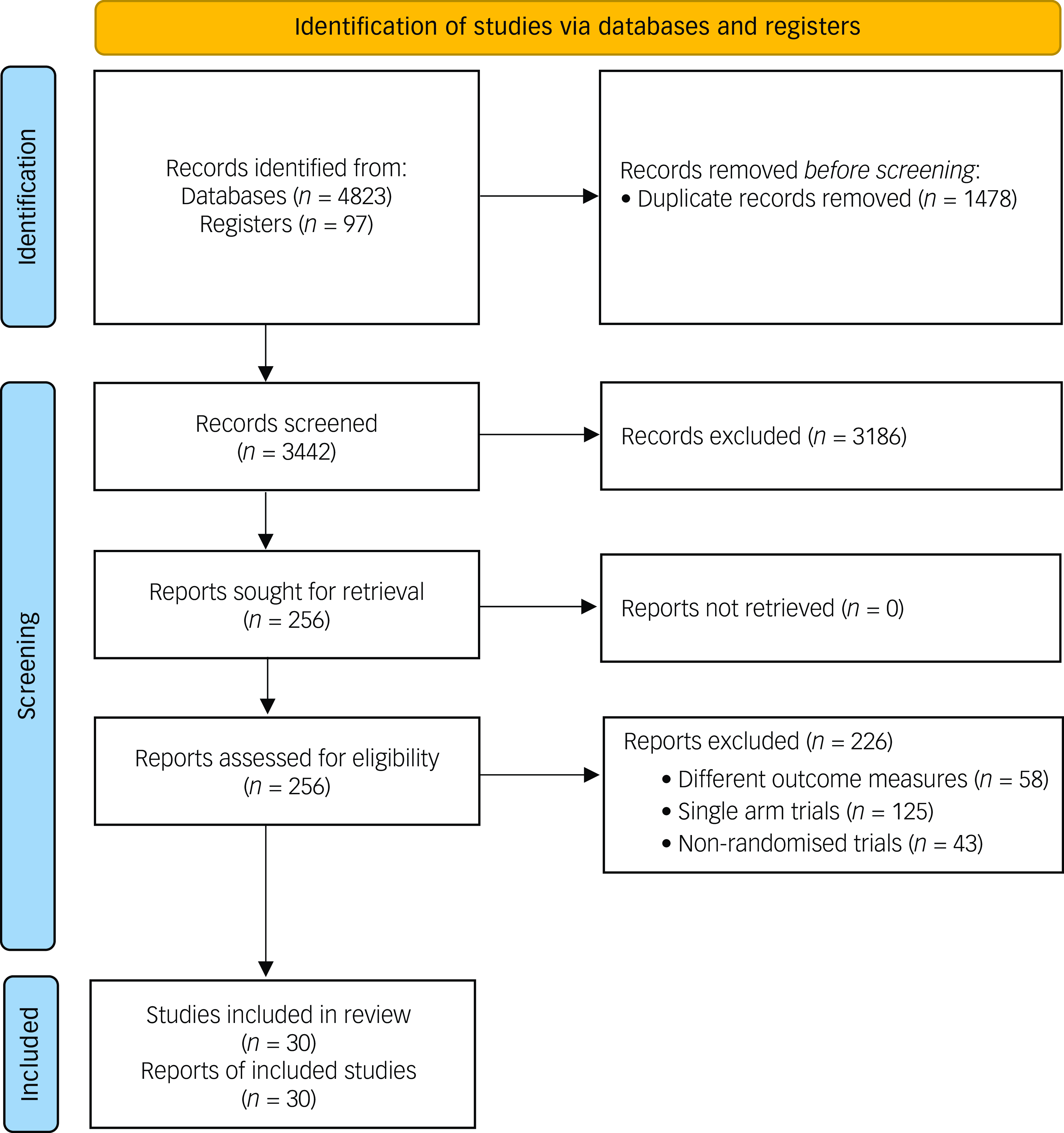
The literature search yielded 4823 articles from databases and 97 from registers in total. In the initial screening, 3442 articles were included following the removal of duplicates. Out of these, 3186 articles were excluded after evaluation based on abstract and title. A total of 256 articles were sought for retrieval and were evaluated for eligibility. Of these, 226 articles were excluded as 58 studies were carried out on different outcome measures: 125 were single-arm studies without any control arm and 43 were non-randomised trials. Finally, 30 studies (with 3128 participants and published over the period from 2001 to 2024) were included in the meta-analysis. Reference Shekhar, Potter, Lightfoot, Lienemann, Dubé and Mallinckrodt14,Reference Deutsch, Schwartz, Schooler, Brown, Rosse and Rosse16,Reference Kaul, Sawchak, Walling, Tamminga, Breier and Zhu28–Reference Keefe, Meltzer, Dgetluck, Gawryl, Koenig and Moebius55 Figure 1 shows a PRISMA flow diagram that illustrates the steps in choosing and short-listing the studies. The characteristics of the included studies are represented in Supplementary Table S1 (Supplementary Material, available at https://doi.org/10.1192/bjp.2025.44). The risk of bias is presented in Supplementary Table S2, summarising the judgement of the reviewers on each risk-of-bias domain in all included studies.
PRISMA flow diagram for the study selection process.

In the included studies, patients were prescribed cholinergic modulators (experimental group) or placebo (control group), and the effects on various outcome measures were compared. In 22 out of the 30 trials, cholinergic drugs were used as augmentation agents with standard of care and in the rest as monotherapy. Muscarinic agonists had been administered to the patient as monotherapy and AChE inhibitor and dual action nicotinic modulator plus AChE inhibitor have been administered as add-on therapy to antipsychotic drugs, whereas nicotinic agonists have been used as standalone therapy in a few trials and as add-on therapy in other trials. Overall, 14 interventions have been tried to modulate cholinergic neurotransmission in various trials at various doses. Studies included in this meta-analysis examined the effects of the cholinergic modulators for a duration ranging from 3 to 24 weeks. Among the included studies, five studies evaluated the effect of muscarinic agonists, there were seven studies on AChE inhibitors, there were 14 studies on nicotinic agonist and there were four studies on combined administration of nicotinic modulator and AChE inhibitor.
Changes in PANSS-T or BPRS score
Twenty-seven out of 30 trials in this meta-analysis reported change in PANSS-T and/or BPRS scores from baseline. In studies for which both the scores were reported, we included changes in PANSS-T score for this meta-analysis. There was a significant heterogeneity among the trials included in this meta-analysis (χ² = 1254.88; p < 0.0001; I² = 97%). The pooled effect size of the change in PANSS-T/BPRS scores (SMD: −0.38; 95% CI: −0.927 to 0.176; p = 0.182; prediction interval: −3.727 to 2.975) was not statistically significant (Fig. 2).
Forest plot of included studies using random-effects model for change in total Positive and Negative Syndrome Scale scores in cholinergic modulators group versus placebo. The diamond represents the pooled effect, while the thin rectangle represents the prediction interval. Numbers 1 or 2 against study name denote two different studies and alphabetic characters (a, b and c) represent different doses of the same experimental drug.
SMD, standardised mean difference.

Subgroup analysis based on type of drug
In the subgroup analysis, the effect size (SMD: −0.57; 95% CI: −0.72 to −0.42; I² = 0%) for change in PANSS-T/BPRS scores in the muscarinic agonist subgroup against placebo was statistically significant. For all other subgroups, the difference between the experimental and the placebo was not statistically significant. The effect size of the subgroup receiving a combined nicotinic modulator and AChE inhibitor was a SMD of −0.17 (95% CI: −0.47 to 0.13), that of the AChE inhibitor subgroup was a SMD of −0.19 (95% CI: −0.61 to 0.22) and that of the nicotinic agonist subgroup was a SMD of –0.40 (95% CI: −1.611 to 0.81).
Subgroup analysis based on the type of therapy
We performed a subgroup analysis for whether the experimental drug was administered as monotherapy or as an add-on to standard antipsychotic drugs. The SMD for the subgroup when the drug was administered as monotherapy was statistically significant with an effect size of −0.50 (95% CI: −0.63 to −0.36) with a heterogeneity of 0%. When the experimental intervention was administered as an add-on to standard antipsychotic therapy, the pooled effect was not statistically significant, with a SMD of −0.36 (95% CI: −1.22 to 0.50) (Supplementary Fig. S1).
Sensitivity analysis
The Baujat plot was generated, and the contribution of the studies by Haig 2016, Walling 2016a and Walling 2016b to overall heterogeneity was found to be the highest (Supplementary Fig. S2). Reference Walling, Marder, Kane, Fleischhacker, Keefe and Hosford48,Reference Haig, Wang, Othman and Zhao50,Reference Haig, Bain, Robieson, Baker and Othman51 Thereafter, we performed a sensitivity analysis after removing these studies, and the overall heterogeneity was reduced to 65%. The pooled effect for change in the PANSS-T/BPRS scores for the cholinergic modulators as compared to the placebo became statistically significant (SMD: −0.24; 95% CI: −0.42 to −0.07; prediction interval: −1.01 to 0.52) (Fig. 3).
Sensitivity analysis for change in total Positive and Negative Syndrome Scale scores in cholinergic modulators group versus placebo. The diamond represents the pooled effect, while the thin rectangle represents the prediction interval. Numbers 1 or 2 against study name denote two different studies and alphabetics characters (a, b and c) represent different doses of the same experimental drug.
SMD, standardised mean difference

Changes in PANSS-N subscale or SANS score
Twenty-two out of 30 trials in this meta-analysis reported change in PANSS-N or SANS score from baseline. There was significant heterogeneity among the trials included in this meta-analysis (χ² = 86.11; p < 0.01; I² = 66%). The change in PANSS-N/SANS scores was greater with the cholinergic modulators when compared with placebo with a SMD of –0.42 (95% CI: −0.59 to −0.25; p < 0.0001; prediction interval: −1.15 to 0.31), thereby indicating an improvement in negative symptoms when compared to placebo. In the subgroup analysis, the mean difference for change in PANSS-N/SANS scores was statistically significant in the muscarinic agonist subgroup (SMD: −0.40; 95% CI: −0.59 to −0.21) and nicotinic agonist subgroup (SMD: −0.28; 95% CI: −0.47 to −0.09). The difference between experimental and placebo groups was not statistically significant for the other two subgroups. The effect size of the combined nicotinic modulator and AChE inhibitor subgroup was a SMD of −0.92 (95% CI: −1.94 to 0.10), and that of the AChE inhibitor subgroup was a SMD of −0.32 (95% CI: −0.72 to 0.09) (Supplementary Fig. S3).
Changes in PANSS-P subscale score
Twelve out of 30 trials in this meta-analysis reported change in PANSS-P scores from baseline. The change in PANSS-P scores (SMD: −0.14; 95% CI: −0.47 to 0.19; p = 0.41; prediction interval −1.368; 1.094) was not significant and showed a significant heterogeneity (χ² = 77.26; p < 0.01; I² = 81%). In the subgroup analysis, the mean difference for change in PANSS-P scores was statistically significant in the muscarinic agonist subgroup (SMD: −0.58; 95% CI: −0.73 to −0.43). The difference between the experimental and the placebo groups was not statistically significant for all other subgroups (Supplementary Fig. S4).
Changes in PANSS Marder’s negative subscale score
Five out of 30 trials in this meta-analysis reported change in PANSS Marder negative scores from baseline. The change in PANSS Marder negative score in the cholinergic modulators group compared to placebo was a SMD of −0.12 (95% CI: −0.643 to 0.40; p = 0.646; prediction interval: −1.96 to 1.71), which was not statistically significant. In the subgroup analysis, the change in PANSS Marder negative score was statistically significant in the muscarinic agonist subgroup (SMD: −0.47; 95% CI: −0.72 to −0.22). The change was not significant in the nicotinic agonist subgroup (SMD: 0.98; 95% CI: −0.57 to 2.54) (Supplementary Fig. S5).
Changes in CGI-S score
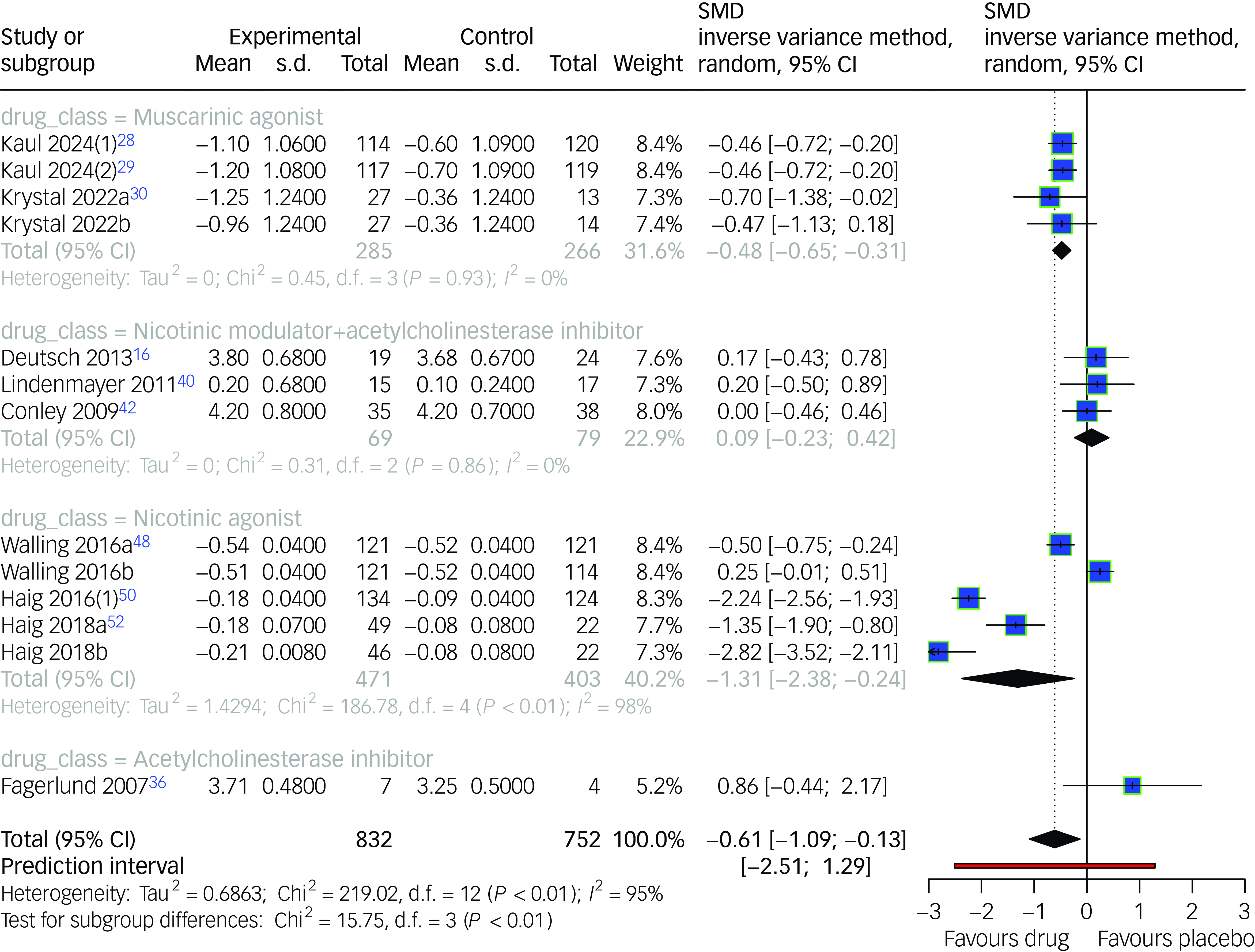
Ten out of 30 trials in this meta-analysis reported a change in CGI-S scores from baseline. The change in CGI-S scores was significantly greater in the cholinergic modulator group compared to placebo with a SMD of −0.61 (95% CI: −1.09 to −0.13; p = 0.012; prediction interval: −2.51 to 1.29). In the subgroup analysis, the changes in CGI-S scores in the muscarinic agonist subgroup (SMD: −0.48; 95% CI: −0.65 to −0.31) and the nicotinic agonist subgroup (SMD: −1.31; 95% CI: −2.38 to −0.24) were statistically significant. The difference between the experimental and placebo groups was not statistically significant for the other two subgroups (Fig. 4).
Forest plot of included studies using random-effects model for change in Clinical Global Impression-severity scores in cholinergic modulators group versus placebo. The diamond represents the pooled effect, while the thin rectangle represents the prediction interval. Numbers 1 or 2 against study name denote two different studies and alphabetics characters (a, b and c) represent different doses of the same experimental drug.
SMD, standardised mean difference

Safety outcome
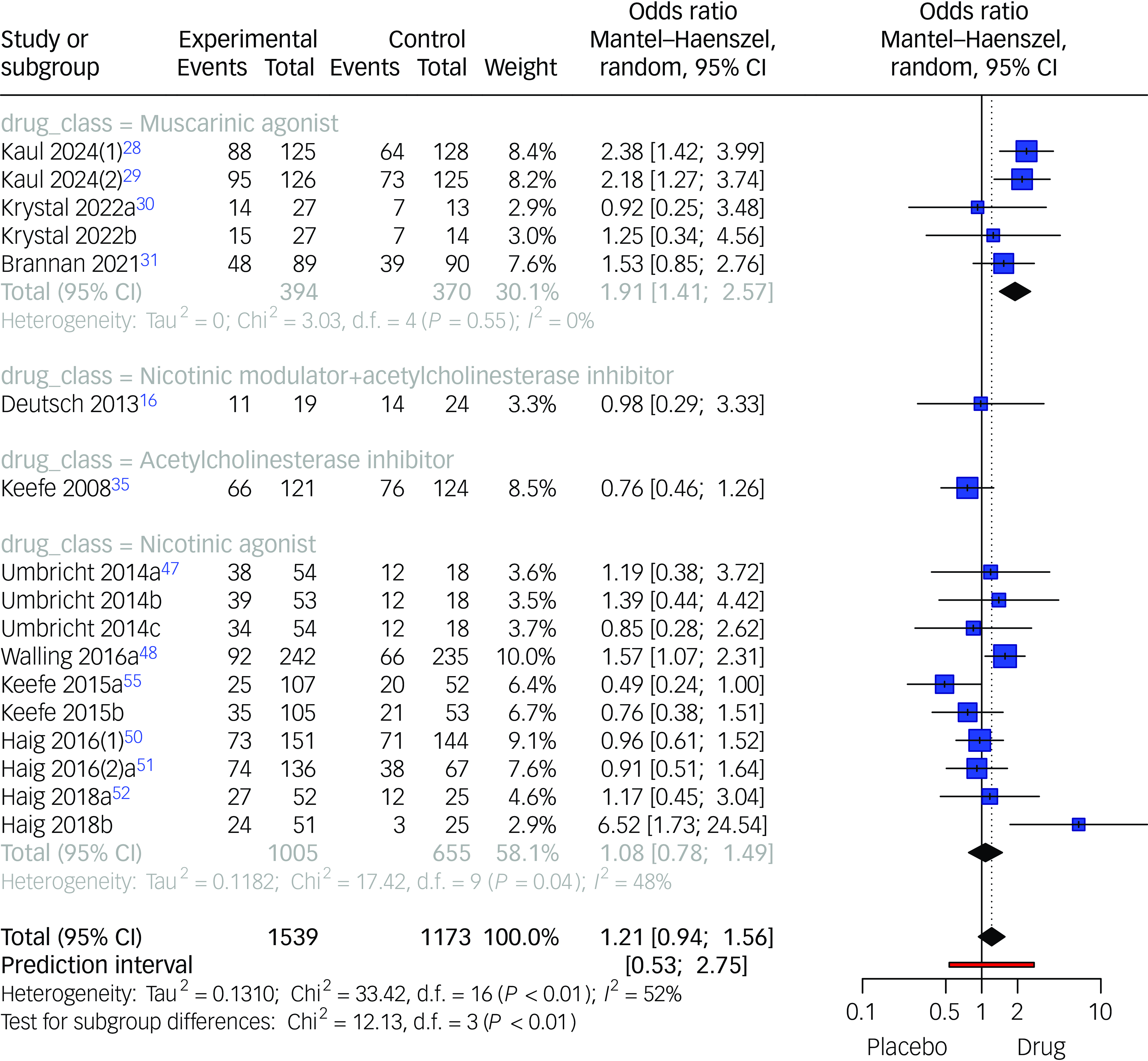
The adverse events reported in these studies were nausea, dyspepsia, vomiting, constipation, headache, insomnia, diarrhoea, dizziness, increased appetite, weight gain, urinary abnormalities, etc. Twelve out of 30 trials included in this meta-analysis reported occurrences of any adverse events. The pooled odds ratio for adverse events (odds ratio: 1.21; 95% CI: 0.94–1.56; prediction interval: 0.53–2.75; p = 0.138) indicates a higher incidence of adverse effects in the experimental group; however, it was not statistically different from that of the placebo group. In subgroup analysis, adverse events were significantly greater with muscarinic agonists compared to placebo (odds ratio: 1.91; 95% CI: 1.41–2.57). For all other subgroups, the effect size was not statistically significant (Fig. 5).
Forest plot of included studies using random-effects model for incidence of adverse events in cholinergic modulators group versus placebo. The diamond represents the pooled effect and the thin rectangle represents the prediction interval. Numbers 1 or 2 against study name denote two different studies and alphabetic characters (a, b and c) represent different doses of the same experimental drug.

Meta-regression
Meta-regression suggested no statistically significant effect of duration of treatment on change in PANSS-T/BPRS scores (slope coefficient: −0.046; s.e.: 0.049; p = 0.35) (Supplementary Fig. S6).
Publication bias
A funnel plot was created and an Egger’s regression test was run. The bias estimate was 0.1915 (s.e. = 2.383), p = 0.936 on Egger’s regression test, suggesting no significant publication bias for the studies included in this meta-analysis (Supplementary Fig. S7).
Certainty of evidence
The summary of the effect estimates and GRADE ratings are presented in Supplementary Table S3. The evidence obtained from this meta-analysis was graded to be moderate for change in PANSS-T and PANSS-N/SANS scores; low for change in CGI-S and PANSS-P scores and incidence of adverse events; and very low for change in MARDER score.
Discussion
This meta-analysis included 30 studies with 3128 participants that compared the effects of various cholinergic modulators in patients with schizophrenia and schizoaffective disorder to study their role in alleviating the symptoms of the disease. The results showed that there was a statistically significant difference for changes in PANSS/BPRS, PANSS negative/SANS, PANSS positive, PANSS Marder negative and CGI-S scores in the muscarinic agonist group over placebo, indicating an improvement of symptoms of the disease. The SMD for changes in PANSS negative/SANS and CGI-S scores was statistically significant in the nicotinic agonist group. There was a significant increase in the pooled odds ratio for adverse events in the muscarinic agonist group over placebo but not in any other groups, including the overall pooled effect.
Muscarinic agonists demonstrated the most consistent and statistically significant improvement in the severity of overall symptoms, negative symptoms and positive symptoms of schizophrenia compared to placebo. The efficacy of this subgroup was observed across multiple outcome measures, including changes in PANSS-T, PANSS-N and CGI-S scores. The reduction in symptom severity was particularly evident when these agents were used as monotherapy rather than as adjunctive therapy. Despite their efficacy, muscarinic agonists were associated with a higher incidence of adverse events, indicating a potential trade-off between clinical benefit and safety. This underscores the need for careful patient selection and monitoring during therapy. In a systematic review done by Vaidya et al,11 it was shown that research into muscarinic receptor-targeted interventions shows potential efficacy and safety in the treatment of several mental illnesses, including schizophrenia. They could not perform a meta-analysis because of inadequate data and concluded that the clinical efficacy of muscarinic receptor-targeted therapies for treating neuropsychiatric diseases requires sufficiently powered prospective studies with subtype-selective interventions. Reference Vaidya, Guerin, Walker and Lawrence11 Our meta-analysis included all available studies with muscarinic-targeted interventions and revealed a significant effect in alleviating positive and negative symptoms of schizophrenia.
The use of nicotinic agonists revealed modest but noteworthy benefits in improving negative symptoms and overall clinical severity, as evidenced by significant changes in PANSS-N and CGI-S scores. However, these agents did not demonstrate a statistically significant effect on the total symptom burden or positive symptoms of schizophrenia. This limited efficacy may stem from the variability in receptor subtype selectivity among nicotinic agonists or differences in study designs across trials. Importantly, the safety profile of nicotinic agonists was favourable, with no significant increase in adverse events compared to placebo. Further exploration of receptor-specific modulation may optimise their therapeutic potential. These results align with prior research indicating that nicotine and other nicotinic agonists modulate multiple neural circuits implicated in schizophrenia, including those involved in cognition and negative symptoms. Reference Smucny and Tregellas56 Moreover, nicotine is recognised to significantly influence neural circuits associated with attention, memory and sensory gating. Reference Smucny and Tregellas56 Nicotinic alpha-7 acetylcholine (nα7) receptor agonists, although theoretically justified, have mainly not shown much benefit in placebo-controlled trials for schizophrenia. Reference Kantrowitz, Javitt, Freedman, Sehatpour, Kegeles and Carlson32
AChE inhibitors showed no significant benefit in reducing the severity of symptoms across most outcome measures, including PANSS-T, PANSS-N and CGI-S scores, in our meta-analysis. The lack of efficacy may be attributed to the indirect mechanism of action of these agents, which rely on increasing endogenous acetylcholine levels rather than directly stimulating cholinergic receptors. While these agents were generally well tolerated with no significant increase in adverse events, their limited clinical efficacy raises questions about their utility in the management of schizophrenia. Future research should focus on identifying sub-populations of patients who may benefit from these interventions, such as those with specific genetic or neurobiological profiles. However, meta-analysis by Singh et al Reference Singh, Kour and Jayaram17 showed a significant improvement in negative and general psychopathology scores and cognition with AChE inhibitors. This discrepancy may be because of the number of studies included for meta-analysis (two in meta-analysis by Singh et al Reference Singh, Kour and Jayaram17 versus six in our meta-analysis) and use of a different summary statistic (SMD) in our study.
The combined use of nicotinic modulators and AChE inhibitors did not yield significant improvements in any of the primary or secondary outcome measures when compared to placebo. This lack of efficacy may reflect the complexity of dual-targeting strategies or potential pharmacodynamic interactions between the two classes of agents. In addition, the limited number of studies in this subgroup may have reduced the statistical power to detect meaningful differences. Despite the absence of significant clinical benefits, this combination was not associated with a notable increase in adverse events, suggesting that further investigation into alternative dosing strategies or combination regimens may be warranted.
The strength of our meta-analysis is the robust methodology and the inclusion of all the interventions that could modulate the cholinergic pathway. We have included all possible studies on cholinergic modulators. There is no evident publication bias in our analysis. To segregate the effect of each type of modulator, we performed subgroup analyses, and meta-regression was performed to evaluate the effect of duration on the primary outcome. One notable limitation of this meta-analysis is the observed heterogeneity across the included studies in the nicotinic agonist subgroup. This may be attributed to variations in study design or different geographical locations and ethnicities in sample populations across the included studies. Second, there were only a few studies included in each subgroup, and the number of participants in each study was less. For example, adverse events data from the studies on AChE inhibitors were inadequate; hence, only one study was found under these two subgroups. Since adverse events were captured only in a few studies, full evaluation of safety may not be possible. Although we had planned to include studies only on patients with schizophrenia, a few studies in our meta-analysis included patients with schizophrenia or schizoaffective disorder and may be source of minor heterogeneity. Heterogeneity in a meta-analysis reflects variability in study outcomes caused by differences in study populations, designs, interventions or methodologies and there was a high heterogeneity in the subgroup of nicotine agonists. High heterogeneity can reduce the reliability of pooled effect estimates in our study, making it difficult to draw definitive conclusions, and may mask true treatment effects or exaggerate inconsistencies. It can also complicate subgroup analyses and limit the generalisability of findings. Another limitation is the lack of studies exploring very short-term treatment effects. In addition, data for safety evaluation could be extracted only from 12 out of 30 studies.
In conclusion, cholinergic modulators are potential treatment options for patients with schizophrenia. The drugs were found to reduce negative symptoms significantly but not positive symptoms. The present meta-analysis showed that out of all cholinergic modulators, muscarinic agonists can achieve a better clinical outcome by improvement in symptoms and disease severity compared with placebo. Nicotinic agonists also showed a significant effect in the reduction of negative symptoms and disease severity. However, active-controlled clinical trials are warranted to generate conclusive evidence and translate it into clinical practice.
Supplementary material
The supplementary material for this article can be found at https://doi.org/10.1192/bjp.2025.44
Data availability
The data that support the findings of this study are available from the corresponding author, upon reasonable request.
Author contribution
A. Shaju: concept and design, study screening and selection, data extraction and management, data analysis and interpretation of data, drafting of the manuscript, final approval of the manuscript. A.M.: study screening and selection, data extraction and management, drafting of the manuscript, final approval of the manuscript. D.M.: concept and design, study screening and selection, data extraction and management, drafting of the manuscript, final approval of the manuscript. A. Srinivasan: study screening and selection, data extraction and management, critical revision of the manuscript for important intellectual content, final approval of the manuscript. R.M.: study screening and selection, data extraction and management, critical revision of the manuscript for important intellectual content, final approval of the manuscript.
Funding
None.
Declaration of interest
None.




eLetters
No eLetters have been published for this article.