Introduction
Anti-leucine rich glioma inactivated 1 (LGI-1) encephalitis is one of the more commonly encountered autoimmune encephalitidies predominating in older adult males, and typically manifests with faciobrachial dystonic seizures, cognitive dysfunction and behavioral dysregulation (Ariño et al., Reference Ariño, Armangué, Petit-Pedrol, Sabater, Martinez-Hernandez, Hara, Lancaster, Saiz, Dalmau and Graus2016; Irani et al., Reference Irani, Alexander, Waters, Kleopa, Pettingill, Zuliani, Peles, Buckley, Lang and Vincent2010; Kunchok et al., Reference Kunchok, McKeon, Zekeridou, Flanagan, Dubey, Lennon, Klein, Mills and Pittock2021). Nearly all patients experience some degree of cognitive impairment in the acute stages of the disease (Huang et al., Reference Huang, Fan, Gao, Li, Ye and Shen2021). Memory deficits are most commonly reported, possibly related to the dense expression of LGI-1 in the hippocampus and overlying temporal cortex (Ohkawa et al., Reference Ohkawa, Fukata, Yamasaki, Miyazaki, Yokoi, Takashima, Watanabe, Watanabe and Fukata2013; Sonderen et al., Reference Sonderen, Coenders, Sanchez, De, Van, Wirtz and Schreurs2016), and the association with hippocampal atrophy (van Sonderen et al., Reference van Sonderen, Petit-Pedrol, Dalmau and Titulaer2017). Although patients can experience an improvement in cognitive function following immunotherapy (Ariño et al., Reference Ariño, Armangué, Petit-Pedrol, Sabater, Martinez-Hernandez, Hara, Lancaster, Saiz, Dalmau and Graus2016), many continue to experience cognitive difficulties at long-term follow up, and may not return to premorbid functional abilities (Binks et al., Reference Binks, Veldsman, Easton, Leite, Okai, Husain and Irani2021; Chen et al., Reference Chen, Wang, Gao, Huang, Lin, Xue, Liu, Zhang and Su2021; Sola-Valls et al., Reference Sola-Valls, Ariño, Escudero, Solana, Lladó, Sánchez-Valle, Blanco, Saiz, Dalmau and Graus2020).
Literature reporting the cognitive phenotype and prognosis of patients recovering from anti-LGI-1 encephalitis is scarce. Few studies have employed objective measures of cognitive function, relying instead on chart review or physician rating scales (Ariño et al., Reference Ariño, Armangué, Petit-Pedrol, Sabater, Martinez-Hernandez, Hara, Lancaster, Saiz, Dalmau and Graus2016; Shin et al., Reference Shin, Lee, Shin, Moon, Lim, Byun, Kim, Lee, Kim, Park, Jung, Lee and Chu2013). Others have used global cognitive screening measures, such as the Mini Mental State Exam (MMSE) or the Montreal Cognitive Assessment (MoCA) (Huang et al., Reference Huang, Fan, Gao, Li, Ye and Shen2021), which provide domain scores that are more easily interpreted by clinicians and compared between groups, but lack the in-depth insights provided by neurocognitive evaluations. Moreover, studies have shown that cognitive screens appear to be insensitive to cognitive impairment in the anti-LGI-1 population (Bettcher et al., Reference Bettcher, Gelfand, Irani, Neuhaus, Forner, Hess and Geschwind2014; Binks et al., Reference Binks, Veldsman, Easton, Leite, Okai, Husain and Irani2021).
Excluding case reports, a total of 8 studies (in 7 unique patient samples) have examined performance on detailed neuropsychological measures in patients with post-acute anti-LGI-1 encephalitis. Three studies employed relatively limited batteries with variable results (Binks et al., Reference Binks, Veldsman, Easton, Leite, Okai, Husain and Irani2021; Sola-Valls et al., Reference Sola-Valls, Ariño, Escudero, Solana, Lladó, Sánchez-Valle, Blanco, Saiz, Dalmau and Graus2020; van Sonderen et al., Reference van Sonderen, Thijs, Coenders, Jiskoot, Sanchez, de Bruijn, van Coevorden-Hameete, Wirtz, Schreurs, Sillevis Smitt and Titulaer2016). Specifically, all three found impairment in at least one memory test, and two found impairments in verbal fluency (Binks et al., Reference Binks, Veldsman, Easton, Leite, Okai, Husain and Irani2021; Sola-Valls et al., Reference Sola-Valls, Ariño, Escudero, Solana, Lladó, Sánchez-Valle, Blanco, Saiz, Dalmau and Graus2020). Other findings were variable, with one demonstrating visuospatial deficits (Binks et al., Reference Binks, Veldsman, Easton, Leite, Okai, Husain and Irani2021) and another showing oral processing speed/set-shifting deficits (Sola-Valls et al., Reference Sola-Valls, Ariño, Escudero, Solana, Lladó, Sánchez-Valle, Blanco, Saiz, Dalmau and Graus2020). All five studies using more detailed cognitive batteries reported learning/memory impairments (Bettcher et al., Reference Bettcher, Gelfand, Irani, Neuhaus, Forner, Hess and Geschwind2014; Finke et al., Reference Finke, Kopp, Prüss, Dalmau, Wandinger and Ploner2012; Heine et al., Reference Heine, Prüss, Kopp, Wegner, Then Bergh, Münte, Wandinger, Paul, Bartsch and Finke2018; Miller et al., Reference Miller, Chong, Aimola Davies, Ng, Johnson, Irani, Vincent, Husain, Jacob, Maddison, Kennard, Gowland and Rosenthal2017; Rodriguez et al., Reference Rodriguez, Klein, Sechi, Alden, Basso, Pudumjee, Pittock, McKeon, Britton, Lopez-Chiriboga, Zekeridou, Zalewski, Boeve, Day, Gadoth, Burkholder, Toledano, Dubey and Flanagan2021) which were an isolated finding in one study (Miller et al., Reference Miller, Chong, Aimola Davies, Ng, Johnson, Irani, Vincent, Husain, Jacob, Maddison, Kennard, Gowland and Rosenthal2017). Others found more diffuse impairments including executive dysfunction (Bettcher et al., Reference Bettcher, Gelfand, Irani, Neuhaus, Forner, Hess and Geschwind2014; Finke et al., Reference Finke, Kopp, Prüss, Dalmau, Wandinger and Ploner2012; Heine et al., Reference Heine, Prüss, Kopp, Wegner, Then Bergh, Münte, Wandinger, Paul, Bartsch and Finke2018; Rodriguez et al., Reference Rodriguez, Klein, Sechi, Alden, Basso, Pudumjee, Pittock, McKeon, Britton, Lopez-Chiriboga, Zekeridou, Zalewski, Boeve, Day, Gadoth, Burkholder, Toledano, Dubey and Flanagan2021), language deficits (Bettcher et al., Reference Bettcher, Gelfand, Irani, Neuhaus, Forner, Hess and Geschwind2014), and attention/working memory impairment (Finke et al., Reference Finke, Kopp, Prüss, Dalmau, Wandinger and Ploner2012; Heine et al., Reference Heine, Prüss, Kopp, Wegner, Then Bergh, Münte, Wandinger, Paul, Bartsch and Finke2018).
Research examining cognitive outcomes in anti-LGI-1 encephalitis is scarce and marked by significant variability, likely due to methodological differences in timing of assessment, measures used, and sampling (i.e., clinically referred vs. research samples). Additional studies are needed to better understand the underlying cognitive profile and prognostic factors associated with anti-LGI-1 encephalitis, in an effort to further understand the pathophysiology, treatment response and long-term outcomes of affected patients. This study provides a detailed description of cognitive functioning in clinically referred patients with anti-LGI-1 encephalitis who were seen for a neuropsychological evaluation at least 9 months post-symptom onset and describes associations between clinical and cognitive outcomes. Test performance was also compared to that of healthy controls (HC) and groups with other types of temporal lobe pathology including amnestic mild cognitive impairment (aMCI) and temporal lobe epilepsy (TLE).
Method
Study design and anti-LGI-1 patients
This is a retrospective, observational study of adult anti-LGI-1 encephalitis patients who were seen for neuropsychological evaluation at the Cleveland Clinic. All anti-LGI-1 encephalitis patients were positive on serum or cerebrospinal fluid by commercial testing using HEK293 cells expressing LGI-1-IgG at commercial clinical laboratories (Athena diagnostics, Associated Regional and University Pathologists, Mayo Clinic Neuroimmunology laboratory). All patients met the clinical criteria for autoimmune encephalitis (Graus et al., Reference Graus, Titulaer, Balu, Benseler, Bien, Cellucci, Cortese, Dale, Gelfand, Geschwind, Glaser, Honnorat, Höftberger, Iizuka, Irani, Lancaster, Leypoldt, Prüss, Rae-Grant and Dalmau2016). Demographic, clinical and radiological cross-sectional data was obtained via medical chart review and/or the Cleveland Clinic autoimmune neurology registry.
Comparison groups
Performance of the patients with anti-LGI-1 on cognitive tests was compared to demographically similar patients determined as cognitively healthy controls (HC), and patients with aMCI and TLE derived from an IRB-approved existing clinical neuropsychological registry. HCs were defined as patients who presented for a clinical neuropsychological assessment due to subjective cognitive complaints, but were not diagnosed with a cognitive disorder following testing. aMCI was operationalized as performance at least 1.5 SD below published norms in any tests within the memory domain and without impaired activities of daily living (Petersen, Reference Petersen2004) as conferred by a clinical neuropsychologist. Patients with TLE were derived from a registry of patients who were seen for evaluation as part of a workup for epilepsy surgery. HCs and patients with aMCI or TLE with a history of other neurological conditions (e.g., traumatic brain injury with loss of consciousness, stroke, etc.) other than obstructive sleep apnea were excluded.
Patients within each comparison group were selected using a two-step process. We first identified all patients in the comparison groups who had completed the CPT-3, as this was the least commonly administered measure, resulting in a sample of 10 HC, 1 right TLE, 0 left TLE and 6 aMCI. We then blindly selected additional patients from each group within the age range of anti-LGI-1 patients until we had a sample of 20 patients for each comparison group.
Cognitive evaluation
Patients underwent a comprehensive cognitive evaluation as part of their clinical evaluation under the supervision of American board-certified neuropsychologists. The evaluation included measures of attention (Wechsler Adult Intelligence Scale, Fourth Edition [WAIS-IV] Digit Span [DSF]; Wechsler, Reference Wechsler2008; Conners Continuous Performance Test, Third Edition [CPT-3]; Conners, Reference Conners2014), processing speed (Symbol Digit Modalities Test; Smith, Reference Smith1982; Trail Making Test – Part A; Heaton et al., Reference Heaton, Miller, Taylor and Grant2004; Delis-Kaplan Executive Function System [DKEFS] Number Sequencing; Delis et al., Reference Delis, Kaplan and Kramer2001), executive function (WAIS-IV Similarities and Matrix Reasoning; Wechsler, Reference Wechsler2008; Trail Making Test- Part B; Heaton et al., Reference Heaton, Miller, Taylor and Grant2004; DKEFS Number-Letter Switching; Delis et al., Reference Delis, Kaplan and Kramer2001; Wisconsin Card Sorting Test; Heaton et al., Reference Heaton, Chelune, Talley, Kay and Curtiss1993), language (Boston Naming Test, Controlled Oral Word Association Test, Animal Fluency, Heaton et al., Reference Heaton, Miller, Taylor and Grant2004), visuospatial skills (Judgment of Line Orientation; Benton et al., Reference Benton, Sivan, Hamsher, Varney and Spreen1994; Rey Complex Figure Test; Strauss et al., Reference Strauss, Sherman and Spreen2006; Brief Visuospatial Memory Test- Revised copy; Benedict, Reference Benedict1997), visual (BVMT-R; Wechsler Memory Scales, Third or Fourth Edition, Logical Memory; Wechsler, 1997, Reference Wechsler2009) and verbal memory (California Verbal Learning Test, Second Edition; Delis et al., Reference Delis, Kramer, Kaplan and Ober2000; Rey Auditory Verbal Learning Test; Strauss et al., Reference Strauss, Sherman and Spreen2006; or Hopkins Verbal Learning Test; Benedict et al., Reference Benedict, Schretlen, Groninger and Brandt1998, Wechsler Memory Scales, Third or Fourth Edition, Logical Memory; Wechsler, 1997, Reference Wechsler2009).
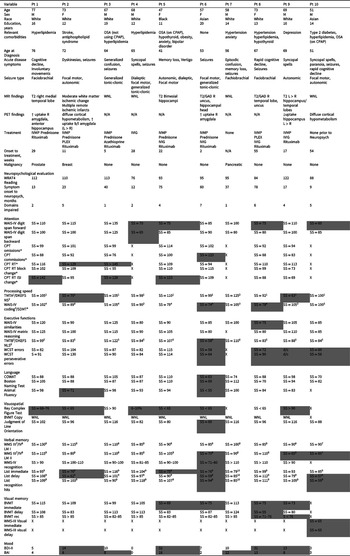
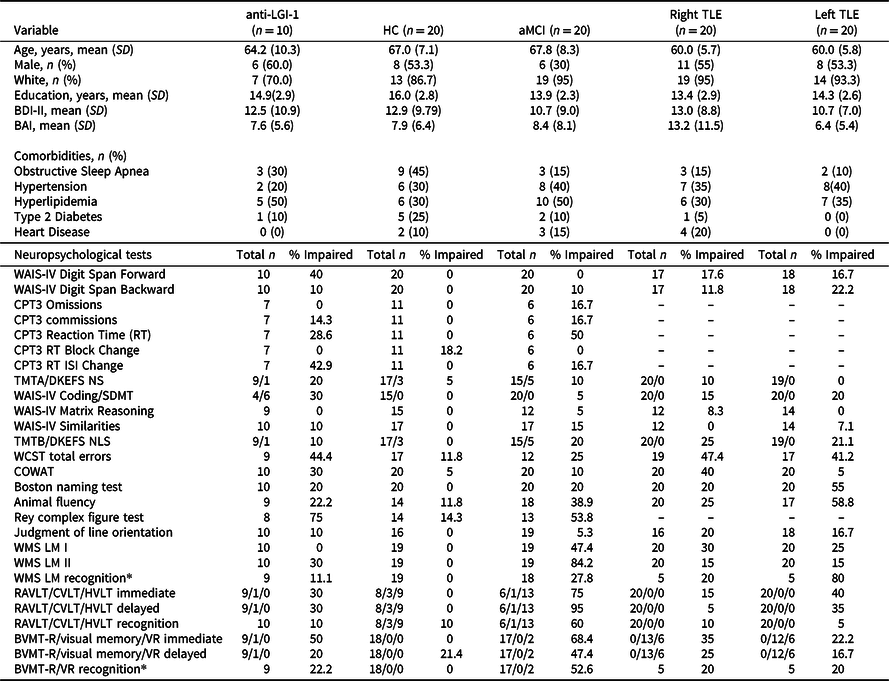
There was some variability in the specific tests administered, given the clinical nature of the evaluation, with some variables representing combinations of similar/related (albeit not identical) tasks. For example, the variable “Coding” was defined as either SDMT written or WAIS-IV Coding score and “List Immediate” was defined as immediate recall on either HVLT, CVLT, or RAVLT. Table 1 includes standardized scores for tests administered for the anti-LGI-1 patients. Table 2 provides full details regarding scores. Three patients underwent multiple neuropsychological evaluations. Given that the focus of this evaluation was long-term cognitive outcomes, we report the results of the evaluation that was furthest from symptom onset.
Characteristics and neuropsychological test performance of the anti-LGI-1 group

Note. Gray cells indicate impairment (defined as >1.5 SD below the normative mean); *Higher scores indicate worse performance.
Abbreviations: OSA = obstructive sleep apnea IVMP= intravenous methylprednisolone, CPAP = continuous positive airway pressure device, GAD = gadolinium enhancement, PLEX = plasmapheresis, M = male, F = female, R= right, L= left, WNL = within normal limits., WRAT4 = wide range achievement test, fourth edition, WAIS-IV = Wechsler adult intelligence scale, fourth edition, CPT = Conner’s continuous performance test, second edition, DKEFS = Delis-Kaplan executive function system, NS = number sequencing, NLS = number-letter switching; TMTA/B = trail making test part A/part B, SDMT = Symbol Digit Modalities Test (written); COWAT = controlled oral word association test; WMS-IV LM = logical memory); 9 = Rey auditory verbal learning test, 10 = California verbal learning test, second edition; BVMT = brief visual memory test – revised; BDI-II = Beck depression inventory, second edition; BAI = Beck anxiety inventory.
Characteristics of the anti-LGI-1 and comparisons samples

Note. anti-LGI-1 = anti-leucine rich glioma inactivated 1 encephalitis; HC = healthy controls; aMCI = amnestic mild cognitive impairment, TLE = temporal lobe epilepsy, BDI-II = Beck Depression Inventory, second edition; BAI = Beck Anxiety Inventory, WAIS-IV = Wechsler Adult Intelligence Scale, Fourth Edition, CPT3 = Conner’s Continuous Performance Test, Third Edition; ISI = Interstimulus interval; SDMT = Symbol Digit Modalities Test; TMTA = Trail Making Test – Part A; DKEFS = Delis-Kaplan Executive Function System; NS = Number Sequencing, NLS = Number-Letter Switching; TMTB = Trail Making Test- Part B; WCST = Wisconsin Card Sorting Test; COWAT = Controlled Oral Word Association Test; BVMT-R = Brief Visuospatial Memory Test- Revised CVLT2 = California Verbal Learning Test; RAVLT = Rey Auditory Verbal Learning Test; HVLT = Hopkins Verbal Learning Test; WMS = Wechsler Memory Scales, Visual Memory = WMS III Visual Memory Index, VR = WMS-IV Visual Reproduction; *WMS-III LM and Visual Immediate do not calculate a recognition score.
Statistical analyses
Scores on each of the cognitive tests were transformed to standard scores (SS; mean = 100, standard deviation = 15) using published normative data, consistent with standard practice. Rates of impairment on each cognitive test (≥ 1.5 standard deviations below the normative mean) were calculated for all groups. The exception was BVMT-R copy, which does not have corresponding normative data, and on which determinations of impairments (within or below normal limits) were made based on qualitative assessment by the neuropsychologist.
Descriptive statistics were used to characterize the sample. Pearson correlation coefficients were calculated to examine the association between time from onset and treatment to neuropsychological testing (domains impaired) in the anti-LGI-1 group. One-way analysis of variance (ANOVA) and Fisher exact tests were used to compare the groups based on demographic variables.
Comparisons of test performance between groups was conducted using a two-step process, that was meant to limit Type I error by reducing the number of comparisons. Rates of impairment on all neuropsychological tests were first compared between the anti-LGI-1 and HC groups using Fisher exact tests. Follow up Fisher-Freeman-Halton exact tests compared rates of impairment between the anti-LGI-1 and other patient groups (aMCI, TLE) for any test which significantly differed between the anti-LGI-1 and HC groups. For tests which did not significantly differ in terms of rate of impairment between right and left TLE groups (based on Fisher exact tests), the groups were combined for analyses. Given the preliminary nature of this study and the primary goals of identifying potential cognitive deficits and estimating effect sizes, the significance level of 0.05 was set for all statistical tests. Effect sizes (Cramer’s V) were calculated for all group comparisons and were interpreted as follows: .10 = small, .30 = medium, .50 = large (Cohen, Reference Cohen1988). All analyses were conducted using IBM SPSS Statistical Software.
Results
Clinical characteristics of the ant-LGI-1 group
Ten patients with anti-LGI-1 encephalitis underwent formal neuropsychological testing at a median time of 38.5 months (range = 9 to 76 months) from symptom onset. Median time from initiation of immunosuppression to neuropsychological assessment was 38 months (n = 8; range = 7 to 70 months). Patients were primarily White (n = 8; 80%) males (n = 6; 60%), and had a median of 14 years of education (range = 11 to 20). The median age at the time of diagnosis was 64.5 years (range = 41 to 76), and the median age at time of cognitive evaluation was 67.5 years (range = 47 to 77). The most commonly observed comorbidities were malignancy (n = 3; 30%), hyperlipidemia (n = 5; 50%), obstructive sleep apnea (n = 5; 50%) and psychiatric disorders (n = 3; 30%).
All 10 patients had both seizures and cognitive deficits at some point in their disease course, with 60% initially presenting with cognitive dysfunction and 80% initially presenting with seizures at the time of diagnosis. The most common seizure types included focal motor seizures (n = 8; 80%) followed by autonomic and generalized tonic-clonic seizures (n = 3; 30% each). Per chart review, all 10 patients reported psychiatric symptoms at some point during their disease course, with anxiety being the most common (n = 6; 60%), followed by depression (n = 4; 40%), insomnia and agitation (n = 2; 20%, each).
MRI was performed on all patients, with temporal lobe involvement occurring in 50% (n = 5), with either unilateral involvement (n = 3; 60%) or bilateral involvement (n = 2; 40%). Five patients showed FLAIR/T2 hyperintensity involving the hippocampus/mesial temporal lobe, while two showed uncal enhancement. Five patients underwent PET/CT, with the most common finding being hypermetabolism in the amygdala (n = 3; 50%), followed by diffuse cortical hypometabolism (n = 2; 40%). One patient showed hippocampal hypometabolism while another showed hippocampal hypermetabolism.
The median time from symptom onset to treatment was 22 weeks (range = 2 to 55). Two patients did not undergo treatment prior to neuropsychological assessment while 8 (80%) patients underwent first-line treatment (n = 7 methylprednisolone, n = 5 intravenous immunoglobulin, n = 2 plasmapheresis). Seven (70%) patients received second line immunotherapy, all 7 received rituximab. One patient also received azathioprine.
Cognitive deficits in the chronic phase were common
Detailed results of the neuropsychological evaluations for all anti-LGI-1 patients are provided in Table 1. Overall, cognitive deficits were common, with 100% of patients demonstrating impairment in at least one test administered, while 80% (n = 8) were impaired in ≥ 2 tests.
Time to follow up was associated with levels of impairment
Pearson correlations revealed a medium effect for the association between number of domains impaired and time from symptom onset to neuropsychological assessment (r = .47), indicating that more domains were impaired the further out from onset a patient was evaluated. Small effects were observed for the association between number of domains impaired and time to initiation of immunosuppression (n = 8; r = .26), depressive symptoms (r = .14), and anxiety (r = -.20).
Comparison group test performances
Demographic characteristics, test performances, and sample sizes for each of the tests for the anti-LGI-1 and comparison groups are available in the Table 2. One-way ANOVA revealed significant group differences for age (F (4, 89) = 4.60, p = .002) and education (F (4, 89) = 2.86, p = .03), though post-hoc analyses showed no significant differences between the anti-LGI-1 encephalitis group and any of the other groups. There were no significant group differences for BDI-II (p = .82) or BAI (p = .12) scores. There were no significant group differences for sex (p = .51) or race (p = .27).
Anti-LGI-1 encephalitis versus healthy controls
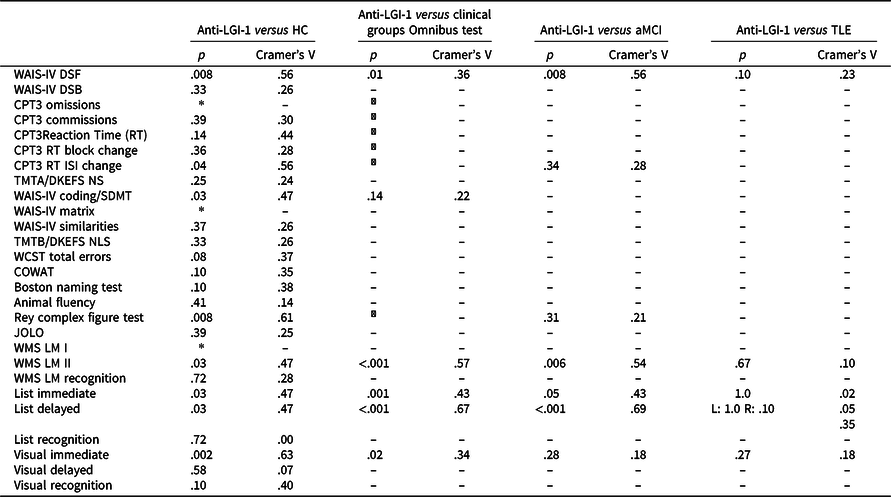
Fisher’s exact tests showed higher rates of impairment in the anti-LGI-1 encephalitis group compared to HC for DSF (p =.008; Cramer’s V = .56), CPT-3 ISI Change (p = .04; Cramer’s V = .56), coding (p = .03; Cramer’s V = .47), Rey Complex Figure Test (p = .02; Cramer’s V = .61), Word List Immediate and Delayed Free Recall (p = .03; Cramer’s V = .47, for both), WMS-IV Logical Memory II (p = .03; Cramer’s V = .47), and Visual Memory Immediate (p =.002; Cramer’s V = .63).
Anti-LGI-1 encephalitis versus clinical groups
Follow up comparisons for CPT-3 RT ISI Change and RCFT did not reveal significant differences between aMCI and ant-LGI-1 groups; these tests were not administered to the TLE patients. Of the other tests which differed between anti-LGI-1 encephalitis and HC groups, only delayed list recall significantly differed between right and left TLE (p = .03); as such, right and left TLE were considered as separate groups for this variable. Overall group comparisons were significant for DSF (p =.01; Cramer’s V = .36), immediate (p = .001; Cramer’s V = .43) and delayed free recall of a word list (p < .001; Cramer’s V = 67), LM II (p < .001; Cramer’s V = .57), and Visual Memory Immediate (p = .02; Cramer’s V = .34).
Follow up analyses revealed that the anti-LGI-1 encephalitis group showed higher rates of impairment on DSF (p = .008; Cramer’s V = .56) and lower rates of impairment on LMII (p = .006; Cramer’s V = .54) and list delayed recall (p < .001; Cramer’s V = .69) compared to the aMCI group. There were no other differences between the aMCI and anti-LGI-1 encephalitis groups. There were no differences between the anti-LGI-1 encephalitis and TLE groups. See Table 3.
Fisher-Freeman-Halton exact test results comparing rates of impairment on neuropsychological tests between the Anti-LGI-1, healthy control, aMCI and TLE groups

Note. *no participants impaired; ⱡno data for TLE.
Abbreviations: anti-LGI-1 = anti-leucine rich glioma inactivated 1 encephalitis; HC = healthy controls; aMCI = amnestic mild cognitive impairment, TLE = temporal lobe epilepsy, R = right, L = left; WAIS-IV = Wechsler Adult Intelligence Scale, Fourth Edition, DSF = Digit Span Forward; DSB = Digit Span Backward CPT2 = Conner’s Continuous Performance Test, Second Edition; ISI = Interstimulus interval; SDMT = Symbol Digit Modalities Test; TMTA = Trail Making Test – Part A; DKEFS = Delis-Kaplan Executive Function System; NS = Number Sequencing, NLS = Number-Letter Switching; Matrix = Matrix Reasoning; TMTB = Trail Making Test- Part B; WCST = Wisconsin Card Sorting Test; COWAT = Controlled Oral Word Association Test; JOLO = Judgment of Line Orientation ; WMS = Wechsler Memory Scales, LM = Logical Memory.
Discussion
Results of this study showed that cognitive deficits are common (100% on 1+ tests, 80% on 2+ tests) in a sample of patients with anti-LGI-1 encephalitis who were approximately 39 months from symptom onset. Patients with anti-LGI-1 encephalitis showed significantly greater rates of impairment in basic attention, vigilance during a sustained attention measure, one test of visuomotor processing speed, complex figure copy, and aspects of learning/memory, including immediate and delayed recall of a word list, delayed recall of short stories, and immediate recall of visual information, when compared to demographically similar healthy controls. In contrast, rates of impairment on tests of auditory working memory, simple visuospatial skills, delayed recall/recognition memory, and other executive functions did not differ from the control group. Patients with anti-LGI-1 encephalitis showed higher rates of impairment on a test of basic attention impairments when compared to aMCI patients, but lower rates of impairment on memory tests. Interestingly, there were no significant differences between anti-LGI-1 encephalitis and TLE patients, though some comparisons (i.e., sustained attention, complex figure copy) could not be made due to differences in test batteries.
Regarding attentional impairments, prior research in patients with anti-LGI-1 encephalitis has been mixed (Binks et al., Reference Binks, Veldsman, Easton, Leite, Okai, Husain and Irani2021; Finke et al., Reference Finke, Kopp, Prüss, Dalmau, Wandinger and Ploner2012), though no prior studies have employed a measure of sustained attention. While the neurological processes underlying sustained attention are not completely understood, they likely involve multiple neural networks (Lawrence et al., Reference Lawrence, Ross, Hoffmann, Garavan and Stein2003), and deficits in this domain may indicate widespread network disruption within this population (Heine et al., Reference Heine, Prüss, Kopp, Wegner, Then Bergh, Münte, Wandinger, Paul, Bartsch and Finke2018; Qiao et al., Reference Qiao, Zhao, Wang, Li, Wang, Cao and Wang2020). Furthermore, deficits in sustained attention may also relate directly to limbic dysfunction (Oken et al., Reference Oken, Salinsky and Elsas2006). Importantly, attentional deficits are nonspecific and can be observed in multiple etiologies, such as sleep apnea (Mazza, Reference Mazza2005), which was a common comorbidity in this sample. However, sleep apnea was more common among the healthy controls, who did not similarly exhibit significant attentional difficulties. Overall, findings warrant further research to evaluate whether attentional deficits represent a core feature among anti-LGI-1 patients.
The anti-LGI-1 encephalitis patients also more commonly impaired on measures of complex visuospatial skills (figure copy) and encoding of visual and verbal memory compared to healthy controls despite similar performance on other visuospatial measures (WAIS-IV Matrix Reasoning, JOLO). However, their performance on these measures did not differ from the other clinical groups evaluated. It is unclear whether these findings relate directly to visuospatial function as opposed to attentional, executive, or processing speed difficulties, which have been shown to contribute both to RCFT (Mullen et al., Reference Mullen, Rolin and Davis2019) and BVMT immediate trials (Tam & Schmitter-Edgecombe, Reference Tam and Schmitter-Edgecombe2013). Similarly, a recent study suggested that visuospatial deficits, along with executive dysfunction, may represent a hallmark feature of cognitive dysfunction in anti-LGI-1 encephalitis. Notably, the authors of the study did not provide information regarding test data in their sample, stating only that impairment in cognitive domains was assessed by two independent raters based on review of patient performance on the cognitive screening instruments and neuropsychological testing as available (Bastiaansen et al., Reference Bastiaansen, van Steenhoven, de Bruijn, Crijnen, van Sonderen, van Coevorden-Hameete, Nühn, Verbeek, Schreurs, Sillevis Smitt, de Vries, Jan de Jong and Titulaer2021). This contrasts other studies which have described visuospatial functioning as being relatively spared (Bettcher et al., Reference Bettcher, Gelfand, Irani, Neuhaus, Forner, Hess and Geschwind2014; Rodriguez et al., Reference Rodriguez, Klein, Sechi, Alden, Basso, Pudumjee, Pittock, McKeon, Britton, Lopez-Chiriboga, Zekeridou, Zalewski, Boeve, Day, Gadoth, Burkholder, Toledano, Dubey and Flanagan2021). Specifically, Bettcher et al. (Reference Bettcher, Gelfand, Irani, Neuhaus, Forner, Hess and Geschwind2014) employed the Benson Figure Copy and Visual Object Space Perception (VOSP) tests as measures of visuospatial function in 12 patients with autoimmune encephalitis and voltage-gated potassium channel complex antibodies (of which anti-LGI-1 is a subtype), 8 of whom were confirmed to have LGI-1 antibodies. Their results showed 20% were impaired on VOSP and only 8% were impaired on the figure copy. The authors concluded that their patient sample displayed “relative preservation of visuospatial skills” (Bettcher et al., Reference Bettcher, Gelfand, Irani, Neuhaus, Forner, Hess and Geschwind2014, p. 1038). Rodriguez et al. (Reference Rodriguez, Klein, Sechi, Alden, Basso, Pudumjee, Pittock, McKeon, Britton, Lopez-Chiriboga, Zekeridou, Zalewski, Boeve, Day, Gadoth, Burkholder, Toledano, Dubey and Flanagan2021) reported that 11% of their sample was impaired on the Rey Complex Figure Test. It is possible that differences in our findings compared to these prior studies were attributable to different tests (Bettcher et al., Reference Bettcher, Gelfand, Irani, Neuhaus, Forner, Hess and Geschwind2014) or normative data (Rodriguez et al., Reference Rodriguez, Klein, Sechi, Alden, Basso, Pudumjee, Pittock, McKeon, Britton, Lopez-Chiriboga, Zekeridou, Zalewski, Boeve, Day, Gadoth, Burkholder, Toledano, Dubey and Flanagan2021) used. Overall, further research into visuospatial functioning in this population is warranted.
Similar to previous studies (e.g., Bettcher et al., Reference Bettcher, Gelfand, Irani, Neuhaus, Forner, Hess and Geschwind2014, Miller et al., Reference Miller, Chong, Aimola Davies, Ng, Johnson, Irani, Vincent, Husain, Jacob, Maddison, Kennard, Gowland and Rosenthal2017), patients with anti-LGI-1 encephalitis demonstrated frequent impairments in learning/memory tasks, though findings were variable. While performance in the anti-LGI-1 encephalitis group was worse compared to controls for both encoding and delayed recall, rates of impairment were lower for the anti-LGI-1 group compared to aMCI. Additionally, anti-LGI-1 patients did not differ from controls on any aspects of recognition memory. It is possible that memory deficits in anti-LGI-1 patients with primary encoding-based impairment result from underlying attentional/executive difficulties (Anderson et al., Reference Anderson, Iidaka, Cabeza, Kapur, McIntosh and Craik2000; Hanseeuw et al., Reference Hanseeuw, Dricot, Kavec, Grandin, Seron and Ivanoiu2011; Putcha et al., Reference Putcha, McGinnis, Brickhouse, Wong, Sherman and Dickerson2018). It is worth noting that five LGI-1 patients also demonstrated deficits in delayed recall/retrieval, and three of them had temporal lobe lesions on MRI, although an additional two patients without delayed recall deficits also showed lesional temporal lobe changes on MRI.
Cognitive processing speed findings were variable compared to controls, with one test being more frequently impaired (digit-symbol coding) while the other two (CPT-3 RT, Trail Making Test Part A) did not differ. This is somewhat in contrast to the suggestion by Bettcher et al. (Reference Bettcher, Gelfand, Irani, Neuhaus, Forner, Hess and Geschwind2014) that deficits in executive domains may have stemmed from general slowing, although this has not been concluded in other studies. Overall, additional work in larger samples is needed to better clarify the role of processing speed in patients with anti-LGI-1 encephalitis. Despite frequent temporal lobe involvement in anti-LGI-1 encephalitis patients, this study did not demonstrate any differences in language tasks compared to controls.
Greater time from disease onset to neuropsychological assessment was associated with greater cognitive impairment. This finding may be subject to a selection bias, given that the patients who are referred for testing later in their disease course are often experiencing a greater cognitive impact. There was no association between overall cognitive impairment and time to immunosuppression, as was found in prior studies (Finke et al., Reference Finke, Kopp, Prüss, Dalmau, Wandinger and Ploner2012; Thompson et al., Reference Thompson, Bi, Murchison, Makuch, Bien, Chu, Farooque, Gelfand, Geschwind, Hirsch, Somerville, Lang, Vincent, Leite, Waters, Irani, Dogan-Onugoren, Rae-Grant, Illes and Shin2018), though it is likely that this study was underpowered to evaluate the impact of treatment on cognitive impairment.
Patients in our sample had multiple comorbidities which may have contributed to their cognitive performance. Similar to other cohorts reported (Binks et al., Reference Binks, Veldsman, Easton, Leite, Okai, Husain and Irani2021), psychiatric symptoms were common in our sample, with greater than half reporting at least mild symptoms of anxiety and three endorsing at least mild symptoms of depression. The association or contribution of psychiatric comorbidities to cognitive symptoms and long-term outcomes has not been well studied, though in this study, there was not a significant association between the presence of depressive or anxiety symptoms and the severity of cognitive difficulties. Additionally, patient 2 had a history of significant cerebrovascular disease, including moderate chronic white matter changes, and a history of multiple remote infarcts, which may also have impacted her cognitive performance. Other studies examining cognitive performance in anti-LGI-1 encephalitis patients have not reported comorbidities (e.g., Bettcher et al., Reference Bettcher, Gelfand, Irani, Neuhaus, Forner, Hess and Geschwind2014; Rodriguez et al., Reference Rodriguez, Klein, Sechi, Alden, Basso, Pudumjee, Pittock, McKeon, Britton, Lopez-Chiriboga, Zekeridou, Zalewski, Boeve, Day, Gadoth, Burkholder, Toledano, Dubey and Flanagan2021) which limits comparability.
There are several limitations of this study. Most notably, the small sample size limits generalizability and examination of potential confounders, which may help to explain some of the inconsistencies with prior research. Sample size further limited statistical comparisons between groups and prevented testing for group by test interaction effects, to determine if the neuropsychological deficits in the anti-LGI-1 group might be functionally specfic. Given the age of the sample, impact from other neuropathology and/or pre-existing cognitive impairment on cognitive testing is possible. Further studies of larger cohorts with longitudinal follow up, ideally with the formation of multicenter registries, are needed to better examine risk factors associated with poorer cognitive outcomes. Another limitation is that there was some variability in the tests administered, which could have impacted results. Specifically, the sustained attention tests were not commonly administered in the comparison groups and future studies may be helpful in determining whether sustained impairment is more common in anti-LGI-1 encephalitis compared to other groups with temporal lobe dysfunction.
Despite its limitations, this study adds to the limited available literature examining comprehensive cognitive profiles in patients with anti-LGI-1 encephalitis in the chronic phase. This is the first study to compare this group to other well-characterized clinical groups with temporal lobe pathology. Taken together, we found that patients in the chronic phase of anti-LGI-1 encephalitis exhibit diffuse cognitive impairment, which extends beyond what would be expected for temporal lobe pathology, suggesting more widespread disruption. Therefore, it is recommended that neuropsychological evaluation in patients with anti-LGI-1 encephalitis include broad assessment across domains, with particular focus on areas of attention, learning/memory, and complex visuospatial skills. Results of sustained attention tests have not been previously reported in this group but may provide interesting insights into underlying cognitive dysfunction in anti-LGI-1 encephalitis. Our study highlights the pervasiveness of cognitive deficits in the chronic phase of anti-LGI-1 encephalitis, and the importance of continued investigation into the specific cognitive domains affected, in order to objectively monitor functional outcomes and treatment response, to provide tailored cognitive rehabilitation strategies and educational support for long-term caregivers.
Acknowledgements
None.
Author contributions
RG was responsible for study design, conceptualization, data collection, analysis, and writing. AA assisted with data collection, analysis, and writing. KK assisted with conceptualization and writing. JL assisted with analysis and conceptualization. AK assisted with conceptualization and writing.
Funding statement
There is no funding to report.
Conflicts of interest
None.