INTRODUCTION
Helminth infections are prevalent throughout tropical regions where malaria parasites are also transmitted, resulting in frequent helminth and malaria co-infections. Infection with helminths has a profound effect on the immune system resulting in polarisation towards T helper 2 (Th2) responses, characterized by high concentrations of cytokines such as interleukin-4 (IL-4), IL-5, IL-13 and high serum concentrations of immunoglobulin E (IgE). Despite these strong Th2 responses, adult worms often survive in the human host, sometimes for decades. This survival is thought to be facilitated by the induction of a regulatory network. These mechanisms include the induction of regulatory T cells and modulation of cells of the innate immune system, such as macrophages and dendritic cells, which results in an anti-inflammatory environment, characterized by increased concentrations of IL-10 and TGF-β. This regulatory network prevents the elimination of the worms and at the same time protects the host against pathology that would otherwise result from excessive inflammation (Maizels and Yazdanbakhsh, Reference Maizels and Yazdanbakhsh2003; Taylor et al. Reference Taylor, LeGoff, Harris, Malone, Allen and Maizels2005). This hyporesponsiveness is not only directed towards parasite antigens, but appears to extend to third party antigens. For example, chronic infection with different types of helminth was shown to reduce the response against tetanus following vaccination (Sabin et al. Reference Sabin, Araujo, Carvalho and Pearce1996; Cooper et al. Reference Cooper, Espinel, Paredes, Guderian and Nutman1998; Nookala et al. Reference Nookala, Srinivasan, Kaliraj, Narayanan and Nutman2004) and there is also evidence that development of allergic responses is modified by helminth infections (Smits, Hartgers and Yazdanbakhsh, Reference Smits, Hartgers and Yazdanbakhsh2005). The influence of helminth infections on the immune system is also expected to extend to the immune response against malaria parasites and thereby possibly affect the course of an infection. A delicate immunological balance is needed for both the control of parasitaemia on the one end and pathology on the other. Helminth infections might upset this balance.
An effective immune response against malaria needs a strong inflammatory T helper 1 (Th1) response followed by the generation of a slowly developing protective antibody response. It is thought that the development of pathology in malaria infection is associated with the imbalance of cytokines involved in the regulation of inflammatory responses (Day et al. Reference Day, Hien, Schollaardt, Loc, Chuong, Chau, Mai, Phu, Sinh, White and Ho1999; Good et al. Reference Good, Xu, Wykes and Engwerda2005). Although pro-inflammatory responses are associated with protective immunity to malaria during the early phases of infection, overproduction of IFN-γ or TNF-α predisposes a subject to severe immunopathology. It is expected that anti-malarial responses are modified during chronic helminth infection. However, the epidemiological data from studies of human helminth and malaria co-infections do not give a clear view of the influence of concurrent helminth infection on the course of malaria infection and disease (reviewed in Hartgers and Yazdanbakhsh, Reference Hartgers and Yazdanbakhsh2006). In some studies, helminth infection has been found to result in a decrease in the development of a protective immune response against malaria (Tshikuka et al. Reference Tshikuka, Scott, Gray-Donald and Kalumba1996; Nacher et al. Reference Nacher, Singhasivanon, Yimsamran, Manibunyong, Thanyavanich, Wuthisen and Looareesuwan2002; Spiegel et al. Reference Spiegel, Tall, Raphenon, Trape and Druilhe2003; Sokhna et al. Reference Sokhna, Le Hesran, Mbaye, Akiana, Camara, Diop, Ly and Druilhe2004), implying that a strong Th2 skewing of the immune system might indeed hamper a strong Th1 anti-malarial response. However, other studies have provided contradictory data, showing that helminth infections protected against malarial infection (Briand et al. Reference Briand, Watier, Le Hesran, Garcia and Cot2005; Lyke et al. Reference Lyke, Dicko, Dabo, Sangare, Kone, Coulibaly, Guindo, Traore, Daou, Diarra, Sztein, Plowe and Doumbo2005) or made no difference (Shapiro et al. Reference Shapiro, Tukahebwa, Kasten, Clarke, Magnussen, Olsen, Kabatereine, Ndyomugyenyi and Brooker2005; Bejon et al. Reference Bejon, Mwangi, Lowe, Peshu, Hill and Marsh2008). The contradictory results obtained in different studies might depend on the species of helminth studied, the intensity of helminth infection and the age of the study population. In addition, the influence of helminth infection on severe malaria disease might be different from the effects on parasitaemia. Although in one study it was found that Ascaris spp. infections were associated with an increase in prevalence of severe malaria (Le Hesran et al. Reference Le Hesran, Akiana, Ndiaye, Dia, Senghor and Konate2004), others found an association between Ascaris spp. infections and protection from cerebral malaria (Nacher et al. Reference Nacher, Gay, Singhasivanon, Krudsood, Treeprasertsuk, Mazier, Vouldoukis and Looareesuwan2000) or from renal failure (Nacher et al. Reference Nacher, Singhasivanon, Silachamroon, Treeprasertsuk, Vannaphan, Traore, Gay and Looareesuwan2001). Cerebral malaria has been associated with increased concentrations of pro-inflammatory cytokines, and so a concomitant helminth infection may be able to suppress these cytokines by production of IL-10 and/or TGF-β (up-regulated by helminth infections, Mahanty et al. Reference Mahanty, Mollis, Ravichandran, Abrams, Kumaraswami, Jayaraman, Ottesen and Nutman1996) and therefore decrease the chance of developing severe malarial disease.
IMMUNOLOGICAL RESPONSES IN HELMINTH-MALARIA CO-INFECTION
Why there are great differences between the results of such co-infection studies must await more extensive studies with well developed protocols. In addition, immunological studies may help towards understanding how the immune system behaves when challenged with co-infections of helminths and malaria. A more detailed knowledge of the type of immune responses that develop during co-infection may help to identify which immunological markers are important in affecting the infection that allows survival and transmission of both parasites without killing the host. However, there are very few studies that have looked at immunological parameters in co-infection of helminths and malaria.
The few studies that have been performed so far have looked at systemic cytokine concentrations comparing sera from malaria-only infected individuals with individuals co-infected with helminths. In a study in Senegal, systemic cytokine concentrations in sera were compared between two groups of subjects, Plasmodium falciparum-infected individuals and individuals co-infected with Schistosoma haematobium and Plasmodium falciparum. The groups were living in two different villages in the same sub-region with a low prevalence and parasitaemia of P. falciparum infection. Co-infected children had higher plasma concentrations of IFN-γ and similar concentrations of TNF-α, TGF-β and IL-10 compared to children infected with P. falciparum only (Diallo et al. Reference Diallo, Remoue, Schacht, Charrier, Dompnier, Pillet, Garraud, N'diaye, Capron, Capron and Riveau2004). Interestingly, co-infected Senegalese adults also showed a significant increase in plasma IFN-γ compared to subjects infected with P. falciparum only, but this was accompanied by higher concentrations of both IL-10 and TGF-β. These immunological differences did not seem to affect parasitaemia, which was not significantly different between the group infected with both S. haematobium and P. falciparum and the one with P. falciparum only. The question of whether or not the presence of higher concentrations of IL-10 and TGF-β in these adults protected them against inflammation and severe malarial pathology, was not addressed.
A second study from Mali selected Schistosoma haematobium-positive and age and sex-matched S. haematobium-negative children (4–14 years old) from the same area and followed them during a malaria transmission season (25 weeks). Serum cytokine analyses revealed elevated concentrations of IL-6 and IL-10 in association with acute malaria in all children. However, these concentrations were lower in children that were co-infected with S. haematobium compared to S. haematobium-negative children (Lyke et al. Reference Lyke, Dabo, Sangare, Arama, Daou, Diarra, Plowe, Doumbo and Sztein2006). This is different from the results of the study in Senegal, where similar IL-10 concentrations were found in malaria-infected children positive or negative for S. haematobium (Diallo et al. Reference Diallo, Remoue, Schacht, Charrier, Dompnier, Pillet, Garraud, N'diaye, Capron, Capron and Riveau2004). However, in the study in Senegal, children with clinical symptoms of malaria were excluded from the cytokine analyses. The lower serum concentrations of IL-10 and IL-6 in the children co-infected with S. haematobium did not correlate with the time to first malaria infection, and could not explain the previous observation that S. haematobium infection protected against malaria infection in children who were 4 to 8 years old. Although lower concentrations of IL-4 at the time of acute malaria infection were negatively correlated with the time to the malaria episode, this was not dependent on S. haematobium infection status (Lyke et al. Reference Lyke, Dicko, Dabo, Sangare, Kone, Coulibaly, Guindo, Traore, Daou, Diarra, Sztein, Plowe and Doumbo2005). The different results obtained in the two studies might be explained by differences in malaria and helminth prevalence, in the malaria transmission season at the time of the study and in the definition of malaria (acute malaria versus malarial parasitaemia). In addition, the set of cytokines that was analysed in the sera was not the same.
These data from human studies are different from a mouse study on co-infection with the nematode Heligmosomoides polygyrus and Plasmodium chabaudi (AS strain), where lower concentrations of IFN-γ and higher concentrations of TGF-β and IL-10 were observed in sera of co-infected mice compared to mice infected with P. chabaudi alone (Su et al. Reference Su, Segura, Morgan, Loredo-Osti and Stevenson2005). In vitro stimulation of spleen cells with malaria antigens also resulted in lower IFN-γ responses in co-infected mice compared to mice infected with P. chabaudi only. These lower concentrations of IFN-γ were most likely the reason for the impairment of development of protective immunity to malaria in co-infected animals and increased mortality (Su et al. Reference Su, Segura, Morgan, Loredo-Osti and Stevenson2005). In another murine model of P. chabaudi, co-infection with Schistosoma mansoni did not result in altered concentrations of IFN-γ after stimulation of spleen cells with malarial antigens or with anti-CD3, although in this case there was a significantly lower production of TNF-α in co-infected mice than in mice infected with malaria only (Helmby, Kullberg and Troye-Blomberg, Reference Helmby, Kullberg and Troye-Blomberg1998). Also here co-infected mice developed a more rapid and severe malaria infection than animals without helminth infection. A third study on P. chabaudi showed that mice with a pre-existing infection with the filarial worm Litomosoides sigmodontis had more severe anaemia and loss of body mass than did mice with malaria only, accompanied by an increased IFN-γ production of polyclonal stimulated spleen cells (Graham et al. Reference Graham, Lamb, Read and Allen2005). As for human populations, the influence of helminth infection on immune responses to malaria might be dependent on several factors such as helminth species, mouse genetic background and the malarial strain used.
A PILOT STUDY IN GHANA
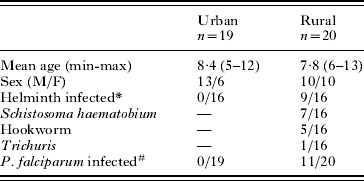
In human studies there are no data so far on how malaria-specific responses are modified by concurrent helminth infections, highlighting the fact that cellular immunological studies are needed. The Institutional Review Board of the Noguchi Memorial Institute for Medical Research, Accra, Ghana approved a pilot study in school children in Ghana, where P. falciparum is endemic. Whole blood from 19 urban and 20 rural children was stimulated in vitro with malarial antigens and cytokine responses were measured. No helminth or malaria infections were detected in the children living in the urban area in Accra (Table I). Although it is known that P. falciparum is endemic in Accra, the ready access to treatment may contribute to the observed zero parasite prevalence. In the rural area, 55% of the children were positive for P. falciparum by microscopy and a similar proportion had one or more helminth infections. None of the children had any symptoms of malaria such as fever or were taking anti-malarial treatment at the time of blood collection.
Pilot study population
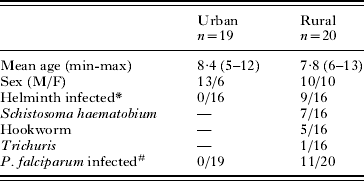
* result of examination of one urine (filtration) and one stool sample (Kato-Katz).
# detection of parasites by Giemsa-stained thick blood smear.
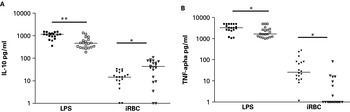
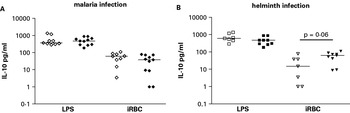
Rural children had lower concentrations of both IL-10 and TNF-α upon stimulation with E. coli LPS compared to the urban children, although the rural children produced more IL-10 after stimulation with malarial antigens than the urban children (Fig. 1). Since the urban children had no P. falciparum infection, the higher IL-10 in the rural children might result from higher exposure to malaria parasites. Therefore, we analysed the rural children separately for P. falciparum infection. P. falciparum-infected children had similar IL-10 production to malarial antigens (or LPS) than the P. falciparum-free children (Fig. 2A). Interestingly, when we performed the same analysis for helminth infection, the helminth-infected children responded with a higher production of IL-10 upon stimulation with malarial antigens than the helminth-free children (P=0·06; Fig. 2B). Groups were too small to compare IL-10 production between subjects infected with helminths only (3 individuals) and subjects co-infected with P. falciparum (6 individuals).
Whole blood cytokine responses of children living in either an urban or rural area in Ghana. Whole blood was stimulated with 100 ng/ml LPS or 1×10⁶P. falciparum-infected RBC (iRBC) (Ponnudurai et al. Reference Ponnudurai, Lensen, Van Gemert, Bensink, Bolmer and Meuwissen1989) for 24 hours and supernatants were collected to measure interleukin (IL)-10 (A) and tumor necrosis factor (TNF)-α (B) by ELISA using commercial kits (PeliKine Compact human ELISA kit, Sanquin, Amsterdam, The Netherlands). Background cytokine production, i.e. cells stimulated with medium only or with uninfected red blood cells, was subtracted from the values obtained after stimulation with LPS or infected red blood cells, respectively. Urban samples are represented as closed symbols, rural samples as open symbols. Horizontal lines indicate median values per group. The cytokine responses between urban and rural samples were compared for each stimulus using the non-parametric Mann-Whitney test. *, P<0·05; **, P<0·01.

IL-10 responses in rural children after 24 hours of stimulation of whole blood with LPS or iRBC. Samples were segregated according to malaria infection (A) or helminth infection (B). Non-infected subjects are represented as open symbols, infected subjects as closed symbols. Horizontal lines indicate median values per group. The cytokine responses between infected and non-infected samples were compared for each stimulus using the non-parametric Mann-Whitney test.

It is possible that regulatory T (Treg) cells play a role in the increased IL-10 production observed in helminth-infected compared to helminth-free individuals. Treg cells are known to be able to produce high concentrations of IL-10 and to be induced by helminth as well as malaria infection (Maizels et al. Reference Maizels, Balic, Gomez-Escobar, Nair, Taylor and Allen2004; Walther et al. Reference Walther, Tongren, Andrews, Korbel, King, Fletcher, Andersen, Bejon, Thompson, Dunachie, Edele, de Souza, Sinden, Gilbert, Riley and Hill2005). High concentrations of regulatory cytokines that are induced by helminth and/or malaria infection may possibly create an environment that favours the induction of malaria-specific Treg cells. The TNF-α responses were not different between helminth-positive and helminth-negative children (data not shown). These results might indicate that anti-malaria responses are indeed modified towards an anti-inflammatory response by a current helminth infection in the rural children. Importantly, the responses against a bacterial stimulus, LPS, followed a different pattern, indicating specificity of the immune response to malarial antigens. Since the number of children in this pilot study is rather small, a larger study will have to be conducted in order to confirm these data and to get better insight into the mechanisms involved.
CONCLUDING REMARKS
Exploring the impact of co-infection of helminths and malaria on the immune system will be instrumental to a better understanding of the interaction between two parasite species or other taxonomic groups. This knowledge will improve the evaluation of malaria vaccine trials, since the results might be modified by concurrent helminth infections. Lastly, it might give us the opportunity for a better evaluation of the consequences of helminth eradication programs for the course of malaria disease.
ACKNOWLEDGEMENTS
We are indebted to the children for their participation in this study, and to Abena Amoah and Irene Akosua Larbi for their excellent support in the field. We thank M. McCall and M. van de Vegte-Bolmer for the production of P. falciparum antigen material.