Explaining why and how tropical rain forests are among the most diverse plant communities in the world remains a major question in ecology (Hubbell Reference Hubbell2001, Wright Reference Wright2002), including whether the same factors drive patterns of diversity in different life forms such as trees and herbs (Jones et al. Reference Jones, Tuomisto, Borcard, Legendre, Clark and Olivas2008). The regional to landscape-scale (mesoscale) distribution of herbaceous plants, similar to woody trees, can be driven by variation in climate (Cicuzza et al. Reference Cicuzza, Kromer, Poulsen, Abrahamczyk, Delhotal, Piedra and Kessler2013, Gentry & Emmons Reference Gentry and Emmons1987), soil (Costa Reference Costa2006, Figueiredo et al. Reference Figueiredo, Costa, Nelson and Pimentel2014, Gentry & Emmons Reference Gentry and Emmons1987, Tuomisto Reference Tuomisto2006, Tuomisto & Ruokolainen Reference Tuomisto and Ruokolainen1993, Reference Tuomisto and Ruokolainen2002), hydrology (Costa et al. Reference Costa, Magnusson and Luizao2005, Drucker et al. Reference Drucker, Costa and Magnusson2008, Moulatlet et al. Reference Moulatlet, Costa, Renno, Emilio and Schietti2014), altitude and topography (Gómez-Díaz et al. Reference Gómez-Díaz, Kromer, Kreft, Gerold, Carvajal-Hernández and Heitkamp2017, Jones et al. Reference Jones, Szyska and Kessler2011, Schietti et al. Reference Schietti, Emilio, Rennó, Drucker, Costa, Nogueira, Baccaro, Figueiredo, Castilho, Kinupp, Guillaumet, Garcia, Lima and Magnusson2013, Willinghofer et al. Reference Willinghofer, Cicuzza and Kessler2011) and/or light conditions (Dirzo et al. Reference Dirzo, Horvitz, Quevedo and Lopez1992, Lima & Gandolfi Reference Lima and Gandolfi2009), as well as dispersal limitation and random chance (Tuomisto et al. Reference Tuomisto, Ruokolainen and Yli-Halla2010). However, our understanding of the microscale distribution of herbs remains limited (Poulsen & Balslev Reference Poulsen and Balslev1991, Poulsen et al. Reference Poulsen, Tuomisto and Balslev2006).
Data for trees >1 cm diameter at breast height (dbh, 1.3 m) in the Yasuní site show that ridge habitat has about 1000 more stems and 100 Mg ha−1 of biomass more than valley habitat (Valencia et al. Reference Valencia, Condit, Muller-Landau, Hernandez and Navarrete2009). Further, distinct differences in species composition of these habitats (25% of tree species had large abundance differences and 50% had moderate abundance differences) suggested a role for topographic niche partitioning (Valencia et al. Reference Valencia, Foster, Villa, Condit, Svenning, Hernández, Romoleroux, Losos, Magård and Balslev2004). More detailed investigation of suites of closely related tree species at the same site have revealed niche differences in terms of seed size, maximum height, habitat associations and regeneration (Endara & Jaramillo Reference Endara and Jaramillo2011, Queenborough et al. Reference Queenborough, Burslem, Garwood and Valencia2007a, b). For herbs, in a 1-ha plot in lowland Amazon rain forest, Poulsen et al. (Reference Poulsen, Tuomisto and Balslev2006) found some effect of topography on herb density and richness, but little effect of soil chemistry. Here, we examine the distribution of herbaceous plants at the 25-ha scale.
In this study we examined patterns of spatial distribution and habitat association with respect to topography for 2417 individuals of six species of Heliconia on a large mapped tree plot in aseasonal lowland terre firme rain forest in Amazonian Ecuador. We hypothesized that the six coexisting Heliconia species exhibit: (1) different species composition between ridge, slope and valley habitat, (2) distinct habitat associations, (3) non-overlapping co-occurrence, and (4) higher abundance in the wetter valley habitat.
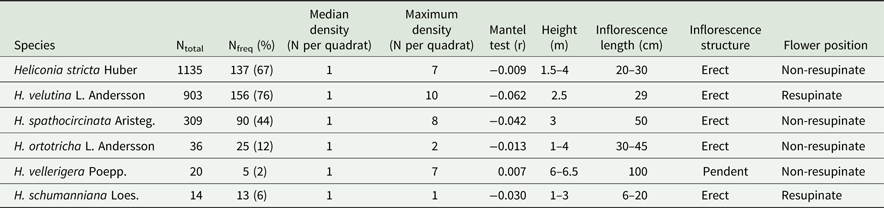
To test these hypotheses, we surveyed Heliconia species in Yasuní National Park and Biosphere Reserve, Amazonian Ecuador, an evergreen lowland wet forest with an aseasonal climate. Mean annual rainfall is 2800 mm and mean monthly rainfall is almost never <100 mm, mean monthly temperature is 25–27°C (Bass et al. Reference Bass, Finer, Jenkins, Kreft, Cisneros-Heredia, McCracken, Pitman, English, Swing, Villa, Di Fiore, Voigt and Kunz2010, Valencia et al. Reference Valencia, Foster, Villa, Condit, Svenning, Hernández, Romoleroux, Losos, Magård and Balslev2004). Heliconia (Heliconiaceae) is a genus of large perennial herbs, growing up to 4 m, with distinctive banana-like leaves and inflorescence bracts that are often showy and colourful. Seven species are found within the Yasuní Forest Dynamics Plot, but only six were recorded in our census (Table 1).
Abundance data for all six species of Heliconia occurring in 204 stratified random 20 × 20 m quadrats in the 25-ha Yasuní Forest Dynamics Plot. Ntotal is the total number of individuals recorded, Nfreq is the number (%) of quadrats in which the species occurs. A Mantel test was run on the abundance of each species in their quadrat locations. No species had significant spatial autocorrelation (P > 0.05 in all cases). Data on height and inflorescence length come from field measurements and Kress et al. (Reference Kress, Betancur and Echeverry2004)

The Yasuní Forest Dynamics Plot (FDP, 0°41′S, 76°24′W) is a 50-ha long-term tree plot in Yasuní National Park wherein all trees >1 cm dbh are censused regularly (Valencia et al. Reference Valencia, Foster, Villa, Condit, Svenning, Hernández, Romoleroux, Losos, Magård and Balslev2004). Each 20 × 20-m quadrat within the FDP is categorized into one of three habitat types; valley, slope or ridge, according to its mean altitude, slope and convexity (Harms et al. Reference Harms, Condit, Hubbell and Foster2001, Valencia et al. Reference Valencia, Foster, Villa, Condit, Svenning, Hernández, Romoleroux, Losos, Magård and Balslev2004). Two drier and brighter ridges surround a shadier and wetter valley (Queenborough et al. Reference Queenborough, Burslem, Garwood and Valencia2007a, Valencia et al. Reference Valencia, Foster, Villa, Condit, Svenning, Hernández, Romoleroux, Losos, Magård and Balslev2004).
In July and August 2015, we surveyed a random sample of 204 20 × 20-m quadrats within the FDP, stratified by topographic habitat. Within each quadrat, we recorded the number of individuals of each Heliconia species. To test for differences in species composition by habitat, we ran a principal components analysis. To test for a difference in abundance and frequency among habitats, we used a χ2 test and GLS regression. To test for patterns of co-occurrence, we used the R package ‘cooccur’ (Griffith et al. Reference Griffith, Veech and Marsh2016), which tests all pairwise species combinations and returns their probability of co-occurring more frequently or less frequently than expected by their observed frequency using a probabilistic model of species co-occurrence (Veech Reference Veech2013). All analyses were carried out in R version 3.7.
We found convincing evidence for habitat filtering and some evidence for habitat niche partitioning among the six species of Heliconia. First, the abundance of Heliconia species in the 204 sampled quadrats in the 25-ha plot ranged from only 14 individuals of H. schumanniana to 1135 individuals of H. stricta (Table 1). There was no marked local (i.e. quadrat-level) clumping of stems (all species had a median quadrat density of 1 individual per quadrat), and common species were spread throughout the plot with a high frequency of occurrence compared with rare species. Further, there was no significant spatial autocorrelation in species composition (Mantel test, r = −0.024, P > 0.05) or abundance for any species (Table 1). The two most abundant species did occur in larger groups than the rarer species, with maximum densities >5 individuals per quadrat, although the second rarest species (H. vellerigera) was somewhat aggregated also with a maximum density >5. More Heliconia individuals of all species were found in valley (N = 979) and slope (847) quadrats than ridge (591) (χ2 = 108.5, df = 2, P < 0.001).
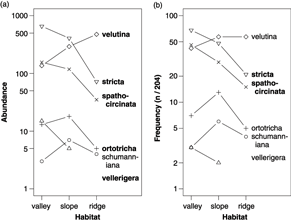
Second, there was no striking difference in species composition between habitats (the PCA showed almost entirely overlapped clusters, and five of the six species were observed at least once in each of the three habitats). However, there were distinct differences in incidence and abundance at the species level (Figure 1). In general, species had higher abundance at lower elevations, except for H. velutina, which had higher abundance on ridges and Heliconia schumanniana (the rarest species), which showed no significant difference in abundance between habitats (Figure 1a). Heliconia stricta, H. spathocircinata and H. ortotricha all had higher abundance in the valley and slope than ridge, and H. vellerigera was completely absent from the ridge. There were fewer differences between species in frequency of occurrence: Heliconia stricta and H. spathocircinata both had greater frequency in valley and slope habitat than ridge (Figure 1b).
The abundance (a) and frequency (b) of six Heliconia species within the 25-ha plot in Yasuní National Park, sampled in 204 random 20 × 20-m quadrats within three topographic habitat categories. Species are referred to by their specific epithets. Names in bold indicate significant differences in abundance or frequency according to a χ2 test (P < 0.001).

Finally, of 13 species pair combinations analysed (two pairs were removed from the analysis because the species were expected to co-occur in less than one quadrat), four species pairs showed significant co-occurrence: Heliconia stricta showed positive co-occurrence with H. ortotricha and H. spathocircinata, whereas H. velutina showed negative co-occurrence with H. spathocircinata and H. stricta.
Our finding that one Heliconia species preferred higher-elevation drier ridges, two species preferred slopes, and three species preferred lower wetter valleys, along with some significant negative co-occurrence between species pairs, suggests that habitat filtering – and maybe even habitat partitioning – is contributing to the distribution of Heliconia species at this microscale, and that ridge-preferring H. velutina may have some adaptations that enable it to thrive where other Heliconia cannot.
Various factors determine the distribution of species, including the environment and random factors. Water availability appears to be a key driver of tree and herb distribution and composition at multiple spatial scales (Engelbrecht et al. Reference Engelbrecht, Comita, Condit, Kursar, Tyree, Turner and Hubbell2007). Herbs appear particularly sensitive to local drainage conditions (Moulatlet et al. Reference Moulatlet, Costa, Renno, Emilio and Schietti2014) and more so to riparian zones than altitude (Drucker et al. Reference Drucker, Costa and Magnusson2008). Topography itself often represents an amalgamation of several interacting climatic, environmental and stochastic factors that can be nearly impossible to untangle (Vormisto et al. Reference Vormisto, Tuomisto and Oksanen2004). One approach to deal with this issue would be to use population dynamic data, rather than the static data used here (and in many other studies), as a more direct estimate of population growth rates and thereby fitness.
Acknowledgements
We thank the Pontificia Universidad Catolica del Ecuador and Yasuní Scientific Research Station for providing logistical support, and Andrew Muehleisen, Soraia Lousa do Branco, Elia Ponce-Tokarz, Madelon Case and Nicolas Tinoco for assistance with fieldwork. E.L.T. was supported by a Fellowship from the Yale Tropical Resources Institute. The Ecuadorian Ministry of the Environment graciously approved this work (permit 012-2015-FLO-MAE-DPAO-PNY). The Forest Dynamics Plot of Yasuní National Park has been made possible through the generous support of the Pontifical Catholic University of Ecuador (PUCE) funds of donaciones del impuesto a la renta, the government of Ecuador, the US National Science Foundation, the Andrew W. Mellon Foundation, the Smithsonian Tropical Research Institute and the University of Aarhus of Denmark.