



LEARNING OBJECTIVES
After reading this article you will be able to:
-
• describe the different classes of apolipoprotein and role of the APOE4 gene expression in pathogenesis of dementia
-
• understand the mechanisms underlying the neuroprotective effects of statins and cyclodextrins in the context of dementia
-
• explore the current evidence regarding the potential benefits of statins and cyclodextrins in preventing or delaying the onset of, or even reducing, cognitive impairment.
Statins are prescribed to reduce low-density lipoprotein (LDL) and triglycerides and increase high-density lipoprotein (HDL), reducing the risk of coronary heart disease (Wang Reference Wang and Li2024). On 28 February 2012, the US Food and Drug Administration (FDA), on the basis of ‘rare’ post-marketing surveillance reports (US Food and Drug Administration 2012), included reversible cognitive impairment as one of the adverse effects of statins (Marcum Reference Marcum, Vande Griend and Linnebur2012). Moreover, National Institute for Health and Care Excellence (NICE) guidelines recommend that statins should not be offered to slow the progress of Alzheimer’s disease (based on four randomised controlled trials including 1084 people with Alzheimer’s disease, which found no significant differences in cognition between statins and placebo) (NICE 2018). However, there are studies that have shown a reduced risk of dementia with statins (Schultz Reference Schultz, Patten and Berlau2018). Thus, there seems to be contradictory evidence which needs to be explored further. One possible solution lies in improving our understanding of apolipoproteins and their relationship with cholesterol, which is where we will begin this review.
Apolipoproteins
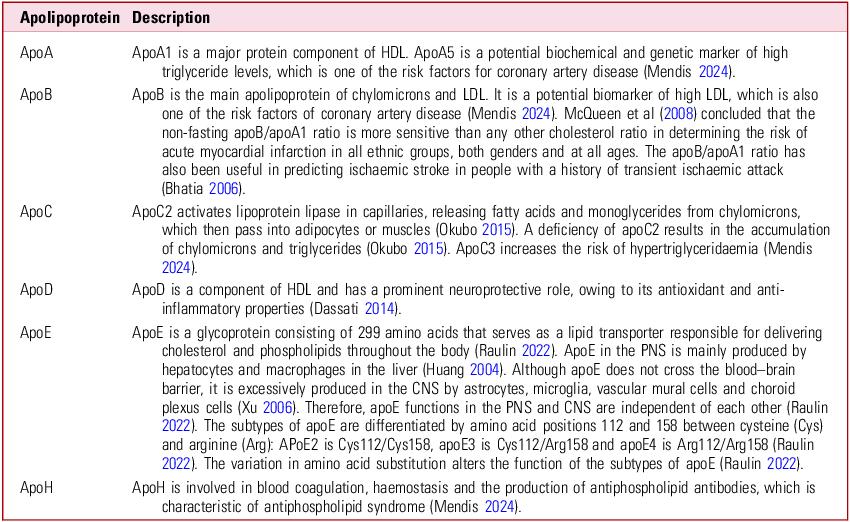
Apolipoproteins are proteins that bind to lipids to form lipoproteins, and their most important functions are lipid transport, maintaining the structural integrity and solubility of lipoproteins, and regulation of certain enzymes in lipoprotein metabolism (Mendis Reference Mendis2024). The six main classes of apolipoprotein are A, B, C, D, E and H (Table 1), and we will focus here on apolipoprotein E (apoE), which in humans is encoded by the APOE gene.
Classes of apolipoprotein: apoA–apoE

CNS, central nervous system; HDL, high-density lipoprotein; LDL, low-density lipoprotein; PNS, peripheral nervous system.
Apolipoprotein E
There are three prominent alleles of the APOE gene that are of clinical significance: APOE2, APOE3 and APOE4 (Raulin Reference Raulin, Doss and Trottier2022). Each person inherits two APOE alleles, in one of one of six possible combinations: 2/2, 2/3, 2/4, 3/3, 3/4 and 4/4. These alleles encode three apoE protein isoforms, apoE2, apoE3 and apoE4. The presence of apoE2 reduces the risk of Alzheimer’s disease, whereas apoE4 increases the risk by a combination of toxic effects and loss of protective functions in the brain. The effect of apoE on amyloid pathology is isoform-dependent, i.e. apoE4 > apoE3 > apoE2. Along with amyloid-β plaque formation, apoE4 also contributes to tau hyperphosphorylation, which is also one of the causes of Alzheimer’s disease.
Along with Alzheimer’s disease, apoE4 is also associated with increased severity of Lewy body dementia, which is independent of Alzheimer’s disease pathology (Dickson Reference Dickson, Heckman and Murray2018). ApoE4 has also been shown to increase the risk of dementia in Parkinson’s disease and reduce the age at onset of Parkinsonian symptoms (Pankratz Reference Pankratz, Byder and Halter2006) by regulating α-synuclein pathology, worsening its toxic effects; this is independent of amyloid pathology (Davis Reference Davis, Inman and Wargel2020). ApoE4 exacerbates cognitive impairment in people with vascular dementia compared with the other alleles (McGuinness Reference McGuinness, Barrett and Craig2010). Considering the clinical implications of apoE, it is important to understand more about its neurobiology.
Peripheral apoE
In the peripheral nervous system, apoE maintains lipid equilibrium by participating in the redistribution and metabolism of lipids, including triglycerides, cholesterol, cholesterol esters and phospholipids, through the formation of lipoprotein particles (Raulin Reference Raulin, Doss and Trottier2022). ApoE4 is mostly found in triglyceride-rich particles such as chylomicrons and very low-density lipoproteins (VLDL), whereas apoE 2 and apoE 3 are mostly found in HDL (Raulin Reference Raulin, Doss and Trottier2022). ApoE4 increases cholesterol dysregulation, stimulates inflammation, disturbs metabolic homeostasis and enhances blood–brain barrier breakdown, leading to atherosclerosis and cerebrovascular damage, and increasing the risk of vascular dementia and Alzheimer’s disease (Duong Reference Duong, Nasrallah and Wolk2021). ApoE4 increases the risk of cerebrovascular disease (odds ratio: 3.0, P = 0.018) and type 2 diabetes mellitus (odds ratio: 2.2, P = 0.04) independently of Alzheimer’s disease (El-Lebedy Reference El-Lebedy, Raslan and Mohammed2016).
Central apoE
The function of apoE in the central nervous system (CNS) is largely dependent on the cell type (Raulin Reference Raulin, Doss and Trottier2022). ApoE4 promotes the accumulation of unsaturated triglycerides and lipid droplets in induced pluripotent stem cell-derived astrocytes and increases cholesterol separation in astrocytes, leading to alterations in the brain matrix, as described by Blanchard et al (Reference Blanchard, Akay and Davila-Velderrain2022). These changes include upregulation of inflammatory and immune-related pathways in: excitatory neurons and inhibitory neurons; T-cell receptor and cytokine signalling in astrocytes; and tumour necrosis factor-mediated signalling in microglia and excitatory neurons. They also include downregulation of synaptic-related processes such as ion channel activity, excitatory postsynaptic potential and synaptic plasticity. Such alterations occur not only in neurons but also in oligodendrocytes, especially in long-term neuronal synaptic plasticity. The presence of apoE4 also leads to widespread alterations to genes involved in amyloid-β metabolism in excitatory neurons, oligodendrocytes and oligodendrocyte precursor cells (OPCs), and DNA damage in microglia and OPCs. Alterations to amyloid-β processing and DNA damage have been associated with the APOE4 gene and Alzheimer’s disease. APOE4 is associated with enhanced expression of cholesterol-related genes in oligodendrocytes in a dose-dependent manner (APOE4/4 > APOE3/4 > APOE3/3, P = 0.01) similar to APOE4’s dose-dependent effect on Alzheimer’s disease. This suggests a correlation between the modulation of cholesterol in oligodendrocytes and Alzheimer’s disease (Blanchard Reference Blanchard, Akay and Davila-Velderrain2022).
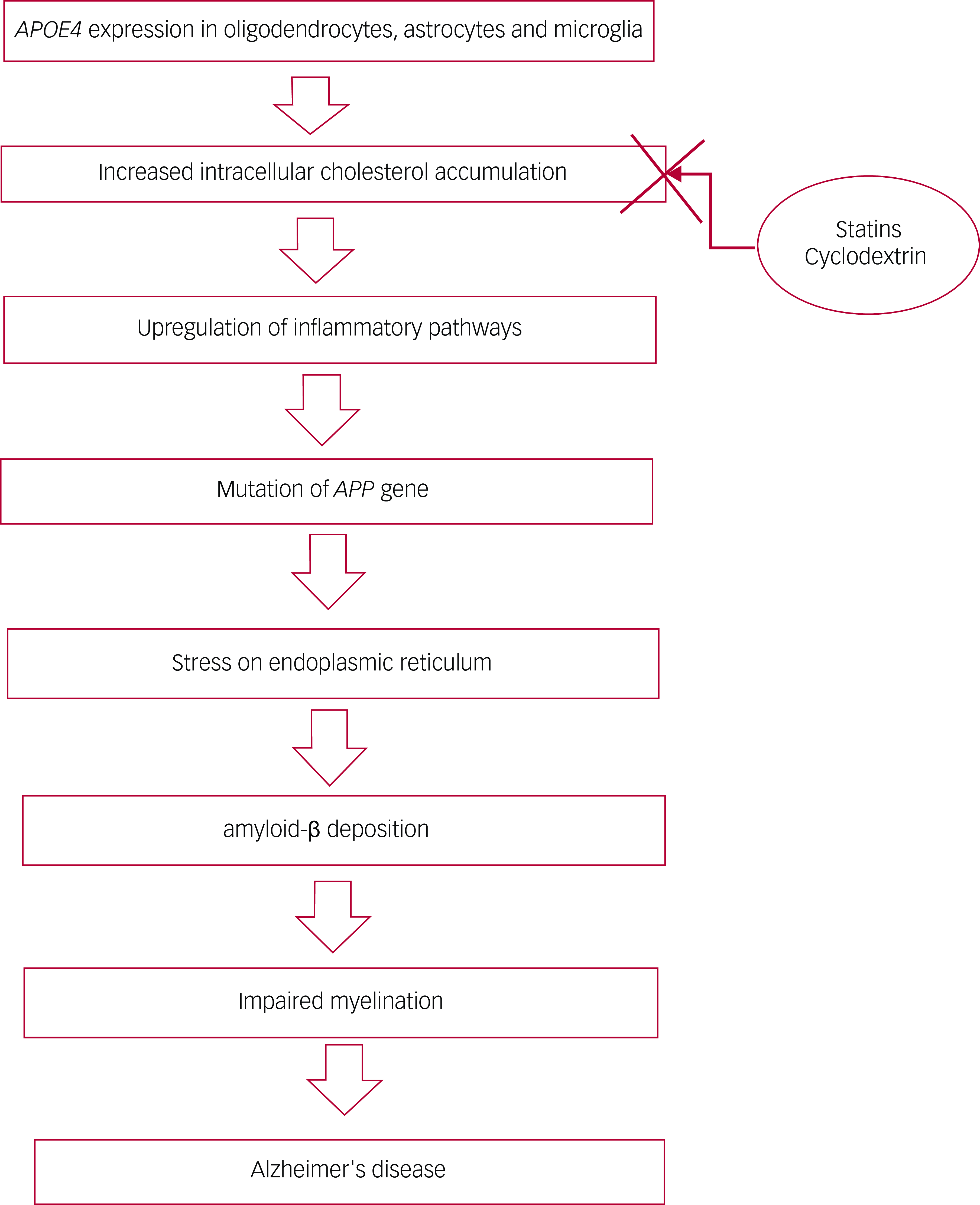
The endoplasmic reticulum is the site of protein synthesis, synthesis of lipids and storage of free calcium. Physiological stresses such as increased secretory load or pathological stress, which includes the presence of mutated proteins that cannot properly fold in the endoplasmic reticulum, cause an imbalance between the demands of protein synthesis and the capacity of the endoplasmic reticulum to synthesise the protein, leading to significant endoplasmic reticulum stress (Lin Reference Lin, Walter and Yen2008). Accumulation of lipid droplets is the common hallmark of endoplasmic reticulum stress (Blanchard Reference Blanchard, Akay and Davila-Velderrain2022). In a study of post-mortem human brains, Blanchard et al (Reference Blanchard, Akay and Davila-Velderrain2022) found that oligodendrocytes in APOE4 carriers showed upregulation of the activating transcription factor-6 (ATF-6)-mediated stress pathways compared with APOE3 carriers, suggesting that endoplasmic reticulum stress and impaired cholesterol transport could potentially have a pivotal role in intracellular cholesterol accumulation (we will return to Blanchard et al’s study below, in the sections on statins and cyclodextrins). Oligodendrocytes myelinate the CNS, and the bioavailability of cholesterol is rate-limiting for the formation and maintenance of myelin (Saher Reference Saher, Quintes and Nave2011). Alteration of cholesterol localisation and equilibrium in apoE4 oligodendrocytes may impair myelination (Blanchard Reference Blanchard, Akay and Davila-Velderrain2022). Therefore, APOE4 expression in oligodendrocytes enhances both cholesterol accumulation and impaired myelination (Blanchard Reference Blanchard, Akay and Davila-Velderrain2022). This clearly suggests a correlation between APOE4 expression in oligodendrocytes and Alzheimer’s disease, as shown in Fig. 1.
The correlation between apolipoprotein E4 (APoE4) gene expression and Alzheimer’s dementia. The administration of statins or cyclodextrins (indicated by the cross in the figure) to address increased intracellular cholesterol accumulation has the potential to interrupt this correlation (Blanchard Reference Blanchard, Akay and Davila-Velderrain2022). APP, amyloid precursor protein.

We have now established the link between high cholesterol levels and apoE4. However, the question is whether statins, which help in lowering cholesterol levels, can potentially reduce the risk of developing dementia. Before we analyse the available evidence, we need to know more about statins in the context of the evidence for or against their use.
Statins and their impact on cognition
Statins are 3-hydroxy-3-methyl-glutaryl-coenzyme A (HMG-CoA) reductase inhibitors and they can be either hydrophilic or lipophilic (Climent Reference Climent, Benaiges and Pedro-Botet2021). Lipophilic statins, such as simvastatin, fluvastatin, lovastatin, pitavastatin and atorvastatin, can enter cells directly by passive diffusion and, hence, become widely distributed in different tissues. However, hydrophilic statins, such as pravastatin and rosuvastatin, require protein transporters to enter the cell to inhibit the HMG-CoA reductase enzyme.
To explore the evidence on positive and negative impact of statins on cognition we conducted a literature search in PubMed and Research Gate. We identified 14 abstracts showing beneficial effects and 8 abstracts showing harmful effects. In this review we include 5 full-text articles supporting statins and 6 full-text articles against their use (Box 1). We excluded studies on animals. The included studies were all completed after 2012, when the FDA added reversible cognitive impairment as one of the adverse effects of statins (Marcum Reference Marcum, Vande Griend and Linnebur2012), have an adequate sample size and are statistically significant.
Included studies on the effects of statins and cyclodextrins on cognition
Statins
Supporting their use in protecting cognition:
-
• Poly et al (Reference Poly, Islam and Walther2019)
-
• Olmastroni et al (Reference Olmastroni, Molari and De Beni2023)
-
• Jamali et al (Reference Jamali, Adeyemo and Abdelgawad2023a)
-
• Ren et al (Reference Ren, Katherine Teng and Tse2024)
-
• Wang & Li (Reference Wang and Li2024)
Against their use in protecting cognition:
-
• Wagstaff et al (Reference Wagstaff, Mitton and Arvik2003)
-
• Gentreau et al (Reference Gentreau, Rukh and Miguet2024)
-
• Ye et al (Reference Ye, Deng and Wu2025)
-
• Zhu et al (Reference Zhu, Fang and Gao2022)
-
• Cai et al (Reference Cai, Wen and Li2021)
-
• Blanchard et al (Reference Blanchard, Akay and Davila-Velderrain2022)
Cyclodextrins
Supporting their potential in protecting cognition (animal studies):
-
• Yao et al (Reference Yao, Ho and Calingasan2012)
-
• Yalcin et al (Reference Yalcin, Soddu and Turunc2016)
-
• Mahjoubin-Tehran et al (Reference Mahjoubin-Tehran, Kovanen and Xu2020)
-
• Blanchard et al (Reference Blanchard, Akay and Davila-Velderrain2022)
Evidence supporting the use of statins in improving or reversing cognitive impairment
Poly et al (Reference Poly, Islam and Walther2019) completed a meta-analysis that included dementia risk in individuals using statins compared with the risk in individuals not using them. They calculated relative risk with a 95% confidence interval (CI) from hazard ratios and odds ratios. They evaluated 30 observational studies and found that statin use was significantly associated with a decreased risk of dementia (relative risk: 0.83, 95% CI 0.79–0.87, P < 0.0001). Of the 30 studies, 20 showed that statin use was significantly associated with a decreased risk of Alzheimer’s disease (relative risk: 0.69, 95% CI 0.60–0.80, P < 0.0001) and 4 studies showed no statistically significant association between statin use and vascular dementia risk (relative risk: 0.93, 95% CI 0.74–1.16, P = 0.54). These findings were fully adjusted by age group, gender and associated comorbidities, such as stroke, diabetes, hypertension and ischaemic heart disease. The analysis was also stratified by gender, duration of statin therapy and different classes of statin used. The use of statins for >3 years showed a relative risk of dementia of 0.37 (95% CI 0.19–0.73), suggesting a significantly reduced risk of dementia with long-term use. However, with a shorter duration of use (i.e. 2–3 years), the overall relative risk was 1.04 (95% CI 0.95–1.13), which is statistically insignificant. Lipophilic statins showed a relative risk of dementia of 0.84 (95% CI 0.75–0.94, P < 0.002) and hydrophilic statins showed a relative risk of 0.72 (95% CI 0.63–0.82, P < 0.0001).
Olmastroni et al (Reference Olmastroni, Molari and De Beni2023) measured risk of dementia or Alzheimer’s disease associated with statin use, based on odds ratios with 95% confidence intervals. Their systematic review included 46 observational studies: of these, 36 showed a decreased risk of dementia (odds ratio: 0.80, 95% CI 0.75–0.86) and 21 showed a decreased risk of Alzheimer’s disease (odds ratio: 0.68, 95% CI 0.56–0.81) – that is, 32% reduction in the risk of Alzheimer’s disease among statin users. Moreover, lipophilic and hydrophilic statins produced similar reductions in the risk of dementia (odds ratio: 0.83, 95% CI 0.76–0.90 and odds ratio: 0.80, 95% CI 0.71–0.89, respectively) and Alzheimer’s disease (odds ratio: 0.61, 95% CI 0.46–0.81 and odds ratio: 0.59, 95% CI 0.43–0.82, respectively).
In a cross-sectional study in which we were involved (Jamali Reference Jamali, Adeyemo and Abdelgawad2023a), participants in a cardiac rehabilitation programme underwent cognitive screening using the Addenbrooke’s Cognitive Examination III (ACE-III). The ACE-III assesses five key cognitive domains (memory, attention, verbal fluency, language and visuospatial abilities) and a higher score indicates better cognitive function. Although the sample size was small (n = 18), 14 out of the 18 participants had some signs of cognitive impairment (mean ACE-III scores: total score 90; verbal fluency 12; visuospatial abilities 16). Of the 10 participants on statins, 7 (70%) had history of cognitive decline, whereas of the 8 who were not on statins, 7 (88%) had history of cognitive decline (mean ACE-III scores: total score 83; verbal fluency 10.5; visuospatial abilities 14). However, the difference was statistically significant only in the visuospatial domain (P = 0.12). It is worth noting that in all participants statins were commenced after myocardial infarction: although the sample size was small, this could be a pointer to the cognitive protective effect of statins following myocardial infarction.
In a retrospective cohort study of people with heart failure, Ren et al (Reference Ren, Katherine Teng and Tse2024) calculated the subdistribution hazard ratio (SHR) with 95% CIs of the risk of Alzheimer’s disease, vascular dementia and unspecified dementia among statin users and non-users. The 10-year cumulative incidence of a diagnosis of any type of dementia (n = 10 031) was 11% among statin non-users and 7.3% among statin users (SHR = 0.80, 95% CI 0.76–0.84). The incidence of Alzheimer’s disease (n = 2250) was 2.6% among non-statin users and 1.5% among statin users (SHR = 0.72, 95% CI 0.63–0.82). The incidence of vascular dementia (n = 1831) was 1.8% among non-statin users and 1.5% among statin users (SHR = 0.82%, 95% CI 0.70–0.95). Lastly, the incidence of unspecified dementia (n = 5950) was 6.4% among non-statin users and 4.3% among statin users (SHR = 0.80, 95% CI 0.75–0.85).
In a cross-sectional study involving people with dyslipidaemia (n = 1062), Wang Li (Reference Wang and Li2024) found that statin use was associated with significant differences across multiple cognitive domains. For example, in older participants (>65 years), the Montreal Cognitive Assessment (MoCA) score was higher in those taking statins (n = 411; F = 8.76, P = 0.003) compared with those without statins. Statin users also demonstrated better memory (F = 6.61, P = 0.014), attention (F = 9.33, P = 0.002), executive function (F = 5.75, P = 0.017) and language (F = 9.45, P = 0.002).
Molecular mechanism of action
First, the potent anti-inflammatory property of statins induces synthesis of endothelial nitric oxide, which causes increased cerebral blood flow regulation, resulting in improved neurovascular function and, consequently, improved cognitive function (De Giorgi Reference De Giorgi, Rizzo Pesci and Rosso2023). The cholesterol-lowering effect of statins, by decreasing LDL oxidation, is linked to the reduction of atherosclerosis (Wang Reference Wang and Li2024). Second, statins can significantly suppress synthesis of tumour necrosis factor alpha (TNF-α) in microglia, which reduces neuronal damage in Alzheimer’s disease (Poly Reference Poly, Islam and Walther2019).
Evidence against the use of statins in improving or reversing cognitive impairment
We begin the discussion with the rationale behind the FDA’s decision to add reversible cognitive impairment as one of the adverse effects of statins (Marcum Reference Marcum, Vande Griend and Linnebur2012; US Food and Drug Administration 2012). It was based on an analysis of 60 cases reported between November 1997 and February 2002 suggesting that statins may be associated with cognitive impairment (Wagstaff Reference Wagstaff, Mitton and Arvik2003). Of these 60 individuals, around 30 were observed to present with cognitive impairment, particularly short-term memory loss, within 2 months of statin therapy. In most cases, cognitive impairment was reversed following discontinuation of statins (Wagstaff Reference Wagstaff, Mitton and Arvik2003). The mechanism behind this was the use of lipophilic statins (by 59 of the 60), which can cross the blood–brain barrier, and a higher dose of these lipophilic statins could worsen cognition (Schultz Reference Schultz, Patten and Berlau2018). Although the FDA consequently included cognitive impairment as a potential adverse effect of statins, it concluded that ‘Data from the observational studies and clinical trials did not suggest that cognitive changes associated with statin use are common or lead to clinically significant cognitive decline’ (US Food and Drug Administration 2012). Moreover, the evidence supporting the use of statins mentioned above, which included observational studies of greater sample size, clearly demonstrated no adverse effects on cognition of long-term use of either lipophilic or hydrophilic statins.
However, a cross-sectional study by Gentreau et al (Reference Gentreau, Rukh and Miguet2024) including 23 220 statin users and 124 282 non-users found an association between short-term statin use and lower global cognitive performance (β = −0.40, 95% CI −0.53 to −0.27, P < 0.0001). This was mostly influenced by the overcorrection of LDL levels, leading to levels falling below 1.8 mmol/L (the normal range is 2.6–3.3 mmol/L) and increased blood glucose in people with diabetes. This study found no association between long-term use of statins (8 years) and cognitive deficit (β = −0.003, 95% CI = −0.11 to −0.10, P = 0.96), owing to the positive effects of lowering C-reactive protein. This is attributed to the anti-inflammatory properties of statins, reducing inflammatory markers such as TNF-α and interleukins IL-1 and IL-6 to protect cognition. Although the initial cognitive deficit with statin use was largely due to overcorrection of LDL, it is important to highlight the significance of lipoprotein(a), or Lp(a), which is a type of LDL (see below), and the impact of statin use in Lp(a) levels.
A prospective cohort study by Ye et al (Reference Ye, Deng and Wu2025) reported that statin use (both lipophilic and hydrophilic) showed significant association with Alzheimer’s disease, when adjusted for confounding variables such as history of diabetes, stroke, cardiac disease, physical activity, smoking and alcohol status, aspirin use and socioeconomic status (hazard ratio: 1.17, 95% CI 1.06–1.29). However, they also observed that the effect of statins as a risk factor for Alzheimer’s disease was altered by genetic influences. Statins may have protective effects in APOE4 carriers compared with APOE4 non-carriers (hazard ratio: 0.72, 95% CI 0.55–0.97). This is attributed to overlapping pathways related to other classes of apolipoprotein, as mentioned below.
Lipoprotein(a) is formed by the binding of apoA to an LDL-like particle (Zhu Reference Zhu, Fang and Gao2022). High levels of Lp(a) increase the risk of atherosclerosis and thrombosis, leading to coronary artery disease, and increase the risk of dementia, particularly vascular dementia (Jamali Reference Jamali, Akinfala and Upendram2023b). An observational longitudinal study by Zhu et al (Reference Zhu, Fang and Gao2022) identified that patients on statins alone (n = 457) had high levels of Lp(a) (≥1.3 mmol/L), increasing the risk of a major adverse cardiovascular event (HR = 1.65, 95% CI = 1.03–2.56, P = 0.037).
A study by Cai et al (Reference Cai, Wen and Li2021) explored the relationship between APOE gene polymorphism and the efficacy of statins in controlling hyperlipidaemia. They found that the rate of reduction of total cholesterol and LDL and rate of increase of HDL in APOE4 non-carriers was much higher than in APOE4 carriers (P < 0.05). Although the sample size of this study was small (n = 220), it indicates the possibility that apoE4 protein potentially affects the efficacy of statins. This is further supported by a study by Blanchard et al (Reference Blanchard, Akay and Davila-Velderrain2022), which we discuss next.
As already mentioned, Blanchard et al (Reference Blanchard, Akay and Davila-Velderrain2022) reported that APOE4 expression in oligodendrocytes causes accumulation of cholesterol and impaired myelination. They reached this conclusion by testing the use of simvastatin and atorvastatin compared with cyclodextrin in potentially reducing intracellular accumulation of cholesterol in humanised APOE knock-in mice. The treatment duration was 2 weeks. The study demonstrated that apoE4 oligodendroglia cultured in the presence of statins exhibited more cholesterol staining.
Summary
The 11 studies outlined above show that although statins have neuroprotective actions owing to their anti-inflammatory properties, this neuroprotective effect is to a certain extent negated by the involvement of other variables, such as apoA, Lp(a) and vascular risk factors such as high blood glucose.
Cyclodextrins and their impact on cognition
Studies identified in our literature search on statins revealed the possibility that another molecule, cyclodextrin, might also have neuroprotective effects in the brain. Cyclodextrins are a group of polysaccharide compounds used to extract cholesterol from cultured cells (Yao Reference Yao, Ho and Calingasan2012), and this action might explain their potentially beneficial effects.
Cholesterol
Cholesterol homeostasis is regulated by sterol regulatory element-binding proteins (SREBPs), and liver X receptors (LXRs) regulate the expression of genes that control the uptake, synthesis and transport of cholesterol (Yao Reference Yao, Ho and Calingasan2012). SREBPs control the expression of genes encoding HMG-CoA reductase and HMG-CoA synthase, which are essential components for cholesterol synthesis. LXRs activate genes encoding the ATP-binding cassette subfamily A/G transporters (ABCA/Gs), which control cholesterol outflow across the plasma membrane to apolipoproteins. ABCA1 plays a crucial role in apoE lipidation and suppression of amyloid-β generation. Moreover, stimulation of LXRs results in behavioural improvement and removal of fibrillar amyloid-β in transgenic mouse models expressing mutant amyloid precursor protein (APP). Disruption of ABCA1 causes increased levels of insoluble amyloid-β and accumulation of amyloid plaques.
The evidence base
Since we did not identify any studies on humans, we include here four animal studies (Box 1).
Yao et al (Reference Yao, Ho and Calingasan2012) noted studies showing that in transgenic mouse models of the lipid storage disease called Niemann–Pick type C1 (NPC1), subcutaneous administration of cyclodextrins improved abnormal cholesterol metabolism and prevented neurodegenerative changes in NPC1 mice. They also pointed to the similarities in the molecular pattern of NPC1 and Alzheimer’s disease, such as neurofibrillary tangles and lysosomal system dysfunction. They therefore conducted a study to examine the hydroxypropyl form of β-cyclodextrin (HP-β-CD) in mice by subcutaneous injection of HP-β-CD twice weekly for 4 months. The study showed that HP-β-CD reduced cell membrane cholesterol and amyloid-β production in a cell model over-expressing APP, improved learning and memory in the mice, significantly reduced amyloid-β plaque load and microgliosis, reduced abnormal lysosomal accumulation and raised the levels of ABCA1, resulting in increased apoE lipidation and accelerating amyloid-β clearance. Moreover, the 4-month subcutaneous administration of HP-β-CD improved memory deficits, suggesting therapeutic potential for the treatment of Alzheimer’s disease. This demonstrates the potential neuroprotective role of cyclodextrins in central apoE.
Excitotoxicity is one of the contributing factors to neuronal death, which is associated with acute or chronic neurodegenerative disorders such as Parkinson’s disease, amyotrophic lateral sclerosis, Huntington’s disease and Alzheimer’s disease (Yalcin Reference Yalcin, Soddu and Turunc2016). Excessive activation of N-methyl-d-aspartate (NMDA) receptors results in excitotoxicity, enhancing the vulnerability of neurons consistent with Alzheimer’s disease (Yalcin Reference Yalcin, Soddu and Turunc2016). Hence, memantine, an NMDA receptor antagonist, is recommended for Alzheimer’s disease (NICE 2018). HP-β-CD has shown neuroprotective effects by disrupting NMDA-dependent glutamate transmission by sequestering cholesterol from postsynaptic densities, suggesting the potential role of cholesterol reduction for NMDA receptor redistribution and eventually reducing excitotoxicity (Yalcin Reference Yalcin, Soddu and Turunc2016). Yalcin et al (Reference Yalcin, Soddu and Turunc2016) illustrated that nasal administration of HP-β-CD in rats reduced excitotoxicity by reducing the levels of oxidative stress, suggesting its potential role as an antioxidant.
Cyclodextrins are available in three forms, α, β and γ. Of these, β-CD has shown a high complex-forming capacity with lipids, where HP-β-CD increased cholesterol outflow and prevented atherogenesis by inducing lipid depletion of LDL and decreasing the susceptibility of LDL to oxidation. In a review article, Mahjoubin-Tehran et al (Reference Mahjoubin-Tehran, Kovanen and Xu2020) report that HP-β-CD has shown promising results in animal studies reducing atherosclerotic plaque size by reducing oxidative stress and inhibiting cellular cholesterol uptake and accumulation. Therefore, there is a clear indication that cyclodextrins can potentially reduce atherosclerosis directly without the influence of other variables, such as diabetes, high Lp(a) or obesity. This also indicates the possibility of cyclodextrins acting on peripheral apoE to reduce the risk of dementia, which includes Alzheimer’s disease, vascular dementia and mixed dementia.
Finally, Blanchard et al’s (Reference Blanchard, Akay and Davila-Velderrain2022) study comparing statins with cyclodextrin found that apoE4 oligodendroglia treated with cyclodextrin evidenced reduced cholesterol staining (P = 0.0092) as well as a reduction in the accumulation of other lipid compounds, such as triglycerides. A further 6-week treatment with cyclodextrin also improved myelination (P = 0.0274). Cyclodextrin also improved learning and executive function in old APOE4 mice when treated for a further 8 weeks.
Limitations of this review
The studies related to statins included in this review are all in humans. However, the studies related to cyclodextrins are all in animals. Therefore, further studies on the efficacy of cyclodextrins in humans are required. Second, since this is a descriptive review, some relevant articles may be missing. A systematic review with meta-analysis would be beneficial. Third, apart from comorbid physical disorders such as diabetes (as mentioned above), comorbid mental disorders can also adversely affect cognition. This review did not explore the impact of statins on cognition in the context of mental comorbidities such as depression or schizophrenia.
In conclusion, there is clear evidence suggesting the neuroprotective effects of statins due to their LDL- and triglyceride-reducing properties, in addition to their anti-inflammatory properties. However, a number of factors can potentially limit their positive effects on the central and peripheral nervous systems. Studies mentioned here have shown that apoE4 can adversely affect the efficacy of statins. Moreover, other variables, such as high levels of Lp(a) and glucose, can also limit the neuroprotective action of statins.
This brings us to the question of whether an alternative treatment is potentially more efficacious than statins. Cyclodextrins have shown some glimmer of hope that they can potentially negate the action of apoE4 by reducing amyloid-β plaque formation and decreasing cholesterol levels centrally and peripherally, reducing the risk of atherosclerosis. Moreover, if administered for longer, they also improve various cognitive domains, including learning and executive function. However, studies thus far have been conducted on animal models, and there is limited evidence on the mode, dose, frequency and duration of administration, which requires longer-term studies. As mentioned above, cyclodextrins have been administered subcutaneously and intranasally; therefore, they have good potential in terms of feasibility and adherence.
Given the potential role of statins (hydrophilic and lipophilic) and cyclodextrins in reducing APOE4 expression (Fig. 1), it would be useful to explore their respective neuroprotective potential. Therefore, further studies are required to determine whether statins or cyclodextrins, with their anti-inflammatory and cholesterol-lowering properties, could potentially reduce APOE4 expression, resulting in improvement of memory deficits in people with Alzheimer’s disease, vascular or mixed (Alzheimer’s and vascular) dementia.
MCQs
Select the single best option for each question stem
-
1 Which of the following statements is true regarding apolipoprotein E (apoE)?
-
a apoE produced in the liver is involved in upregulating inflammatory and immune-related pathways in neurons
-
b alteration of cholesterol localisation and equilibrium in apoE4 oligodendrocytes may impair myelination
-
c apoE4 decreases the ability of cholesterol to cause atherosclerosis
-
d apoE2 is mostly found in triglyceride-rich particles such as chylomicrons and very low-density lipoproteins
-
e the function of apoE in the CNS is independent of cell type.
-
-
2 Which of the following statements is false regarding the risk of Alzheimer’s dementia?
-
a apoE4 contributes to tau hyperphosphorylation, which is one of the causes of Alzheimer’s disease
-
b apoE is involved in the distribution of cholesterol and phospholipids throughout the body
-
c APOE2 is a significant genetic risk factor for Alzheimer’s disease
-
d apoC3 increases the risk of hypertriglyceridaemia
-
e apoB is a potential biomarker for raised LDL, a risk factor for cerebrovascular disease.
-
-
3 There is conflicting evidence regarding the effect of statins on cognitive impairment: which of the following statements is false?
-
a the FDA added reversible cognitive impairment as one of the adverse effects of statins in 2012
-
b studies suggest that long-term use of statins, typically for >3 years, is associated with reduced risk of development/progression of dementia
-
c lipophilic and hydrophilic statins have shown a similar reduction in the risk of dementia
-
d statins have anti-inflammatory properties, which induce endothelial nitric oxide synthesis and increase cerebral blood flow
-
e statins can increase the expression of TNF-α synthesis in microglia, which reduces neuronal damage in Alzheimer’s disease.
-
-
4 Evidence suggests that cyclodextrin reduces the risk of dementia: which of the following statements best supports this statement?
-
a hydroxypropyl β-cyclodextrin disrupts NMDA-dependent glutamate transmission
-
b subcutaneous administration of cyclodextrin improved abnormal cholesterol metabolism and prevented neurodegenerative changes in transgenic mouse models of the lipid storage disease
-
c hydroxypropyl β-cyclodextrin has been associated with reduction in oxidative stress and inhibition of cellular cholesterol uptake in animal studies
-
d studies have established that all of the above are correct
-
e none of the above has been established by any studies.
-
-
5 As regards the neuropathology of dementia, which of following is false?
-
a it has been associated with APOE4 expression in oligodendrocytes, astrocytes and microglia
-
b it involves increased intracellular cholesterol accumulation
-
c excessive inhibition of NMDA receptors enhances the vulnerability of neurons, consistent with Alzheimer’s disease
-
d it has been associated with mutation of amyloid precursor protein (APP) gene.
-
e none of the above.
-
MCQ answers
-
1 b
-
2 c
-
3 e
-
4 d
-
5 c
Data availability
Data availability is not applicable to this article as no new data were created or analysed in this study.
Author contributions
Q.J.: conceptualisation, literature search, analysis and manuscript writing. C.O.: critical review of the article, learning objectives and MCQs.
Funding
This research received no specific grant from any funding agency, commercial or not-for-profit sectors.
Declaration of interest
None.



eLetters
No eLetters have been published for this article.