1. Introduction
In recent years, the relationship between corporate governance, legal systems and innovation has been the focus of growing attention by empirical economists. Institutional differences and similarities across countries have been found to significantly influence aggregate innovation patterns (e.g. Vatiero, Reference Vatiero2017), especially during the unprecedented development of intellectual property rights protection over the last three decades (Gurpinar, Reference Gurpinar2016). In particular, the relationship between innovation performance and labour laws has been analysed in a small bunch of empirical studies by considering a complex bundle of legal norms commonly referred to as employment protection legislation (EPL), which relates mainly to dismissal restrictions and to the availability of temporary contracts (Acharya et al., Reference Acharya, Baghai and Subramanian2013, Reference Acharya, Baghai and Subramanian2014; Griffith and Macartney, Reference Griffith and Macartney2014). These studies point to some positive influences of stringent laws governing dismissal of employees on countries’ innovation outcomes. Other important dimensions of labour law (such as employee representation frameworks) have been addressed only incidentally by empirical legal research and are generally deemed to be unrelated to aggregate innovative performance (e.g. Acharya et al., Reference Acharya, Baghai and Subramanian2013).
The aim of this paper is to improve on this literature as regards the institutional perspective, by exploring the role played by institutional complementarities between labour laws. More specifically, we will study the possible joint effect of EPL and employee representation legislation (hereafter ERL) on the patenting activity of firms in the manufacturing sectors. While the economic effects of institutional complementarities between macro-spheres of the political economy (typically, labour and financial markets) have been emphasized as a relevant issue in shaping the innovation patterns of corporations in capitalist economies (see, e.g. Amable, Reference Amable2000 and Aoki, Reference Aoki2001), a deeper focus on the relationship between specific legal institutions within the labour regulation domain is still missing.
The motivating intuition of our study is that employee representation laws, which concern the institutional devices shaping the worker's rights to participate in business management, may contribute to influencing the innovation incentives of firm members (primarily, workers and shareholders) only in conjunction with given regulatory schemes for dismissal. If employee representation rules define the worker's right to voice and to claim a larger share of the extra profits generated by an innovation and if discharge laws determine the firing (i.e. hold-up) powers of the employer, then it is the complementarity between these two spheres of labour law that shapes the incentives of both workers and shareholders to invest in firm-specific and uncertain projects, such as innovative productions, in a context of incomplete contracts. In particular, where the labour law does not impose significant exit costs for employers, the latter may renegotiate ex-ante agreements with workers over revenue sharing by threatening dismissal, even in the presence of relatively strong ERL, thereby reducing innovative effort by employees.
The panel regression estimates presented in this paper, obtained by analysing country-sector panel data for the US, UK, India, France and Germany over the 1977–2005 period and 21 two-digit manufacturing sectors, show that improved employee representation laws in the presence of stricter firing restrictions are, in fact, associated with higher aggregate innovation output and that the magnitude of this empirical relationship is larger in those sectors where the human capital contribution to production is higher. Although causal interpretation of these estimates should be made with caution, we interpret our findings as possibly corroborating the argument that greater employee voice (i.e. stronger ERL) under legal protection against hold-up risks (i.e. stricter EPL) may stimulate the workers’ incentive to contribute to innovation by limiting the ability of shareholders to unduly retain all the rents generated by successful projects. Even though stricter EPL and ERL may also exert some detrimental impact on working effort (for example, through shirking and employee opportunism) and on employers’ financial effort, our estimates seem to suggest that the positive innovation incentives of improved workers’ representation rights in the presence of relatively strong protections against unjust dismissal are likely, at least, to counterbalance possible negative effects, especially in human-capital-intensive sectors.
These preliminary findings, based on aggregate correlations, require further tests if they are to be unambiguously interpreted in a causal sense. However, they are also suggestive and stimulating, both for the varieties of capitalism approach to the analysis of economic institutions (Hall and Soskice, Reference Hall, Soskice, Hall and Soskice2001), which tends to exclude significant positive effects of more stringent labour laws in liberal market economies, and for the legal policy-making, which may need to consider reconciling employee voice to the business management and worker protections against hold-up as a possible way to improve the organizational structures of innovative firms.
The paper proceeds as follows. In section 2, we summarize the related literature and introduce our research hypothesis. In section 3, we describe the data to be used in the empirical analysis and provide a picture of how labour regulatory frameworks are structured in the countries considered for the econometric study. In section 4, we present our empirical exercise and summarize the main findings, whose implications for both future research and policy-making are discussed in the concluding section 5.
2. Theoretical motivation
The idea that employment regulations may impact on aggregate economic outcomes is long-standing. The literature has explored several possible channels linking labour laws and the economic performance of firms and countries. Among others, Autor et al. (Reference Autor, Kerr and Kugler2007) and Cingano et al. (Reference Cingano, Leonardi, Messina and Pica2016) find that mandated employment protection may alter production techniques and induce capital investment distortions. Bird and Knopf (Reference Bird and Knopf2009) show that wrongful-discharge protections reduce firm profitability by hampering productive efficiency. Garibaldi (Reference Garibaldi1998), Mortensen and Pissarides (Reference Mortensen and Pissarides1999) and Caballero et al. (Reference Caballero, Cowan, Engel and Micco2013) emphasize how dismissal restrictions tend to reduce worker flows and labour reallocation, thereby raising firms’ adjustment costs. Riphahn (Reference Riphahn2004) and Ichino and Riphahn (Reference Ichino and Riphahn2005) highlight the link between worker protection and possible employee shirking. Finally, Saint-Paul (Reference Saint-Paul2002) and Samaniego (Reference Samaniego2006) maintain that more stringent dismissal laws induce firms to specialize in mature and stable sectors in order to reduce the impact of unexpected market variations.
The interest surrounding the relationship between labour laws and innovation is relatively recent and generally focuses on EPL, including various forms of dismissal restriction. Griffith and Macartney (Reference Griffith and Macartney2014) use an overall index of EPL, which is a weighted sum of a set of sub-indicators for regular and temporary contracts and collective dismissals and innovation data from a sample of around 2,200 multinational innovative firms over the 1997–2003 period, and find that EPL may spur incremental patenting activity. Acharya et al. (Reference Acharya, Baghai and Subramanian2013) and Acharya et al. (Reference Acharya, Baghai and Subramanian2014) use, respectively, cross-country variation in dismissal regulations and the staggered adoption of wrongful-discharge laws across US states and find that dismissal restrictions do spur innovation. In this body of empirical literature, the role played by employee representation legislation is considered only incidentally. While Griffith and Macartney (Reference Griffith and Macartney2014) and Acharya et al. (Reference Acharya, Baghai and Subramanian2014) do not measure the possible effect of representation laws, Acharya et al. (Reference Acharya, Baghai and Subramanian2013) empirically test the relationship between innovation and a set of labour indicators covering the regulation of dismissal and employee representation devices (which include the workers’ right to collective bargaining, board membership and unionization), pointing to representation laws having a non-significant effect. A notable exception is the study of Kraft et al. (Reference Kraft, Stank and Dewenter2011), focused on the 1976 German Co-determination Act, which introduced full parity of labour representation on the supervisory board. In their country-specific study, the patenting activity of a sample of German firms before and after the reform is compared, showing that co-determination has no negative impact on innovativeness, while, if anything, a positive effect can be estimated.
This paper aims to improve on this line of research by analysing institutional complementarities between employee representation laws and standard job security provisions, which are considered, in the available literature, as two independent (and, to some extent, alternative) mechanisms to protect employee interests in the firm.
We tackle this issue by considering how the production of technological innovations may be influenced both by the degree of asset specificity (Williamson, Reference Williamson1985) and by the distribution of residual decision rights between shareholders and employees in the firm, namely the division of the surplus derived from a successful innovation, as in a Grossman–Hart–Moore (GHM) perspective (Grossman and Hart, Reference Grossman and Hart1986; Hart and Moore, Reference Hart and Moore1990).
In an innovation process, while employers make a project-specific financial effort, employees are required to make a significant learning effort. This may take the form of acquiring and elaborating new information, understanding firm-specific technical problems and organizational schemes, and exchanging information with colleagues. All these activities have little value outside the relationship with the firm, and may also make the worker less capable if adapting her skills to other firms, thus reducing her external options and further increasing the opportunity costs associated with her investment. It is, therefore, important that the institutional arrangement through which employer and employee interact both favours the continuity of the relationship, to allow the two parties to fully contribute to the development of the production process with their specific investments, and provides effective mechanisms for workers and shareholders to claim their due share of the surplus. This is particularly true in the production of technological innovations, which may require long periods (often, many years) to be successfully completed, in the presence of significant technological uncertainty. In principle, long-term commitments would be easy to implement in a world of complete labour contracts, where each party's obligations in every possible state of the world can be foreseen and specified in a formal contract. This, however, is unlikely to happen in knowledge-intensive and innovative firms, where considering all possible future contingencies is unfeasible and contracting for details of every conceivable eventuality is too costly.
In this context, EPL and employee representation laws, when taken in isolation, may have both positive and negative effects on innovation. On the one hand, stricter EPL may sustain longer employment relationships, thereby improving the quality of training and human capital development (Arulampalam and Booth, Reference Arulampalam and Booth1998; Franceschi and Mariani, Reference Franceschi and Mariani2016; Michie and Sheehan, Reference Michie and Sheehan2003; Pieroni and Pompei, Reference Pieroni and Pompei2008), but may also favour shirking (Ichino and Riphahn, Reference Ichino and Riphahn2005; Riphahn, Reference Riphahn2004). On the other, a stricter ERL may induce higher working effort but also reduce financial effort, as it reinforces the ability of unions to extract undue rents at the expense of the shareholders (see, generally, Menezes-Filho and Van Reenen, Reference Menezes-Filho, Van Reenen, Addison and Schnabel2003).
While the possible direct economic effects of EPL and ERL are relatively straightforward, their joint impact on aggregate innovation outcomes has never been framed and measured. Our motivating intuition is that, in a world of incomplete contracts, ERL alone is insufficient to define the distribution of control rights between the employee and the shareholder, if the latter has an ultimate right to fire the worker without the worker receiving her share of the innovation revenues. In other words, if the shareholder can renegotiate ex-ante agreements once a successful innovation has been made in order to extract undue rents at the expense of the worker by threatening dismissal, stronger ERL is unlikely to spur innovative effort by employees. The incentive effects of ERL on innovation, on the contrary, will be significant only provided that the shareholder cannot threaten to fire the worker after the innovation revenues are realized, i.e. where labour law imposes sufficiently high (monetary or non-monetary) costs of exit on the side of the employer.
To illustrate this problem in simple terms, let us consider employee representation and discharge laws as two separate spheres of labour regulation and analyse their joint effects on the innovative output of a stylized knowledge-intensive firm, composed by workers and shareholders who both make relation-specific investments in the presence of contractual incompleteness. The firm produces only one good, which may have an average quality or an improved quality (in this case, it can be referred to as an innovation). The production of the innovation is an uncertain process, i.e. the delivery of an innovation cannot be contracted ex ante. In particular, the innovation can be stylized as a probability function increasing in the worker's learning effort and the employer's financial effort, both to be considered as firm-specific and sunk investments. If the innovation process is successful, the innovative product is patented. While the property of the patent remains in the hands of the employer, workers and shareholders can bargain over the division of the rents generated from selling the good on the market.Footnote 1 Without institutional devices binding parties’ behaviour, the worker may be tempted, on the one hand, to hold the employer up once the latter has undertaken his specific financial effort, to obtain a higher share of innovation revenues. On the other hand, the employer may force the workers to renegotiate ex-ante wage agreements downward by threatening dismissal. If both parties anticipate the risk of an ex-post opportunistic action by the counterpart, they may refuse to undertake the specific investments ex ante. Now, let us introduce labour laws and consider different possible scenarios, depending on whether employee representation rights and dismissal constraints are weak (i.e. the employer retains full control rights over revenues sharing and faces low dismissal costs) or strong (i.e. workers’ voice powers and safeguards against unjust dismissal are strong). Where strict dismissal regulation and weak employee representation laws are combined, the employer is unable to force the worker to renegotiate ex-ante agreements by threatening dismissal, because dismissal is virtually impossible, while the workers have little decision-making power and are not allowed to participate in revenue sharing. Thus, while the employer has an incentive to make significant financial investments, the workers are likely to exert low learning effort (due also to possible shirking, given firing restrictions). With strong dismissal and employee representation regulations, the workers are both protected against possible hold-up by the employer and have voice powers through which they may claim larger innovation shares. In this case, the shareholders’ financial contribution and the workers’ learning effort will be, respectively, reduced and increased with respect to a system with low EPL and strong ERL. Finally, under a weak dismissal regulation, with both weak and strong employee representation laws, the employer will always have hold-up powers, thus inducing a high financial effort by shareholders and a low learning effort by employees. This very simplified framework does not allow us to identify which institutional system maximizes firms’ overall innovation incentives. Nonetheless, it may suggest that, in knowledge-intensive productions, an institutional setting that sustains workers’ learning effort, even at the price of lower financial investments, may positively contribute to improving innovation performance; this is especially true in sectors where human capital is a key input and where the payoff that workers can obtain from participating in an innovation project and its revenues is higher than the utility from shirking.
Other papers have studied the incentives for innovation using an institutional approach. Holmstrom (Reference Holmstrom1989) conceptualizes innovation decisions as investment decisions and proposes an explanation for why incentive schemes that motivate innovation must exhibit substantial tolerance for failures. He argues that performance measures are weak in innovative firms and, therefore, the most efficient forms for organizing innovative activity in the private sector are those motivating working effort through higher discretion and less centralized decision making. In the same vein, Manso (Reference Manso2011) shows that commitment to a long-term compensation plan, job security and feedback on performance are essential ingredients for motivating innovation. For managers especially, profit-sharing mechanisms are likely to encourage innovative business strategies. An optimal contracting perspective is also taken by Aghion and Tirole (Reference Aghion and Tirole1994), who argue that, in an incomplete contract framework where the marginal efficiency of the working effort is relatively higher than that of the financial effort of shareholders, control rights should be allocated to workers.Footnote 2
We add also to this literature, by proposing that institutional complementarities between labour laws may shape the internal organization of innovative firms, thus influencing the innovation incentives of workers and corporate financers. However, the extent to which this institutional dimension contributes to explain differences in aggregate innovation performance across economic systems, depending also on their sectoral specialization, remains an empirical question and is left to the econometric exercise presented below.
3. Data
The purpose of our empirical study is to estimate the effect of employment representation laws on innovation activity under different schemes of dismissal law. To this end, we conduct an econometric investigation by means of a cross-country industry panel regression analysis, in which a sectoral measure of innovation output is allowed to react to the interaction between ERL and EPL. We first describe the data and then present the identification strategy and the model specification.
Labour laws
We measure labour regulations using the labour laws data provided by Deakin et al. (Reference Deakin, Lele and Siems2007). The data cover the UK, US, Germany, France and India for the period 1970–2005. Although only five countries are considered, they represent significant national economies as three of them are ‘parent’ systems, one is the world's largest economy, and the other is the largest democracy.
Deakin et al.’s legal coding is based on the ‘functional equivalents’ concept. According to this approach, the relative importance of a given legal variable may differ across countries, while, on the other hand, different legal mechanisms (such as legal versus non-legal sources of norms) may play a functionally similar role in different systems. Consistent with the theory of functional equivalents, Deakin et al.’s data encompass several aspects of labour institutions, by taking into account both positive law and self-regulatory mechanisms, including collective agreements, which may achieve the same effect as a rule of law in certain countries. Moreover, these data take into account differences between formally binding or mandatory laws and default rules.
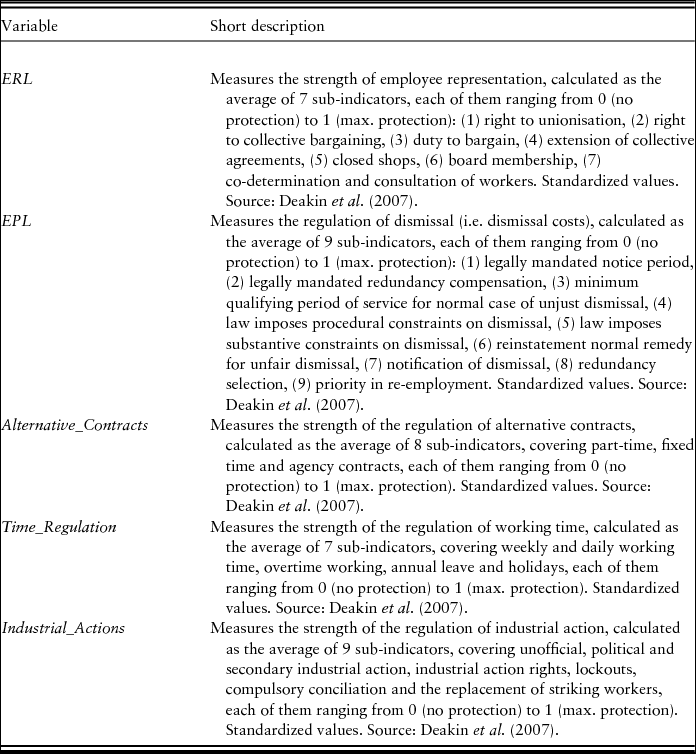
In particular, in our analysis, we employ an indicator of ERL that measures the strength of employee representation as proxied by a set of seven sub-indicators covering the right to form trade unions, the right to collective bargaining, the employer's duty to bargain with unions, the extension of collective agreements to third parties at the national or sectoral level, the regulation of closed shop entry, the workers’ right to nominate board-level directors, and the legal power of co-decision making given to works councils. The overall ERL index is calculated as the average of these seven sub-indicators and ranges from 0 (weakest regulation) to 1 (most stringent regulation). In our econometric analysis, we refer to the ERL index with ERLc,t at a country–year level, c being the country and t the year.
As for firing restrictions, we use Deakin et al.’s index of regulation of dismissal (referred to as EPLc,t in our empirical study), constructed by combining a set of variables on a legally mandated notice period and redundancy compensation, a minimum qualifying period of service for a normal case of unjust dismissal, procedural constraints on dismissal, remedies for unjust dismissal, notification of dismissal, rules of redundancy selection and of priority in re-employment. EPLc,t also ranges from 0 (weakest regulation) to 1 (most stringent regulation).
Moreover, as controls for the larger labour law environment, we also include a set of three indicators in the regression analysis, measuring the regulation of alternative contracts (Alternative_Contractsc,t), the regulation of working time (Time_Regulationc,t) and the regulation of industrial action (Industrial_Actionsc,t), again obtained from Deakin et al. (Reference Deakin, Lele and Siems2007). A short description of the labour law variables is provided in Table 1.
Description of the labour laws indicators and other labour regulation controls

From these data, a significant cross-country heterogeneity of national labour regulations emerges. While the relatively more stringent EPL provisions of Anglo-Saxon economies (primarily, the UK and the US) are well known and documented, the regulation of employee representation structures across the considered countries is more articulated. Employee representation rights are generally structured into three levels pertaining to information, consultation and co-determination. Information and consultation rights tend to be protected, to different extents, both in Europe and North America. Co-determination rights, which apply where the consent of the employees is a mandatory requirement for undertaking specific decisions, are basically absent in the UK and US and tend to have stronger protection in continental Europe. In France, two members of the enterprise committee have the right to attend board meetings in private sector companies but without effective co-management powers. In Germany, co-determination has developed to a greater degree and employees are given seats on a board of directors or on a supervisory board. Moreover, in both France and Germany, the right to unionization is protected by the constitution. In Germany, however, employees are represented mainly by the works council and trade union density has been declining over the last decades (OECD, 2015). In the UK, the formation of trade unions is allowed, and unions are considered as a matter of public interest, but many companies in which trade unions are absent have no employee representation. In the US, although the Constitution allows unions to represent workers, the right to form trade unions is not recognized and the law does not encourage trade unionism.
The effective implementation of worker representation rights is also affected by the employer's duties to bargain or to reach an agreement with unions, works councils or other organizations of employees. On this matter, again, significant differences emerge across national legislation. Germany has no employer duty to bargain as such in its labour law (however, once collective agreements are reached, they are generally extended to third parties at the national or sectoral level). France enacted a duty to bargain at workplace level in the 1982 ‘Lois Auroux’ (an extension of sector-level collective agreements by legislation, moreover, is a long-standing practice in France, dating back to 1936). UK and US laws, finally, lay down duties to bargain, without providing for a collective agreements extension to non-signatory workers or unions.
Innovation
We measure economy-wide innovation outcomes at a country-sector level by means of the yearly number of successful patent applications (in the business enterprise sector) to the European Patent Office (EPO). Patent applications filed at the EPO are an attractive measure of innovative activity because they provide information of an administrative nature under well-defined rules that are independent of the location of the patent applicant. Patent data, moreover, have been widely used by related studies (Acharya et al., Reference Acharya, Baghai and Subramanian2013, Reference Acharya, Baghai and Subramanian2014; Griffith and Macartney, Reference Griffith and Macartney2014; Kraft et al., Reference Kraft, Stank and Dewenter2011).Footnote 3
EPO data are available for a large sample of countries and industries from 1977 onwards. In our empirical study, we match EPO data with Deakin et al.’s labour laws data and obtain a final sample of five countries (UK, US, Germany, France and India) over the 1977–2005 period and 21 two-digit manufacturing sectors. Our final innovation outcome variable is the standardized per-capita number of yearly manufacturing business patent applications (i.e. the one-year difference of total patent levels) measured at a country–sector–year level and denoted by Innovationc,m,t, with c being the country, m the sector and t the year.
4. Econometric evidence
Empirical modelling of labour laws complementarity and innovation
The key idea of our research hypothesis is that ERL effects on innovation output are conditional on the stringency of firing restrictions. Thus, if the average innovation probability reacts more intensively to working effort than to the financial effort, the effect of ERL will be positive and significant only when firing costs are high. Under costless firing, the impact of ERL is expected to be low or insignificant. As the centrepiece of our identification strategy, this motivates the estimation of ERL effects by means of an explanatory variable that measures the strength of ERL conditionally on the level of the firing costs. Specifically, we first construct three dummy variables measuring alternative dismissal regulation regimes, depending on whether EPLc,t is higher or lower than given quantiles of its distribution. In particular, we consider the following three dummies: EPL_lowc,t (dismissal costs are low or absent), which equals 1 if EPLc,t is lower than (or equal to) the twenty-fifth percentile and otherwise equals 0, EPL_medc,t (dismissal costs are medium), which equals 1 if EPLc,t is higher than the twenty-fifth and lower than (or equal to) the seventy-fifth percentile and otherwise equals 0, and EPL_highc,t (dismissal costs are high) which equals 1 if EPLc,t is higher than the seventy-fifth percentile and otherwise equals 0. We then construct three variables measuring ERL conditional on dismissal costs, given by the product between our basic ERLc,t indicator and the three EPL dummies, i.e. ERLc,t × EPL_lowc,t, ERLc,t × EPL_medc,t and ERLc,t × EPL_highc,t. These three variables (ERLc,t × EPL_lowc,t being the benchmark) will be employed as the main regressors of interest in our cross-country estimation analysis.
A second issue to be tackled is the very large number of country-level variables that may affect innovation while being correlated with both ERL and EPL, many of which are unlikely to be observable or measurable. Examples include country business cycles, firm demography, the quality of physical and institutional infrastructures, higher education levels and capital market development. The presence of unobservable time-varying country-level omitted variables correlated with changes in labour laws may be a source of endogeneity and may confound our results. To address this endogeneity concern, we exploit the country–sector–year level variation of the data in some model specifications, to enable the inclusion of country × year fixed effects. These fixed effects absorb variation at the country–year level and allow us to account for sources of omitted variables for each country–year pair in our sample. While the country–sector–year level specification allows us to circumvent a source of possible endogeneity, it also introduces sectoral heterogeneity in the model. In our context, sectoral heterogeneity may be relevant to the extent that countries show a different propensity to innovate across sectors. As Acharya et al. (Reference Acharya, Baghai and Subramanian2014) show, labour laws may have relatively more impact on innovation in industries that exhibit a greater propensity to innovate (because, in such industries, incomplete contracting problems are relatively more intense). We tackle this issue by measuring the one-year lagged sectoral innovative specialization of countries (Specializationc,m,t −1) and interacting it with our one-year lagged interaction terms between ERL and EPL. Specifically, Specializationc,m,t −1 is measured as the ratio between the country–sector–year innovation outcome and the total country–year innovation, as follows: Specializationc,m,t −1 = Innovationc,m,t −1/Innovationc,t −1, where Specializationc,m,t −1 indicates the sectoral specialization level for country c and sector m in the year t−1. All the explanatory variables are one-year lagged to avoid reverse causality. Note that, although the interaction of the ERL indicators with Specializationc,m,t −1, in the model specifications where it is included, allows us to specify the regression equation at a country–sector–year level so as to circumvent the possible omitted variable bias, it is not, however, compelling to obtain identification (through alternative empirical models, we will also show that the estimated ERL effects are not driven by the interaction with Specializationc,m,t −1).
Moreover, sectors may be characterized by industry-specific time-invariant unobservable factors and by different time-variant innovation patterns (possibly due to sector-specific technological shocks). We capture time-variant sectoral innovation patterns by using a first-order autoregressive component, that is, Innovationc,m,t −1 (it accounts for direct-level effects of lagged sectoral innovation activity), and, finally, we introduce sectoral fixed effects in order to absorb time-constant sector-specific heterogeneity.
The final baseline regression model we implement is:
 $$\begin{eqnarray}
&&Innovatio{n_{c,m,t}} = {b_0} + {b_1}ER{L_{c,t}}_{ - 1} \times EPL\_lo{w_{c,t}}_{ - 1}(\times Specializatio{n_{c,m,t}}_{ - 1}) \nonumber \\
&&\quad+\, {b_2}ER{L_{c,t}}_{ - 1} \times EPL\_me{d_{c,t}}_{ - 1}( \times Specializatio{n_{c,m,t}}_{ - 1}) \nonumber\\
&&\quad+\,{b_3}ER{L_{c,t}}_{ - 1} \times EPL\_hig{h_{c,t}}_{ - 1}( \times Specializatio{n_{c,m,t}}_{ - 1}) \nonumber\\
&&\quad+ \,{b_4}Specializatio{n_{c,m,t}}_{ - 1} + {\rm{ }}{b_5}Innovatio{n_{c,m,t}}_{ - 1} + Labour\_Control{s_{c,t}}_{ - 1} \nonumber\\
&&\quad+\, {b_c} + {b_m} + {b_t}\left( { + {b_{c,t}}} \right) + {e_{c,m,t}}
\end{eqnarray}$$
where b 0 is the model constant, b c, b m, b t and b c,t are country, sector, time and country × year fixed effects respectively, e c,m,t are the residuals, and b 2 and b 3 (ERLc,t −1 × EPL_lowc,t −1 being the benchmark) are the parameters of interest. Labour_Controlsc,t −1 is a vector of covariates, including the linear (non-interacted) labour regulation indicators (ERLc,t −1, EPL_lowc,t −1, EPL_medc,t −1, EPL_highc,t −1), the labour regulation controls (Alternative_Contractsc,t −1, Time_Regulationc,t −1 and Industrial_Actionsc,t −1) and, in those regressions where it is required by the triple interaction nature of the model specification, the interactions between these indicators and Specializationc,m,t −1. Note that country × year fixed effects can be included only when ERLc,t −1 × EPL_lowc,t −1, ERLc,t −1 × EPL_medc,t −1 and ERLc,t −1 × EPL_highc,t −1 are interacted with Specializationc,m,t −1. All the variables included in the model are standardized.
We also run two additional versions of model [1] to address two further possible sources of endogeneity.
A first additional source of endogeneity may be due to the spurious correlation between innovation outcomes and labour laws, to the extent that stricter employment regulations induce firms to substitute labour with capital by adopting more advanced capital-intensive technologies. If capital-intensive technologies are also more innovative, we may then observe a positive relationship between the strictness of labour laws and innovation, even if labour regulation has no direct impact on employees’ motivation and working effort. In order to check whether such technology selection effect drives the econometric findings, we run a modified version of the baseline model and estimate the impact of labour laws on innovation, also controlling for physical capital deepening. We use two different measures of capital intensification: the ratio of gross fixed capital formation to value added (Capital_to_Value_Addedc,m,t) and the ratio of gross fixed capital formation to the number of employees (Capital_to_Employeesc,m,t). Both measures are extracted from the STAN Database (OECD, 2015) and are provided as aggregate values at a sector-country–year level.
A second issue relates to the possibility that labour law reforms are implemented in response to bad industrial performance and to accommodate sectoral innovation patterns, thus raising reverse causality concerns in our econometric analysis. While in our basic model specifications we use one-year lagged explanatory variables to circumvent possible reverse causality, we also check whether our findings are robust in an instrumental variable regression. It is widely acknowledged that political and institutional variables are a major driver of labour law reforms at the national level (see, for example, Botero et al., Reference Botero, Djankov, La Porta, Lopez-de-Silanes and Shleifer2004; Deakin et al., Reference Deakin, Lele and Siems2007). This is documented by the modern comparative legal research (Roe, Reference Roe2003), the varieties of capitalism approach in the contemporary political science literature (Hall and Soskice, Reference Hall, Soskice, Hall and Soskice2001) and the recent empirical literature on the political economy of corporate governance (Pagano and Volpin, Reference Pagano and Volpin2005). Accordingly, in an additional regression, we instrument our interacted labour laws indicators with an index of governments’ orientation with respect to economic policy and an index of institutional separation of ownership and control. Specifically, following Botero et al. (Reference Botero, Djankov, La Porta, Lopez-de-Silanes and Shleifer2004) and Fiori et al. (Reference Fiori, Nicoletti, Scarpretta and Schiantarelli2012), we measure the political determinants of labour law by means of an indicator (Political_Orientationc,t), computed as the interaction between two sub-indicators measuring a government's political orientation (from conservative to socialist) and the total vote share of all government parties (i.e. as the political orientation of the government in office weighted by its voting power in the parliament), at a country- and year-level. Both these sub-indicators are extracted from the Database of Political Institutions (Beck et al., Reference Beck, Clarke, Gro, Keefer and Walsh2001). On the other hand, we measure the institutional drivers of labour laws through an index of shareholder protection against directors, managers and other shareholders (Shareholder_Protectionc,t), at country and year levels, provided by Lele and Siems (Reference Lele and Siems2013). Both Political_Orientationc,t and Shareholder_Protectionc,t are unlikely to be influenced by aggregate innovation outcomes (the correlation coefficients between Political_Orientationc,t and Shareholder_Protectionc,t, on the one hand, and Innovationc,m,t, on the other, are below the threshold of 0.3, which is traditionally used as a rule of thumb). Therefore, they satisfy the relevance and validity criteria necessary for an instrumental variable procedure.
Results
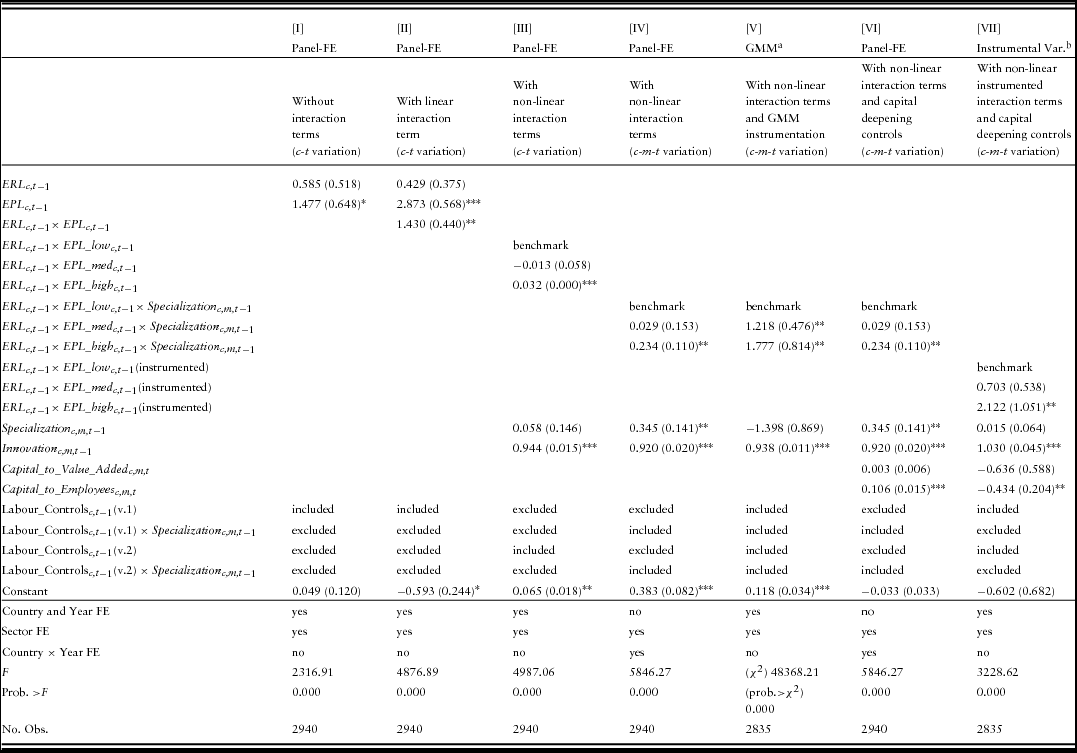
Our estimation results are collected in Table 2. In column [I], we report the simplest version of the empirical model, in which both the original ERL and dismissal regulation indicators are included as separate regressors. In column [II], we introduce a simple interaction term between the two basic ERLc,t −1 and EPLc,t −1 variables, and detect positive and statistically significant complementarities between ERL and dismissal regulation. In column [III], we study ERL effects under different levels of dismissal costs, by distinguishing weak, medium and stringent dismissal regulations, and find that ERL effects on innovation are positive and statistically significant only under relatively strict regulations of dismissal. In column [IV], we employ our full country–sector–year version of the regression model and confirm the statistical significance of ERL effects conditional on high firing costs also in the presence of country × year fixed effects. Since lags of the dependent variable may be correlated with the residuals in a standard fixed effects model, in column [V] we implement a generalized method-of-moments (GMM) estimator in an Arellano–Bond estimation (Arellano and Bond, Reference Arellano and Bond1991), and show that autocorrelation of patent outcomes, if present, does not drive our findings. In column [VI], we run the full country–sector–year version of the model and add the additional controls for capital deepening. Finally, in column [VII] we collect the results of the instrumental variable regression. Here, note that ERLc,t −1 × EPL_lowc,t −1 being the benchmark category in the second-stage equation, it does not need to be instrumented in the first stage. Consequently, we end up with two endogenous variables and two excluded instruments in the first-stage regression and the model is identified.Footnote 4
Estimated effects of labour laws complementarities on aggregate innovation (dependent variable: standardized per-capita EPO patents)

Note: aArellano–Bond dynamic panel GMM estimator (Arellano–Bond test for zero second-order autocorrelation in first-differenced errors: Z = 1.5798; prob. > Z = 0.1141; Sargan test: prob. > χ2 = 0.205).
b Instrumental variable panel regression (being ERLc,t −1 × EPL_lowc,t −1 the benchmark, only ERLc,t −1 × EPL_medc,t −1 and ERLc,t −1 × EPL_highc,t −1 are instrumented, both with Political_Orientationc,t and Shareholder_Protectionc,t; first-stage F (prob. > F): 2,252.67 (0.000) and 1,293.53 (0.000), respectively; first-stage R 2: 0.980 and 0.966, respectively; over-identification test: equations exactly identified).
Statistical significance: * = 10%, ** = 5%, *** = 1%. Standard errors (in parenthesis) are heteroscedasticity-robust. The vector ‘Labour_Controlsc,t −1 (v.1)’ includes Alternative_Contractsc,t −1, Time_Regulationc,t −1 and Industrial_Actionsc,t −1. The vector ‘Labour_Controlsc,t −1 (v.2)’ includes the set of the linear (non-interacted) labour regulation indicators (ERLc,t −1, EPL_lowc,t −1, EPL_medc,t −1, EPL_highc,t −1). When the model is specified at a country–sector–year level, ‘Labour_Controlsc,t −1 (v.1)’ and ‘Labour_Controlsc,t −1 (v.2)’ can be included only once interacted with Specializationc,m,t −1, while linear (non-interacted) labour regulation indicators must be excluded because all the country–year variation is absorbed by country × year FE.
Although any causal interpretation of these estimates should be made with caution given the complexity of the relationship between labour institutions and countries’ innovation performance, our results seem to support the argument that improved employee representation laws, combined with stronger dismissal protections, are associated with better innovation outcomes. In particular, and consistently with our theoretical intuitions, we find that ERL effects on aggregate patenting activity are positive and statistically significant when firing costs are high. Following our theoretical discussion of institutional complementarities between labour laws in an incomplete contract framework, our findings may suggest that, on average, employee representation rights under strict firing restrictions tend to stimulate workers’ effort more than they reduce the financial contribution to innovation programmes by the shareholders. Both positive and negative effects of EPL and ERL may lie behind our estimates, including possible shirking and employee opportunism. Nevertheless, the positive influence of improved workers’ protections on innovation performance seems to dominate over potentially detrimental effects and to counterbalance a possible reduction of financial injections by capital providers.
To give a sense of scale to our estimates, it is useful to calculate that, according to the simplest full model specification (column [III] of Table 2), a 0-to-1 change of both our EPL and ERL indicators is associated with an increase in the standardized number of per-capita patents of about 0.03. In our data, this is a non-negligible effect, as it corresponds to about 2% of the yearly number of patent applications at a country level. At the same time, however, it should be noticed that single labour policy initiatives are unlikely to induce a complete change of both employee representation rights and layoff provisions from being very weak (no restrictions) to very strong (extremely protective regulation). Thus, our estimates should be interpreted as an upper bound, while, in practice, a more typical magnitude of regulation effects in our sample of countries would be lower.
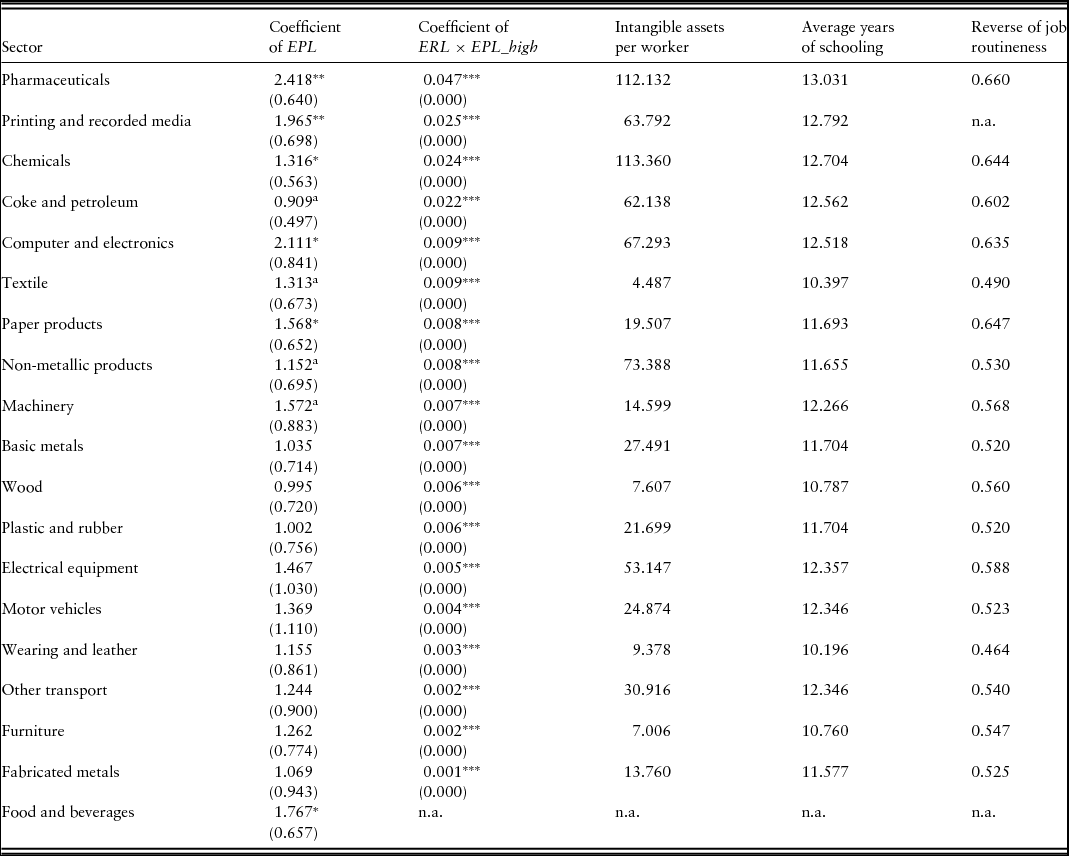
If our GHM-style argument is correct, we should also observe a higher impact of ERL in those sectors where the human capital is more important and a lower impact where shirking (due to more effective job security provisions) is more significant. We investigate these effects by exploiting the industry-level dimension of the patent data and estimating both conditional ERL effects and non-interacted EPL effects at a sectoral level. We run a sector-level country–year panel regression version of model [1] industry by industry and compare the sectoral coefficients of ERLc,t −1 × EPL_highc,t −1 and EPLc,t −1 with an industry-specific measure of the potential efficiency of the working effort. To this aim, we use three alternative proxies. First, the level of intangible assets per worker, obtained from balance sheet data of a sample of 45,168 firms from the UK, US, India, France and Germany included in the ORBIS database (Bureau van Dijk, Reference Bureau2013). Second, the sectoral level of average years of schooling in 1980, calculated by Ciccone and Papaioannou (Reference Ciccone and Papaioannou2009) for the US and reclassified to match our sectoral data. Third, the reverse of an index of routineness of sectors, calculated by the Costinot et al. (Reference Costinot, Oldenski and Rauch2011) for the US from the 2007 version of the Occupational Information Network database and measuring the importance of the worker ability to ‘make decisions and solve problems’ at an industry level.
Sectoral estimation results are presented in Table 3. Sectoral effects are reported in descending order from the largest to the lowest ERLc,t −1 × EPL_highc,t −1 coefficient. Interestingly, we find that EPL effects on innovation are positive and significant in the pharmaceuticals, printing, computer and electronics, food and beverage industries and in few other sectors, while they are not statistically significant in many industries. We interpret this evidence as caused by possible employee shirking and a lower innovative effort of both workers and capital owners where dismissal restrictions have a greater impact, given the job characteristics and monitoring issues. The complementarity effects of ERL and EPL, on the other side, turn out to be positive and statistically significant across all industries. Specifically, the magnitude of conditional ERL effects is larger in those sectors where employee effort has a greater impact on innovation outcomes, as measured by means of the three alternative indicators mentioned above. As an example, the estimated effect of our index of ERL conditional on high firing costs in a human capital-intensive industry such as the pharmaceuticals (where the intangible capital per worker is 112.13 thousand euros) is 29.78 times the effect of the same variable in a physical capital-intensive industry such as the fabricated metals (where the intangible capital per worker is only 13.76 thousand euros). These industry-level findings may further corroborate the argument that institutional settings favouring the undue appropriation of rents by shareholders have detrimental effects on workers’ behaviour, reducing their incentive to contribute to innovation, with potential consequences on aggregate innovation performance of firms and sectors.
Industry-by-industry regressions: sectoral effects

Note: Statistical significance: a = 15%, * = 10%, ** = 5%, *** = 1%. Standard errors (in parenthesis) are heteroscedasticity-robust. Estimated coefficients of one-year lagged EPL and ERL × EPL_high are obtained from sector-by-sector panel model specifications of equation (1). The level of intangible assets per worker is obtained from balance sheet data of a sample of 45,168 firms from the UK, US, India, France and Germany included in the ORBIS database (Bureau van Dijk, Reference Bureau2013); the sectoral level of average years of schooling in 1980 is calculated by Ciccone and Papaioannou (Reference Ciccone and Papaioannou2009) for the US (and reclassified in order to match our sectoral data); the reverse of an index of routineness of sectors is calculated from the original measure of the importance of the worker ability to ‘make decisions and solve problems’ computed at an industry-level by Costinot et al. (Reference Costinot, Oldenski and Rauch2011) for the US from the 2007 version of the Occupational Information Network database. For food and beverages, there is no clear matching between the sectoral measures of human capital contribution to production provided by the literature and our EPO classification. Tobacco and other activities not elsewhere classified are omitted because of data availability constraints.
5. Discussion and conclusions
We have analysed how innovation outcomes of countries may be influenced by employee protection and representation laws. The available literature generally maintains that dismissal restrictions tend to hamper short-term firms’ efficiency and aggregate country productivity (e.g. Autor et al., Reference Autor, Kerr and Kugler2007; Bird and Knopf, Reference Bird and Knopf2009; Cingano et al., Reference Cingano, Leonardi, Messina and Pica2016; Ichino and Riphahn, Reference Ichino and Riphahn2005; Riphahn, Reference Riphahn2004), while some positive effects on patenting activity have been detected by very recent studies (Acharya et al., Reference Acharya, Baghai and Subramanian2013, Reference Acharya, Baghai and Subramanian2014; Griffith and Macartney, Reference Griffith and Macartney2014). By contrast, the relationship between employee representation legislation and innovation has received much less attention and is found to be statistically insignificant (Acharya et al., Reference Acharya, Baghai and Subramanian2013). This paper has attempted to contribute to this literature from an institutional perspective. We matched some elements highlighted by previous empirical research, such as the possibility that labour laws influence human capital development and firm's efficiency (through their impact on shirking, monitoring issues and capital deepening), with the insights of incomplete contract theory (Grossman and Hart, Reference Grossman and Hart1986; Hart and Moore, Reference Hart and Moore1990; Williamson, Reference Williamson1985) and optimal contracting modelling of innovative team productions (Aghion and Tirole, Reference Aghion and Tirole1994; Holmstrom, Reference Holmstrom1989; Manso, Reference Manso2011). If employee representation rules influence the employees’ voice within the firm and if dismissal restrictions define the ability of employers to hold their workers up (or not), it is the complementarity between these two spheres of labour law that shapes the incentives of both workers and shareholders to invest in firm-specific and uncertain projects, in the presence of contract incompleteness.
Although our cross-country empirical exercise does not aim to establish causal links, the empirical correlations shown in the paper may corroborate the argument that labour law complementarities may, in fact, contribute to influencing the innovation performance of national economies. Even if stricter EPL and ERL may exert some detrimental impact on working effort (through shirking and employee opportunism), our estimates suggest that the positive innovation incentives of improved workers’ representation rights in the presence of relatively strong protections against hold-up risks are likely, at least, to counterbalance possible negative effects. Consistent with our theoretical intuition, moreover, the positive impact of labour law complementarities appears to be larger in those sectors where the human capital is relatively more important.
Such cross-industry variability, besides human capital heterogeneity, also seems to partly reflect different degrees of innovation incrementality, as defined in the varieties of capitalism approach to the analysis of economic institutions (Hall and Soskice, Reference Hall, Soskice, Hall and Soskice2001). For instance, we find that conditional ERL effects are relatively larger in some incremental innovation sectors, such as the manufacturing of chemical products, petroleum products and printing (where, as found by Hall and Soskice, Reference Hall, Soskice, Hall and Soskice2001, coordinated market economies tend to show relatively better performances). At the same time, however, we also find strong ERL effects in the pharmaceuticals sector, which combines both high human skill intensity (according to the Ciccone and Papaioannou Reference Ciccone and Papaioannou2009 classification) and a high rate of citations to non-patent literature, which is considered by Griffith and Macartney (Reference Griffith and Macartney2014) as a proxy of innovation radicality. Thus, while our sectoral estimates are generally consistent with the patterns described by the varieties of capitalism research, they may also leave room for an exploration and implementation of labour policies that may reconcile a partial reallocation of control rights to workers in radical innovation sectors, which are more developed in liberal market economies and where more stringent labour laws are not expected by the varieties of capitalism literature to exert significant positive effects.
From a legal policy perspective, in light of the functional equivalents approach, based on which the EPL and ERL data used in this paper are coded, different strategies may be considered, consistently with each country's institutional pattern. Among others, board membership co-determination, works councils’ rights, the extension of collective agreements and the right to unionization, are all institutional devices for employee representation and participation at the governance level of the company. On the other side, procedural requirements, notice periods, redundancy compensations and other substantive constraints are possible alternative instruments for regulating dismissal decisions. There is, therefore, no best practice or given solution that can be transplanted, as such, from one country to another. Rather, functional continuity can also be obtained through formally diverse systems of labour regulation.
Although a precise identification of specific policy recommendations remains outside the scope of the present paper, basically the main message of our analysis is that labour policy-makers may need to consider how seemingly unrelated labour laws (such as dismissal restrictions and employee representation, which have been always considered in isolation by related empirical research) may actually have joint economic effects, as institutional theory suggests it does in other legal domains. Especially, laws reconciling employee voice to business management, worker protection against hold-up and incentives to invest may need to be considered as a legal bundle and, as such, to be analysed by future theoretical and applied scholarship.
Acknowledgements
I wish to thank participants of the 2016 Meeting of the American Law and Economics Association at Harvard Law School; the 2016 SIOE Conference at Sciences Po, 2015 International Law & Economics Workshop organized by Tel Aviv University, Toronto Law School and University of Siena; the 2015 AIEL Conference; the 2016 IAFEP Conference at Copenhagen Business School; the USI-IdEP Research Seminar, LUMSA Economic Seminar and the 11th SIDE-ISLE Conference for helpful comments. I am indebted to Francesca Affortunato, Marianna Belloc, Gabriel Burdin, Bruno Caprettini, Massimo D'Antoni, Lucia Dalla Pellegrina, Claudine Desrieux, Monica Gago, Pierluigi Murro, Anthony Niblett, Mario Padula, Raphael Parchet, Roberto Pinheiro, Marcello Puca and Matteo Rizzolli for their precious advice at various stages of this project. Finally, I wish to thank the Centre for Business Research at the University of Cambridge for their generous hospitality throughout the drafting of this paper. Any remaining errors are my own.