Introduction: why landscape?
Astrobiology has exhibited explosive growth in the last quarter of century, such a dramatic expansion caused – or highlighted – a number of internal problems characteristic for any growing multidisciplinary field. Among these, perhaps the most disturbing one is the lack of communication between different sectors of astrobiological research. Even a casual survey of the ongoing astrobiological research reveals very heterogeneous, fragmented realm. How can astrobiologists persuade anyone of the unique span and significance of their mission when they ‘speak in so many tongues’? Hereby, we shall argue that astrobiological landscape – an abstract landscape-like structure in the space of astrobiological parameters – is a concept capable of unifying different strands of thought and research. In arguing that astrobiological landscape is a working concept, useful for actual research and not only a metaphor, we shall invoke several lines of reasoning, some of which can only be briefly explicated in this format (for more details, see Ćirković Reference Ćirković2012).
We need solid foundations to base any universality upon. In the oft-cited final words of the Origin of Species, Charles Darwin contrasted simple motion of our planet under the law of gravity (with its implied regularity, analytical and short description) with an ‘entangled bank’ as a metaphor for the biological complexity attained by evolution (Darwin Reference Darwin1859, pp. 489–90):
It is interesting to contemplate an entangled bank, clothed with many plants of many kinds, with birds singing in the bushes, with various insects flitting about, and with worms crawling through the damp earth, and to reflect that these elaborately constructed forms, so different from each other, and dependent on each other in so complex a manner, have all been produced by laws acting around us. … There is grandeur in this view of life, with its several powers, having been originally breathed into a few forms or into one; and that, while this planet has gone cycling on according to the fixed law of gravity, from so simple a beginning endless forms most beautiful and most wonderful have been, and are being, evolved.
We wish to use the image as an example of a spectrum of things any concept of life – regardless of the controversial issue of formal definition – in the cosmic context must encompass.
‘The entangled bank’ here embodies characters such as complexity of a particular kind of (eco)system, distributed over a particular region of space in a particular epoch of time. Complexity plays the key role – Darwin chooses this image to convey the impression of a huge number of interrelated and intertwined biological processes.Footnote 1 However, the complexity of an entangled bank is different from the complexity of a scrub plain or the complexity of a savannah. The difference is not just in geography. In other words, there is a differentia specifica of the entangled bank in comparison with the other ecosystems, even if they are located very close in the physical space. There is a set of parameters required to describe the entangled bank which are different from the set of parameters required to describe scrub plain or savannah. Let us call these parameters dynamical parameters; we explain the reasons for this label below. Dynamical parameters might be a black box to us – we may feel that it is easy to distinguish between a river bank ecosystem and a rainforest ecosystem, but what we really wish to have are a few – the less the better – underlying principles which entail all the differences, and not a full encyclopaedic list of differences. The principles might be unknown, but it is both epistemologically and practically prudent to assume that they exist. After all, if we wish to build any form of astrobiological theory, we must find a way to quantify and condense an enormous amount of information describing the diversity of habitable sites in the Galaxy.
Thus, in our mental image, we bundle together four things: (1) complexity of life, (2) space in which we observe this complexity, (3) time at which we observe this complexity, and (4) parameters specifying the kind of environment in which we observe this complexity. What does here point exclusively to Earth and the specific biosphere we currently observe? Nothing, it seems. Darwin's words could – to the best of our knowledge and imagination – resonate with a non-human naturalist on the (hypothetical) fourth planet of ζ Reticuli planetary system, when the allowance for different kinds of ecosystems is made. Any other situation can be analogously accommodated in the landscape framework.
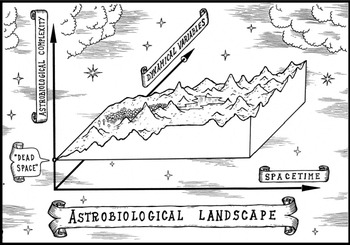
How do we visualize astrobiological landscape? Of course, since it is an abstract multidimensional space, we cannot hope for a literal visualization, but one graphical approach is shown schematically in Fig. 1. Although changes in location and epoch can obviously be compressed into one axis, the condensation of – yet unknown – astrobiological dynamics into a single axis may look controversial. Since the theory dictates our working concepts, we cannot yet have the complete list of those parameters we compressed under the banner of ‘dynamical variables’. However, as long as we stick to naturalism, there is no reason to doubt their existence; and as long as we stick to Copernicanism, there is no reason to doubt that by local research – say within the Solar System – we shall be able to discern them. Equally reasonably, one expects that there is a universal zero point of astrobiological complexity – the lack of all life, what is denoted by ‘dead space’ in the figure. We could intuitively understand it as the Universe of distant past, before chemical evolution created sufficient amount of carbon and other heavy nuclei for biogenesis to occur; or the similar conditions prevailing today in most elliptical and dwarf Galaxies. (Of course, chemical enrichment is only one of the prerequisites for astrobiological complexity; even regions with high abundance of heavy elements may have zero astrobiological complexity if they lack some of the other necessary ingredients – for instance, dynamical stability or limitations on the amount of ionizing radiation; this is probably the case with the innermost regions of the Milky Way and other spiral galaxies.) In addition, the property of all complex systems is that complexity – irrespectively of the exact metric – depends on the spatiotemporal region considered and the values of at least some dynamical parameters of the system.
A schematic presentation of the astrobiological landscape. Since we are dealing with multidimensional parameter space, it is impossible to visualize it directly, so we suggest this simplified sketch that condenses space and time coordinates into one axis, and all astrobiological dynamical parameters into another. Thus, the landscape links astrobiological complexity with yet poorly understood set of dynamical variables and spatiotemporal region under consideration (both could be defined in many contexts, starting from a local planetary to the global cosmological). (Courtesy of Slobodan Popović; for more elaborate discussion see Ćirković 2012, esp. Chapter 3.)

As an example of fruitful research on the hidden astrobiological dynamics is the study of the biologically relevant chemical enrichment of Galactic matter: fewer elements heavier than helium mean a smaller probability for the formation of terrestrial planets, and perhaps a smaller probability of biochemical processes leading to life, intelligence and observers. This has been recently spectacularly quantified by Lineweaver and collaborators who showed that, for instance, the median age of Earth-like planets in the Milky Way is 6.4 ± 0.9 billion years; before then, conditions were far less favourable for the formation of possible life-bearing sites throughout the Galactic Habitable Zone (GHZ; Lineweaver Reference Lineweaver2001; Lineweaver et al. Reference Lineweaver, Fenner and Gibson2004; Gonzalez Reference Gonzalez2005). These results quantify intuitive hypothesis often present in astrobiological and the Search for ExtraTerrestrial Intelligence (SETI) research that most habitable planets are significantly older than the Earth.
Viable astrobiological histories
Alternatively, we can understand the astrobiological landscape as a set of viable evolutionary histories of life in a particular region of space. In view of the highly clustered cosmological distribution of matter, it is only natural to put into focus our own Galaxy. Consider, for instance, the following astrobiological scenarios (or ‘histories’) for the Milky Way:
1. Dead Space: The Galaxy is entirely dead and it stays that way in all epochs.
2. Sporadic Life: Life forms emerge here and there, without any particular correlation neither in space nor time.
3. Rare Earth: Although simple life is ubiquitous in the Galaxy, complex biospheres, like the terrestrial one, are very rare due to the exceptional combination of many improbable requirements.
4. False Precision #N: the number of inhabited planets in the Galaxy behaves like A ln(t/t MW)+Bt, where t MW is the present age of the Milky Way, and A, B are given constants.
5. Red Dwarf Kingdom: Although simple life forms are ubiquitous in the Galaxy, the peaks of complexity could be found only around M-class red dwarf stars, which create the stablest conditions over their huge lifetimes.
6. Galactic Club: Life and intelligence and civilizations evolved independently long ago in various places, and many older civilizations are aware of one another and are actively communicating and/or collaborating.
7. Extinct Galactic Club: The same as in the Galactic Club, except that some unspecified natural or intentional cataclysm have destroyed most or all advanced civilizations at some moment in the past (rather close to the present in comparison to t MW).
8. Black Clouds with a Vengeance: Life on planets is a rare exception and most of the astrobiological complexity lies within giant molecular clouds and their low-density, low-temperature ecosystems (cf. Hoyle Reference Hoyle1957).
Obviously, there is a huge number of conceivable scenarios; some are specific, some are more general, including many others in them. Each broader category includes many related scenarios differing only in the numerical values of parameters (explicit or implicit). What exactly – and how tightly – constrains such scenarios? This question is central not only for understanding the entire concept of the landscape but also for outlining useful directions for future astrobiological research. This especially applies to the theoretical domain, where there is still so much work to be done. We can still infer many important constraints. It is obvious that the Dead Space does not work – we are here. Sporadic life is falsified by the recent work on GHZ, which indicates strong correlations in both spatial and temporal distribution of habitable sites in the Milky Way (Gonzalez et al Reference Gonzalez, Brownlee and Ward2001; Gonzalez Reference Gonzalez2005). Although it would seem that the False Precision #N can be fitted by some future database by particular choices of the constants, it is completely arbitrary and, lacking any theoretical motivation, should not be taken seriously. Further, it seems that the more extravagant versions of the Galactic Club did not work either, at least not as it was assumed in the period of wild SETI optimism in 1960s and early 1970s; otherwise, our search efforts would have been crowned by success long ago (cf. Bracewell Reference Bracewell1975). If it is Extinct now, we can predict that a sort of ‘interstellar archaeology’ (cf. Freeman & Lampton Reference Freeman and Lampton1975) will eventually be successful. Rare Earth is a serious and well-developed astrobiological hypothesis (Ward & Brownlee Reference Ward and Brownlee2000), which is a subject of extensive recent research. Overall, the heterogeneous nature of such astrobiological histories should not hide the fact that they belong to the same wide family, and that our empirical research can be framed as pruning of their set.
Even naive astrobiological hypotheses of earlier times can be accommodated into this framework, the rate and degree of certainty of their rejection being the measure of our progress in understanding. Old ideas of William Herschell and others about Sun and other stars being inhabited (see, e.g., Crow Reference Crow1986) can also be framed as astrobiological histories, and such which are non-viable: their part of the total space of possibilities has been discarded long ago. Now, the question about the future of astrobiological research could be formulated as: how quickly are we converging onto the set of physically viable histories?
Of course, astrobiological histories do not end with the present epoch or with the level of complexity attained on Earth. In the realm of very high complexity, which comprises intelligent observers and possibly a whole array of more complex forms of organization of matter, it is certainly hard to say anything specific at present, since we understand such high complexity phenomena so poorly. This does not mean, however, that such regions of the parameter space do not exist or that we should not strive to elucidate their properties to the best of our capacities.
Constraints
Clearly, a part of the constraints comes from our understanding of the overall physical structure of our Galaxy. For example, even if interstellar panspermia is possible over very long timescales, we still cannot imagine spherically symmetric panspermia over the scales of kiloparsecs in the Milky Way, since the distribution of possible habitats is clearly non-spherical over such spatial scales, the vast majority of habitable stars being concentrated in the thin disk component of our Galaxy. This example immediately shows that with better astrophysical knowledge we can always do much better: with the information on precise densities of habitable stars (which has become available recently), we can put other, tighter constraints on pace and probabilities of panspermia. For instance, since we know that the density of stars in the disk varies roughly as exponential with the galactocentric distance, we may conclude that this will enhance the probability of successful transport of biotic or prebiotic material between the nearest stellar neighbours in the inner regions of the Milky Way in comparison with the outer regions. Although this is almost trivial, it is important to keep in mind that any generalizations quickly become highly complex. The same applies to temporal scales: that the age of the thin disk is somewhat below 12 Gyr, forces us to reject those astrobiological histories in which life forms have had, say, a petayear (1015 years) to evolve at any habitable site. (It also excludes the notions of ‘eternal life’, popular in the 19th century; e.g. Fry (Reference Fry2000).) Thus, some constraints on the landscape come from cosmological considerations, other from more local astrophysical, astrochemical, planetological, etc. findings. The expansion of our astrobiological knowledge may be construed as getting sharper and more focused view on specific areas of the landscape. For instance, natural further steps include more precise understanding of GHZ and its evolution – the acceptable histories have to be in agreement with the results of Lineweaver and collaborators mentioned in the previous section. Further constraints stem from the relative abundance of various stellar types in the realistic Galactic stellar population (Vukotić Reference Vukotić2010).
From the empirical point of view, acceptable histories will necessarily be fuzzy at any particular level of our understanding. For instance, suppose that near-future space missions discover microfossils of simple life forms on Mars, very similar to terrestrial bacterial fossils, or to those alleged in the controversial August 1996 study by David McKay and collaborators (McKay et al. Reference McKay1996). Since inferring a biochemical detail from microfossils is at best an extremely difficult task, in this scenario we may still be unable to decide which of the three hypotheses is likely to give the best account of the data: (A) that life originated on Earth and got transported to Mars via meteorites (or even recent human spacecraft); (B) that life originated on Mars and got transported to Earth via meteorites; or (C) that life emerged independently on Earth and Mars. (We neglect here possible complication from a ‘higher order’ panspermia hypothesis that life emerged neither on Earth nor on Mars, but perhaps in an interstellar cloud and was transported to both planets via interstellar panspermia.) The last hypothesis implies that life similar to the terrestrial one is likely to emerge quickly wherever the conditions are hospitable for it; this would be argument for a form of ‘strong convergence’ of viable life forms to something resembling the known terrestrial type. So (C) would, if correct, suggest that biogenesis is inherently probable and that we are very likely not alone in the Galaxy; but the hypotheses (A) and (B) would preclude any conclusion regarding this question, just as a person seeing her own reflection in a mirror could not infer anything about being alone in the apartment or not. This circumstance does not entail that probabilities of (A) and (B) being true are equal; it is a difficult empirical question related to the reconstruction of early conditions on Earth and Mars, correct theory of biogenesis, etc. to decide whether it is more likely that life first started on early Earth or early Mars. In any case, such a discovery would strongly constrain possible astrobiological histories of our Solar System, but since we would be unable – without additional information – to determine whether we have discovered an independent biogenesis or a case of interplanetary panspermia, fuzziness will remain.
Another part of constraints come from what we understand by habitability, more precisely, what we consider a reasonable extension and generalization of capacities of life. This is usually only tacitly assumed and rarely discussed and questioned, but is of paramount importance, since biotic feedback plays an important role in shaping the global properties of our planet, starting with the obvious (atmospheric chemistry), up to complex local ecological details. The current search for biomarkers in the set of extrasolar planets relies exactly on such methodological basis (Kaltenegger et al. Reference Kaltenegger, Fridlund, Kasting, Foing and Battrick2002; Summers et al. Reference Summers, Lieb, Chapman and Yung2002; Edwards Reference Edwards2004). Thus, the unknown astrobiological dynamics will likely need to incorporate this non-linear feedback in any complete description. For example, no matter how quick biogenesis has been on Earth, it is still quick in geological and astronomical terms, in ‘deep time’. It is unreasonable – though perhaps cannot yet be decisively refuted – to assume that somewhere else in the Milky Way, in a similar type of habitat, biogenesis could be accomplished in drastically shorter interval, say on the scale of years or months. Perhaps such astrobiological histories can be excluded from the landscape as well. Further insight into prebiotic chemistry and biogenesis will enable clear delineation and sharpening of our view of this important sector of the astrobiological landscape.
Fermi's Paradox and a toy model example
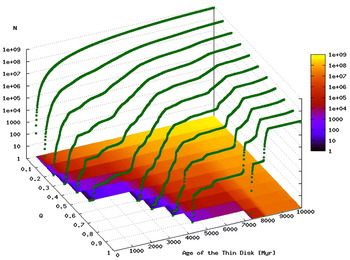
Finally, the most interesting constraints come from insight into the specific problems of astrobiological research; this notably applies to Fermi's Paradox that makes the original optimistic Galactic Club scenario unacceptable.Footnote 2 This obviously demonstrates the role of such constraints as boundary conditions to yet unknown astrobiological dynamics. Of course, the problem is that insufficient research on Fermi's paradox has not yet enabled making precise quantitative models. As an extremely simplified illustration, a toy model of a very special case of astrobiological landscape built in order to study Fermi's paradox is shown in Fig. 2 (adapted from Ćirković & Vukotić Reference Ćirković and Vukotić2008). The major motivation for that particular study has been the possibility of generalizing Stephen Jay Gould's ‘third tier’ to the GHZ: ‘…mass extinctions are sufficiently frequent, intense and different in impact to undo and reset any pattern that might accumulate during normal times.’ (Gould Reference Gould1985). Here, astrobiological complexity is represented only by the simplest step function: 1 for each site containing an extraterrestrial civilization, 0 otherwise (and the cumulative plot is shown). It is assumed that all habitable sites are equal and homogeneous spatially – but of course not temporally – distributed in GHZ. Since the model has been constructed to test whether evolution dominated by global Galactic catastrophes (in the specific case of γ-ray bursts, following the lead of Annis Reference Annis1999) can explain Fermi's paradox, the only dynamics of interest is represented by the severity parameter Q, describing the probability of extinction of life under the effect of a Galactic supernova or a γ-ray burst. (Implicitly present as parts of the relevant dynamics are the random distribution of burst events and log-uniform distribution of biological timescales.) Initial conditions include the distribution of ages of planets, according to Lineweaver's results.
A toy model of the astrobiological landscape in the context of GHZ. Presented is the number of planets that have achieved noogenesis at least once (cumulative plot), as a function of the age of the Milky Way thin disk stellar population and the mean extinction probability Q per catastrophe. (For more details, see Ćirković & Vukotić Reference Ćirković and Vukotić2008.)

Results show that the system exhibits a systematic shift of behaviour as we move from small values of Q (gradualism) to large values of Q (catastrophism). At large Q, we encounter a step-like succession of astrobiological regimes, governed by external timescale forcing (Vukotić & Ćirković Reference Vukotić and Ćirković2007). In each regime, it is obvious that the ages of inhabited planets are not independent and uncorrelated, just the contrary, as we expected from the considerations above. Although these results are very tentative, they demonstrate not only that quantitative models of specific astrobiological problems (in that study, Fermi's paradox) are possible but also that by highlighting specific aspects of the astrobiological landscape we can detect and, at least in principle, test new explanatory hypotheses.
The astrobiological landscape is large – and necessarily so, since it potentially contains all useful (and much useless) astrobiological information, just as the phase space contains all useful (and much useless) information in statistical physics. It is also spatially additive, in the sense that we may imagine it for a galaxy, or for a group of galaxies, or just a small piece of a galaxy (like the Solar System or any other extrasolar planetary system). In other words, it can be zoomed in and out revealing structure which reflects the physical distribution of matter in the Universe. Although we may think that parts of it will be similar (for instance, the landscapes of the Milky Way and our nearest giant spiral neighbour, M31 at the same epoch), this is essentially an empirical hypothesis to be tested – in the long term, at least – by observation. Of course, in practical terms it is the Galactic astrobiological landscape that is of foremost interest for research.Footnote 3 In theory, we can imagine zooming out so much that we include galaxies located at cosmological distances, which are impossible to observe except in very early stages in their evolution; this is, of course, purely abstract point, since nobody really expects to have anything but the Dead space zero level at cosmologically early epochs. However, it serves another important epistemic point: to remind us that the distribution of matter – or even more, kosmos in the ancient Greek meaning of the word – does neither stop at the faintest visible galaxies nor at our cosmological horizon.
Instead of conclusions
As always with new concepts, the major question is whether the astrobiological landscape is an operational concept or just a new metaphor. In a sense, only further research can give answer to this question; since theories determine the content of our concepts, it is clear that the future overarching theory of astrobiological dynamics will assign quantifiable content to the landscape as well. In any case, attempts should be made to make theoretical astrobiology as quantitative and precise as possible at any given time. If analogy with the development of 19th century physical science (exemplified by achievements of Maxwell or Boltzmann; see Brush Reference Brush1983) and early 20th century evolutionary theory (e.g., Wright Reference Wright and Jones1932) can tell us anything useful in this respect, the lesson is that it is fruitful to try to define comprehensive and general space of possibilities of a complex system (phase space and fitness landscape, respectively). In the particular case of astrobiology, such space can serve as a vehicle for a new and modern neo-Copernican synthesis of physical and life sciences.
Why the prefix ‘neo’? The reason is simple: classic Copernicanism dealt with selection in tangible and intuitive spaces, notably in the configuration space or in the real or hypothetical sample of similar objects (e.g., planetary systems in the Galaxy). Hence, the conventional designation of ‘Principle of Mediocrity’ or something similar. That is clearly not enough for the range and scope of the emerging astrobiological synthesis. What is needed is the extension of Copernicanism to more abstract spaces of dynamical parameters, those constituting the astrobiological landscape. Thus, we are dealing with Copernicanism with a vengeance – a very general heuristics which, for the first time, would be based not on general philosophical principles, but on the physical understanding of the preconditions for observership. With the increase of our understanding what physical, chemical, geological, etc., requirements underlie the complexity of living and intelligent systems, we enter a new phase in which the promise of the Copernican revolution is fulfilled to its logical end. A consequence of such a project is that typicality becomes reductively explainable, in the same manner as, for example, typicality of hydrogen and helium in our Universe is reductively explainable through the theory of primordial nucleosynthesis (and chemical evolution in general). This changed – or, better, upgraded – epistemic status of Copernicanism deserves a modest change in designation. The change symbolizes formulation of very concrete research programmes, and disassociation with the old-fashioned and (often implicitly, however unjustly) disparaging view of philosophical principles.
Acknowledgements
The authors thank the organizers of the wonderful event on Tycho's island of Ven in September 2011. This research has been supported by the Ministry of Education, Science and Technological Development of the Republic of Serbia through the project ON176021.