Clinical Implications
1. Depressive symptoms occur frequently in patients with schizophrenia (with an estimated modal prevalence rate of 25%).
2. Validated questionnaires (e.g., the Calgary Depression Rating Scale for Schizophrenia) are considered useful for diagnosing depressive episodes in this patient population.
3. Current evidence suggests that sulpiride, clozapine, olanzapine, aripiprazole, quetiapine, lurasidone, and amisulpride have a modest beneficial effect on reduction of depressive symptoms compared to other antipsychotics.
4. Physical activity is highly recommendable when patients suffer from depressive symptoms given its beneficial effects on symptom severity and the lack of adverse effects.
5. Although based on only a few studies, additional treatment with antidepressants or cognitive-behavioral therapy showed modest effectiveness in depressed patients with schizophrenia.
Introduction
Depressive symptoms are often seen in patients with schizophrenia, with an estimated modal prevalence rate of 25%.Reference Buckley, Miller, Lehrer and Castle1, Reference Siris2 Because of this frequently cooccurring symptomatology, there is an ongoing debate as to whether mood symptoms should not be considered as part of the symptom profile of schizophrenia.Reference Siris2
The recognition and diagnosis of depressive episodes or symptoms in patients with schizophrenia can sometimes be challenging due to its conceptual overlap with negative symptoms. Nevertheless, diagnosing depressive episodes is highly relevant since it is associated with a higher risk of suicide,Reference Karvonen, Sammela and Rahikkala3–Reference Hawton, Sutton, Haw, Sinclair and Deeks5 a poorer quality of life,Reference Conley, Ascher-Svanum, Zhu, Faries and Kinon6 and decreased treatment adherence.Reference Conley, Ascher-Svanum, Zhu, Faries and Kinon6 Clinicians may focus on the treatment of psychotic symptoms, while patients report that depressive symptoms bother them most and have the greatest impact on their satisfaction with life.Reference Fervaha, Agid, Takeuchi, Foussias and Remington7 The above led to the inclusion of depressive symptoms as one of the dimension scores in the fifth edition of the Diagnostic and Statistical Manual of Mental Disorders (DSM–5, §III).8 Next to the dimension of depression, the DSM–5 incorporates seven other dimensions: hallucination, delusion, mania, disorganized speech, abnormal psychomotor behavior, negative symptoms, and impaired cognition. By offering the Clinician-Rated Dimensions of Psychosis Symptom Severity Scale, more emphasis is given on the differences in occurrence and severity of several symptom dimensions. This may facilitate administration of specific interventions.Reference Heckers, Barch and Bustillo9
Despite the high prevalence rates of depressive symptomatology in schizophrenia, treatment studies that use reduction of depressive symptoms as the primary outcome of interest are scarce. However, some new studies that investigated the addition of antidepressantsReference Helfer, Samara and Huhn10 to care as usual practice and the effectiveness of exerciseReference Dauwan, Begemann, Heringa and Sommer11 on depressive symptoms have not yet been included in recent guidelines and articles on this topic.12–Reference Castle and Bosnac14 Therefore, the present review aims to give an overview of treatment possibilities for depressive episodes and symptoms in schizophrenia. Based on the current evidence, we will provide a stepwise approach that can be applied when treating a patient with schizophrenia and depressive episodes or symptoms.
Methods
The articles included in this review were selected after performing a literature search in PubMed (Medline). To find the most relevant studies on this topic, we combined the following search terms: “schizophreni*,” “psychos*,” and “depress*.” The search was last performed on 14 June 2017. For this review, we restricted our search to meta-analyses, systematic reviews, and randomized controlled clinical trials that were performed over the previous 10 years. Articles were included if they investigated effectiveness on depressive episodes or symptoms as a primary or secondary outcome in patients diagnosed with schizophrenia.
Diagnosing depressive episodes in schizophrenia
In the current literature, the terms “comorbid depression,” “depressive symptoms,” and “depression” are often used interchangeably. For the uniformity of this review, we will use the term “depressive episode(s)” if patients were included who met the criteria for a major depressive episode (in accordance with the DSM–5 criteria) and/or a validated questionnaire was employed for diagnosing a depressive episode in patients with schizophrenia. Of note, these episodes are often recurrent. In all other cases, including subsyndromal depression, we will use “depressive symptoms.”
The conceptual overlap of depressive symptoms with other symptoms (e.g., negative symptoms and/or extrapyramidal side effects) might provide another explanation for the broad range of prevalence rates and the clinical challenge to diagnose a depressive episode in patients with schizophrenia. To give some clinical guidance, a depressive episode is characterized by a depressed mood, while a flat or blunted affect and emptiness rather points to negative symptoms. Furthermore, feelings of hopelessness and guilt as well as suicidal thoughts are seen more frequently in the case of depressive symptomatology.Reference Siris2, Reference Castle and Bosnac14 Because of these differences, it is recommended to use validated questionnaires to diagnose a depressive episode in patients with schizophrenia. For example, the Calgary Depression Rating Scale for Schizophrenia (CDSS)Reference Addington, Addington and Schissel15 is specifically designed to distinguish between depressive symptoms and other symptom domains (i.e., negative and or extrapyramidal side effects).Reference Goldman, Tandon, Liberzon and Greden16, Reference Lako, Bruggeman and Knegtering17 Nevertheless, a thorough clinical evaluation that integrates several important factors (i.e., time of onset, course of symptomatology, and relation between the use of medication and depressive symptomatology) remains crucial when diagnosing a depressive episode in patients with schizophrenia. Hausmann et al.Reference Hausmann and Fleischhacker18 have provided a clinically useful overview on this topic.
Moreover, clinicians should be aware of several somatic disorders that can contribute to the emergence of a depressive episodes or symptoms. This can occur, among others, in endocrine disorders, malignancies, and cardiovascular diseases.19 This is highly important, since the prevalence of cardiovascular and oncological diseases is higher in patients with schizophrenia compared to healthy controls.Reference Olfson, Gerhard, Huang, Crystal and Stroup20 Additionally, depressive symptoms can also occur after the use (or discontinuation) of certain medications (e.g., [lipophilic] antihypertensive agents and corticosteroids) and the use of substances (i.e., drugs, alcohol, and caffeine).Reference Baker, Bucci, Lewin, Richmond and Carr21
Possible causes and explanations for depressive episodes in schizophrenia
In the last few decades, different studies have tried to elucidate the high prevalence rates of depressive symptomatology in patients with schizophrenia. On the one hand, there are several biological studies that tried to investigate the difference in underlying pathophysiology of patients diagnosed with schizophrenia with and without depressive symptomatology. The neurobiological studies that investigated both disorders (i.e., schizophrenia and unipolar depression) showed a large overlap between these two disorders with respect to potential factors contributing to the pathophysiology of both disorders. These include comparable risk factors during youth (such as childhood trauma and neglect),Reference Birchwood, Iqbal and Upthegrove22 changes in the immune–inflammatory system,Reference Anderson, Maes and Berk23 and structural changes in brain morphology from neuroimaging studies.Reference Meisenzahl, Seifert and Bottlender24 These observations may point to a common pathophysiology, which might explain why depressive episodes or symptoms are often seen in patients with schizophrenia, and/or that patients with schizophrenia are vulnerable for developing depressive symptoms.Reference Anderson, Maes and Berk23 On the other hand, several studiesReference Upthegrove, Marwaha and Birchwood13, Reference Birchwood, Iqbal and Upthegrove22, Reference Birchwood25 have emphasized the effects of the different psychological factors that are believed to play an important role in the onset of depression (e.g., depression as a psychological reaction to being diagnosed with schizophrenia and the social consequences of this disease or as a reaction to psychotic relapse).
The evidence to date regarding the possible causes and explanations for depressive episodes in patients with schizophrenia is sometimes conflicting and appears highly dependent on selection of samples and sample size. It is beyond the scope of this review to discuss the pathophysiology of depressive episodes in depth. For a more comprehensive discussion on this topic, we refer the reader to a review by Upthegrove et al.Reference Upthegrove, Marwaha and Birchwood13 In sum, there is no evidence for a single, straightforward explanation of the high prevalence of depressive episodes in schizophrenia. In line with the plausible causal pathways of unipolar depression, current evidence points toward a multifactorial etiology, including psychosocial, neurobiological, and environmental risk factors.
The treatment of depressive episodes and symptoms in schizophrenia
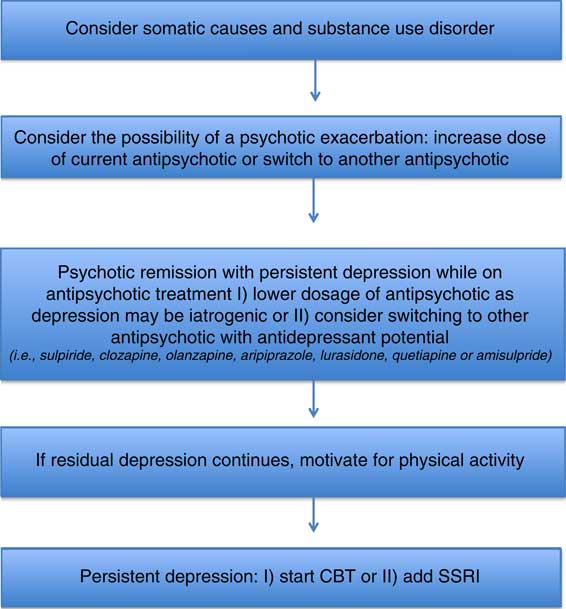
Below we will first review studies focused on pharmacological treatment (antipsychotics, antidepressants in addition to antipsychotics, and other pharmacological treatments) and nonpharmacological interventions. When evidence is available, we will first discuss the effects on depressive episodes and then the effects on depressive symptoms. We will also consider the most important limitations of the current reports. Current findings are summarized in a practical stepwise approach (Figure 1). Lastly, we briefly discuss the treatment aspects of suicide, as the risk on suicide is elevated by the presence of depressive episodes or symptoms.
Framework for treating depression in patients with schizophrenia. Based on the framework as designed by Castle and Bosnac.Reference Castle and Bosnac14

First phase of treatment
In the acute phase of psychosis, it is advisable to treat depressive symptoms primarily with antipsychotics only, because depressive symptoms can improve or disappear with the remission of a psychosis.Reference Tapp, Kilzieh, Wood, Raskind and Tandon26, Reference Tandon, Goldman, Goodson and Greden27 For example, when patients suffer from severe positive symptoms (such as delusions and hallucinations), these may potentially lead to social isolation and in turn cause depressive symptoms. Resolution of psychotic symptoms by D2 antagonists might therefore lead to improvement of depressive symptoms. However, previous research also showed that an increased blockade (i.e., higher dosages or higher affinity of antipsychotic agent) of the dopamine D2 receptors by antipsychotics is associated with worse subjective well-being and/or dysphoria.Reference de Haan, van Bruggen, Lavalaye, Booij, Dingemans and Linszen28–Reference Mizrahi, Rusjan and Agid30 Likewise, the induction of EPS by antipsychotics has previously been associated with “neuroleptic dysphoria.”Reference Tandon31, Reference Voruganti and Awad32 It seems plausible that especially an unwarranted high dosage of antipsychotics is associated with these side effects and dysphoria, which might especially manifest itself after the acute-phase treatment of psychosis. Consequently, the first step of treating depressive symptoms is to adequately treat positive symptoms with antipsychotics but also to optimize the dosage of this medication and when possible lower the dosage of current D2 antagonists. Herein, we acknowledge the complex balance of efficacy and tolerability of antipsychotic treatment in the case of depressive symptoms.
Pharmacological treatment
Antipsychotics
Over the last few decades, several studies have investigated the antidepressant effect of antipsychotics. However, the number of studies investigating the effectiveness of antipsychotics for treating depressive episodes in schizophrenia specifically are limited, as shown in a Cochrane review by Furtado et al.Reference Furtado, Srihari and Kumar33 The possible effects in this Cochrane review were expressed as “weighted mean differences” (WMDs), which calculate the difference between decreases of a score on a depression rating scale by different interventions, weighted by the pooled variance of these differences.
From the few included studies in this review, one study compared sulpiride versus chlorpromazine with a double-blind design (in which it was unclear whether participants were randomly assigned to the treatment conditions). Sulpiride was associated with a significant decrease in depression scores compared to patients receiving chlorpromazine (n=19 and n=17, respectively; WMD=–0.70; 95% confidence interval [CI 95%]=[–1.2, –0.2]; p=0.0058). In another included double-blind study, quetiapine yielded no significant improvement in depression scores compared with patients receiving haloperidol (n=94 and n=86, respectively; WMD=–0.57; CI 95%=[–1.4, 0.3]). The authors of this Cochrane review concluded that there was insufficient evidence to determine whether or not newer atypical antipsychotics were more effective compared to older antipsychotics in the treatment of depressive episodes in patients with schizophrenia.
Furthermore, in contrast to the above Cochrane review, some meta-analyses pooled additional studies comparing the effectiveness of antipsychotics on depressive symptoms (instead of depressive episodes). Leucht et al.Reference Leucht, Arbter, Engel, Kissling and Davis34 investigated whether some antipsychotic drugs were more effective compared to placebo, assessing several outcome measures including depressive symptoms. This meta-analysis showed that a number of antipsychotics were significantly more effective in reducing depressive symptoms relative to placebo. Amisulpride (2 trials, n=261, pooled effect size [ES]=–0.50; CI 95%=[–0.75, –0.24], p=0.0001), olanzapine (3 trials, n=479, pooled ES=–0.28, CI 95%=[–0.47, –0.10], p=0.0024), ziprasidone (3 trials, n=404, pooled ES=–0.33, CI 95%=[–0.52, –0.13], p=0.0011), and zotepine (1 trial, n=79, pooled ES=–0.48, CI 95%=[–0.92, –0.03], p=0.0349) were significantly more effective than placebo. Haloperidol had a beneficial effect on depressive symptoms (2 trials, n=299, pooled ES= –0.33, CI 95%=[–0.56, –0.11], p =0.0039) compared to placebo. No significant differences in effect between the agents clozapine, quetiapine, risperidone, or sertindole were found.
The effectiveness of haloperidol in the treatment of depressive symptoms, with its high potency for dopamine D2 receptor antagonism, is in apparent contradiction with research that describes the worse subjective well-being and/or dysphoria due to blockade of the D2 receptor.Reference de Haan, van Bruggen, Lavalaye, Booij, Dingemans and Linszen28–Reference Mizrahi, Rusjan and Agid30 There are various explanations to explain this contradiction: for example, haloperidol might effectively treat psychotic symptoms, which in turn causes a decrease in depressive symptomatology (as outlined earlier). Based on these findings, there is no conclusive evidence to support switching when depressive symptoms initially appear and when a patient is already treated with haloperidol, but instead lowering the dose could be considered, while balancing the efficacy and tolerability of the drug as adequately as possible.
In a second meta-analysis of Leucht et al.,Reference Leucht, Corves, Arbter, Engel, Li and Davis35 nine second-generation atypical antipsychotics were compared with first-generation antipsychotics, with depressive symptoms as the measured outcome. From this study, amisulpride (9 trials, n=900, pooled ES=–0.37, CI 95%=[–0.51, –0.24], p<0.0001), aripiprazole (1 trial, n=1278, pooled ES=–0.12, CI 95%=[–0.24, –0.01], p=0.040), clozapine (6 trials, n=426, pooled ES= –0.51, CI 95%=[–.0.87, –0.14], p=0.006), olanzapine (12 trials, n=2893, pooled ES=–0.27, CI 95%=[–0.35, –0.19], p<0.0001), and quetiapine (4 trials, n=442, pooled ES=–0.23, CI 95%=[–0.41, –0.04], p=0.016) were more effective in treating depressive symptoms than first-generation antipsychotics. In contrast to the earlier mentioned meta-analysis of Leucht et al.,Reference Leucht, Arbter, Engel, Kissling and Davis34 zotepine and ziprasidone were not more effective in this analysis compared to other antipsychotic treatments. Of note, risperidone and sertindole were both found to be ineffective compared to first-generation antipsychotics in reducing the severity of depressive symptoms. The limitations of this second meta-analysis were the small effect sizes (apart from clozapine), the short follow-up of the included studies (i.e., 81% of the studies had a duration of 12 weeks), and that in most studies (95) antipsychotics were compared to haloperidol, mostly in relatively high doses (as pointed out in published comments).Reference Gotzsche36, Reference Johnsen37 Given the findings of previous research which showed that an increased blockade (i.e., higher dosages) of the dopamine D2 receptors by antipsychotics is associated with worse subjective well-being and/or dysphoria,Reference de Haan, van Bruggen, Lavalaye, Booij, Dingemans and Linszen28–Reference Mizrahi, Rusjan and Agid30 and the favorable effect sizes of second-generation antipsychotics compared to first-generation antipsychotics, these results might reflect an overestimation due to high doses of the comparator drug.
The Clinical Antipsychotic Trials of Intervention Effectiveness (CATIE) trialReference Lieberman, Stroup and McEvoy38 also examined whether second-generation antipsychotics were more effective compared to first-generation antipsychotics in the treatment of depressive symptoms in schizophrenia patients (n=1,460).Reference Addington, Mohamed and Rosenheck39 In the first phase of this double-blind study, patients were randomly assigned to perphenazine, olanzapine, quetiapine, risperidone, or ziprasidone and followed for 18 months. During these 18 months, depressive symptoms decreased in all treatment groups, and there were no significant differences between these groups. If only the patients were taken into account (n=448) that had clinically relevant depressive symptoms (i.e., patients with a score of 6 or higher on the CDSS) at baseline, mixed-model analyses showed that the patients who were treated with quetiapine had significantly lower depression scores at outcome compared to the group receiving risperidone. However, this was observed at four out of the seven measurements during follow-up, and only small differences were found between both groups.
Regarding the more recently approved antipsychotic lurasidone, this agent proved to be effective in the treatment of depressive symptoms.Reference Nasrallah, Cucchiaro, Mao, Pikalov and Loebel40 Nasrallah et al.Reference Nasrallah, Cucchiaro, Mao, Pikalov and Loebel40 pooled the results of double-blind randomized controlled trials that investigated the effect of lurasidone on depressive symptoms. Although the duration of these trials was short (6 weeks), patients treated with lurasidone showed a significant, though small, decrease in depressive symptoms compared to placebo (4 trials, n=898 and n=432, respectively; pooled ES=–0.24; p<0.001).
A more recent meta-analysis and metaregressionReference Galling, Roldán and Hagi41 was published regarding the effectiveness of antipsychotic augmentation, which is highly debated considering its cost and the ambiguous evidence. Considering the effectiveness for depressive symptoms, augmentation did not lead to a significant improvement in severity of depressive symptoms, although the pooled effect size was moderately large and significant at a trend level (10 trials, n=351, pooled ES=–0.69, CI 95%=[–1.42, 0.05], p=0.066).
In summary, since blockade of dopamine D2 receptors is possibly associated with a worsening of subjective well-being and/or dysphoria, the first step is to lower the dosage of current antipsychotic treatment while maintaining remission from psychosis and/or to treat when depressive symptoms occur. There is not enough evidence to encourage switching among antipsychotics when depressive symptoms initially appear while a patient is treated with high-potency D2 receptor antagonists. In that situation, it is advisable to reconsider the dosage of the drug to balance efficacy and tolerability. All first- and second-generation antipsychotics antagonize D2 receptors to a greater degree as dosing increases. Most guidelines suggest lowering to the most effective antipsychotic dose,12, Reference Falkai, Wobrock and Lieberman42, 43 which may improve depressive symptoms. However, if depressive symptoms persist, there are indications that a number of antipsychotics (including sulpiride, clozapine, olanzapine, aripiprazole, quetiapine, lurasidone, and amisulpride) have a slightly more favorable effect than other antipsychotics or placebo when treating depressive symptoms in patients with schizophrenia, and a switch may be warranted. Although haloperidol might also be effective, the increased effectiveness of second-generation antipsychotics compared to first-generation antipsychotics may be explained by the fact that several second-generation antipsychotics have a lower affinity for the dopamine D2 receptor and an antagonistic action on the 5-HT2 receptor, both of which may contribute to an antidepressant effect. Some second-generation antipsychotics may potentially partially agonize D2, D3, and 5HT1a, or antagonize 5HT2c, 5HT3, or 5HT7—all of which have theoretical antidepressant properties.Reference Nikiforuk44–Reference Meltzer and Massey46 In this light, it is also important to mention brexpiprazole, which may have an antidepressant effect in patients with schizophrenia due to its receptor profile (including partially agonizing at the D2 and 5HT1a receptors and antagonizing at the 5HT2a and noradrenaline α1b and α2c receptors).Reference Garnock-Jones47 Correll et al.Reference Correll, Skuban and Hobart48 performed a meta-analysis on the effectiveness of brexpiprazole in one phase II study and two phase III studies, showing a significant reduction in a depression/anxiety factor in one phase III study compared to placebo. However, some uncertainties remain regarding depressive episodes, because most studies evaluated the effect on depressive symptoms instead of treatment of depressive episodes. Moreover, studies investigating second-generation antipsychotics were using relatively high doses of first-generation drugs, which limits comparability.Reference Rosenheck49 Most second-generation antipsychotics possess antidepressant properties at their lower doses.
Antidepressants in addition to antipsychotic medication
Efficacy and tolerability
In 2002, a Cochrane review by Whitehead et al.Reference Whitehead, Moss, Cardno, Lewis and Furtada50 was published regarding adding antidepressants to antipsychotics in the case of depressive episodes in patients with schizophrenia. Based on the small sample sizes and poor quality of the six randomized controlled trials (RCTs), the authors concluded that the addition of antidepressants to an antipsychotic in comparison to the addition of a placebo did not significantly reduce depression (6 trials, n=261, WMD=–2.1, CI 95%=[–5.04, 0.84]). No conclusions were made regarding the effectiveness of individual agents.
The earlier-mentioned Cochrane review by Furtado et al.,Reference Furtado, Srihari and Kumar33 which investigated the antidepressant effect of atypical antipsychotics, also included one short study that compared clozapine with other unspecified antipsychotics in combination with an antidepressant or placebo in a double-blind design. Severity of depression significantly decreased in patients treated with clozapine (n=18) in comparison with the group of patients who received an antipsychotic agent in combination with mianserin (n=11, WMD=–5.53, CI 95%=[–8.23, –2.8], p<0.0001), as well as in comparison with patients receiving an antipsychotic agent in combination with moclobemide (n=14, WMD= –4.35, CI 95%=[–6.7, –2.03], p=0.00024), as well as in comparison with patients receiving an antipsychotic agent in combination with amitriptyline (n=12, WMD=–3.61, CI 95%=[–6.58, –0.64], p=0.017), and also compared to patients who received an antipsychotic agent in combination with placebo (n=15, WMD=–6.35, CI 95%= [–8.6, –4.1], p<0.00001).
After these Cochrane reviews, some additional reviews and meta-analysis were published that further evaluated the addition of antidepressants in patients with schizophrenia on several outcomes, including depressive symptoms (instead of depressive episodes).Reference Helfer, Samara and Huhn10, Reference Terevnikov, Joffe and Stenberg51–Reference van Dijk, Dapper and Vinkers55 The most recent of these, which also included the majority of the studies, is a meta-analysis by Helfer et al.,Reference Helfer, Samara and Huhn10 which included 82 RCTs (N=3,608). By making use of wider inclusion criteria (i.e., including nonblinded clinical trials and trials that used control conditions in which no treatment was given), the authors included more studies at the expense of a lower level of study quality.
Of the 82 included studies, 42 trials used depressive symptoms as an outcome. Based on these studies, antidepressants provided a significant (though limited) decrease in depressive symptoms compared with control conditions (i.e., placebo or no active treatment, 42 trials, n=1849, pooled ES=–0.25, CI 95%=[–0.38, –0.12], p=0.0001). However, in stratified analyses, the studies using selective serotonin reuptake inhibitors (SSRIs) showed a nonsignificant decrease in depressive symptoms (19 trials, n=859, pooled ES=–0.19, CI 95%= [–0.40, 0.02]). The following individual antidepressants were significantly more effective in reducing depressive symptoms: trazodone (1 trial, n=60, pooled ES=–0.98, CI 95%=[–1.51, –0.44], p=0.0004); duloxetine (1 trial, n=40, pooled ES=–0.80, CI 95%=[–1.45, –0.16], p=0.01); sertraline (4 trials, n=205, pooled ES=–0.51, CI 95%=[–0.91, –0.12], p=0.01); and amitriptyline (4 trials, n=138, pooled ES=–0.34, CI 95%=[–0.68,0.00], p=0.05).
In an additional analysis, the authors found no indication of increased efficacy of antidepressants in patients with “pronounced depressive symptoms” compared to patients with lesser severity (p=0.38). However, in contrast to the overall nonsignificant effects of SSRIs against depressive symptoms, SSRIs were beneficial in schizophrenia patients with depressive episodes (7 trials, n=422, pooled ES=–0.48, CI 95%=[–0.84, –0.11], p=0.01). These additional analyses suggest that antidepressants in general, and SSRIs more specifically, are beneficial when patients meet the criteria for a depressive episode. Future high-quality studies are required to validate these results.
Additionally, tolerability is a relevant outcome when adding antidepressants for the treatment of depressive episodes. This is of high importance since patients diagnosed with schizophrenia are, in general, already being treated with antipsychotics prone to side effects. Patients treated with additional antidepressants had significantly more complaints of abdominal pain, constipation, dizziness, and dry mouth, which are common adverse effects of antidepressants. However, psychotic exacerbations were not more frequently observed in the group treated with antidepressants.
Interactions due to combined antipsychotic–antidepressant treatment
Most pharmacokinetic interactions between antipsychotics and antidepressants are the result of competitive binding with different cytochrome P450 (CYP) enzymes.Reference Spina and de Leon56 These interactions result in changing plasma levels of drugs (increase or decrease depending on inhibition or induction of specific CYP enzymes). Some new antidepressants act as inhibitors of different CYP enzymes, where most antipsychotic drugs do not have these inhibiting effects but are indeed metabolized (i.e., substrates) by these enzymes.Reference Spina and de Leon56 Due to the inhibitory effect of the antidepressants, the elimination of antipsychotic drugs might be diminished, resulting in higher plasma levels of antipsychotic drugs. A constantly updated overview of the strength of the inhibitory effects of different antidepressants can been found in “drug Interaction tables” (available at http://medicine.iupui.edu/clinpharm/ddis/main-table).Reference Flockhart57
Since there are SSRIs and serotonin–norepinephrine reuptake inhibitors (SNRIs) (e.g., sertraline, (es)citalopram, and duloxetine) with mild to moderate inhibitory effects of CYP enzymes, it may be recommended to use one of these drugs, especially if monitoring of the serum levels of antipsychotics is not available. Moreover, it is advisable to use therapeutic drug monitoring (TDM) of the antipsychotic. These blood levels can be done before and during the process of adding an antidepressant and might clarify the intraindividual interactional effects. However, TDM results might be difficult to interpret, especially since large intraindividual differences have been described.Reference Spina and de Leon56 Whenever there is too little evidence for the application of TDM (e.g., for aripiprazole and quetiapine) and/or where TDM is not available,Reference Hiemke, Baumann and Bergemann58 as a third option correction factors could be applied. Correction factors give an indication if and how a dosage of a substrate (i.e., those drugs that are metabolized by CYP enzymes) should be reduced in the case of adding an antidepressant to antipsychotic medication (for an extensive overview of correction factors when combining specific combinations of antidepressant and antipsychotics, we refer to the review by Spina and Leon).Reference Spina and de Leon56
Additionally, pharmacodynamic interactions (at the level of binding to receptors) are also important. These effects, in contrast to the pharmacokinetic interactions, are not a result of changes in plasma levels and may result in improved or reduced effectiveness, but at the same time with more or less adverse drugs reactions. However, the possible occurring effects when combining antidepressants and antipsychotics are poorly investigated, although these interactions are more likely to occur with mirtazapine and bupropion.Reference Spina and de Leon56 Prolonged QTc interval, with torsades de pointes as a rare but possibly lethal outcome, is described when SSRIs and second-generation antipsychotics are combined. Additive risk factors include a “family history of sudden death; personal history of syncope, arrhythmias or heart conditions; hypokalemia, hypomagnesaemia and co-prescription of other medications that increase QTc.”Reference Spina and de Leon56 If the aforementioned situations are applicable, an electrocardiogram is recommended.Reference Spina and de Leon56
Other pharmacological treatments
Two Cochrane reviewsReference Leucht, Helfer, Dold, Kissling and McGrath59, Reference Wang, Xia, Helfer, Li and Leucht60 investigated the effect of the addition of lithium or valproate, respectively, on depressive symptoms in patients with schizophrenia, but neither treatment showed a significant improvement in depressive symptoms. With respect to lithium, to the best of our knowledge, there are no studies to date that have investigated the effect of addition of lithium in combination with both antipsychotics and antidepressants. This indeed could be a plausible strategy, considering the effects of addition of lithium in the case of nonresponse to antidepressants in patients with unipolar depression.19
In summary, there is evidence that the use of antidepressants to treat depressive symptoms and depressive episodes may be of help to some degree in patients with schizophrenia. However, interactions between antidepressants and antipsychotics should be taken into account. There is not enough evidence to indicate which antidepressant is preferred as an additive to antipsychotic medication; however, the best available evidence supports the use of SSRIs. Within the group of SSRIs, no advice can be given regarding the effectiveness of individual agents; nonetheless, agents with mild to moderate inhibitory effects on CYP enzymes might be preferable to reduce pharmacokinetic interactions.
Nonpharmacological interventions
A recent systematic review and meta-analysis by Dauwan et al.Reference Dauwan, Begemann, Heringa and Sommer11 examined the effect of exercise in patients with schizophrenia on several outcome measures, including depressive symptoms. They compared exercise to both a passive and an active control condition (the “active” control group included, e.g., patients with schizophrenia who played table soccer or followed occupational therapy, whereas the “passive” condition comprised patients with schizophrenia who were on a waiting list). There were seven trials included (N=296) that examined the effect on depressive symptoms, and these found that exercise reduced depressive symptoms in patients with schizophrenia compared to control conditions (pooled ES= –0.71, p<0.001). Qualitative assessment showed that patients had to perform physical activity for at least 30 minutes, three times weekly, at a considerable intensity, for at least three months. The positive effects of exercise are extremely important, especially in patients with schizophrenia who are mostly treated with antipsychotics for a longer period of time, but antipsychotics are particularly known for their harmful side effects, including weight gain, diabetes mellitus, and dyslipidaemia.Reference De Hert, Detraux, van Winkel, Yu and Correll61
Regarding cognitive-behavioral therapy (CBT), most studies focus on the effectiveness of CBT on psychotic symptoms, and no studies investigated the effectiveness of this intervention on depressive symptoms as a primary outcome.Reference Upthegrove, Marwaha and Birchwood13 Nevertheless, the National Institute for Clinical Excellence (NICE, 2014)12 described a small to moderate positive effect (ES=–0.30) for reduction of depressive symptoms in comparison with standard treatmentsReference Wykes, Steel, Everitt and Tarrier62 or other psychosocial treatments.Reference Jones, Hacker, Cormac, Meaden and Irving63 Given the beneficial effects of CBT in patients with unipolar depression, CBT is an interesting intervention to further investigate in patients with schizophrenia and a depressive episode.19
Other therapeutic interventions, which are frequently used in the treatment of unipolar depressive disorder19 (e.g., electroconvulsive therapy [ECT] and repetitive transcranial magnetic stimulation [rTMS]) have also been investigated in schizophrenia. A Cochrane reviewReference Tharyan and Adams64 investigated the effectiveness of ECT in patients (n=30) with schizophrenia and showed that there is no evidence that ECT is effective in the treatment of depressive symptoms, which is at least remarkable considering the success rates of ECT in the treatment of resistant unipolar depression. Another Cochrane review by Dougall et al.Reference Dougall, Maayan, Soares-Weiser, McDermott and McIntosh65 examined the effectiveness of repetitive transcranial magnetic stimulation (rTMS) in patients with schizophrenia on various outcomes, including depressive symptoms. These studies, which evaluated the effectiveness of rTMS on depressive symptoms (5 trials, total sample sizes ranging between 22–43), suggested some beneficial effects. These findings are in need of further replication since the included studies were of limited quality and small in size. Thus, there is currently no evidence available to support the use of ECT and insufficient evidence to fully support rTMS for the treatment of depressive symptoms in patients with schizophrenia.
Suicide
Suicide is an important cause of death in patients diagnosed with schizophrenia, being responsible for approximately 5% of mortality in these patients.Reference Harvey and Espaillat66, Reference Palmer, Pankratz and Bostwick67 An in-depth review regarding the treatment and management of suicidality in patients with schizophrenia is beyond the scope of our review (e.g., see Harvey and EspaillatReference Harvey and Espaillat66). However, previous (and current) depressive episodes constitute an important risk factor for suicide and suicide attempts in patients with schizophrenia.Reference Karvonen, Sammela and Rahikkala3–Reference Hawton, Sutton, Haw, Sinclair and Deeks5, Reference Harvey and Espaillat66 An earlier meta-analysis on this topic showed that previous depressive episodes are associated with (completed) suicide in patients with schizophrenia (odds ratio [OR]=3.03, CI 95%=[2.06, 4.46]). Here, we think it is important to mention that treatment with clozapine diminishes suicidality in patients with schizophrenia, as proved by the International Suicide Prevention Trial (InterSePT).Reference Meltzer, Alphs and Green68 This was further established in a meta-analysisReference Hennen and Baldessarini69 based on five studies that compared clozapine to other agents. This meta-analysis showed a 2.9-fold reduction in completed suicides in patients treated with clozapine compared to other agents (pooled risk ratio=2.9 favoring clozapine, CI 95%=[1.5, 5.7], p=0.002).Reference Hennen and Baldessarini69
Discussion
In the present review, we aimed to provide an overview of the current evidence regarding treatment of depressive episodes and symptoms in patients diagnosed with schizophrenia. Depressive symptoms are often seen in patients with schizophrenia; however, prevalence rates vary widely.Reference Buckley, Miller, Lehrer and Castle1, Reference Siris2 There is a strong urgency to diagnose and treat depressive episodes, since they are associated with serious consequences. Regarding the treatment of depressive episodes and symptoms, we provided a practical stepwise approach when facing patients with schizophrenia and a depressive episode (Figure 1). In general, more research concerning the effectiveness of therapeutic interventions for depressive episodes in patients with schizophrenia is needed.Reference Upthegrove, Marwaha and Birchwood13 The overall interpretation of the results of the treatment studies is complicated by the use of different questionnaires, which were not always validated for diagnosing depressive episodes or assessing the severity of depressive symptoms in patients with schizophrenia. Additionally, the follow-up of these studies was often short, and there was considerable variation in the populations studied.
The recommendations of our review need to be considered in the light of the following limitations. First, it should be noted that this review cannot be considered a systematic review, though we aimed to provide a comprehensive overview of the most important studies on this topic. Second, differences between countries regarding the registration and availability of specific antipsychotic agents may reduce the choices described. However, we aimed to give an overview despite these differences. Consequently, we summarized the available international evidence, which should be combined with the availability and registration of antipsychotics per country.
Conclusions
Based on the current evidence, it is advisable to treat depressive episodes and symptoms in the acute phase of psychosis primarily with antipsychotics only, because depressive symptoms can also improve or disappear with the remission of a psychosis. If depressive symptoms persist (or develop later), it must be determined whether the depressive symptoms are the result of a too powerful and persistent dopamine D2 receptor blockade. If so, decreasing the dosage of antipsychotics or switching to an antipsychotic with a weaker affinity for dopamine D2 receptors (or a partial agonist) or those with other potential antidepressant properties may be appropriate. Current evidence suggests that sulpiride, clozapine, olanzapine, aripiprazole, quetiapine, lurasidone, and amisulpride have a modest beneficial effect on depressive symptoms in patients with schizophrenia compared with other antipsychotics. Physical activity is recommended when depressive symptoms are present, given its beneficial effects and the favorable balance between efficacy and side effects. If the depressive symptoms persist, and especially if there is a depressive episode diagnosed, a next step is recommended. Based on current evidence, it is difficult to advise whether to start CBT or add an antidepressant (e.g., SSRIs). When antidepressants are chosen, the possibility of pharmacological interactions reducing the antipsychotic effects and/or increasing side effects must be considered.
Disclosures
Drs. van Rooijen, Vermeulen, de Haan, and Ruhé hereby declare that they have no conflicts of interest to disclose.