Introduction
Cardiac arrest is a major public health issue and is one of the leading causes of death in places such as the United States, China, and Europe. 1 , Reference Bhanji, Donoghue, Wolff, Flores, Halamek and Berman 2 Though there are significant scientific advances in treatment for cardiac arrest victims, the cardiac arrest survival rate is not so satisfactory for out-of-hospital victims. For out-of-hospital cardiac arrest victims, one of the key determinants of survival is the timely performance of bystander cardiopulmonary resuscitation (CPR).Reference Bhanji, Donoghue, Wolff, Flores, Halamek and Berman 2 Therefore, it is pressing to train and educate common people to save lives. The CPR skills should be delivered at schools for at least two reasons. One reason is that students can be easily motivated, learn quickly, and retain skills more persistently.Reference Jones, Whitfield, Colquhoun, Chamerlain, Vetter and Newcombe 3 The other reason is that sudden cardiac death in elementary schools and middle schools has extremely malignant impact on families, schools, and communities.Reference Mitani, Ohta, Yodoya, Otsuki, Ohashi and Sawada 4
However, it is still unknown whether or not the recommendations appropriate for Caucasian students are also suitable for East Asians with different physical and educational qualities. Meanwhile, striking disparities in cognitive and psychomotor development exist among students of different ages. Previous guidelines and studiesReference Jones, Whitfield, Colquhoun, Chamerlain, Vetter and Newcombe 3 , 5 - Reference Bottiger and Van Aken 7 from Caucasian students demonstrate that students at the age of 12 can be qualified candidates to provide effective chest compressions after standard training. However, no similar studies on East Asian students have ever been reported. To fill this gap, the purpose of this study is to identify what is the best age for East Asian students to receive CPR training.
Methods
Design
This is a prospective observational study to explore what is the best age for East Asian students to perform effective chest compressions. The research protocol was approved by the Research Ethics Committee of the People’s Hospital of Deyang City (Deyang, China).
Participants and Randomization
Students were recruited by stratified random sampling from two primary schools, two junior schools, and two senior middle schools in Deyang City, Sichuan Province, China.
A group of 30 students without CPR training experience were randomly selected from each grade using the drawing lots system. Students who were not mentally/physically healthy or declined to participate were excluded. Consent was obtained from each student’s guardian. A total of 12 groups of students were involved with the study from continuous 12 grades: one through six grades from primary schools, one through three grades from junior middle schools, and one through three grades from senior middle schools. As a result, a total of 360 students were recruited in this study.
Basic Life Support Training
Each group of students participated in Basic Life Support (BLS) training provided by trained tutors who were nurses or doctors experienced in emergency medicine. The training comprised a theoretical introduction followed by a practical demonstration of recognition of the emergency and activation of the Emergency Medical Services system, with early CPR as CPR treatment recommendation.Reference Nolan, Hazinski, Aickin, Bhanji, Billi and Callaway 8 , Reference Neumar, Shuster, Callaway, Gent, Atkins and Bhanji 9 Each student attended the 60-minute training with a manikin (Resusci Anne QCPR; Laferal, Norway) and was assessed within one hour of being trained.
Measures
Baseline data, including age, gender, body weight, height, and so on, were obtained. Before and after training, students were asked to conduct an objective structured examination of continuous chest compressions on manikins for approximately two minutes. The critical components of CPR were assessed with objective manikin data, including compression rate, depth, complete release, and correct hand position rate. Correct compression, depth, and rate were defined as 50-60 mm at 100-120 per minute according to 2015 American Heart Association (AHA; Dallas, Texas USA) CPR guidelines.Reference Neumar, Shuster, Callaway, Gent, Atkins and Bhanji 9
Statistical Analysis
Analyses were performed by using SPSS software 16.0 (SPSS Inc.; Chicago, Illinois USA); a P value<.05 was considered to be statistically significant. Categorical variables were expressed as percentages and continuous variables were expressed as mean (SD). The compression quality was compared amongst groups by using the one-sample T test with test values recommended by CPR guidelines.
Results
Baseline Characteristics
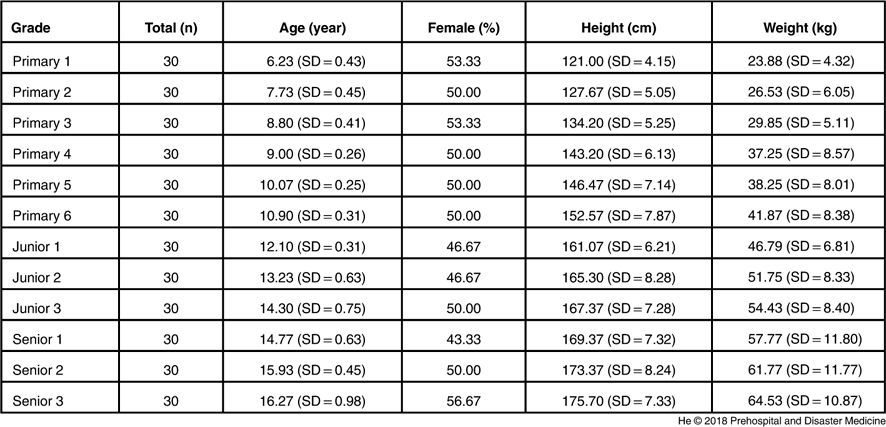
A total of 360 students who constituted 12 continuous grades from six schools were recruited for this study. The baseline characteristics and demographics for all students are presented in Table 1. Students’ height and weight increased progressively across successive school grades.
Baseline Characteristics and Demographics for 360 Students Included, by School Grade

Quality Assessment
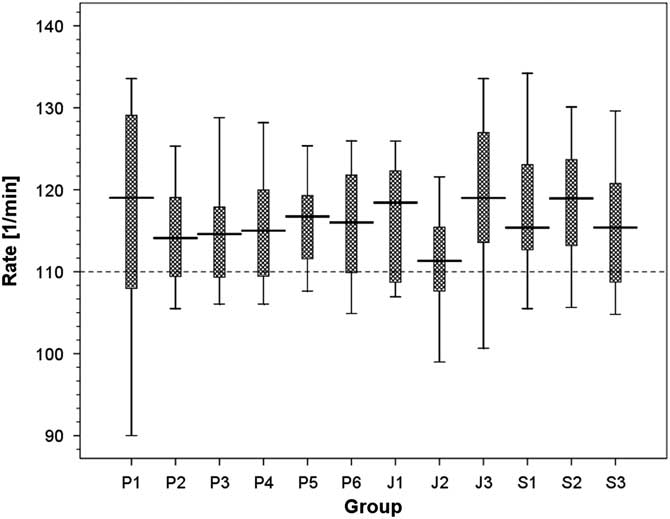
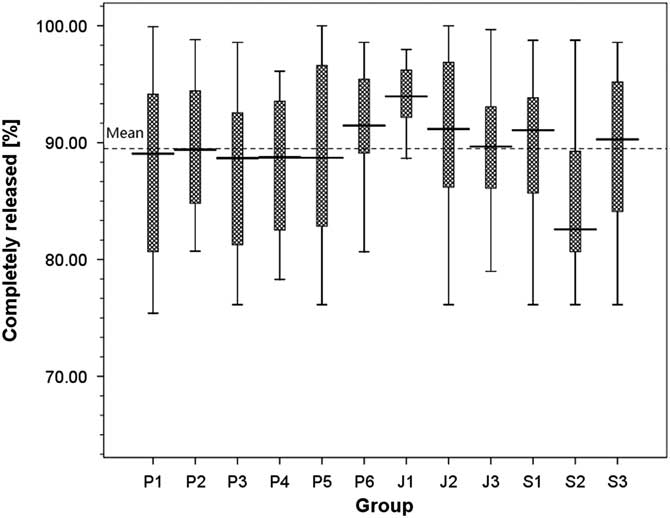
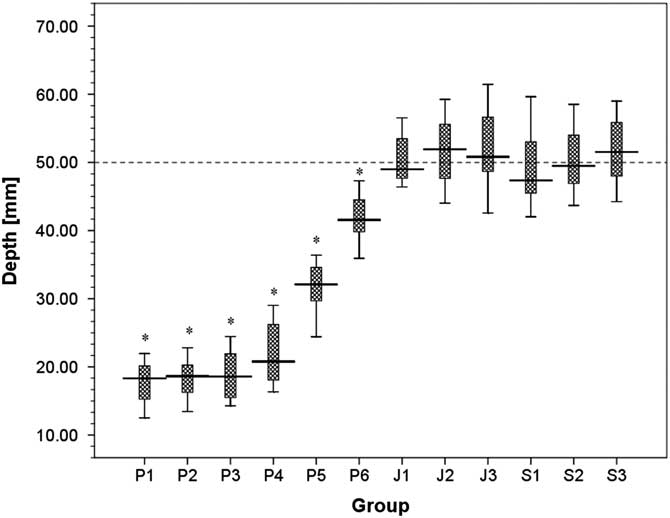
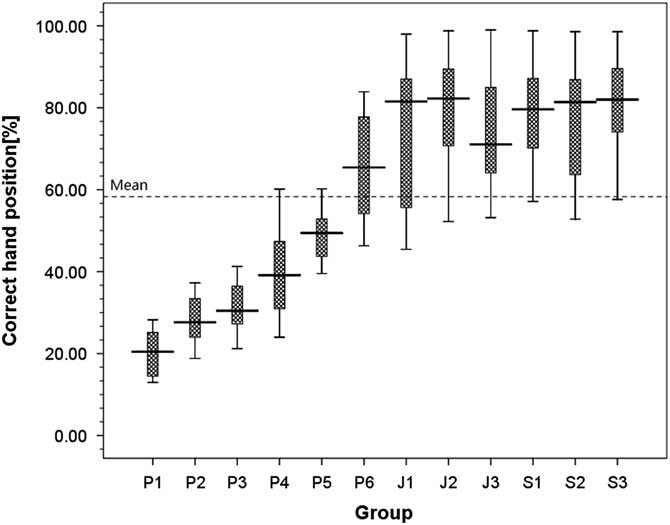
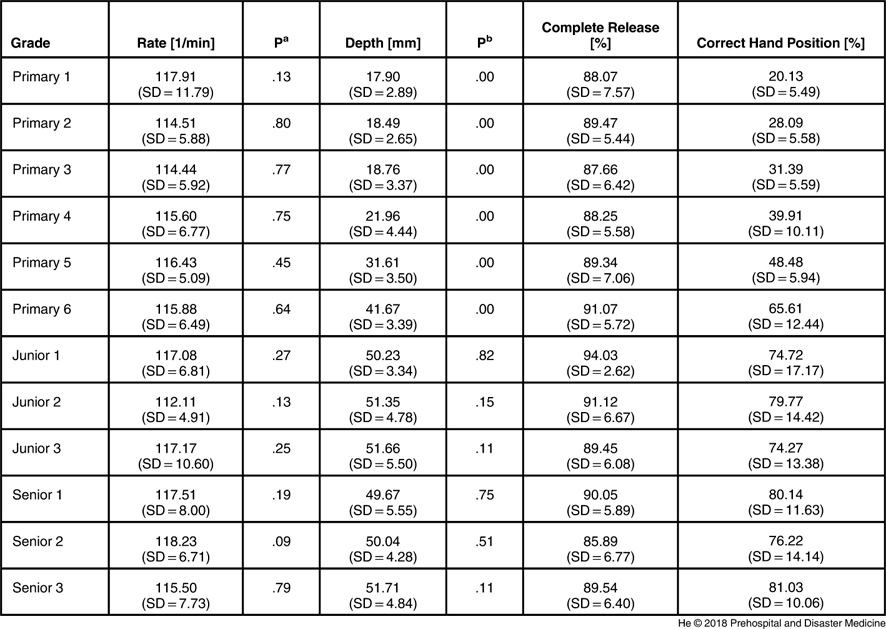
Quality of performance was assessed through comparison with the 2015 AHA CPR guidelines.Reference Neumar, Shuster, Callaway, Gent, Atkins and Bhanji 9 The quality assessment was taken after training for different school grade groups. From the beginning of the P1 group (age of six years), compression rates closely aligned to 110 per minute as the 2015 AHA CPR guidelines recommend (Footnote Table 2, Figure 1). Meanwhile, complete release rates were similar across all the age ranges (Footnote Table 2, Figure 2). However, alignment of compression depth to 50mm began from J1 group (age of 12; Footnote Table 2, Figure 3). Similarly, correct hand position rate in the J1 group and above had reached a much higher level than that of the younger ones (Footnote Table 2, Figure 4).
Compression Rate of Continuous 12 Grades After CPR Training. Abbreviation: CPR, cardiopulmonary resuscitation. * P<.05; One-sample T test, test value=110/min.

Complete Release Rate of Continuous 12 Grades After CPR Training. Note: Mean value=89.47%. Abbreviation: CPR, cardiopulmonary resuscitation.

Compression Depth of Continuous 12 Grades After CPR Training. Abbreviation: CPR, cardiopulmonary resuscitation. * P<.05; One-sample T test, test value=50.00mm.

Correct Hand Position Rate of Continuous 12 Grades After CPR Training. Note: Mean value=58.29%. Abbreviation: CPR, cardiopulmonary resuscitation.

The Quality of Chest Compressions after CPR Training by School Grade

Abbreviation: CPR, cardiopulmonary resuscitation.
a One-sample T test, test value=110/min.
b One-sample T test, test value=50.00mm.
Discussion
The main findings of this study are two-fold. First, compression adequate depth can be achieved since the J1 group (age of 12) and satisfactory correct hand position rate can be reached in the same group of J1 and above. Second, successful compression rate can be achieved at an earlier age (P1, age of six) and complete release rates are similar across all the age ranges. Current recommendations based on evidence from Caucasian students to cultivate a full-capacity CPR rescuer at the age of 12 are also appropriate for East Asians. Moreover, younger students (younger than 12 years old) can still be potential candidates for chest compressions, considering the importance and urgency of CPR training.
Educating school children has been proven to be the optimal way to deliver CPR skills to large parts of the populationReference Bottiger and Van Aken 7 because it is relatively easier and more effective than educating adults. If all students receive practical CPR training in school, a large proportion of the population will master basic skills within a few decades. Therefore, a statement from the European Patient Safety Foundation (EuPSF; Brussels, Belgium), the European Resuscitation Council (ERC; Niel, Belgium), the International Liaison Committee on Resuscitation (ILCOR), and the World Federation of Societies of Anesthesiologists (WFSA; London, United Kingdom), approved by the World Health Organization (WHO; Geneva, Switzerland), recommends that all school children should receive CPR training every year from the age of 12.Reference Greif, Lockey, Conaghan, Lippert, DeVries and Monsieurs 6 This study included students from continuous 12 grades (from Primary 1 to Senior 3), which has been the widest age range ever studied to present knowledge. In this study, students can achieve resuscitation quality of compression rate, depth, and satisfactory correct hand position simultaneously since Junior 1 (age of 12), which is consistent with recommendation as well as the results from other similar studies.Reference Jones, Whitfield, Colquhoun, Chamerlain, Vetter and Newcombe 3 , 5 , Reference Berthelot, Plourde, Bertrand, Bourassa, Couture and Berger-Pelletier 10
Different from compression depth and correct hand position rate, this study indicates that compression rate and complete release rate can be achieved at a much younger age (Primary 1, age of six), which is consistent with previous studies by JonesReference Jones, Whitfield, Colquhoun, Chamerlain, Vetter and Newcombe 3 and Berthelot.Reference Berthelot, Plourde, Bertrand, Bourassa, Couture and Berger-Pelletier 10 The results from this study and previous studies support the view that the ability to provide the correct rate is similar across all the age ranges from primary to senior middle schools. Moreover, this study indicates that a similar situation exists in complete release rate.
The results of this study have important practical implications. First, it is important to find a balance between compression depth and rate. Considering the compression quality, training a full-capacity CPR rescuer at the age of 12 is appropriate. However, younger students still can be potential candidates to be trained, given the importance and urgency of CPR training. Second, the current recommendations for Caucasian students to cultivate a full-capacity CPR rescuer are appropriate for East Asian students as well. This work provides an additional reference for educators to make an optimal choice based on evidence and importance assessment of CPR.
Limitations
There are several limitations in this study. First, the number of students in each group was limited. Second, ventilation assessment was not included in this study given the safety and acceptability of students and their guardians. Lastly, this study assessed the short-term effect of training, while the long-term performance of students after training was not evaluated.
Conclusions
In this study, students older than 12 years can achieve chest compressions satisfactorily as CPR guidelines recommend. The ability to provide the correct compression rate and complete release rate is similar across all the ages ranging from primary to senior schools. Current recommendations for Caucasian students are also appropriate for East Asian students. The optimal age for students to receive CPR training should be decided based on evidence and importance assessment of CPR.