1. Introduction
A sphere and a disk are two prototypical bodies widely studied in the literature. For the case of a sphere both experimental and numerical results are in very good agreement, but significant differences exist for the case of a disk and flat cylinders of large aspect ratio
 ${\it\chi}$
(
 ${\it\chi}=d/h$
, where
 $d$
is the cylinder diameter and
 $h$
stands for its height). We shall call a disk a cylinder of infinite aspect ratio (
 ${\it\chi}=\infty$
). If the body is cylindrical with non-zero height, it will be called a flat cylinder.
The transition in the wakes of a fixed disk and thin flat cylinder of aspect ratio
 ${\it\chi}=10$
, placed in a uniform flow, differs significantly in direct numerical simulations (DNS) of Fabre, Auguste & Magnaudet (Reference Fabre, Auguste and Magnaudet2008) and Shenoy & Kleinstreuer (Reference Shenoy and Kleinstreuer2008) from that widely accepted for a sphere (see Johnson & Patel Reference Johnson and Patel1999; Ghidersa & Dušek Reference Ghidersa and Dušek2000; Tomboulides & Orszag Reference Tomboulides and Orszag2000). The case of the fixed disk placed perpendicular to the flow has been investigated numerically and theoretically by Fabre et al. (Reference Fabre, Auguste and Magnaudet2008) and Meliga, Chomaz & Sipp (Reference Meliga, Chomaz and Sipp2009). They have shown that, similar to the case of a sphere, the primary bifurcation is regular (at the critical Reynolds (
 $\mathit{Re}$
) number 115), but starting from the onset of the secondary Hopf bifurcation (at
 $\mathit{Re}=121$
) the bifurcation scenario becomes different. The Hopf bifurcation gives rise to oscillations perpendicular to the plane selected at the primary bifurcation, yielding a loss of planar symmetry. Fabre et al. (Reference Fabre, Auguste and Magnaudet2008) call the corresponding state ‘reflectional symmetry breaking’ (RSB), whereas Meliga et al. (Reference Meliga, Chomaz and Sipp2009) call it the
 $MM_{{\rm\pi}}$
mode (mixed mode with phase
 ${\rm\pi}$
), to mark the difference from the ‘reflectional symmetry preserving’ (RSP) or
 $MM_{0}$
mode characteristic of the sphere wake. As the amplitude of oscillations of this mode increases, the initially non-zero mean value decreases until the planar symmetry is recovered (at
 $\mathit{Re}\approx 140$
according to Fabre et al.
Reference Fabre, Auguste and Magnaudet2008), albeit in a perpendicular direction to that of the primary bifurcation state. This state is called a standing wave (SW) in both papers.
A thick disk (flat cylinder) of aspect ratio
 ${\it\chi}=3$
has been investigated by Auguste, Fabre & Magnaudet (Reference Auguste, Fabre and Magnaudet2010) and was shown to follow the sphere-like scenario, as far as the first two bifurcations are concerned, until a quasiperiodic (‘knit knot’) mode without planar symmetry sets in. The RSB mode appears only as a fourth bifurcating state. The scenario of a flat disk, in which the RSB mode remains as the second bifurcating state, holds up to aspect ratio 4 for cylinders (see Chrust, Bouchet & Dušek Reference Chrust, Bouchet and Dušek2010). The experimental results obtained by Szaltys et al. (Reference Szaltys, Chrust, Przadka, Goujon-Durand, Tuckerman and Wesfreid2012) and by Bobinski, Goujon-Durand & Wesfreid (Reference Bobinski, Goujon-Durand and Wesfreid2014) for fixed flat cylinders of aspect ratio in the range
 $1\leqslant {\it\chi}\leqslant 24$
did not confirm the numerical predictions, and showed a transition scenario qualitatively similar to that observed for a sphere in the entire aspect ratio range investigated. The numerical and experimental data can be compared for the flat cylinder of aspect ratio
 ${\it\chi}=6$
.
The DNS of Chrust et al. (Reference Chrust, Bouchet and Dušek2010), for a flat cylinder of aspect ratio
 ${\it\chi}=6$
, yielded the threshold of the regular bifurcation in the
 $m=1$
azimuthal subspace at Reynolds number
 $\mathit{Re}_{num}^{I}=137.9$
. Secondary Hopf bifurcation was found to set in at
 $\mathit{Re}_{num}^{II}=150.1$
. The bifurcation was found to be subcritical with a co-existence interval of about
 $[148,150]$
. The periodic oscillating regime attained is characterized by the RSB (
 $MM_{{\rm\pi}}$
) mode, in agreement with results obtained for an infinitely flat disk. The Strouhal number at the threshold is
 $\mathit{St}_{num}^{II}=0.112$
. The mean lift of the RSB mode becomes zero at
 $\mathit{Re}_{num}^{III}=166.0$
and the SW mode is obtained. In contrast, the experiments of Szaltys et al. (Reference Szaltys, Chrust, Przadka, Goujon-Durand, Tuckerman and Wesfreid2012) and Bobinski et al. (Reference Bobinski, Goujon-Durand and Wesfreid2014) provide a different picture.
The experimental thresholds of the primary and secondary bifurcations are reported (see Szaltys et al.
Reference Szaltys, Chrust, Przadka, Goujon-Durand, Tuckerman and Wesfreid2012) as
 $\mathit{Re}_{exp}^{I}=125$
and
 $\mathit{Re}_{exp}^{II}=137$
, and the Strouhal number of oscillations at the onset of the Hopf bifurcation is
 $\mathit{St}_{exp}^{II}=0.16$
. This quantitative disagreement between the experimental and numerical data is relatively minor in view of the most striking difference, namely that the experimentally observed oscillating mode is RSP in the same way as in a sphere wake (see figure 1 of Szaltys et al.
Reference Szaltys, Chrust, Przadka, Goujon-Durand, Tuckerman and Wesfreid2012). The scenario of the sphere wake also persists at higher Reynolds numbers. The SW mode is never observed; instead, at
 $\mathit{Re}_{exp}^{III}=185$
a lower frequency sets in and leads to quasi-periodicity similar to that described by Bouchet, Mebarek & Dušek (Reference Bouchet, Mebarek and Dušek2006) for a sphere.
The disagreement between the transition scenario for thin flat cylinders predicted by DNS and that given by experimental observation motivated a joint discussion between the authors of the numerical and experimental results, with the aim of shedding light on the possible origins of the discrepancies. Three potential experimental deficiencies were identified as possible sources of the departure from the predictions, relevant for the idealized unconfined and perfectly axisymmetric configuration simulated numerically and analysed theoretically. These imperfection factors are (i) the confinement of the experiment, (ii) the support of the cylinder, and (iii) the imperfect perpendicular inclination of the object. Confinement was discounted in view of the very satisfactory qualitative agreement between numerical data and experimental observation for a spherical body in the same experimental set-up as that of Szaltys et al. (Reference Szaltys, Chrust, Przadka, Goujon-Durand, Tuckerman and Wesfreid2012) (see Gumowski et al. Reference Gumowski, Miedzik, Goujon-Durand, Jenffer and Wesfreid2008). In the present paper we mainly focus on the effect of inclination, which can be quantified numerically with high accuracy. An unwanted and uncontrolled inclination might preselect a symmetry plane and change the observed scenario. The support might be expected to have the same effect since it also breaks the axisymmetry of the flow and selects a symmetry plane. The purpose of the numerical investigation is to test the stability of the disk-like scenario quantitatively with respect to the value of the inclination angle.
It is interesting to note that this idea was considered by Meliga et al. (Reference Meliga, Chomaz and Sipp2009) in their weakly non-linear model. A steady forcing term was added to test the effect of imperfect initial axisymmetry. The result was an imperfect bifurcation scenario still dominated by the
 $MM_{{\rm\pi}}$
(RSB) mode, which (obviously) never loses its mean lift and never gives way to the SW one.
As far as strongly inclined disks are concerned, experimental results exist for inclination angles between
 $10^{\circ }$
and
 $50^{\circ }$
(see Calvert Reference Calvert1967) and for high Reynolds numbers (3500–5000). Calvert (Reference Calvert1967) also used flat cylinders of aspect ratio 6 (5.9, according to the data of the paper) and observed strong vortex shedding of increasing frequency with increasing inclination angle. Figure 2 at the end of his paper clearly shows the planar symmetry of the wake. The investigation of the effect of inclination of the disk or of the flat cylinder on the vortex shedding is thus of general interest. This interest is not limited to small inclination angles or to the problem of experimental confirmation of the transition scenario in the idealized perfectly axisymmetric configuration.
The present paper focuses mainly on numerical simulations and aims at providing answers to two fundamental questions.
-
(i) How does the disk-like scenario give way to the sphere-like scenario as the angle of inclination becomes non-zero?
-
(ii) What are the thresholds and the typical Strouhal numbers of vortex shedding at significant inclination angles?
In view of this rather fundamental focus, it is more appropriate to consider the academic configuration of an infinitely thin disk. Nevertheless, to stay close to an experimentally more realistic situation, the flat cylinder of aspect ratio 6 is also considered. In view of the numerical results concerning the first issue, we found it delusory to tackle the issue of axisymmetric and almost axisymmetric configurations by experimental means. Nevertheless, the investigation of strong inclinations seemed to us to be within the possibilities of the available experimental techniques. For this reason, a battery of measurements with flat cylinders of variable inclination was prepared to match the numerical simulations. Despite deficiencies of the experiment, the attempt to compare results might prove very instructive.
2. Numerical implementation
2.1. Equations and numerical method
We now consider either a fixed axisymmetric flat cylinder or a disk, with axis inclined by an arbitrary angle
 ${\it\phi}$
with respect to the direction of the uniform flow. The flow of an incompressible fluid past these bodies is governed by the Navier–Stokes equations (2.1) and (2.2), non-dimensionalized with respect to the inflow velocity
 $U$
and the diameter
 $d$
:
 $$\begin{eqnarray}\displaystyle & \boldsymbol{{\rm\nabla}}\boldsymbol{\cdot }\boldsymbol{v}=0 & \displaystyle\end{eqnarray}$$
 $$\begin{eqnarray}\displaystyle & \displaystyle \frac{\partial \boldsymbol{v}}{\partial t}+(\boldsymbol{v}\boldsymbol{\cdot }\boldsymbol{{\rm\nabla}})\boldsymbol{\cdot }\boldsymbol{v}=-\boldsymbol{{\rm\nabla}}p+\frac{1}{\mathit{Re}}{\rm\nabla}^{2}\boldsymbol{v}. & \displaystyle\end{eqnarray}$$
 $\mathit{Re}$
is defined as
 $\mathit{Re}=Ud/{\it\nu}$
. The second dimensionless parameter, the aspect ratio introduced in the previous section, completely defines the geometry of the cylinder. For an inclined body, the geometry is no longer axisymmetric. To deal with such flow problems we use the recently developed domain decomposition technique (see Chrust, Bouchet & Dušek Reference Chrust, Bouchet and Dušek2013; Chrust, Bouchet & Dušek Reference Chrust, Bouchet and Dušek2014) associated with the spectral–spectral element discretization described in Ghidersa & Dušek (Reference Ghidersa and Dušek2000). The new version with dynamic decomposition of the computational domain was recently used to simulate the path instability of freely moving disks (see the cited papers). In the present paper the computational domain is decomposed into a spherical subdomain containing the non-spherical but still axisymmetric body and the remaining cylindrical part. For a brief description of the method and for the numerical tests see Chrust et al. (Reference Chrust, Bouchet and Dušek2013).
The Navier–Stokes equations are solved in cylindrical coordinates but, throughout the paper, the figures are represented in Cartesian coordinates with the
 $z$
-axis coinciding with the flow direction. In each of the two subdomains, the Navier–Stokes equations are solved in cylindrical coordinates (
 $z,r,{\it\theta}$
), with the
 $z$
-axis parallel to the free-stream direction in the outer subdomain and coinciding with the body symmetry axis in the spherical one (
 $r$
denotes the distance from the axis while
 ${\it\theta}$
is the azimuthal angle). The efficiency of the method relies on the combination of the Fourier expansion in the azimuthal direction with spectral element discretization in the
 $(z,r)$
-plane. In the outer subdomain, no-stress boundary conditions are applied at the outflow and at the lateral boundaries. The flow is forced by a uniform Dirichlet boundary condition at the inflow basis of the cylindrical subdomain. On the surface of the body the no-slip boundary condition is applied. As already mentioned, the
 $(z{-}r)$
-plane is broken up into spectral elements with
 $N$
Gauss–Lobatto–Legendre collocation points in each direction
 $(z,r)$
. The spherical subdomain with centre
 $O$
has a radius
 $R_{s}~(d/2<R_{s}<R_{c})$
, where
 $d$
is the diameter of the cylinder and
 $R_{c}$
denotes the radius of the cylindrical domain. In general, the axes of the subdomains are not aligned. The coupling between the subdomains takes place on the spherical surface of radius
 $R_{s}$
and uses the spherical function expansion. The truncation of both the spherical function expansion at the spherical interface and that of the azimuthal decomposition in each of the subdomains is defined by the maximal polar number
 $\ell _{max}$
retained in the spherical function decomposition.
2.2. Numerical tests
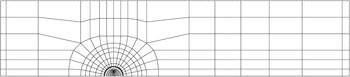
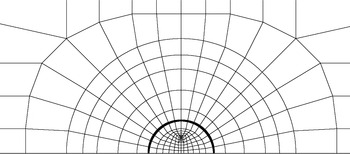
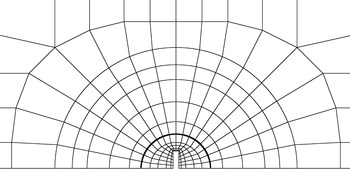
The overall size of the domain and the breakup into spectral elements of the radial–axial plane can be observed in figure 1. The same mesh, without the domain decomposition, was used in Chrust et al. (Reference Chrust, Bouchet and Dušek2010). It was shown that the thresholds of the first two bifurcations in the wake of a fixed disk (placed perpendicular to the flow direction) are insensitive to further increase of the domain size, as well as to the mesh refinement. To better resolve the flow around the sharp edge of the disk, the mesh was refined in its vicinity. Figures 2 and 3 show the enlarged mesh for the flat disk and the cylinder of aspect ratio
 ${\it\chi}=6$
. The resulting number of spectral elements is
 $N_{el}=278$
for the disk and
 $N_{el}=252$
for the flat cylinder. The tests of Chrust et al. (Reference Chrust, Bouchet and Dušek2010) have shown that with this mesh the thresholds of bifurcations can be determined within a fraction of Reynolds number unit.
Thin disk
 ${\it\chi}=\infty$
. Spectral element discretization of the radial–axial plane of the computational domain. The inflow is situated on the left. The cylindrical computational domain of radius
 $R=8d$
extends
 $12d$
upstream and
 $25d$
downstream. The mesh contains
 $N_{el}=278$
spectral elements. The interface at
 $R_{s}=d$
is marked by a thick line.

Thin disk
 ${\it\chi}=\infty$
. Details of the spectral element discretization of the radial–axial plane of the computational domain. The interface at
 $R_{s}=d$
is marked by a thick line.

Cylinder
 ${\it\chi}=6$
. Details of the spectral element discretization of the radial–axial plane of the computational domain. The mesh contains
 $N_{el}=252$
spectral elements. The interface at
 $R_{s}=d$
is marked by a thick line.

Two new numerical parameters arise from the domain decomposition, namely the radius of the spherical subdomain
 $R_{s}$
and the truncation of spherical function expansion
 $\ell _{max}$
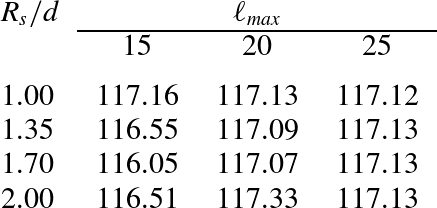
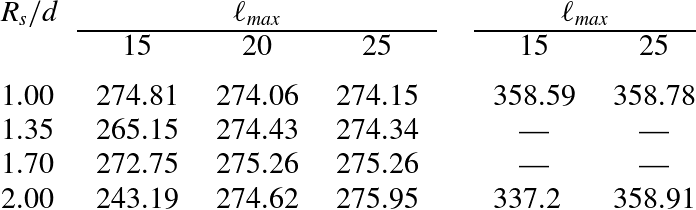
at the interface between the subdomains. Our present concern is to show that the coupling at the spherical interface of the two subdomains does not affect the quality of the numerical simulations. First, we show that the same results are obtained with and without the domain decomposition in the axisymmetric configuration and, secondly, that the numerical convergence can also be demonstrated for an inclined disk. The results of the first test for the cases
 ${\it\chi}=\infty$
and
 ${\it\chi}=1$
are presented in tables 1 and 2. The truncation of the expansion into spherical functions at
 $\ell _{max}=15$
is already sufficient to obtain the accuracy better than 1 % for the thin disk (independent of the radius
 $R_{s}$
). At
 $\ell _{max}=15$
, the error is much higher for the thick cylinder; nevertheless, with moderately increased
 $\ell _{max}$
, virtually the same threshold is obtained independent of the spherical subdomain radius. For the disk, the critical Reynolds number obtained differs by 0.03 % from the benchmark value. For the thick cylinder of aspect ratio
 ${\it\chi}=1$
the largest discrepancy for
 $\ell _{max}=25$
does not exceed 0.6 %. The agreement is even better for the secondary bifurcation threshold. The tables also indicate that the smaller radius
 $R_{s}$
is preferable.
Threshold of the primary bifurcation of an infinitely thin disk
 ${\it\chi}=\infty$
perpendicular to the flow. Influence of the radius
 $R_{s}$
of the spherical domain and of the truncation level
 $\ell _{max}$
of the spherical function expansion. The threshold of the primary bifurcation obtained with the original code is equal to
 $\mathit{Re}_{I}=117.17$
(see Chrust et al.
Reference Chrust, Bouchet and Dušek2010).

Threshold of the primary (left) and secondary (right) bifurcation of a cylinder
 ${\it\chi}=1$
perpendicular to the flow. Influence of the radius
 $R_{s}$
of the spherical domain and of the truncation level
 $\ell _{max}$
. The threshold of the primary and secondary bifurcation obtained with the original code is equal to
 $\mathit{Re}_{I}=274.16$
and
 $\mathit{Re}_{II}=358.89$
. ‘—’ denotes unavailable results.

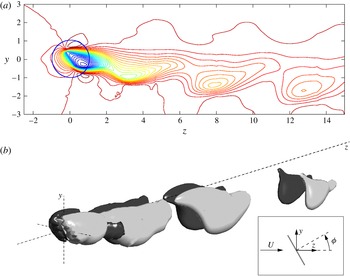
For the disk inclined by
 $30^{\circ }$
, we present in figure 4 the streamwise component of the velocity field in the symmetry plane and the streamwise vorticity at
 $\mathit{Re}=120$
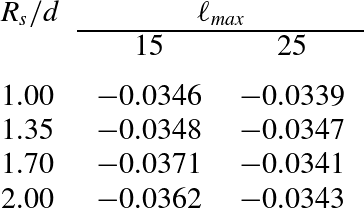
, i.e. in the oscillating regime. The interface between domains remains invisible, proving that its influence on the flow is negligible. Further, table 3 allows us to claim that numerical convergence has occurred.
Disk
 ${\it\chi}=\infty$
,
 $\mathit{Re}=120$
inclined by
 ${\it\phi}=30^{\circ }$
. (a) Streamwise component of the velocity field. The circle marks the interface between two subdomains.
 $\ell _{max}=15$
,
 $R_{s}/d=1$
. (b) Streamwise component of the vorticity at levels
 $\pm 0.2$
. The inclination angle is measured between the streamwise direction (
 $z$
-axis) and the axis of the disk (see the inset in b).

Decay rate of the oscillations of the fixed disk inclined by
 ${\it\phi}=30^{\circ }$
with respect to the free stream direction at
 $\mathit{Re}=105$
. The bifurcation threshold lies at
 $\mathit{Re}_{I}=110$
.

In what follows, the interface radius
 $R_{s}/d=1$
and
 $\ell _{max}=15$
are used.
3. Disk-like versus sphere-like scenario
To address the first issue presented in § 1 i.e. how the disk-like scenario disappears and gives way to the sphere-like scenario when the disk becomes inclined, we considered very small inclination angles. The difficulty in observing the theoretical disk-like scenario experimentally led us to expect the transition from one scenario to the other to be a matter of very small inclination angles.
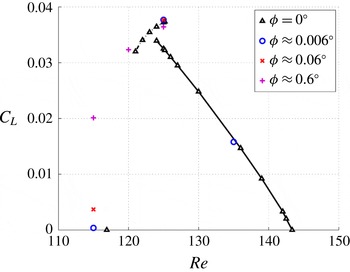
Thin disk
 ${\it\chi}=\infty$
. Lift coefficient for varying inclination close to the onset of instabilities. The increasing branch corresponds to the steady non-axisymmetric state, and the decreasing branch to the unsteady periodic one (the mean value is displayed). Note the subcritical behaviour leading to a narrow interval of coexistence of both states. (Critical Reynolds numbers of the first two bifurcations in the wake of a perpendicular disk:
 $\mathit{Re}_{I}=117$
,
 $\mathit{Re}_{II}=125$
.)

We thus examined angles of inclination of
 $0.0057^{\circ }$
,
 $0.057^{\circ }$
,
 $0.57^{\circ }$
,
 $2^{\circ }$
and
 $4^{\circ }$
. Even the smallest inclination resulted in a non-zero lift; nevertheless, the effects characteristic of the primary (regular) bifurcation persisted. The inclination, no matter how small, selects only the symmetry plane of the resulting flow. The instability increases the lift and makes it approach progressively the same curve as for the perfectly axisymmetric geometry. By rotating the disk about the
 $x$
-axis we select the
 $y{-}z$
plane as symmetry plane. This results in a positive lift in the direction of the
 $y$
-axis for Reynolds numbers below the threshold of unsteadiness. In figure 5 we present the lift coefficient obtained for three small inclination angles and for different Reynolds numbers close to the first two critical Reynolds numbers corresponding to a disk placed exactly perpendicular to the flow direction. At
 $\mathit{Re}=115<\mathit{Re}_{I}$
, the lift is essentially proportional to the inclination angle. In contrast, for
 $\mathit{Re}=125$
all the three values are practically superimposed on that corresponding to
 ${\it\phi}=0^{\circ }$
. The lift is virtually independent of the (small) inclination, which indicates that imperfect bifurcation took place. (Because of the long transients we limited ourselves to reaching the saturated value only for
 ${\it\phi}=0.57^{\circ }$
at
 $\mathit{Re}=120$
. Similarly, at
 $\mathit{Re}=135$
, the mean value of the lift for the oscillating state is represented only for the smallest inclination angle.)
Thin disk
 ${\it\chi}=\infty$
inclined by
 ${\it\phi}=0.0057^{\circ }$
at
 $\mathit{Re}=135$
:(a)
 $y$
-component and (b)
 $x$
-component of the lift coefficient as a function of time. Note the linear scale of (a) and the semi-logarithmic scale of (b).

Thin disk
 ${\it\chi}=\infty$
inclined by
 ${\it\phi}=0.0057^{\circ }$
at
 $\mathit{Re}=135$
. Projection of the lift coefficient on the plane perpendicular to the free stream direction. The oscillations leave the initial symmetry plane and settle with a mean value perpendicular to the initial steady value. (Note that the
 $x$
-component is plotted along the vertical axis.)

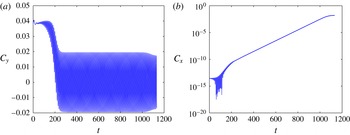
We conclude that, for sufficiently small inclination, the effects of the regular bifurcation are dominant and the role of the inclination is reduced to the selection of the symmetry plane. The main issue, however, is to see what happens at the onset of the Hopf bifurcation. Even a very small inclination yields a surprising result. Recall that when the disk is placed in a position perfectly perpendicular to the flow (so that the configuration is exactly axisymmetric), the Hopf bifurcation triggers oscillations of the lift perpendicular to the symmetry plane. This is not the case for the smallest considered inclination of
 $0.0057^{\circ }$
obtained for
 $\mathit{Re}=135$
(see figures 6 and 7). The simulation was started from the initial condition corresponding to the steady state at
 $\mathit{Re}=125$
(circle symbol at
 $\mathit{Re}=125$
in figure 5). In spite of the tiny value of the inclination angle, the oscillations emerge in the symmetry plane (along the
 $y$
-axis). The symmetry plane appears to be sufficiently stable to allow the Hopf bifurcation to saturate. This occurs after about 200 time units (see figure 6
a). The mean value progressively decreases with the growing amplitude of oscillations. The RSP mode temporarily becomes almost an SW mode. However, the plane of oscillations still respects the symmetry plane imposed by geometry. For
 $\mathit{Re}=135$
and for the introduced small inclination angle this state is unstable. A non-zero mean lift appears in the direction perpendicular to the plane of oscillations, which is characteristic of the RSB (
 $MM_{{\rm\pi}}$
) mode. This can be seen in the
 $C_{x}$
-component of the lift presented in figure 6(b). The growth rate in the
 $x$
-direction is driven by the amplitude of the oscillating mode, since it reaches a constant value at the same time at which the amplitude of
 $C_{y}$
reaches saturation. The growth rate is very small, i.e. the RSP mode is only very weakly unstable. Because of the too perfect initial symmetry (initial value of
 $C_{x}$
of the order of
 $10^{-14}$
), 1000 time units of simulation were needed to obtain a saturation of
 $C_{x}$
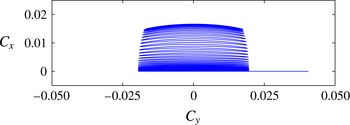
. Figure 7 shows that the plane of the oscillations is progressively shifted in the direction of the
 $x$
-axis, yielding the non-zero mean value of
 $C_{x}$
. The final state is thus again asymmetric and with a non-zero mean lift corresponding to the RSB (
 $MM_{{\rm\pi}}$
) mode, as is the case for a perfectly perpendicular disk. However, the mean lift is perpendicular to the initial symmetry plane while the oscillations occur in a plane parallel to it.
This type of asymptotic mode is in agreement with the weakly non-linear model with a forcing term of Meliga et al. (Reference Meliga, Chomaz and Sipp2009). The somewhat surprising orientation of the resulting mode with the lift perpendicular to the initial symmetry plane is, however, not in contradiction with theory. We note that Meliga et al. (Reference Meliga, Chomaz and Sipp2009) do not discuss the phase
 ${\it\phi}_{A}$
of the complex amplitude
 $A$
of the ‘stationary mode’ in the ‘mixed case’, i.e. when the amplitudes of the ‘spiral modes’ are non-zero. In this case (here we use the equation numbers of the cited paper), instead of the condition (5.5), the imaginary part of (5.4a) yields
 $$\begin{eqnarray}\frac{1}{{\it\epsilon}^{2}}|A|\dot{{\it\phi}_{A}}=|{\it\alpha}_{f}|\sin ({\it\phi}_{f}-{\it\phi}_{A})-\tilde{{\it\chi}}_{A}|B^{+}|\,|B^{-}|\,|A|\sin ({\it\phi}_{B}^{+}-{\it\phi}_{B}^{-}-2{\it\phi}_{A}).\end{eqnarray}$$
At this point the reader is invited to consult the paper by Meliga et al. (Reference Meliga, Chomaz and Sipp2009) to fully understand the underlying theory. Here, to help the reader, we limit ourselves to recalling that the theoretical model deals with the competition of a steady mode characterized by a complex amplitude, written in the trigonometric form
 $A=|A|\,\text{e}^{\text{i}{\it\phi}_{A}}$
, and of a pair of oscillating modes associated with a complex eigenpair characterized by amplitudes
 $B^{\pm }=|B^{\pm }|\,\text{e}^{\text{i}{\it\phi}_{B}^{\pm }}$
. The angle
 ${\it\phi}_{A}$
describes the orientation of the symmetry plane setting in upon breaking the axisymmetry of the flow and the term
 $({\it\phi}_{B}^{+}-{\it\phi}_{B}^{-})/2$
describes the orientation of the plane of oscillations. In the absence of a forcing term (and for a flat cylinder), we obtain the characteristic
 $MM_{{\rm\pi}}$
mode satisfying
 ${\it\phi}_{B}^{+}-{\it\phi}_{B}^{-}-2{\it\phi}_{A}={\rm\pi}$
(which corresponds to the argument of the second sine on the right-hand side of (3.1) equal to
 ${\rm\pi}$
). Otherwise stated, the plane of oscillations makes an angle of
 ${\rm\pi}/2$
with the primary plane of symmetry.
For a steady asymptotic solution
 $\dot{{\it\phi}}_{A}=0$
and a very small forcing amplitude
 $|{\it\alpha}_{f}|\ll \tilde{{\it\chi}}_{A}|B^{+}|\,|B^{-}|\,|A|$
, a non-zero value of
 $\sin ({\it\phi}_{f}-{\it\phi}_{A})$
is compensated by an unobservable deviation of the sum of phases
 ${\it\phi}_{B}^{+}-{\it\phi}_{B}^{-}-2{\it\phi}_{A}$
from
 ${\rm\pi}$
. In contrast, a large forcing allows for a non-zero value of the second sine on the right-hand side of (3.1) without observable departure from the condition
 $\sin ({\it\phi}_{f}-{\it\phi}_{A})=0$
. This allows for shifting to the RSP mode.
The instability of the symmetric state was monitored by evaluating the growth rate of the
 $x$
-component of the lift as a function of the inclination angle (without attempting to reach the saturation). The growth rate only slightly decreases from 0.023 at
 $0.0057^{\circ }$
to 0.022 at
 $0.57^{\circ }$
, but at
 $2^{\circ }$
it was impossible to decide whether a growth was still present, and we estimate that at this inclination angle it is close to zero. At the same time the mean value of the
 $y$
-component of the lift remains visibly non-zero. At
 $4^{\circ }$
the
 $x$
-component of the lift remained at the level of
 $10^{-14}$
, even after the oscillations of the
 $y$
-component had reached saturation, showing the stability of the planar symmetry. Starting from an inclination of
 $4^{\circ }$
, the Hopf bifurcation conserves the symmetry plane. The state has non-zero mean lift in the same plane as that of the oscillations. This is in agreement with the scenario of the sphere wake. As the scenario of the exactly perpendicular disk is limited to extremely small inclinations (smaller than
 $2^{\circ }$
), it is not surprising that it can hardly be confirmed by experiments in which the disk support modifies the flow: the incoming flow is never perfectly uniform and the disk inclination cannot be controlled to sufficiently high accuracy.
4. Large inclinations (exceeding
 $4^{\circ }$
)

This section is devoted to investigation of the wake of a disk and a flat cylinder
 ${\it\chi}=6$
for significant inclinations starting from
 $4^{\circ }$
and reaching
 $60^{\circ }$
. We determine the thresholds of vortex shedding and the oscillation frequencies. We perform experiments for the flat cylinder and compare the results with our DNS. It seems that the experimentally measured frequencies, in particular, are in insufficient agreement with the simulations. More detailed numerical insight is required to explain this discrepancy and provide suggestions for possible improvement of the experimental set-up.
4.1. Infinitely thin disk
For
 ${\it\phi}=4^{\circ }$
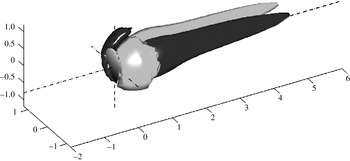
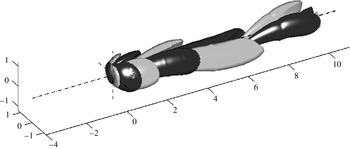
, the symmetry plane was found to be stable, as evidenced in § 3. It is selected by the inclination of the disk, yielding a flow pattern similar to that characterizing the steady planar symmetric flow arising due to symmetry breaking in a perfectly axisymmetric configuration (see figure 8). For small inclinations the imperfect bifurcation enhances the intensity of the counter-rotating vortices. The first true bifurcation is of the Hopf type and gives rise to the typical RSP flow pattern presented in figure 9.
Thin disk
 ${\it\chi}=\infty$
inclined with respect to the free-stream direction by
 ${\it\phi}=4^{\circ }$
at
 $\mathit{Re}=120$
. Axial vorticity iso-surfaces at levels
 $\pm 0.2$
. Steady planar symmetric state.

Thin disk
 ${\it\chi}=\infty$
inclined to the free-stream direction by
 ${\it\phi}=4^{\circ }$
at
 $\mathit{Re}=135$
. Axial vorticity iso-surfaces at levels
 $\pm 0.1$
. Periodic state with non-zero mean lift. The initial plane of symmetry is conserved. The first bifurcation is of Hopf type.

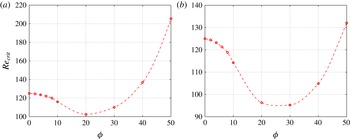
We have investigated numerically the threshold of the Hopf bifurcation as a function of the inclination angle up to
 $50^{\circ }$
. It is not a monotonic function of the inclination angle
 ${\it\phi}$
(see figure 10). At first, the threshold decreases with inclination angle reaching a minimum for
 ${\it\phi}^{min}\approx 20^{\circ }$
. For inclination angles
 ${\it\phi}>20^{\circ }$
, the threshold starts to grow rapidly. The growth is partly due to the definition of the Reynolds number, which does not account for the decreasing perpendicular cross-section of the disk. Nevertheless, a qualitatively similar curve is obtained for the Reynolds number based on the length scale associated with the perpendicular projection of the disk diameter
 $d\cos ({\it\phi})$
.
Thin disk
 ${\it\chi}=\infty$
. Threshold of the Hopf instability as a function of the inclination angle
 ${\it\phi}$
. (a)
 $\mathit{Re}=Ud/{\it\nu}$
; (b)
 $\mathit{Re}=Ud\cos ({\it\phi})/{\it\nu}$
.

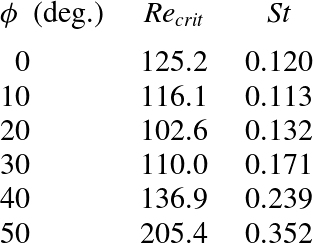
Table 4 sums up the numerically obtained values of the critical Reynolds numbers. The values of the Strouhal number
 $\mathit{St}=fd/U$
(where
 $f$
stands for the oscillation frequency) at the threshold of unsteadiness are also provided. For both dimensionless parameters, the diameter of the disk was chosen as the characteristic length scale (rather than its projection on the plane perpendicular to the flow). After an initial decrease observed for
 ${\it\phi}=10^{\circ }$
, the Strouhal number grows with the inclination angle. In agreement with the observation of Calvert (Reference Calvert1967), we have noticed the strengthening of the vortex structures (level of vorticity) with the inclination
 ${\it\phi}$
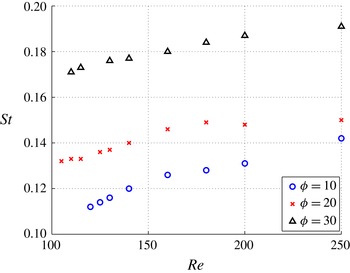
. Except when close to the onset of unsteadiness, the Strouhal number varies only slightly with the Reynolds number (see figure 11). Indeed, the Strouhal numbers computed at
 $\mathit{Re}=250$
, for inclination angles varying from
 $0^{\circ }$
to
 $40^{\circ }$
, agree remarkably well with those obtained by Calvert (Reference Calvert1967) at Reynolds numbers between 3500 and 5000, which indicates that the Strouhal number no longer varies in the turbulent regime (see figure 12).
Thin disk
 ${\it\chi}=\infty$
. Strouhal number as a function of the Reynolds number. For
 $\mathit{Re}>150$
the Strouhal number varies slowly with the Reynolds number. For
 ${\it\phi}=10^{\circ }$
and
 $20^{\circ }$
the flow is already chaotic at
 $\mathit{Re}=250$
. The Strouhal number then corresponds to one of the two dominant peaks of the frequency spectrum.

Thin disk
 ${\it\chi}=\infty$
. Strouhal number as a function of the inclination angle
 ${\it\phi}$
. Comparison of numerical results obtained at
 $\mathit{Re}=250$
with the experimental values obtained by Calvert (Reference Calvert1967) for Reynolds numbers between 3500 and 5000.

Thin disk
 ${\it\chi}=\infty$
. Critical Reynolds and Strouhal numbers at the onset of the periodic state as a function of the inclination angle
 ${\it\phi}$
.

The periodic state with planar symmetry (RSP mode) was observed to persist upon the increase of the Reynolds number for all inclinations
 ${\it\phi}\geqslant 4^{\circ }$
until the transition to chaos. In the interval of Reynolds numbers investigated, chaos was observed for disk inclinations of
 $10^{\circ }$
and
 $20^{\circ }$
starting from
 $\mathit{Re}=250$
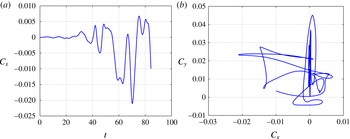
. As can be seen in figure 13, both the periodicity and the planar symmetry of the wake disappear at the onset of chaos.
Thin disk
 ${\it\chi}=\infty$
inclined by
 ${\it\phi}=10^{\circ }$
. Chaotic state at
 $\mathit{Re}=300$
: (a)
 $x$
-component of the lift coefficient as a function of time; (b)
 $x$
-component versus
 $y$
-component of the lift coefficient.

4.2. Flat cylinder of aspect ratio
${\it\chi}=6$
inclined with respect to the free-stream direction: comparison of experiment to DNS

4.2.1. Experimental set-up
We carried out the experiments in a low-velocity horizontal water channel with a rectangular cross-section
 $150~\text{mm}\times 100~\text{mm}$
and a length of the test section of 860 mm (located at the Institute of Aeronautics and Applied Mechanics, Warsaw University of Technology). A typical free-stream velocity ranged between 4 and
 $40~\text{mm}~\text{s}^{-1}$
which, in the case of the cylinder considered, corresponded to Reynolds numbers
 $50{-}500$
(for ambient temperature
 $T=20\,^{\circ }\text{C}$
). The free-stream velocity measured at the centre of the empty channel was used to estimate the Reynolds number. To account for the existence of the boundary layer near the channel walls, we carried out the velocity profiles measurements using laser Doppler anemometry at the cross-section corresponding to the place where the cylinder was mounted (see figure 14). This calibration allowed us to determine the Reynolds number, in the vicinity of the cylinder (in the centre), with a precision of
 $\pm 5\,\%$
.
(a) Measured longitudinal velocity (
 $U_{LDA}$
) profiles inside the channel for different velocities
 $U_{avg}$
(estimated with the average flow rate). (b) Longitudinal velocity difference in the centre of the channel as a function of velocity
 $U_{avg}$
. (c) Displacement thickness
 ${\it\delta}^{\ast }=\int (1+u(y)/U_{0})\text{d}y$
. (d) Momentum thickness
 ${\it\theta}=\int (u(y)/U_{0})(1+u(y)/U_{0})\text{d}y$
, where
 $U_{0}=U_{LDA}|_{y=50}$
.

The cylinder investigated had diameter
 $d=16~\text{mm}$
and thickness
 $h=2.7~\text{mm}$
, resulting in an aspect ratio of
 ${\it\chi}=6$
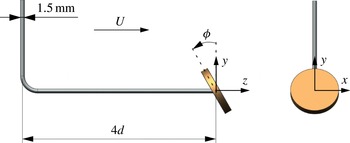
. It was mounted in the central part of the cross-section (at the front of the test section) by a rigid tube of diameter 1.5 mm, which supplied fluorescein dye used for the flow visualization. The dye was injected through a circular orifice on the downstream face of the cylinder. The blockage ratio (defined as the ratio of the cross-sectional area of the cylinder to the cross-sectional area of the channel) was below
 $\mathit{Br}=1.3\,\%$
in the perpendicular configuration. The inclination of the cylinder was obtained by soldering it to the mounting tube at an appropriate angle. The maximum inclination considered in the investigations was
 $60^{\circ }$
. The details of the cylinder support are presented in figure 15.
Details of the cylinder support. Cylinder diameter
 $d=16~\text{mm}$
, thickness
 $h=2.7~\text{mm}$
. The cylinder is inclined to the flow by the angle
 ${\it\phi}$
. The length of the vertical tube of diameter of 1.5 mm was adjusted to keep the cylinder in the middle of the test section for all inclination angles tested.

To verify the onset values obtained with the laser-induced fluorescence (LIF) technique, we employed two-dimensional particle image velocimetry (PIV). This allowed us to obtain quantitative information about the longitudinal vorticity field time evolution. For low Reynolds numbers, we observed a stationary pattern of two counter-rotating vortices. As mean flow velocity increased, i.e. for higher Reynolds numbers, this vortex structure started to oscillate. This procedure was repeated for each investigated inclination of the flat cylinder, confirming the results obtained by means of the LIF method.
The Strouhal number was determined (by the LIF method) by measuring the duration of 100 hairpin shedding oscillations. The measurement error was calculated as
 ${\rm\Delta}\mathit{St}=|\partial \mathit{St}/\partial T|{\rm\Delta}T+|\partial \mathit{St}/\partial U|{\rm\Delta}U+|\partial \mathit{St}/\partial d|{\rm\Delta}d$
, where
 $T$
,
 $U$
,
 $d$
denote the period of hairpin shedding, the mean flow velocity and the cylinder diameter respectively.
4.2.2. Results
The inclination angle
 ${\it\phi}$
of the cylinder varied from
 $0^{\circ }$
to
 $60^{\circ }$
both in experiment and in numerical simulations. In the experiments, we have estimated the accuracy of determining this angle to be
 $\pm 2^{\circ }$
.
The transition scenario, investigated for aspect ratio
 ${\it\chi}=6$
numerically (see Chrust et al.
Reference Chrust, Bouchet and Dušek2010) and experimentally (see Szaltys et al.
Reference Szaltys, Chrust, Przadka, Goujon-Durand, Tuckerman and Wesfreid2012; Bobinski et al.
Reference Bobinski, Goujon-Durand and Wesfreid2014) for a cylinder placed perpendicular to the uniform flow, was discussed in § 1. In principle, the symmetry plane selected by the first bifurcation in numerical simulations is arbitrary and depends only on initial conditions. This is not the case in experiments. The support (see figure 15) imposes the orientation of the symmetry plane. In our case, the tube supporting the cylinder lies in a vertical plane aligned with the free-stream direction. Its influence forces the symmetry plane to coincide with this plane (see figure 1 of Szaltys et al.
Reference Szaltys, Chrust, Przadka, Goujon-Durand, Tuckerman and Wesfreid2012). Gumowski et al. (Reference Gumowski, Miedzik, Goujon-Durand, Jenffer and Wesfreid2008) demonstrated for the case of the sphere that the symmetry plane selected at the primary bifurcation is distorted if the plane defined by the support is not aligned with the free-stream direction. Moreover, this distortion is conserved by the secondary Hopf bifurcation. Szaltys et al. (Reference Szaltys, Chrust, Przadka, Goujon-Durand, Tuckerman and Wesfreid2012) found that the same occurs for the flat cylinder. The orientation of the symmetry plane selected by the support remains unaltered until the transition to chaos.
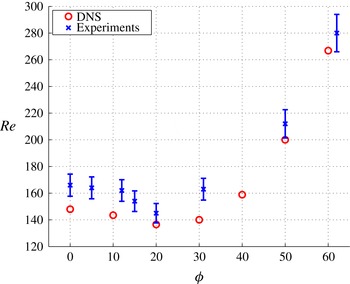
The thresholds of the Hopf bifurcation obtained numerically and experimentally are compared in figure 16. In the experiments, the thresholds were identified based on the fluorescein dye visualization. As the angle of inclination increases, the intensity of the vortex shedding rises, facilitating the determination of the thresholds. For the case of a cylinder perpendicular to the free-stream direction, the onset of visible shedding of vortex structures was preceded by the undulation of the two counter-rotating vortices. The agreement is very satisfactory. The systematic upward shift with respect to the numerical result might stem from the confinement of the water tunnel. The support might also have a stabilizing effect. In both experimental and numerical results, the thresholds of the Hopf bifurcation follow a trend similar to the thin disks. The threshold initially decreases, reaching the minimum for
 ${\it\phi}^{min}\approx 20^{\circ }$
, and starts to grow rapidly for
 ${\it\phi}>{\it\phi}_{min}$
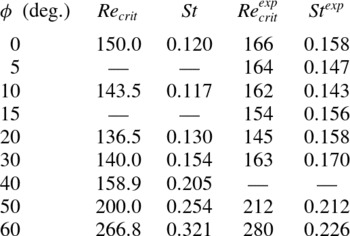
. The Strouhal numbers found numerically and experimentally at the instability thresholds are reported in table 5 along with the critical Reynolds numbers.
Flat cylinder
 ${\it\chi}=6$
. Threshold of the Hopf bifurcation as a function of the inclination angle
 ${\it\phi}$
. (
 $\mathit{Re}=Ud/{\it\nu}$
, where
 $U$
denotes the centreline velocity). Bars represent error margin for experimental results.

Strouhal number at the onset (at
 $\mathit{Re}=\mathit{Re}_{crit}$
) of the periodic state as a function of the inclination angle
 ${\it\phi}$
for a cylinder of aspect ratio
 ${\it\chi}=6$
;
 $\mathit{St}$
refers to numerical (unconfined flow) and
 $\mathit{St}^{exp}$
to experimental results, respectively. Strouhal numbers found experimentally are higher than those predicted by our DNS. Similar overestimation of Strouhal numbers was observed for a sphere. This is related to the blockage effect of the water tunnel and the effect of the support.

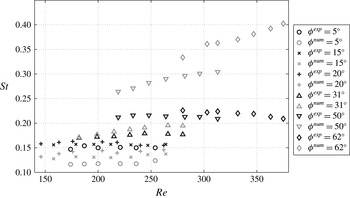
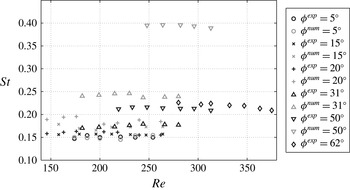
While good agreement between the numerical data and experimental measurements has been obtained as far as the critical Reynolds numbers of the onset of unsteadiness are concerned, this is not the case for the values of Strouhal numbers in table 5. As can be inferred from figure 17, significant differences in the Strouhal number exist between experiment and numerical simulations. For large inclination angles the experimental Strouhal numbers are smaller, and for small angles larger, than values predicted by DNS. The experimentally found Strouhal numbers are almost independent of the Reynolds number. Similar results were reported recently by Klotz et al. (Reference Klotz, Goujon-Durand, Rokicki and Wesfreid2014) for a cube placed in a low-Reynolds water tunnel (with cross-section
 $100~\text{mm}\times 100~\text{mm}$
, located at PMMH, ESPCI). Unlike the experiments by Calvert, which were carried out in a wind tunnel representing to a large extent an unconfined configuration, our experiments were realized in a water channel with non-negligible blockage factor. In contrast, the numerical simulations were performed for an unconfined flow. The disk support was not included in the DNS, while the perturbation it introduces to the flow may have a significant effect on the Strouhal number.
Flat cylinder
 ${\it\chi}=6$
. Strouhal number as a function of Reynolds number for different cylinder inclination angles
 ${\it\phi}$
. Comparison of numerical results (unconfined configuration, pale markers) with the experimental values (dark markers).

In order to clarify the observed differences in the Strouhal number determination, we decided to consider complementary simulations. To assess the effect of the blockage ratio, we performed simulations for the same blockage ratio as in the experiment with the wall boundary condition on the outer surface of the cylindrical computational domain. Figure 18 shows a comparison of the Strouhal numbers obtained for this configuration with experimental results for inclination angles varying from
 $5^{\circ }$
to
 $50^{\circ }$
. The confinement considerably reduces the Reynolds number dependence and shifts the Strouhal numbers upwards. Accounting for confinement yields very good agreement for small inclination angles.
Flat cylinder
 ${\it\chi}=6$
. Comparison of experimental Strouhal numbers with numerical data in the confined configuration (circular tube) of the same blockage ratio. (Pale and dark markers denote, respectively, numerical and experimental results.)

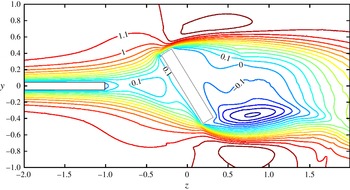
The support is clearly another important source of discrepancies. Due to the details of the numerical implementation (azimuthal Fourier expansion) described in § 2, we were unable to account for the vertical part of the tube constituting the support, but it can be assumed that the essential effect comes from the boundary layer of the tube approaching the upstream face of the cylinder. The spectral Fourier decomposition in the spherical subdomain does not allow the simulation of the tube if the spherical subdomain encompassing the body is rotated. We had to end the tube slightly outside the spherical subdomain. In order to limit the effect of the gap, we chose the radius of the spherical domain to be small and equal to
 $R_{s}=0.75d$
. The horizontal tube, of the same non-dimensionalized diameter as in the experiment, extended from
 $4d$
upstream from the centre (as in the experiment) of the cylinder and ended
 $1d$
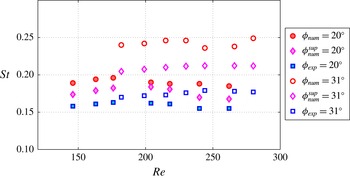
upstream of its centre. Figure 19 shows the zoom on the wake of the support. It can be seen that the junction between the support and the cylinder is quite reliably represented. The velocity in the wake behind the tube barely exceeds 0.1 of the free-stream magnitude. Figure 20 shows the trend obtained for inclination angles
 $20^{\circ }$
and
 $31^{\circ }$
. A very significant downward shift is obtained, especially for the higher inclination angle.
Flat cylinder
 ${\it\chi}=6$
. Wake of the support. Isolines of the streamwise component of the velocity (
 $\text{max}=1.3771$
,
 $\text{min}=-0.51505$
).

Flat cylinder
 ${\it\chi}=6$
. Simulation of the effect of the support. Strouhal number as a function of Reynolds number.
 ${\it\phi}_{num}$
denote numerical results in the confined configuration,
 ${\it\phi}_{num}^{sup}$
denote numerical results in the confined configuration with the simulation of the support,
 ${\it\phi}_{exp}$
correspond to the experimental results.

The purpose of the last two sets of numerical simulations was not to reproduce the experimental data but rather to provide deeper understanding of the origin of discrepancies. This may come in useful for future improvement of the experimental set-up.
5. Conclusions
We have demonstrated that the transition scenario predicted by DNS for flat cylinders of aspect ratio
 ${\it\chi}\geqslant 4$
is purely theoretical. As evidenced for the case of a disk, a slight disturbance of the axial symmetry of the problem results in a significant change. Above the Hopf bifurcation threshold, the (small) inclination of the disk does not select the direction of the mean lift but of the plane of its oscillations. The long transients of the phenomenon indicate the weak stability of the resulting state, making it unlikely to resist experimental disturbances. For inclination angles exceeding
 $2^{\circ }$
, the periodic state without planar symmetry (RSB mode), characteristic of a disk placed perpendicular to the free-stream direction, is suppressed even in numerical simulations. It is replaced by a periodic state with a planar symmetry (RSP mode), qualitatively similar to that observed in the wake of a sphere. We thus infer that it is practically impossible to observe experimentally the scenario numerically and theoretically predicted by Fabre et al. (Reference Fabre, Auguste and Magnaudet2008) and Meliga et al. (Reference Meliga, Chomaz and Sipp2009). This stems from the influence of the support and from the small uncontrolled inclination of the cylinder in the experiments carried out. Their effect is to force the symmetry plane of the wake for all states present in the transition scenario until the appearance of chaos. Inspired by the experimental paper by Calvert (Reference Calvert1967), we have investigated the effect of the inclination on the Hopf bifurcation threshold in the wake of the disk and of the cylinder of aspect ratio
 ${\it\chi}=6$
. For this purpose, we have combined the numerical simulations with experimental measurements. Both the numerical and experimental results are in good agreement as far as the critical Reynolds numbers are concerned.
It can be concluded that, for disks as well as for flat cylinders, the inclination promotes vortex shedding at small inclination angles (the critical Reynolds number decreases). At inclination angles exceeding roughly
 $20^{\circ }$
this trend reverses, even if the Reynolds number is related to the scaled height of the body. While investigating the frequencies of vortex shedding, we have found non-negligible discrepancies between the numerical and experimental data. The experimental Strouhal numbers appeared significantly less sensitive to the inclination angle than evidenced by DNS. The confinement of the water tunnel and the presence of cylinder’s support were identified as possible reasons for this disagreement.