Scholarly engagements with music in the context of empire often invoke a myriad of overlapping questions about aesthetic values and cultural authorities: For whom is imperial musical knowledge created? How do empires create these forms of knowledge? How is musical knowledge reified and/or challenged by the identity of the individual (colonial or otherwise) versus that of the empire? And what of the role of the colonial consumer versus the imperial institution: the colonizer versus the colonized? Through these shifting definitions, where does the elusive musical act emerge? How do imperial and colonial musical practices create or resist authoritative constructions of knowledge – and how can these constructions be usefully interpreted?Footnote 1
These are flagrantly broad – if not impossible – questions. Yet as we approach a cultural history of how the British empire constructed, perpetuated and challenged notions of cultural authority through music, they are relevant to our understanding of how imperial and colonial musical cultures have negotiated the complexities of empire. Ronald Radano and Tejumola Olaniyan have recently challenged musicology to acknowledge the potential of making room for an engagement with the senses within imperial history, although, admittedly, the risk of abstraction runs high:
To propose now that empire be understood within the sensory realm of the auditory might seem to risk perpetuating an already problematic tendency. For if the concept of empire has become too abstract in its excessive usage, it would now appear, as a referent of the sonorous, to draw further into the ether, aligning with immaterial forms and bringing imperial action and history into that what we cannot touch, feel, or see.Footnote 2
My starting point is the act of bringing those musical experiences that we cannot ‘touch, feel, or see’ into dialogue with imperial and colonial archival sources from around 1894. In narrowing my research focus onto two musical individuals who travelled between Britain and South Africa in the 1890s, this article presents a case study of the often conflicting authorities of musical knowledge that were created as a result of imperial systems. By exploring the overlapping themes of empire and authority through music, I thus provide two contrasting narratives of ‘unsettled imperial boundaries’ that examine how new hierarchical spaces for music-making, such as the graded exam and the colonial hymn, could form powerful sites for negotiating imperial and colonial experiences.Footnote 3 While the narratives here concern relatively ‘minor’ historical figures who (probably) never met, the networks reflected in their reception are indicative of the shifting constructions of musical authority across the British empire – systems deeply intertwined with conflicting modes of imperial authority and aesthetic value that were also played out at the level of the individual.
London, 16 July 1894: the examiner
His name was Franklin Taylor.
On a midsummer’s evening in July 1894, the first examiner to travel abroad on behalf of the Associated Board of the Royal Schools of Music (ABRSM) was toasted at the board’s Fifth Annual Dinner. Sir George Grove, president, rose to invite the departing examiner to speak, ‘so that we shall have an opportunity of hearing Mr. Taylor’s farewell accents from the chair which he is going for a few months to forsake us [sic] in favour of the black men’.Footnote 4 The examiner’s destination was the Cape Colony. The location of the farewell dinner was the lavish Whitehall Rooms of the Hotel Metropole in London’s West End. These richly carpeted rooms may still be reserved for formal events today in what is now the Corinthia Hotel in Whitehall Place.Footnote 5 This site was located at the beating heart of the empire, only 300 yards south of Trafalgar Square; the towers of the Palace of Westminster loomed nearby, and Big Ben penetrated the dinner’s soundscape with its regular affirmations of Greenwich Mean Time.
In the summer of 1894, London was brimming with patriotic gestures to imperial and economic expansion, movements closely mirrored by institutional developments in the history of British music. Less than two months previously, the pavements of Prince Consort Road, South Kensington, had been decorated with wreaths and festive lights for the grand opening of the new building of the Royal College of Music (RCM). A few months later, John Stainer would deliver an address to the Twenty-First Annual Meeting of the Musical Association (now the Royal Musical Association) on the success of Britain’s growing musical life.Footnote 6 Beyond musical spheres, July 1894 also marked a period of international and technological developments that simultaneously hailed the expansion of London as a centre of international trade. Global commerce was growing through increased cargo and passenger routes to and from London. The Merchant Shipping Act of 1894 had provided new legislation regulating the registration of ships in the United Kingdom and across the empire.Footnote 7 Within the urban metropolis, traffic patterns were altered on a grand scale when, two miles east of the Hotel Metropole, London’s iconic Tower Bridge was opened for the first time on 30 June, facilitating greater access between the north and south banks of the Thames.Footnote 8
International diplomatic news was also in the air. Earlier on the same day as the ABRSM dinner, in nearby government buildings, the first earl of Kimberley, John Wodehouse, had signed the Anglo-Japanese Treaty of Commerce and Navigation with Japan’s representative, Aoki Shūzō. This was a landmark example of the heralding of the gradual end of extraterritoriality in Japan, and a signal of continuing British diplomacy in the globalizing of trade.Footnote 9 In musical spheres, Japan was also of interest to the east London offices of the Curwen Press, a publishing house with contacts such as the tonic sol-fa evangelist Emily Patton (b. 1831), who was appointed in 1894 to teach tonic sol-fa at the Tokyo Academy of Music.Footnote 10 In addition, the Curwen Press was mass-producing tonic sol-fa hymns and ‘moralizing’ secular songs to be sent to southern Africa, Japan, Burma, China, the United States and the Indian subcontinent.Footnote 11 As the departing examiner, Franklin Taylor (1843–1919), rose to address the ABRSM dinner in London, the transnational networks circulating through the metropole outside perhaps reinforced the international validity of the ABRSM’s enterprise.
Lovedale, South Africa, 16 July 1894: the evangelist
His name was John Knox Bokwe.
As toasts were being raised in London, a Xhosa composer residing in the modest accommodations of the rural mission station of Lovedale, close to the town of Alice near South Africa’s Eastern Cape, was preparing to publish the second edition of a set of Xhosa hymns in tonic sol-fa notation. Ten days later he would be lauded by a local Xhosa newspaper as the creator of the first indigenous compositions by a black musician.Footnote 12 This composer did not know the ABRSM Annual Dinner attendees, and it was unlikely that any of them would hear of him until his hymns crept into British hymnals, but his name would later be familiar throughout the world of Victorian hymn writing.
South Africa in 1894 was considered a precarious colonial outpost. In the unstable years between the end of the First Boer War in 1881 and the commencement of the Second in 1899, and until the military victory of 1902, the Cape Colony was not technically under British dominion. By 1894, however, a British military presence was swiftly growing, with tensions once again mounting between the British and the Dutch.Footnote 13 Grassroots social justice movements for non-white colonial subjects were also developing: in August 1894, Mahatma Gandhi founded the Natal Indian Congress and in September became the first South African of Indian ethnicity to be named an Advocate of the Supreme Court of Natal.Footnote 14 British interest in Africa as a continent worthy of future investment would find robust expression in the First Pan-African Conference in London in 1900, the seeds of which were sown when Henry Sylvester Williams founded the African Association in London in 1897.Footnote 15 And in musical spheres, tonic sol-fa hymnody had been introduced so successfully to the Cape Colony by missionaries that the exchange began to work both ways, as Xhosa hymns in tonic sol-fa from Lovedale would travel in the 1890s, along with their composer, John Knox Bokwe (1855–1922), all the way back to London, and even as far north as Scotland.Footnote 16
Taylor’s submission; Bokwe’s authority? Negotiating colonial musical knowledge
A close engagement with these two musical figures – the white examiner from London who tours to South Africa and the black journalist and minister of the Scottish Free Church from the Lovedale Mission Station who later travels through London and as far north as Scotland – constitutes an example of the powerful yet often porous modes of musical authority that resulted from imperial contact.
My starting point is to ask how the networks of aesthetic value that both Taylor and Bokwe encountered were implicitly imbued with imperial and racial ideologies. I take as a wider framework the concept of ‘transnationalism’, adopting Bob van der Linden’s idea that to investigate ‘musical parallels, networks, and interactions within “webs of empire” that were independent and mutually constitutive in metropolis and colony’ will create novel contributions to transnational musical understanding,Footnote 17 and Ghosh and Kennedy’s contention that expanding our assessments of traditional binaries between metropole and colony will ‘extend our analytical focus to the multiple networks of exchange that arose from the imperial experience’.Footnote 18 In this way, Taylor’s and Bokwe’s musical lives are far from binary opposites, despite the superficial appeal of placing them into the categories of ‘colonizer and colonized’.Footnote 19 Rather, the ‘webs’ of their experience are suggestive of how musical experience can reappropriate imperial hierarchies at the level of the individual rather than the state: Taylor, the imperialist, was still ‘submissive’ to the higher authorities of the ABRSM’s global aims; Bokwe, the colonial subject, is remembered today for writing some of the first choral music of South Africa’s black resistance.
Thus, the juxtaposition of these two transnational musical careers is deeply suggestive of the complexities of legitimizing sonic knowledge as an authoritative presence. Music, here, is a particularly compelling place to start precisely because of its cultural permeability. Georgina Born has asked, ‘Is there something especially complex about music as an object in the world, and as an object of study [which requires] an expanded analytics of the social, cultural and material in music?’Footnote 20 If the answer to this question is, indeed, yes, then the transnational accounts that follow may stand as a reflection of the complex identities of music and authority found within the cultural networks between South Africa and Britain towards the end of the nineteenth century. The synchronized presentation of these narratives in this article therefore attempts a transnational comparison where the pairing of two musical careers that might appear superficially opposite highlights corresponding negotiations of musical knowledge and value. This juxtaposition opens the door to future readings of power structures played out across and against boundaries of institution, class and race.
Imperialism, unavoidably, is found at the core of late nineteenth-century acts of musical exchange between Britain and South Africa. The growing empire had set in motion a fundamental need for new international definitions of music, race and authority in Britain and its colonies across the decade of the 1890s. On a surface level, this was used as a primary justification for the promotion of standardized music exams abroad: for example, only three years after Taylor was sent to South Africa, it was noted at the ABRSM’s Eighth Annual Dinner in 1897 that their international exams were ‘producing a result which is most useful to the dispersal of musical education not only over all England, but over the Colonies, which may be said to represent the whole world’.Footnote 21
The rhetorical convention of defining institutional success in London with reference to the colonies (effectively, ‘the world’) was particularly apparent in so far as national projects for cultural education were concerned – musical or otherwise.Footnote 22 As discussed below, institutional definitions of musical success in late nineteenth-century London relied ever more heavily on the justification of institutional growth in the colonies. Taylor’s travels to South Africa, for example, functioned for the ABRSM as an essential cog in its examining machinery. Likewise, colonial musical compositions recorded in the colonizer’s notation (whether staff or sol-fa) existed within a musical and theoretical vocabulary that was closely related to imperial evangelizing and examining projects.
South Africa in the 1890s was the first international outpost for the ABRSM examinations, and was at the same time one of the largest locations for the spread of tonic sol-fa outside Britain.Footnote 23 There was also a precedent for South Africa as an examining outpost: Trinity College of Music, the ABRSM’s main competitor, had already been examining there since 1881.Footnote 24 Thus, the press in London had ample opportunity to report about musical activities in the Cape. Preference, perhaps unsurprisingly, was often given to musical individuals who had connections with Britain: the eager recognition given to both Taylor and Bokwe by newspapers and publishing companies in Britain and South Africa, for example, would not have been possible had they not both been well-educated, fairly well-connected men, even though neither had originally come from a particularly elite background.Footnote 25 Yet their names commonly arose in the public press and in publishing advertisements in the 1890s in part because both made relatively high-profile international trips; as the Musical News noted the week after the ABRSM July 1894 dinner, for instance, ‘Mr. Franklin Taylor’s mission […] will be watched with much interest,’Footnote 26 a comment which rang true when the press reported on the South Africa examining tours for years to come.Footnote 27
Still, neither man was first and foremost a composer of ‘great musical works’, and perhaps because of this, neither Taylor nor Bokwe were particularly canonized within musicology after their lifetimes. Several explanations for this might be traced to social tiers based on race and class, and the inescapability of the social positioning of educated lower-middle-class men who could rise only so far in their respective musical industries (especially if, like Bokwe, they had dark skin).Footnote 28 That said, their ability to traverse international boundaries to some extent challenged these social preconceptions.
Franklin Taylor, examiner
It was a career marked by ever-increasing circuits of travel. The pianist Franklin Taylor had progressed in his early career from being an organist in Birmingham to studying at the prestigious Leipzig Conservatory.Footnote 29 Following his years in Leipzig under Ignaz Moscheles (1859–61), Taylor later studied with Clara Schumann in Paris, before settling down into a permanent post under Grove at the RCM in London, where he became one of the founder members of the ABRSM.Footnote 30 This was a move that eventually allowed him to travel to the peripheries of the empire to examine junior candidates in music.
The examining tours to South Africa were, to a degree, a career step. A loyal member of staff at the RCM, Taylor had still mostly served as a junior colleague to the board’s president, Grove.Footnote 31 Consequently, and perhaps precisely because he never rose to the top-tier levels of administrative management as had his colleagues Grove and Arthur Sullivan, Taylor was placed in the position of travelling as the ABRSM’s first international examiner.Footnote 32 These tours were tiring and often financially draining, and took examiners away from their families for months at a time.Footnote 33 In climates unknown to him, Taylor would have stayed at local hotels of widely varying standards, enduring – as many colonial examiners were to complain – hours of examining on pianos in humid climates which were notoriously in bad condition.Footnote 34
When he arrived in South Africa, Taylor was thus simultaneously the sole representative of British musical prestige and a highly visible employee (one might even posit, ambassador) of the ABRSM.Footnote 35 His presence on the one hand resembled a benevolent construction of the spread of ‘good’ music, while on the other hand it deeply reinforced commodifiable imperial hierarchies. As Timothy Keegan notes with regard to the growth of colonial administration and systematized bureaucracy in South Africa, ‘It is ironic that the triumph of liberal economic and social values in the nineteenth-century European world should have coincided with the intensification and spread of race consciousness and theories of racial supremacy.’Footnote 36 Adding music – a ‘liberal’ subject – to this hierarchical system further complicates a postcolonial critique, for, in the Victorian mindset, the spread of British music abroad carried inherently philanthropic, rather than specifically authoritarian, connotations.Footnote 37
What did it signify, then, to export musical ‘value’ – in the form of certification – abroad? Taylor had not often challenged the authorities of musical education to which he had been exposed. Having been trained by the most esteemed German teachers at the Leipzig Conservatory, he had returned to Britain able to promote himself with the most prestigious of musical accreditations (for musical authority, prior to the founding of the RCM, did not belong to Britain).Footnote 38 At the same time, a job at the RCM also provided financial security, and when it came to the extra remuneration of examining for the ABRSM, Taylor was, at its inception, classed as a senior professor in its two-tier system of wages, earning £7 10s. for a six-hour day, exclusive of travel and hotel expenses.Footnote 39
The uprooting of Taylor to the colonial context is symbolic of larger cultural associations with knowledge constructions of aesthetic value. In Taylor’s case, his social standing as a music examiner during his two-month trip to South Africa would have placed him in a position of racial and intellectual authority that he had not previously known. At the same time, his authority as examiner was based on his ability to administer the certifications of auditory surveillance put in place by his superiors at the ABRSM.Footnote 40 In practice this meant that he was, institutionally speaking, interchangeable with any other examiner they might have sent in his stead. Although he was in a new position of power when examining colonial children in South Africa, Taylor was still operating as a representative of the ABRSM’s authority, abiding by its rules and expectations. His background in choral societies and lack of a general formal education outside musical spheres (notably in the classical languages, which were still held as the benchmark of elite status) would forever place him on a slightly lower social footing than his superiors.Footnote 41 Moreover, despite many attempts to do so, he was unsuccessful at gaining promotions within the RCM: in 1894 he had applied and was short-listed for the position of director of the RCM, as Grove’s health declined, but the council unanimously chose Parry, given Grove’s emphatic recommendation that it be someone whom he thought suited in intellect to the job.Footnote 42
Taylor’s position therefore embodies the paradox of the colonial music examiner: he found himself in a place of unprecedented colonial authority only because he was unable to gain greater authority within his institution at home.Footnote 43 Indeed, the intellectual snobbery of some of his institutional superiors in London is implied by throwaway comments made within these social circles. For example, Grove was to recall with annoyance that while on holiday on the Isle of Wight with Taylor and his wife, Minna, he had been ‘annoyed that the Taylors were intellectually inadequate, unaccustomed to reading and conscious only of superficialities’; in irritation, he had sullenly retreated from them to immerse himself in ‘Longfellow and Wordsworth’.Footnote 44
Taylor’s ultimate legacy of musical knowledge in Britain lay within his pupils, many of whom became examiners themselves.Footnote 45 Thus, perhaps for Taylor, musical examining as self-promotion not only related to his impact in South Africa, but also aided his status on his home turf. At the 1894 Annual Dinner, Grove had bestowed warm public praise upon Taylor, referring to him as an ‘intimate and dear friend’ of many years who had been his most ‘valued colleague at the Royal College of Music since the very beginning’ and concluding, ‘I know no man on whose ability, on whose knowledge, and more than both, on whose judgment I more confidently rely. I cannot think it a more happy circumstance and an excellent omen that he should have been chosen to be our first apostle to distant regions.’Footnote 46 And once the first examining tour was deemed successful, this status could remain: Taylor would visit the Cape Colony again on a second trip which followed in 1896, when ABRSM examinations were already being proposed for Malta, Tasmania, New Zealand, British Columbia and Gibraltar.Footnote 47
In making his farewell toast in London in July 1894, Taylor was now placed in a new position. Having been so constructed as an apostle of musical truth to the colonies, he rose to speak to the room of dignitaries and musicians. Taylor thanked the ABRSM for the opportunity to represent it, and concluded that he would be careful at all times to represent its standards rather than to insert his own individual opinions regarding the expected South African candidates.Footnote 48 He reiterated his understanding of the board’s international superiority (not to mention the necessity of an examinations board, above and beyond business objectives) by supposing that the standards in South Africa would probably not be very high, and that although he would take that into consideration, the ABRSM standards were not to be compromised:
I can only say I shall do my very best on my visit to make the name of the Associated Board respected in that land. I shall not be over harsh I hope in my judgment, because I do not think it right to expect too much. Were I to do so I might be disappointed. I hear from the Cape that there are something like 400 candidates to be examined, so I think I shall have my hands full.Footnote 49
Taylor’s projections concerning the low quality of the musical candidates in the colonies were challenged by the results at the end of September: of his 346 colonial candidates, 77% received a pass, which was notably higher than the average pass rates for music examinations in Britain, which averaged around 50%.Footnote 50 What can be surmised is that his journey placed him, in race, social standing and gender, at a higher level of musical authority than he could attain in London, where he would always be one examiner among many. In one sense, then, empire worked for him, at least as defined by the ABRSM’s work abroad, as it had worked for generations of East India Company men and the colonial functionaries of the Raj.Footnote 51 Yet there was also the danger that empire might work against him, as the 1894 departure was unprecedented, and perhaps the necessity for a musical examiner in the colonies was not taken for granted in South Africa itself – not to mention the mounting tensions of another Boer War, and the risk of a lack of relevance of the ABRSM exams to the daily life of South African residents. As the historian T. C. McCaskie notes, the apprehensiveness of colonial encounter risks complex misunderstandings of authority:
Encounters between cultures are complex, ambiguous, and unstable transactions, simultaneously events in time and works of the imagination. Their leitmotif is a tangled knot of realities and representations. This is difficult to untie, for it clothes issues of cause and effect in projections and fantasies. Motive and purpose then become hard to tease out of an already complex factual record that reveals the process of encounter between cultures as a constantly shifting kaleidoscope of give and take. Tension is implicit in this quotidian incommensurability between cultures. Thus, imperatives to imposition and acculturation by one side invoke strategies of negotiation and acculturation by the other. The historical result is an ever evolving cultural hybrid in which the imagined, willed, and contingent acts are densely interwoven.Footnote 52
Applying McCaskie’s notion of a ‘constantly shifting kaleidoscope of give and take’ to an anecdote of Taylor’s second examining trip to South Africa two years later in 1896 opens the door to a historiographic reimagining of the many variables of gender, race, class, smell, subjectivity, perceptual abilities, personal boundaries and new soundscapes in the colonial examining process. During his first trip in 1894, affiliated with the University of the Cape of Good Hope, he had examined primarily in and around Cape Town, although he also went to Paarl, Stellenbosch, Wynberg, George, Kimberley and Burgersdorp.Footnote 53 During his second examination tour, Taylor covered 15 centres around the southern Cape, after which he reported to the board that there was growing ‘keen interest’ in the exams, ‘not only by the candidates themselves, but by the teachers, who are unanimous in earnestly desiring that means may be found to render the scheme a permanent one, and that similar examinations might be held year by year’.Footnote 54
One might well imagine that in South Africa, just as in Britain, the rarity and prestigious appeal of the examination certificate – musical success reified on paper with the seal of London’s approval – was a nerve-inducing factor for both candidate and examiner. Published three years after the second trip in interviews for the Musical Times, the following is an example of the lengths to which a colonial examinee might go to participate in the British examinations. Summarizing an interview with Taylor, the journal reported that he dictated the following story from the 1896 trip:
At Uitenhage, a place two hours’ railway journey from Port Elizabeth, a young lady candidate was inadvertently absent from the examination, at the conclusion of which Mr. Taylor returned to Port Elizabeth. He was seated in the smoking-room of his hotel when two ladies entered the apartment – the younger was the absentee examinee, the other, her governess. They had travelled the two hours’ journey by rail to lay siege to the examiner. They knew not his visage, except by description, nor did they know his whereabouts. They had visited all the hotels, looked in at various windows, and at last, about 9 p.m., they tracked the examiner down. All three then made their way to an upper verandah, at one end of which there was an old upright pianoforte. The other occupants of the apartment discreetly moved to a respectful distance, and the examination proceeded. The candidate and her chaperone then started upon their two hours’ railway journey home again, which they would reach somewhere about midnight. ‘There is enthusiasm for you’, Mr. Taylor [says], ‘But did she pass’, [the Musical Times asks]? ‘Yes; she did’, he laughingly replies.Footnote 55
This episode is indicative of Taylor’s evident status and cultural cache within the heart of the Cape Colony – or, at least, how he wished to (re)present this story to a wide London readership. The fact that he later relayed it in an interview with the Musical Times would suggest his pleasure in remembering the fevered pursuit of this young girl and her governess for his examining attentions, all the way from rural Uitenhage to his intimate smoking room in Port Elizabeth.Footnote 56 The dynamic of prestige, not to mention the nerves and the uncertainty as to the unstated reason for the delay to their journey (as the quotation reveals, it had been anticipated that the examination would take place in Uitenhage, not the larger Port Elizabeth), display the lengths to which the candidate in question was willing to go in the name of musical accreditation from London. Although Uitenhage is relatively close to Port Elizabeth by the standards of modern travel (around 35 miles), roads were unreliable at the time and this would have been a two-hour journey by slow train. Given that the candidate and her governess were unaccompanied females, they probably lacked the ability to travel by road.Footnote 57
The tone of the Musical Times with regard to this anecdote is largely sympathetic to the lost pair, except inasmuch as they are said to have wanted to ‘lay siege’ to the examiner – perhaps a joking turn of phrase but conceivably also a disparaging one, with a nod to the visible strain brought on after a day of being nervous and lost, asking stranger after stranger for directions. The experience of hastily walking as a woman and a girl along the large streets of Port Elizabeth, led only by the ‘visage, [unknown] except by description’ of the examiner, brought the vulnerable pair into an urban environment much larger than their home town.Footnote 58 The young examinee also ran the risk of scandal by entering a hotel in the dark of night with only a female chaperone.
Taylor’s memory of this enaction of imperial and gendered authority, mediated by time, space and the presence of the journalist for the Musical Times, requires a process of reimagining imperial musical authority that tantalizingly leaves much to the imagination for the reader both in 1899 and today. We do not know whether the event was inappropriate, amusing or even simply tedious. Perhaps Taylor told her that she passed there and then; perhaps she waited to receive her report in due course. Whatever did occur on that evening, there on the verandah the young white girl, her governess and the middle-aged Englishman enacted a musical examination governed by power structures that the candidate, along with many readers back in London in 1899, could potentially barely articulate. The Bach invention or Czerny exercise on her ABRSM syllabus, a gold standard of truth and authority, had appeared before her in the physical form of Taylor as examiner. His final ruling on her mark would forever remain undisputed.Footnote 59
Like all of the historically imagined details of this examining encounter on the dimly lit verandah, the extent to which the nameless girl took this certification as gospel truth is impossible to know: the archive is silent about this, and the realm of speculation must lie open to alternative possibilities. However, from the anecdotal tone of the Musical Times report, we might wonder if the article was, through the telling of this story, partially questioning the veracity of foreign elite musical accreditation. After all, this periodical, as might be remembered from its full title at the time, the Musical Times and Singing Class Circular (it was not shortened to the Musical Times until 1903), functioned as a public voice interested in just that: the musical times of the ‘singing class’ that John Curwen’s tonic sol-fa movement – in many respects, the antithesis of the ABRSM mindset – would have represented. The tone of the journal intentionally framed its musical debates in reference to a social class more receptive to the background of the rural musical candidate than to that of her examiner, even though he too had originally come from humbler origins. However, earlier in the 1899 Musical Times article, working-class sympathy had also been elicited for the examiner when it was noted that Taylor ‘cannot boast of a musical ancestry’, and had been raised on informal music lessons from his mother before becoming heavily involved with the working-class, patriotic choral performances in Birmingham that were part of the Hullah singing class movement.Footnote 60
The interpretative possibilities behind this anecdote – emphasizing the boundaries between what might be imagined as inappropriate, humorous or excessive – are indeed emblematic of a larger movement in the public press at the time to challenge the imperial authority that a standardized musical examination represented. Only three months earlier, indeed, the very same Musical Times had published an article explicitly declaring Britain to be ‘the most examined nation on earth’,Footnote 61 self-consciously downplaying the objectivity of all examining boards. Moreover, as the journal was a vehicle of the singing classes, the elite routes to musical education that it marketed as simply the first step en route to staff notation, coupled with the growing financial burden of music examinations, were conceivably at the back of many readers’ minds. Accordingly, this journal, and others like it, often allied its journalistic tone with the point of view of the working classes, rather than that of the top tier of musical examiners.
On the other hand, the length and detail of this five-page interview published in 1899 demonstrate that both Taylor and the Musical Times saw something to gain from this mutual attention, and the journal does work to make Taylor relatable to its ‘singing classes’. Recalling that in Birmingham the 13-year-old Taylor had composed for a Hullah-style choral society a part-song entitled ‘Hurrah for England’,Footnote 62 the article goes on to link this patriotic song to current events in South Africa: ‘Only the other day this juvenile composition was recalled to Mr. Taylor’s memory when he read in the newspapers of the departure of troops to the Transvaal to the strains of “Hurrah for England”.’Footnote 63 The Musical Times, in short, represents Taylor as a man not only rooted in communal music-making in Birmingham, but also patriotically linked to the project of authority formation around commodifiable imperial standards.
By contrast, the Musical News, a publication sponsored by the Curwen Press,Footnote 64 the largest tonic sol-fa publishing company at the time, was more willing to criticize standardized music examinations as a commercial scam. It noted that for examinations given abroad, ‘The scheme is pretty extensive, and we observe that the fee set down is two guineas, so it cannot be said that the examination is a cheap one, nor is the standard one which can easily be passed,’ concluding that all of this amounted to yet ‘another instance of the estimation in which music is held by the far-away subjects of our vast empire’.Footnote 65 When Taylor retired from the ABRSM in 1917, however, the Musical News commented on his importance within the ABRSM’s history, noting that: ‘Mr. Taylor was an original member, and one of the most assiduous workers they ever had. He was largely instrumental in shaping their work and policy, especially in connection with the examinations in South Africa, while his position as an examiner, teacher, and authority was well known.’Footnote 66 Thus, although the authority of an unknown examiner might have been suspicious for many readers of the Musical News, Taylor’s authoritative position was later suggested to be unquestionable.
How Taylor himself remembered the way in which musical authority was constructed as part of these examination tours is left up to conjecture. It is not recorded what his attitudes might have been to black South Africans in general – such as the Xhosa people known in colonial parlance as ‘kaffirs’, who would have been around him constantly as servants and drivers even if they were not taking the examinations. His willingness to enact musical parodies of race was to all intents and purposes in line with conventional white middle-class Victorian attitudes. This is revealed in a memory regarding his time in Leipzig mentioned by the same Musical Times interview from 1899, where it is noted that in his youth he had joined forces with fellow conservatory students Domenico Dragonetti Barnett (a grandson of Robert Lindley and son of John Barnett), Sullivan and the young Leonidas Polk Wheat from Tennessee to form an informal Blackface Christy Minstrel Troupe.Footnote 67 As Taylor recalled, for their student fun and games,
We had proper nigger wigs (although Sullivan, with his immense shock of black hair, hardly needed any addition to his pericranium), paste-board standing shirt collars of a very pronounced Gladstonian type, and we made our faces very black. Oh! the agony of washing it off! Barnett played the bones, Sullivan the tambourine, Wheat the violin, and, as there was not such a thing as the banjo to be had in Germany, I extemporized that indispensable Ethiopian instrument by playing the part upon a viola, pizzicato! We sang four-part songs. Sullivan sang ‘Uncle Ned’, while I contributed ‘Oh! Suzannah’; and we played in fine style the ‘Yankee Doodle Gallop’.Footnote 68
This is a provocative example of the pervasiveness of blackface minstrelsy in nineteenth-century British and American culture,Footnote 69 and of Taylor’s use of music as an excuse for the darkening of his own skin, which he did not give up entirely after returning to Britain, as he and Sullivan are later referred to as raucously dressing up as the ‘niggers of Leipzig’ when they visited Grove’s south London home.Footnote 70 While the ‘agony of washing it off’ might simply have referred to the physical difficulty of scrubbing off the burnt cork, this throwaway statement might also be taken as a broad metaphor for the complexity and intensity of conceptions of racial difference based on widely held attitudes towards the complexities of skin colour, music and entertainment outside the conservatory and the examination board.
It is doubtful that Taylor actually examined a non-white candidate – although of course he would have been surrounded by black Africans during his journeys between examining venues. Evidence for the rarity of non-‘British’ candidates from the nineteenth-century music examinations in South Africa is revealed in a comment by Walter Parratt, who, examining for the ABRSM in South Africa a few years after Taylor’s first tour, later recalled in a ‘Reminiscence’ printed in the Royal College of Music Magazine that although children of Dutch ethnicity were very common among his candidates, only two black students had enrolled for the examinations, and they were not up to the standard of the white children: ‘Among my candidates I had numbers of Smuts, Jouberts, de Wets, and once I examined two Kaffirs and tried hard to pass them, but without success.’Footnote 71
This scarcity of black examinees meant that Taylor may well not have directly encountered in the musical African a rebuke to his youthful cross-racial dressing for domestic performances of minstrelsy – or if he did, his silence about it is powerful too. What was talked about in the press with regard to music examinations was the musical progress of the white candidate, even if, incongruously, black South Africans were feared by British missionaries as being more innately musical in their biological evolution.Footnote 72 In other words, examined musical accreditation could be the sole province of white candidates in the ‘dark continent’ only so long as it was regulated by examination practices that effectively eliminated the non-white body.Footnote 73 This construction of Victorian musical progress as necessitating ostensibly raceless and objective ‘standards’ of performance norms that were nonetheless practised within the pedagogical culture of colonial whiteness was at the core of Taylor’s personal pedagogical ideology. Systematizations of instrumental music became Taylor’s justification for moving away from the choral movements he grew up with, in part because adhering to new standardized systems and to the project of German instrumental music had enabled him to rise as far in terms of institutional prestige as he could possibly go.Footnote 74 Yet perhaps it was essential for the utopian façade of the art-music project by the end of the nineteenth century to associate standards in instrumental music with the authority of educated white men, whose bodies, while ideologically unnecessary for the existence of absolute music, were still physically required in the examination room as a means of hierarchical reinforcement. The largest educational alternative in music for a white Briton travelling to South Africa – tonic sol-fa notation – might have rendered familiar to Taylor what the ABRSM’s project was trying to avoid: the black convert, musically literate via an alternative and perhaps more permeable means of imperial education.
John Knox Bokwe, evangelist
The second strand of this article is the story of a black man whose hymns in tonic sol-fa notation eventually made their way to Britain. He did not undergo musical examinations, for the form of colonial music-making to which he had been introduced was based on contrasting, if thoroughly contemporaneous, hierarchical principles: those of tonic sol-fa notation, a system associated with Nonconformist mission rather than with European performance standards.Footnote 75
Bokwe was named after the Scottish Protestant reformer John Knox by his parents, who became converts to Christianity at the Lovedale Mission Station, founded in 1824 by the Glasgow Mission Society.Footnote 76 He was born a member of the Xhosa-speaking Ngqika Mbamba clan based at Ntselamanzi, near Lovedale. Bokwe was one of the first to adapt Curwen’s tonic sol-fa system to Xhosa music.Footnote 77 His earliest tonic sol-fa transcriptions of the songs of the famous Xhosa convert and poet Ntsikana were published in 1878. Bokwe went through many stages of education, and through his upbringing at the Lovedale Mission Station he first learnt to read and then to arrange and write music in tonic sol-fa. He then worked for many years in the 1870s as an editor for the Kaffir Express, after which he became the editor of the first Xhosa language newspaper, Imvo Zabantsundu (which essentially translates as The Black/Native Opinion).Footnote 78 Bokwe first travelled to Scotland in 1892, where he disseminated many of his popular hymns. When he returned to South Africa, he nursed further ambitions to return to Scotland; like Taylor, he made his own second voyage, becoming ordained as a Presbyterian minister in Scotland in 1906.Footnote 79 Like many Nonconformist evangelicals at the time, Bokwe saw tonic sol-fa music and the accessibility of the visual symbols as a key tool for evangelization.
In July 1894, during the same month that the ABRSM dinner had toasted the departure of Franklin Taylor, Imvo Zabantsundu noted that Bokwe was preparing the publication of a collection of tonic sol-fa hymns entitled Amaculo ase Lovedale (Lovedale Music):
So far as we know, this is the most complete collection of music pieces, composed by a South African Native, that has yet to be published. From the songs, and the music, one is able to discern more clearly the prevailing qualities of Native music. Every nation has its own peculiar way of expressing its joys and its sorrows, its aspirations and its defeats in the music of song, and the South African Natives are no exceptions to this general rule.Footnote 80
This book was one of many publications by the Lovedale Press, which was the public voice of the mission station.Footnote 81 Bokwe had been notating hymns in tonic sol-fa since around 1875.Footnote 82 Percival Kirby, one of South Africa’s first musicologists and himself a product of the elite examinations system, undertook much of the initial research on Bokwe in the early twentieth century. Born in Scotland in 1887, Kirby was among the first students at the RCM, and moved to South Africa in 1914 as Music Organizer for the Natal Education Department, later becoming one of the most famous pioneering scholars of black South African music, although most of his work was not completed until the 1930s.Footnote 83 Kirby’s writings around the time of his death display an interest in indigenous South African music that is partly marred by what he perceived as the taint of European influence on the black composer – a common process, prevalent in musicology of the time, of reifying music of pre-European contact as unchanging.Footnote 84 This was also the concern of the British press during the tours of the South African Choir (a group consisting of all-black male and female singers, directly modelled on the African American Fisk Jubilee Singers) to Britain in the early 1890s. In a reminder of the absence of black candidates from ABRSM certification, the choir was somewhat ambiguously welcomed into the musical world of Britain.Footnote 85 The hymn-teaching of (largely Scottish) missionaries was the main exception to this attitude, and had thus constituted Bokwe’s musical education.Footnote 86
However, owing to the hybrid nature of his writing, Bokwe received criticism from institutionally trained British musicians because his music could not be perceived or classified as either African or British. ‘He was entirely self-taught,’ noted Kirby, but, ‘An intensive study of a number of his compositions reveals the fact that while he had obtained a fair grasp of the basic principles of simple European harmony, his musical grammar was frequently at fault, which was to be expected from one who learned it from studying models which were not always impeccable.’Footnote 87 This is in part a critique of the educational methods of the tonic sol-fa movement that had been taught at Lovedale, which Kirby, with his RCM training, thought inferior.Footnote 88 Bokwe would find little official approval from white musicians educated in South Kensington. Thus, even from the perspective of early musicologists like Kirby, any sense of African authenticity in Bokwe’s writings was undermined by the professor’s complaint that when he did write European hymns they did not conform to the more sophisticated harmonic rules taught by the RCM or the ABRSM.Footnote 89
Other aspects of Bokwe’s colonial mission station life may be pieced together from records of the Lovedale Mission Station, where he lived and learnt the tonic sol-fa method. His father, Jacob Bokwe, was a pupil there, enrolling with the first class of students when Lovedale opened in the new guise of a teaching institution in 1841.Footnote 90 Named the Lovedale Missionary Institution at its inception in 1824, it had been founded as a mission settlement through the work of John Love (1758–1825), secretary of the Glasgow Mission Society, and eventually admitted around 600 students per year.Footnote 91 It bore the reputation of a mission station that became ‘an interpreter and mouthpiece of the Non-European people of South Africa’ through the nineteenth and early twentieth centuries.Footnote 92 Music, in the form of both daily hymn singing and the secular musical activity of a mission station brass band, was an integral agent of evangelization. The founder and notoriously strict president, Dr James Stewart (1831–1905), had noted in 1894 that ‘as all Africans are musical’, music was one way to further racial integration: ‘Black and white mingle in the [mission station] band, as they do elsewhere and in the classes, though they sit at separate tables and have separate rooms.’Footnote 93
However, more recent histories of Lovedale suggest that there was disgruntlement and resistance to mission education by this time, which Bokwe himself noted; he wondered if mission education had begun to reach its limits.Footnote 94 In 1885, when Bokwe was composing hymns and beginning to think about his theological studies in earnest, a Joint Theological Faculty of Presbyterians and Congregationalists was inaugurated at Lovedale.Footnote 95 The index Lovedale, Past and Present was published in 1886, listing the names of people associated with the mission; it remembers Bokwe as secretary to Stewart, and ‘later an honoured musician and minister among his people’.Footnote 96
Bokwe first emerged as an internationally renowned composer during the 1891 tour of the South African Choir to England. Although he did not participate in the tour, the choir sang his hymns in England, gaining Bokwe fame as a black musician. This was noted with some trepidation at Lovedale, although with a certain reserved pride in Bokwe’s abilities as a reflection of the progress of mission education. The Rev. W. J. B. Moir, editor of the Christian Express and acting principal of Lovedale on several occasions between 1872 and 1893, was opposed to the choir tour because he believed that the ‘South African Bantu lacked characteristic music’ and had no real tunes of their own, excepting Ntsikana’s hymn (see below) and ‘John Knox Bokwe’s music’.Footnote 97
Bokwe himself expressed concern that he was almost entirely self-taught as a hymn writer. Concerning the first, shorter edition of Amaculo ase Lovedale (1885), he worried that ‘the harmonising [is] from ear’ so ‘not likely to be a scientifically […] got-up affair’, and that he did not consider himself ‘much of a judge of correct harmony’.Footnote 98 However, since he grew up singing from Scottish Free Church hymnals, advocated by Stewart, he would have internalized the structures, metres and harmonic language of Victorian hymns, which the missionaries encouraged the black converts to use as replacements for indigenous forms of music-making.Footnote 99
The unusual phrase structures of Bokwe’s best-known piece, a transcription of Ntsikana (named after an early black convert to Christianity), have been studied by Janet Hodgson and Dave Dargie, who have drawn out the fact that Bokwe was interested in the declamatory repetitions of phrase structures from Xhosa oral poetry, although, theoretically, he was trained only in the language of Western hymns.Footnote 100 The convert Ntsikana is said by Hodgson to have lived from 1780 to 1821 and to have been ‘revered by many Africans as a prophet and a saint’.Footnote 101 It was Bokwe who first transcribed, translated and published this hymn, thereby expressing his interest in rendering the Xhosa conversion experience in music that was accessible to a Western audience. To this end, he undertook extensive research. As Hodgson notes, ‘Bowke collected his information from the old people’, including his grandparents, ‘who had been disciples of Ntsikana. He transcribed the music in Western style using tonic sol-fa notation, and this arrangement was included when he incorporated the hymn in his collection of Lovedale songs, Amaculo ase Lovedale, in 1885.’Footnote 102 One way to view the popularity of Bokwe’s transcription of Ntsikana’s hymn among the first Xhosa converts, then, is to take into account the fact that it was included in the earliest Xhosa hymn books, along with the missionaries’ own compositions.Footnote 103
Bokwe’s own hymns, such as ‘Saviour of Sinners’, ‘The Saviour Died’ and ‘Thy Will be Done’, were far more orthodox in their phrase structures, using fewer ‘call and response’ forms. He was also praised by Robert Young, author of Trophies from African Heathenism, for being ‘an intelligent native’ by virtue of his musical abilities,Footnote 104 something that enabled him to be taken more seriously as a composer in England, and as someone who – like Samuel Coleridge-Taylor, a biracial student at the RCM around this time – was debatably seen almost to transcend his race (though never fully) through his appropriately ‘Victorian’ musical success.Footnote 105 For example, in 1892 Young described Bokwe as a prime example of an African with good ‘mental capabilities’ who, at a meeting of the Lovedale Literary Society, came across as ‘an intelligent native’.Footnote 106 Bokwe was also classified as a member of the Xhosa Intellectuals of the 1880s, a generation of African intellectuals engaged with European modernity.Footnote 107 The historian Ntongela Masilela comments that Bokwe, writing in his old age, often referred to the role that indigenous-language newspapers played in making it possible for black South Africans to negotiate a transition from tradition to modernity.Footnote 108
The migration patterns of black South African hymnody were notoriously difficult to contain, spreading quickly across the empire and back. Thus it is far harder to ‘map’ – or to ‘classify’ in a hierarchical system of knowledge – imperial hymnody than it is to trace the spread of standardized graded exams, which moved in only one direction (from London outwards), and which were meticulously maintained by the prevailing institution. In terms of imperial music that affected concert life in both colony and imperial metropole, however, it was arguably hymnody that had the greater impact. In its permeability and omnipresence in worship services, the hymn was, in the colonial context, a more accessible and porous genre than works of Western art music that, in the context of the concert or music exam, retained associations of financial privilege. The hymn, therefore, perhaps spoke the language of empire more fluently than the musical genres Taylor came to South Africa to pursue. In recalling Heather Sharkey’s notion that encounters of imperial mission can be ‘intensely local, global, and transnational at once’,Footnote 109 one might say that the colonial hymn, both in its ubiquity in religious services and in the simplicity and malleability of its musical style, was a genre that itself could be ‘intensely local, global, and transnational – a genre that, more than any other, allowed for musical migration from imperial centre to colony and back.
Bokwe’s South Africa in the 1890s was a context in which the hymn could play the double function of conforming to imperial mission ideology while also reframing indigenous-language religious songs as sites of black pride. The seed for this had already been planted by the South African tours of the African American gospel singers the Fisk Jubilee Singers.Footnote 110 The South African Choir, specifically modelled on the Fisk Jubilee Singers, performed many of Bokwe’s hymns on their tours to Britain in 1891 and 1893. In 1892 Bokwe travelled to Edinburgh, where he reputedly performed several of his songs at social gatherings, ostensibly both as a means of promoting his own music and as a possible step towards integration.Footnote 111 The members of the South African Choir themselves functioned as what Veit Erlmann has called ‘emissaries to the imperial consciousness, musical reminders of “England’s duty”’.Footnote 112 Often during the choir’s tour, the British press was disappointed at the choir members’ adoption of sober Victorian dress and the fact that they did not move as much as was expected on stage.Footnote 113 When the choir toured London it sang Bokwe’s arrangement of Ntsikana’s Ulo Thixo omkhulu (‘That Great God’), Singamawele (‘We are Twins’) and the ‘Kaffir Wedding Song’, pieces that closely resembled Victorian hymns in musical construction.Footnote 114 Yet British audiences had perhaps been primed by the spectacle of ‘native villages’ at international exhibitions and ethnographic displays such as the Stanley and African Exhibition of 1890: in one sense they expected dramatic performances of the ‘exotic’ or ‘indigenous’ and missed those elements of the choir’s promotion of Christian mission education.Footnote 115
What is also noteworthy is that by 1894, when Taylor was beginning to launch the ABRSM examinations in South Africa, Bokwe’s second edition of Amaculo ase Lovedale was published, not only for black South Africans, but also as a souvenir for the audience members of the South African Choir in Britain.Footnote 116 This booklet, entirely in tonic sol-fa, contains 37 hymns, 25 of which are in Xhosa, while 12 are in English, specifically provided for those ‘who may not be able to sing the Kaffir’.Footnote 117 Written in both Xhosa (transliterated using a system developed by British missionaries) and English, Bokwe’s preface notes that the second edition is expanded from the first, which was also only in tonic sol-fa notation. He also articulates a need for the publication of an edition of Amaculo ase Lovedale in staff notation to broaden the market for the book; however, the reason that he did not and could not make this happen, he specifies, is the lack of the expensive technology needed for staff-notation printing – reinforcing, perhaps, the growing association of staff notation in nineteenth-century South Africa with privileged (white) elitism, and of tonic sol-fa with Nonconformist (increasingly, black) mission stations.Footnote 118 Indeed, the link in the Victorian mindset between tonic sol-fa notation as a less evolved form of self-education extended to the idea that colonial converts could compose only a less evolved form of music.Footnote 119 That Bokwe was taught tonic sol-fa only in the context of the mission station rather than through professional music training is often used as an explanation for the lack of harmonic sophistication in his works. For example, the Scottish vocalist David Kennedy, who travelled widely in the Cape, recounted that:
John Knox Bokwe presented us with an original manuscript duet – ‘Giving’ – the penmanship of which was irreproachable. He writes and harmonises melodies for the Kaffir psalms, that language requiring a special adaptation of tune. The harmonies are not faultless in all cases; but John Knox Bokwe’s knowledge of music has been self-acquired, and his chords are written by ear. His compositions are printed in Tonic-Solfa at the Institution.Footnote 120
Bokwe’s own stated compositional objective was in one sense wholly reflective of imperial mission, in that he wanted his hymns to lead other black converts to Christianity. As he states in the Preface to Amaculo ase Lovedale, ‘It is needless to add that this little book is sent to the music-loving African, in the hope that it may prove acceptable to all who may use its pages […] and so help to spread the joyful news of Jesus Christ.’Footnote 121 Nonetheless, Bokwe’s commercial and evangelical interests had implications for the white, English-speaking, staff-notation-reading public in Britain. He indeed attempted to market the book in this direction, relying on ‘friends in Scotland’ to send him the correct typeface, providing an English translation of the preface and publishing a third edition of Amaculo ase Lovedale in English.Footnote 122
Bokwe, like Taylor, was therefore constantly negotiating how to use the authorities associated with imperial music-making for commercial and personal promotion within the racial and social categories in which he worked. Like Taylor, he made careful choices about promoting his musical career as an extension of his own beliefs in nationalism, education and moral progress, which would then be picked up, out of his control, by the British musical press. For example, in reacting to the 1894 edition of Amaculo ase Lovedale in Britain, the Musical Herald remarked: ‘We have received (with the author’s portrait), a book of tunes in four-part harmony, composed by John Knox Bokwe. The record of his life shows how even an African newly emerged from barbarism may be tamed by the strains of music.’Footnote 123 Bokwe’s social burden, then, of composing hymns that not only pushed a missionizing project for the Xhosa residents of Lovedale but also advertised the success of the missions in Britain, reveals a transnational juncture where colonial musical publishing reinforces an imperial agenda. At the same time, however, it also created a space for the performative power of black song, clothed as it was in the notation of the working and colonial classes.
Grant Olwage has suggested that many of Bokwe’s hymns possess a self-conscious voice, and that, ‘More than any other of Bokwe’s songs, his “Plea for Africa” performed the work of exhibiting.’Footnote 124 Unlike most of the songs in Amaculo ase Lovedale, ‘Plea for Africa’ did not contain any Xhosa translation. The original publication of the song advertises itself as ‘A Plea for Africa, Umtandazo Nge-Africa, Sung During a Tour in Scotland, 1892’, with ‘words by a Glasgow lady’.Footnote 125 One way to interpret the hymn further might be to suggest that in terms of its text this is a hymn of British imperialism, but that in terms of its musical material, although it follows a fairly standard harmonic progression for hymns at the time, the mournfulness of the melody perhaps represents the ambiguity in Bokwe’s musical process.Footnote 126
Given that the text was written by a ‘Glasgow lady’ for the South African Choir to sing on their tours in England and Scotland, Bokwe’s musical negotiation of this text raises several questions of transnational distancing, as the collective ‘we’ in Bokwe’s transcription (and in the performances of the hymn by the South African Choir) alters from that of ‘we, as white Britons, should give a thought to Africa’ to a more abstruse performance of the black African choir imploring white audiences to bestow paternalistic sympathy for the missionizing project: indeed, fundraising for black Christian education was the primary rationale for the choir tours in the first place. Sung from their ‘swarthy lips’, their ‘voices crying now’ became embodied by black voices performing the hymn to audiences of curious British concert-goers who might be moved to make donations.Footnote 127 The concluding line of the second verse, ‘Loyal to our King’, then also brings to mind not only God, but also any male successors to Queen Victoria:
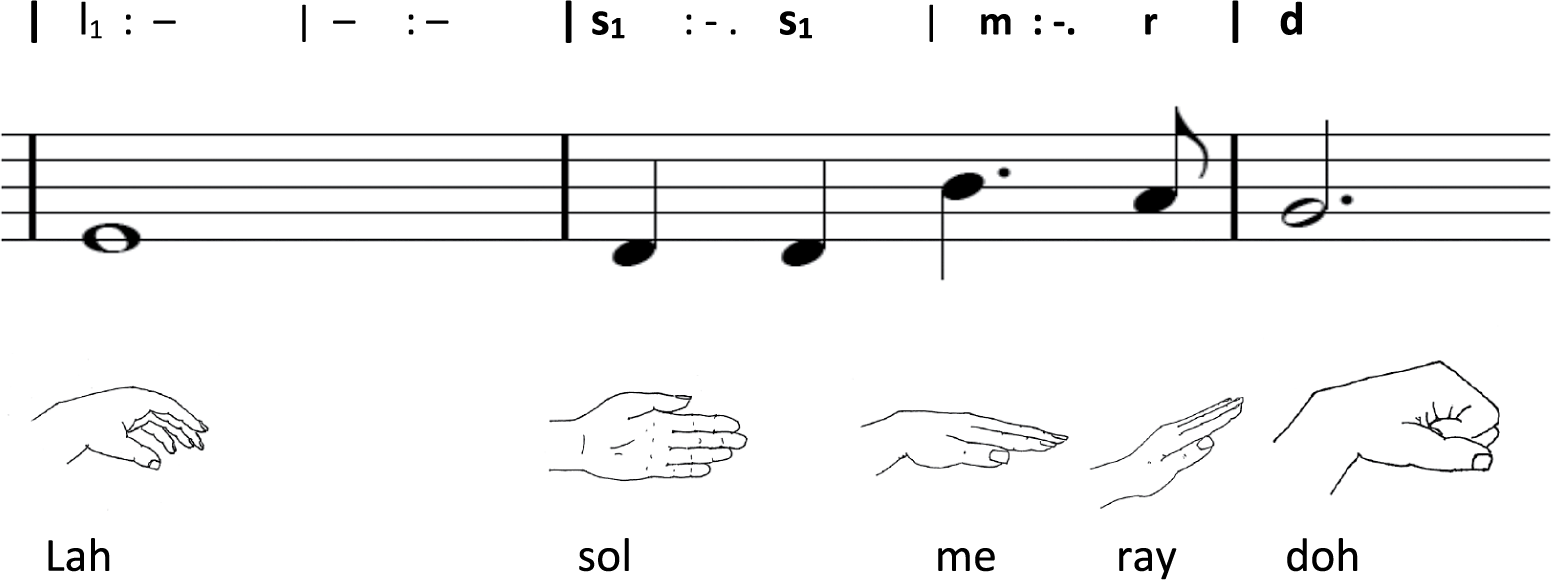
On the level of the hymn’s melody, it is revealing to view this piece within the mindset of tonic sol-fa missionary pedagogy. The highly accessible sol-fa method was based on the idea of sight-singing in parts from alphabetical letters representing solfège scale degrees (rather than learning to read noteheads on a staff), and the importance given to scale-degree pitch rather than harmony in scores of tonic sol-fa instruction books corroborates this fact.Footnote 129 Solfège taught in this pictorial way would have deeply affected a musician who had been taught to conceive of music in terms of the visual associations of scale degrees and their relation to one another. Thus, although by ear Bokwe could, with little knowledge of harmonic progressions, notate straightforward standard triads, the recurrence of the melodic lingering on the ‘lah’, or sixth scale degree, in the semibreves in the melody of the main verse retains the visual associations of the limp hand in the tonic sol-fa system (see Figure 1). This was the attitude towards the character of the ‘lah’ within the tonic sol-fa singing school mindset, even if the Lovedale Mission Station used the hand signals only sporadically.Footnote 130
Reduction of the recurring ‘lah–sol, sol–me–ray–doh’ motif in Bokwe’s ‘Plea for Africa’. The key of the excerpt is G major. My sincere thanks to Freya Jarman for sketching the hand signals, which are based on John Curwen’s system of hand signs found in his Standard Course of Lessons and Exercises in the Tonic Sol-fa Method of Teaching Music (London: Tonic Sol-fa Agency, 1872), iv.

How did Bokwe compose colonial authority here? Although the underlying harmony beneath the ‘lah’ in the melody is the resonance of a major IV chord, the extended lingering on the ‘lah’ brings a certain minor-mode poignancy. If the black singers and composer had learnt only tonic sol-fa and the meanings behind the solfège syllables, their understanding of the hymn was perhaps more melodically than harmonically driven, and the melodic emphasis on ‘lah’ referred them to the sixth scale degree, represented on the tonic sol-fa ‘modulator’ as a weak note,Footnote 131 rendering it both nostalgic and problematically clothed within a strangely compromised major sonority. As can be seen in Figure 1, which sets the recurring melodic patterns of ‘[extended] lah–sol, sol–me–ray–doh’ against the visual signs, the ‘sol’, as the second strongest note in the scale to the major tonic, visually ‘opens’ the melody up, setting the weeping ‘lah’ back on its course again. The stable, flat-hand signal of ‘me’ then reaffirms the major third of the tonic triad; the ‘ray’ reaches optimistically upwards; and the iron fist of ‘doh’ grounds the melody back in its major tonicity.
This is also a musical illustration of how the tonic sol-fa pedagogical methods reflected Curwen’s avoidance of the minor mode, as it was not a convincing move in the context of a tonic sol-fa setting, given the limp appearance of the note ‘lah’ within the visualized hand symbols that accompanied the solfège. This is yet another factor that set the tonic sol-fa movement apart compositionally from the increasinglyè important role of the minor mode in late nineteenth-century Romantic instrumental music.Footnote 132 Does Bokwe’s hymn tune attempt a minor nostalgia without the theoretical language to engage with it? Or, as a people who, according to contemporary British attitudes, were said by Victorians to have ‘no music’ of their own (owing to their skin colour and alleged lack of sophisticated musical intelligence) until songs were brought to them by the British,Footnote 133 were the members of the South African Choir reduced to resisting Victorian voice-leading even while employing it on the surface? Was Bokwe, as an evangelist for Christian mission, also constructing a musical site of colonial agency?
On the surface, Bokwe was always a staunch spokesman for self-improvement through Western education. As he wrote in the Christian Express of 1891:
The point of view from which I regard the influence of the European races upon my fellow-countrymen (and all the native races of Africa I hold to be my fellow-countrymen), is this. The European races being professedly the dominant race, in power, in knowledge, and in character, what effect is their presence and power, and character having in moulding the character and stimulating the energies of the Native races? […] It is a strange and sad fact that the sons of Colonists, according to the native mind, swerve from the upright courses of their fathers.Footnote 134
In short, colonial (African or British) singers veering into the performative territory of this song needed to be reminded of the ‘upright courses of their fathers’, embracing the mission evangelism of the British while simultaneously singing for a sense of black nationalism. But perhaps this ambiguity gave the hymn its power – a sense that as a piece of music open to a ‘public examination’ (as opposed to – in the case of the ABRSM – a ‘private’ or ‘privatized’ examination)Footnote 135 in the wider imperial world, it transcended the idea of imperialism while at the same time being a product of it.
How did this ‘public examination’ of ‘Plea for Africa’ create room for forms of resistance to imperial disciplining? Shortly after his death, indeed, Bokwe was compared by a friend to Booker T. Washington.Footnote 136 Black colleagues consistently remembered him as someone who transcended his own race, with, for example, his acquaintance A. W. Roberts remembering in 1925: ‘His neighbours in his presence forgot his colour: they took him for what he was, both in mind and heart and soul, a true man.’Footnote 137 Yet in the late twentieth century, the revered anti-apartheid political leader Walter Sisulu, writing from prison, claimed back Bokwe’s ‘Plea for Africa’ – for Africa alone.Footnote 138 One might wonder whether, despite his sympathies with British imperialism, a part of Bokwe might have approved.
Postlude
These musical narratives, as well as the ongoing debates about how British musical authority should really be defined and codified, did not end in the 1890s. Just as Taylor was only the first of many ABRSM examiners to travel to South Africa, Bokwe’s desire to seek Western education for black South Africans continued long into the twentieth century, and he was only one of many black South Africans who travelled to Britain around the turn of the century. His son, R. T. Bokwe, became a qualified doctor after training in Edinburgh; it is unclear whether he was taken there by his father or sent separately.Footnote 139 It is unknown whether John Knox Bokwe’s wife, who is never listed as more than ‘Mrs John Knox Bokwe’, travelled with him during his first trips, but after her husband’s death she was invited in 1938 by the women of the Church of Scotland to travel to Scotland for the centenary of the Church of Scotland Women’s Foreign Mission.Footnote 140 As the Lovedale records note: ‘To her fell the honour of representing African womanhood’, and, among other delegates from India and China, she visited congregations all over Scotland, both rural and urban, where ‘often by just a few words she won the hearts of vast audiences’.Footnote 141 She also attended the General Assembly of the Church of Scotland in Edinburgh in May 1938, at which, as reported eagerly by the South African Outlook back in her home country, she was especially thanked by the moderator.Footnote 142
Within white South Africa, and for many of the white Europeans who, like Taylor, travelled there during the late nineteenth century, the superficial presumption was that black musicians would be grateful for opportunities for Western education, musical or otherwise, and that the spread of tonic sol-fa singing might go slightly too far if it encroached too greatly upon white South African musical practice. An 1894 editorial in the Musical News entitled ‘The Staff Notation Versus the Tonic Sol-fa’, for example, was full of racial and aesthetic repugnance for the prevalence of the ‘new notation’ (sol-fa) over the ‘old’ (staff) when it reported on the London School Board vocal competition that had taken place at the Royal Albert Hall on 18 July (the same week as Taylor’s send-off dinner). Referring to staff notation as ‘universal’, the editorial described tonic sol-fa as ‘hieroglyphics’ which were ‘ugly and black’ to look at, and ludicrous for advanced (or ‘superior’) pieces of music that required frequent accidentals and modulations.Footnote 143
These associations did not die out easily, and yet tonic sol-fa still continued to proliferate in colonial South Africa, as reported by future musical agents of empire. Under the heading ‘Tonic Sol-fa at Durban’, John Charles James Hoby, a successful former student at the RCM and author of The South African School Sight Singing Method, Tonic Sol-fa and Staff (published, notably, not only in London but also in New York and Bombay),Footnote 144 wrote a letter to the Tonic Sol-fa Record in 1904 from Durban as follows:
I am in this far-away corner of the Empire busily at it all day and till late at night with Music. I have the Orchestral Society, the Municipal Choir, 150 strong, a Male Voice Choir of about 30, and the Organist and Choirmastership of the Parish Church here (surpliced choir mixed), and am Instructor in School Music to the Natal Government Education Department.
We have thousands of children in the schools here, and any amount of teachers who, till I was allowed by government to start the work with them, had no sol-fa at all, and indeed all over the colony, school singing was mostly in a wretched state. Now things are much improved. I was converted to Tonic Sol-fa by reading up all the Curwen publications. I have Tonic Sol-fa in my church choir; I have a preliminary choir entirely Tonic Sol-fa, a feeder for my Choral Society, and all my schools (5 large ones), now have it.Footnote 145
Hoby is a useful example of the next generation of musician educated at the RCM who also advocated for and even published in tonic sol-fa once they witnessed its utility for black colonial (or working-class white) students in schools and churches. The persistence of tonic sol-fa as the chief means of teaching musical notation to black students in South African schools even today (whereas it is largely non-existent as a form of musical notation in white South African schools) is indicative of how deeply this prejudice still runs.Footnote 146
A more negative reaction was recorded later in the century by Kirby in his auspiciously titled autobiography of musical life in London and South Africa, Wits End: An Unconventional Biography (1967). He remembered first finding that ‘at mission stations, black children had long been taught to sing in 4-part harmony’, and that soon the spread of tonic sol-fa had become ubiquitous for singing in schools.Footnote 147 ‘I soon found that I should have to do what I could to change the outlook of both the Education Department and the school teachers,’ Kirby noted, lamenting that, ‘Singing by means of Tonic Sol-fa notation was in full swing in all the primary schools in Natal,’ which meant that white children were starting to sing it too. Kirby then commented that the teachers were not to blame, ‘for few of them had any serious training in music […] and they could hardly be expected to do very much’.Footnote 148 His solution was that singing should switch to a short practice period every morning rather than only once a week, and that staff notation should replace tonic sol-fa.
Kirby must have met with success in this endeavour, for he remembers that ‘I was immediately put in a position of considerable power […] I could also guide their musical taste with comparatively little difficulty.’Footnote 149 On Kirby’s recommendation, each Natal schoolchild was provided with a copy of The National Song Book, which contained 212 of Charles Villiers Stanford’s staff (and, later, tonic sol-fa) notation arrangements of British songs that were specifically published for use in British schools.Footnote 150 Such an imposition of staff notation and a renewal of Britishness through national song in colonial schools is a testament to the deeply held notion that RCM alumni such as Hoby and Kirby brought to the colonial context: that students would receive educational betterment through learning staff notation as a means of re-identifying themselves as British. The ongoing persistence of tonic sol-fa in black South African communities today, however, leads to the question of how these students might have negotiated their own sense of colonial difference when singing from The National Song Book.
The lives of the examiner and the evangelist were both curated by imperial authorities of knowledge. Yet as each musician undertook substantial journeys between colony and metropole, the significance of music as an emblem of race, imperial authority and personal self-promotion not only altered their own careers but also reflected the possibilities of music as a more reflexive mode of authority in the context of transnational encounter. The partiality – or the strong risk of partiality – latent in the authority structures of an exhausted girl playing piano exercises on a verandah in the Eastern Cape; the utility of this ‘fevered pursuit’ for Taylor’s own professional reputation as published in the periodical press back in London; and the hesitant ‘plea’ from ‘swarthy lips’ for financial assistance for black education set to a mournful tonic sol-fa tune by Bokwe raise questions of the possibilities for dormant musical resistance emerging even from contexts of cultural appropriation.
The modes of imperial knowledge construction affecting the contrasting musical experiences of empire here thus coalesce along deeper channels than their geographical proximities and chronological timelines set them apart: both Taylor and Bokwe made personal use of the ambiguity of late-Victorian imperial music-making – the art that was simultaneously used as a symbol of the success of empire and yet required provocative control – as a means of negotiating their own personal and ideological standing when confronted with the ‘unsettled boundaries’ of imperial knowledge in the context of empire. The ‘“webs of empire” that were independent and mutually constitutive in metropolis and colony’Footnote 151 thus saw emerging musical networks around 1894 that could encompass both the graded board exam and the tonic sol-fa hymn. One might posit, however, that it was Bokwe’s hymn rather than Taylor’s examination certificate which, in South Africa’s public memory, offered the more flexible navigation of music’s capacity to negotiate and eventually reframe the aesthetic authorities of empire.