Discovery
With the 2008 discoveryReference Kamihara, Watanabe, Hirano and Hosono1 of high-temperature superconductivity in fluorine-doped LaFeAsO—an iron-based material—the hunt for similar materials and the race toward understanding their properties began. This race has been tremendously fruitful, yielding both a wide variety of new superconducting compounds and unveiling unanticipated aspects of superconductivity. After the discovery, it was immediately observedReference Kamihara, Watanabe, Hirano and Hosono1 that these materials have similarities to the other well-known family of very high-temperature superconductors, the cuprates. LaFeAsO and all the other known Fe-based superconductors feature a square planar transition-element sheet analogous to the square planar CuO2 sheets in the cuprates, and furthermore these compounds are near antiferromagnetism. Also, similar to the cuprates, a wide variety of Fe-based compounds both with the original structure and related structure types were discovered following the initial report of high-temperature superconductivity. Initial efforts focused on substitutions based on the prototypical material, LaFeAsO, which is superconducting when doped with F. The rare-earth substituted materials RFeAsO (R = rare earth) showed a clear and much-discussed systematic trendReference Lee, Iyo, Eisaki, Kito, Fernandez-Diaz, Ito, Kihou, Matsuhata, Braden and Yamada2: Reported critical temperatures T c across the lanthanides are 26 K, 41 K, 52 K, 52 K, 55 K, 36 K, 46 K, 45 K, and 36 K for R = La,Reference Kamihara, Watanabe, Hirano and Hosono1 Ce,Reference Chen, Li, Wu, Li, Hu, Dong, Zheng, Luo and Wang3 Pr,Reference Ren, Yang, Lu, Yi, Che, Dong, Sun and Zhao4 Nd,Reference Ren, Yang, Lu, Yi, Shen, Li, Che, Dong, Sun, Zhou and Zhao5 Sm,Reference Chen, Wu, Wu, Liu, Chen and Fang6, Reference Ren, Lu, Yang, Yi, Shen, Li, Che, Dong, Sun, Zhou and Zhao7 Gd,Reference Cheng, Fang, Yang, Zhu, Mu, Luo, Wang and Wen8 Tb,Reference Bos, Penny, Rodgers, Sokolov, Huxley and Attfield9 Dy,Reference Bos, Penny, Rodgers, Sokolov, Huxley and Attfield9 and Ho,Reference Rodgers, Penny, Marcinkova, Bos, Sokolov, Kusmartseva, Huxley and Attfield10 respectively. Therefore, maximum T c increases from R = La to R = Sm compounds and then decreases, though not uniformly.
Chemistry and properties
So far, five additional families of iron-based superconductors have been found. They are all based on tetragonal structure types, with tetrahedrally coordinated, nominally divalent Fe on a square lattice. Beyond the ZrCuSiAs-type, RFeAsO (R = rare earth),Reference Kamihara, Watanabe, Hirano and Hosono1 these are the ThCr2Si2-type BFe2As2 (B = alkaline earth)Reference Rotter, Tegel, Johrendt, Schellenberg, Hermes and Pottgen11, Reference Rotter, Tegel and Jorendt12 and AFe2Se2 (A = Alkali metal or Tl),Reference Guo, Jin, Wang, Wang, Zhu, Zhou, He and Chen13 the Cu2Sb-type AFeAs,Reference Wang, Liu, Lv, Gao, Yang, Yu, Li and Jin14–Reference Tapp, Tang, Lv, Sasmal, Lorenz, Chu and Guloy16 the PbO-type FeCh (Ch = chalcogen: Se or alloys with S and Te),Reference Hsu, Luo, Yeh, Chen, Huang, Wu, Lee, Huang, Chu, Yan and Wu17, Reference Mizuguchi, Tomioka, Tsuda, Yamaguchi and Takano18 the Sr3Fe2O5Cu2S2-type Sr3T 2O5Fe2As2 (T = Sc),Reference Zhu, Han, Mu, Zeng, Cheng, Shen and Wen19 and the Sr4T 2O6Fe2Pn 2 compounds (T = Sc or V; Pn = pnictogen: As or P).Reference Ogino, Matsumura, Katsura, Ushiyama, Horii, Kishio and Shimoyama20, Reference Zhu, Han, Mu, Cheng, Shen, Zeng and Wen21 The main structural families are shown in Figure 1. The six families are known as the 1111, 122, 111, 11, 32522, and 42622 compounds, respectively.
The layered tetragonal room-temperature structures of the main families of Fe-based superconductors. FePn or FeCh layers are in gray (the red atoms are pnictogens Pn or chalcogens Ch). The same picture applies to both the 111 and 11 families, where lithium or iron atoms respectively sit in square planes of red atoms.

Besides these Fe-based superconductors, there are families of Ni-based superconductors with similar structures.Reference Ronning, Kurita, Bauer, Scott, Park, Klimczuk, Movshovich and Thompson22 However, these materials have low T c and are apparently standard electron-phonon materials,Reference Kurita, Ronning, Tokiwa, Bauer, Subedi, Singh, Thompson and Movshovich23, Reference Subedi and Singh24 while the Fe-based materials are not.Reference Boeri, Dolgov and Golubov25, Reference Mazin, Singh, Johannes and Du26 On the other hand, LaFePO, which was previously discovered to be a low-T c superconductor,Reference Kamihara, Hiramatsu, Hirano, Kawamura, Yanagi, Kamiya and Hosono27 appears to be closely related to the high-T c Fe-based superconductors. Remarkably, and in contrast to cuprates, the parent compounds of Fe-based superconductors can be doped by alloying on the active Fe-site, thereby inducing high-temperature superconductivity.Reference Sefat, Jin, McGuire, Sales, Singh and Mandrus28
The Fe atoms making up the square planes are tetrahedrally coordinated by pnictogen or chalcogen atoms in these structures. This is universal to the Fe-based superconductors. Unlike cuprates, where the Cu-Cu distances are long (∼3.8 to 3.9 Å), the Fe-Fe neighbor distances range from ∼2.67 to 2.85 Å, only somewhat longer than the Fe-Fe distance in α-Fe (2.48 Å). The FePn or FeCh layers in all the compounds have two Fe atoms per unit cell due to the coordination of Pn or Ch. The compounds differ in the separation of the FePn or FeCh layers.
Electronic structure
The importance of the relatively short near-neighbor Fe-Fe distance for the electronic structure was noted early on.Reference Singh and Du29 Density functional calculations for these materials show a mixed ionic/covalent structure for the FePn or FeCh layers, with occupied ligand p bands lying 2 eV or more below the Fermi energy, and Fe bands at and around the Fermi energy. This is consistent with core-level and valence spectroscopies,Reference Kurmaev, Wilks, Moewes, Skorikov, Izyumov, Finkelstein, Li and Chen30–Reference Bondino, Magnano, Booth, Offi, Panaccione, Malvestuto, Paolicelli, Simonelli, Parmigiani, McGuire, Sefat, Sales, Jin, Vilmercati, Mandrus, Singh and Mannella35 which showed that the bands near the Fermi energy, E F, have predominantly Fe character, hybridized with ligand p states. As a consequence of Fe-Fe interactions, the electronic structure (Figure 2) does not correspond to that of a d Reference Chen, Wu, Wu, Liu, Chen and Fang6 ion in a tetrahedral ligand (crystal) field, but instead shows a semi-metallic character with a dip in the density of states around the Fermi energy, E F. The Fermi surface consists of small pockets: hole cylinders around the zone center and electron cylinders around the corner of the Brillouin zone.Reference Singh and Du29, Reference Lebegue37
(a) Density of states and (b) Fermi surface as obtained for FeSe by density functional calculations.Reference Subedi, Zhang, Singh and Du36 The arrow indicates a possible wave vector for nesting of the Fermi surface between the electron pocket e and the hole pocket h.

Even though there is a dip in the density of states near E F, the actual values at E F are not low compared to other materials. This is because the bands are heavy (i.e., the relevant d bands are narrow). The key point is that in 3d transition-metal compounds, values of the d electron density of states above ∼2eV−1, on a per transition metal atom basis, place materials near itinerant magnetism due to the near fulfillment of the Stoner criterion, N(E F)I > 1. For typical Stoner parameters, I, this happens between 2 eV−1 and 3 eV−1. Thus the high density of states at E F in these Fe-based superconductors places them near magnetism from this point of view. This sets the stage for competition of different magnetic ground states.
The Fermi-surface structure, consisting of small, disconnected sheets made of heavy bands, and the nearness to magnetism are universal to all of the iron-based superconductor families and are very different from the large, light-mass Fermi surfaces predicted for cuprates at this level of theory.Reference Pickett, Krakauer, Cohen and Singh38 Also, unlike cuprates, where a single  orbital dominates the electronic structure, there are multiple d orbitals involved in the low-energy electronic structure of the Fe-based superconductors.
This basic picture is in accord with experimental measurements, particularly photoemission and related spectroscopies. However, detailed measurements show deviations from the simple predictions of density functional calculations that are both interesting and almost certainly important, as well as key differences from the cuprates.
Early photoemission experiments showed a Fermi-surface structure in qualitative accord with electronic-structure calculations (i.e., disconnected sheets around the zone center and zone corner and band characters consistent with theoretical predictions).Reference Koitzsch, Inosov, Fink, Knupfer, Eschrig, Borisenko, Behr, Kohler, Werner, Buchner, Follath and Durr31, Reference Lu, Yi, Mo, Erickson, Analytis, Chu, Singh, Hussain, Geballe, Fisher and Shen39–Reference Wray, Qian, Hsieh, Xia, Li, Checkelsky, Pasupathy, Gomes, Parker, Fedorov, Chen, Luo, Yazdani, Ong, Wang and Hasan44 In fact, early high-field measurements were consistent with two-gap superconductivity, with the implication that at least two sheets of Fermi surface may be present and involved in superconductivity.Reference Hunte, Jaroszynski, Gurevich, Larbalestier, Jin, Sefat, McGuire, Sales, Christen and Mandrus45 An interesting feature is that both band-structure calculations and experiments show a less two-dimensional Fermi surface than in the cuprates.Reference Yuan, Singleton, Balakirev, Baily, Chen, Luo and Wang46–Reference Liu, Kondo, Ni, Palczewski, Bostwick, Samolyuk, Khasanov, Shi, Rotenberg, Budko, Canfield and Kaminski48 This is consistent with measurements of superconducting properties, which show less anisotropy than cuprates. As discussed in the articles in this issue by Beasley and by Malozemoff, lower anisotropy is very favorable for potential applications that depend on flux pinning.Reference Jia, Cheng, Luo, Yang, Ren, Shan, Gu and Wen49–Reference Yamamoto, Jaroszynski, Tarantini, Balicas, Jiang, Gurevich, Larbalestier, Jin, Sefat, McGuire, Sales, Christen and Mandrus52
As mentioned, there are differences between experiments and predictions based on standard density functional theory. Although, in contrast to cuprates, there is a large Fe d spectral weight at E F; nonetheless, a substantial renormalization of the bandwidth is needed to bring band-structure calculations into accord with experimental spectra. This is the case even though no clear Hubbard band, arising from on-site repulsion, is seen below the Fe d bands.Reference Kurmaev, Wilks, Moewes, Skorikov, Izyumov, Finkelstein, Li and Chen30, Reference Lu, Yi, Mo, Erickson, Analytis, Chu, Singh, Hussain, Geballe, Fisher and Shen39 The non-observation of Hubbard bands is in contrast to cuprate superconductors and other strongly correlated oxides where Coulomb interactions shift spectral weight to states at high binding energy. Similarly, a large reduction relative to band-structure predictions is found in the Drude (optical) kinetic energy, indicative of non-trivial electron correlations.Reference Qazilbash, Hamlin, Baumbach, Zhang, Singh, Maple and Basov53
While the presence of a renormalization is reminiscent of superconducting cuprates, the overall behavior is in rather strong contrast to them: (1) There is very strong Fe spectral weight at E F; (2) there are no Hubbard bands below the Fe d bands, although there is evidence of a redistribution of spectral weight within the d bands; (3) the renormalizations have very non-trivial momentum dependence;Reference Yi, Lu, Analytis, Chu, Mo, He, Moore, Zhou, Chen, Luo, Wang, Hussain, Singh, Fisher and Shen54 and (4) no Mott insulating phase that is clearly connected to the Fe-based superconductors has been discovered, while undoped cuprates are invariably Mott insulators. This different nature of the Fe- compared to Cu-based materials is in accord with many-body calculations based on dynamical mean-field theory when the Coulomb parameter, U, is obtained from first principles.Reference Anisimov, Korotin, Korotin, Kozhevnikov, Kunes, Shorikov, Skornyakov and Streltsov55–Reference Nakamura, Arita and Imada58
A key challenge will be to understand the importance of these differences in relation to the apparently different superconducting properties of these two classes of materials.
Magnetism and superconductivity
Returning to the shape of the Fermi surface, it was noted early on that small hole and electron Fermi surfaces with similar orbital character will be nested (Figure 2), and this will be reflected in the details of the magnetic susceptibility.Reference Mazin, Singh, Johannes and Du26, Reference Kuroki, Onari, Arita, Usui, Tanaka, Kotani and Aoki59 Sufficiently strong nesting will lead to magnetic ordering with the nesting wave vector, which, in this case, is the vector connecting the electron and hole sheets,  , in the 2D zone.Reference Mazin, Singh, Johannes and Du26 A magnetic ordering with this wave vector was, in fact, discovered using neutron diffraction in LaFeAsO, and it was shown that this ordering vanishes when the material is doped to the optimum superconducting composition.Reference de la Cruz, Huang, Lynn, Li, Ratcliff, Zaretsky, Mook, Chen, Luo, Wang and Dai60
Optical measurements showed that this magnetic ordering was accompanied by a strong reconstruction of the Fermi surface characterized by a reduction in the density of states, as would be expected in a spin density wave (SDW) transition.Reference Hu, Dong, Li, Li, Zheng, Chen, Luo and Wang61 Since then, there has been considerable discussion of the mechanism of the magnetic ordering. The extent to which this transition is driven by the Fermi surface (i.e., SDW) versus electronic states away from the Fermi surface (local-moment superexchange mechanism)Reference Yildirim62 remains controversial.Reference Johannes and Mazin63 Importantly, like the superconducting phases, the magnetic phases are metallic, as was shown by the observation of quantum oscillations.Reference Sebastian, Gillett, Harrison, Lau, Singh, Mielke and Lonzarich64 This implies a more intimate connection between the antiferromagnetic and superconducting states in the Fe-based superconductors than in the cuprates, which is also apparent from the phase diagrams (see also the Ni and Bud’ko article in this issue).
The magnetically ordered state consists of alternating ferromagnetic chains, thus lowering the symmetry from tetragonal to orthorhombic or lower. This leads to a substantial orthorhombic distortion of the lattice, which is generally ascribed to magnetoelastic coupling.Reference Yildirim65 Remarkably, it was found that as the temperature was lowered in the tetragonal phase, the structure distorted first, and the magnetic ordering then set in at a lower temperature, thus demonstrating the existence of a mysterious broken-symmetry intermediate phase with the structure distortion that would be expected for the magnetic phase but with no ordered magnetism.Reference de la Cruz, Huang, Lynn, Li, Ratcliff, Zaretsky, Mook, Chen, Luo, Wang and Dai60
Subsequent studies on the 1111 and other compounds have shown a variety of remarkable phase diagrams, with such broken-symmetry phases occurring in many but not all cases. For example, in the 122 compounds (e.g., BaFe2As2), the structural and magnetic transitions coincide, but they separate as the material is electron doped (see also the article by Ni and Bud’ko in this issue). Interestingly, these phase diagrams often show substantial regions of co-existence between magnetic ordering and superconductivity, although magnetic ordering is generally fully suppressed by the time the maximum T c is reached.
The magnetism of the Fe-based superconductors is unusual and intimately connected with superconductivity. This is shown by the phase diagrams as well as trends in microscopic properties, such as the nuclear magnetic resonance (NMR) relaxation rate in crossing between magnetic and superconducting regions.Reference Ning, Ahlian, Imai, Sefat, Jin, McGuire, Sales and Mandrus66, Reference Klingeler, Leps, Hellmann, Popa, Stockert, Hess, Kataev, Grafe, Hammerath, Lang, Wormehl, Behr, Harnagea, Singh and Buchner67 Magnetism plays a central role in these materials and almost certainly in their superconductivity, as discussed later in the text. Nonetheless, there are many aspects of the magnetic behavior that are not yet understood. Unraveling these will yield a more general understanding of high-temperature superconductivity and may lead to the discovery of materials with even better superconducting properties.
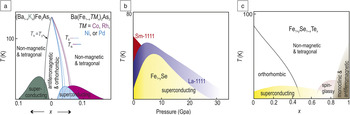
The phase diagrams, schematically depicted in Figure 3 following literature,Reference Ren, Lu, Yang, Yi, Shen, Li, Che, Dong, Sun, Zhou and Zhao7, Reference Sefat, Jin, McGuire, Sales, Singh and Mandrus28, Reference Rotter, Pangerl, Tegel and Johrendt68–Reference Katayama, Ji, Sato, Wen, Xu, Gu, Xu, Lin, Enoki, Chang, Yamada and Tranquada78 show crucial differences between these materials and the cuprates. In the cuprates, there is a clear competition between a Mott insulating phase and superconductivity; superconductivity is produced by destroying the Mott phase via doping. In the Fe-based materials, the interplay is much richer. While there is evident competition between these two orders, there is also coexistence of magnetic and superconducting order and other competing strongly magnetic phases distinct from the SDW-type antiferromagnetic order, as in FeTe,Reference Li, de la Cruz, Huang, Chen, Lynn, Hu, Huang, Hsu, Yeh, Wu and Dai76 and overdoped materials related to TlFe2Se2.Reference Zhang and Singh79 Furthermore, while the SDW order can be destroyed in favor of superconductivity by doping, this can also be done by pressure or isovalent alloying.Reference Sharma, Bharathi, Chandra, Reddy, Paulraj, Satya, Sastry, Gupta and Sundar80–Reference Zhang and Singh83 The case of alloying arsenic compounds with phosphorous may be an example where disorder has a stronger effect on magnetic ordering than on superconductivity, leading to the occurrence of the latter, as is possible with spin-fluctuation-induced pairing.Reference Singh, Du, Zhang, Subedi and An84
Phase diagrams illustrating the interplay of superconductivity and magnetism as a function of (a) doping, (b) pressure, and (c) isovalent substitution based on literature data.Reference Ren, Lu, Yang, Yi, Shen, Li, Che, Dong, Sun, Zhou and Zhao7, Reference Sefat, Jin, McGuire, Sales, Singh and Mandrus28, Reference Rotter, Pangerl, Tegel and Johrendt68–Reference Katayama, Ji, Sato, Wen, Xu, Gu, Xu, Lin, Enoki, Chang, Yamada and Tranquada78 (a) Behavior of the 122 system with different chemical dopants as a function of concentration. Here T S and T N are the structural and Néel ordering temperatures, which coincide at x = 0 and for the K-substituted compounds. (b) Pressure-dependent T c for Sm-and La-based 1111 as compared to FeSe. (c) Effect of isovalent alloying of Se with Te in the 11 structure. Note that the Te-rich side of this phase diagram has different antiferromagnetic ordering than the spin density wave that is commonly found in Fe-based superconductors.

In some materials, such as FeSe, the SDW order does not occur in the measured part of the phase diagram. Interestingly, FeSe shows a structure distortion at 70 K at ambient pressure consistent with magnetism,Reference Margadonna, Takabayashi, McDonald, Kasperkiewicz, Mizuguchi, Takano, Fitch, Suard and Prassides75 but does not magnetically order and instead becomes superconducting at ∼8 K, as if the compound is very close to the SDW order. Pressure, which presumably moves the compound further from magnetism, leads to a strong increase in T c,Reference Medvedev, McQueen, Toryan, Palasyuk, Eremets, Cava, Naghavi, Casper, Ksenofontov, Wortmann and Felser72, Reference Margadonna, Takabayashi, Ohishi, Mizuguchi, Takano, Kagayama, Nakagawa, Takata and Prassides73 as does isovalent doping with Te. In fact, as shown in Figure 3b, there is a rather interesting connection between the behavior of optimally doped 1111 arsenides and FeSe under pressure. Specifically, the maximum T c in these compounds is much more similar than would be inferred from ambient-temperature data. As is also seen, the differences between T c of optimally doped 1111 compounds with different rare earths are reduced under pressure, with T c decreasing for the Sm compound but increasing in the case of La.
Puzzles
There are a number of important puzzles related to the magnetism of Fe-based superconductors. First of all, even without doping, the ordered moments are very material dependent, ranging from zero in FeSe, for example, up to ∼2μB, suggesting softness of the moment, as might be the case in a material near a spin-state transition. In fact, consistent with this idea, phonons that modulate the Fe–As bond lengths are strongly coupled to magnetism in these materials, reflecting an apparent competition between covalent Fe–ligand bonding and Fe moment formation.Reference Reznik, Lokshin, Mitchell, Parshall, Dmowski, Lamago, Heid, Bohnen, Sefat, McGuire, Sales, Mandrus, Subedi, Singh, Alatas, Upton, Said, Consolo, Shvudko and Egami85 Second, standard density functional calculations strongly overestimate the ordered moments and the tendency toward ordering.Reference Yildirim65, Reference Mazin, Johannes, Boeri, Koepernik and Singh86 Third, there are a number of experiments indicating exceptionally strong spin fluctuations in the non-ordered states above the Néel temperature and in the doped non-magnetic superconducting materials. These include spectroscopic measurements that show splittings of the Fe core levels, characteristic of an ordered magnetic phase, even in non-magnetic superconducting material.Reference Bondino, Magnano, Malvestuto, Parmigiani, McGuire, Sefat, Sales, Jin, Mandrus, Plummer, Singh and Mannella87 Finally, there is the puzzle of the intermediate phase that often, but not always, occurs between the structural and magnetic ordering temperatures and which shows signatures in transport reminiscent of the gapping of the Fermi surface expected for magnetic ordering.Reference McGuire, Christianson, Sefat, Sales, Lumsden, Jin, Payzant, Mandrus, Luan, Keppens, Varadarajan, Brill, Hermann, Sougrati, Grandjean and Long88 This phase is clearly not long-range magnetic ordered and is also not short-range static ordered as in a spin glass. These phenomena suggest strong renormalization of the magnetic state by quantum fluctuations.Reference Mazin, Johannes, Boeri, Koepernik and Singh86–Reference Mazin and Johannes90 However, the details, which may well be central to a detailed understanding of Fe-based superconductivity, remain to be established. An interesting possibility is that SDW magnetic ordering temperatures are suppressed by quantum fluctuations associated with competing magnetic orders, and the actual bare magnetic energy scales are very high. This would suggest that the limit on the superconducting T c may not yet have been reached.
Turning to the superconductivity, simple considerations based on the form of the magnetic susceptibility in relation to the Fermi surface led to predictionsReference Mazin, Singh, Johannes and Du26, Reference Kuroki, Onari, Arita, Usui, Tanaka, Kotani and Aoki59 that the superconducting state should have s symmetry, but with a sign change between the electron and hole surfaces—a state that is denoted s ±. Such a sign change is essential to obtain pairing from a repulsive interaction—a key point since spin fluctuations are repulsive in a singlet channel (e.g., s or d).
The s ± state can be fully gapped when the Fermi surface is disconnected as in the Fe-based superconductors, but it can also have accidental nodes on the Fermi surface. These could arise either from competing interactions or simply Coulomb avoidance. In an s ± state, the average of the order parameter over the Fermi surface is small (though not symmetry-constrained to be exactly zero). This means that the Hebel-Slichter peak that is typically observed in nuclear magnetic resonance in conventional superconductorsReference Hebel and Slichter96 will be suppressed, and superconductivity will not be damaged by Coulomb avoidance, as is also the case in other unconventional superconductors. Importantly, the sign change will also lead to a neutron spin resonance,Reference Maier and Scalapino91, Reference Korshunov and Eremin92 which is observed in these materials.Reference Christianson, Goremychkin, Osborn, Rosenkranz, Lumsden, Malliakas, Todorov, Claus, Chung, Kanatzidis, Bewley and Guidi93 This resonance would not generally be expected without such a sign change, although it could be possible under special circumstances.Reference Onari, Kontani and Sato94 This resonance at the nesting vector is also present in superconducting Te-rich Fe(Se,Te), where there is a competing magnetic ordering.Reference Qiu, Bao, Zhao, Broholm, Stanev, Tesanovic, Gasparovic, Chang, Hu, Qian, Fang and Mao95
Conclusion
The discovery of Fe-based superconductivity has revealed new facets of superconductivity and its interplay with magnetism. Certainly, it has further established the paradigm where the discovery of new materials leads to new previously unasked scientific questions and resulting insights into the behavior of condensed matter. Perhaps more importantly, it has challenged prior thinking about high-temperature superconductivity by providing a set of materials that differ in many crucial aspects from the previously known example of the cuprates. It could be that the Fe-based superconductors are essentially different from the cuprates, and nature in her richness has provided us with two independent paths to high-temperature superconductivity, or perhaps there are subtle connections between these two classes, the elucidation of which will reveal the underlying mechanism.
Acknowledgments
This work was supported by the U.S. Department of Energy, Basic Energy Sciences, Division of Materials Sciences and Engineering.