INTRODUCTION
Problems with text comprehension can cause significant difficulties completing everyday activities, such as trouble following healthcare information and other instructions. Despite the fact that text comprehension is important in everyday living and can be negatively impacted by language disturbances, deficits in memory and executive functioning difficulties (Chapman, Zientz, Weiner, Rosenberg, Frawley, & Burns, Reference Chapman, Zientz, Weiner, Rosenberg, Frawley and Burns2002; Kempler, Almor, & MacDonald, Reference Kempler, Almor and MacDonald1998), few studies have investigated text comprehension abilities in the MCI population. In this study, we use think-aloud methodology to evaluate how individuals with MCI use information (from prior text and world knowledge) to make inferences while reading narrative text.
In the cognitive literature, think-aloud methodology has commonly been used to provide insight into the strategies readers use to construct a coherent understanding of the presented text (e.g., Cote & Goldman, Reference Cote, Goldman, van Oostendorp and Goldman1999; Graesser, Singer, & Trabasso, Reference Graesser, Singer and Trabasso1994; Magliano, Trabasso, & Graesser, Reference Magliano, Trabasso and Graesser1999; Zwaan & Brown, Reference Zwaan and Brown1996). Typical think-aloud procedures require readers to periodically comment about a text as they progress through it (Ericsson & Simon, Reference Ericsson and Simon1993). While a blend of variables influence reading comprehension (e.g., background knowledge, word reading; Cromley & Azevedo, Reference Cromley and Azvedo2007), think-aloud methods have shown that more skilled readers produce greater numbers of coherence-maintaining inferences and rely less on literal strategies (e.g., paraphrasing) when reading text (Graesser et al., Reference Graesser, Singer and Trabasso1994; Laing & Kamhi, Reference Laing and Kamhi2002; Langston, Trabasso, & Magliano, Reference Langston, Trabasso, Magliano, Ram and Moorman1999).
The verbal protocol analysis developed by Trabasso and Magliano (Reference Trabasso and Magliano1996a) distinguishes between three types of inferences. Predictive inferences are forward-oriented in narrative time as they speculate about possible future events that may occur later in the text. Associations are concurrent in narrative time, and typically provide further elaboration and descriptive detail about the focal sentence. Explanatory inferences are backward-oriented in narrative time as they serve to answer why a state, event, or story action has occurred. Explanations, which appear to unite propositions in text and aid the reader in constructing a coherent mental representation of the text, are the most frequent inference type produced by readers while thinking-aloud (Laing & Kamhi, Reference Laing and Kamhi2002; Trabasso & Magliano, Reference Trabasso and Magliano1996a; Zwaan & Brown, Reference Zwaan and Brown1996). Readers who use more explanatory inferences have also been found to exhibit better understanding for what they read and better long-term retention of text information (Magliano et al., Reference Magliano, Trabasso and Graesser1999; Trabasso & Magliano, Reference Trabasso, Magliano, Graves, van den Brock and Taylor1996b; Trabasso & Suh, Reference Trabasso and Suh1993;).
To effectively create causal connections between different segments of text, however, readers must have continued access to previous information within the text. Therefore, memory operations are required during reading to provide information to the reader necessary for forming inferences. According to Trabasso and Magliano (Reference Trabasso and Magliano1996a), readers can explain incoming story events and actions by looking for causal antecedents of the events in either (a) working memory, (b) the prior text (or episodic memory), or (c) semantic/world knowledge. Research has demonstrated that both working memory and episodic memory are important in making explanatory inferences (Trabasso & Suh, Reference Trabasso and Suh1993), which help to facilitate text comprehension and memory for text. In contrast, associative inferences, which tend to be based on knowledge activated via semantic relations with words in the sentence, can cause the reader to activate irrelevant information and to focus on the focal sentence rather than on how the sentence is related to the larger discourse context (Magliano & Millis, Reference Magliano and Millis2003; Whitney, Ritchie, & Clark, Reference Whitney, Ritchie and Clark1991).
In a recent study, Creamer and Schmitter-Edgecombe (in press) used the verbal protocol analysis of Trabasso and Magliano (Reference Trabasso and Magliano1996a) to examine the roles of inferencing and memory in the narrative text comprehension of individuals with Alzheimer’s disease (AD). In comparison to controls, AD participants exhibited poorer story comprehension but produced comparable amounts of think-aloud data. Examination of the think-aloud data revealed that, compared with controls, the AD participants produced fewer inferences, and were less skilled at providing explanations of story events and using prior text information to both explain and predict outcomes. The AD group also produced more incoherent noninferential statements and relied more on the activation of world knowledge, which contributed to less effective inferences. The authors reasoned that the episodic memory difficulties of the AD participants interfered with their ability to integrate story events through the use of inferences and thereby create a global coherence to support text comprehension.
Given the central role that episodic memory difficulties play in the diagnostic criteria for amnestic MCI, we were interested in whether individuals with MCI would demonstrate difficulties similar to the AD population in producing inferences and using prior story events when comprehending text. While no studies to date have directly evaluated the processes involved in narrative comprehension in the MCI population, several studies have evaluated quality and quantity of discourse production by having participants describe a picture or generate a story (Bschor, Kuhl, & Reischies, Reference Bschor, Kuhl and Reischies2001; Fleming & Harris, Reference Fleming and Harris2008, Reference Fleming and Harris2009). In one study, Bschor et al. (Reference Bschor, Kuhl and Reischies2001) had MCI, AD, and control participants report on everything that was happening in a picture. While all groups produced verbal responses of similar length, the mild and moderate-to-severe AD groups mentioned fewer people, objects, localities, and actions when compared with the MCI and control groups. No differences emerged between the MCI and control groups in spontaneous speech content. In a more recent study, Fleming and Harris (Reference Fleming and Harris2008) had MCI and control participants describe in detail all activities that would be associated with taking a trip. They found that both the length and quality (as assessed by core element production) of the discourse produced by the MCI participants was poorer than that of controls; no group differences were found in syntactic complexity. The poorer performance of the MCI participants was hypothesized to reflect executive deficits, as the task required individuals to have adequate cognitive skills for planning, organizing, and problem-solving about the events they were being asked to relate. The authors also speculated that difficulties with inferential information may have contributed to the MCI groups’ poorer discourse production.
Studies that have more directly evaluated narrative comprehension skills in the MCI population have focused on gist-level and detail-level information processing (Chapman et al., Reference Chapman, Zientz, Weiner, Rosenberg, Frawley and Burns2002; Hudon, Belleville, Souchay, Gély-Nargeot, Chertkow, & Gauthier, Reference Hudon, Belleville, Souchay, Gély-Nargeot, Chertkow and Gauthier2006). While detail-level processing involves explicitly stated information, gist-level processing involves a more generalized understanding of the text that is often created by incorporating inferences between explicitly stated information and world knowledge. In a study by Chapman et al. (Reference Chapman, Zientz, Weiner, Rosenberg, Frawley and Burns2002), individuals with MCI, AD, and healthy controls studied a narrative text and were subsequently tested for gist-level and detail-level comprehension. The findings revealed deficits in both gist-level and detail-level information for the MCI and AD groups when compared with controls. Chapman and colleagues implicated impaired inferential ability as one possible explanation for the difficulties the AD and MCI groups had comprehending gist-level information. Hudon et al. similarly found that when prose recall of a studied story was evaluated, both gist and detail memory were impaired in individuals with MCI and AD compared with controls. These authors reasoned that episodic memory deficits might explain the AD and MCI groups’ difficulties with recall of gist-level information.
In the current study, we extend prior research by using think-aloud methodology to evaluate the strategies that MCI participants use during the process of narrative comprehension. Individuals with MCI and older adult (OA) controls read narratives, one sentence at a time, pausing after each sentence to verbalize thoughts that would help them understand the sentence within the context of the narrative. Based on prior findings of poorer gist-level and detail-level processing in the MCI population (Chapman et al., Reference Chapman, Zientz, Weiner, Rosenberg, Frawley and Burns2002; Hudon et al., Reference Hudon, Belleville, Souchay, Gély-Nargeot, Chertkow and Gauthier2006), we expected that the MCI group would produce fewer inferential statements and exhibit poorer comprehension for the text than controls. If memory plays an important role in the reading comprehension deficits of individuals with MCI, we expect the MCI group to also produce fewer explanatory types of inferences, which help create a coherent mental representation of the text, and rely less on retrieval as a memory operation when making inferences.
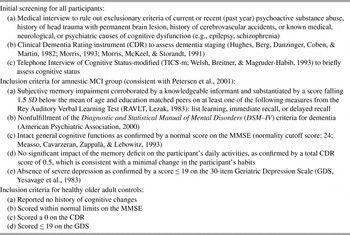
METHODS
Participants
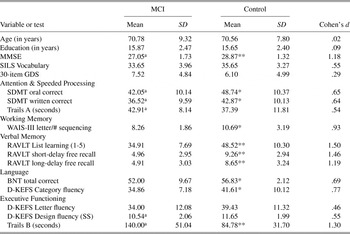
Participants were 23 individuals with MCI of the amnestic type (13 females, 10 males) and 23 OAs (13 females, 10 males), age 50 or older. Because few of the MCI participants could be considered single-domain (n = 6), we did not distinguish further between amnestic MCI single-domain and multi-domain. Participant inclusionary and exclusionary criteria are detailed in Table 1. Participants for both groups were recruited through advertisements, physician referrals, and referrals from local agencies working primarily with older adults. Each MCI participant was closely matched with a healthy OA control in terms of age, gender, and education (see Table 2). This study was conducted as part of a larger study investigating memory and everyday abilities in older age (see Schmitter-Edgecombe, Woo, & Greeley, Reference Schmitter-Edgecombe, Woo and Greeley2009).
Inclusionary and exclusionary criteria for the mild cognitive impairment (MCI) and control groups

Demographic data and mean summary data for the mild cognitive impairment (MCI) and older adult (OA) control groups

Notes
Unless otherwise indicated, mean scores are raw scores. MMSE = Mini-Mental State Examination; SILS = Shipley Institute of Living Scale; GDS = Geriatric Depression Scale; SDMT = Symbol Digit Modalities Test; WAIS-III = Wechsler Adult Intelligence Scale-Third Edition; RAVLT = Rey Auditory Verbal Learning Test; BNT = Boston Naming Test; D-KEFS = Delis-Kaplan Executive Functioning Scale.
a Data available for only 22 MCI participants, as one of the MCI participants was unable to complete the entire neuropsychological battery due to time constraints.
* p ≤ .05.
** p < .01.
All participants completed a battery of neuropsychological tests. As seen in Table 2, consistent with criteria used to define amnestic MCI, the MCI participants performed more poorly than the OA controls on all verbal learning and memory measures (RAVLT [Rey Auditory Verbal Learning Test]; Lezak, Reference Lezak1983). The MCI participants also performed more poorly than controls on tests assessing category fluency (D-KEFS Category Fluency [Delis-Kaplan Executive Functioning Scale]; Delis, Kaplan, & Kramer, Reference Delis, Kaplan and Kramer2001), word-finding (BNT [Boston Naming Test]; Kaplan, Goodglass, & Weintraub, Reference Kaplan, Goodglass and Weintraub1983), and working memory (WAIS-III Letter-Number Sequencing subtest [Wechsler Adult Intelligence Scale-Third Edition]; Wechsler, Reference Wechsler1997). In addition, significant group differences were found on some tests assessing attention/speeded processing (SDMT [Symbol Digit Modalities Test]; Smith, Reference Smith1991) and executive functioning abilities (Trails B; Reitan, Reference Reitan1958) but not others (Trails A; Reitan, Reference Reitan1958; D-KEFS Verbal Fluency and Design Fluency; Delis et al., Reference Delis, Kaplan and Kramer2001). The groups did not differ on a test assessing word knowledge (SILS [Shipley Institute of Living Scale]; Zachary, Reference Zachary1991). In return for volunteering their time, all participants received a report documenting their performances on the neuropsychological tests. This protocol was reviewed and approved by the Institutional Review Board at Washington State University.
Materials
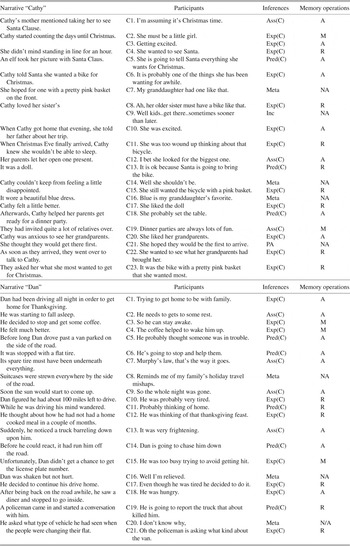
The two narratives were short stories about characters during a holiday (see Table 4). Both narratives consisted of 20 sentences that were typed separately in the center of 4.25 × 5.5 inch cards. Text comprehension was tested with 20 true/false questions (10 per story). Five questions about each story were based on explicitly stated factual information, while the other five questions were inferential.
Procedures
The think-aloud task took between 15 and 25 min to complete. Participants were presented with one card at a time, read each sentence aloud, and then verbalized thoughts that came to mind while reading the sentence. Consistent with procedures used by Trabasso and Suh (Reference Trabasso and Suh1993) and Schmitter-Edgecombe and Bales (Reference Schmitter-Edgecombe and Bales2005), participants were instructed to focus on thoughts that would aid their understanding of the sentence within the context of the story. They were told that they might want to discuss what they thought was happening and report any inferences, predictions, or connections between current story events and prior story events. By having participants verbalize their thoughts after reading each sentence as opposed to a large unit of text, we could be more certain that their responses accurately reflected the contents of their short-term memory (Fonteyn, Kuipers, & Grobe, Reference Fonteyn, Kuipers and Grobe1993; Pressley & Afflerback, Reference Pressley and Afflerback1995). Participants were told that they would also be asked to answer true/false questions about each story.
Prior to being given the two experimental stories, participants completed a practice story; “Ivan,” from Trabasso and Magliano (Reference Trabasso and Magliano1996a). Studies suggest that thinking aloud is a natural process that does not require lengthy training (Ericsson & Simon, Reference Ericsson and Simon1993). Participants did not complete the experimental stories until they demonstrated task understanding, and directions were re-read as necessary. Participants think-aloud responses were recorded and later transcribed verbatim for analysis.
Think-Aloud Scoring
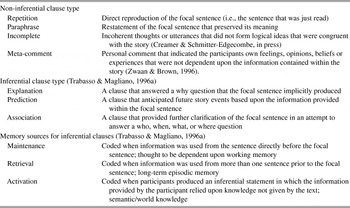
The verbal protocols were first broken down into clauses. A clause was defined as a subject, its verb and any extraneous modifiers. Changes in subject or verb that clearly indicated a new thought by the participant were divided into a separate clause. Each clause was assigned to one of four non-inferential categories or one of three inferential categories. Non-inferential clauses were coded as repetitions, paraphrases, incompletes, or meta-comments. Inferential clauses were coded using the criteria of Trabasso and Magliano (Reference Trabasso and Magliano1996a) as explanations, predictions, or associations. Table 3 provides detailed code assignment information.
Verbal protocol analysis variables

Inferential statements were also judged for accuracy. Correct inferences were coded for responses that were logical and could be linked to information in the story. Incorrect inferences were coded for clauses that were illogical or unreasonable within the context of the story (Laing & Kamhi, Reference Laing and Kamhi2002). Any predictive inference that was explicitly unsubstantiated by the preceding text was also coded as incorrect. In addition, each inferential statement was coded for the memory operation used in its generation as activation, retrieval, or maintenance (see Table 3). All generated inferences that included information provided earlier in the narrative were identified as relying upon maintenance or retrieval; the difference being the distance the information was from the focal sentence. In contrast, activation of relevant world knowledge was considered a concurrent memory operation relying purely upon information contained within the focal sentence. Table 4 shows an example text along with the think-aloud clauses and accompanying inferences and memory operation classifications.
Sample protocol and analysis

Note
C1, C2, C3 = clause number; EX = explanation; PR = prediction; ASS = association; PA = paraphrase; Meta = Metacomment; Inc = incomplete; (C) = correct; (I) = incorrect; A = activation; M = maintenance; R = retrieval; N/A = not applicable.
Scoring Reliability
Half of the data was first scored by two scorers working independently of one another. One rater was blind to the grouping of each individual. Greater than 88% agreement was found for the scorers judgments of clause type (inferential, non-inferential), non-inferential clause type (repetition, paraphrase, incomplete, meta-comment), inferential clause type (explanation, prediction, association), and memory source (retrieval, maintenance, activation). The two scorers then discussed the protocols together and resolved all discrepancies. The second author subsequently scored the remaining protocols individually.
RESULTS
Clauses
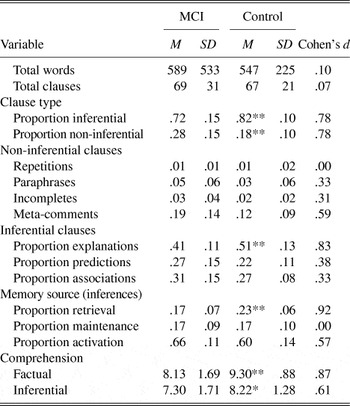
The data from both stories were totaled for each variable as the pattern of data was similar for each story and story did not interact with group in any of the analyses. We first compared the total number of words and clauses in the verbal protocols produced by the MCI and control participants. Independent samples t-tests revealed no significant differences in either the total number of words supplied by the MCI participants (M = 589; range = 227–2845) and controls (M = 547; range = 282–1018), t(44) = −.35, or the overall number of coded clauses generated by the MCI participants (M = 69; range = 40–192) and controls (M = 67; range = 44–101), t(44) = −.18. These findings indicate that the MCI participants were able to report their thoughts about the story narratives in a quantity similar to that of the OA controls.
To account for individual variability found in number of total clauses produced by participants, consistent with prior research (e.g., Creamer & Schmitter-Edgecombe, in press; Schmitter-Edgecombe & Bales; Reference Schmitter-Edgecombe and Bales2005), we used proportional scores for the analyses.Footnote 1 Proportional scores allow for discussion of the data in terms of the proportion of the protocol that involved use of a specific strategy. Table 5 shows summary means and standard deviations for the coded protocol variables for each group.
Narrative comprehension data for the mild cognitive impairment (MCI) and older adult control groups

Notes
Proportional data represents the amount of each type divided by the total amount possible (i.e., proportion of inferences = number of inferences/total clauses).
* p < .05.
** p ≤ .01.
To assess for group differences in number of inferences produced, inferential and non-inferential clauses were first divided by the total number of clauses each participant produced. A 2 group (OA, MCI) by 2 clause type (inferential, noninferential) mixed model analysis of variance (ANOVA) revealed that participants in both groups produced a greater proportion of inferential statements (M = .77) as compared to noninferential statements (M = .23), Wilk’s Λ = .18; F(1,44) = 200.20; p < .001; η2 = .82. Breakdown of the significant group by clause type interaction, Wilk’s Λ = .85; F(1,44) = 7.84; p < .01; η2 = .15, revealed that the OA group produced a greater proportion of inferential clauses and fewer noninferential clauses than the MCI group, ts(44) ≤ 2.87, ps ≤ .01 (see Table 5).
Non-inferential Clauses
To examine non-inferential statement use, proportional data were first obtained by dividing each non-inferential statement type (repetition, paraphrase, incomplete, meta-comment) by the total number of clauses produced by each participant. A 2 group by 4 non-inferential statement type mixed model ANOVA revealed a significant main effect of statement type, Wilk’s Λ = .28; F(3,42) = 35.54; p < .001; η2 = .72. As seen in Table 5, meta-comments made up the large majority of non-inferential statements, being produced by both groups significantly more often than all other non-inferential statement types, Fs > 23.13, ps < .001. The group by statement type interaction was not significant, F = 2.29.
Inferential Clauses
The verbal protocols of both groups consisted of very few incorrect inferential clauses (< 1% of the total inferential statements). This indicates that both groups showed very accurate inference generation as they considered each sentence in turn.
Before evaluating for group differences in inference types, proportional data were obtained by dividing the number of explanatory, associative, and predictive inferences by the total number of inferential clauses each participant produced. A 2 group (MCI, OA) by 3 inference type (explanation, prediction, and association) ANOVA revealed a significant main effect of inference type, Wilk’s Λ = .47; F(2,43) = 24.77; p < .001; η2 = .54, and a significant group by inference type interaction, Wilk’s Λ = .86; F(2,43) = 3.54; p < .05; η2 = .14. As seen in Table 5, the inferential statements of both groups were characterized by greater use of explanatory inferences as compared to associations and predictions, ts(45) > 5.40, ps < .001. In addition, the proportion of explanatory inferences produced by the OA controls was significantly greater than that of the MCI group, t(44) = 2.69, p = .01. The groups did not differ significantly in the proportion of predictive and associative inferences generated, ts < −1.42.
Memory Source for Inferential Clauses
Prior to assessing for group differences in the memory sources supporting inferential clause generation, proportional data were obtained by dividing the memory sources (retrieval, maintenance, activation) by the total number of inferential clauses each individual produced. A 2 group (MCI, OA) by 3 source type (retrieval, maintenance, activation) ANOVA revealed a significant main effect for source type, Wilk’s Λ = .14; F(2,43) = 132.89; p < 001; η2 = .86, that was modified by a significant group by source type interaction, Wilk’s Λ = .79; F(2,43) = 5.62; p < .01; η2 = .21. As can be seen in Table 5, participants in both groups used a statistically greater proportion of activations as the memory source, compared with retrieval and maintenance, ts(45) > 14.34, ps < .001. Breakdown of the interaction revealed that the MCI group produced fewer inferences that relied on retrieval as the memory source than the OA controls, t(44) = 3.37, p < .005, while the groups did not differ in their proportion of use of activations or maintenance, ts < 1.44. Individual data examination further revealed that the proportion of inferences that relied on retrieval was greater than 20% for 12 of the control participants but only 5 of the MCI participants.
Comprehension Questions
Because the 20 true/false comprehension questions were divided into 10 non-inferential (factual) and 10 inferential questions, a 2 group (MCI, OA) by 2 question type (factual, inferential) ANOVA was conducted to compare narrative comprehension performance. The analyses revealed that the MCI participants (M = 15.4) answered fewer of the 20 comprehension questions correctly than the OA controls (M = 17.5), F(1,44) = 7.95, p < .01, η2 = .15. More factual (M = 8.7) than inferential (M = 7.8) questions were also answered correctly by both groups, Wilk’s Λ = .76, F(1,44) = 13.70, p = .001, η2 = .24. The interaction was not significant, F = .04.
Correlations for Think-Aloud Method
Narrative understanding has been shown to be highly related to inference production (proportion of inferences), specifically explanatory inference production (proportion of explanatory inferences). To further examine these relationships along with the role of participant’s ability to integrate prior story events into their inferences (proportion of retrievals as a memory source) to support text comprehension, correlational analyses were conducted. We used total accuracy on the factual and inferential questions to capture the coherence of the participant’s representation of the stories as group did not interact with type of comprehension question. For the MCI group, using a more conservative α level of p ≤ .01, the results revealed a significant correlation between text comprehension and ability to use retrieval as a memory source when making inferences, r = .56, p < .01. The MCI group’s performance on the comprehension questions was not significantly related to proportion of inferences, r = .09, or proportion of explanatory inferences generated, r = .23. For the OA group, performance on the comprehension questions was not significantly correlated with either use of retrieval as the memory source, r = .23, proportion of inferences, r = .09, or proportion of explanatory inferences, r = .11. These findings are suggestive of a relationship between the MCI group’s text comprehension performance and their ability to retrieve and incorporate prior story events when making inferences.
Correlations With Neuropsychological Tests
To aid understanding of those cognitive factors that may be contributing to the MCI group’s poorer comprehension, exploratory Pearson correlation analyses between participants’ think-aloud data and their performance on standard neuropsychological measures were conducted. For each group we examined the relationship between the previously identified variables that differed between the MCI and the OA groups (i.e., proportion of inferences, proportion of explanatory inferences, proportion of retrievals as the memory source, and comprehension questions answered correctly) and the neuropsychological measures of attention and speeded processing, working memory, verbal memory, language, and executive functioning listed in Table 1. Due to the large number of correlations, a more conservative α level of p ≤ .01 was adopted. For the OA controls, no significant correlations emerged, rs < .44. For the MCI group, accuracy on the comprehension questions was significantly correlated with RAVLT list learning, r = .50, p = .01 and the RAVLT short, r = .64, p = .001, and long, r = .59, p < .005, delayed recall measures. None of the remaining correlations reached significance, rs < .47. The findings indicate that the MCI participants who showed better verbal learning and delayed memory abilities also tended to answer a greater number of comprehension questions correctly.
DISCUSSION
We used think-aloud methodology to investigate how individuals with MCI use information (from prior text and world knowledge) to make inferences while reading narrative text. We found that both the MCI and OA control groups produced comparable amounts of think-aloud data (i.e., total number of words and clauses). Consistent with previous research (e.g., Creamer & Schmitter-Edgecombe, in press; McGinnis, Goss, Tessmer, & Zelinski, Reference Creamer and Schmitter-Edgecombe2008; Trabasso & Magliano, Reference McGinnis, Goss, Tessmer and Zelinski1996a, Reference Trabasso and Magliano1996b; Trabasso & Suh, Reference Trabasso, Magliano, Graves, van den Brock and Taylor1993), we also found that both groups produced more inferential than non-inferential statements, more explanatory inferences than predictive or associative inferences, and used activation as the memory source more often than maintenance and retrieval. This comparable group data pattern suggests that the MCI group likely approached the think-aloud task in a manner similar to controls.
Despite the dominance of inferential statements and explanatory inferences in the think-aloud data of both groups, the MCI group produced proportionally fewer inferences and proportionately fewer explanatory inferences than controls. The MCI group also produced a proportionately greater amount of non-inferential statements, which have been considered characteristic of incomplete comprehension and reduced textual cohesion as they can derail the textual cohesion process and result in the inclusion of irrelevant information (Maglinano et al., 1999; Trabasso & Magliano, Reference Trabasso and Magliano1996a, Reference Trabasso, Magliano, Graves, van den Brock and Taylor1996b; Trabasso & Suh, Reference Trabasso and Suh1993). In contrast, the causal connections established through the formation of explanatory inferences are thought to facilitate the integration of individual elements within the text-based memory representation and to improve subsequent recall by providing retrieval pathways to these elements (Myers & Duffy, Reference Myers, Duffy, Graesser and Bower1990). Because much evidence suggests that explanations form the core of understanding in text comprehension (e.g., Graesser et al., Reference Graesser, Singer and Trabasso1994; Pressley & Afflerbach, Reference Pressley and Afflerback1995), a reduction in the generation of explanatory inferences by MCI participants could influence their ability to fully and accurately comprehend everyday reading material.
Inferences that rely on retrieval (episodic memory) as the memory source are also especially thought to be important to comprehension because they help to create causal connections between different parts of the text and to establish a sense of an integrated story (Trabasso & Magliano, Reference Trabasso and Magliano1996a). We found that, compared with OA controls, the MCI group produced significantly fewer inferences that relied on retrieval as the memory source. This may indicate limits on the ability of participants with MCI to access and apply narrative information stored in long-term memory to the text being considered. Such limits could subsequently result in inference generation not directly related to story events (i.e., activations) or more non-inferential statements, leading to poorer narrative understanding. In further support of a relationship between memory abilities and reading comprehension, the MCI participants who performed more poorly answering the comprehension questions were also less likely to use retrieval as a memory source when producing inferential statements and were more likely to exhibit poorer delayed verbal memory abilities.
Using the verbal protocol analysis of Trabasso and Magliano (Reference Trabasso and Magliano1996a), Creamer and Schmitter-Edgecombe (in press) similarly found that the memory difficulties of AD participants appeared to interfere with their ability to integrate story events through the use of inferences. In addition to generating fewer inferences, fewer explanatory inferences, and fewer inferences based on retrieval than controls, the AD group also produced more associative inferences and relied more on the activation of world knowledge when generating inferences. This may suggest that, as memory and other cognitive deficits become more impaired with the progression from MCI to dementia, individuals will experience greater difficulties integrating the focal sentence with prior text and base more of their inferences on knowledge activated via semantic relations with words in the focal sentence.
It has also been suggested that the tendency to focus less on global, full text coherence and more on local, sentence by sentence coherence, could result from an inability to maintain information in working memory (Whitney et al., Reference Whitney, Ritchie and Clark1991). The Trabasso and Magliano (Reference Trabasso and Magliano1996a) protocol analysis used in this study defines maintenance (working memory) as the incorporation of information into an inference that is from one sentence prior to the focal sentence. Currently, however, there is controversy regarding what constitutes working memory span in language processing (van der Linden & Poncelet, Reference van der linden, Poncelet, Stemmer and Whitaker1998). In addition, it has been hypothesized that a form of long-term working memory, which allows information to be stored in long-term memory and kept directly accessible by means of retrieval cues in short-term memory, may play an important role in the construction of mental representation during text comprehension (Ericsson & Kintsch, Reference Ericsson and Kintsch1995). It is, therefore, possible that some of the inferences that were coded as containing retrieval as the memory source may have partially reflected a contribution from working memory.
In contrast to prior research (e.g., Magliano et al., Reference Magliano, Trabasso and Graesser1999; Trabasso & Magliano, Reference Trabasso, Magliano, Graves, van den Brock and Taylor1996b), we did not find a strong relationship between inference generation or explanatory inferences production and text comprehension in the healthy control group. Possible explanations include our modest sample size, the restricted range of performance by OA controls on the text comprehension measure, aging effects as most studies have used young adult samples, and the way that text comprehension was measured in this study. Most prior studies have used narrative recall rather than a recognition test, which may have allowed for responses based on familiarity rather than true recollection and understanding of the information, and several have used extended time delays (e.g., 2 days; Magliano et al., Reference Magliano, Trabasso and Graesser1999; Trabasso & Magliano, Reference Trabasso, Magliano, Graves, van den Brock and Taylor1996b; Trabasso & Suh, Reference Trabasso and Suh1993).
Limitations include the small sample size and the high level of education of participants, which may limit generalization to less highly educated OA and MCI samples. In addition, although the think-aloud procedure has been used successfully with brain injured populations (Creamer & Schmitter-Edgecombe, in press; Schmitter-Edgecombe & Bales, Reference Creamer and Schmitter-Edgecombe2005), it remains unknown whether the procedure itself might place additional burdens on already impaired working memory and/or executive functioning thereby interfering with the ability of individuals with MCI to encode information into episodic memory, possibly confounding the results. Our data suggest that the MCI group generally approached the think-aloud task in a manner similar to controls and in a manner typical of what has been found in other studies. Future studies should, however, investigate the impact of the think-aloud procedure on narrative comprehension for brain injured populations by comparing text comprehension following a think-aloud procedure and a silent reading condition. Our results are also limited to narrative text. Future research should include the evaluation of expository text. Expository text is a widely represented reading material that is frequently encountered by older adults and that can often have important implications for everyday living (e.g., product safety instructions, health care information).
By using the think-aloud method, we were able not only to view the amount of textual comprehension that occurred after an entire narrative had been considered (i.e., true/false accuracy), but also the strategies used by MCI participants during the process of comprehension. We found that, despite producing a similar amount of clauses as controls, the MCI group produced fewer inferences, and were less skilled at generating explanatory inferences and in using prior text information to generate inferences. The memory deficits of the MCI group appeared to be an important contributing component to their poorer performances. The findings suggest that text comprehension in individuals with MCI might be facilitated by the development of text that reduces demands placed on memory and explanatory inference production. This may be especially important for materials related to health care. Emphasis could also be placed on teaching individuals with MCI to use reading strategies that promote explanatory reasoning. Continued research will be needed to better identify those factors that limit text comprehension abilities in the MCI population, and to develop techniques for improving text comprehension in the MCI population.
ACKNOWLEDGMENTS
We thank Alicia Rueda, Michelle Langill, and Kimberly Lanni for their support in coordinating data collection. We also thank Jarrett Riley for his contributions to the protocol coding process. Portions of this research were presented at the Thirty-sixth annual meeting of the International Neuropsychological Society, Waikoloa, Hawaii. This research was funded in part by an Edward R. Meyer Project Award. No financial or other relationships exist that could be interpreted as a conflict of interest pertaining to this manuscript.