Introduction
The ‘reproductive assurance’ hypothesis suggests that selfing evolves because it increases seed production when mates or pollinators are scarce (Darwin Reference Darwin1876, Lloyd Reference Lloyd1965). Traditionally, this hypothesis has been proposed as a possible evolutionary response for alpine and arctic plant species facing impoverished pollinators (Mosquin Reference Mosquin, Taylor and Ludwig1966). In these ecosystems, the levels of diversity, availability and activity of pollinators decline as a consequence of harsh climatic conditions such as low temperatures, strong winds and overcast conditions (Torres-Diaz et al. Reference Torres-Díaz, Gómez-González, Stotz, Torres-Morales and Paredes2011).
Despite this, self-pollination is not a single unvarying process that occurs in the same manner in all species that practice any selfing (Lloyd Reference Lloyd1979). On the contrary, there are different ecological, morphological and physiological factors that constraint self-fertilization (Lloyd & Schoen Reference Lloyd and Schoen1992). For instance, the degree of dichogamy and herkogamy, the behaviour of different vectors, the floral phenology and the environmental conditions may influence the cross- and self-fertilization frequencies. In contrast to the ‘reproductive assurance’ hypothesis, this has been termed the ‘increased pollination probability’ hypothesis (Lloyd & Schoen Reference Lloyd and Schoen1992).
Among alpine plant species, there is evidence of mechanisms that could balance the reduction in pollinator visitation (Fabbro & Körner Reference Fabbro and Körner2004). In order to maintain out-crossing, plants may increase flower showiness (Fabbro & Körner Reference Fabbro and Körner2004), flower longevity and duration of pistil receptivity (Arroyo et al. Reference Arroyo, Armesto and Primack1985, Steinacher & Wagner Reference Steinacher and Wagner2010, Torres-Diaz et al. Reference Torres-Díaz, Gómez-González, Stotz, Torres-Morales and Paredes2011). Moreover, research has revealed that, although pollinator diversity and visitation rates might be significantly lower, effective pollination by some vectors (transport and effective deposition of pollen on stigmas) may compensate for this (Berry & Calvo Reference Berry and Calvo1989, Reference Berry, Calvo, Rundel, Smith and Meinzer1994; Bingham & Orthner Reference Bingham and Orthner1998, Bingham & Ranker Reference Bingham and Ranker2000). The paramo is an alpine ecosystem of the high neotropical mountains, located between the upper limit of forest vegetation (3200–3800 m altitude) and the lower limit of perpetual snow (4400–4700 m altitude), concentrated in the north-west corner of South America, mostly in Venezuela, Colombia and Ecuador and with extensions in Costa Rica, Panama and northern Peru (Luteyn Reference Luteyn1999). Most information on breeding systems in paramo plants relates to giant rosettes of Espeletia species (Körner Reference Körner2003). These studies have suggested xenogamy as the principal reproductive system (Berry & Calvo Reference Berry and Calvo1989, Reference Berry, Calvo, Rundel, Smith and Meinzer1994; Fagua & Gonzalez Reference Fagua and Gonzalez2007, Sobrevila Reference Sobrevila1989) and have reported bumblebees (Bombus species) and some hummingbird species as the most common pollinators (Berry & Calvo Reference Berry and Calvo1989, Reference Berry, Calvo, Rundel, Smith and Meinzer1994; Fagua & Gonzalez Reference Fagua and Gonzalez2007). These studies also have reported phenological adaptations that may have evolved to compensate for reduced pollinator availability and to increase cross-pollination success, which includes a synchronous flowering peak in the population, long individual flowering period, and flowers with long periods of stigmatic receptivity and pollen presentation (Berry & Calvo Reference Berry and Calvo1989, Reference Berry, Calvo, Rundel, Smith and Meinzer1994; Fagua & Gonzalez Reference Fagua and Gonzalez2007).
Bromeliads, both terrestrial and epiphytes, are a dominant element of paramo flora, and the members of the genus Puya are emblematic species of this ecosystem (Luteyn Reference Luteyn1999, Smith & Young Reference Smith and Young1987). Some research on these species, contrary to Espeletia reports, have found that some of them are self-compatible (Chaparro Reference Chaparro and Bonilla2005, González et al. Reference González, Urbano and Pianda2010, Lara & Bonilla-Gómez Reference Lara and Bonilla-Gómez2006), but with mechanisms that can optimize cross-pollination, such as incomplete protogyny (Chaparro Reference Chaparro and Bonilla2005). Thus, different Puya species can show a mixed reproductive system, where cross-pollination or self-pollination success depends on biotic and abiotic conditions (Chaparro Reference Chaparro and Bonilla2005, Chaparro & Mora Reference Chaparro and Mora2003, González et al. Reference González, Urbano and Pianda2010, Lara & Bonilla-Gómez Reference Lara and Bonilla-Gómez2006).
Puya nitida Mez is an endemic bromeliad, distributed in the Colombian paramo and subparamo between 2700–3500 m of altitude (García & Galeano Reference García and Galeano2006, Smith & Downs Reference Smith and Downs1974). This plant is known as a species with an important flowering season and primordial source of nectar for different species of hummingbirds (Franco-Saldarriaga Reference Franco-Saldarriaga2014, Gutiérrez Reference Gutiérrez2005). In spite of this, there is no research on P. nitida mating-systems and consequently studies on the mechanisms that this species uses to assure reproductive success in its populations.
The aims of the current research were (1) to determine the breeding system, (2) to describe the floral biology (floral morphology and floral development) and (3) establish the phenological pattern in P. nitida, specifically to determine whether these mechanisms can support the reproductive assurance hypothesis or the increased pollination probability hypothesis. Considering the reproductive assurance hypothesis, a predominantly autogamous breeding system would be expected for Puya nitida. In contrast, under the increased pollination probability hypothesis, an outcrossing breeding system, high flower and stigma longevity, herkogamy or dichogamy and other floral characteristics could be interpreted as adaptations that contribute to cross-pollination.
Materials and methods
Study site and species
The study was conducted between February 2013 and February 2014 (13 months) in the Chingaza National Natural Park, specifically in the Piedras Gordas paramo, that is located in the north-west of the park in the Eastern Andes of Colombia at 3400 m elevation (04º44′15.1′′N, 73º50′28.52′′W). Chingaza is a humid paramo with a unimodal precipitation regime. It has a dry season from December to February and a period with higher precipitation between June and July. Mean annual precipitation is 1200 mm and the mean annual temperature varies between 6.7°C and 7.9°C with significant changes during the day (Vargas & Pedraza Reference Vargas and Pedraza2003).
The vegetation in this zone is characterized by species of families such as Hypericaceae (Hypericum sp.), Ericaceae (Macleania rupestris, Disterigma empetrifolium, Gaultheria anastomosans), Asteraceae (Espeletia grandiflora) and other species such as Puya goudotiana, Calamagostris sp. and Aragoa corrugatifolia which are families of Bromeliaceae, Poaceae and Rubiaceae respectively.
Puya nitida Mez is endemic to the Eastern Cordillera of the Andes of Colombia and is distributed in the subparamo and paramo between 2700 and 3500 m. It has numerous leaves arranged in a basal rosette; leaves are lanceolate and glabrous with straight spines on the margin. Each rosette is monocarpic, producing terminal inflorescences 1–2 m high which die after flowering and fructification. However, it has a clonal reproduction which give them a polycarpic status to the genetic individual and additionally allows it to form dense rosette modules with different phenological states. For this reason, they are called perennial monocarpics (Chaparro Reference Chaparro and Bonilla2005). Perfect zygomorphic flowers have petals 5–6 cm long coloured yellow-green to violet. The fruit is capsular, subglobous, dark brown to black with many winged seeds (Pedraza-Peñalosa et al. Reference Pedraza-Peñalosa, Betancur and Franco-Rosselli2005, Smith & Downs Reference Smith and Downs1974).
A transect of 0.06 km was delimited where 47 modules were previously marked with fluorescent tape. Each module had to have at least one rosette in fertile state: buds, flowers, unripe fruits (green fruits with persistent petals), ripe fruits (brown to black fruits with notable dehiscence line in each of the locules) and dehiscent fruits (fruits with releasing of seeds) and be separated by at least 20 m.
Floral biology
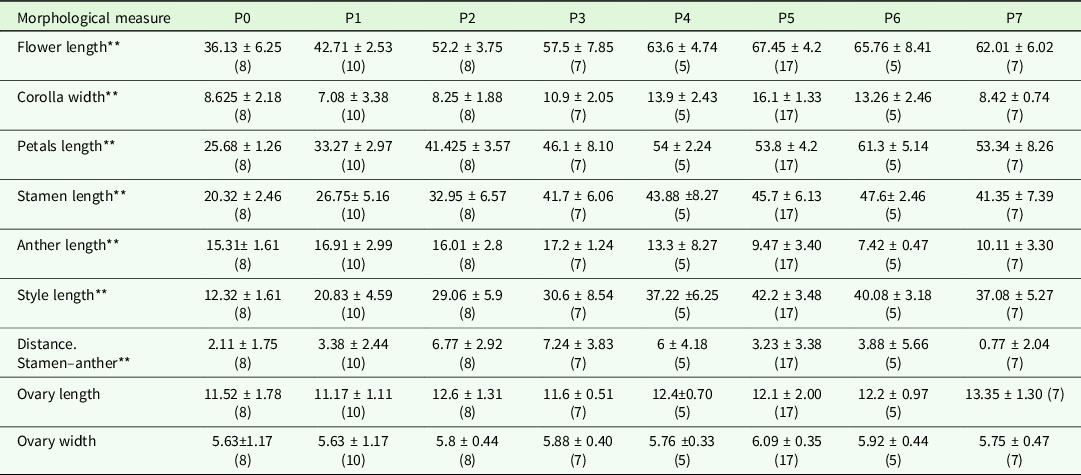
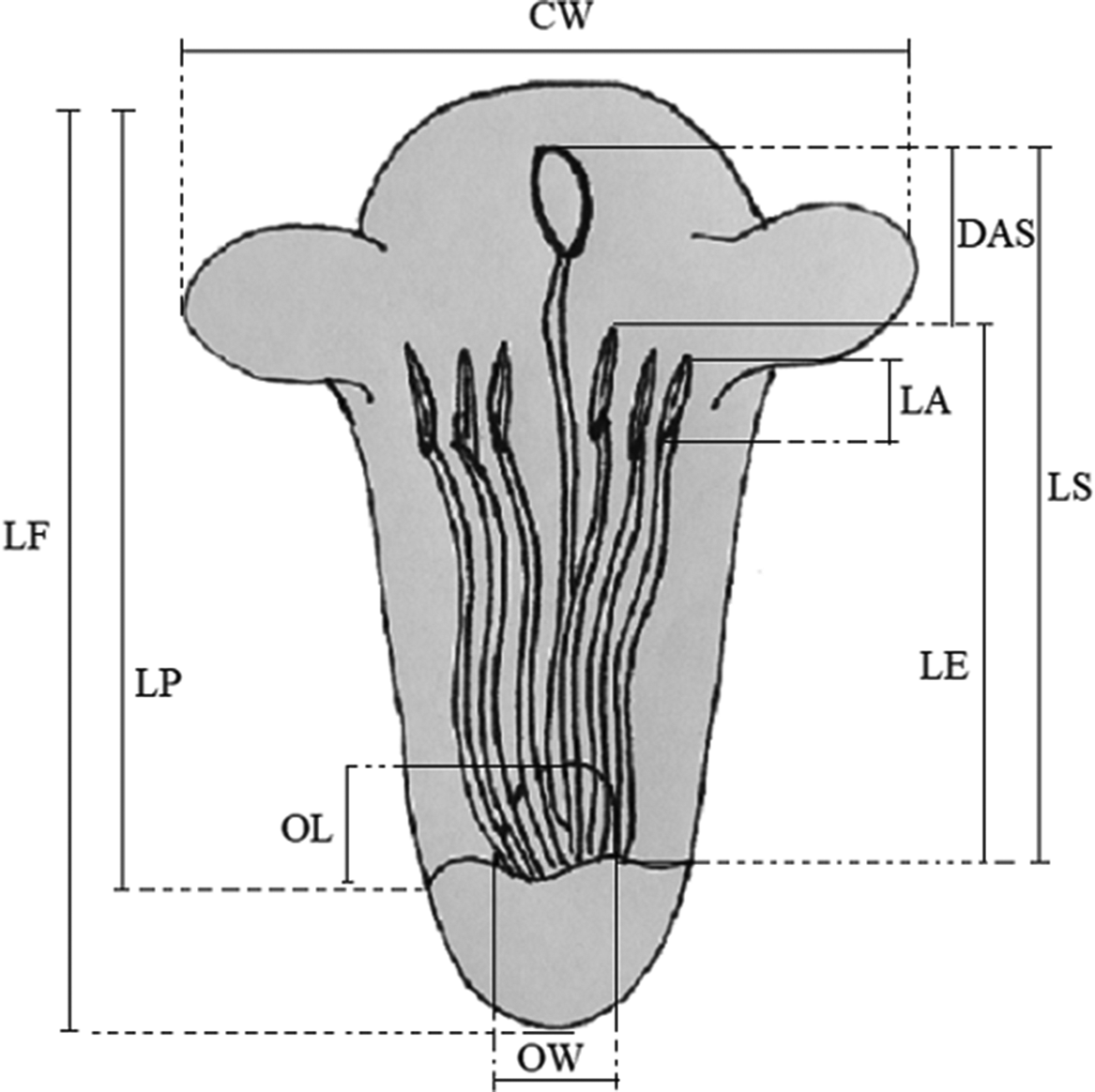
In order to assess floral development of P. nitida, we randomly selected 67 fresh flowers from 14 inflorescences and 12 modules. We considered eight floral phases: Phase 0 – Floral primordia, Phase 1 – Floral Bud, Phase 2 – Bud with petals visible, Phase 3 – Anthesis beginning, Phase 4 – Flower opening, petals upright and partially reflexed, Phase 5 – Flower fully mature, petals totally reflexed, Phase 6 – Flower senescing, Phase 7 – Flower senescent. Table 1 shows the number of collected flowers for each phase. In each floral phase we evaluated (1) floral morphology (length of flowers, petals, anthers, styles and stamens, corolla width, the distance between the anthers and stigma and finally ovary length and ovary width), Figure 1 shows how each variable was measured; (2) separation of male and female functions in space (herkogamy) and time (dichogamy); and (3) nectar production (yes/no) in each floral phase.
Morphological measures of floral structures of Puya nitida in each floral phase (P). **Morphological measures with significant differences among floral phases (ANOVA P <0.05). Sample size in parentheses (n). P0 = Floral primordia, P1 = Floral Bud, P2 = Bud with petals visible, P3 = anthesis beginning, P4 = Flower opening, petals upright and partially reflexed, P5 = Flower fully mature, petals totally reflexed, P6 = Flower senescing, P7 = Flower senescent

Morphological floral traits measured. LF, length of flowers; LP, length of petals; LA, length of anthers; LS, length of styles; LE, length of stamens; CW, corolla width; DAS, the distance between the anthers and stigma; OL, ovary length; OW, ovary width.

Herkogamy was evaluated by the variation in style length and stamen position and dichogamy by observing if pollen release preceded the stigma receptivity (protandry) or vice versa (protogyny). Male function was monitored by verifying the different stages of anther development, if the dehiscence line was present, if the anthers was dehisced, if the anthers had released pollen and finally, if anther was empty of pollen. Female function was determined by peroxidase reaction test with 3-(4, 5-dimethylthiazol-2-yl)-2, 5-diphenyltetrazolium bromide (MTT) according to methods proposed by Rodríguez-Riaño & Dafni (Reference Rodriguez-Riano and Dafni2000). The test solution consisted of a 1% concentration of MTT in 5% of sucrose solution (0.5 g sucrose +10 ml water, mixed, and then 0.1 g MTT added into the sucrose solution). MTT can detect the presence of active dehydrogenase. Active dehydrogenase is generally on the surface of receptive stigmas which will turn deep pink or purple by MTT. We used five fresh styles per floral phase (40 styles in total) from the 14 inflorescences and 12 modules mentioned above. Then we put them on the EP tube and added several drops of the test solution and kept the stigma in the solution. About 30 minutes later, we checked whether the stigma had turned purple or not.
To assess the duration of each floral phase we carried out direct and daily observations (every 24 hours), monitoring 10 floral buds from 5 inflorescences labelled previously with small coloured plastic rings.
To estimate the quantity and quality of nectar produced by P. nitida the volume and concentration of nectar was calculated in 24 randomly selected flowers in anthesis. Measurements were carried out through calibrated capillary tubes of 5 μl and a handheld refractometer (ATAGO-Brix scale range 0 to 32%).
Reproductive phenology
To estimate annual reproductive phenology, we recorded monthly from February 2013 to February 2014 the total number of buds, flowers, unripe fruits (green fruits with persistent petals), ripe fruits (brown to black fruits with notable dehiscence line in each of the locules) and dehiscent fruits (fruits with releasing of seeds) on 71 fertile rosettes of 46 modules that were previously marked with fluorescent tape.
At population level we described patterns such as: frequency, defined as the number of ‘on’/‘off’ cycles per year (one cycle consists of a flowering episode followed by a non-flowering interval). Flowering can be classified in four basic classes: continual (flowering with sporadic brief breaks), subannual (flowering in more than one cycle per year), annual (only one major cycle per year), and supra-annual (one cycle over more than one year); Regularity, if the phenological state occurs in the same period of time year after year (regular, irregular); Duration: we divided annual flowering patterns into three classes: brief flowering (<1 mo), intermediate flowering (1–5 mo), and extended flowering (>5 mo).
Breeding system
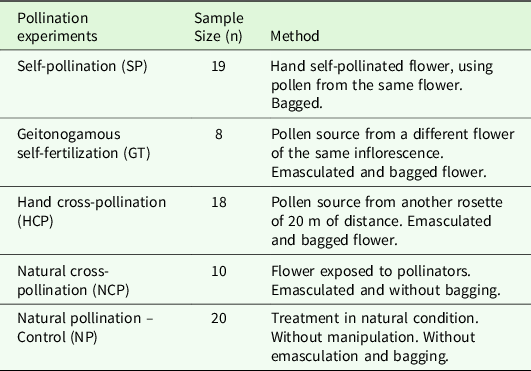
To evaluate the breeding system, we carried out five pollination experiments in 75 flowers randomly selected from 10 modules and 12 different inflorescences. The experiments were performed in flowers under floral phase 3 – anthesis beginning, the period when stigma was receptive and their own anthers have not released pollen. The pollen donors were flowers in floral phase 4 – Flower opening, petals upright and partially reflexed and Phase 5 – Flower fully mature, petals totally reflexed. Each bud was marked with colour tape according to the pollination treatment and the bud was isolated within a synthetic mesh bag to avoid herbivorous attack and floral visiting (only for those treatments that required it) (Table 2).
Pollination experiments used to determine the reproductive system of P. nitida

To determine the effect of each pollination treatment we calculated the number of developed fruits (Fruit-set) and estimated their quality from their weight, height and width. Moreover, the index of self-incompatibility (ISI) proposed by Zapata & Arroyo (1978, described in Dafni 2001) was calculated using the formula ISI = extent of fruit set in self-pollinated flowers/extent of fruit set in cross-pollinated flowers. Thus, a plant species is considered fully self-compatible when ISI is ≥1, partially self-incompatible when ISI is ≥0.2 but <1, mostly self-incompatible when ISI is <0.2 but >0 and fully self-incompatible when ISI is 0.
Data analyses
Taking into account that the data presented normal distribution (Kolmogorov–Smirnov, Shapiro–Wilk P >0.05) and homogeneity of variances (Levene P >0.05), we used one-way ANOVA to detect differences (1) among the size of floral structures and the different development phases of the flowers and (2) among the fruit quality and pollination experiments. In all cases, post hoc comparisons were made with Tukey tests. Differences in the number of unripe fruits, ripe fruits, dehiscent fruits, buds, and flowers across the months were analysed using Friedman test ANOVA. We used a Chi-squared test to compare the number of formed fruits and the breeding system treatments. All analyses were performed with R 3.0.1 (2013) software.
Results
Floral biology
Puya nitida has perfect, complete and zygomorphic flowers. Flowers are organized in a simple terminal inflorescence, arranged in acropetal order. Puya nitida showed characteristics such as tubular flowers, thick floral bracts, flowers without fragrance, diurnal anthesis and distance between the nectar chamber and the sexual organs of the flower. Additionally, this species had a concentration and mean volume of nectar of 16, 24 ± 5, 51% (n = 24) and 41.5 μl ± 31 (n = 24), respectively.
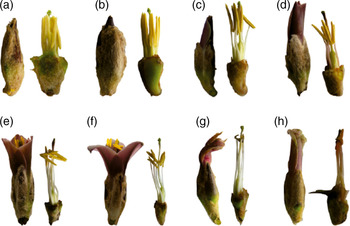
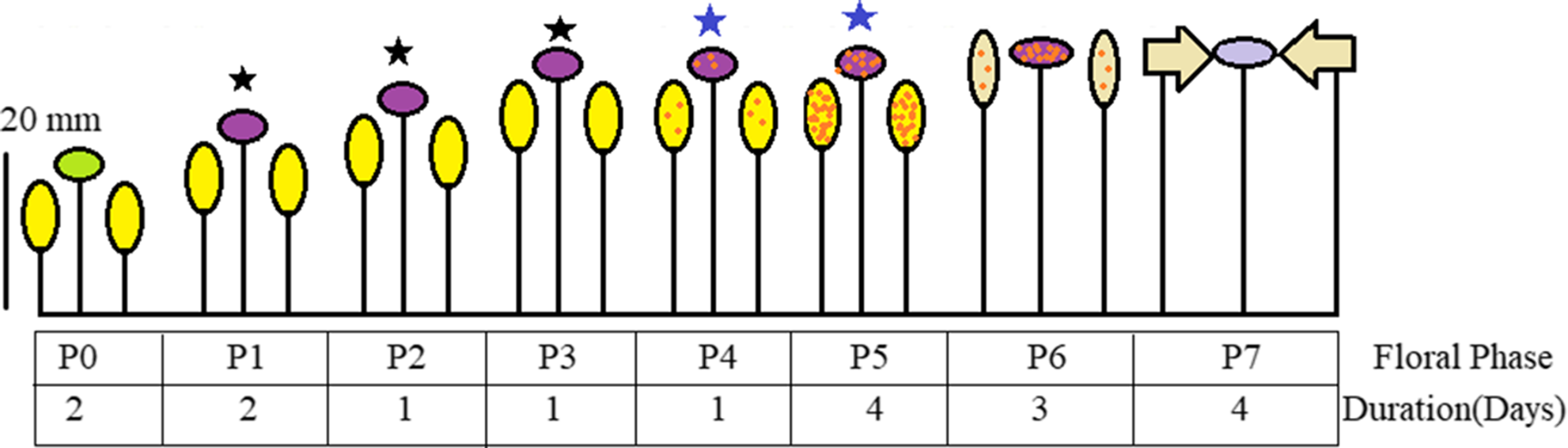
Based on the recorded data, it was shown that the total period of time required to complete the entire flowering process was 19 days through a sequence of eight phases. The details of each phase are shown as follows (Table 1, Figures 2 and 3).
Details of diagnostic features in the different floral states of Puya nitida. (a) phase 0 – Floral primordia; (b) phase 1 – Floral bud; (c) phase 2 – Bud with petals visible; (d) phase 3 – Anthesis beginning; (e) phase 4 – Flower opening, petals upright and partially reflexed; (f) phase 5 – Flower fully mature, petals totally reflexed; (g) phase 6 – Flower senescing; (h) phase 7 – Flower senescent.

Separation of male and female functions in space (herkogamy) and time (dichogamy) of P. nitida flowers. Yellow circles are the anthers without dehiscence; the yellow circles with orange points are the anthers releasing pollen; pale yellow circles and arrows are the empty anthers which are in contact with the stigma; green circles are immature stigmas; purple circles are stigmas receiving pollen and pale purple circles the stigma of a flower senescent. Black stars show the phases where herkogamy occurred and blue stars where herkogamy and dichogamy occurred at the same time.

Phase 0 (Floral primordia): the sepals completely covered the floral primordial, so the reproductive structures were not visible. The petals, stamens and pistil were immature and with a shorter length than the other floral states, while, the anthers had a larger size than the other phases, without dehiscence (they have not released pollen) and without contact with the stigma (Table 1, Figures 2 and 3). In this phase there was no nectar production and the mean duration of this phase was 2.5 ± 0.70 days (n = 10, max. = 4, min. = 2).
Phase 1 (Floral bud): The sepals began to open at the top and the petals were visible between 5–10 mm. The reproductive structures were not visible due to the petals remaining closed. Both petals, stamens and pistils lengthened slightly compared with phase 0 (Table 1, Figures 2 and 3). The anthers remained closed without dehiscence and without contact with the stigma. As in phase 0, there was no nectar production. In this phase the stigma was receptive and the mean duration of this phase was 2.2 ± 0.42 days (n = 10, max. = 3, min. = 2).
Phase 2 (Bud with petals visible): This was a similar phase to the previous one, since the reproductive structures were not visible, the anthers remained closed and there was no nectar production. In this phase there was a significant lengthening of all organs, especially of stamens, style and petals (Table 1). The petals exceeded the sepals by more than 15 mm and the stigma was receptive; the mean duration of this phase was 1.1 ± 0.3 days (n = 10, max. = 2, min. = 1).
Phase 3 (Anthesis beginning): The petals and the rest of the floral structures grew significantly compared with the previous phases (Table 1). The petals began to open in their apical parts, where the stigma could be visible. The anthers remained closed without dehiscence. However, they were more versatile and separate from the stigma than in the previous stage (Table 1). At this stage the flower began nectar production. The present phase lasted about a day.
Phase 4 (Flower opening, petals upright and partially reflexed): In this stage anthesis could be detected. The petals developed a tube where the stamens, stigma and the base flower could be perceived. There was nectar production and the male phase began, since there was pollen release. Stages 2, 3 and 4 were shorter than the other stages, with a mean duration of 1.1 ± 0.3 days (n = 10, max. = 2, min. = 1).
Phase 5 (Flower fully mature, petals totally reflexed): The flower reached its maximum diameter, the gynaecium and androecium were visible (Table 1, Figures 2 and 3). The petals, stamens and pistils ceased growth. The anthers showed changes in their morphology and pollen content, since pollen was being released and was available to the pollinators (Table 1). In this stage the male and female phase were synchronized. In some flowers the stigma and the anthers touched, but in others the anthers exceeded the corolla and the stigma, because they were more versatile and longer. This was the longest stage and nectar production was noticeable (4.4 ± 0.56 days, n = 10, max. = 5, min. = 3).
Phase 6 (Flower senescing): The petals and reproductive structures wilted. The corolla was rolled inwards and the reproductive structures were not visible. The appearance of the flower deteriorated with dark pigmentation. The stigma was receptive and the anthers were smaller than the other phases because the pollen had dispersed (Table 1, Figures 2 and 3). The mean duration was 2.7 ± 0.67 days (n = 10, max. = 4, min. = 2) for this phase.
Phase 7 (Flower senescent): the petals were completely rolled inwards, the stamens were wrapped around the pistil and touching the stigma. The stigma was at the same level as the anthers and different from the other phases where both structures were separated by a few millimetres. So in the measure ‘distance between the stigma and the anthers’ there were significant differences between the phase 7 and the other phases (Table 1, Figures 2 and 3). The anthers were empty and nectar production could not be detected. This phase had a duration of 4 days parallel with fruit development.
In general, there were significant differences between the length of the petals (ANOVA, F7.59 = 96.71, P < 0.001), stamens (ANOVA, F7.59 = 20.89, P < 0.001) and style (ANOVA, F7.59 = 39.02, P < 0.001), and the floral phases, since these structures were growing while the flower was changing and increasing in age. Despite this, in the three last phases (phases 5, 6, 7) there were no differences in the size of the floral structures because flower growth was suspended (Tukey, P >0.05) (Table 1). Moreover, anther length showed differences between the floral phases (ANOVA, F7.59 = 14.59, P <0.001), but in this case, the reason was a reduction in its size. Differences found were mainly between the four first stages and the last two because pollen was released (Tukey, P <0.001) (Table 1).
According to the MTT test, stigma receptivity was of ∼12 days and could be detected from Phase 1 – Floral Bud to Phase 6 – Flower senescing, maturing before the anthers and showing a temporal lag or protogyny between the reproductive parts of the flower. The male phase could be detected between phase 4 – Flower opening, petals upright and partially reflexed and phase 6 – Flower senescing with ∼8 days of duration (Figures 2 and 3).
Flowering phenology
The Puya nitida population showed a regular flowering pattern and subsequently the other phenological stages (buds, unripe fruits, ripe fruits and dehiscent fruits). The phenological stages had an annual frequency with an intermediate duration (4 months that could extend to >6 months). In February 2013 the P. nitida population had some rosettes that were in the final flowering phase of 2012 and others that were at the beginning of fruit development.
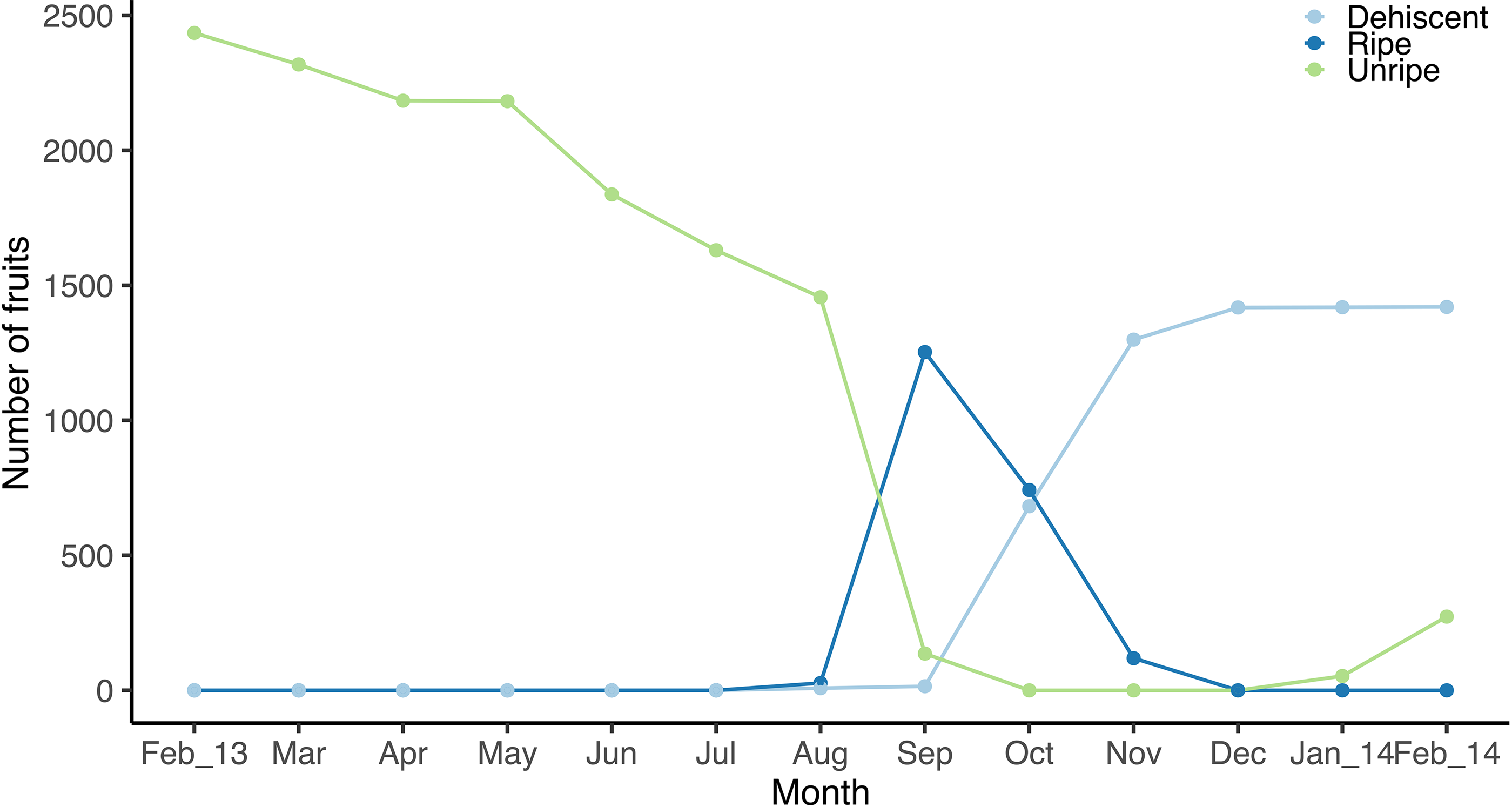
The time that elapsed from unripe fruits to ripe fruits was ∼7 months (February 2013 to September 2013). However, the number of unripe fruits decreased throughout the months, because these were affected by different insect species. Thus, in February (2013), about 2500 unripe fruits were calculated, a figure that gradually dropped to almost half in August, with 1426 fruits (Figure 4). Furthermore, the number of unripe fruits fell considerably to 136 from August–September, since this stage changed to ripe fruits (Figure 4). As a result, there were significant differences between the numbers of unripe fruits and the evaluated months (ANOVA Friedman = 483.503, df = 12, P <0.001) (Figure 4). The ripe fruits phase was distinguished from the last part of August 2013 to November 2013. Subsequently, during the last month the fruits that began to release seeds (dehiscent fruits) remained like this for more than 5 months from October 2013 to February 2014, since seeds were slowly dispersing. Also, the number of ripe fruits (ANOVA Friedman = 449.16, df = 12, P <0.001) and the number of dehiscent fruits (ANOVA Friedman = 540.80, df = 12, P <0.001) showed substantial differences throughout the months (Figure 4).
Monthly variation at population level in the number of immature fruits, ripe fruits and fruits with seeds dispersed of Puya nitida.

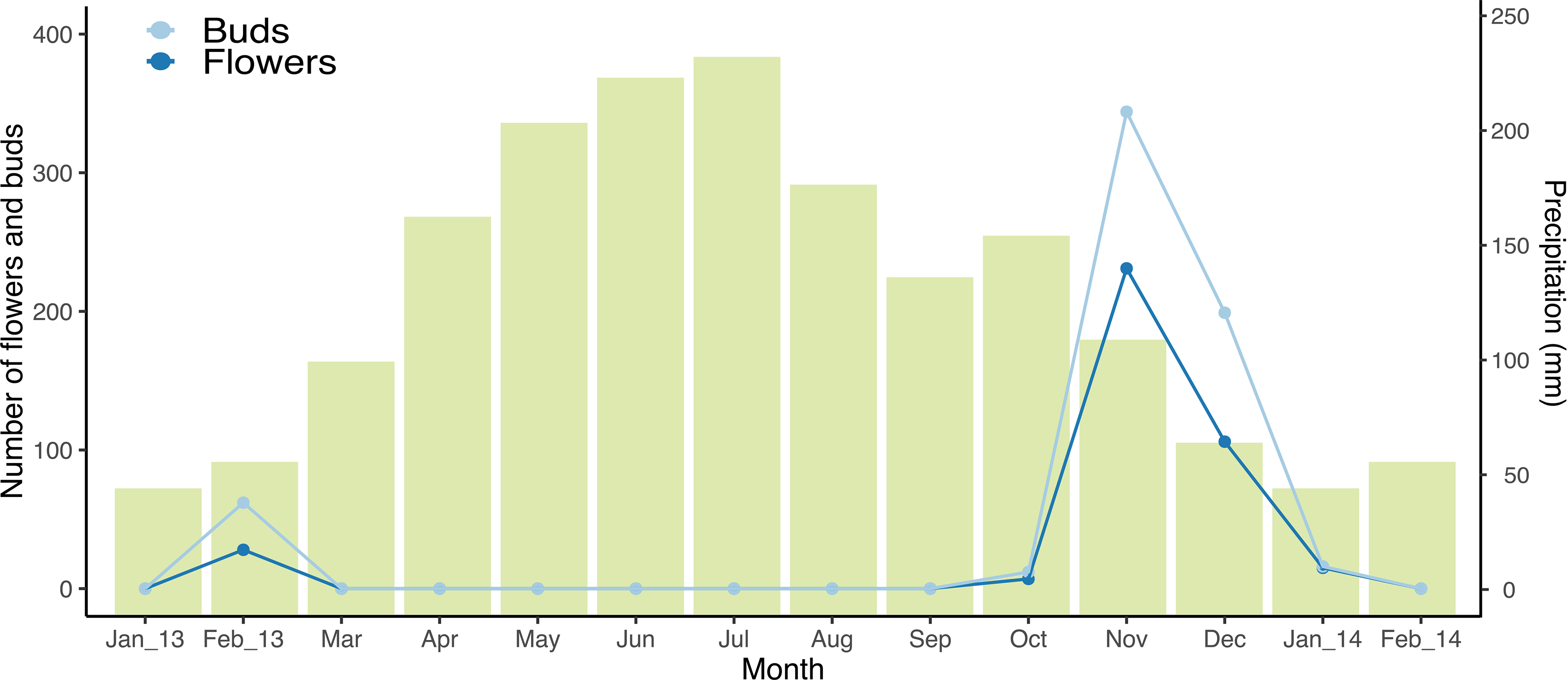
Figure 5 illustrates that in February 2013 the P. nitida population showed some rosettes in the final phase of the flowering of 2012 that carried on with fruit development. Furthermore, this figure shows that the 2013 flowering of the same population occurred from the last part of October 2013 to the beginning of February 2014. A clear and marked flowering peak occurred in November with about 231 flowers and 344 floral buds. This peak led to considerable differences in the number of buds (ANOVA Friedman = 113.50, df = 16, P <0.001) and flowers (ANOVA Friedman = 98.54, df = 16, P < 0.001) throughout the months. The flowering peak coincided with the dry season or the season of less precipitation for the Chingaza National Natural Park (Figure 5).
Monthly variation at population level in the number of buds and flowers in anthesis of Puya nitida and multiannual average rainfall (1927–2013) in the Chingaza National Natural Park.

Reproductive system
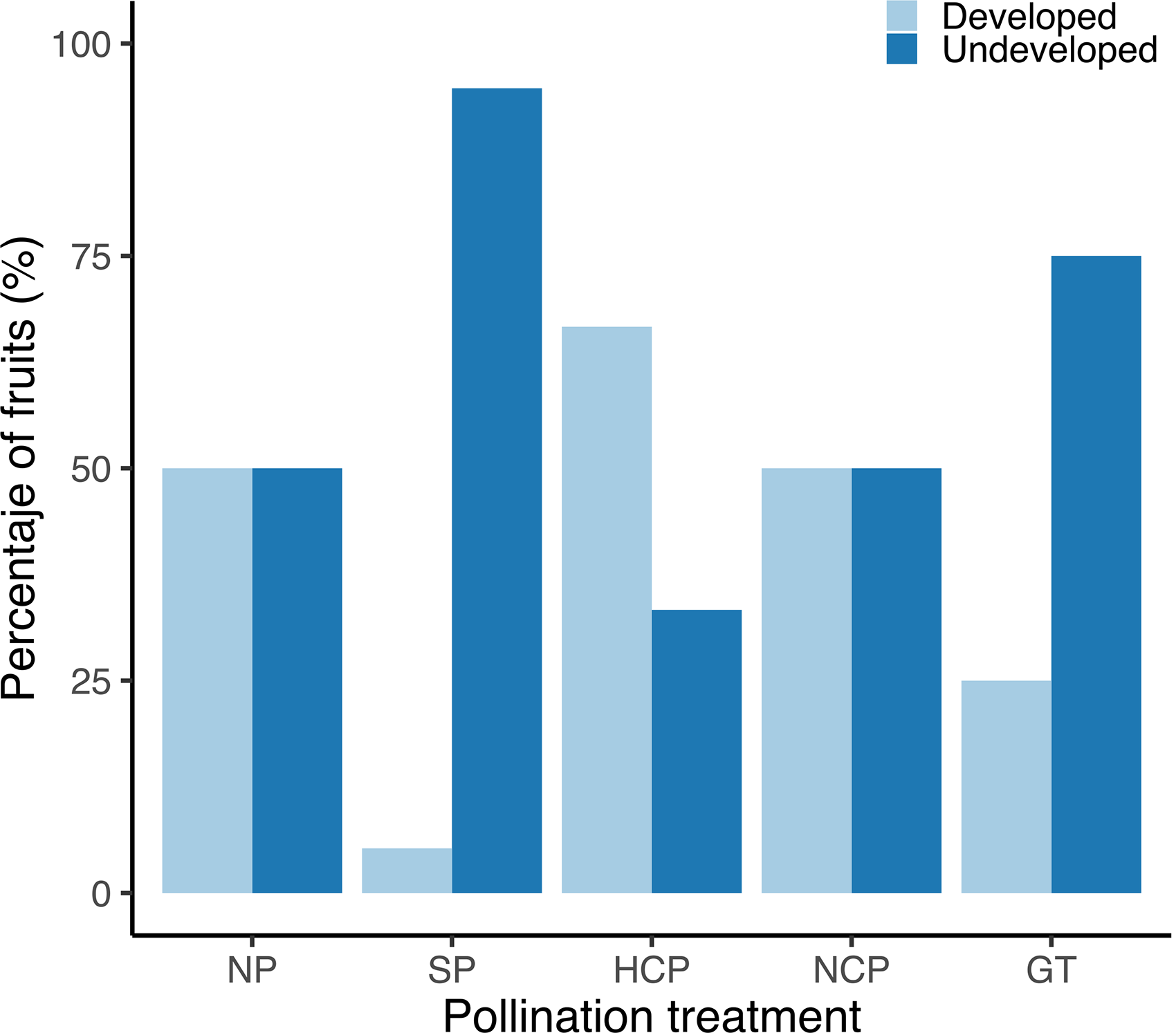
The index of self-incompatibility (ISI) in P. nitida was 0.08, indicating that this species is predominantly self-incompatible. The number of developed fruits was significantly different among the pollination treatments (χ2= 16.886, df = 4, P = 0.002). The hand cross-pollination (HCP) treatment produced the highest percentage of fruits with 66% (n = 18), following by natural pollination (NP) (N = 20) and natural cross-pollination (NCP) (n = 10) with 50% each. Self-pollination (SP) produced the least number of fruits with 5.26% (n = 19) (Figure 6).
Percentage of developed fruits or undeveloped fruits for each pollination treatments. NP, natural pollination-open pollination; SP, hand self-pollination; HCP, hand-cross pollination; NCP, natural cross-pollination; GT, geitonogamous self-fertilization.

Significant differences between the quality of developed fruits and the pollination treatments were found. We registered marked differences in fruit weight between SP and HCP (Tukey, P <0.001) treatments, and between SP and NCP and NP (Tukey, P <0.05) treatments, since HCP and NCP had fruits that were heavier than the rest of the pollination experiments. Likewise, we found significant differences in the height and width of the fruits, between SP and NCP and HCP (Tukey, P <0.05), where HCP and NCP were larger than the other treatments (Table 2).
Discussion
Floral characteristics related to ornithophily, herkogamy and dichogamy, flowers and receptive stigmas with more than 5 days of longevity and an index of self-incompatibility that shows that it is mostly self-incompatible, were the principal findings of this study that supported that P. nitida reproductive success could be favoured by cross-pollination and added evidence to the increased pollination probability hypothesis in high mountain plants.
According to the ornithophily hypothesis (Faegri & Van Der Pijl Reference Faegri and Van Der Pijl1979), P. nitida might be pollinated by birds, especially hummingbirds, since this plant species had floral characteristics such as tubular flowers without fragrance, production of diluted nectar, diurnal anthesis and distance between the nectar chamber and the sexual organs of the flower. This kind of pollination has been corroborated by the research of Franco-Saldarriaga (Reference Franco-Saldarriaga2014) and Restrepo-Chica & Bonilla-Gómez (Reference Restrepo-Chica and Bonilla-Gómez2017), since hummingbirds such as Lesbia victoriae, Chalcostigma heteropogon, Eriocnemis vestita and Pterophanes cyanopterus and a flowerpiercer, Diglossa humeralis have been shown to be the principal floral visitors of P. nitida.
Moreover, P. nitida has a wide corolla and anthers whose arrangement during anthesis probably favours hummingbirds with short and long bills, while other species of birds and even bats which could carry out legitimate visits and come in contact with the reproductive parts of the flower, conferring cross-pollination in different proportions, have been seen in different investigations (Franco-Saldarriaga Reference Franco-Saldarriaga2014, Gutiérrez Reference Gutiérrez2005, Hornung-Leoni & Sosa Reference Hornung-Leoni and Sosa2006, Restrepo-Chica & Bonilla-Gómez Reference Restrepo-Chica and Bonilla-Gómez2017).
Stigma longevity and flower duration (the length of time a flower remains open and functional) have been recognized as traits that could ensure successful pollination in alpine habitats where pollinators are sparse or uncertain (Arathi et al. Reference Arathi, Rasch, Cox and Kelly2002, Arroyo et al. Reference Arroyo, Armesto and Primack1985, Bingham & Orthner Reference Bingham and Orthner1998, Fabbro & Körner Reference Fabbro and Körner2004, Steinacher & Wagner Reference Steinacher and Wagner2010, Torres-Díaz et al. Reference Torres-Díaz, Gómez-González, Stotz, Torres-Morales and Paredes2011). In paramo areas it is very likely that this low availability of pollinators is also present and that plants can ensure their reproductive success with this floral mechanism, receiving the amount of pollen necessary to fertilize the ovules during the flowering time (Restrepo-Chica & Bonilla-Gómez Reference Restrepo-Chica and Bonilla-Gómez2017). Puya nitida showed receptive stigmas and functional flowers for 12 and 9 days, respectively, that could enhance investment in pollinator attraction and allow higher cross-pollination opportunities. These results were similar to other paramo plants such as Espeletia grandiflora with 12–15 days of stigmatic receptivity (Fagua & Gonzalez Reference Fagua and Gonzalez2007) and Puya trianae with ∼8 days of flower longevity (Chaparro Reference Chaparro and Bonilla2005). Nevertheless, further research is necessary to determine whether these responses in P. nitida are due to differences in pollen deposition. Experimentally modified rates of pollen removal and/or receipt could be used to estimate the minimum flower longevity by maximizing pollination success with supplemental hand pollination and the maximum flower longevity by minimizing pollination success with pollinator exclusion (Trunschke & Stöcklin Reference Trunschke and Stöcklin2017).
Herkogamy and dichogamy have been suggested as traits that act in general to reduce self-interference and often also to reduce self-fertilization (Lloyd & Webb Reference Lloyd and Webb1986). Puya clava-herculis and P. trianae are two related species with P. nitida which are also distributed in the paramos. For both species a temporary separation (dicogamy) of the male and female organs has been recorded, showing protogynous flowers (Chaparro Reference Chaparro and Bonilla2005, Miller Reference Miller1987). Specifically, in P. trianae, Chaparro (Reference Chaparro and Bonilla2005) indicated that this species has an incomplete protogyny and possibly a delayed selfing, since at the end of anthesis and the beginning of the senescence of the flower, the stamens were wrapped around the pistil and touching the stigma, allowing a possible self-pollination when the flowers had not been visited by pollinators.
In accordance with the above, we distinguished herkogamy and dichogamy during the floral development of P. nitida, since the stigma matured first (Phase 1 – Floral bud) than the anthers (Phase 4 – Flower opening, petals upright and partially reflexed) and was more exposed to pollinators (from Phase 2 – anthesis beginning to Phase 4 – Flower opening, petals upright and partially reflexed), so pollinators might first touch this structure during the visit and thus favour cross-pollination (Figure 3, Table 1). Franco-Saldarriaga (Reference Franco-Saldarriaga2014) and Restrepo-Chica & Bonilla-Gómez (Reference Restrepo-Chica and Bonilla-Gómez2017) corroborated the aforementioned, since recorded hummingbird species such as Lesbia victoriae, Chalcostigma heteropogon, Eriocnemis vestita and Pterophanes cyanopterus behaved effectively and efficiently when they visited P. nitida flowers, suggesting they are pollinators of this plant species.
Although we also observe that at the end of anthesis and the beginning of the senescence of the flower, the stamens were wrapped around the pistil and touching the stigma, we are not sure if delayed self-pollination occurs in this case. In order to corroborate this, we suggest future studies where stigma receptivity and pollen viability tests during these floral phases can be carried out and, additionally, conduct pollination experiments for that purpose.
Another aspect of the reproductive biology which supported fertilization mediated by vectors was that flowering coincided with the dry season at the study site, so the flight and foraging activity of floral visitors is favoured (Figure 5). Moreover, this could be supported by results in pollination experiments, since this species is predominantly self-incompatible and shows a higher percentage and quality of developed fruits for hand cross-pollination (HCP), natural pollination (NP) and natural cross-pollination (NCP), suggesting that P. nitida requires pollen vectors to produce more fruits with a higher quality and consequently to increase the reproductive success of the plant (Table 3, Figure 6). Both the flowering season and the reproductive system of P. nitida were different from a study reported by Chaparro (Reference Chaparro and Bonilla2005) for P. trianae at the same site. For P. trianae the flowering peak was found to be during the season with higher precipitation and fruit production could be increased by selfing, i.e. the total of hand self-pollination experiments that result in fruits. Restrepo-Chica (Reference Restrepo-Chica2014), indicated that the reproductive system was partially self-compatible for another population of P. nitida. Nevertheless, it is important to underline that reproductive systems in plants can vary among populations and even among individuals (Arista et al. Reference Arista, Berjano, Viruel, Ortiz, Talavera and Ortiz2017, Raduski et al. Reference Raduski, Haney and Igíc2011). This variation can be a consequence of environmental (temperature, humidity, age of the flower, internal style conditions, pollen vectors availability, etc.) and genetic conditions (mutation or polymorphism in multi-allelic S-locus) (Arista et al. Reference Arista, Berjano, Viruel, Ortiz, Talavera and Ortiz2017, Lloyd & Schoen Reference Lloyd and Schoen1992, Raduski et al. Reference Raduski, Haney and Igíc2011, Travers et al. Reference Travers, Mena-Ali and Stephenson2004, Vogler et al. Reference Vogler, Das and Stephenson1998). For instance, Arista et al. (Reference Arista, Berjano, Viruel, Ortiz, Talavera and Ortiz2017) recognize that there are some Asteraceae species that often show broad variation in the self-incompatibility response, since they have both strictly self-incompatible and self-compatible populations, while others have partially self-compatible populations in which a mixture of self-incompatible and self-compatible individuals co-occur.
Fruit characteristics in different pollination experiments applied to P. nitida. SP (Hand self-pollination), GT (geitonogamous self-fertilization), HCP (hand-cross pollination), NCP (natural cross-pollination), NP (natural pollination – control). Sample size in parentheses (n)

Our results showed that despite pollinator diversity and frequencies being lower in the paramo of Chingaza (Franco-Saldarriaga Reference Franco-Saldarriaga2014), P. nitida exhibited components of its floral biology that might compensate for the presumed reduction and contribute to cross-pollination: (1) floral traits related to ornithophily such as tubular flowers, without fragrance, diurnal anthesis and diluted nectar; (2) a prolonged floral display and flowers and receptive stigmas with an extended longevity (>5 days); and (3) herkogamy and dichogamy in some of the phases of the floral development.
Furthermore, the fact that flowering coincided with the dry season in the study site might be interpreted as an advantage for the flight and foraging activity of floral visitors, and finally, the higher percentage and quality of developed fruits for cross-pollination experiments suggested that P. nitida requires pollen vectors to increase the reproductive success of the plant. Overall, our investigations demonstrate that xenogamous breeding systems and mechanisms for increasing pollination can be selected in a tropical high-elevation ecosystem and additionally add evidence to the increased pollination probability hypothesis, specifically for a plant species of the paramo, an ecosystem where pollinators are scarce.
Acknowledgements
We would like to thank the Programme of Young and Innovative Researchers of Colciencias, the Executive Directorate of Research of Bogota (DIB), Grupo de investigación en Biología de Organismos Tropicales (BIOTUN) and The National Natural Park Chingaza and its officials for research permission.