



Introduction
The role of elite individuals in craft production is key to understanding economic organisation in the past. Most discussions of elite involvement in craft production focus on the relationship between actors of differing sociopolitical statuses, such as elite management of lower-status craftworkers (e.g. Costin Reference Costin1991, Reference Costin, Feinman and Price2001, Reference Costin, Feinman and Nichols2004; Domínguez Carrasco & Folan Reference Domínguez Carrasco, Folan, Laporte, Arroyo and Escobedo1999; Inomata Reference Inomata2001; Clark Reference Clark2007; Flad & Hruby Reference Flad and Hruby2007; Shimada Reference Shimada and Shimada2007; Hirth Reference Hirth2009). The identification of elite management of craft activities involves evaluations of access to and the formal organisation of production areas, proximity to political elite structures and standardisation of processes and products (Costin Reference Costin1991, Reference Costin, Feinman and Price2001, Reference Costin, Feinman and Nichols2004; Ames Reference Ames, Price and Feinman1995). Archaeological studies have assessed the role of elites in the organisation of crafting in many parts of the world, including the Americas (Ames Reference Ames, Price and Feinman1995; Hruby Reference Hruby2007; Swenson & Warner Reference Swenson and Warner2012; Davenport Reference Davenport2020), Asia (Sun Reference Sun2008; Campbell et al. Reference Campbell, Li, He and Jing2011; Yee et al. Reference Yee, Darith, Rachna and Suy2021), Africa (Chirikure Reference Chirikure2020; Moffett et al. Reference Moffett, Hall and Chirikure2020) and elsewhere (Barrowclough & Lister Reference Barrowclough and Lister2004; Olausson Reference Olausson2017; Amesbury et al. Reference Amesbury, Walth and Bayman2022). However, elites not only managed crafting, sometimes they were also craftworkers. Here, we focus on Maya elites as crafters (see Ames Reference Ames, Price and Feinman1995; Inomata Reference Inomata2001; Inomata et al. Reference Inomata, Triadan, Ponciano, Pinto, Terry and Eberl2002; Aoyama Reference Aoyama2007; Hruby Reference Hruby2007), to evaluate the role of elite crafting in the wider economic organisation in the Maya region.
Elite crafting in the Maya world is associated with the production of objects that are either used in ritual activities or which require specialised knowledge for their production (O'Neil Reference O'Neil2009; Houston Reference Houston2014, Reference Houston2021; see also Helms Reference Helms1993). During the Classic period (AD 250–800), stone was seen as animate and thus stoneworking was a ritual activity (Houston Reference Houston2014: 91; Houston et al. Reference Houston, Stuart, Taube and Houston2021a). Through stone crafting, power was ritually transferred to a modified object (Stuart Reference Stuart1996; O'Neil Reference O'Neil2009; Houston Reference Houston2014: 91).
While monumental architecture and stone monuments, such as stelae and sculptures, were important to ancestral Maya lifeways, little is known about people who produced them. While individuals of different statuses participated in the creation of monuments (Inomata Reference Inomata2001), establishing the identities of these individuals is difficult. Identification of crafters has been attempted through the consideration of archaeological assemblages, including caches (Andrews & Rovner Reference Andrews, Rovner, Harrison and Wauchope1973; Inomata Reference Inomata2001; Inomata et al. Reference Inomata, Triadan, Ponciano, Pinto, Terry and Eberl2002; Aoyama Reference Aoyama2007; Clarke Reference Clarke2020; Clarke et al. Reference Clarke, Horowitz and Palingin press) and through glyphic/iconographic studies (Stuart Reference Stuart and Kerr1989; O'Neil Reference O'Neil2009; Houston Reference Houston2021). However, it is unusual to find clear archaeological evidence of such crafters due to the nature of the contexts in which crafting toolkits were disposed. Tools were typically discarded when exhausted and such broken or worn artefacts are difficult to identify. Furthermore, tools used for carving could also be used for other purposes and can therefore only be identified through assemblage-level comparisons. Sculptors occasionally signed their work, making it possible to distinguish the hand of an individual craftworker, but linking known stoneworking sites to specific sculptors is currently impossible (Houston et al. Reference Houston, Scherer, Taube and Houston2021b).
Greenstone held particular cultural and economic significance for the ancestral Maya (e.g. Freidel Reference Freidel and Lange1993; Taube Reference Taube2005; Kovacevich & Callaghan Reference Kovacevich and Callaghan2018). Evidence for greenstone working areas indicates the involvement of elite actors in the crafting process (Kovacevich Reference Kovacevich, Hruby, Braswell and Chinchilla Mazariegos2011; Andrieu et al. Reference Andrieu, Rodas and Luin2014; Kovacevich & Callaghan Reference Kovacevich and Callaghan2018). The segmented production identified at Cancuen, in Guatemala, points to the range of specialised knowledge integral to the production process, as that specialised knowledge was required more in some stages of production than others, and hence production at those stages was restricted to certain individuals (Kovacevich Reference Kovacevich2006, Reference Kovacevich, Hruby, Braswell and Chinchilla Mazariegos2011).
In this article, we present an assemblage of stoneworking objects, or modifiers, from El Perú-Waka’ (hereafter Waka’), an ancestral Maya site in the central Maya lowlands (Figure 1) in modern-day Petén, Guatemala. We use ‘stone modifiers’ to refer to objects used to work stone during the manufacture of stone artefacts, including monuments and greenstone production. We prefer the term ‘modifier’ as not all of the objects discussed in this piece have yet been subject to use-wear analysis to distinguish, for example, those used for grinding versus polishing. Excavations at an elite residential group at Waka’ identified materials that had likely been used for modifying stone items, specifically for masonry/monument production and greenstone working. This assemblage provides an opportunity to address the role of elite individuals in crafting and contributes to the global literature on craft specialisation. We propose that the crafters who occupied Waka's residential group were elite actors who participated in multiple artisanal activities, including stone carving and greenstone working. These finds support the identification of elite participation in ‘dirty’ crafting (Inomata Reference Inomata2001) and suggest that elite possession of specialised knowledge facilitated their participation in these stoneworking activities (Helms Reference Helms1993; Ames Reference Ames, Price and Feinman1995; Stuart Reference Stuart1996; O'Neil Reference O'Neil2009; Houston Reference Houston2014).
Location of Waka’ (figure by D. Marken).

Identifying stoneworking assemblages
The successful identification of stoneworking assemblages is rare in the Maya region, as they are difficult to discern without the sorts of contextual evidence that does not preserve well archaeologically (Clarke et al. Reference Clarke, Horowitz and Palingin press). Several studies do, however, provide insights into the types of tools, which are discussed below, linked with stone and greenstone working (Kidder et al. Reference Kidder, Jennings and Shook1946; Mirambell Reference Mirambell1968; Digby Reference Digby1972).
Most stoneworking assemblages have been identified in unique depositional contexts, for example, at the site of Aguateca, Guatemala, which was rapidly abandoned, leaving objects in the locations in which they were last used (Inomata & Triadan Reference Inomata and Triadan2000; Inomata et al. Reference Inomata, Triadan, Ponciano, Pinto, Terry and Eberl2002). Assemblages at Aguateca indicate that polished greenstone axes formed part of toolkits for carving stelae (Inomata Reference Inomata2001; Inomata et al. Reference Inomata, Triadan, Ponciano, Pinto, Terry and Eberl2002; Aoyama Reference Aoyama2007). The differently sized axes were related to specific carving or incising tasks (Inomata Reference Inomata2001; Inomata et al. Reference Inomata, Triadan, Ponciano, Pinto, Terry and Eberl2002; Aoyama Reference Aoyama2007). Aoyama (Reference Aoyama2007) used use-wear analyses to illustrate that greenstone axes were used to work stone for masonry blocks or carving stone monuments (see also Haviland Reference Haviland1974; Houston Reference Houston2000; Clarke et al. Reference Clarke, Horowitz and Palingin press) but traceological studies, which examine the microscopic wear on objects to determine the function of those objects, demonstrate that greenstone was also used to polish greenstone ornaments (Melgar & Andrieu Reference Melgar, Andrieu, Arroyo, Méndez and Ajú2016; Meléndez Reference Meléndez2019; Melgar Reference Melgar2023). Greenstone items found in stoneworking assemblages could therefore have been used as polishers for greenstone ornaments.
Polishers, including polished limestone objects, ‘banana-shaped’ polishers, and polished bifaces are also associated with stoneworking assemblages (Andrews & Rovner Reference Andrews, Rovner, Harrison and Wauchope1973; Rovner & Lewenstein Reference Rovner and Lewenstein1997). Polished bifaces were worked/rounded on one side but retain traces of bifacial working on the other (see Andrews & Rovner Reference Andrews, Rovner, Harrison and Wauchope1973). When assemblages of such polishers are found, they are interpreted as residences of masons or areas of masonry work (Parker et al. Reference Parker, Bey and Gallareta Negrón2019; see also Clarke Reference Clarke2020; Clarke et al. Reference Clarke, Horowitz and Palingin press). Other objects associated with polishing include manos, a particular form of groundstone tool, and pumice, the volcanic rock (Clarke Reference Clarke2020; Clarke et al. Reference Clarke, Horowitz and Palingin press).
Overall, stoneworking assemblages contain a mix of greenstone axes, polishers (including limestone pieces, polished bifaces and ‘banana’ polishers) and whetstones, which are used for sharpening tools. Yet the identification of all of these objects together in a single context is unusual (Andrews & Rovner Reference Andrews, Rovner, Harrison and Wauchope1973; Rovner & Lewenstein Reference Rovner and Lewenstein1997), and the identification of stoneworking assemblages is often dependent on contextual information rather than a complete toolkit (Clarke Reference Clarke2020).
Greenstone working assemblages are most often identified by the presence of debitage from the production process and associated toolkits that include hammerstones of various sizes, string saw anchors, chert blades and drills, abraders or polishers, and materials used as abrasives, including broken greenstone and quartz (Kidder et al. Reference Kidder, Jennings and Shook1946; Kovacevich Reference Kovacevich2006, Reference Kovacevich, Hruby, Braswell and Chinchilla Mazariegos2011; del Águila Flores Reference del Águila Flores2009; Rochette Reference Rochette2009, Reference Rochette2014; Andrieu et al. Reference Andrieu, Rodas and Luin2014). One such assemblage was identified at Cancuen, in the southern Maya lowlands (AD 760–800), with tools including chert, greenstone and quartzite hammerstones, and chert drills (Kovacevich Reference Kovacevich2006: 181, Reference Kovacevich, Hruby, Braswell and Chinchilla Mazariegos2011; Andrieu & Forné Reference Andrieu, Forne, Arroyo, Linares and Paiz2010: 947; Andrieu et al. Reference Andrieu, Rodas and Luin2014). Similarly, excavations in the Motagua region in the northern Maya highlands—close to the only known sources of jadeite in Mesoamerica—have uncovered tool assemblages and debitage linked to bead and preform production including greenstone cobbles, flakes and hammerstones and chert drills (Rochette Reference Rochette2009, Reference Rochette2014).
El Perú-Waka’
Located at the south-west of the Petén Karst Plateau, in modern-day Guatemala, the Maya city of Waka’ was occupied from the Late Preclassic to the Terminal Classic periods (400 BC–AD 1000, Freidel & Escobedo Reference Freidel, Escobedo, Navarro-Farr and Rich2014; Navarro-Farr & Rich Reference Navarro-Farr and Rich2014; Eppich et al. Reference Eppich, Marken, Menéndez, Marken and Arnauld2023; Figure 1). Excavations within the city core and in the surrounding region indicate that Waka’ figured prominently in Classic period Maya political dynamics (Guenter Reference Guenter, Navarro-Farr and Rich2014; Martin & Velásquez Reference Martin and Velásquez2016; Martin Reference Martin2020). The activities of Waka's elites mirror those of other major Maya centres, including the erection of carved stone monuments (Stuart Reference Stuart1996; O'Neil Reference O'Neil2009; Houston Reference Houston2014, Reference Houston2021).
Waka’ was one of the most densely populated settlements in the Maya region (Marken Reference Marken, Marken and Fitzsimmons2015; Canuto et al. Reference Canuto2018; Marken et al. Reference Marken, Pérez, Navarro-Farr, Eppich, Arroyo, Salinas and Ajú Álvarez2019; Marken & Ricker Reference Marken, Ricker, Eppich, Marken and Freidel2024). Multiple types of economic activities were practised across the city and its hinterlands, in which individuals of all statuses participated. Eppich and Freidel (Reference Eppich, Freidel and King2015; see also Eppich Reference Eppich, Masson, Friedel and Demarest2020) suggest marketplace exchange of utilitarian goods but that prestige goods likely circulated through different mechanisms.
Here, we focus on materials from the Payes group within the Ical neighbourhood, the north-western residential sector of the city's urban core (Figure 2; Marken & Cooper Reference Marken, Cooper, Pérez, Pérez and Friedel2018). The Ical neighbourhood consists of 133 structures dominated by an acropolis (Marken et al. Reference Marken, Menéndez, Cuyán, Pérez, Plunkett, Van Oss, Canté, Pérez Robles, Navarro-Farr and Marken2023). Located near the centre of the neighbourhood, adjacent to the acropolis, is the Payes group, which consists of 30 structures around seven patios. Excavations consisted of test units across the neighbourhood (Menéndez & Cuyan Reference Menéndez, Cuyán, Pérez and Pérez2016; Marken et al. Reference Marken, Menéndez, Cuyán, Pérez, Plunkett, Van Oss, Canté, Pérez Robles, Navarro-Farr and Marken2023), slot trenches on the edges of particular land-use features (a reservoir and a causeway) and horizontal excavation of two residences (Marken & Cooper Reference Marken, Cooper, Pérez, Pérez and Friedel2018). All excavations were conducted using natural and cultural stratigraphic layers and sediment was screened through a one-quarter inch (6.35mm) mesh. The objects and architecture revealed, and their proximity to a large residential complex (the acropolis), point to the presence of high-status individuals within the neighbourhood. Structures K10-11 and K10-12B, where the stoneworking assemblage was identified, are both located in the northernmost part of the Payes group, due east of the acropolis on the north-east edge of the Ical tank (a large water storage reservoir), flanking the tank's outlet (Figure 3).
Map of Waka’ overlaid on the lidar image for the site (figure by D. Marken, with permission of Proyecto Arqueológico Waka’).

Payes group (figure by D. Marken, with permission of Proyecto Arqueológico Waka’).

Materials and methods
Lithic artefacts (including flaked and ground stone items) recovered from excavations in the Payes group were analysed using a detailed attribute analysis. Analysis of flaked stone artefacts followed conventions of lithic analysis (Whittaker Reference Whittaker1994; Odell Reference Odell2003; Andrefsky Reference Andrefsky2005) and collected information on 23 attributes including metric data, technological and typological attributions, production stage and mechanism, raw material and the presence of cortex and heat treatment, among others. Cores and formal tools, such as bifaces, were subject to additional analyses, including morphological and technological analyses, to provide fuller characterisation. Analysis of the groundstone assemblage followed conventions of such analyses (Adams Reference Adams2002) including metric measurements, raw material and form designations. The results of the flaked stone lithic analysis are summarised in Table 1, and the results of the ground stone analysis are discussed in the following section.
Chert lithics from structures K10-11 and K10-12B.

*Not including the stone modifier assemblage.
Evidence for carving and polishing at Waka’
An assemblage of stone modifiers was recovered during removal of collapsed masonry from structure K10-11 (Marken & Cooper Reference Marken, Cooper, Pérez, Pérez and Friedel2018). This cluster of artefacts was identified as embedded within and on top of the masonry of the southern portion of the structure's east wall. Other materials from structure K10-11 and the adjacent structure K10-12B, described further below, indicate stone and greenstone working.
Structure K10-11 was a small, vaulted, stone-built residential structure consisting of two rooms with east facing doorways. Room 1 contained a masonry bench with a single step along the northern side (Figure 4). Prior to the roof collapse, the body of a middle-aged woman (Burial 76) had been placed on the bench (Patterson Reference Patterson, Pérez, Pérez and Friedel2018) and the structure was likely abandoned shortly thereafter, as some of the bones were knocked to the floor during the collapse. Several artefacts, including a small bead modifier, two manos, two large shell bivalves, a projectile point and two partial ceramic vessels, were recovered from the floor of room 1 (Marken & Cooper Reference Marken, Cooper, Pérez, Pérez and Friedel2018; Figures 4 & 5).
North profile (A) and plan (B) of structures K10-11 and K10-12B (drawings by R. Ozaeta (A & B) and D. Marken (B), with permission of Proyecto Arqueológico Waka’).

Photograph of the stone working assemblage in situ in room 1 of structure K10-11 (photograph by D. Marken).

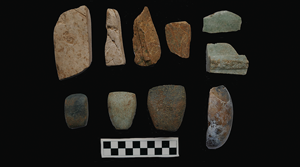
The assemblage of stone modifiers (Figure 6) consists of two polished stones with greenstone flecks, three greenstone axes, two polished limestone pieces, two greenstone pieces polished on one side only and one polished chert biface. All were recovered from the same area, along with a general utility biface, a common tool type from the Maya lowlands that was also associated with stoneworking.
Stone working assemblage. Top row) two polished limestone pieces, materials with greenstone flecks, and cut greenstone; bottom row) three greenstone axes and polished biface (photograph by R. Horowitz).

The assemblage includes objects typically used for the working of stone and greenstone (see Andrews & Rovner Reference Andrews, Rovner, Harrison and Wauchope1973; Rovner & Lewenstein Reference Rovner and Lewenstein1997; Inomata & Triadan Reference Inomata and Triadan2000; Aoyama Reference Aoyama2007; Clarke et al. Reference Clarke, Horowitz and Palingin press). In particular, the three greenstone axes (Figure 6) resemble those axes from Aguateca, which represent the tools of a stelae carver, with different sizes for different stages of work. The polished chert biface and the shaped limestone pieces are comparable with objects identified by Andrews and Rovner (Reference Andrews, Rovner, Harrison and Wauchope1973) from a mason's toolkit from Dzibichaltun (Andrews & Rovner Reference Andrews, Rovner, Harrison and Wauchope1973; Rovener & Lewenstein Reference Rovner and Lewenstein1997; Parker et al. Reference Parker, Bey and Gallareta Negrón2019). Those bifaces were polished on one side, with the other side illustrating their bifacial production. The shaped limestone pieces also resemble those identified by Andrews and Rovner (Reference Andrews, Rovner, Harrison and Wauchope1973; Rovner & Lewenstein Reference Rovner and Lewenstein1997; Parker et al. Reference Parker, Bey and Gallareta Negrón2019).
The two greenstone pieces that are polished on one side, one of the polished stones with greenstone flecks and one of the two polished limestone pieces show evidence of sawing, which probably relates to greenstone working. Based on the straightness of the marks, it is probable that planks, possibly made of wood, or stone slabs were used to rub abrasives (e.g. sand) acting as a saw. As both greenstone and limestone pieces show saw marks, we propose that they were in the process of being made into preforms for the manufacture of greenstone ornaments or limestone tools (e.g. abraders). Traceological studies identified limestone as the preferred modifier of Classic-period Maya artisans for abrading greenstone ornaments in the central Maya lowlands (Melgar & Andrieu Reference Melgar, Andrieu, Arroyo, Méndez and Ajú2016; Meléndez Reference Meléndez2019). We propose hypothetical scenarios for the polished surfaces of the two greenstone pieces: either these pieces were fragments of finished goods that were in the process of modification for reuse or were used as greenstone polishers themselves. Their glossy sections are the result of friction exerted over their surface by another agent, such as abrasives.
In addition to the stone modifier assemblage, other finds likely indicative of stoneworking were recovered from structures K10-11 and K10-12B, with most concentrated in structure K10-11. These include pumice (n = 4), greenstone (n = 2) and mano (n = 3) fragments, a stone with nine hemispherical holes on one side (likely for modifying beads), a bark beater (in 2 pieces) and a potential abrading stone. The pumice, which was imported from the volcanic area to the south of Waka’, could have been used as an abrasive, while manos were used for a variety of stoneworking activities, including polishing (Clarke Reference Clarke2020; Clarke et al. Reference Clarke, Horowitz and Palingin press).
The stone with the hemispherical holes (Figure 7) is similar to those used in bead production (Chase & Chase Reference Chase and Chase2011: 116; Kovacevich Reference Kovacevich, Hruby, Braswell and Chinchilla Mazariegos2011; Landry Reference Landry2013; Kovacevich & Callaghan Reference Kovacevich and Callaghan2018). This stone modifier is broken; the fragment contains nine depressions ranging from 10–12mm in diameter, though more may originally have been present. It differs slightly in form from other known stone modifiers and the flat interior surface of the depressions suggests that it was used to work relatively small, flat objects. The presence of this stone modifier alongside the partially sawn greenstone pieces indicates that multicrafting activities (Shimada Reference Shimada and Shimada2007; Hirth Reference Hirth2009) were undertaken within these structures, as they relate to greenstone production.
Stone modifier from Structure K10-11. The hemispherical holes were possibly used for modifying beads (photograph by R. Horowitz).

In addition to the stoneworking assemblage, other lithic materials recovered during the excavations include a mix of formal and informal chert tools and debitage (Table 1). Bifaces were the most common flaked stone tool and include general utility bifaces (n = 10), projectile points (n = 5), unidentifiable fragments (n = 10) and a polished biface similar to that described above (Figure 8; Andrews & Rovner Reference Andrews, Rovner, Harrison and Wauchope1973). Both the general utility bifaces and the polished biface are typically associated with stoneworking activities (see Clarke Reference Clarke2020; Clarke et al. Reference Clarke, Horowitz and Palingin press).
‘Banana-shaped’, polished chert biface showing polished (left) and unpolished (right) sides (photographs by R. Horowitz).

While the remaining chert materials are not directly related to either stelae carving or greenstone working, chert tools were used in both tasks. Traceological studies indicate that chert was the preferred raw material for perforating greenstone ornaments (Melgar & Andrieu Reference Melgar, Andrieu, Arroyo, Méndez and Ajú2016; Meléndez Reference Meléndez2019; Melgar et al. Reference Melgar, Solís, Monterrosa, Puy and Meléndez2021) and, at Teotihuacan, Mexico, was used for polishing both monuments and greenstone ornaments (Cabrera et al. Reference Cabrera, Guzmán, Melgar and Sánchez2018; Melgar & Solís Reference Melgar, Solís and Manzanilla2018).
Discussion
The lithic assemblage from the Payes group is indicative of stone and greenstone working. The presence of distinctive tools, including polished and ‘banana-shaped’ bifaces, stone objects for abrading/polishing and greenstone axes point to stoneworking, while greenstone and abrading/polishing implements point to the working of greenstone. While it is impossible to determine exactly what was produced here, comparisons with assemblages from other sites suggest the tools may have been used for carving stelae and greenstone working, possibly of greenstone ornaments. The lack of greenstone debitage suggests that greenstone production was segmented and most reduction occurred elsewhere.
The location of the stoneworking assemblage within the Payes group indicates crafting conducted by the high-status residents of Waka’. Similarly, at Cancuen, some greenstone working areas were located near the royal palace, and the presence of greenstone and limestone sawing, abrading and polishing at structure K10-11 at Waka’ corresponds with the activities performed at high-status groups at Cancuen (Kovacevich Reference Kovacevich2006: 36). Given the evidence for stone and greenstone working, the location of the artefacts within the Payes group and the symbolic nature of the activities themselves (see Stuart Reference Stuart1996; Inomata Reference Inomata2001; Aoyama Reference Aoyama2007; O'Neil Reference O'Neil2009; Houston Reference Houston2014), we argue that high-status producers were involved in stelae carving and the production of greenstone objects at Waka’. These high-status crafters participated in ‘dirty crafts’ (Inomata Reference Inomata2001), including sawing greenstone and limestone cobbles to manufacture preforms.
The animate nature of stone in the Maya region meant that stoneworking was a ritual activity and physical objects were imbued with power (Stuart Reference Stuart1996; O'Neil Reference O'Neil2009; Houston Reference Houston2014: 91; Houston et al. Reference Houston, Stuart, Taube and Houston2021a; Horowitz et al. Reference Horowitz, Brown, Yaeger and Cap2024). The esoteric nature of stoneworking, and the symbolic importance of stone monuments and greenstone objects, therefore point to the involvement of high-status producers. Production by high-status crafters also added to the economic and social value of such monuments and objects (Helms Reference Helms1993; Kovacevich Reference Kovacevich, Mathews and Guderjan2017) and it is likely that the ritual and esoteric knowledge involved in their crafting was limited to select (high-status) individuals (Stuart Reference Stuart1996; Houston Reference Houston2014; Clarke Reference Clarke2020; but see Weedman Arthur Reference Weedman Arthur2018 for a discussion of animate stone and specialist knowledge in stone tool production by non-elite Gamo hide scrapers in Ethiopia). In turn, the use and exchange of stone objects was mediated through knowledge about the producer.
The identification of stoneworking toolkits outside caches or special abandonment contexts is unusual and the Waka’ stone modifier assemblage therefore provides a unique opportunity to explore crafting locations. Structures K10-11 and K10-12B lie on the outskirts of the residential group, near a water source (Figures 3 & 4), suggesting that the latter was important for stone working. The burial of a female within structure K10-11 could indicate the involvement of individuals of multiple genders in these activities.
Finally, the assemblage provides evidence for multicrafting (Shimada Reference Shimada and Shimada2007), with the crafters involved in stone and greenstone working, and in the production of their own tools. The location of the finds supports the hypothesis of elite participation in crafting, adding weight to previous assertions based on the symbolic and ritual significance of the raw materials and the finished products, and on the specialised knowledge required for production.
Conclusion
Consideration of a stone modifier assemblage from the ancestral Maya city of Waka’, and its location within a high-status area of the site, provides evidence that elite individuals participated in difficult to perform, labour-intensive and ‘dirty’ craft production activities (Inomata Reference Inomata2001). Although Inomata (Reference Inomata2001) highlighted elite participation in crafts that are difficult work, often scholars have continued to assume that difficult tasks were performed by non-elite individuals. We suspect that elite participation in similar crafting activities is more common globally than documented thus far. Furthermore, the ontological understanding of stone, or other materials, may shape who can undertake such crafting, despite the difficulties of working with these materials.
Hence, elite involvement in crafting may result from the possession of the ritual or specialised knowledge necessary for certain types of production.
The Waka’ assemblage suggests that elites participated in a variety of crafts, and that their participation in craft production was almost certainly shaped by the ontological understanding of the raw materials and the knowledge necessary to produce such goods. We suggest that elite crafting is probably under-recognised archaeologically, and we hope that this case study provides a framework for the identification of such crafting at other sites and in other parts of the world.
Acknowledgements
Investigations were conducted by the Proyecto Arqueológico Waka’ (PAW), directed at the time of excavations by David Freidel and Juan Carlos Pérez, with support and permission from the Ministerio de Cultura y Deportes de Guatemala, which includes the Dirección General del Patrimonio Cultural y Natural, the Instituto de Antropología e Historia (IDEAH), and the Departamento de Monumentos Prehispánicos y Coloniales. Thanks to Rene Ozaeta, Zachary Cooper and the people of Paso Caballos, La Cebita and Dolores for their assistance.
Funding statement
Research was funded by the GeoOntological Development Society and the Bergen Excellence in Archaeology Fund, Washington State University.
Data availability
All relevant data are contained within the manuscript and archaeological materials are stored by the Proyecto Arqueológico Waka’ and IDEAH. The site of El Perú-Waka’ and the residential Payes Group are part of Guatemala's cultural patrimony. Researchers interested in pursuing these data for scholarly purposes may contact IDEAH for permissions (direcciongeneraldepatrimonio@mcd.gob.gt).



