Introduction
CHD affects one out of every 120 births in the United States of America, contributing to the highest number of birth-defect-related hospital admissions and associated high use of hospital resources. Reference Arth, Tinker, Simeone, Ailes, Cragan and Grosse1 Many patients with CHD undergo one or more cardiac operations across their lifetime. Placement of chest tubes is a nearly universal experience in the immediate postoperative period of congenital cardiac surgery patients. Reference Jacobs, Mavroudis and Quintessenza2–Reference Larsen, Emmertsen, Johnsen, Pedersen, Hjortholm and Hjortdal4 While important for drainage of postoperative thoracic fluid, these chest tubes contribute significantly to pain, and negatively impact appetite, oral intake, mobility, and overall length of stay after congenital heart surgery.
We have previously reported significant variability in the management of these postoperative chest tubes, Reference Bates, Madsen and Khadr5,Reference Taylor, Bates and Kipps6 and our successful experience in reduction of chest tube duration and associated length of stay using a collaborative learning methodology Reference Mahle, Chanani and Wolf7,Reference Kugler, Beekman Iii and Rosenthal8 at 9 centres participating in the Pediatric Acute Care Cardiology Collaborative (PAC3) and the Pediatric Cardiac Critical Care Consortium (PC4) data registries. Reference Bates, Connelly and Khadr9 With knowledge gained from this work, specifically in the utility of collaborative learning and allowing each centre to have an independent but transparent approach to earlier chest tube removal, we aimed to spread the gains measured in the initial hospitals to more centres within the PAC3 network. This manuscript reports our experience using quality improvement methodology to spread this initiative across our collaborative, leading to broader reduction of postoperative chest tube duration across the congenital heart surgery patient population, while simultaneously documenting the capacity to sustain these gains within the original set of PAC3 centres.
Methods
Data sources
As in our prior study, data from two congenital cardiac learning networks were used for this study: PAC3 and PC4. While PAC3 focuses on quality improvement and research in the acute care cardiology unit, Reference Kipps, Cassidy and Strohacker10 PC4 aims to improve the quality of care and associated outcomes for patients in the paediatric cardiac ICU. The PAC3 and PC4 registries share patient identifiers and common terminology, while also utilising common data definitions with the Society of Thoracic Surgeons Congenital Heart Surgery Database. Reference Gaies, Cooper and Tabbutt11 Participating centres are audited on a regular schedule, and these audit results suggest complete, accurate, and timely submission of data across centres, with the most recent PAC3 audit results demonstrating a major discrepancy rate of 0.26–0.88% across 295 mandatory fields. Reference Khadr, Hart and Schachtner12 PC4 audit results revealed an overall data accuracy rate across all sites of 99.4%, with a major discrepancy rate of 0.52%. Reference Schuette, Zaccagni and Donohue13 The project aims and data use were approved by leadership from both registries at the time of its conception.
Data for this study included baseline demographic information, diagnosis and operation type, perioperative information, and postoperative length of stay. Chest tube duration was defined as the time (in hours) from postoperative arrival in the cardiac ICU to removal of the last remaining chest tube placed at the time of the surgery. Postoperative length of stay (in days) was defined as the time from date of surgery to date of discharge from the study centre. All centres recorded strictly defined variables specific to chest tube management, including chest tube duration, need for chest tube replacement during index hospitalisation, and readmission within 7 days of discharge because of pleural effusion. Reference Bates, Connelly and Khadr9 This study was approved by the Cincinnati Children’s Hospital Medical Center Institutional Review Board. A waiver of consent was granted.
Statistical methods
Traditional statistical methods were employed to compare patient demographics between the baseline and the intervention periods. Categorical variables were summarised as frequency (percentage) and compared using a two-tailed t-test. Continuous variables were summarised as median (inter quartile range) and compared using Wilcoxon rank sum test. We considered a p-value of < 0.05 to be statistically significant. Analyses were performed using R. 14
Statistical process control charts were used to track changes in chest tube duration over time. Statistical process control charts are standard practice in quality improvement science to track change because they allow the study team to differentiate between expected variation in a system (“common cause variation”) and variation outside the expected bounds of a system as defined by confidence limits (“special cause variation”). To evaluate the ability to successfully sustain previously achieved gains, we examined chest tube duration from the original 9 sites featured in the manuscript by Bates et al. Reference Bates, Connelly and Khadr9 , whom we labelled “Pioneer”. To measure the ability to successfully spread gains to new centres we tracked chest tube duration at 8 new spread sites, whom we labelled “Spread”. Pioneer and Spread outcomes were analysed by X-bar (mean chest tube duration) and S charts (standard deviation) over time, including documentation of the transition from baseline phase to intervention phase. Unlike our previously reported data, Spread results are not log transformed, as they did not demonstrate substantial skew. For both Pioneer and Spread cohorts, we set the initial centreline and control limits according to the baseline period for that cohort, followed by intervention data points to evaluate for special cause signals. Reference Provost and Murray15 For Pioneer, we defined the baseline period as June 2017 to June 2018; for Spread, we defined the baseline period as May 2019 to September 2019. Both cohorts were followed for at least 13 months post intervention. We used standardly accepted rules for identifying special cause variation, including observing at least 8 consecutive points above or below the centreline, a probability-based rule that roughly corresponds to a P < 0.01. Reference Wheeler, Davis and Brilli16
The X-Bar and the S charts use relative study month in their x-axis as opposed to calendar month; this allows Pioneer and Spread cohorts to be shown together. Point 0 on the X-axis refers to the month in which interventions formally began (July 2018 for Pioneer sites and October 2019 for Spread sites). For both cohorts, baseline (pre-intervention) periods are designated with negative numbers and positive values refer to each month after the intervention began.
Study population
All PAC3 centres who had not been Pioneer sites were invited to join the Spread cohort and 8 sites committed to this effort. Patients who underwent one of nine STS benchmark operations Reference Jacobs, O’Brien and Pasquali17,Reference Jacobs, Jacobs and Austin18 were eligible for measurement of the primary outcomes: chest tube duration and postoperative length of stay. Patients undergoing Fontan surgery were excluded given the variable clinical approach to their postoperative effusion management and the higher incidence of chylothorax in this population. Reference Lo Rito, Al-Radi and Saedi19 Other exclusion criteria matched those of the original study, including presence of hemothorax or chylothorax requiring change in diet, or any patient with mortality prior to discharge. Reference Bates, Connelly and Khadr9 Length of stay data were analysed for any patient who did not undergo another cardiac operation during the same hospitalisation and remained on the cardiology service throughout their entire postoperative course until the time of discharge.
Collaborative learning model and interventions
In early 2019, once the decrease in chest tube duration in the Pioneer cohort was confirmed, project leaders assessed the program’s readiness for spread. We discussed a plan to include additional sites during a PAC3 conference in May 2019, at which time our total network included 37 centres. Readiness for spreading the change to additional centres was determined based on 5 criteria: relative advantage, simplicity, trialability, adaptability, and relatability. Reference Langley, Moen, Nolan, Nolan, Norman and Provost20,Reference Damschroder, Aron, Keith, Kirsh, Alexander and Lowery21 High scores in each category suggested that the project was a good candidate for spread throughout the collaborative. Pioneer centre data and lessons learned were openly shared with the entire PAC3 network, which enabled potential Spread sites to consider their local readiness and the specifics of their local context prior to signing on to participate. While participation was voluntary, care was taken to involve sites with a range of surgical volumes and geographic locations.
In June 2019, a Spread project champion to lead the sustain and spread efforts was recruited by PAC3 leadership. Additionally, the Pioneer site project champions agreed to ongoing involvement to support the new Spread sites. New sites were onboarded through webinars focused on logistics and QI education. Similar to the Pioneer sites, the Spread sites took variable approaches to reducing chest tube duration, based on which interventions might work best locally. Some choose to work on earlier removal in specific populations (for example, removal of chest tubes in eligible patients with biventricular circulation within 24 hours of postoperative ICU admission), some focused on tolerating an overall higher volume/kg of output at which chest tubes would be removed, while others expanded provider training to remove chest tubes in order to facilitate timely removal. Some Spread centres adopted a single approach through the entire study period, some added or pivoted to a different approach if the initial strategy was met with resistance.
Throughout the project, the Spread sites met via monthly webinars, and the Pioneer site leaders joined on a quarterly rotation (every 3 months), pairing with a Spread site that had chosen similar interventions or had similar characteristics such as surgical volume or baseline approach to chest tube removal. In these “collaborative conversation” sessions, the Pioneer site team would provide feedback and coaching to the Spread site team, as well as give updates on their own work to sustain previous gains. Sites discussed topics such as clinical and administrative support, resource availability, data collection challenges, best practices, and barriers to implementation. The shared learning in this model was key to supporting the Spread sites through a more rapid intervention timeline and assisted Pioneer sites to remain engaged in their project to sustain success. Outcome and balancing measures data were reported for all participating sites at each webinar, maintaining data transparency across the larger group, and shared more broadly at each semiannual PAC3 meeting. In early 2021, all centres moved to quarterly webinars as the project transitioned to the sustain phase for all sites, with opportunities for coaching from project leaders. In mid-2021, the project officially entered the sustain phase for all centres, with results monitoring via our executive committee dashboard, and highlighted twice per year at PAC3 conferences.
Results
Pioneer and spread cohorts baseline data
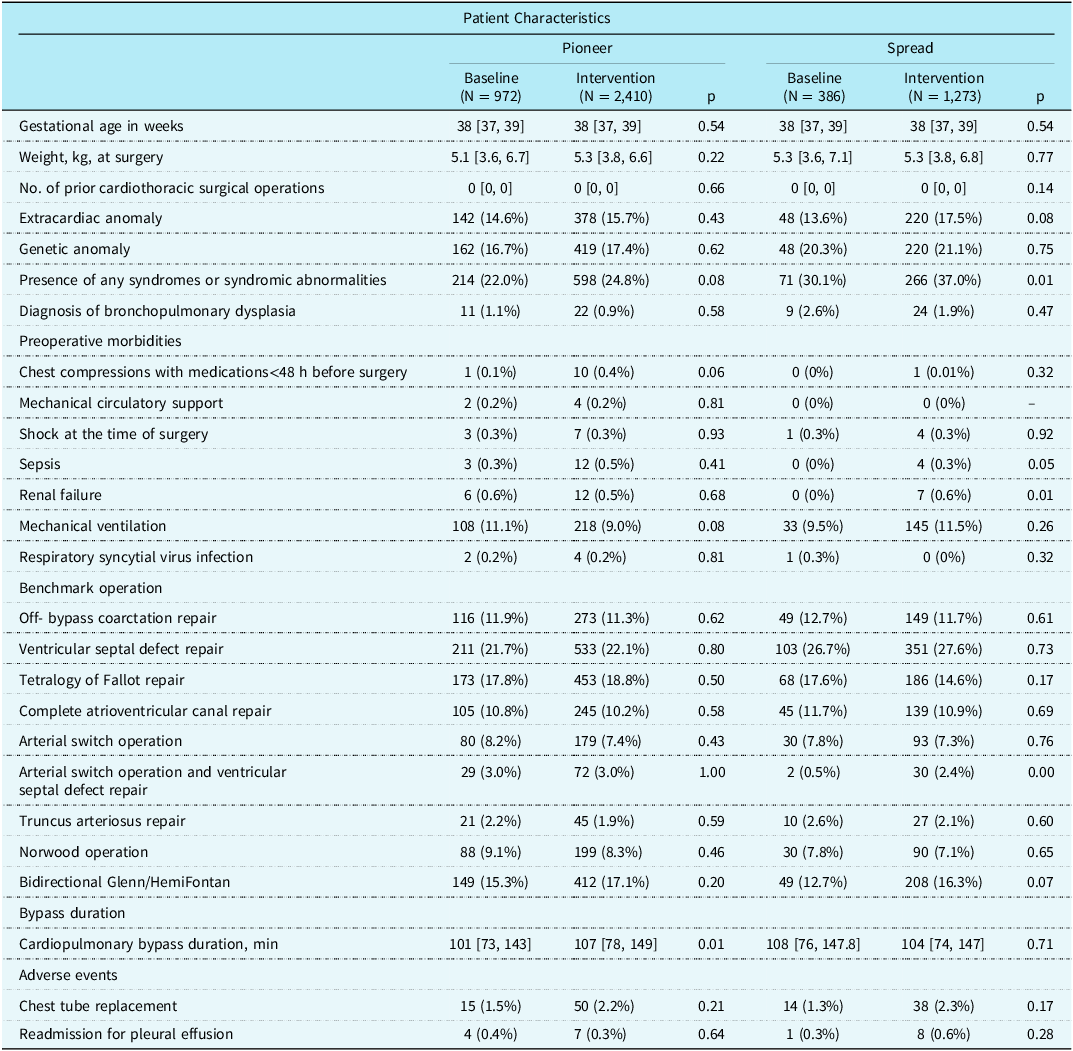
Patient characteristics at the time of the index operation for Pioneer and Spread cohorts are summarised in Table 1. Pioneer patient demographics before and after intervention were comparable. Spread demographics showed higher incidence of factors that may contribute to increased patient complexity, such as extracardiac anomalies, syndromes or genetic abnormalities, and bronchopulmonary dysplasia, but were otherwise comparable in terms of preoperative morbidities. Both cohorts had similar surgical distributions.
Patient characteristics at time of index operation, by cohort and study period

Data were analysed on 5,042 patients across the 17 centres. Registry data from all centres were reviewed to assure that all eligible patients were included. Spread sites started at a lower baseline average chest tube duration than the Pioneer sites (73.1 hours compared to 91.9 hours, respectively). Figure 1 consists of Funnel Plots showing each site’s baseline and intervention chest tube duration compared to the cohort’s mean duration, displayed from smallest to largest patient volume. In this type of SPC chart, the indicator of interest is plotted against the denominator and gives it the characteristic funnel shape. Reference Provost and Murray15 The centreline is calculated as the overall mean of chest tube duration. A site outside the lower or higher control limits (3 standard deviations away from the mean in each direction) has a statistically significantly lower or higher average chest tube duration, respectively. We can see that six of eight Spread sites had baseline CT duration below the overall centreline at baseline, whereas only two Pioneer sites (including Site B, from which Pioneer interventions were modelled) were below the centreline before interventions started. Additionally three Spread sites (sites J, P, and R) were outside the lower control limits, while the Site B was the only Pioneer site below the lower control limits.
Chest tube duration in hours, by cohort and study period. Funnel plot (Xbar).

Figure 2 shows the change in mean chest tube duration over the study period. Spread sites (n = 1,659) successfully reduced their mean chest tube duration from 73.1 hours to 66.0 hours (a 9.6% reduction, p = 0.036) and sustained that reduction for at least 13 months after interventions began. In comparison, Pioneer sites (n = 3,383) reduced their mean chest tube duration from 91.9 hours to 70.5 hours (a 22.6% reduction, p = 0.001) over their study period. Both cohorts have collectively sustained these lower centrelines until the end of the study period (13 months post-intervention).
Average chest tube duration (hours) over the study period.

Adverse events related to the early chest tube removal, such as rates of chest tube replacement and readmission within 7 days for pleural effusion did not significantly change (Table 1). There was no statistical change in overall length of stay in the Spread cohort, as measured in days (8 versus 8, p = 0.689).
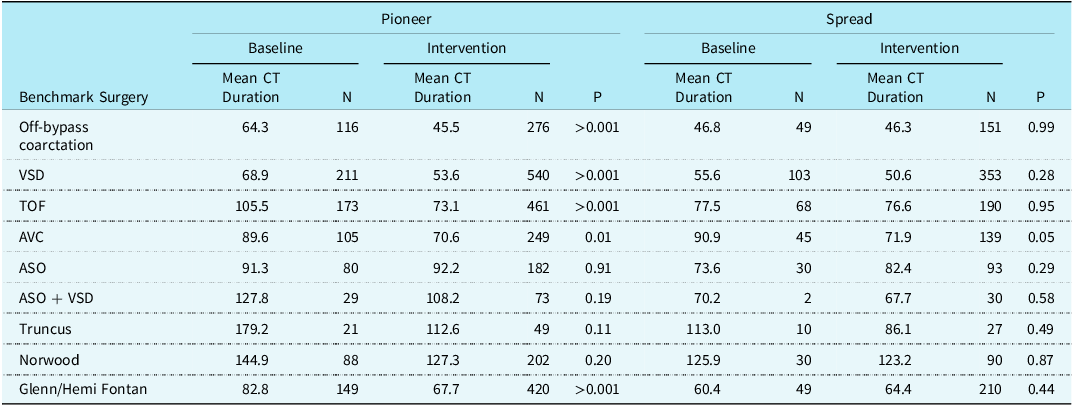
In order to assess if certain operations were more likely to have successful reduction of chest tube duration than others, we analysed chest tube duration before and after intervention in each cohort by benchmark operation (Table 2). Neonatal operations did not see a significant reduction in chest tube duration, as opposed to operations that would generally be performed outside of the neonatal period. The Pioneer cohort showed statistically significant reduction in several benchmark operations; the Spread cohort saw significant reduction in chest tube duration in the benchmark atrioventricular canal operation.
Discussion
In this multicentre prospective interventional cohort study utilising a collaborative learning model, we demonstrated the ability to sustain previous reductions in chest tube duration and length of stay without adverse events while successfully documenting the generalisability of the intervention to 8 additional centres. While the absolute reduction of chest tube duration in Spread sites was less than that in the Pioneer sites, the interventions trialled demonstrated their overall effectiveness in multiple different contexts. Importantly, these interventions were demonstrated to be sustainable and safe as measured in the prolonged post-intervention phase of the Pioneer sites. At these participating centres, patients now experience less time with invasive drains and are able to move along their postoperative care path more quickly.
The Spread sites had notably lower baseline chest tube duration across almost all operations compared to the Pioneer sites. In discussions with the project site leaders, the Pioneer sites identified prolonged chest tube duration as a compelling challenge at their centres and were early participants for this reason. Presentation of the Pioneer interventions and outcomes at PAC3 conferences showcased the relative advantages and simplicity of the project. This may have motivated Spread sites to participate with the goal of significant decreases in their chest tube duration, but baseline data show that the overall chest tube duration at these additional sites was already comparable to the Pioneer sites’ intervention phase. The influence of data sharing may be especially significant for the Spread sites that had been part of the collaborative for more than a year and were already discussing Pioneer strategies and results at their home institutions, before a spread plan was formally announced. This speaks to the benefit of participating in multicentre collaboratives with frequent and transparent data sharing, as sites may start subtly changing clinical practices prior to formally measuring metrics and implementing change. As time goes on, we hope to continue to see the effects of practice changes at the Spread sites in further reducing chest tube duration.
The Spread sites were able to enter into the intervention phase quickly due to existing Pioneer infrastructure, such as well-defined operational metrics, data entry methods, leadership structure, and established cadence of webinars. The onboarding process for Spread sites was completed over two one-hour webinars. In contrast, the Pioneer sites went through a 1-year design and implementation period before the intervention began. These factors supported Spread’s ability to onboard quickly and successfully implement interventions, leading to spread success.
Given their longer time period in the study, the Pioneer centres were able to expand their interventions at their local centres. For example, building on early success in the physiologically biventricular population, several of the Pioneer sites implemented strategies for earlier chest tube removal in physiologically single-ventricle patients. Among the Spread sites, interventions focused primarily on the biventricular population during the shorter study period, though several are now working on reducing chest tube duration after Norwood and Glenn operations. The shorter time in the intervention period may have contributed to a less significant decrease in overall chest tube duration in the Spread population.
Our aim in this project was to lower postoperative chest tube duration across the paediatric congenital heart surgery population as a whole, by shifting the paradigm around chest tube management strategies towards early removal. We have demonstrated the benefit of reducing variability in a practice for which there is a lack of evidence. As seen in other fields of medicine, when high practice variation is identified, there is opportunity for improvement. Reference Dixon-Woods22–Reference Yu, Black and Sands24 Across the 17 sites involved in this study, postoperative chest tube management practices have now aligned to reduce overall duration without significant negative consequence. Though there was a paucity of evidence to establish new care guidelines, by sharing practices and outcomes transparently among multiple centres, identifying positive outliers, and aligning practices in an iterative fashion, we successfully lowered chest tube duration across these 17 centres who have variability in geography and programme size.
Mean CT duration (hours) by era, study period, and benchmark operation

Abbreviations: VSD = Ventricular Septal Defect; TOF = Tetralogy of Fallot; AVC = Atrioventricular Canal; ASO = Arterial Switch Operation; CT = Chest tube.
Limitations
This strategy was tested for a specific set of paediatric cardiothoracic operations and may not be generalisable to all CHD operations. The centres involved in this study all participated in a collaborative learning network, and lack of peer support may challenge individual centres wishing to implement similar strategies. We did not collect data on chest tube duration from the 20 centres in PAC3 that did not formally participate in the project at the time. Some of these centres were new to the registry, some did not identify chest tube duration as a significant problem at their centre, and others did not feel that they had the time or resources to dedicate to the project at the time. To mitigate the obstacles to performing similar improvement work, we have developed a detailed change package, as described below.
As discussed previously, our early data may be affected by attention around the issue. Reference Sedgwick and Greenwood25 The Spread sites may have been influenced towards practices that lower chest tube duration before participating in the formal project. This may have led to adoption of successful interventions before sites officially signed on to the study. We believe that this is one of the benefits of participating in clinical collaboratives, and that even informal alignment of practices can lead to changes in outcomes.
Both Pioneer and Spread sites choose a variety of interventions to reduce chest tube duration. The project leadership team encouraged each site to have multidisciplinary conversations with their teams to decide which strategy may work best locally. Team members included cardiothoracic surgeons, cardiologists, cardiac intensivists, advanced practice providers, and nurses. We are unable to determine which single strategy led to the most successful reduction in duration, as sites could trial one approach to decreasing duration, and potentially switch approaches or add another strategy. We believe that the strategies most likely to succeed are determined by the teams most familiar with their own context and the flexibility to choose an intervention supports local project success and feasibility.
Future directions and sustainability
Postoperative chest tube duration data is now being collected within the PAC3 data registry, and the sustainability of the project gains is monitored regularly. We report this data out to the collaborative at our twice-yearly conferences, and it has been incorporated into our network-wide dashboard.
The Chest Tube Change Package is a learning tool for centres participating in the registry, but who did not participate in the formal project, with the goal of continuing to support spread of the project gains throughout the collaborative. 26 We know of at least two centres who have used this tool to implement chest tube management changes, and they can monitor their data regularly through the registry. We are continuing to apply this model for collaborative learning and spread throughout a network of centres to future quality improvement projects within PAC3.
Acknowledgements
The authors gratefully acknowledge the support from the PAC3 data coordination centre and teams from the participating centers who led local efforts to standardise chest tube management:
Arkansas Children’s Hospital
Children’s Health Dallas
Children’s Healthcare of Atlanta
Children’s Mercy Hospital – Kansas City
Children’s Hospital of Philadelphia
Children’s Hospital of Pittsburgh
Children’s Hospital of Wisconsin
Cincinnati Children’s Hospital
Lucile Packard Children’s Hospital, Stanford
Lurie Children’s Hospital
Medical University of South Carolina
Nicklaus Children’s Hospital
St . Louis Children’s Hospital
Texas Children’s Hospital
The Hospital for Sick Children
UCSF Benioff Children’s Hospital
University of Michigan / C .S . Mott Children’s Hospital
University of Utah / Primary Children’s Hospital.
Financial support
At the time of this study, PC4 was supported by funding from the University of Michigan Congenital Heart Center, Champs for Mott, and the Michigan Institute for Clinical & Health Research (National Institutes of Health/National Center for Advancing Translational Sciences, UL1TR002240). PAC3 was supported by the Heart Institute at Cincinnati Children’s Hospital. Cardiac Networks United was supported by the Children’s Heart Foundation, in addition to receiving support from the University of Michigan Congenital Heart Center and the Heart Institute at Cincinnati Children’s Hospital.
Competing interests
The authors declare no financial conflicts of interest.
Ethical standard
This study was approved by the Cincinnati Children’s Hospital Medical Center Institutional Review Board. A waiver of consent was granted.