1. Introduction
The institutionalized party system is one of the most essential factors of politically modern states (Dix, Reference Dix1992; Mainwaring and Scully, Reference Mainwaring and Scully1995; Huntington, Reference Huntington2001; Stockton, Reference Stockton2001). As Schattschneider observed (1942: 1), ‘political parties created democracy, and . . . democracy is unthinkable save in terms of parties’. However, Korean political parties have been significantly volatile (i.e., easily formed, divided, and dissolved), and this phenomenon has delayed political development of Korea (Helgesen, Reference Helgesen1995; Heo and Stockton, Reference Heo and Stockton2005; Steinberg and Shin, Reference Steinberg and Shin2006; Hermanns, Reference Hermanns2009; Park, Reference Park2010). Over 200 political parties have been formed since the 1950s and almost all of them disappeared within five years of their creation. This political phenomenon has not been limited to old Korean politics where political parties were suppressed by authoritarian military-based politics. Even after the transition to a democratic political system in 1987, when plural political parties were guaranteed under the Ninth Constitution, Korean political parties have remained organizationally unstable: since that time, more than 50 political parties have competed in six National Assembly elections.Footnote 1
Regarding the issue, it has been conventionally believed that Korean political parties have been organizationally unstable due to Confucian political culture, which accentuates hierarchical rules centered on family leaders (Helgesen, Reference Helgesen1995; Kang, Reference Kang, Soong Hoom and Moon2001; Steinberg and Shin, Reference Steinberg and Shin2006; Hermanns, Reference Hermanns2009; Im, Reference Im, Yin-wah and Wong2010). Many studies have argued that Korean political parties have been used as personal instruments of party leaders due to cultural factors and that these leaders have frequently created, dissolved, and rebuilt political parties to achieve Daekwon (great power) (Helgesen, Reference Helgesen1995; Kang, Reference Kang, Soong Hoom and Moon2001; Heo and Stockton, Reference Heo and Stockton2005; Steinberg and Shin, Reference Steinberg and Shin2006). Though these explanations may not be completely wrong, they have oversimplified the internal/external politics of political parties. They implicitly have assumed that Korean political parties are totally hierarchical and that party members have never opposed their leaders’ party management decisions. However, it would be theoretically irrelevant to assume that politicians always follow their leaders regardless of their own self-interest. Rather, it is more reasonable to suppose that politicians pursue their own interests even under the influence of Confucian culture.
In this respect, this paper suggests a distinctive look at the instability of Korean political parties. This article argues that Korean political parties are organizationally unstable due to the ‘cue-chasing behaviors’ of self-interested politicians, rather than Confucian morality. This proposition is examined by a historical review of Korean political parties between 1987 and 2012.
2. The politics of Korean political parties
Self-interested politicians and intraparty conflicts
Political parties are political coalitions that consist of subgroups who have distinctive political grounds and ideologies (Schwartz, Reference Schwartz1989; Aldrich, Reference Aldrich1995). In other words, political parties are not unitary actors, rather collections of diverse factions whose members are politically self-interested. Though Korean political parties have been hierarchical owing to Confucian culture, they also consist of diverse subgroups. For example, the Grand National Party (GNP, renamed the New Frontier Party (NFP) in February 2012), the majority party under the President Lee Myung Bak in 2012, had several factions, such as the pro-Lee Myung Bak group and that pro-Park Geun Hye group. These two factions competed against each other for party-leading positions at the GNP's national convention in July 2011, rather than unconditionally following President Lee's opinions. This internal competition shows that Korean political parties are not based on a single command-and-control chain centered on a ‘familial’ leader. Rather, they are political coalitions consisting of diverse subgroups.
Moreover, these subgroups are not blindly loyal to their party leaders. Rather, they tend to be highly self-interested in National Assembly seats. In reality, almost all of the intraparty conflicts in Korean party politics have been highly related with candidate selection. To illustrate, the two groups of the GNP intensely competed for candidate selections around the 18th National Assembly election of 2008. Then, many pro-Park Geun Hye group members defected from the GNP, opposing the nomination process led by the pro-Lee Myung Bak group. They formed a new political party named Pro-Park Alliance in order to run for the National Assembly. As this case shows, (re)election is one of the most important factors affecting politicians’ and their factions’ behaviors; ‘the probability of being (re)elected’ is a main concern of faction members.
In order to be ‘(re)elected’, politicians need to acquire majority votes in elections. However, it is not a sufficient condition for winning National Assembly seats. To run for elections, they have to be selected by political parties as candidates (or run for elections independently). In other words, politicians decide their behavioral strategies, considering not only (1) the probability of acquiring majority votes in elections, but also (2) the probability of being selected as candidates. The product of these two probabilities is the probability that a politician will win a National Assembly seat.
Political parties as electoral heuristics
According to the rational choice models, constituents are likely to cast their votes by comparing the relative distances of their own ideological positions and those of political parties (Hotelling, Reference Hotelling1929; Downs, Reference Downs1957). However, it is nearly impossible for ‘ill-informed’ and ‘unsophisticated’ voters to interpret all the political, economic, and social information (Converse, Reference Converse and Apter1964; Mayhew, Reference Mayhew1991). Therefore, ‘reasoning voters’ might rely on information shortcuts to understand their candidates and policy pledges properly (Sniderman et al., Reference Sniderman, Brody and Tetlock1991; Lupia, Reference Lupia1994; Bartels, Reference Bartels2000). Especially, they frequently depend on their party identification to make their voting decisions. In other words, the ‘brand names’ of political parties are one of the most significant ‘cues’ for constituents in many countries; voters tend to infer candidates’ ideological stances, personal capabilities, and moralities through those cues.Footnote 2
However, the cues of political parties themselves have not been very influential in Korean politics due to the long history of Korean authoritarian politics. To illustrate, Park Jung Hee, president of Korea from 1961 to 1979, dissolved the National Assembly and banned party formation and competition under the Yusin Constitution (enacted on 17 October 1972). Likewise, Chun Doo Hwan, president of Korea from 1980 to 1988, disbanded the National Assembly, dissolved political parties, arrested leading politicians, and prohibited many political activities, including party formation. In this period, almost all the political parties were short-lived and were not able to provide consistent cues to voters. Consequently, these political situations have resulted in a high degree of voter independence in Korea. The Comparative Study of Electoral Systems data show that Korean people have had significantly low partisanship compared with other countries (Dalton and Weldon, Reference Dalton and Weldon2007) and that 65% of Korean people did not identify with a party during 1996–2000 (Schmitt, Reference Schmitt2002). The rate of partisan independence also reached 71.5% in the 16th National Assembly election (So and Hyun, Reference So and Hyun2006).
Instead of political parties, conspicuous individual politicians have played the heuristic role for voters in Korean politics. Especially, the three Kims (Kim Young Sam, Kim Dae Jung, and Kim Jong Pil) were remarkable ‘cue-givers’ in the 1980s and 1990s. In this paper, a ‘cue-giver’ is defined as a politician who has a highly favorable political cue based on his/her personal characteristics (such as political careers, professional capabilities, and morality) and, consequently, has strong vote-getting power. Rather than political parties’ brand names or ideological stances, cue-givers’ political support has been used as an information shortcut for Korean voters. For example, Kim Dae Jung has been the most important cue-giver in Jeolla provinces in Korea. He acquired between 80% and 90% of the votes in the area in the 13th (1987), 14th (1992), and 15th (1997) presidential elections. The candidates of his parties almost always acquire more than 50% in Jeolla's districts, despite the fact that he led different parties in the 13th (Peaceful Democratic Party in 1988), 14th (United Democratic Party in 1992), 15th (National Congress for New Politics in 1996), and 16th (Millenium Democratic Party in 2000) National Assembly elections. Not only the three Kims, but also other famous politicians such as Lee Hoi Chang and Roh Moo Hyun (especially in the 2000s) have played heuristic roles in elections; their cues have been relatively more effective than the heuristics of their political parties.
In sum, Korean political parties have had only limited influence on the ‘probability of acquiring the majority votes in elections’. Rather, dominant cue-givers, such as the three Kims, have had deterministic influence over the probability.
Factional conflicts over candidate selection
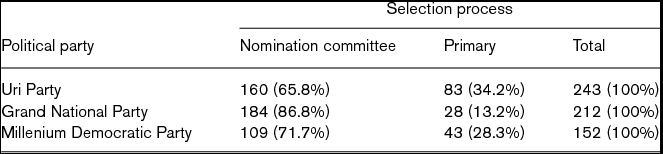
In contrast, Korean political parties have possessed decisive power in candidate selection. In other words, ‘the probability of being selected as candidates’ is in the hands of party-leading groups, regardless of cue-givers. Because the Korean Constitution does not restrict the nomination processes of political parties, they can select their candidates without the intervention of national laws. In these political circumstances, Korean National Assembly election candidates have generally been determined by parties’ nomination committees, which consist of a small number of party members and some citizens who are appointed by party leaders. Admittedly, the trend of candidate selection has been somewhat transformed since the 17th National Assembly election of 2004. All the major Korean political parties declared that they would nominate candidates through primaries. In reality, however, only a limited number of candidates were selected by primaries in the election (see Table 1).
Candidate selections for the 17th National Assembly election

Source: Jeon (Reference Jeon2005), p. 223.
Furthermore, the GNP and the United New Democratic Party (UNDP), gave up selecting candidates through primaries in the next National Assembly election in 2008; all the candidates were selected by nomination committees. Because of the top–down nomination process, several party leaders and their faction members have ‘dominated’ the nomination process. Though major political parties used primaries (in selecting candidates for several districts) before the 19th National Assembly election in 2012, many of candidates were still chosen by party leaders. Moreover, several party members asserted that party leadership intervened in the result of candidate selection in primaries. On the other hand, minority subgroups have frequently been disadvantaged in the nomination decisions of political parties, even when cue-givers belonged to the subgroups. As a result, minority subgroups led by significant cue-givers have tended to have a strong grievance in deciding candidates and enacting detailed rules for the nomination process.
The mechanisms of Korean party instability
From the characteristics of Korean party politics, this paper suggests two different mechanisms of party instability as follows: (1) if a political faction has a remarkable cue-giver, but is internally at a disadvantage in candidate selection, the faction might want to defect from its political party. Thanks to the cue-giver, it is highly probable for his/her faction members to acquire majority votes in the cue-giver's districts, regardless of their party memberships. Thus, if the cue-giver's faction is disadvantaged in candidate selection, the faction would not need to stay in the political party. Rather, the faction members might want to defect and establish a new political party to maximize their ‘probabilities of being (re)elected’. The other mechanism is that (2) the political party might not be able to sustain its organization without a dominant cue-giver, because individual politicians tend to switch parties chasing dominant cue-givers in order to increase their probabilities of acquiring majority votes. In sum, Korean political parties have been organizationally unstable due to the defections and collapses derived from politicians’ ‘cue-chasing’ behaviors.
Hypothesis 1: When a cue-giver's faction and the party-leading (i.e., nomination deciders’) faction are different and in conflict, it is highly probable that the cue-giver's faction would decide to defect.
Hypothesis 2: Without a dominant cue-giver, a political party lacking significant partisan cues might easily collapse.
However, these hypotheses do not imply that party stabilization in the Korean context is impossible. Korean political parties have been organizationally unstable mainly because they have had only inferior heuristics compared with individual political moguls. Korean politicians have had little incentive to stick to specific political parties. Rather, they have chased individual cue-givers, in order to maximize their probabilities of being (re)elected. Thus, when the political heuristics of cue-givers become comparatively ineffective, i.e., if political parties acquire superior cues, Korean political parties could be highly stabilized. In other words, self-interested politicians would make efforts to maintain their party organizations, rather than chasing cue-givers, if partisan cues become relatively stronger than individual cue-givers’ heuristics.
Hypothesis 3: Political parties could be ‘settled’ when their heuristics become superior to those of cue-givers.
3. The instability of Korean political parties
In this section, Hypotheses 1 and 2 will be examined by exploring Korean party politics between 1987 and 2012. Though detailed features of Korean party politics are somewhat different according to the times, Korean political parties have been generally unstable; party defections and collapses have prevailed in this period.
The three Kims’ era in the 1980s and 1990s
In the 1980s and 1990s, Korean politics was under the control of three political moguls: Kim Young Sam, Kim Dae Jung, and Kim Jong Pil. This period has been sometimes called the ‘three Kims’ era’. Each of them has his own political cue in specific regions: Kim Young Sam in South Gyeongsang and Busan, Kim Dae Jung in Jeolla, and Kim Jong Pil in Chungcheong (especially, South Chungcheong). Their individual cues in the provinces were exceptional and they ‘monopolized’ regional politics in this period. In contrast, their political parties did not have any significant heuristics. In this respect, Helgesen (Reference Helgesen1995: 28) wrote, ‘The leader does not represent the party; rather . . . the leader is the party.’ Due to the significant cues of the three Kims, it was nearly impossible to acquire legislative seats without the support of the moguls. Especially, in the 13th National Assembly election held on 26 April 1988, the Reunification Democratic Party (RDP) led by Kim Young Sam took 15 out of 16 seats in Busan; the Peaceful Democratic Party (PDP) led by Kim Dae Jung took 36 out of 37 seats in the Jeolla districts; and the New Democratic Republican Party (NDRP) led by Kim Jong Pil took 13 out of 18 seats in the South Chungcheong area. Because there was no discordance between cue-giver's faction and the nomination decider's faction, their political parties were somewhat organizationally stable in this period. The nomination process was totally in the hands of the cue-givers’ factions (Kim, Reference Kim1997; Shin et al., Reference Shin, Jin, Gross and Eom2005).
However, the three party merger between the RDP, NDRP, and Democratic Justice Party (DJP) created a giant new political party (the Democratic Liberty Party, DLP) in 1990. Though the political cues of Kim Young Sam and Kim Jong Pil were significant in their regions, they wanted to extend their political influence in order to acquire Daekwon. Then, a fair number of legislators agreed to the party merger decision, though the merger was severely criticized as being non-democratic. Admittedly, Confucian culture might have had a partial impact on this political event. Nevertheless, the main cause was that many legislators of South Gyeongsang (including Busan) and South Chungcheong could not be (re)elected without the cues of their party leaders, Kim Young Sam and Kim Jong Pil. For example, Roh Moo Hyun, who was one of the few legislators who opposed the party merger, failed to be reelected in the 14th National Assembly election of 1992. In the 13th National Assembly election of 1988, Roh acquired 50.6% in Busan Donggu with the support of Kim Young Sam, but received only 31.9% in the next election (and 36.8% in the mayoral election of Busan in 1995) without the help from Kim Young Sam.
However, this party merger brought about serious internal conflicts in the DLP. As Kim Young Sam took control of the party after the merger, Kim Jong Pil's subgroup felt uneasy about the DLP's intraparty power relations. Though Kim Jong Pil was the representative of the DLP at that time, his faction could not gain the ‘upper hand’. Moreover, Kim Young Sam faction members were scheming to oust Kim Jong Pil from power positions. For instance, Kim Young Sam's right-hand man, Choi Hyung Woo, the secretary-general of the DLP, mentioned in an interview that the DLP representative should be changed in order to initiate political reforms. The internal conflicts between the cue-givers’ factions came to the surface ahead of the 15th National Assembly election of 1996. Kim Jong Pil faction members predicted that they might be at a big disadvantage in the nomination process of the DLP, but that they could acquire majority votes in elections thanks to Kim Jong Pil's cue, if they are nominated. Then, they decided to leave the party. In February 1995, Kim Jong Pil's faction members broke away from the DLP and established a new political party, the United Liberal Democrats (ULD). The ULD took 25 out of 28 seats in the Chungcheong districts in the 15th National Assembly election.
On the other hand, the PDP led by Kim Dae Jung was succeeded by the Democratic Party (DP) in 1991, incorporating the party members who opposed the three party merger. The party acquired 37 out of 39 seats in the Jeolla districts in the 14th National Assembly election, relying on Kim Dae Jung's political cue in the region. However, Kim Dae Jung announced his retirement from politics after his defeat in the 14th presidential election of 1992. the DP was then led by Lee Ki Taek, who had been independent from the three Kims’ factions. As Lee Ki Taek's faction increased its influence – though his internal influence was limited because the main cue-giver of the party was Kim Dae Jung in spite of his retirement – the conflicts between the traditional Kim Dae Jung faction and the Lee Ki Taek faction became serious. Despite this conflict, the traditional Kim Dae Jung faction members had stayed in the party before the mid-1990s, because of the absence of Kim Dae Jung, the cue-giver. However, things changed in 1995, when Kim Dae Jung declared his return to politics. Immediately after his comeback, 65 out of 95 legislators of the DP left the party and created a new political party, the National Congress for New Politics (NCNP). NCNP took 26 out of 27 seats in the Jeolla districts and emerged as the first minority party in the 15th National Assembly election. In contrast, the DP without the cue-giver collapsed and was absorbed into the New Korea Party (NKP, the successor of the DLP) in 1997.Footnote 3
These cases of the DLP and DP support Hypotheses 1 and 2. There were major defections in both parties, because of the conflicts between the cue-giver's group and the party-leading group: the ULD and NCNP were established based on the dominant political cue-givers, such as Kim Jong Pil and Kim Dae Jung, when the cue-givers’ factions had been (at least, they felt) at a disadvantage especially regarding the nomination process. Moreover, the political parties without strong cue-givers were easily dissolved. The DP without cue-giver Kim Dae Jung was dissolved immediately after the defection of Kim Dae Jung's faction. The party was merged into NKP in 1997. In contrast with the DP, the DLP maintained its organization. Despite the defection of Kim Jong Pil's group, there was one more dominant cue-giver in the party, Kim Young Sam. Though the NKP (the successor of DLP) was defeated in the Chungcheong districts due to the defection of Kim Jong Pil's faction, the party acquired 38 out of 44 seats in the South Gyeongsang and Busan districts and became the majority party after the 15th National Assembly election of 1996.
3.2 The end of the three Kims’ era in the late 1990s
Though there were other politicians possessing significant cues in the 1980s and early 1990s,Footnote 4 there is little doubt that the three Kims had exclusive political heuristics in this period. In the mid-1990s, however, new cue-givers appeared. Due to the economic crisis of the late 1990s and his son's (Kim Hyun Chul) bribery and tax evasion cases in 1997, President Kim Young Sam's influence diminished as his presidential term of office was nearing its end.Footnote 5 Instead, new cue-givers such as Lee Hoi Chang and Lee In Je emerged in the NKP. Based on their administrative careers, Lee Hoi Chang built up an upright image, and Lee In Je constructed his image regarding economic improvement. Because Lee In Je had belonged to Kim Young Sam's faction, some members of the group believed that he could inherit Kim Young Sam's political cue. In contrast, Lee Hoi Chang developed his own political cues in opposition to Kim Young Sam by publicly declaring the end of the three Kims’ era. Though Lee Hoi Chang did not have firm political support in the party, the faction members of the old DJP supported him. These two politicians competed for the presidential candidate position of the NKP; Lee Hoi Chang won the race. This implies not just that Lee Hoi Chang was elected as the presidential candidate, but that the old DJP faction acquired internal power against the old RDP faction supported by Kim Young Sam. As a result, internal conflicts within the NKP, between the two new cue-givers’ groups, occurred in the mid-1990s. Then, Lee In Je and some old RDP members defected from the NKP and formed a new political party, the New Nation Party (NNP) in 1997. Though he partly inherited Kim Young Sam's cue, Kim's political image had already been seriously impaired during his presidential term. Moreover, Lee In Je's own political cue was shallow compared with the three Kims (and his defection damaged his political image). Thus, only a limited number old RDP members defected following him at that time. Finally, the NNP had nearly failed in the second regional election and then collapsed in 1998, due to the weak heuristics of Lee In Je.
Kim Jong Pil's political cue also diminished in the late 1990s as he joined with Kim Dae Jung (the so-called DJP alliance) before the 15th presidential election of 1997. Though this alliance allowed Kim Dae Jung to be elected as president, it damaged Kim Jong Pil's political cue. In reality, his ‘second member’ image (i.e., second to the other two Kims) in his DLP days was confirmed by the alliance. This image was fatal as a faction leader and his political cue became negative. Though his party, the ULD, won 25 out of 28 seats in the Chungcheong districts in 1996, the party acquired only 11 out of 24 seats in the area in the 16th National Assembly election of 2000.Footnote 6 The party won only four seats in the 17th National Assembly election of 2004, and Kim Jong Pil announced his retirement immediately after the election. Without its cue-giver was absorbed into the GNP in 2006.
In sum, Korean party instability persisted even in the late 1990s, supporting Hypotheses 1 and 2. The NKP suffered from a major defection, due to the internal conflicts promoted by a new cue-giver's faction (i.e., Lee In Je's faction). Moreover, some parties without dominant cue-givers were dissolved. The NNP and ULD collapsed as the political cues of Kim Jong Pil, Kim Young Sam, and Lee In Je diminished in the late 1990s. These two parties could not sustain their organizations without vote-getting cue-givers.
New cue competition in the 2000s
In the absence of dominant cue-givers, many politicians began to compete for political cue niches. Though it has been nearly impossible for any politician to have exceptional cues comparable with the three Kims, they have developed their own heuristics. In the early 2000s, several conspicuous politicians emerged around the 16th presidential election of 2002: Roh Moo Hyun, Chung Mong Joon, and Lee Hoi Chang. These politicians tended to challenge, rather than inherit, the three Kims’ political cues in order to develop their own cues.Footnote 7 Because regional legacies of the three Kims were still prevalent in this period, however, these new cue-givers could not have strong cues by stressing regional origins. Rather, they emphasized their ideological stances. Because the threat of North Korea has prevented Korean politicians from expressing liberal ideologies, which have frequently been equated with communism (Kang, Reference Kang, Soong Hoom and Moon2001; Hermanns, Reference Hermanns2009), it had been nearly impossible for new cue-givers to provide ideological heuristics in the three Kims’ era.Footnote 8 Thanks to the end of cold war period, however, newly emerged politicians could build up their heuristics by expressing their ideological stances (especially liberal ones). Structural changes also accelerated the development of ideological cues. As the economic and generational cleavages deepened, several cue-givers such as Roh Moo Hyun could acquire ideological heuristics more easily (Kim et al., Reference Kim, Young Choi and Cho2008). This political situation led to a new season of cue competitions among the old and new cue-givers.
In the MDP, the conflicts between the pro-Roh Moo Hyun group and the traditional Kim Dae Jung faction caused the defection of pro-Roh Moo Hyun group. Even after Kim Dae Jung's retirement,Footnote 9 the traditional Kim Dae Jung group continued to lead the MDP and had significant influence over the party nomination process. Though Roh Moo Hyun's political cue could not be comparable with that of Kim Dae Jung, he did establish his own ‘ideologically liberal’ cue. Thus, intraparty conflicts were inevitable. Five months ahead of the 17th National Assembly election, the pro-Roh Moo Hyun group defected from MDP and established the Uri Party (UP) in November 2003. Based on Roh Moo Hyun's liberal heuristics, in the 17th National Assembly election, the UP succeeded in almost all the regions but Gyeongsang provinces. In particular, in the districts where local colors are not strong, such as Seoul and Gyeonggi, the UP won significantly; the party acquired 32 out of 48 seats in Seoul and 35 out of 49 seats in Gyeonggi. Furthermore, the UP acquired 25 out of 31 seats in the Jeolla, and 19 out of 24 seats in the South Chungcheong districts, where Kim Jong Pil's political cues had been severely damaged. However, the UP collapsed as the political cue of President Roh Moo Hyun was much impaired during his presidential term of office.Footnote 10 His often-made aggressive and provocative remarks damaged his fame. Moreover, his suggestion of an alliance with the GNP in 2005 greatly impaired his political cue. Because his cue had been based on liberal ideology, his alliance suggestion with the ‘conservative’ GNP blurred his liberal cue. On the other hand, other UP leading members, such as Yoo Si Min and Chun Sye Kyun, did not have significant heuristics. They could not substitute for the ‘impaired’ Roh Moo Hyun. As a result, the UP was completely defeated in the fourth regional election of 2006; the party won only a single victory in 16 key regional posts. Facing the decline of Roh Moo Hyun, UP legislators noticed that they could not be reelected relying on the cue-giver in the 18th National Assembly election of 2008. Many UP legislators defected from the party and chased other dominant cue-givers; only 73 legislators remained in the party in April 2007, though the party had acquired 152 seats in the 17th National Assembly election. Inevitably, the UP without dominant cue-givers was merged into the United New Democratic Party (UNDP, later Democratic United Party in December 2011), the successor of MDP, in 2007. However, years later, the old UP faction (mainly, led by Yoo Si Min) defected the UNDP and built up the Participation Party (PP) in 2010 when the political cue of Roh Moo Hyun recovered following his suicide in 2009.
In contrast, the cue-giver's faction and the nomination decider's faction were the same in the GNP centered on Lee Hoi Chang, at least before the 16th presidential election of 2002. This does not imply that there were no faction conflicts in the GNP. Rather, there were numerous internal conflicts between diverse factions led by Lee Hoi Chang, Kim Yun Hwan, Lee Han Dong, Kim Duk Ryong, Lee Ki Taek, and other RDP groups. Despite the conflicts, minor groups could not defect the party, because the groups’ leaders, other than Lee Hoi Chang, did not have sufficient political cues. However, things changed in 2002 as Lee Hoi Chang declared his retirement after his defeat in the 16th presidential election. In the empty room of ‘conservative ideology’, which had been filled by Lee Hoi Chang's political cue, two remarkable politicians, Lee Myung Bak and Park Geun Hye, took their places. Though these two politicians had only limited political careers, they acquired significant political cues from their personal histories. Lee Myung Bak was the chief executive officer of Hyundai Engineering & Construction, and Park Geun Hye was the daughter of Park Jung Hee who had been the president of Korea from 1962 to 1979. Their well-known personal histories allowed them to acquire remarkable images, and new factions centered on the cue-givers were formed in the GNP. Their factions competed against each other for party-leading positions. Their conflicts became fierce, especially after Lee Myung Bak won the nomination race and took the presidential chair in the 17th presidential election of 2007. That event allowed Lee Myung Bak's faction to hold real power especially regarding candidate selection. Consequently, many of Park Geun Hye faction members were not nominated as GNP candidates for the 18th National Assembly election of 2008, even though a number of them were incumbents. Thus, many of her faction members defected from the party and established a new political party named ‘Pro-Park Alliance’, where ‘Park’ denoted the cue-giver Park Geun Hye.Footnote 11 The party acquired 14 seats in 18th National Assembly election, relying on her political cue.
In sum, Korean political parties remain organizationally unstable, even after the end of the three Kims’ era. Due to cue competitions among old and new cue-giver factions, party defections and collapses have been prevalent even in the 2000s, supporting Hypotheses 1 and 2.
4. Korean party politics in the late 2000s
As seen above, Korean political parties have been unstable not only in the three Kims’ era, but in the 2000s as well. However, it is also true that several political parties such as the GNP (later the NFP) have maintained their party organizations for more than a decade. Even though many political parties remain unsettled, a few political parties began to stabilize their party organizations in the late 2000s. This section examines the phenomenon in light of Hypothesis 3.
Gradual decline of cue-givers
In the 1980s and 1990s, the three Kims’ cues were simple and exclusive; their heuristics were regionally based and uni-dimensional and there were no serious conflicts between their cues. These characteristics were the main strengths of the three Kims’ cues. Voters could infer policy pledges clearly from the three Kims’ heuristics, and the political moguls maintained significant vote-getting powers. As a result, the three political moguls monopolized regional politics in Korean politics. However, things have changed since the 2000s as the political cues of the three Kims diminished and new cue-givers such as Roh Moo Hyun and Lee Hoi Chang challenged the three Kims. Under the serious competition among old and new cue-givers, their heuristics have become less simple and less exclusive.
Because the legacies of the three Kims have been significant even in the 2000s, new cue-givers noticed that they could not construct salient cues through regionalism.Footnote 12 Rather, they have made efforts to differentiate themselves from the three Kims by emphasizing their ideologies. For example, Roh Moo Hyun emphasized his ‘liberal ideology’ rather than his regional background in Busan. To illustrate, though his party, the UP, was successful in traditionally liberal districts such as Gwangju, it nearly failed in Busan; UP acquired all seven seats in the Gwangju districts, while the party won only one seat out of 18 in the Busan districts during the 17th National Assembly election. As a result, the political cues of individual politicians have become multi-dimensional in terms of ideological and regional spectrums. This has complicated cue-givers’ heuristics and, as a result, has prohibited voters from having clear ‘signals’ from the cue-givers. Moreover, their cues have frequently overlapped. For instance, Kim Jong Pil, Lee Hoi Chang, Lee In Je, and Sim Dae Pyong have competed against each other for the regionally Chungcheong-oriented and ideologically conservative heuristics since the early 2000s. None of them could provide monopolistic cues to the voters of the Chungcheong districts, while Kim Jong Pil had exclusive influence in the districts of the three Kims’ era. As a consequence, cue-givers’ heuristics have become less simple and less exclusive and voters could not have clear images of individual cue-givers.
The emergence of partisan cues
In contrast with cue-givers, political parties have reinforced their heuristics. Their cue competitions have become less serious; only a limited number of parties, such as the GNP and the UNDP, have remained alive and maintained exclusive influences in the 2000s. For instance, the GNP has monopolized the regionally Gyeongsang-oriented and ideologically conservative cues for more than a decade. Likewise, the UNDP has dominated the regionally Jeolla-oriented and ideologically liberal cues. Though some new political parties have emerged, they have not been able to challenge the major parties. For example, Chun Mong Joon, who is the son of Chun Joo Yung, former chief executive officer of Hyundai, founded People's Power 21 (PP21) in 2002, and Moon Kuk Hyun, who is the former chief executive officer of Yuhan Kimberly, established a new party named the Creative Korea Party (CKP) in 2007, based on their own cues. However, the parties completely failed to encroach on major parties’ heuristics, and they were totally defeated in the National Assembly elections; only one PP21 legislator was elected in the 17th National Assembly election and three legislators (including two proportional representatives) of the CKP were elected in the 18th National Assembly election. Therefore, only a few major political parties have maintained exclusive heuristics. Further, there have been no remarkable mergers between ideologically or regionally distinctive political parties since the three party merger of 1987. Compared with individual cue-givers, who have attempted to ally themselves with ideologically and regionally different politicians, the GNP and the UNDP have preserved regionally and ideologically consistent identities.
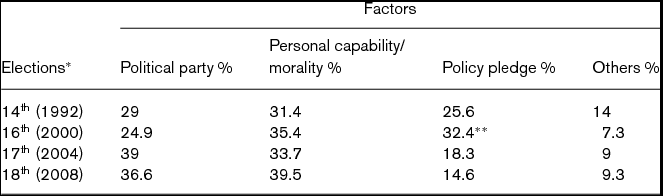
As a consequence, voters have begun to infer policy pledges not only from individual politicians, but also from political parties. The decline of individual cue-givers has reinforced this trend. Table 2 shows that many constituents have used political parties as the main heuristics in the 2000s. Though personal capability and morality of leaders have almost always been the most important factors, political parties have also enhanced their cues in the 2000s.
Post-election survey on the most important factor in voting decisions

Notes: All the surveys were performed immediately after National Assembly elections by the National Election Commission (NEC). In the 15th National Assembly election, NEC performed a similar survey using a five-point Likert scale (5 for most important, 1 for least important). Voters answered that personal capability/morality was the most important factor (3.22), compared with political party (2.76) and policy pledge (2.83).
*: They are National Assembly elections.
**: 13.5% for political reformative tendency and 18.9% for the expectation of regional development.
Party settlement of the GNP
As a result of the rise of political parties and the downfall of cue-givers, major political parties have acquired superior cues and have stabilized in the late 2000s. Cue-chasing politicians have tended to remain in their parties, and defections have been limited. Especially, the GNP has become more stable than its liberal counterparts (Park, Reference Park2010).Footnote 13 Though there have been some defections of the ULD and Pro-Park Alliance, the party has maintained its conservative and Gyeongsang-oriented identity since its creation. Thanks to the historical consistency since the 1990s, the political cues from dominant politicians such as Kim Young Sam, Lee Hoi Chang, Park Geun Hye, and Lee Myung Bak have melted into the political party itself. Even after strong cue-givers defected from the party, the GNP has survived based on its ‘own’ heuristics. For example, Lee Hoi Chang was a main cue-giver of the GNP in the late 1990s and early 2000s and acquired 38.7% and 46.6% in the 15th and 16th presidential elections as a GNP candidate, respectively. However, even after his defection, the GNP has preserved its party organization. In contrast, Lee Hoi Chang as an independent candidate acquired only 15.1% in the 17th presidential election, while the GNP's candidate Lee Myung Bak (48.7%) was elected president. This can be contrasted with Kim Dae Jung's case. He had acquired between 30% and 40% of the votes for all four presidential runs, though he changed his political parties repeatedly. In addition, the steep collapse of ULD and other conservative parties in the 2000s helped the GNP acquire exclusive heuristics regarding conservatism. As a result, the GNP has acquired the most effective heuristics in Korean political history. The party has always maintained at least 100 district-elected legislators, regardless of cue-givers’ defections. Moreover, only a limited number of GNP members have defected from the party even under the severe conflicts between internal factions. In particular, in the 19th National Assembly election in 2012, many incumbent legislators who belonged to pro-Lee Myung Bak group failed to be nominated as candidates by the National Frontier Party (NFP; the renamed party of the GNP). However, almost all the legislators remained in the party, though they expressed their serious grievance about the nomination results. They might notice that the probability to be reelected was very low, without the help from the partisan cue from NFP. As a consequence, NFP could have maintained its organizations without dominant cue-givers like the three Kims.Footnote 14 Though in a humble way, some Korean political parties have begun to establish stable organizations in the late 2000s.
5. Concluding remark
Korean political parties have been organizationally unstable, even though the country has significantly democratized in recent decades. Facing this political phenomenon, many studies have assumed that the instability of Korean political parties has been due to Korean Confucian culture and entourage politics. Though this explanation was not the wrong answer, it was incomplete; this view overemphasized cultural factors and neglected the self-interest of politicians. This paper clarified that Korean political parties have been unstable because of legislators’ self-interested behaviors of chasing dominant cue-givers. When there are serious intraparty conflicts between the cue-giver's faction and the party-leading faction, the cue-giver's group is likely to defect and establish a new political party, in order to maximize the probability of being (re)elected. On the other hand, if cue-givers can no longer provide significant heuristics, their political parties easily collapse, because their party members are likely to go over to other parties chasing superior cue-givers. In sum, depending on the politicians’ cue-chasing behaviors, Korean political parties have fluctuated; politicians have decided to move, defect, and/or participate in political parties not because they have been faithful to their bosses under the influence of Confucian culture, but because they wished to increase their probabilities of being elected by relying on their leaders’ cues.
However, Korean party instability has changed according to the times. In the three Kims’ era of the 1980s and the early 1990s, Kim Young Sam, Kim Dae Jung, and Kim Jong Pil exhibited regionally monopolistic heuristics. Many constituents used these politicians as informational shortcuts in casting their votes. Therefore, it was nearly impossible for legislators to be (re)elected in the cue-givers’ regions without their cues. As a result, almost all the politicians chased the three Kims’ cues, rather than partisan ones. Consequently, Korean political parties were organizationally unstable due to the conflicts between the cue-givers’ faction and the party leadership factions. For example, the ULD and NCNP were established when the factions of Kim Jong Pil and Kim Dae Jung felt disadvantaged in their political parties; the legislators of their factions defected from the DLP and UDP and formed new parties to maximize their probabilities of being elected. However, things have changed since the late 1990s. While many new cue-givers have emerged, they have not possessed the dominant cues of the three Kims. As a result, cue-givers’ heuristics have been less simple and less exclusive under serious conflicts between old and new cue-givers. Since individual cue-givers’ vote-getting powers have declined, legislators have begun to lose the incentive to chase individual cue-givers. On the other hand, several major political parties have provided consistent and exclusive cues to constituents for years, which have led many voters to use partisan cues. Especially, the GNP has established robust partisan cues in the 2000s under the limited competition between conservative and Gyeongsang-oriented parties. Though the level of party stability is still limited, a few Korean political parties have become somewhat stable recently.
About the author
Jongkon Lee is an assistant professor of political science and international relations at the Ewha Womans University. His current research interests include party politics, bureaucratic politics, and policymaking theories.
Appendix 1. History of Korean political parties, 1987–2012
Source: Author.