INTRODUCTION
Cancer has been the leading cause of death since 1980 in Japan, and it has long been said that this disease will afflict one in every two to three citizens. Cancer treatment has advanced remarkably in the intervening years, with a wide variety of new treatment options becoming available. Cancer should be regarded as a chronic disease, much like diabetes or kidney disease, so that the intention of treatment now includes not only prolonging life but also improving and maintaining quality of life. An essential part of treatment is disclosure of information about cancer pathology and treatment methods. Indeed, patients themselves have come to demand more complete and accurate information about their disease. Modern technology has fostered the idea of obtaining information instantaneously—certainly, a wide variety of medical information is now available to all at the click of a mouse. Nevertheless, another reality is that obtaining medical information can significantly impact mental state and psychological adjustment of cancer patients.
As stipulated by the Medical Service Law, the Japanese Government allowed the diagnostic pathology clinic at our institution to advertise its services as of April of 2008. According to the Medical Service Law and the Medical Practitioners Law, a pathologist is required to immediately register their pathological and cytological diagnoses in the medical record. They also must provide patients with a direct, easy-to-understand explanation, if requested. A pathology clinic was instituted at the Kure Medical Center in 1996, even before the pathology and diagnosis departments were established. In the clinic, the results of a pathological diagnosis (obtained through observation of collected tissue and cells) are explained in detail to the patients who wish to know this information.
Since many patients and families consider surgery to be the only option for a cure of cancer, they are sometimes confused about the treatment that occurs after surgery. In addition to an explanation of the state of the disease and of the available treatment options, a visiting physician offers an explanation of the pathology results and provides accurate information to the patients directly, thus promoting patients' understanding of the disease and of the chosen adjuvant therapy. In other words, the clinic is a novel medical tool that offers a pathologist the opportunity to explain the pathological diagnosis of the cancer. This is done in the hope of affecting a patient's psychological state, allowing them to recognize the consequences of their disease, and offering them a chance to modify their behavior with respect to the disease and its treatment. Indeed, many clinical cases that manifest these changes have been reported (see, e.g., Taniyama et al., Reference Taniyama, Kuraoka and Saito2012).
Important aspects of the care of cancer patients include objectively ascertaining their psychological state during treatment and investigating what role medical information plays in terms of affecting their emotional well-being and sense of awareness. We decided that the psychological effect of a pathology clinic would serve as a model for further investigation of these matters. Additionally, no clinical study about a pathology clinic has been conducted from the point of view of psychological effects.
To clarify the short-term effects of clinic attendance, we investigated changes in patients' psychological state and their psychological adjustment to cancer using a paper-based questionnaire as well as a qualitative analysis of semistructured interviews at two timepoints, i.e., soon after surgery and soon after visiting the clinic (about a 1-month interval). All subjects were patients who had undergone a radical mastectomy. We compared these results with those obtained in a similar patient group that had not visited the clinic. We also performed qualitative analysis of the interview content.
METHODS
Participants
Our study was conducted at the National Hospital Organization (NHO) Kure Medical Center (Hiroshima). Of 215 female patients with breast cancer who had undergone a radical mastectomy between July of 2008 and December of 2010 and were recommended to visit the pathology clinic (PC) after surgery by their visiting breast cancer surgeons, we surveyed 55 patients who consented to participate. Patients visited the clinic about a month after surgery. Of the 55 patients enrolled, 41 visited the pathology clinic and 14 did not.
The 55 patients who consented to participate were surveyed twice, once between surgery and discharge from the hospital (pretest) and the other immediately after visiting the pathology clinic (posttest). Questionnaire data analysis included the 33 patients who completed both questionnaires (PC group, n = 28, non-pathology clinic group (NPC group), n = 5). In addition to the questionnaire survey, patients were interviewed posttest by a psychotherapist. Some 12 of the 33 patients consented to this interview (PC group, n = 11; NPC group, n = 1).
The mean age of the 33 surveyed patients was 59.30 ± 10.25 (31–75) years. A variety of patients attended the pathology clinic, some who had not decided on adjuvant therapy, others who had already had chemotherapy and/or hormone therapy, and those who were receiving adjuvant therapy (e.g., radiotherapy).
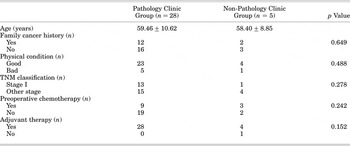
The subjects' disease staging (TNM classification [primary t umor/regional lymph n odes/distant m etastasis]) at time of diagnosis was as follows: stage 1, n = 14 (42.4%); stage 2A, n = 8 (24.2%); stage 2B, n = 6 (18.2%); stage 3A, n = 1 (3.0%); stage 3B, n = 1 (3.0%); stage 3C, n = 2 (6.1%); and stage 4, n = 1 (3.0%). About half the patients were at an early stage of cancer (stage 1). Only one had a distant metastasis. Some 12 (36.4%) subjects had preoperative chemotherapy. Postoperatively, all subjects but one had either one type of adjuvant therapy or a combination thereof, consisting of chemotherapy, radiotherapy, and/or hormonal therapy (Table 1).
Comparison of the attributes and basic data of PC and NPC groups

The Pathology Clinic Procedures and Details
Patients hospitalized at our center for breast cancer surgery were handed a pamphlet about the clinic upon admission by the visiting surgeon. A psychotherapist visited them individually at the hospital and asked whether they wished to visit the clinic. If the patient expressed a desire to do so, a request was submitted, and the patient attended about a month after surgery.
Once at the clinic, the pathologist provided the following information in the context of a face-to-face interview in a private room: (1) the pathology of their disease, focusing on visually comparing excised cancer cells with normal cells using photomicrographs; (2) the presence or absence of lymph-node metastases; (3) presentation of data supporting utilization of hormone therapy or chemotherapy; and (4) confirmation of treatment strategies. Patients were then asked if they had any questions. The interviews lasted about 40 minutes.
The visiting physician also reported the precise name of the disease, discussed the presence or absence of lymph-node metastases, and explained and confirmed future treatment strategies. There was thus a lot of overlap with what was presented at the clinic, the main point of difference being provision of the images of the cells. Repetition of content in the pathology clinic was intended to help patients more fully understand their condition.
Survey Procedures and Details
Our study was approved by the institutional review board and the ethics committee of the NHO Kure Medical Center. Patients provided written consent after being fully informed about the purpose of the study.
A psychotherapist also conducted a survey using a paper-based questionnaire and a semistructured interview to investigate the effect of the pathology clinic on subjects' psychological state and their psychological adjustment to their cancer. After subjects were admitted to the hospital and had undergone surgery, they were presented with this survey content in paper form, and oral consent to cooperate in the survey was obtained. The paper questionnaire was handed out to the patients who gave their consent, and they were asked to complete it. The pretest was conducted after the surgery and before discharge, while the posttest took place immediately after attending the clinic. Those who expressed no desire to visit the clinic were asked to respond to the same questionnaire approximately a month after discharge when they visited the hospital as outpatients. This paper-based questionnaire took about 20 minutes to complete. We also asked them to participate in an interview with a psychotherapist as part of the posttest. After consent was obtained, patients were moved to a private room, separate from the clinic, and asked about their motivation for visiting the clinic and about their general impressions of attending the clinic. This interview took 30 minutes to an hour, and the interview content was recorded on an integrated-circuit (IC) recorder, with permission from the patient.
Measures
The Hospital Anxiety and Depression Scale (HADS) (Zigmond & Snaith, Reference Zigmond and Snaith1983; Kugaya et al., Reference Kugaya, Akechi and Okuyama1998), Japanese version: This measure assesses anxiety and depression related to disease and consists of 14 items and 2 subscales (Anxiety and Depression, each with 7 items).
The Mental Adjustment to Cancer (MAC) scale (Watson et al., Reference Watson, Greer and Young1988), Japanese version: This scale rates a patient's style of coping with their cancer and consists of a total of 40 items, with 5 subscales: Fighting Spirit (FS: 16 items, 16–64 points), Helpless/Hopeless (H: 6 items, 6–24 points), Anxious Preoccupation (AP: 9 items, 9–24 points), Fatalism (F: 8 items, 8–32 points), and Avoidance (A: 1 item, 1–4 points).
Personal background interview: Patients were asked about their age, occupation, family structure, final academic qualification, family history of cancer, and current physical condition.
Analysis
Attributes and basic data were examined with the χ2 and t tests, while HADS and MAC subscale scores were analyzed with a t test. The threshold of significance was set at p < 0.05, and p < 0.10 was deemed to indicate a significant trend. Values are presented here as mean ± standard deviation.
For qualitative analysis of the interview content, recordings were transcribed verbatim, and terms related to their motivations for visiting the clinic and their impressions were extracted. These keywords were coded into groups of terms with similar meanings and analyzed (Holstein & Gubrium, Reference Holstein and Gubrium1995; Kvale, Reference Kvale1996; Lofland & Lofland, Reference Lofland and Lofland1995).
RESULTS
Short-Term Effect of Visiting the pathology Clinic on Patients' Psychological State and Adjustment
Results of Comparative Analysis of the Pre- and Posttest Paper-Based Questionnaires
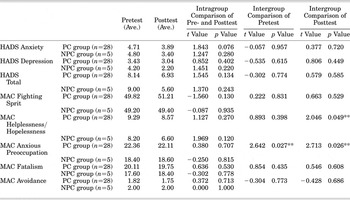
The HADS anxiety scores in the PC group tended to be lower at posttest than at pretest (4.71 → 3.89 points, t = 1.843, p = 0.076) (Table 2). There were no significant differences or significant trends in the pre-/posttest comparison of other HADS and MAC subscales. In addition, there were no significant differences or significant trends in the pre/posttest comparison of any of the subscales in the NPC group (Table 2).
Comparison of HADS/MAC scores before and after patients with breast cancer visited the pathology clinic (intragroup comparison of pre- and posttest) and comparison of HADS/MAC scores between the PC and NPC groups (intergroup comparison of pre- and posttest)

Results of Analysis of the Transcribed Interview Content
A total of 12 subjects participated in this interview, but analysis was conducted with only the 11 subjects in the PC group, as there was inadequate reliability for the 1 subject in the NPC group. Terms related to motivation for attending the clinic and patients' impressions were extracted from the recorded interviews (n = 11), and these keywords were then analyzed. With respect to motivation for visiting the clinic, two categories of patients were coded: (1) proactive patients, who had heard about the pathology clinic from an attending physician (or nurse), showed interest, and proactively decided to visit the clinic to learn more; and (2) passive patients, who had heard about the pathology clinic from an attending physician (or nurse) and visited with a comparatively passive attitude because it was recommended. There were three proactive patients and eight passive patients, showing that most patients had a somewhat passive attitude about clinic attendance.
Next, three categories were coded with respect to impressions about the pathology clinic: (1) an increased desire for treatment: understanding of the basis for treatment (“I was able to understand why I am receiving this type of treatment,” etc.), and ability to have questions answered (“I was able to ask questions I could not ask the attending physician,” etc.); (2) psychological benefits: feeling reassured (“I was encouraged, truly understood the process and felt reassured,” etc.), and satisfied with the consultation (“the situation was explained in detail, and explained in an understandable manner,” etc.); and (3) anxiety, difficulty in understanding: increased level of anxiety (“information was too detailed, so instead it frightened me,” “I thought that I had a more formidable disease,” etc.), and difficulty in understanding (“I am just a layperson, so there were parts I did not understand,” “I did not understand all of the explanations,” etc.). There were eight subjects who provided positive assessments of their clinic visit, stating that it increased their motivation for treatment and helped them feel reassured and satisfied, while three subjects negatively assessed attendance, reporting that they experienced increased anxiety and had difficulty understanding the content.
In terms of a correlation between assessment of pathology clinic attendance stated in the interviews and the results of the paper-based questionnaire, there were too few respondents involved, which made the results unreliable, so we were unable to conduct any statistical analysis in this regard.
Comparison of the Pathology Clinic and Non-Pathology Clinic Groups
Comparison of Attributes and Basic Data of the PC and NPC Groups (Table 1)
The mean age of the PC group was 59.46 ± 10.62 years, and the mean age of the NPC group was 58.40 ± 8.85 years (no significant difference or tendency). Some 12 of the 28 subjects in the PC group had a family history of cancer, and 2 of the 5 in the NPC group (no significant difference between the two groups, p = 0.649).
We asked subjects to rate their current physical condition on a 4-item Likert-type scale: very good, n = 6 (18.2%); good, n = 22 (66.7%), bad, n = 4 (12.1%); and very bad n = 0 (0%); unknown, n = 1 (3.0%). When these results were divided into “good” and “bad” and compared between the two groups, 23 of the 28 subjects in the PC group rated their physical condition as good, while 4 of the 5 subjects in the NPC group reported the same (no significant difference, p = 0.488).
Comparative Analysis of HADS Scores
Of the 33 total subjects surveyed in the pretest, there were 10 in the PC group and 3 in the NPC group who had HADS scores of 11 points or higher, leading us to suspect a depressive state, while in the posttest there were 8 such subjects in the PC group and none in the NPC group. However, for both tests there was no significant difference or tendency in terms of number of subjects in a depressive state between the two groups (pretest, p = 0.295; posttest, p = 0.224). In addition, there was no significant difference or tendency on any of the HADS subscales between groups (see Table 2).
Comparative Analysis of MAC Scores
AP scores were significantly higher in the PC group for the pretest (PC group, 22.36 points; NPC group, 18.40 points; t = 2.642, p = 0.027), and also for the posttest (PC group, 22.11 points; NPC group, 18.60 points; t = 2.713, p = 0.026). There was no significant intergroup difference in H scores for the pretest, but the scores for the NPC group were significantly higher on the posttest (PC group, 8.57 points; NPC group, 6.60 points; t = 2.046, p = 0.049). However, there was no significant intergroup difference for FS scores, which was surmised to correlate with the behavior of visiting the pathology clinic, particularly for the MAC (Table 2).
DISCUSSION
Short-Term Effect of Visiting the Pathology Clinic on the Psychological State and Adjustment of Breast Cancer Patients
There was no statistically significant difference in terms of general psychological state based on HADS scores when comparing test results before and after visiting the pathology clinic (pre/posttests) or between the PC and NPC groups. There was also no significant difference in percentage of patients suspected of having depression based on total HADS scores. It is thus at least unlikely that visiting the pathology clinic increases anxiety level.
On the other hand, based on HADS scores, the PC group showed a tendency toward lower anxiety levels after the clinic visit compared to before discharge, a tendency not seen in the NPC group. In addition, based on the qualitative assessment of interview transcripts, pathology clinic attendance increased the desire for treatment and provided reassurance, and most patients (8 of 11 subjects) evaluated clinic attendance positively. These results suggest that clinic attendance may reduce anxiety in the short term.
Furthermore, many patients indicated in their interviews that, though they did not fully understand the content of the clinic, they were satisfied with how courteously they were treated. These results indicate that patients feel reassured not only because the information they received was readily understandable and accurate, but they also appreciated how the medical staff was willing to spend time with the patients and provide explanations from a patient's perspective.
Correlation Between Pathology Clinic Attendance and Patients' Ability To Cope
With respect to coping ability measured by the MAC, there was no significant difference between the PC and NPC groups for Fighting Spirit. On the other hand, the PC group had a significantly higher level of Anxious Preoccupation (AP) than the NPC group on both tests before discharge and after the clinic. These results suggest that patients who visited the clinic were more likely to adopt coping behaviors than those who did not attend.
There are nine items on the MAC AP subscale: “I am doing something good for my health, such as changing my diet,” “I find it difficult to make plans because I have health problems,” “I am doing something good for my health, such as exercising,” “I worry about recurrence or exacerbation of the cancer,” “I want to contact people with the same disease,” “I can't believe this has happened to me,” “I am apprehensive,” “I want to know everything about cancer,” and “It's aggravating that I became sick.” Thus, a high AP score may be regarded as an indication of a patient's tendency toward a high level of anxiety and worry regarding their disease, a high interest in the disease, and a preference for choosing behaviors that are potentially healthier.
Fujimori and colleagues (Reference Fujimori, Parker and Akechi2007), in a study of the attitudes of Japanese patients toward communication with their physicians, reported that female patients and patients with high AP scores consider the following five factors important when hearing bad news from a physician: “facilitation of questions and direct responses to questions,” “a clear explanation,” “emotional support,” “medical information,” and “the clinical setting.” Other studies have shown that patients who choose adjuvant therapy have higher AP scores (Davidson et al., Reference Davidson, Geoghegan and McLaughlin2005). We can thus infer that a high AP score indicates that a patient has a coping style where they recognize their anxiety related to the disease, that they have a strong desire to fully understand their disease and to receive information that is comprehensible, and that they try to eliminate their anxiety by adopting certain behaviors. We believe that the patients who visited our pathology clinic had high AP scores because they were trying to eliminate their anxiety by learning more about their disease, and the clinic was the place where they could learn about the results of the pathological examination of their biopsied tissue.
Based on previous studies indicating that high AP scores do not positively affect psychological adjustment (Akechi et al., Reference Akechi, Okuyama and Imoto2001; Matsuoka et al., Reference Matsuoka, Nakano and Inagaki2002), even along with such behaviors as good diet and regular exercise, we surmise that these patients are not easily stabilized psychologically due to their strong anxiety about the disease. Members of the PC group are interested in their own disease and are taking action to obtain information about their disease. If this type of coping behavior is adopted, the necessity for psychological support may not be so apparent to the those around them. However, these patients do in fact have high levels of anxiety, and it could be said that they are desperately trying to eliminate their anxiety and are taking actions to do just that. So, even if patients at first glance appear to be adopting coping behaviors, they most probably have high levels of anxiety and are readily perturbable. It is essential to bear in mind that this type of patient often requires psychological support.
We would like to note that this research did not include a survey to ascertain the character tendencies of our subjects, making it difficult to ascertain the factors involved in AP score differences. In addition, since sample size (particularly that of the NPC group) was so small and the correlation between paper-based survey results and the interview results could not be analyzed, the reliability of our results may not be strong.
Nevertheless, our study suggests that a visit to a pathology clinic may help reduce anxiety over the short term in patients with breast cancer who have undergone a radical mastectomy. The visit seems to have the effects of increasing their motivation to undergo treatment, of providing a sense of reassurance, and of reducing anxiety (as indicated by HADS scores). The results also indicate that the group that visited the pathology clinic may tend to autonomously eliminate anxiety about their disease through such behaviors as collecting medical information related to the disease and adopting healthier behaviors. This sheds light on the need for appropriate support in the form of accurate medical information and appropriate emotional support.
ACKNOWLEDGMENTS
We thank the breast cancer surgeons and the ward and outpatient staff at the Kure Medical Center for their collaboration in implementing this study. We are also grateful to the study subjects for allowing us to have the privilege of working with them, and for sharing their experiences.