Introduction
Congenital malformations (CM) originate from disorders that occur during fetal life, with defects ascertaining at birth, during the neonatal period, or in the first years of post-natal life. This variable condition includes structural and functional changes associated with genetic, environmental, infectious, nutritional, sociodemographic, and other multifactorial influences. Reference Melanda, Galiciolli, Lima, Figueiredo and Oliveira1,2 Maternal pathologies such as preeclampsia and eclampsia, Reference Abalos, Cuesta and Carroli3,Reference Auger, Fraser, Healy-Profitós and Arbour4 gestational diabetes, Reference Ornoy, Reece, Pavlinkova, Kappen and Miller5 lupus, Reference Vinet, Pineau, Scott, Clarke, Platt and Bernatsky6 obesity, Reference Stothard, Tennant, Bell and Rankin7 malnutrition, Reference Vohr, Davis, Wanke and Krebs8 and folic acid deficiency, Reference Canfield, Collins and Botto9,Reference Hall and Solehdin10 have been associated with a high risk of CM, abortions, stillbirths, and premature birth. Infections acquired during pregnancy, such as syphilis, Reference De Santis, De Luca and Mappa11 toxoplasmosis, Reference Onadeko, Joynson, Payne and Francis12,Reference Wang, Li and Ma13 cytomegalovirus, Reference Wang, Li and Ma13 rubella, Reference Wang, Li and Ma13,Reference Deodhar14 and Zika virus, Reference Mlakar, Korva and Tul15 can also result in CM. Reference Silva, Oliveira and Almeida16
In 2010, CM was responsible for approximately 6% of deaths during the first year of life and 2.5% of deaths between the first and fourth years of life, representing the 14th disease with the highest number of potential years lost. Reference Murray, Vos and Lozano17 According to the Centers for Disease Control and Prevention (CDC), it is estimated that one in 33 babies in the United States of America (USA) is born with CM annually. 18
Unhealthy lifestyle and environmental factors may trigger the development of CM. Exposure to radiation, pesticides, organic solvents, and trihalomethanes can cause teratogenicity and increase the risk of congenital malformations. Reference Gilboa, Desrosiers and Lawson19–Reference Xiong, Xu and Wang24 The consumption of alcoholic beverages, tobacco cigarettes, and other recreational drugs during gestation has been associated with cardiac malformations, musculoskeletal disorders, gastrointestinal disorders, cleft lip and palate, clubfoot, craniofacial malformations, and neurological changes. Reference Hackshaw, Rodeck and Boniface25–Reference Muggli, Matthews and Penington29
Considering the environmental causes of CM, smoking is one of the most frequent and preventable factors, reliably reported, and well-documented in the CDC database. Although the relationship between maternal smoking and CM is well-documented, geographic variations in the prevalence of specific CM subtypes, as well as interactions with maternal comorbidities and environmental factors, have not yet been comprehensively explored. This study stands out by using a robust CDC database, encompassing 150,775 children diagnosed with CM (2000-2004), to map and quantify the incidences of different types of CM across various USA states.
Methods
CM dataset
This quantitative and retrospective study analyzed CDC reports from 2000 to 2004, including all American children born alive to non-Hispanic White American (NHWA) mothers during this period. Notably, data for this period (i.e., 2000–2004) are unavailable for certain American states, including California, the District of Columbia, and New Mexico (2000–2004); Pennsylvania and Washington (2003–2004); and Florida, Idaho, Kentucky, New Hampshire, New York, South Carolina, and Tennessee (2004). The annually consolidated CDC data were stored in an encoded text file that was submitted to the developed program (script in R) to extract specific information corresponding to the characteristics of the child and mother. Owing to codification changes in the CDC database, two lines of programing were created: one for extracting data before 2002, and the other for data after this year.
The total information collected corresponded to 20,337,729 birth records in the 5 years (2000-2004) of study in the USA territory. Of these, 10,696,235 were born alive to NHWA mothers in a single pregnancy. The collected variables included the year of birth, the month of birth, American status at birth, sex, birth weight, residence status, pregnancy weight gain, alcohol and/or tobacco use during pregnancy, preexisting or acquired anemia and/or diabetes mellitus during pregnancy, and the presence or absence of CM (e.g., anencephaly, spina bifida, hydrocephalus, microcephalus, other central nervous system anomalies, heart malformations, other circulatory malformations, rectal atresia, trachea and esophageal fistula, omphalocele, other gastrointestinal malformations, malformed genitalia, renal agenesis, other urogenital malformations, cleft lip, polydactyly, club foot, diaphragmatic hernia, other musculoskeletal malformations, Down syndrome, other chromosomal alterations, and other CM). This study included only NHWA mothers to avoid confounding biases. Studies have reported that the incidence of CM varies according to race and ethnicity. Reference Brender, Suarez and Langlois30–Reference Le, Shumate, Hoyt, Wilkinson and Canfield33
Statistical analysis
R, a language and environment for statistical computing, was used to perform all analyses and generate reports, maps, tables, and graphs. 34 For comparisons between categories, the chi-square and Mantel-Haenszel tests were used. Reference Mantel35,Reference Mantel and Haenszel36 The odds ratio (OR) was assessed using Fisher’s exact probability statistic with the chi-square test for the maximum OR. The 95% confidence intervals (significance level, p-value<0.05) were calculated using the exact (mid-p and Fisher) and normal approximation (Wald) methods.
Results
CM
A total of 150,775 children of NHWA mothers were diagnosed with CM during the study period (2000-2004). The characteristics of the mothers and newborns, including birth weight, presence of CM, maternal age, weight gain during pregnancy, maternal comorbidities (anemia, diabetes mellitus, and eclampsia), and information on tobacco and alcohol use during pregnancy are presented in Supplementary Table 1 . Figure 1 illustrates the cumulative incidence of CM per 10,000 births in each state between 2000 and 2004. The annual incidence of CM (CM/10,000 births) calculated for each American state is shown in Supplementary Fig. 1 .
Cumulative incidence of all types of congenital malformations (CM) from 2000 to 2004 (CM/10,000 births). Incidence rates are shown in spectra of colors varying from light blue to the highest rates in red. States without available data were excluded (dark gray).

Massachusetts had the highest incidence of CM during the study period (427.8/10,000 births/year). Considering all types of CM, Arkansas had the highest incidence of anencephaly (3.4/10,000 births/year) and omphalocele (8.1/10,000 births/year); Utah had the highest incidence of cleft lip (16.2/10,000 births/year), club foot (13.9/10,000 births/year), malformed genitalia (37.3/10,000 births/year), and renal agenesis (3.6/10,000 births/year); South Dakota had the highest incidence of diaphragmatic hernia (3.5/10,000 births/year) and hydrocephalus (4.7/10,000 births/year); Vermont had the highest incidence of Down syndrome (10.7/10,000 births/year); Rhode Island had the highest incidence of microcephalus (1.6/10,000 births/year), other central nervous system anomalies (10.5/10,000 births/year), heart malformations (44.0/10,000 births/year), and other urogenital malformations (66.9/10,000 births/year); North Dakota had the highest incidence of polydactyly (11.4/10,000 births/year) and trachea and esophageal fistula (2.8/10,000 births/year); Missouri had the highest incidence of rectal atresia (2.2/10,000 births/year); Louisiana had the highest incidence of spina bifida (4.9/10,000 births/year); Oklahoma had the highest incidence of other chromosomal alterations (27.2/10,000 births/year); Nevada had the highest incidence of other circulatory malformations (61.8/10,000 births/year) and other gastrointestinal malformations (39.6/10,000 births/year); Massachusetts had the highest incidence of other CM (110.8/10,000 births/year) and other musculoskeletal malformations (131.2/10,000 births/year).
Risk factors for CM
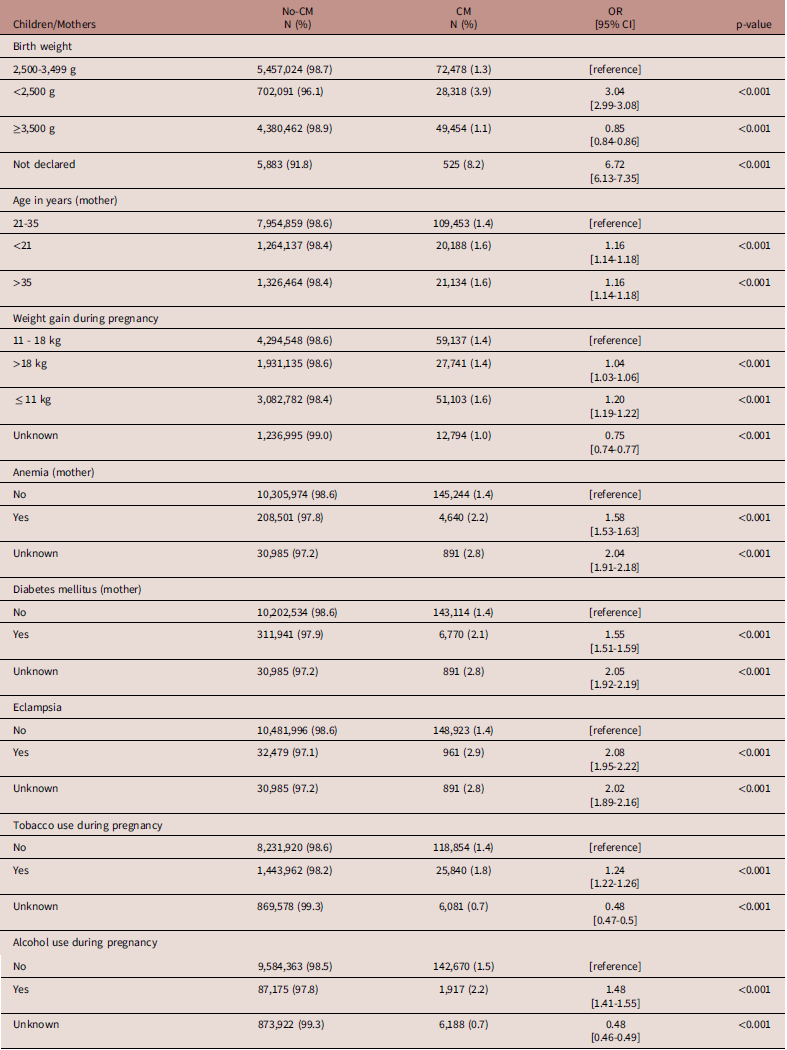
As observed in Table 1, factors significantly associated with an increased risk for CM were birth weight<2,500 g (OR: 3.04; 95% CI: 2.99-3.08, p-value<0.001), mother’s age<21 (OR: 1.16; 95% CI: 1.14-1.18, p-value<0.001) and>35 (OR: 1.16; 95% CI: 1.14-1.18, p-value<0.001) years, mother’s body weight gain during pregnancy (> 18 kg – OR: 1.04; 95% CI: 1.03-1.06, p-value<0.001 and ≤ 11 kg – OR: 1.20; 95% CI: 1.19-1.22, p-value<0.001), anemia (OR: 1.58; 95% CI: 1.53-1.63, p-value<0.001), diabetes mellitus (OR: 1.55; 95% CI: 1.51-1.59, p-value<0.001), eclampsia (cases of preeclampsia were omitted; OR: 2.08; 95% CI: 1.95-2.22, p-value<0.001), smoking (tobacco use) (OR: 1.24; 95% CI: 1.22-1.26, p-value<0.001), and alcohol use (OR: 1.48; 95% CI: 1.41-1.55, p-value<0.001) during pregnancy.
Risk factors for congenital malformations (CM) between 2000 and 2004.

No-CM: Children born without congenital malformations; CM: Children born with congenital malformations.
Tobacco use during pregnancy
Between 2000 and 2004, 1,469,802 children were born alive to NHWA mothers who claimed to have used tobacco during pregnancy. Of this total, 1.80% (25,840) were diagnosed with CM; this ratio was 1.40% (118,854) for mothers who did not report tobacco use (i.e., non-smoking mothers) during pregnancy (Table 1). Children born to non-smoking (8,350,774) and smoking (1,469, 802) mothers were used to calculate the incidence of CM. As shown in Figure 2, smoking mothers had a higher incidence of CM than non-smoking mothers in most American states.
Cumulative incidence of congenital malformations (CM) (CM/10,000 births) in children from non-smoking and smoking mothers per American state from 2000 to 2004. The incidence rates are shown in the spectra of colors, varying from light blue to the highest rates in red. States without available data are excluded (dark gray).

To represent the impact of smoking across time in American states, we selected four CM with a significantly higher incidence in children of smoking mothers (identified in a large number of states) than in those of non-smoking mothers. The four selected CM (CM4) were clubfoot (detected in 13 American states), cleft lip (11 American states), polydactyly (11 American states), and omphalocele (9 American states) (Fig. 3).
Impact of smoking on congenital malformations development across time and geographic region. The incidence rates are shown in the spectra of colors, varying from light blue to the highest rates in red. Dark gray represents the states without available data.

Considering non-smoking mothers, the incidence of clubfoot was the highest in Montana (18.22 cases/10,000 births) and Utah (17.13 cases/10,000 births) in 2003. Considering smoking mothers, the highest incidence of clubfoot in children was documented in Hawaii in 2000 (100 cases/10,000 births) and 2002 (84.75 cases/10,000 births), and in Rhode Island (75.76 cases/10,000 births) in 2003 (Fig. 3). Among non-smoking mothers, the highest incidence of cleft lip was recorded in Wyoming (24.17 cases/10,000 births) in 2000 and North Dakota (22.77 cases/10,000 births) in 2004. The highest incidence of cleft lip in the children of smoking mothers was recorded in Hawaii (50 cases/10,000 births) in 2000 and Montana (37.45 cases/10,000 births) in 2003 (37.45 cases/10,000 births) (Fig. 3). The highest incidence of polydactyly among children of non-smoking mothers was documented in Vermont (20.89 cases/10,000 births) in 2001 and Rhode Island (18.97 cases/10,000 births) in 2003. The highest incidence of polydactyly in children of smokers was observed in Rhode Island (348.88 cases/10,000 births) in 2004 (Fig. 3). Considering non-smoking mothers, the highest incidences of omphalocele were recorded in Arkansas (9.52 cases/10,000 births) in 2003 and South Dakota (8.84 cases/ 10,000 births) in 2001. The highest incidence of omphalocele in children of smoking mothers was recorded in Montana (28.37 cases/10,000 births) in 2000 and North Dakota (20.60 cases/10,000 births) in 2002 (Fig. 3).
ORs between smoking and non-smoking mothers were calculated for clubfoot, cleft lip, polydactyly, and omphalocele. Smoking mothers had an increased probability of having a child with clubfoot (OR: 1.78; 95% CI: 1.69-1.88, p-value<0.001), cleft lip (OR: 1.54; 95% CI: 1.46-1.61, p-value<0.001), polydactyly (OR: 1.45; 95% CI: 1.36-1.54, p-value<0.001), and omphalocele (OR: 1.98; 95% CI: 1.83-2.14, p-value<0.001) than nonsmoking mothers.
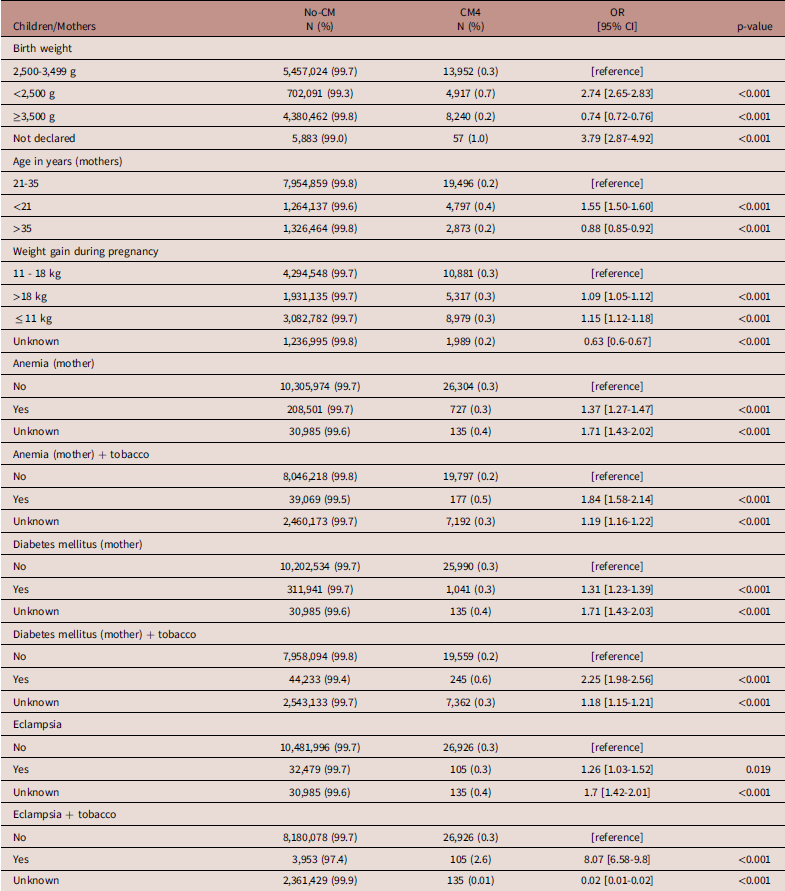
The OR for each risk factor associated with tobacco use was calculated among children born with at least one of the CM4, namely clubfoot, cleft lip, polydactyly, or omphalocele, from 2000 to 2004, as described in Table 2. When tobacco use was associated with other risk factors, such as anemia, diabetes mellitus, and eclampsia (cases of preeclampsia were omitted), the OR for CM4 increased, suggesting that smoking during pregnancy could negatively impact the fetus, leading to CM, especially in the presence of a preexisting risk factor.
Children from smoking and non-smoking mothers who had at least one of the following malformations: clubfoot, cleft lip, polydactyly, or omphalocele (CM4), from 2000 to 2004

No-CM: Children born without congenital malformation; CM4: Children born with one specific type of congenital malformation (club foot, cleft lip, polydactyly, or omphalocele).
Notably, smoking mothers in Texas, Ohio, Virginia, and Georgia exhibited an increased incidence of the CM4 (cleft lip, clubfoot, polydactyly, and omphalocele) (Fig. 4 and Supplementary Table 2). Considering the variation in CM over the years, smoking mothers exhibited a higher incidence of CM than non-smoking mothers. Among smoking mothers, Texas showed an increased incidence of other types of CM (heart malformations, malformed genitalia, central nervous system anomalies, circulatory malformations, and musculoskeletal malformations) during the study period. Ohio also reported an increased incidence of CMs among smokers in terms of hydrocephalus, microcephalus, and other CM. In addition, Virginia and Georgia showed an increased incidence of other CM among smokers.
The annual incidence of clubfoot, cleft lip, polydactyly, and omphalocele (2000-2004) comparing smoking and non-smoking mothers in the most affected American states (Texas, Ohio, Virginia, and Georgia).

Discussion
Cumulative environmental influences associated with biological responses throughout life, including diet, behavior, and endogenous processes, can contribute to CM development. Reference Miller and Jones37 Smoking tobacco during pregnancy is one of the most common causes of CM. Anti-smoking advocacy and educational and social measures in the USA have grown progressively over the last two decades, resulting in improved health outcomes. Reference Ibrahim and Glantz38,39 Tobacco control reduced the number of premature deaths associated with tobacco use in the United States between 1964 and 2012. Reference Holford, Meza and Warner40
Herein, we observed remarkable smoking disparities during the study period (2000-2004), revealing substantial geographical differences in CM incidence rates and highlighting the four most common CM (clubfoot, cleft lip, polydactyly, and omphalocele). A high prevalence of NHWA-smoking mothers was observed, ranging from 14.31% (in 2000) to 12.68% (in 2004). Interestingly, the percentage of mothers who smoked during pregnancy has declined across all racial groups between 2016 and 2021. A 36% decline in smoking (from 10.5% in 2016 to 6.7% in 2021) was documented among NHWA mothers. Reference Hansen, Akomolafe, McGalliard, Belle-Isle and Zhang41–Reference Drake, Driscoll and Mathews43
Our study focused on NHWA-smoking mothers to reduce differences and confounders in genetics, race, ethnicity, and culture. In some instances, disparities grew during the study period. In addition to active and passive smoking, other external factors may affect the well-being of mothers and their children with CM. Considering the investigated period (2000–2004), we noted an overall CM incidence of 141/10,000 children born alive to NHWA mothers. Accordingly, CM could be associated with cumulative risk factors, indicating that a reduction in tobacco use, as well as an overall improvement in lifestyle and low exposure to other comorbidities and environmental factors, may reduce the risk of developing CM.
Factors such as maternal age at pregnancy, anemia, diabetes mellitus, and eclampsia are known to play roles in the development of CM. Anemia was identified in 2 of every 100 pregnant mothers (1.99% [1.97–2.12%]) in general and in 3 of every 100 mothers of children with CM (3.08% [2.74–3.25%]), and the OR for CM with anemia associated with smoking during pregnancy was increased. Our findings corroborate those of previous reports demonstrating that diabetes mellitus can affect the appearance of CM, such as cardiovascular and neural tube defects. Reference Ornoy, Reece, Pavlinkova, Kappen and Miller5 Exposure to environmental factors, as evaluated based on the mother’s place of residence, was another factor that could also affect the development of CM. The USA has distinct geographical characteristics, including climate, population density, drinking water quality, and presence or absence of industries. In the present study, all types of CM were grouped to determine the disease behavior in each American state.
As an isolated factor or associated with other maternal conditions, smoking during pregnancy was significantly associated with CM in NHWA mothers. By analyzing the available data, it was observed that among all types of CM in the groups of mothers (smokers and non-smokers), the risk of CM increased across all USA states for four types, namely, clubfoot, cleft lip, polydactyly, and omphalocele. Based on this finding, it was decided to further study these CM. Club foot is a common CM and has been associated with family history, serotonin inhibitors, use of tobacco by the mother and/or father, maternal obesity, gestational diabetes, and mother’s age. Reference Dibello, Di Carlo, Colin, Barbi and Galimberti44,Reference Cady, Hennessey and Schwend45 Cleft lip malformation is the most frequent CM of the head and neck region, and its etiology involves genetic and environmental factors, ethnic origin, and paternal age. Reference Shkoukani, Lawrence, Liebertz and Svider46,Reference Murray47 Alcohol and tobacco use during pregnancy has been investigated as a risk factor for congenital cleft lip malformations. Reference Martinelli, Palmieri, Carinci and Scapoli48–Reference Jorda, Conant, Sandstrom, Klug, Angal and Burd51 Polydactyly is a common congenital anomaly of the limbs, which can present in isolation or as a syndrome. Polydactyly follows an autosomal dominant inheritance pattern, with hereditary characteristics and extreme phenotypic heterogeneity. Reference Farrugia52–Reference Umair, Ahmad, Bilal, Ahmad and Alfadhel54 Omphalocele is a rare CM of the anterior abdominal wall, and approximately 40–80% of all cases present with a concurrent anomaly. The main associated factors include the mother’s age (> 35 years), multiple births, and high cigarette and alcohol consumption during pregnancy. Reference Barrios Sanjuanelo, Abelló Munarriz and Cardona-Arias55,Reference Verla, Style and Olutoye56 The physiological mechanism by which tobacco causes CM is not well understood. However, some studies suggest that smoking during pregnancy may lead to vasoconstriction, reduced blood flow, and carbon monoxide binding to hemoglobin, which decreases the oxygen available to the fetus and causes hypoxia. Reference Lambers and Clark57,Reference Quinton, Cook and Peek58 Additionally, smoking during pregnancy has been associated with reduced amino acid uptake in the placenta Reference Sastry59 and epigenetic modification, such as DNA methylation. Reference Lee and Pausova60
This study presented a limitation in that the information was analyzed only from 2000 to 2004; however, this is due to the lack of access to complete information in the CDC databases (2005-2023). Despite this limitation, the information presented includes a large part of the population at the time, thus supporting future research. Another limitation of this research is multivariate modeling; however, with a large amount of information (20,337,729 records of live births in the period), convergent univariate modeling works practically with the population and not with a sample. Furthermore, despite grouping the information by state, the environmental effects of each region were not considered. By grouping this information, the striking characteristics of the emergence of failures at birth can be verified.
Conclusions
CM accounted for 1.41% (150,775) of all births in the NHWA population (total live births from 2000 to 2004:10,696,235). Anemia, diabetes mellitus, eclampsia (cases of preeclampsia were omitted), body weight gain during pregnancy, mother’s age, and use of tobacco and alcohol during pregnancy are risk factors for CM, resulting in an increased incidence of clubfoot, cleft lip, polydactyly, and omphalocele. Texas, Ohio, Virginia, and Georgia have experienced repeated annual occurrences of CM caused by smoking, with smoking mothers having a higher incidence of CM than nonsmoking mothers. Tobacco and alcohol consumption during pregnancy and the presence of maternal comorbidities such as anemia, diabetes mellitus, and eclampsia (cases of preeclampsia were omitted) can increase the risk of CM, and special attention is warranted when tobacco use is associated with other risk factors. The different incidence rates among states suggest that other environmental risk factors may critically affect the development of CM. Identifying the most common causes and risk factors associated with CM will facilitate the development of health policies to prevent or minimize these abnormalities.
Supplementary material
The supplementary material for this article can be found at https://doi.org/10.1017/S2040174425000054
Acknowledgments
This work was conducted with the support of the Big Data Research Group of the Pelé Pequeno Principe Research Institute and Pequeno Príncipe Hospital.
Author contribution
Conceptualization and formal analysis, B.C.F. and D.P.A.; writing-original draft, D.P.A.; methodology and investigation, B.C.F., D.P.A., C.M.M., D.C.R.A., H.L., L.L., M.E.P., C.S.O.; supervision and visualization, D.P.A., B.C.F., and L.L.; investigation and editing. All authors reviewed the literature, the last version of the manuscript and approved the final manuscript.
Financial support
This study received no external funding. The authors would like to thank for scholarships. DPA received a scholarship from Coordenação de Aperfeiçoamento de Pessoal de Nível Superior – Brazil (CAPES) – Financing Code 001/2018–2021 (www.capes.gov.br). BCF had a scholarship from National Council for Scientific and Technological Development (Conselho Nacional de Desenvolvimento Científico e Tecnológico), Brazil, 303592/2021-4, www.cnpq.br.
Competing interests
The authors declare no conflicts of interest.
Declarations
The authors whose names are listed above certify that they have NO affiliations with or involvement in any organization or entity with any financial interest (such as honoraria; educational grants; participation in speakers’ bureaus; membership, employment, consultancies, stock ownership, or other equity interest; and expert testimony or patent-licensing arrangements), or non-financial interest (such as personal or professional relationships, affiliations, knowledge or beliefs) in the subject matter or materials discussed in this manuscript.
This statement is signed by the correspondent author, Dr Bonald Figueiredo, with the agreement of the other authors, to indicate agreement that the above information is true and correct.