One of the domains of the five-column model for health technology assessment (HTA) development presented in the EUR-ASSESS report (Reference Banta3) and elaborated on by Busse et al. (Reference Busse, Orvain and Velasco4) in the ECHTA/ECAHI Working Group 4 report concerns the psychosocial, legal, and ethical aspects of a technology application (the other domains being effectiveness, safety, economic, and health services impact). The importance of addressing such domains when researching the impact of a health technology is also evident in the HTA CoreModel™, developed during the EUnetHTA project (2006–2008) (6). This is not only of interest for reasons of achieving equitable outcomes but also due to the impact these factors have on the effectiveness of the technology in question.
According to the World Health Organization (WHO), “gender” refers to the socially constructed roles, behaviors, activities, and attributes that a given society considers appropriate for men and women, while “sex” is the sum of biological and physiological characteristics that define men and women, making sex a constant and gender a variable in different societies. However, in research related to health care, “gender” is still often used to signify the biological characteristics of men and women rather than the respective social positions of the sexes.
The existing disparities in health for men and women cannot be singularly attributed to physiological differences and they are present in all societies. Gender plays a significant part in the health status and health seeking behavior of individuals and can therefore have an impact on the relative positions of men and women in a given healthcare context.
Gender sensitivity in conducting health-related research and transforming it into policy is an issue of considerable importance and has been gaining interest in the past few years, especially since several researchers, such as Annandale and Hunt (Reference Annandale and Hunt2), Spitzer (Reference Spitzer13), and Sharma (Reference Sharma12), have identified and recognized gender inequalities as a significant health determinant to be taken into account.
Gender sensitivity is of special interest with regard to HTA as well, not only because HTA-producers draw information from other forms of healthcare research, which is prone to gender bias and therefore requires a certain level of gender-awareness, but also due to the nature of HTA itself as one of the most important forms of policy-informing research.
The purpose of this study is to provide an initial overview of the ways and extent to which gender is taken into consideration in contemporary HTA production worldwide by looking at the approaches of HTA-performing agencies and the networks that facilitate their coordination as manifested on their Web sites.
METHODOLOGY
Two international collaborative networks, the International Network of Agencies for Health Technology Assessment (INAHTA) and EUnetHTA, were used as sources, their members constituting the initial agency pool for this research. Information on each agency's URL was initially collected from the members lists of the networks and the Web sites were visited between August 2008 and October 2008.
A systematic investigation of the information presented on the Web sites of HTA-performing agencies was carried out aiming at gaining insight into the extent of gender consideration in HTA production. The Web site approach was selected not only as the handiest option, but also because of the assumption that agency Web sites would provide not only a comprehensive amount of information but also that information that is of importance to the agency in question.
To select an agency for the analysis, a valid and accessible Web site presenting the agency and its practices had to be available. Additionally, a version of the Web site and the downloadable published documentation needed to be in a language accessible to the authors (English, German, French, Greek, Spanish, and Italian). The Web site of each individual agency was scrutinized for indications that gender issues were addressed as part of the HTA production. Documents provided online on each Web site (e.g., mission statements, process guides, methodological guidance) were also included in this process.
A systematized approach was used to process each included Web site based on four main issues: (i) social perspective in the mission statement or goals of the agencies, (ii) social aspects and particularly gender in HTA priority setting, (iii) social aspects and particularly gender in the methodological approach, and (iv) initiatives with regard to gender equity and equality.
The social perspective was investigated because gender designates a socio-cultural construct in contrast to sex. For the same reason, attention was paid to assessing the meaning attributed to the concept “gender” to determine whether the word was used correctly in this respect.
RESULTS
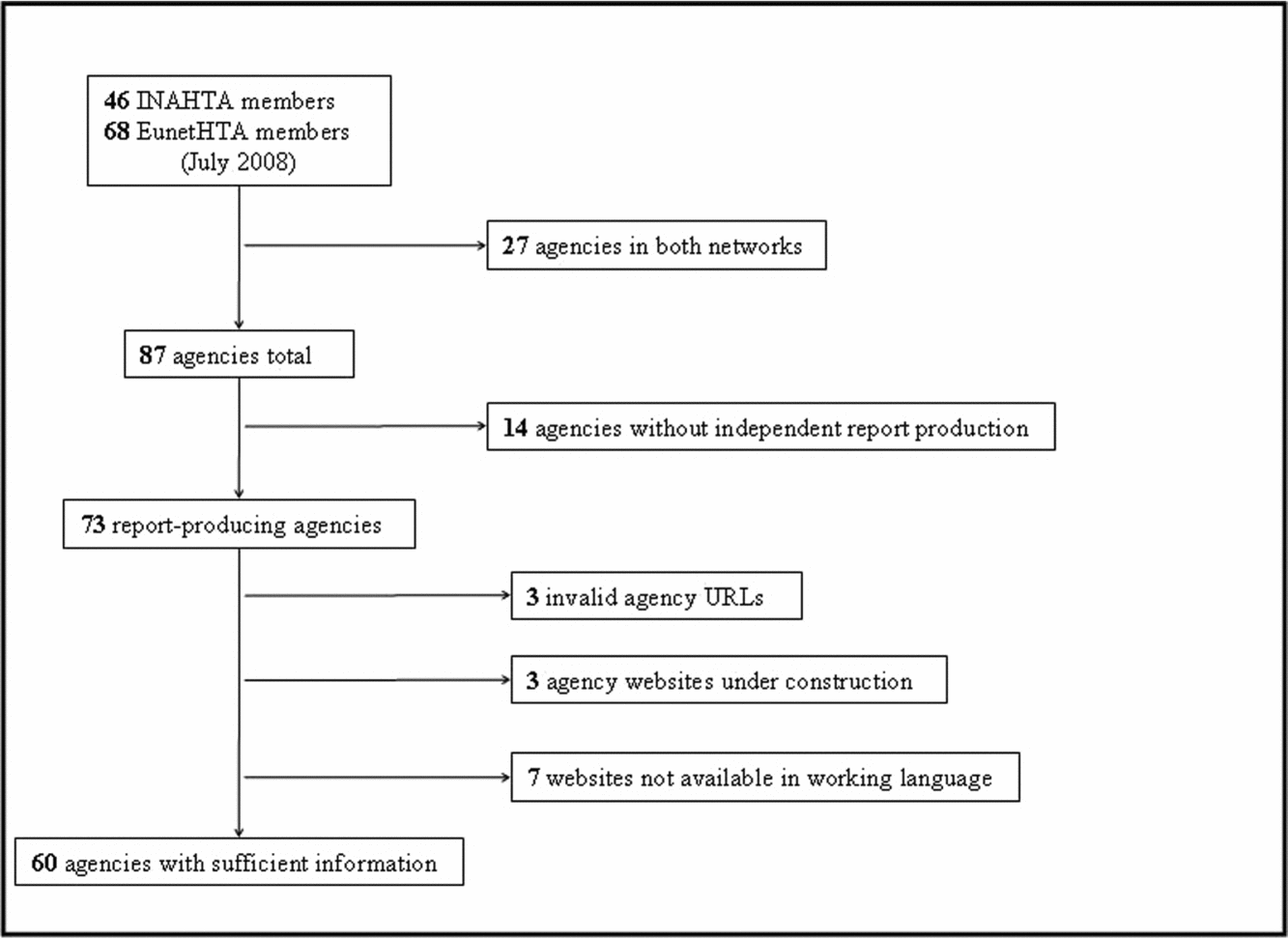
At the time of investigation, INAHTA and EUnetHTA together had 73 distinct HTA agencies as members, whose Web sites were visited to obtain the information needed. Of the identified agencies, fifty-five were located in Europe, seven in North America, four in South America, four in Oceania, and three in Asia. After eliminating the agencies that lacked accessible information, sixty agencies remained (Figure 1).
Initial agency pool and final number of agencies included in the analysis.

Social Perspective in the Mission Statements of Agencies
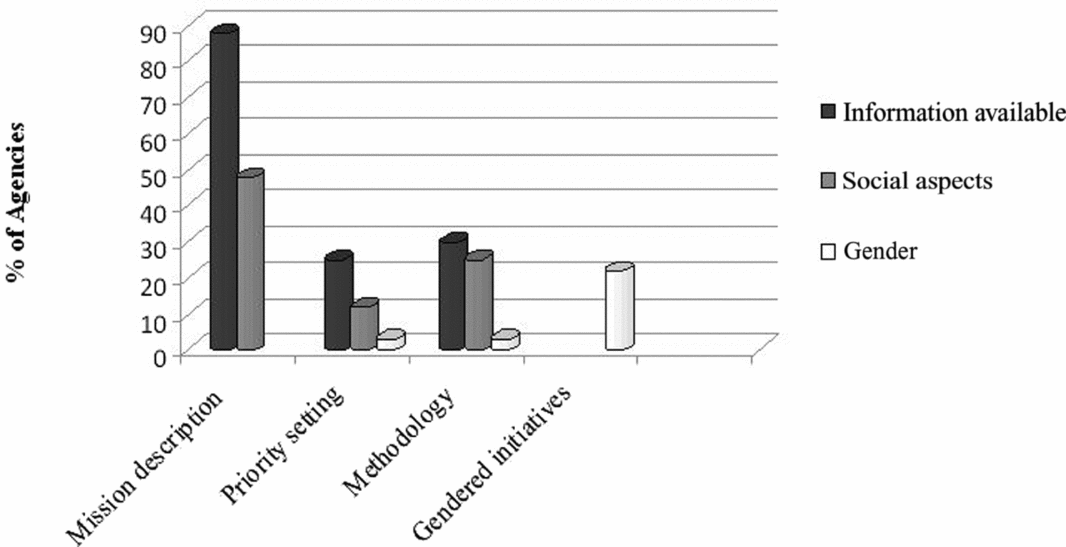
Of the sixty accessible Web sites, twenty-nine included a social perspective in their mission statements or the description of their work goals (Figure 2). We considered the outcome corresponding to the term “social perspective” validly present, if it recognized the composition, structures, needs, and other characteristics of the social context of the population represented or covered by the agency in question.
Quantitative results, overview.

Priority Setting and the Inclusion of Social Aspects and Gender
Of the sixty accessible Web sites, fifteen provided explicit information on prioritization and the selection criteria for HTA topics (Figure 2). Seven agencies included the social consequences of the intervention as one of the criteria for commissioning and performing assessments. Only in two cases (the Andalucian Agency for Health Technology Assessment in Spain (1) and the Medical Advisory Secretariat/the Ontario Health Technology Advisory Committee in Canada), equitable health care with special reference to gender was included in the prioritization process.
Social Perspective and Gender in the Methodological Approach of Agencies
Eighteen of the sixty HTA agencies’ Web sites included some input on the principles and particulars of their methodological approaches and working processes (Figure 2). Social issues with regard to the implementation of medical technologies were present in fifteen of these cases, whereas specific mention to gender in the context of equitable treatment was made in only two cases, namely by the Canadian Agency for Drugs and Technologies in Health (CADTH) (5) and by the National Institute for Health and Clinical Excellence (NICE) in England (10).
Agency Initiatives on Gender and Equity
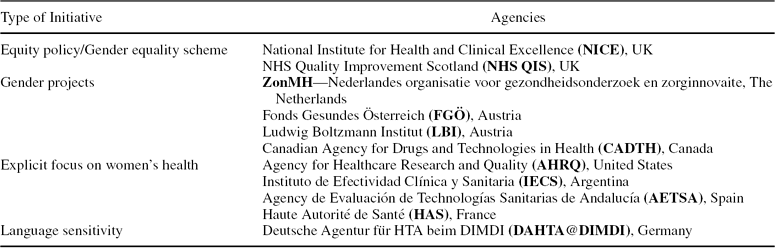
Accessible Web sites were scrutinized to determine if the agency had any specific approach toward gender in healthcare in the form of initiatives beyond HTA priority setting and methodology. Relevant results were identified in thirteen cases (Figure 2 and Table 1).
Gendered Initiatives

The two most notable examples are NICE in England (9) and the NHS Quality Improvement Scotland (NHS QIS) (7;8), because they demonstrate not only a sensitivity toward gender issues on behalf of the agencies, but also some possibilities for hands-on approaches.
DISCUSSION
Methodological Limitations
This study restricted itself to the information available online to the public user to perceive the current place of gender in HTA research as it is publicly declared by those who perform this type of research. An obvious risk with this choice of approach is that the results rely on the publication of agency or network policy and principles on the Web site of the agency or network. Information not published on the Web site would not be included, thus threatening the fairness of results.
Additionally, statements on priority setting and methodological principles would be a priori taken at face value. A comparison to determine whether the work processes and results (in the form of an HTA report, for example) adhered to the stated principles was not performed. This concern might be somewhat mitigated by the fact that interested parties can compare published assessment products with principles and draw their own conclusions.
In order for sturdier and more specific conclusions to be drawn on the matter, further research is called for in the form of direct contact with the agencies included, so as to verify the validity of this study's findings in practice.
Current Practice in Considering Gender Issues in HTA
Despite the limitations of our research, it is obvious from the above results that gender is rarely addressed explicitly in the current HTA-producing context. The amount of available information on process and methodology varied substantially among agencies, with the probability of detailed information dependent on the size and extensiveness of the Web site. With relatively few exceptions, the extent of material obtainable by the public user was surprisingly limited.
In order for HTAs to be performed in a gender-sensitive way, the agency responsible for the research must first be aware of the role social structures and statuses play in healthcare provision and healthcare-seeking behaviors in general. The percentages for the inclusion of social aspects presented in this paper are not that encouraging in the first place. Moreover, presuming that gender is included when social aspects in general are being taken into consideration in healthcare research and policy cannot be taken for granted and would be too optimistic an assumption.
Gender and sex-based analysis (GSBA) has been conceived and developed as a tool to introduce a gender-sensitive approach to research, specifically looking for sex- and gender-related differences inherent in every issue, without presuming that these differences exist (15). However, eliminating gender bias in research, with particular reference to health care, would necessitate addressing firmly established hierarchies and ideologies that are resistant to change (Reference Risberg, Hamberg and Johansson11). It is for this reason that several attempts have been only mildly successful and providing the theoretical framework and tools does not necessarily translate into practice (Reference Busse, Orvain and Velasco4).
With regard to HTA, including gender as a determinant in the report production process could improve quality of health by pinpointing appropriate interventions, from priority setting to integrating GSBA in the methodological approach and considering relevant particularities pertaining to the dissemination and implementation of the assessment results. It could also increase effectiveness by addressing acceptability and appropriateness, thus ameliorating adherence problems, actual health outcomes, and patient satisfaction. However, it has to be stressed that gender cannot be considered on its own when performing an assessment that determines the comprehensive effectiveness or “community effectiveness” (Reference Banta3) and which serves as the main tool for informing decision making on all healthcare provision levels. As elaborated on by Thurston and Vissandjée (Reference Thurston and Vissandjée14), it has to be part of a diversity framework that assesses several aspects which produce health inequities, such as socioeconomic status, ethnicity, age, and migration status.
The structuring and application of such a framework would require a (re)commitment to the socio-cultural side of HTA and the recognition of the importance of assessing the social context within which a technology is to be implemented as one of the determining axes of its potential impact.
POLICY IMPLICATIONS AND SUGGESTIONS
This study was conceived as a tool for gaining a first impression of the extent to which gender as a variable is taken into account in current HTA production. The study design mirrored this general approach, and even though absolute conclusions cannot be drawn based on this methodology, some initial observations which are supported in the literature are of interest.
To be more successful in introducing a gender-sensitive approach in HTA production, a general inclusion of gender issues in healthcare research is necessary because HTA reports mainly draw information from these primary sources of data. Thus, introducing gender-awareness and analysis in the basic curricula of healthcare-related studies as well as continued education in the field would produce healthcare professionals and researchers who are acquainted with the importance and particulars of a gendered approach.
Addressing gender bias in research also requires a top-down endorsement of gender-sensitive practices. Familiarizing agency staff with the concept of gender, endorsing a gender-balanced composition in research teams and requiring a gendered analysis on behalf of the commissioning or coordinating bodies would help tackle forms of bias such as gender blindness, male bias, or gender-role ideology, and thus promote equity and enhance validity and applicability of HTA.
CONTACT INFORMATION
Dimitra Panteli, MD, MScPH (dimitra.panteli@tu-berlin.de), Annette Zentner, MPH (annette.zentner@tu-berlin.de), Technische Universität Berlin, Department of Health Care Management, Administrative office H80, Str. des 17. Juni 135, 10623 Berlin, Germany
Philipp Storz-Pfennig, MA, MPH (Philipp.Storz@gkv-spitzenverband.de), Abteilung Medizin, GKV-Spitzenverband, Mittelstraße 51, 10117 Berlin, Germany
Reinhard Busse, MPH, FFPH (rbusse@tu-berlin.de), Technische Universität Berlin, Department of Health Care Management, Administrative office H80, Str. des 17. Juni 135, 10623 Berlin, Germany
CONFLICT OF INTEREST
Dimitra Panteli has received funding from Pfizer Deutschland GmbH. The other authors report they have no potential conflicts of interest.