INTRODUCTION
Dignity at death has been studied in several areas, and although the concepts of dignity and dignity in dying may vary depending on an individual's context and beliefs, it is important to make clear what we mean when we refer to death with dignity in palliative care.
Traditionally, dignity in palliative care has been defined using two distinct but not opposite approaches. On the one hand, death with dignity refers to the right to die how when, and where an individual decides (Chochinov, Reference Chochinov2002). This definition is still the subject for debate and is related to such legal aspects as euthanasia. On the other hand, dignity in dying has been defined as death without suffering (Chochinov, Reference Chochinov2002). The study of the concept carried out by Whittemore and Knafl (Reference Whittemore and Knafl2005), for example, found 28 works on death with dignity. These authors sorted the studies on dignity into several groups, which followed the following topics: human rights, autonomy and dependence, symptom control, respect, human and personal feelings, significant social relationships, dignified treatment and care, existential and spiritual satisfaction, privacy and intimacy, and security and calm. More recently, Guo and Jacelon (Reference Guo and Jacelon2014) reviewed the concept of dignity at the end of life and found similar topics to those of Whittemore and Knafl (Reference Whittemore and Knafl2005). In total, nine different but complementary matters were related to the meaning of dignity in dying: human rights, autonomy and independence, relieved symptom distress, respect, being human and being oneself, meaningful relationships, dignified treatment and care, existential/spiritual satisfaction, and privacy.
Within the literature, several models have underpinned dignity in the context of end-of-life care. Among them, four models stand out in scholarly circles: the conceptual model of dignity (Pleschberger, Reference Pleschberger2007), the preservation model of dignity (Periyakoil et al., Reference Periyakoil, Noda and Kraemer2010), the decision-taking model of dignity (Vladeck & Westphal, Reference Vladeck and Westphal2012), and the Chochinov model of dignity (Chochinov et al., Reference Chochinov, Hack and Hassard2002a). Among these, Chochinov's model (Chochinov et al., Reference Chochinov, Hack and Hassard2002a; Reference Chochinov, Kristjanson and Hack2006; Hall et al., Reference Hall, Longhurst and Higginson2009) is the most used to evaluate and measure dignity, as well as in interventions (Chochinov et al., Reference Chochinov, Hack and McClement2002b; Chochinov et al., Reference Chochinov, Hassard and McClement2008; Doorenbos et al., Reference Doorenbos, Wilson and Coenen2006). Chochinov (Reference Chochinov2002) and Chochinov et al. (Reference Chochinov, Hack and Hassard2002a) developed a dignity model for the terminally ill that incorporates a broad range of physical, psychological, social, and existential concerns affecting an individual's perception of dignity. The three major categories of resources that affect a patient's sense of dignity are: illness-related issues, a dignity-conserving repertoire, and a social dignity inventory (Chochinov et al., Reference Chochinov, Kristjanson and Hack2006; Chochinov, Reference Chochinov2006). Another recurrent model in the scientific literature is the theoretical model of preservation of dignity developed by Periyakoil and colleagues (Reference Periyakoil, Noda and Kraemer2010). These authors distinguished between intrinsic and extrinsic dignity. Whereas intrinsic dignity belongs to the individual, extrinsic dignity depends on others.
These models have led to several dignity measurement instruments, including the Patient Dignity Inventory (PDI; Chochinov et al., Reference Chochinov, Hack and McClement2002b), based on Chochinov and colleagues' model of dignity; the Dignity Card-Sort Tool (DCT) and the Preservation of Dignity Card-Sort Tool (p–DCT), developed within the framework of the theoretical model of preservation of dignity (Periyakoil et al., Reference Periyakoil, Kraemer and Noda2009; Reference Periyakoil, Noda and Kraemer2010); and the Instrument to Measure Factors Related to Self-Perceived Dignity, measuring factors that affect patients' dignity in end-of-life care (Vlug et al., Reference Vlug, de Vet and Pasman2011).
These instruments can assist in drawing a map of the relations among dignity in end-of-life care and the related variables. In almost every study carried out in palliative care, emotional distress is present, being reported by up to 49% of patients (Van't Spijker et al., Reference Van't Spijker, Trijsburg and Duivenvoorden1997). Emotional distress, many times defined as high levels of anxiety and depression, has been related to a lack of dignity as measured by the Patient Dignity Inventory (Chochinov et al., Reference Chochinov, Hassard and McClement2008). Resilience is a construct that has gained attention during the last few years in the palliative context (Vanistendael, Reference Vanistendael, Monroe and Oliviere2007), becoming a protective factor when it comes to emotional well-being (Barreto et al, Reference Barreto, Fombuena and Diego2013). Finally, spirituality, social support, and quality of life have also been positively related to patient dignity and well-being. Patient spirituality, for example, has been found to be a negative predictor of anguish symptoms (Chochinov et al., Reference Chochinov, Hassard and McClement2009). Social support, in turn, has shown up to benefit palliative care patients (Edmondson et al., Reference Edmondson, Park and Blank2008; Peterman et al., Reference Peterman, Fitchett and Brady2002). Finally, quality of life has been defined as the last bastion of dignity, and has been incorporated into the NCCN guidelines for oncology and palliative care (NCCN, 2013).
The aim of our research was to develop a new and brief instrument for measurement of dignity that has sound psychometric properties and is based on the perceptions of patients, relatives, and professional with respect to dignity.
METHODS
Step 1. Development of the Palliative Patients' Dignity Scale (PPDS)
Taking as a framework Chochinov and colleagues' model (Chochinov, Reference Chochinov2002; Chochinov et al., Reference Chochinov, Hack and Hassard2002a), and with the aim of detecting preservation of and threats to dignity at the end of life, we developed the Palliative Patients' Dignity Scale (PPDS). In order to achieve this, we conducted several surveys with key informants on home care: patients receiving palliative care, family caregivers, and palliative care professionals.
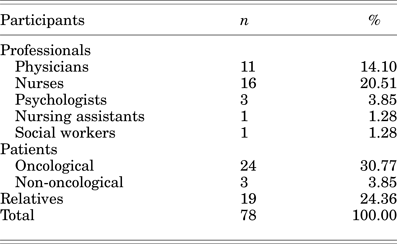
From a total of 37 professionals consulted, 32 agreed to participate. Some 19 of 27 patients and families also did. The total number of participants was 78, including patients, family caregivers, and professionals, from three different units: a home care unit, a continued care unit, and a long-stay hospital. Participant characteristics are presented in Table 1.
Participants in step 1

The items were created taking into account participants' answers to the following questions:
1. What does dignity represent for you?
2. Mention three words related to dignity at the end of life.
3. Give an example of a dignified attitude at the end of life.
4. Which are the conveniences or benefits of dignity? Why?
5. Which are the inconveniences or weak points of dignity? Why?
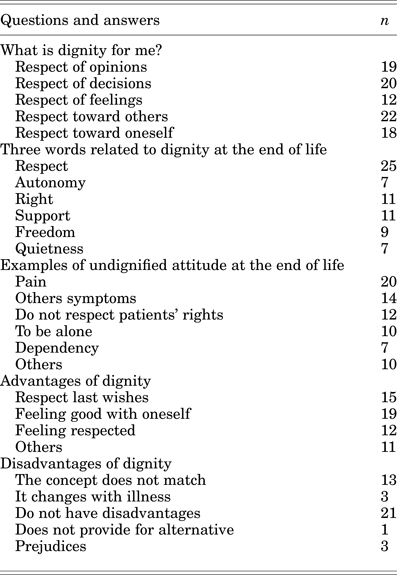
Once categorization of patients, family, and professionals' answers was accomplished, the frequencies for each category were calculated (see Table 2).
Categorization of answers to open questions on dignity concept
As can be seen in Table 2, dignity was defined in the context of four basic categories:
• As an attitude, that is to say, as a stance or intention with several orientations. In some cases, it was seen as an attitude oriented toward the individual; in others, toward the society; and in others, toward the values of life.
• As a quality—a virtue intrinsic to the person.
• As a right, as a human being and being related to others. Dignity was defined as a right to freedom and security. Negative expressions related to insecurity and difficulties in decision making were also mentioned.
• As well-being or hedonism—as a claim to pleasure or happiness as ultimate goals.
The categories that encompass the opinions of the participants were integrated in order to fulfill the individual's sense of identification. Our model was thus based on the verbalizations of patients, families, and professionals, expressed in both positive and negative ways: dignity was expressed as preserved or lost, respected or threatened. Within this approach, any personal expression related to the values, beliefs, attitudes, experiences, and circumstances of the individual can be expressed.
Step 2. Pilot Project
Based on our results, and following Chochinov and colleagues' model (Chochinov, Reference Chochinov2002; Chochinov et al., Reference Chochinov, Hack and Hassard2002a), we developed a measurement instrument assessing dignity preservation and threat at the end of life. We took into account the following premises:
• It had to be brief, and it had to examine patients' comfort and try to avoid burden with test administration.
• Its goals had to be easy to follow.
• Its items and response options were to be easy to understand, so that people with different cultural backgrounds could have access to them.
• It had to serve health professionals with different disciplinary affiliations.
As regards its length, a maximum of 10 items were proposed: 3 for the attitude approach; 3 for quality; 2 for rights; and 2 for well-being. The distribution was made taking into account the proportion of expressions gathered. Both positive and negative expressions were included, covering the two main approaches to dignity that arose in step 1: its preservation and its threat. The items were drafted following the structure of the statements that patients, families, and professionals had expressed in the exploratory study.
Some 20 palliative care patients were surveyed with this pilot questionnaire. The mean age was 65.25 years old; 55% were women and 85% oncological patients. As patients expressed comprehension difficulties with 2 of the 10 items, they were removed.
Step 3. Testing of the Psychometric Properties
Design, Procedure and Sample
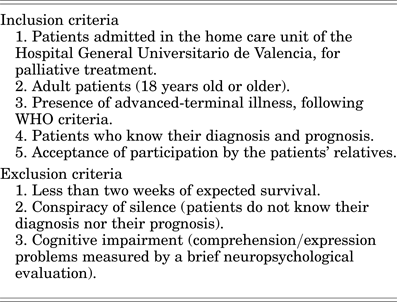
This step was conducted with palliative care patients admitted to a home care unit. After obtaining permission from the Research and Ethical Committee of the Hospital General Universitario de Valencia Foundation and the Ethics Committee on Human Research of the University of Valencia, a survey design was adopted. The survey had two parts. In the first, information on diagnosis and prognosis was included, so as to check the inclusion and exclusion criteria (see Table 3). The second, which was formed using the new questionnaire together with other scales related to dignity and quality of life at the end of life.
Inclusion and exclusion criteria
From a total of 80 patients, 70 met the inclusion criteria and made up the final sample. The mean age was 70.21 (SD = 12.55); 60% of the sample were men; 78.6% were married, 12.9% widowed, and 8.6% single; 78.60% were oncological patients.
Instruments
Together with sociodemographic data, information on the following scales was gathered:
1. Palliative Patients' Dignity Scale (PPDS; Cuestionario de Dignidad en Cuidados Paliativos, CED–PAL). As explained, the final version of the instrument was composed of eight items, measuring two factors: the perception of dignity preservation, understood as feeling respected by others, respecting oneself, quality in a sense of intrinsic virtue to the “personhood” right to security and peace; and dignity threat or loss, seen as feelings of insecurity and values violation, lack of support, or depletion of feeling “as a person.” Answers scored on a Likert-type scale ranged from 0 (nothing) to 9 (a lot). The psychometric properties of the instrument are reported within the manuscript. The scale can be consulted in Appendix 1.
2. The Patient Dignity Inventory (PDI; Chochinov et al., Reference Chochinov, Hassard and McClement2008). This instrument was designed to identify several sources of distress in patients at the end of life. We used the Spanish version (Martínez-García et al., Reference Martínez-García, Rullán and Centeno2013). The scale is composed of 25 items, assessing 5 dimensions: symptom distress, existential distress, dependency, peace of mind, and social support. The individual indicates his/her degree of concern on a 5-point Likert-type scale, from 1 (not a problem) to 5 (an overwhelming problem). The values of Cronbach's alpha were 0.89, 0.84, 0.71, 0.63, and 0.70, respectively.
3. The Hospital Anxiety and Depression Scale (HADS; Zigmond & Snaith, Reference Zigmond and Snaith1983). This scale was designed to measure anxiety and depression in patients with comorbid physical illness. It is composed of 14 items, 7 for each dimension. Responses range from 0 (never) to 3 (almost all day). We utilized the Spanish version (Quintana et al., Reference Quintana, Padierna and Esteban2003). The values of alpha were 0.73 for the anxiety subscale and 0.45 for the depression subscale. Because of the lower reliability obtained for the depression factor, this subscale was not included in the analyses.
4. The Brief Resilient Coping Scale (BRCS; Sinclair & Wallston, Reference Sinclair and Wallston2004). This scale measures resilience with four items. It has been validated in Spain (Tomás et al., Reference Tomás, Sancho and Melendez2012) and previously used in palliative care studies (Benito et al., Reference Benito, Oliver and Galiana2014). Items were rated on a 5-point Likert-type scale, from 1 (totally agree) to 5 (totally disagree), with higher scores reflecting greater resilience. Its internal consistency was 0.92.
5. Two items of the EORTC Quality of Life C-30 (EORTC–QLQ–C30; Bjordal et al., Reference Bjordal, de Graeff and Fayers2000). Only two items of the Global Health Subscale were used: “How would you rate your overall health during the past week?” and “How would you rate your overall quality of life during the past week?” As palliative care patients undergo inevitable physical deterioration, the other dimensions related to increased or decreased symptoms have been proved to be always negative and are thus not a good indicator of a patient's quality of life (Chochinov et al., Reference Chochinov, Hassard and McClement2008). These two items are score on a 7-point Likert-type scale, ranging from 0 (very poor) to 7 (excellent). Its value for Cronbach's alpha was 0.85.
6. The GES Questionnaire (Benito et al., Reference Benito, Oliver and Galiana2014). Originally developed in Spanish, this scale includes six open questions, followed by eight items that assess a general dimension of spirituality, as well as three subscales: intrapersonal, interpersonal, and transpersonal spirituality. The scores for these eight items ranged from 0 (nothing) to 4 (a lot). The value of Cronbach's alpha for this was 0.85.
7. The Duke–UNC-11 Functional Social Support Questionnaire (Broadhead et al., Reference Broadhead, Gehlbach and Degruy1988). This instrument assesses two dimensions of social support: confidential support (received from people to whom the patient can communicate intimate feelings) and affective support (received from those who express positive empathy to patients). Each item scored was on a 5-point Likert-type scale, from 1 (much less than I would like) to 5 (as much as I would like). Its internal consistency was 0.93 for the confidential support dimension and 0.80 for the affective dimension.
Statistical Analyses
Descriptive statistics were calculated. Moreover, several reliability estimations were offered: Cronbach's alpha, the rho coefficient, and the greatest lower bound (GLB). Although alpha is the internal consistency coefficient used most often (considered moderate with values between 0.70 and 0.79, and high with values of 0.80 or above; Cicchetti, Reference Cicchetti1994; Clark & Watson, Reference Clark and Watson1995), other indices like rho and GLB are recommended for scales with a limited number of indicators. Test–retest reliability was also calculated, within a temporal break of 3 to 4 weeks. The behavior of the items was also studied.
In order to assess the factorial structure of the scale, a structural model was estimated and tested. Specifically, a confirmatory factor analysis, based on the two dimensions previously obtained in the pilot project, was estimated. The estimation method used was maximum likelihood (ML), the standard method employed with data meeting the multivariate normality criteria (Mardia <1.75). In order to assess the model's fit, several criteria were used (Hu & Bentler, Reference Hu, Bentler and Hoyle1995; Tanaka, Reference Tanaka, Bollen and Long1993): (1) a chi-square statistic, with a nonstatistically significant value indicating a good fit (Kline, Reference Kline2011); (2) the Comparative Fit Index (CFI), indicating an adequate fit with values above 0.90 (and ideally greater than 0.95) (Hu & Bentler, Reference Hu, Bentler and Hoyle1995); (3) the Goodness-of-Fit Index (GFI), also with values above 0.90 for a good fit (Tanaka, Reference Tanaka, Bollen and Long1993); (4) the standardized root-mean-square residual (SRMR), with values lower than 0.08 considered indicators of goodness of fit (Hu & Bentler, Reference Hu, Bentler and Hoyle1995); and (5) the root-mean-square error of approximation (RMSEA), with values of 0.05 or less indicating good fit (Bentler, Reference Bentler1990). To this global fit, the significance of each of the relations proposed in the model was tested, offering information on what is known as analytical fit.
Convergent validity was studied through correlations among the dimensions of the Palliative Patients' Dignity Scale and the Patient Dignity Inventory, and external or nomological validity as well, through correlations among the scale and other constructs theoretically related to dignity at the end of life. Finally, to propose a cutoff point in PPDS scores for screening purposes, contingency tables were calculated. Dichotomous clinical anxiety and quality-of-life variables were employed as scores to explore the capabilities of the PPDS. Taking into account that HADS questionnaire scores in anxiety over 7 are considered indicative of psychopathology (Zigmond & Snaith, Reference Zigmond and Snaith1983), this was the cutoff criteria chosen for anxiety. In terms of quality of life, a score of 4 is in the medium range of the scale, and so it was used as a cutoff criterion. A score of 3 or lower in quality of life, then, was indicative of a negative perception of quality of life. This score was used to suggest which patients might have dignity issues with which to work.
RESULTS
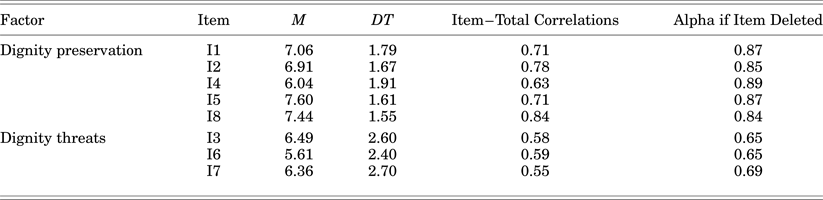
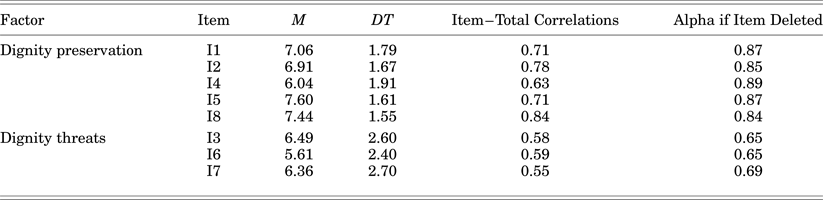
The estimations related to the internal consistency of the scale were appropriate for both dimensions: preservation of dignity obtained a Cronbach's alpha of 0.89, a value of rho of 0.89, and a GLB score of 0.94; and threats to dignity an α of 0.75, a rho of 0.75, and a GLB of 0.75. The test–retest reliability values were 0.52 and 0.32 for the dignity preservation and the dignity threat dimensions, respectively. It is worth noting that this scale also aims to monitor intervention effects on dignity. These test–retest results should be interpreted in the context of an intervention, as a sensitive trait of the measure. Table 4 presents the means and standard deviations for the items, item–total correlations, and values of alpha when an item is removed for the two dimensions of the scale. The results were adequate, with no items showing any anomalous behavior.
Means, standard deviations, inter-total correlations, and values of alpha if item deleted for the CED–PAL items
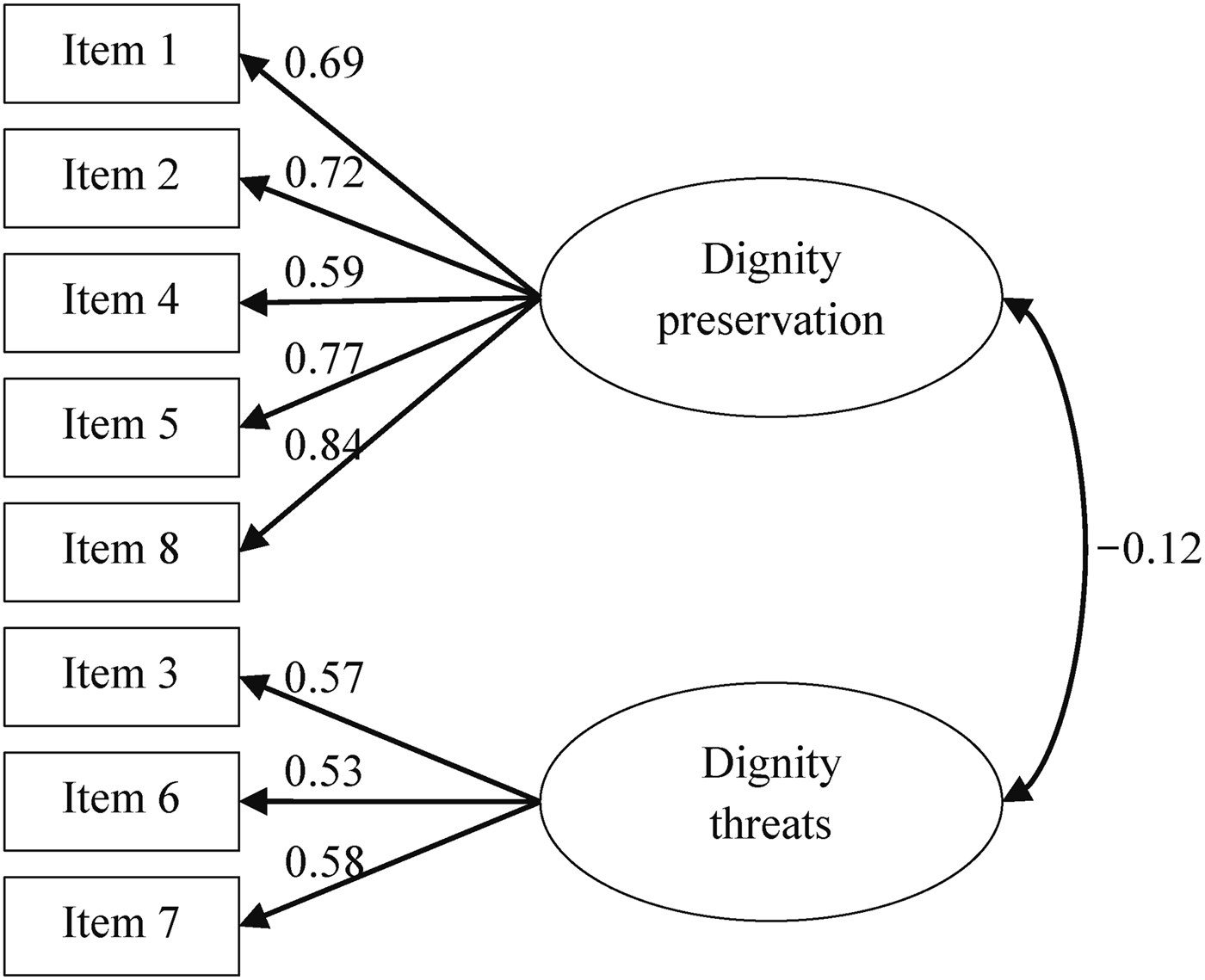
Confirmatory factor analysis results also showed an appropriate fit for the model: χ2(19) = 21.43, p = 0.31, CFI = 0.99, GFI = 0.92, SRMR = 0.07, and RMSEA = 0.04—all of the criteria with values in accord with the literature. The analytical fit was also good, with all factorial loadings being statistically significant (see Figure 1).
Analytical fit of the confirmatory factor analysis. Note that all the factor loadings were statistically significant, but not the correlation between latent factors.
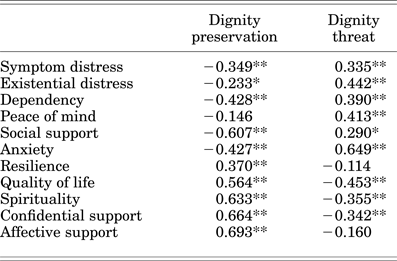
The correlations between the two dimensions of the new questionnaire and the dimensions of the PDI and the rest of the scales included in our study were in the expected direction, as is shown in Table 5.
Correlations among dignity dimensions and other related variables
Note. *p < 0.05, **p < 0.01.
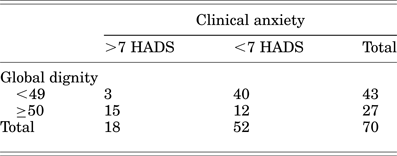
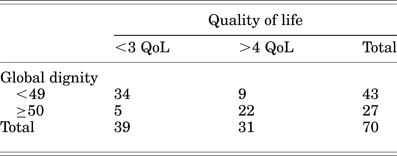
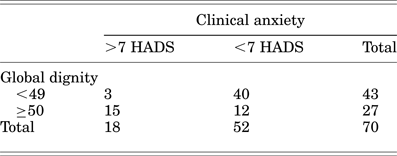
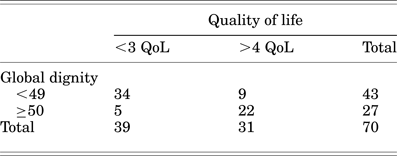
Additionally, chi-square tests revealed a cutoff criteria of 50 on the overall scale (calculated with the sum of the scores for the preservation dignity items and the scores for dignity threats, after being reversed). This score represented the 65th percentile. Our results showed a significant association between groups with low versus high dignity and low versus high anxiety (χ 2(1) = 20.49, p < 0.001, ϕ = 0.541) (Table 6). In the case of quality of life, the association was also significant (χ 2(1) = 24.65, p < 0.001, ϕ = 0.593) (Table 7). It appears that patients scoring under 50 on the PPDS were those more likely to suffer anxiety or poor perception of quality of life.
Contingency table: Total dignity on the CED–PAL vs. anxiety
Contingency table: Total dignity on the CED–PAL vs. quality of life
DISCUSSION
In the context of palliative home care, our new measure, the Palliative Patients' Dignity Scale (PPDS) (Cuestionario de Dignidad en Cuidados Paliativos, or CED–PAL in Spanish), has been developed, taking as a starting point analyses of dignity conceptions expressed by palliative care patients, these patients' relatives, and professionals (physicians, nurses, and psychologists). From these expressions, ideas of preservation and threat to or loss of dignity emerged in many aspects. These ideas supported previous research, mainly based on palliative care professionals (Periyakoil et al., Reference Periyakoil, Noda and Kraemer2010; Turner et al., Reference Turner, Chye and Aggarwal1996). Although palliative patients' self-perceptions of dignity at the end of life have been examined in the literature (Lynn, Reference Lynn1997; Singer et al., Reference Singer, Martin and Kelner1999; Stewart et al., Reference Stewart, Teno and Patrick1999), it was Chochinov's (Reference Chochinov2012) dignity therapy that built an integrative model of patients' needs in the context of palliative care.
Our model was developed in the context of the PDI measure (25 items). Taking this measure as a starting point, we tried to go further, attending to such issues as briefness, use of confirmatory procedures, and adaptation to a different psychosocial context. A new measure of perception of dignity preservation and threat in palliative care patients has thus been developed and validated in the home care context. The PPDS (CED–PAL) is formed from eight 8 items that are scored on a Likert-type scale, measuring two dimensions: preservation and dignity. Within this manuscript, evidence on its appropriate internal consistency, test–retest reliability, and factorial structure has been offered. The self-evident two-dimensional structure was thus supported.
As regards the comparability of our results, the sample matches for age, marital status, and study level of populations the other studies based on psychological and dignity intervention in palliative care patients (Chochinov et al., Reference Chochinov, Hassard and McClement2008; Chochinov, Reference Chochinov2012). This fact, together with the good reliability of the measure, does not make the sample size a limitation, because, as Iacobucci (Reference Iacobucci2010) has pointed out, if the variables are reliable, the effects are strong, and the model is not overly complex, so that smaller samples will suffice (Bearden et al., Reference Bearden, Sharma and Teel1982; Bollen, Reference Bollen1989).
Evidence regarding convergent and criterial validity was also appropriate. Whereas the dimension of dignity preservation was positively related to the five factors of the PDI (and statistically significant for all, except the peace-of-mind dimension), the threats-to-dignity dimension was positively and statistically related to symptom and existential distress, dependency, and absence of peace of mind and social support. Along the same lines, high levels of dignity preservation with the PPDS were related to high resilience, good quality of life, spirituality, and confidential and affective support, and to lower levels of anxiety, in accord with the previous literature (Barreto et al Reference Barreto, Fombuena and Diego2013; Chochinov et al., Reference Chochinov, Hassard and McClement2009; Edmondson et al., Reference Edmondson, Park and Blank2008; NCCN, 2013; Peterman et al., Reference Peterman, Fitchett and Brady2002). Finally, the suggested cutoff point, which could be used to detect patients with dignity needs, is one of the advantages of this new dignity measure.
In conclusion, our results point to the appropriate properties of the PPDS when used to assess dignity in home care patients. Potential uses of this new measure will include monitoring psychotherapeutic dignity interventions. Previous research supports the effectiveness of intervention-based therapy in counseling for dignity, and suggests that our new measure may be useful in diagnosis and intervention (Arranz & Bayés, 2000; Arranz & Cancio, Reference Arranz, Cancio and Gil2000; Barreto et al., Reference Barreto, Saez and Saavedra2010; Chochinov, Reference Chochinov2006; Chochinov et al., Reference Chochinov, Hack and Hassard2002a; Reference Chochinov, Hack and Hassard2005; Reference Chochinov, Kristjanson and Hack2006). In our context, there is already evidence of the sensitivity of the PPDS in quantifying reduction of anxiety and distress, a better quality of life, and a better perception of social support (Rudilla et al., Reference Rudilla, Barreto and Oliver2015).
However, our study does have some limitations. Searching for practical or clinical context application, we developed a brief measure that perhaps would not fulfill some research requirements that could be addressed in longer-term research and with more well-established measures, especially when working with the complex and diverse construct of dignity at the end of life.
FUNDING
This research received no specific grant from any funding agency in the public, commercial, or not-for-profit sector.
APPENDIX 1. PPDS (CED–PAL) items in English and Spanish