




Introduction
Across prehistoric Europe, spindle whorls varied in shape, size and weight. These differences have been linked to different functions (e.g. spinning and plying), the use of different fibres (e.g. plant bast and wool) and distinct cultural traditions. In this article, we characterise assemblages of spindle whorls from two fourth-millennium BC sites using morphometric variables, and then compare these to a wider dataset of spindle whorls in order to tease apart the technological and cultural considerations.
Thread—the processed strands of plant or animal fibre employed for making textiles—is made using several different techniques. A common thread-making method uses a symmetrical spindle whorl to weigh down a spindle stick, providing steady rotation and tension for twisting the fibres. Spinning a thin, tight thread or fibres with shorter staple lengths, such as wool, requires faster rotation; this is achieved with lighter whorls with smaller diameters and greater height. Spindle whorls of larger dimensions facilitate slower rotation, which is more suitable for the production of thicker threads or the spinning of fibres with longer staple lengths, such as flax (Barber Reference Barber1991: 52). Another thread-making technique, using only the fingers, was practised in Central Europe in the fourth millennium BC (Rast-Eicher & Dietrich Reference Rast-Eicher and Dietrich2015: 34). Known as ‘splicing’, this technique, which was unsuitable for short plant fibres and animal hair, was used for making thread from various plant bast materials (Leuzinger & Rast-Eicher Reference Leuzinger and Rast-Eicher2011; Gleba & Harris Reference Gleba and Harris2019: 2342).
The production of yarn in Neolithic Europe usually involved the joining of two spliced threads (Gleba Reference Gleba2014). This method, known as ‘plying’, could be performed—like spinning a thread—with a spindle whorl, but this was not essential. Consequently, spindle whorls could be used for multiple purposes: spinning a thread, imparting twist to a (hand)spliced yarn to make it more stable, or to ply together spliced threads (Gleba & Harris Reference Gleba and Harris2019: 2341).
Slower rotating, flat whorls were commonly used for plying spliced threads made of plant fibres (Gleba & Harris Reference Gleba and Harris2019: 2341), which were basic materials during the Neolithic in the pre-Alpine region, the area between the Swiss plateau and the northern side of the Alps (Rast-Eicher Reference Rast-Eicher, Bichler, Grömer, Keijzer, Kern and Reschreiter2005). In contrast, the use of spindle whorls of greater height, such as conical whorls, is commonly taken to indicate the processing of fibres such as animal wool that have shorter staple lengths, and which therefore require faster rotation (Rast-Eicher Reference Rast-Eicher, Bichler, Grömer, Keijzer, Kern and Reschreiter2005: 127; Chmielewski & Gardyński Reference Chmielewski and Gardyński2010: 876; Grabundžija & Russo Reference Grabundžija and Russo2016: 313).
Previous research on fourth-millennium BC spindle whorls suggests that their morphometric and function-related variables are ‘culture’ specific (Grabundžija Reference Grabundžija, Siennicka, Rahmstorf and Ulanowska2018a). Research on Central and East-Central Europe, for example, has connected the appearance of the conical whorl with the so-called ‘Badenization’ process, whereby various traits of the Eneolithic Baden Culture spread north and west (Przybył Reference Przybył, Nowak and Zastawny2015: 482). These conical spindle whorls point simultaneously to wool-bearing sheep husbandry and the cultural influence of the Boleráz/Baden phase of the Baden Culture. In this article, we compare spindle whorls from two distant regions, the pre-Alpine region and East-Central Europe, using morphometric analysis of shape and size to assess possible differences in the contemporaneous thread-making technologies and to identify two plausible scenarios for cultural/technological transfer. The results clearly indicate the existence of two geographically distinct technologies and suggest wider cultural contacts.
The pre-Alpine dataset
Dendrochronology and radiocarbon dating can reveal the duration of wetland settlements with high accuracy (e.g. Leuzinger & Rast-Eicher Reference Leuzinger and Rast-Eicher2011; Maier & Schlichtherle Reference Maier and Schlichtherle2011; Ruoff & Seifert Reference Ruoff and Seifert2018). Such research suggests that many Neolithic settlements in the pre-Alpine area were inhabited for a maximum of 20 years. The site at Bad Buchau-Torwiesen II in the Federsee bog in southern Germany, for example, comprised 15 houses constructed between 3283 and 3279 BC; after less than ten years, the site was abandoned (Schlichtherle Reference Schlichtherle, Schlichtherle, Vogt, Maier, Schmidt, Ismail-Meyer, Kühn and Wick2011: 20). At Arbon-Bleiche 3 on Lake Constance in north-eastern Switzerland, one-third of the settlement has been investigated, with 27 houses identified. Construction began in 3384 BC and the settlement burnt down in 3370 BC (Jacomet & Leuzinger Reference Jacomet, Leuzinger, Jacomet, Leuzinger and Schibler2004: 33).
Artefacts and ecofacts recovered from both settlements (Table 1) reveal several technological innovations. At Arbon-Bleiche 3, trace marks on cattle bones suggest their use as draught animals, while isotopic analyses of these bones indicate transhumance (Gerling et al. Reference Gerling, Doppler, Heyd, Knipper, Kuhn, Lehmann, Pike and Schibler2017), and a charred wooden object represents the oldest known yoke found in Central Europe (Leuzinger Reference Leuzinger, Köninger, Mainberger, Schlichtherle and Vosteen2002a). An intra-site distribution pattern of animal remains provides evidence for distinct subsistence traditions and dietary habits, suggesting cohabitation of culturally diverse groups (Marti-Grädel et al. Reference Marti-Grädel, Deschler-Erb, Hüster Plogmann, Schibler, O'Day, Neer and Ervynck2004: 175; Doppler Reference Doppler2013). At Bad Buchau-Torwiesen II, variation in house size and building timber quality and a diversity of cultivated plants per household suggest socio-economic heterogeneity (Schlichtherle et al. Reference Schlichtherle, Bleicher, Dufraisse, Kieselbach, Maier, Schmidt, Stephan, Vogt, Classen, Doppler and Raminger2010).
Investigated archaeological sites in the pre-Alpine and East-Central European areas, listed from west to east.

Spindle whorls from both sites (Leuzinger Reference Leuzinger, de Capitani, Deschler-Erb, Leuzinger, Marti-Grädel and Schibler2002b: 115; Schlichtherle Reference Schlichtherle, Schlichtherle, Vogt, Maier, Schmidt, Ismail-Meyer, Kühn and Wick2011: 24) were mapped according to shape. At Buchau-Torwiesen II, 94 whorls—around 40 per cent of which are complete—were left behind when the site was abandoned. At Arbon-Bleiche 3, which was destroyed by fire, 411 whorls and 24 loom weights were preserved (Leuzinger Reference Leuzinger, de Capitani, Deschler-Erb, Leuzinger, Marti-Grädel and Schibler2002b; Leuzinger & Rast-Eicher Reference Leuzinger and Rast-Eicher2011: 540). The ceramic assemblages include forms and decorations typical of the Boleráz/Baden Culture. As this pottery was produced using local clays, however, it seems likely that they were made at the site by immigrants from the Middle Danube region (de Capitani Reference de Capitani, de Capitani, Deschler-Erb, Leuzinger, Marti-Grädel and Schibler2002: 209–16).
Textiles made of tree bast were recovered from both sites (Leuzinger Reference Leuzinger, de Capitani, Deschler-Erb, Leuzinger, Marti-Grädel and Schibler2002b: 122–34), while textiles of linen (Linum usitatissimum L.) were preserved only at Arbon-Bleiche 3. Threads, strings and ropes (n = 74) from Arbon-Bleiche 3 were exclusively made of lime bast, apart from one specimen made from grasses (Leuzinger Reference Leuzinger, de Capitani, Deschler-Erb, Leuzinger, Marti-Grädel and Schibler2002b: 123). These threads, strings and ropes were single, double or triple plied, and of varying thicknesses (0.7–21mm) (Leuzinger Reference Leuzinger, de Capitani, Deschler-Erb, Leuzinger, Marti-Grädel and Schibler2002b: 123–25). Some were found attached to the handles of ceramic jars (Leuzinger Reference Leuzinger, de Capitani, Deschler-Erb, Leuzinger, Marti-Grädel and Schibler2002b: 127), while one specimen was wound around a wooden spindle and another—a preserved fishing line—was still attached to a bone hook (Leuzinger Reference Leuzinger, de Capitani, Deschler-Erb, Leuzinger, Marti-Grädel and Schibler2002b: 125–26). Other objects made of tree bast, such as baskets and pieces of twined and woven cloth, were also recovered. Only two fragments of plain weave were identified as being made from linen (Leuzinger Reference Leuzinger, de Capitani, Deschler-Erb, Leuzinger, Marti-Grädel and Schibler2002b: 134). The textiles from Bad Buchau-Torwiesen II are currently unpublished.
Flax (Linum usitatissimum L.) played an important role at both settlements (Hosch & Jacomet Reference Hosch, Jacomet, Jacomet, Leuzinger and Schibler2004: 112–13; Maier Reference Maier, Schlichtherle, Vogt, Maier, Schmidt, Ismail-Meyer, Kühn and Wick2011). Archaeobotanical studies indicate the cultivation of a small-seeded flax variety, probably for fibre production (Herbig & Maier Reference Herbig and Maier2011; Karg et al. Reference Karg, Diederichsen, Jeppson, Siennicka, Rahmstorf and Ulanowska2018). Evidence indicating the breaking of flax stems for extracting fibres was detected at both settlements (Hosch & Jacomet Reference Hosch, Jacomet, Jacomet, Leuzinger and Schibler2004: 124–25). The spatial distribution of linen seeds at Bad Buchau-Torwiesen II indicates variation in use between houses, suggesting that flax processing was regimented among households (Schlichtherle et al. Reference Schlichtherle, Bleicher, Dufraisse, Kieselbach, Maier, Schmidt, Stephan, Vogt, Classen, Doppler and Raminger2010; Maier & Schlichtherle Reference Maier and Schlichtherle2011: 575).
The ceramic finds from Bad Buchau-Torwiesen II belong to the early Horgen, a regional Neolithic culture that lasted roughly between 3400 and 2850 BC (Schlichtherle Reference Schlichtherle, Schlichtherle, Vogt, Maier, Schmidt, Ismail-Meyer, Kühn and Wick2011: 11), although exotic ceramic forms can be attributed to the Boleráz/Baden Culture. As at Arbon-Bleiche 3, the spindle whorls are also linked to this cultural influence from the Danube region (Schlichtherle Reference Schlichtherle, Schlichtherle, Vogt, Maier, Schmidt, Ismail-Meyer, Kühn and Wick2011: 24).
The East-Central European dataset
We analysed 398 whorls from 20 East-Central European sites covering the region from the northern slopes of the Central Balkan Mountains in the south to the Danube River in the east, and to the foothills of the Carpathian Mountains and the Alps in the north and west. The sites are spread across the southern parts of the Pannonian Plain, including modern Slovenia, southern Hungary, northern and eastern Croatia and northern Serbia (Table 1). The fourth-millennium BC spindle whorls from East-Central Europe form part of a larger textile tool database previously collated during an Excellence Cluster Topoi PhD research project (Becker et al. Reference Becker, Graßhoff and Meyer2016). The complete catalogue of finds contains 1048 textile tools dated to between the fifth and the second millennia BC and is available online (Grabundžija Reference Grabundžija2020); analysis of the material is published elsewhere (Grabundžija & Russo Reference Grabundžija and Russo2016; Djurdjevac Conrad et al. Reference Djurdjevac Conrad2018; Grabundžija Reference Grabundžija, Siennicka, Rahmstorf and Ulanowska2018a & Reference Grabundžija, Balen, Miloglav and Rajkovićb).
This heterogeneous fourth-millennium BC East-Central European spindle-whorl dataset is attributed to six regional and supra-regional Eneolithic cultural contexts: Furchenstich, Retz-Gajary, Proto-Boleráz, Boleráz, Baden and Kostolac. To date, these cultural groups have been defined on the basis of similarities in ceramic production (Raczky Reference Raczky and Kovács1995), and have hitherto rarely been approached in relation to other cultural considerations, such as economy, settlement patterns or burial practice. The Middle Eneolithic sample consists of finds from various sites of the so-called Furchenstich and Retz-Gajary horizon in Slovenia, Croatia and Hungary: Kalinovnjek pri Turnišu, Turnišče, Pod Kotom-jug pri Krogu, Tolna-Mözs Kenderföldek-dűlő, Čeminac-Vakanjac, Ivandvor, Jagodnjak-Napuštene njive and Josipovac Punitovački-Veliko polje. This horizon represents the transition to the Late Eneolithic, and much of the horizon's distinctive ceramic assemblage is assigned to the earliest Late Eneolithic period (i.e. the Proto-Boleráz phase; Kalicz & Horváth Reference Kalicz, Horváth, Šuteková, Pavúk, Kalábková and Kovár2010).
Here, we focus on the Late Eneolithic period, during which three consecutive and partly contemporaneous cultural horizons—the Boleráz, Baden and Kostolac—can be identified. Radiocarbon dates place the Retz-Gajary Culture between 3950/3900 and 3600/3500 BC (Balen Reference Balen2008: 20). Its end is concurrent with the appearance of the Boleráz group, although these two cultures probably briefly existed contemporaneously (Velušček Reference Velušček2004: 260–62; Balen Reference Balen2008: 20). The Furchenstich group in Transdanubia (modern-day Hungary) (Raczky Reference Raczky and Kovács1995: fig. 1) and Slovenia (Velušček Reference Velušček2004: 295) is broadly contemporaneous, dating to between 3850 and 3600/3500 BC. In absolute chronological terms, the Proto-Boleráz and Boleráz cannot be separated, as radiocarbon dates place them in the same timespan, dating the Proto-Boleráz Culture to between 3750 and 3300 BC and the Boleráz Culture to between 3700 and 3350 BC (Wild et al. Reference Wild2001: 1062). The core area of the Baden Culture in South-eastern Europe dates to between 3360 and 2995 BC, while its late (IV) phase persisted to c. 2800 BC (Horváth et al. Reference Horváth, Svingor and Molnár2008: 453–54).
In the previously accepted chronology (Němejcová-Pavúková Reference Němejcová-Pavúková1991), the Boleráz group was interpreted as an early stage in the development of the Baden Culture and an independent cultural group that was a part of the Cernavoda III cultural complex. Radiocarbon dating, however, has now shown that it pre-dates the Cernavoda III phase, which is actually synchronous with the later Baden Culture (Wild et al. Reference Wild2001: 1062–63). This new dating has prompted theories about the Boleráz Culture originating in Lower Austria/Moravia/Slovakia/western Hungary, from where it spread to the south-east (Stadler et al. Reference Stadler, Draxler, Friesinger, Kutschera, Priller, Rom, Steirer, Wild, Roman and Diamandi2001: 544; Wild et al. Reference Wild2001). The Kostolac Culture dates to between 3300 and 2700 BC, its onset being contemporaneous with the Baden Culture and its end overlapping with the Vučedol Culture (Balen Reference Balen2011). It probably developed under the influences of the Baden Culture on local Neolithic populations in eastern Slavonia and Syrmia (Dimitrijević Reference Dimitrijević and Benac1979: 230).
Methods for comparing thread-production technologies
Around half of the spindle-whorl assemblage (55 per cent) relates to a variety of cultural and chronological contexts from across the Pannonian Plain region. The remaining 45 per cent are attributed to the early Horgen Culture, which relates to a smaller area and a shorter timespan (Figure 1: top).
Top) spindle-whorl counts per type according to culture-historical attribution; bottom) main spindle-whorl types recorded in the fourth-millennium BC assemblage: A) biconical; B) conical; C) convex; D) cylindrical; E) spherical; F–G) flat (discoid and lenticular) (figure by A. Grabundžija).

The recording protocol for the pre-Alpine and East-Central European datasets was adopted from the methods established by the Centre for Textile Research in Copenhagen. We measured the diameter, height and weight of all the whorls. Subsequently, the weight:diameter and height:diameter ratios were calculated. The height:diameter ratio, together with the weight, affects the inertia of a whorl: taller tools have a higher height:diameter ratio and therefore spin faster (Chmielewski & Gardyński Reference Chmielewski and Gardyński2010; Verhecken Reference Verhecken, Andersson Strand, Gleba, Mannering, Munkholt and Ringgaard2010). Whorls included in the comparative analysis (n = 731) were either complete or preserved in half (in the latter cases, we calculated weight by doubling the weight of the extant half). Other, unevenly fragmented examples were not included in the analysis due to a more complicated weight calculation.
Whorls from Arbon-Bleiche 3 and Bad Buchau-Torwiesen II were also analysed for spatial clustering according to their shape. Published whorl typologies for these two sites were consolidated by establishing two main categories: various conical subtypes, such as ‘Trompetenmundstück-förmig’ (Leuzinger Reference Leuzinger, de Capitani, Deschler-Erb, Leuzinger, Marti-Grädel and Schibler2002b: 116) or ‘Trichter-förmig’ (Schlichtherle Reference Schlichtherle, Schlichtherle, Vogt, Maier, Schmidt, Ismail-Meyer, Kühn and Wick2011: 24), were classified as conical whorls, while lenticular- and discoid-shaped specimens were classified as flat whorls (Figure 1: bottom).
Gleba and Harris (Reference Gleba and Harris2019: 2341) suggest that discoid- and lenticular-shaped Neolithic spindle whorls were particularly suitable for plying due to their slow but continuous rotation, connecting the appearance of other, taller whorl shapes during the Bronze Age with the adoption of woollen textiles. With this in mind, we examined the distribution of the conical and flat whorls for any spatial correlation with other archaeological evidence from the two pre-Alpine wetland sites (de Capitani Reference de Capitani, de Capitani, Deschler-Erb, Leuzinger, Marti-Grädel and Schibler2002: 217; Schlichtherle Reference Schlichtherle, Schlichtherle, Vogt, Maier, Schmidt, Ismail-Meyer, Kühn and Wick2011: 24). We also performed a multivariate discriminant analysis on the complete whorl assemblage to test the degree to which whorls can be assigned to a particular cultural group based only on metric properties (i.e. height, weight).
Results
The variation in whorl height and weight (Figure 2: top) demonstrates distinct clustering associated with different culture-historical groups. The material from the pre-Alpine dataset differs greatly from the Pannonian Plain material. Most (>80 per cent) of the pre-Alpine examples weigh less than 40g, and their height:diameter ratio values are mostly uncorrelated with the weight. Thus, whorls of similar weight vary considerably in their height. Plotting the weight and diameter parameters (Figure 2: bottom) also reveals a notable standardisation of whorl diameters at the pre-Alpine wetland sites. Whorls with smaller diameter values (<50mm) relate predominantly (>75 per cent of all recorded whorls) to the Horgen Culture.
Spindle whorls per culture-historical attribution (n = 731): top) distribution of weight (x) and height:diameter ratio (y) values; bottom) distribution of weight (x) and diameter (y) values (figure by A. Grabundžija).

These distinct differences in whorl size and proportion prompted the application of a multivariate discriminant analysis, using height, diameter, height:diameter ratio, weight and perforation diameter as metric variables (Figure 3). The first discriminant function, accounting for 90.6 per cent of the total variance, shows high correlation with weight and height (r>0.8) and moderate correlation with the other variables (r~0.5). The second discriminant function, accounting for only 7.1 per cent of the variance, reflects predominantly the diameter and the perforation diameter of the whorls. Both functions display the culturally classified whorls in an almost parabolic shape (Figure 3). In the left half of the plot, the Horgen whorls group together with the Proto-Boleráz, Retz-Gajary and Furchenstich whorls, whereas the right half of the plot is dominated by Boleráz, Baden and Kostolac whorls. Based solely on the discriminant functions, almost 65 per cent of all whorls would be correctly classified according to their cultural attribution, but with notable differences: 95 per cent of all Horgen whorls would be correctly classified as Horgen based on their dimensions, while only 54 per cent of Baden whorls would be correctly classified as Baden. Based on the discriminant functions, however, some 50 per cent of the Furchenstich, 89 per cent of the Proto-Boleráz and 97 per cent of the Retz-Gajary whorls would be incorrectly classified as Horgen.
Linear discriminant analysis per culture-historical attribution (n = 731), using spindle-whorl height, diameter, the ratio of both, and the weight and perforation diameter as metric variables (figure by W. Schier).

Compared with the Pannonian Plain dataset (Figure 4), only the sample attributed to the Retz-Gajary group, along with some specimens attributed to the Baden Culture, resemble the whorls from the pre-Alpine wetland sites. Whorls assigned to Baden and Kostolac cultural contexts are the most diverse in the entire assemblage, suggesting that their thread production was based on a variety of fibre resources and/or produced a range of final products using several different techniques. Kostolac whorls are generally very heavy (>70 per cent weighing above 80g); 77 per cent of all investigated whorls weighing over 80g belong to the Kostolac tool sample. Very heavy whorls possibly indicate the spinning of long fibres and/or the production of thicker threads (Hochberg Reference Hochberg1979: 21; Barber Reference Barber1991: 52). Additionally, the use of another technique, such as plying thicker and durable yarns, or even practising a supported spinning technique (Grömer Reference Grömer, Bichler, Grömer, Keijzer, Kern and Reschreiter2005), could explain the weight and size of these particular whorls.
Spindle whorls per culture-historical attribution (n = 731): top) weight parameter mean and range values; bottom) height:diameter ratio parameter mean and range values (figure by A. Grabundžija).

The distribution of the Horgen Culture whorl weight and diameter parameters (Figure 5: top) more clearly reflects the above-mentioned diameter standardisation. Uncommon at Bad Buchau-Torwiesen II, heavier whorls (>40g) with diameter values over 50mm do appear at Arbon-Bleiche 3 (ten per cent of the site assemblage), indicating the production of some thicker threads at this site. At Bad Buchau-Torwiesen II and Arbon-Bleiche 3, the whorls typical of the local Horgen Culture demonstrate some variety in height and weight (Figure 5: bottom). Spinners at Bad Buchau-Torwiesen II used taller whorls than those at Arbon-Bleiche 3, as revealed by both the height parameter (height:diameter ratio) range and mean values (Figure 6: top). In particular, taller (height:diameter ratio >0.3), lighter whorls (<20g) were more common (25 per cent of the sample) at Bad Buchau-Torwiesen II than at Arbon-Bleiche 3 (only six per cent of the sample). The weight parameter range and mean values (Figure 6: bottom) show that the Bad Buchau-Torwiesen II whorls were more standardised (96 per cent of the whorls are <40g and 83 per cent have a diameter <50mm) when compared with the Arbon-Bleiche 3 whorls (90 per cent are <40g, and 66 per cent have a diameter <50mm). The lightest whorls were more commonly used for spinning or plying at Bad Buchau-Torwiesen II (>30 per cent of the whorls weighed <20g) than at Arbon-Bleiche 3 (<26 per cent of the whorls weighed <20g).
Horgen Culture spindle whorls (n = 333): top) distribution of weight (x) and diameter (y) values per site; bottom) distribution of weight (x) and height:diameter ratio (y) values per site (figure by A. Grabundžija).

Pre-Alpine spindle whorls (n = 333): top) height:diameter ratio parameter mean and range values per site; bottom) weight parameter mean and range values per site (figure by A. Grabundžija).

Whorls of different shape are not randomly distributed among the houses at Bad Buchau-Torwiesen II (Schlichtherle Reference Schlichtherle, Schlichtherle, Vogt, Maier, Schmidt, Ismail-Meyer, Kühn and Wick2011: 24). Conical forms were found in all parts of the settlement, but with the highest concentration in the three westernmost houses. This correlates with the houses with the highest concentrations of flax seed finds per litre of sediment (Schlichtherle et al. Reference Schlichtherle, Bleicher, Dufraisse, Kieselbach, Maier, Schmidt, Stephan, Vogt, Classen, Doppler and Raminger2010; Maier & Schlichtherle Reference Maier and Schlichtherle2011: 575). The same area of the settlement has also yielded Boleráz/Baden ceramics. Flat whorls are distributed across a much smaller area on the eastern side of the settlement, with only three specimens occurring in the western part (Figure 7).
Spatial distribution of different forms of spindle whorls at Bad Buchau-Torwiesen II (figure by A. Harwath & A. Kalkowski, Landesamt für Denkmalpflege im Regierungspräsidium Stuttgart).

Some parallels in whorl distribution can be observed with Arbon-Bleiche 3 (Figure 8). Although there is no clear division in the distribution of different shapes, conical forms were found in the locations with higher concentrations of Boleráz-/Baden-related ceramics, supporting the notion that Boleráz/Baden immigrants retained both cultural and technological practices. Unlike at Bad Buchau-Torwiesen II, flat whorls are more evenly distributed among the houses, and are not localised in particular areas. This suggests that alongside the distinct technological practices of the Boleráz/Baden immigrants at Arbon-Bleiche 3, all of the inhabitants of the site also simultaneously practised another spinning technique or exploited other types of fibres. Although a full discussion of Neolithic weaving technology will be presented elsewhere, it is notable that evidence for warp-weighted looms at Arbon-Bleiche 3 was recovered both from the houses with higher concentrations of Boleráz/Baden ceramics (i.e. houses 3, 4 and 14) and from buildings without any such ceramics (i.e. houses 10 and 20). Based on the spatial distribution of loom weights, weaving on a warp-weighted loom could not be solely assigned to either of the cultural groups at the site.
Spatial distribution of different forms of spindle whorls at Arbon-Bleiche 3 (figure by D. Mayer, Amt für Archäologie Thurgau).

Discussion
Compared with the contemporaneous East-Central European dataset, the high whorl frequency at the pre-Alpine sites indicates a more advanced thread production. The levels of standardisation and the intra-site spatial organisation of the spinning/plying processes support this argument. Along with the archaeobotanical remains, preserved textiles at the wetland sites confirm that plant fibres were a staple material for textile production during the Late Neolithic.
The faster rotational properties of conical whorls, with a pronounced height:diameter ratio (ranging between 0.3 and 0.9, with an average of 0.5 in the sample), could indicate a technological and functional adaptation at the pre-Alpine sites to shorter (animal) fibres, which require greater twisting of the sort that can be provided by conical whorls. The introduction of taller, faster rotating whorls from East-Central Europe possibly reflects a shift to the use of new fibres (and associated subsistence strategies). If we consider the adoption of draft spinning as a technological transfer, based on the acquisition of skills and techniques learned from the processing of sheep wool (which cannot be spliced) (Gleba & Harris Reference Gleba and Harris2019: 2342), we can interpret the fourth-millennium conical whorls as its material expression. Zooarchaeological analysis of the Arbon-Bleiche 3 faunal assemblage supports this interpretation, as both the demography and age-at-death profiles of the sheep suggest the exploitation of wool (Deschler-Erb & Marti-Grädel Reference Deschler-Erb, Marti-Grädel, Jacomet, Leuzinger and Schibler2004: 179). Indeed, the idea that the early Baden Culture was responsible for the introduction and spread of wool-bearing sheep across Europe has been previously proposed (Bondár Reference Bondár2012; Struhár et al. Reference Struhár, Soják, Cheben, Nowak and Zastawny2014).
The spatial distribution of conical whorls at the pre-Alpine sites is suggestive of Boleráz/Baden immigrants. Previous research on Baden textile production supports this hypothesis, as the appearance of conical whorls (Figure 9: top) is attested throughout the entire area occupied or influenced by the Baden group (Chmielewski Reference Chmielewski2009: 99; Przybył Reference Przybył, Nowak and Zastawny2015: 482).
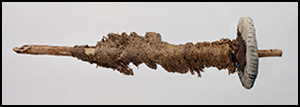
Top) examples of conical whorls from different Baden Culture contexts in the East-Central European dataset (by A. Grabundžija); bottom) preserved spindle with a ‘flat type’ discoid whorl and an attached plied thread made from tree bast fibres, found at Arbon-Bleiche 3 (3384–3370 BC) (by D. Steiner, Amt für Archäologie Thurgau).

Previous research on Neolithic spindle whorls has suggested that thread-making had a ‘culture-specific’ technological signature (Grabundžija Reference Grabundžija2020), with whorl typology and the morphometric specifications displaying a statistically significant dependence on what is referred to in culture-historical discourse as an ‘archaeological culture’ (Grabundžija Reference Grabundžija, Balen, Miloglav and Rajković2018b). Thus, the particular conical whorl type that appears in the pre-Alpine site assemblages during the early Horgen Culture (3400–2850 BC) supports the hypothesis of a direct cultural influence from the Middle Danube culture(s).
Conclusions
The quantity of spliced and plied, rather than spun, Neolithic yarn from the pre-Alpine wetland sites suggests that most spindle whorls were used for plying. The presence of a plied thread made from tree bast and attached to a preserved spindle at Arbon-Bleiche 3 (Leuzinger Reference Leuzinger, de Capitani, Deschler-Erb, Leuzinger, Marti-Grädel and Schibler2002b: 115 & fig. 147.3) confirms that plying with a spindle whorl was practised at Horgen sites (Figure 9: bottom). Given the quantity of preserved textiles and the apparent popularity of the splicing method at the wetland sites, plying was one of the key steps in yarn production (Gleba & Harris Reference Gleba and Harris2019: 2333), and the most common and widespread technique during the Neolithic period (Rast-Eicher & Dietrich Reference Rast-Eicher and Dietrich2015). Nevertheless, preserved yarn made of spun grass (Poaceae) fibres was found at the wetland site of Stare gmajne in Slovenia (Pajagič Bregar et al. Reference Pajagič Bregar, Velušček, Tolar, Strlič, Bukošek, Kolar, Ravbar and Velušček2009)—a site at which a strong Boleráz/Baden influence was also recorded (Velušček Reference Velušček and Velušček2009: 31). Dating to the end of the fourth millennium BC, this yarn implies that draft spinning was already being practised in Central Europe during the Eneolithic.
The presence of conical whorls at the pre-Alpine sites and its connection to foreign cultural influences adds a new dimension to our understanding of the socio-economic importance and complexity of Neolithic thread production, particularly in the context of innovation. Technological change was a multifaceted process, and was far more dynamic and complex than a simple linear diffusion (Gleba & Harris Reference Gleba and Harris2019: 2342).
The research presented here aimed to identify the spread and adoption of technologies based on a cross-cultural, techno-typological analysis of spindle-whorl assemblages and their chronological and geographic association with cultural groups identified by previous studies (de Capitani Reference de Capitani, de Capitani, Deschler-Erb, Leuzinger, Marti-Grädel and Schibler2002: 209–16; Schlichtherle Reference Schlichtherle, Schlichtherle, Vogt, Maier, Schmidt, Ismail-Meyer, Kühn and Wick2011: 24). Determining whether the transmission of this new innovation in spinning technology, which is manifested in the use of conical whorls, was further driven by intensification in textile production or the exploitation of new raw material resources, such as wool, remains to be addressed.
Although other large spindle-whorl datasets from Central Europe are currently unavailable, textile tools from the fourth millennium BC (Furchenstich and Jevišovice Cultures) are under investigation as part of a joint project between the Natural History Museum in Vienna and the University in Prague (Schierer & Grömer Reference Schierer and Grömer2019). Further analysis of the Boleráz/Baden cultural presence in other parts of Central Europe (e.g. modern Austria and the Czech Republic), which could not be included in the current study, promises to reveal more details concerning the range of factors that may have propagated and influenced the spread of the faster rotating spindle whorls across prehistoric Europe.
Funding statement
The research was enabled thanks to an Excellence Cluster TOPOI postdoctoral fellowship and the German Research Council (project 289510075).


 Open access

