Introduction
Contraceptive use is primarily aimed at stopping, spacing or postponing births, and is hence an important health and fertility status indicator (Cleland & Ali, Reference Cleland and Ali2004; DeRose & Ezeh, Reference DeRose and Ezeh2010; Van Lith et al., Reference Van Lith, Yahner and Bakamjian2013; Ejembi et al., Reference Ejembi, Dahiru and Aliyu2015). According to the United Nations (2014), women have the right to control their family size as it is key to attaining gender equality and empowerment. However, constraints and challenges among women in the use of modern contraceptives remain to be solved in African contexts, not excluding Eswatini (Ziyani et al., Reference Ziyani, Ehlers and King2003; Bongaarts & Casterline, Reference Bongaarts and Casterline2012; Van Lith et al., Reference Van Lith, Yahner and Bakamjian2013).
Overall, lower contraception practice has retarded fertility decline in Africa when compared with the rest of the world (Cleland & Ali; Reference Cleland and Ali2004; DeRose & Ezeh, Reference DeRose and Ezeh2010; Andi et al., Reference Andi, Wamala, Ocaya and Kabagenyi2014). For instance, contraceptive prevalence is highest in Latin America and the Caribbean, rising from 61.2% to 72.7% between 1990 and 2015. However, for the same period contraceptive use increased from 16.2% to 38.6% in East and Southern Africa. In West and Central Africa, the rates for the same period were much lower, rising from 8.7% to 17.6% (UNFPA, 2016). In the same time span, specifically for Eswatini, contraceptive prevalence rose from 31% to 64%. Prior to 1990, the contraceptive prevalence rate was much lower, rising from 4% in the early 1980s to 16.6% in 1988 (Ministry of Health, 1990; CSO, 2008). This study sought to investigate community contextual influences on contraceptive use, net of individual factors, in the context of Eswatini.
Earlier studies in Eswatini (Lule, Reference Lule and Adepoju1991; Warren et al., Reference Warren, Johnson, Gule, Hlophe and Kraushaar1992) have well established the importance of individual-level factors (such as education, employment, place of residence, child death, polygyny, socioeconomic status and age at first marriage) as determinants of fertility behaviour outcomes including contraceptive use. With the exception of a recent multi-country study by Elfstrom and Stephenson (Reference Elfstrom and Stephenson2012), the role of community in contraceptive use in Eswatini has been under-examined. Similarly, Montgomery and Hewett (Reference Montgomery and Hewett2005), Stephenson et al. (Reference Stephenson, Baschieri, Clements, Hennink and Nyovani2007) and Wang et al. (Reference Wang, Alva, Winter and Burgert2013) posited that there had been less research focus on contextual influences on contraception than on mortality in Africa and elsewhere. Entwisle (Reference Entwisle2007) in a list of 503 published articles found that contraceptive outcomes had the least research output in comparison to mortality- and public health-related subjects.
The expanding literature on contraceptive use highlights that acts of fertility control using contraceptives for individual women are not solely independent of their community influence or any other external forces (Carter, Reference Carter and Casterline2001; Colleran & Mace, Reference Colleran and Mace2015). Bongaarts and Watkins (Reference Bongaarts and Watkins1996) and Montgomery and Casterline (Reference Montgomery and Casterline1996) have argued that through social learning and interaction women are subjected to imitate or conform to reproductive choices or behaviours of reference groups, peers and neighbours in their community. Communities, however, are not uniform in structure and size. Social structure and attitudes differ from community to community (Caldwell & Caldwell, Reference Caldwell and Caldwell2001) generating non-uniformities in contraceptive decision-making and use (DeRose & Ezeh, Reference DeRose and Ezeh2010; Janevic et al., Reference Janevic, Sarah, Leyla and Elizabeth2012). Recent studies have addressed the importance of community-level characteristics in explaining contraceptive use in sub-Saharan Africa using multilevel regressions (Clements et al., Reference Clements, Baschieri and Hennink2004; Stephenson et al., Reference Stephenson, Baschieri, Clements, Hennink and Nyovani2007; Kaggwa et al., Reference Kaggwa, Diop and Storey2008; Benefo, Reference Benefo2010; Elfstrom & Stephenson, Reference Elfstrom and Stephenson2012; Aremu, Reference Aremu2013; Wang et al., Reference Wang, Alva, Winter and Burgert2013; Ejembi et al., Reference Ejembi, Dahiru and Aliyu2015).
According to Stephenson et al. (Reference Stephenson, Baschieri, Clements, Hennink and Nyovani2007) community-level contextual factors affecting contraceptive use have been examined not in a holistic manner, but considering one or few contextual dimensions. Some studies that inspired this study, such as Bentley et al. (Reference Bentley, Kavanagh and Smith2009), Wang et al. (Reference Wang, Alva, Winter and Burgert2013) and Ejembi et al. (Reference Ejembi, Dahiru and Aliyu2015), however, have incorporated this broader perspective, which facilitates the understanding of the factors influencing contraceptive use variation at the community evel. The key literature, in overview, considers contextual sphere variables on i) community socioeconomic development (including area disadvantage and socioeconomic disadvantage), ii) community fertility norms and marital practices, and iii) gender equity and women empowerment in the community. The key institutional features of the communities are represented by these community variables (Hermalin, Reference Hermalin1986). The importance of these community variables might warrant policy attention and interventions in Eswatini. Omitting community characteristics in statistical regressions explaining outcomes at the individual level, especially when dealing with hierarchical survey data or dependent data, has implications for measurement errors and generate bias when interpreting results (Hank, Reference Hank2002; Carle, Reference Carle2009; Ferede, Reference Ferede2013).
Previous studies have shown that women living in disadvantaged rural areas or regions and communities with socioeconomic disadvantaged women in terms of education, employment, wealth and exposure to mass media have lower contraceptive use (Stephenson et al., Reference Stephenson, Baschieri, Clements, Hennink and Nyovani2007; Bentley et al., Reference Bentley, Kavanagh and Smith2009; Benefo, Reference Benefo2010; Janevic et al., Reference Janevic, Sarah, Leyla and Elizabeth2012; Ferede, Reference Ferede2013). Some studies have highlighted the importance of dimensions of the effects of community on contraceptive use such as polygyny (Ezeh, Reference Ezeh1997), women’s empowerment/autonomy (Moursund & Kravdal, Reference Moursund and Kravdal2003; DeRose & Ezeh, Reference DeRose and Ezeh2010) and fertility norms (Colleran & Mace, Reference Colleran and Mace2015). According to DeRose and Ezeh (Reference DeRose and Ezeh2010) gendered roles and attitudes are recognized as products of collective socialization, but these are rarely measured at the community level when predicting reproductive outcomes.
A previous multi-country study, which included Eswatini, found the mean ideal number of children in the community to vary significantly across clusters on contraceptive use in the country (Elfstrom & Stephenson, Reference Elfstrom and Stephenson2012). However, the study concentrated on examining factors influencing contraceptive use in the context of marriage, leaving out a significant proportion of single or never-married sexually experienced women. In Eswatini, early and out-of-wedlock childbearing is prevalent and proves fecundity among women as a way to secure later marriages (Warren et al., Reference Warren, Johnson, Gule, Hlophe and Kraushaar1992; CSO, 2008; CSO & UNICEF, 2011). Therefore, this study focused on the contraceptive use of women who have ever engaged in sexual intercourse. Furthermore, it is imperative to gain understanding on modern contraceptive fertility control practice for individual women in their context, within a population rather than across populations. This minimizes the need to standardize measurement variables across countries, for which variables may not necessarily be meaningful in some contexts. The meaning of individual-level variables often depends on context (DeRose & Ezeh, Reference DeRose and Ezeh2010). The objectives of this study were to examine the association between current contraceptive use and community-level factors adjusting for individual-level factors using a multilevel logistic statistical model and to assess the extent of the variation in current contraceptive use between communities in Eswatini.
Methods
Study setting
The Kingdom of Eswatini is one of the smallest landlocked countries in the southern African region covering 17,363 square kilometres. The country has a lower middle-income economy heavily reliant on agricultural activities and the service industry sector (CSO, 2008, 2010; MEPD, 2012). The Swati society exhibits a monolithic traditional culture distinguished as a patriarchal society structure. However, wide differences exist in the political and administrative economy of the country. Two regions (Hhohho and Manzini) have higher levels of socioeconomic development in terms of infrastructure, industries and services, while Shiselweni and Lubombo are resource poor and reflect the impoverished rural economy (MEPD, 2002, 2012). Both modern and traditional systems of government are practised. The chiefs and traditional council leaders in rural areas serve as the vanguards of Swati indigenous customs, values and norms at constituencies (Tinkhundla). Urban areas are run by local municipality authorities (MEPD, 2002). This synopsis of political economy underlines vital aspects of culture and contextual influences on reproductive behaviour.
Data and sample
The data came from the 2006–07 Eswatini Demographic and Health Survey (DHS) cross-sectional study, which collected information on family planning and fertility behaviour as well as other demographic, socioeconomic and health indicators. The survey is the first and only official DHS conducted in the country. The survey was nationally representative and used a two-stage cluster sampling design (CSO, 2008). The 1997 population census was the sampling frame, where primary sampling units (PSU) were 275 divided into 111 and 164 clusters for urban and rural areas, respectively. From each cluster, a systematic sample of 5500 households was selected for the study. All women aged 15–49 were eligible for interview, but only 4987 were successfully interviewed (CSO, 2008). The sample for the study was limited to 4112 sexually experienced women, i.e. those who ever had sexual intercourse. Except for place and region of residence, community-level variables were aggregated at the level of the sampling cluster as in previous studies (Kravdal, Reference Kravdal2006; Kaggwa et al., Reference Kaggwa, Diop and Storey2008).
Variables
The dependent variable was a binary outcome: that is, whether a woman was using any form of modern contraceptive at the time of the study (coded 1 if a current user and 0 otherwise). These contraceptives included female and male sterilization, intrauterine device (IUD), implants, pills, male and female condoms, injectables and the Lactational Amenorrhea Method (LAM). Traditional methods – withdrawal, periodic abstinence, rhythm and folk method – constituted a mere 1.9% (87 women) of the sample and were considered as part of ‘non-users’. Of the 4112 women aged 15–49 who had ever had sexual intercourse 44.2% were found to be users of current modern contraceptives.
The study considered for analysis micro (individual and household) and macro (community) level independent variables selected from literature on fertility behaviour. Both micro and macro variables were measured as categorical variables. The micro-level variables included were fourteen: occupation, household wealth index (DHS generated quintile index based on ownership of household items and facilities), education, media exposure, women’s empowerment, ideal number of children, union status, age, number of living children, child death experience, religion, contraceptive use, age at first birth and age at sexual debut. Media exposure and women’s empowerment were composite index variables generated using a reliability coefficient (Cronbach’s alpha). An alpha coefficient of 0.7 or higher was considered reliable (Smith, Reference Smith2011). Both variables were within the acceptable threshold of 0.70. Mass media exposure (α = 0.6776) was measured by combining questions on whether women had access to media (newspapers, radio and television) and whether or not they have been exposed to family planning messages. Building on previous work (Do & Kurimoto, Reference Do and Kurimoto2012; Upadhyay & Karasek, Reference Upadhyay and Karasek2012), women empowerment (α = 0.6804) was measured as an overall index measure based on questions on women’s household decision-making, attitudes towards gender-based violence and sexual activity.
The study considered seven macro variables for modelling contraceptive use classified under four dimensions as follows: i) area disadvantage (place of residence, region of residence), ii) socioeconomic disadvantage (community social position, community media exposure), iii) women autonomy or empowerment (community women’s empowerment), and iv) fertility norms (community ideal fertility norm on preferred number of children, community polygyny). The contextual variables, except for residence, were aggregated individual-level variables at the cluster level measured as average proportions classified into low and high levels for each variable. A number of studies guided the construction of the indices and community variables used in this study (Stephenson et al., Reference Stephenson, Baschieri, Clements, Hennink and Nyovani2007; Do & Kurimoto, Reference Do and Kurimoto2012; Elfstrom & Stephenson, Reference Elfstrom and Stephenson2012; Upadhyay & Karasek, Reference Upadhyay and Karasek2012; Wang et al., Reference Wang, Alva, Winter and Burgert2013; Ejembi et al., Reference Ejembi, Dahiru and Aliyu2015).
Statistical analysis
Data were weighted to account for multistage sample design and analysed using Stata 14 (StataCorp, 2015). Univariate analysis depicted frequencies and percentages for each individual and community variable. Cross-tabulations of each independent variable and contraceptive use were applied for inferential analysis. A chi-squared test determined whether there was any association between contraceptive use and each characteristic. Individual-level variables were retained using the chi-squared test, with p < 0.05 considered as significant. All community-level variables hypothesized for the study were retained in the model.
Logistic bivariate and multivariate regressions models were fitted to determine the direction and magnitude of association between contraceptive use and the independent variables. Collinear independent variables, with correlation coefficient r > 0.6, were excluded in the study. Multicollinearity in the final model was assessed using the Variance Inflation Factor (VIF) cut-off point >10 to exclude any remaining variable. The unadjusted and adjusted odds ratios (ORs) with 95% confidence intervals were reported. The strength and direction of the association was determined using unadjusted odds ratios (UOR) and adjusted odds ratios (AOR) for the bivariate and multivariate logistic regressions, respectively.
A two-level multilevel logistic regression was employed to examine the association of individual- and community-level factors with contraceptive use. Also, considering the hierarchical DHS data structure (i.e. women nested within clusters/communities), a multilevel (random intercept) model was appropriate to examine the role of contextual influences on contraceptive use in Eswatini.
The random intercept logistic regression model was of the form (Hank, Reference Hank2002; Rabe-Hesketh & Skrondal, Reference Rabe-Hesketh and Skrondal2012):
 $${\rm{logit(Pr(}}{{\rm{y}}_{{\rm{ij}}}}\, = \,1|{x_{{\rm{ij}}}},{\zeta _{\rm{j}}}))\, = \,{\rm{logit(}}{\pi _{ij}}/(1 - {\pi _{ij}}))\, = \,{\beta _0}\, + \,{\beta _1}{x_{1ij}}\, + \,{\beta _2}{x_{2j}}\, + \,{\zeta _j}$$
where π ij is the proportion of women who are currently using any contraceptive method; the subscript j is j = 1,…, M clusters (level 2 units), with cluster i consisting of i = 1,…, n j observations (level 1 units) for individual women; ζ j is the community-level variance with mean 0 and variance ψ; β 0 is the intercept coefficient; β 1 is the vector of regression fixed coefficients of the individual-level variables or covariates x 1ij, while β 2 corresponds to those coefficients of community-level factors x 2j.
The fixed effects (measures of association) were measured by odds ratios while the random effects (measures of variation) were assessed using the median odds ratio (MOR). The higher the value of MOR from 1 the greater is the between-community variation (Aremu, Reference Aremu2013).
A four-step multilevel logistic modelling approach was done using the Stata command melogit. The empty model (Model 0) had no covariate, aimed at testing whether there was variation between communities in use of contraceptives. Model 1, with only individual-level variables, measured their effects on contraceptive use. Model 2 analysed the separate effect of community factors. Last, but not least, Model 3 was the full model to determine the combined effects of individual- and community-level characteristics.
Results
Characteristics of the respondents
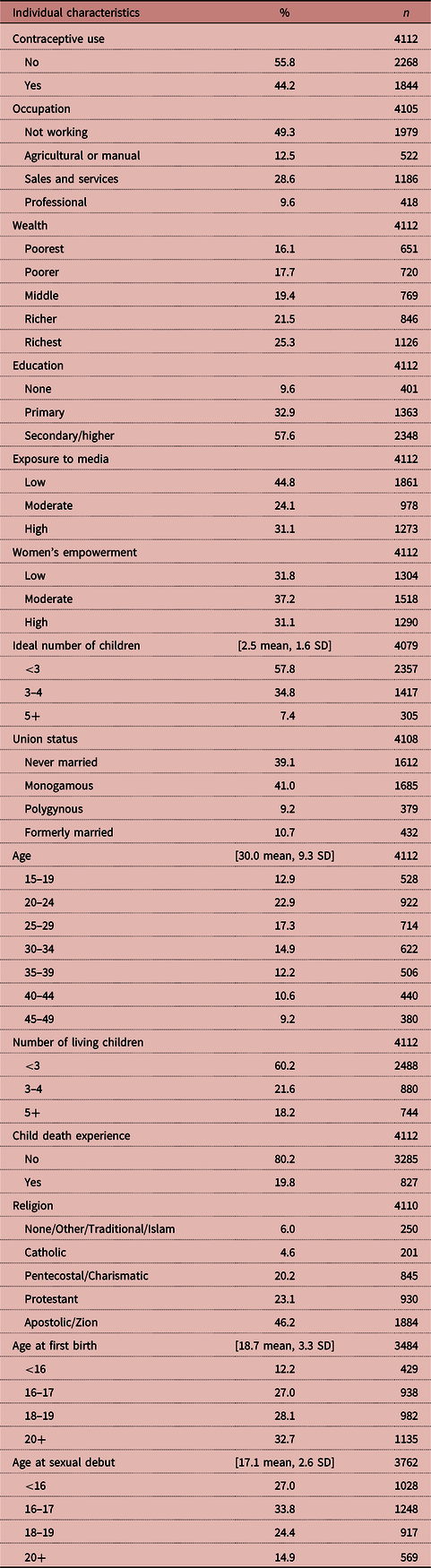
The prevalence of modern contraceptive use stood at 44.2% in 2007 among sexually experienced women aged 15–49 in Eswatini (Table 1). At individual level, the majority of women had secondary or higher education (57.6%), no child loss (80.2%), low parity (fewer than 3 children; 60.2%), a small fertility norm preference (fewer than 3 ideal number of children; 57.8%) and moderate or higher mass media exposure (55.2%), as well as autonomy/empowerment (68.2%). Almost half of the women were not formally employed (49.3%) and were of the Apostolic/Zion religion (46.2%). Among women employed, most had a job in sales and services (28.6%). More women were in monogamous (41%) than polygynous (9.2%) relationships. Almost a third of sexually experienced women were in the bottom two wealth quintiles (33.8%), had delayed onset of first sexual intercourse (33.8%) and give birth at a later age of 20 or higher (32.7%) (Table 1).
Selected individual characteristics of sexually experienced women aged 15–49, Eswatini, 2007

SD: standard deviation; n: sample observations.
Data do not up to 4112 for the sexually experienced women sub-sample due to missing cases.
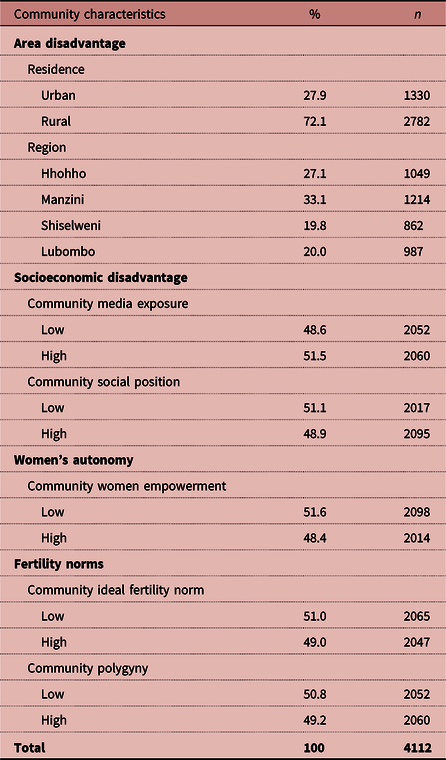
At the community level, almost three-quarters of women (72%) resided in rural clusters/communities. A fair share of women lived in non-poor resourced communities in the regions of Hhohho (27.1%) and Manzini (33.1%). There was an almost equitable distribution of women in communities with low and high levels of media exposure, social position, women empowerment, ideal fertility norms and polygyny (Table 2).
Selected community characteristics of sexually experienced women aged 15–49, Eswatini, 2007

Bivariate association results
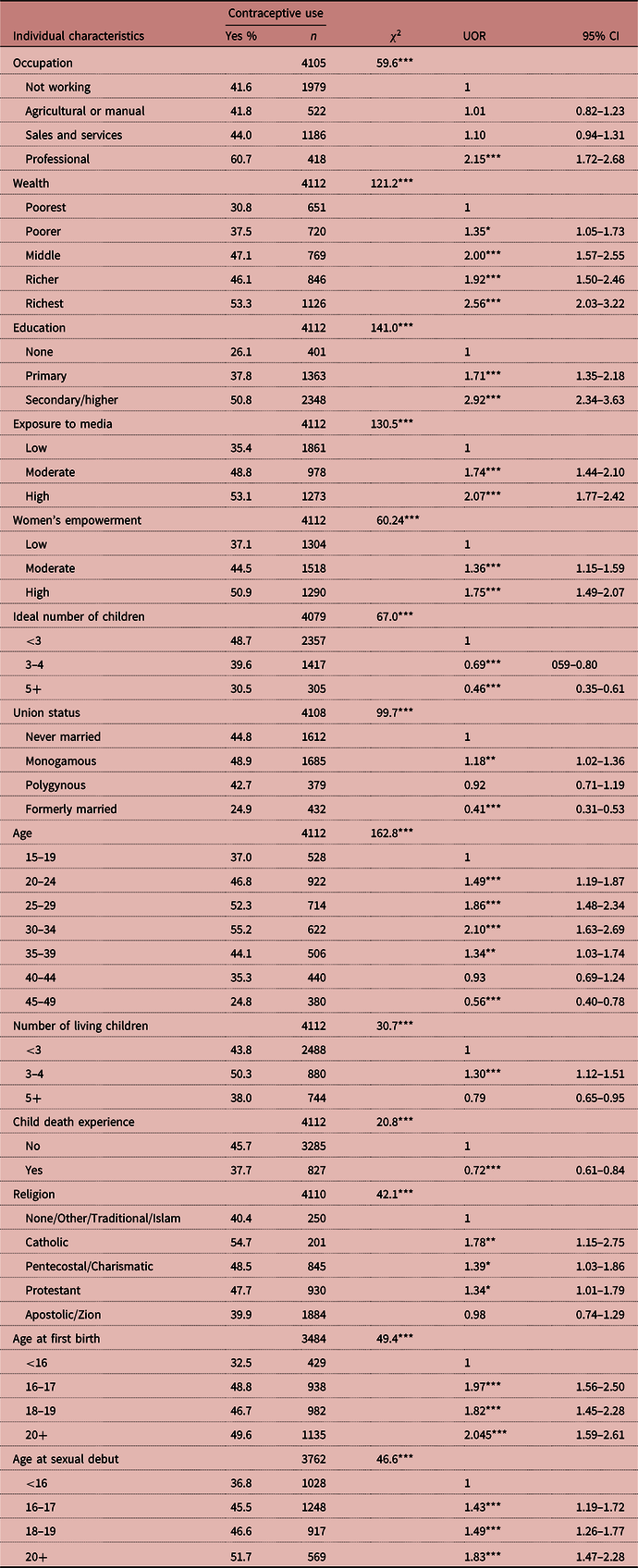
The focus of the study was on the influence of community context, therefore the results presented do not overemphasize the influences of the well-established individual factors on contraceptive use. The contraceptive prevalence estimated for the sub-sample of sexually experienced women is shown in Tables 3 and 4 for individual and community characteristics, respectively.
Percentage distribution of women currently using contraceptives by individual characteristics and sexual activity, Eswatini, 2007 DHS

UOR: unadjusted/crude odds ratio; CI: confidence interval.
***p<0.001; **p<0.01; *p<0.05.
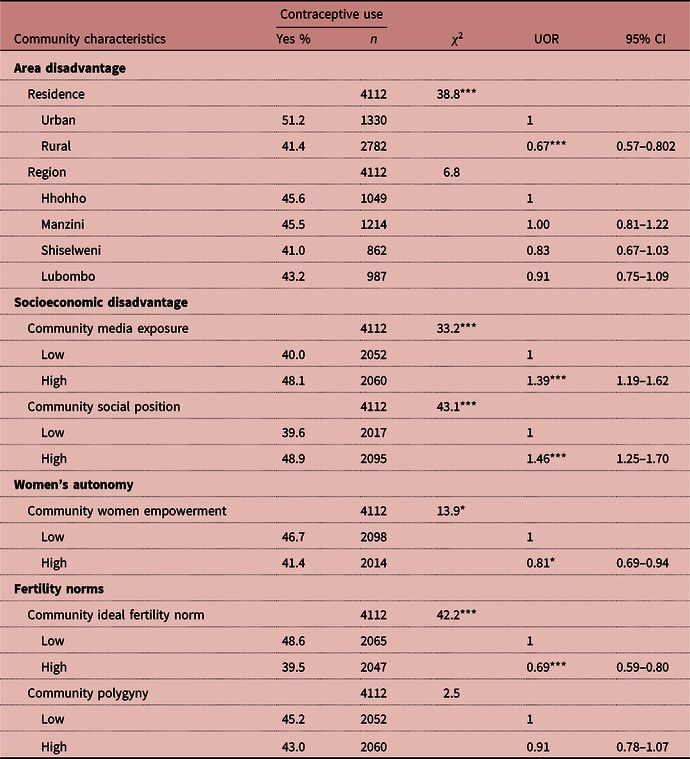
Percentage distribution of women currently using contraceptives by community characteristics and sexual activity, Eswatini, 2007

UOR: unadjusted/crude odds ratio; CI, confidence interval.
***p<0.001; **p<0.01; *p<0.05.
Table 3 indicates that all individual characteristics controlled for in the study were significantly associated with contraceptive use (p < 0.001). Overall, contraceptive use significantly increased with household wealth index, level of education, exposure to media, women’s empowerment/autonomy index and age at first sex. Employed women had higher current use of contraceptives than unemployed women. An increase in women’s ideal number of children and experience of child loss among women significantly decreased contraceptive use.
Community characteristic variations in contraceptive use were noticeable among sexually experienced women (Table 4). The differences were statistically significant for all community variables, except for region and community level of polygyny. Contraceptive use was lower in communities located in Shiselweni and Lubombo (less-urbanized or resource-poor regions) compared with Manzini and Hhohho (less-disadvantaged regions). In rural clusters, contraceptive use was less common than in urban clusters (41.4% vs 51.2%). Women who lived in communities with a high ideal family size norm (greater than 4) were 31% less likely to use contraceptives than those residing in communities with small family size ideals. In addition, the rates of contraceptive use were lower in communities with low levels of media exposure and low levels of social status/position for women. Contrary to empowered women at the individual level who had higher contraceptive use, at the community level, clusters with a high proportion of empowered women were less likely to use contraceptives. It appears women’s empowerment tends to operate differently at the individual and community level in shaping use of contraceptives, and hence is a point of further inquiry for researchers.
Multilevel logistic regression analysis results
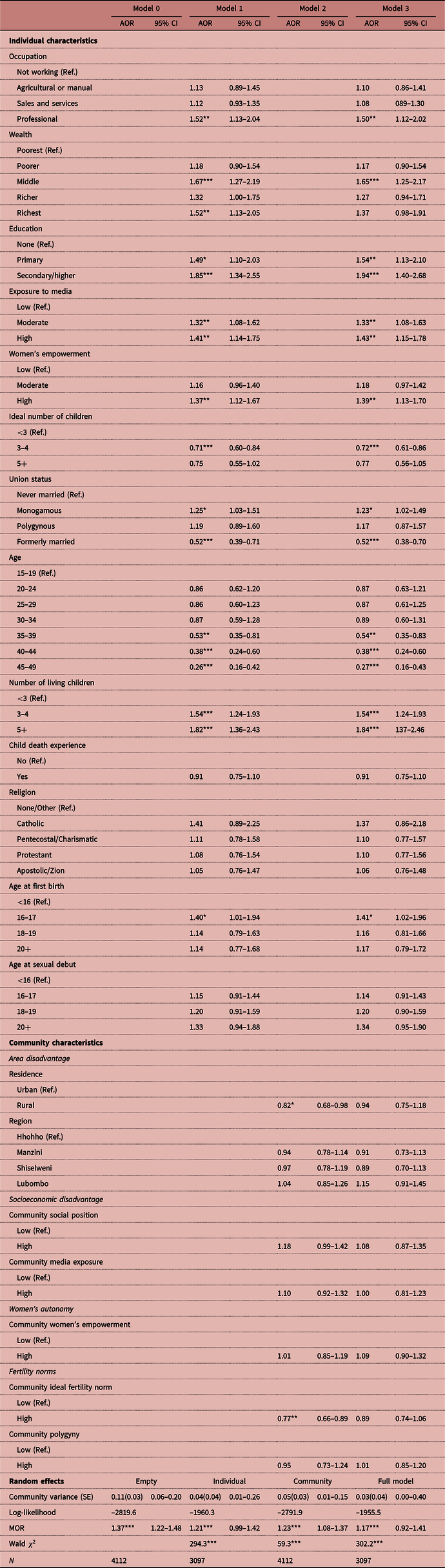
Table 5 presents adjusted odds ratios (AORs) on fixed effects for modelling contraceptive use using random intercept logistic regression models. The random effects depicted using the median odds ratios (MOR) provide between-community variance in use of contraceptives. Four models were used to determine the effect of individual and community variables on contraceptive use. Key results were drawn from the full model (Model 3, including all individual- and community-level variables), while other models were meant for comparison purposes. The empty model (Model 0) shows that there was a significant variation in contraceptive use across communities (MOR = 1.37, 95% CI: 1.22–1.48). Although the between-community variance was different from zero, the level of heterogeneity in contraceptive use was small.
Results of the multilevel logistic regression analysis of the predictors of contraceptive use among sexually experienced women aged 15–49, Eswatini, 2007

AOR: adjusted odds ratio; SE: standard error; MOR: median odds ratio; Ref.: reference; N: sample observations.
***p<0.001; **p<0.01; *p<0.05.
Model 1 includes individual-level variables only. This model still shows small community-level variability in contraceptive use (MOR = 1.21, 95% CI: 0.95–1.42). The study zeroed in on the importance of community characteristics on contraceptive use. Model 2 examined only the effect of contextual factors of interest. Area disadvantage in contraceptive use was noticeable with respect to urban–rural distribution of women. Net of other community factors, rural women were 18% less likely to use contraceptives compared with urban women. On area disadvantage, there was, however, no regional variability in contraceptive use. This pattern of observation is consistent with the bivariate logistic regressions findings shown in Table 4.
Socioeconomic disadvantage variation in contraceptive use for women in communities could be observed, although the variability within the community variables was not statistically significant. The odds of contraceptive use were higher in communities with a high level of social status/position and exposure to mass media. These multivariate logistic results contradict binary analysis results where the same socioeconomic disadvantage variables (social position and media exposure) had significant effects on contraceptive use (Table 4). It can be noted that the binary results did not include the influence of other independent variables on the outcome, as was the case for the multivariate results.
Adjusting for all other community variables, there were no community differences in contraceptive use between high- and low-community levels of women’s empowerment (Model 2, Table 5). This suggests the observed significant difference between the two-level classifications of communities in bivariate relationships (see Table 4) was weak. In Table 5, the odds of contraceptive use significantly reduced for women’s communities with a high fertility norm: greater than 4 ideal number of children (AOR = 0.77, 95% CI: 0.66–0.89). High levels of community polygyny also reduced the odds of contraceptive use, although the difference was not statistically significant. These results on fertility norms match the bivariate results (see Table 4). Overall, the results in Model 2 confirm independent or separate contextual community influences of urban–rural residence and ideal number of children (fertility norms) on contraceptive use.
In the full model (Model 3 in Table 5) individual-level variables added to community factors reduced slightly the community variance from 0.04 to 0.03. Thus, unobserved heterogeneity explains very little of the random variance in contraceptive use across communities. Furthermore, this reflects that community-level factors explain very few of the differences in between-cluster variance in contraceptive use. More so, the MOR decreased from 1.21 (Model 1) to 1.17 (Model 3), signifying small, although significant, differences between communities in the use of contraceptives. This indicated that there remained some unexplained community variability in the full model.
The full model results show that, net of individual-level variables, all the community-level variables considered in the study were not significantly associated with current use of contraceptives among sexually experienced women (Model 3, Table 5). Despite this, women living in communities with a high number of ideal children (high fertility norm) had lower odds of contraceptive use, as expected. The results from the unadjusted bivariate regression shown in Table 4 suggest that communities with a high proportion of empowered women had significantly reduced odds of contraceptive use. However, net of all other factors, this pattern reversed. Women residing in communities with high women empowerment had a higher likelihood of contraceptive use (AOR = 1.09, 95% CI: 0.90–1.32), although the results were not statistically significant.
Discussion
This study examined in a holistic manner the contextual determinants of contraceptive use among sexually experienced women in Eswatini with special focus on community dimensions of area disadvantage (urban–rural, region), socioeconomic disadvantage (media exposure and social position), women’s empowerment/autonomy and fertility norms (polygyny and ideal number of children). The study found that unmeasured variability in contraceptive use across communities was significant though marginal. That is, the community-level factors explained very little of the differences in contraceptive use between communities that are explained by individual-level variables. Such effects have been observed elsewhere, where micro factors account for some contextual variability in contraceptive use (Clements et al., Reference Clements, Baschieri and Hennink2004).
Overall, all the contextual factors for the study were found to be not significantly associated with contraceptive use at the cluster/community level, net of other factors (Model 3). This observation is not rare when all individual and community variables are considered simultaneously (Kaggwa et al., Reference Kaggwa, Diop and Storey2008). This is an important finding showing the importance of multilevel models in analysing hierarchical structured DHS data. Furthermore, since the study observed community variability in contraceptive use for the empty model (Model 0) it implies other community factors not accessible in the dataset and beyond those investigated in the study may be important. Community access to health facilities and community norms of childbirth have been demonstrated to be important determinants of contraceptive use (Wang et al., Reference Wang, Alva, Winter and Burgert2013; Ejembi et al., Reference Ejembi, Dahiru and Aliyu2015).
Individual-level factors seem to be more important than community characteristics in determining contraceptive use. The identified significant individual-level factors were occupation, household wealth, education, exposure to media, women’s empowerment, union/marital status, age, age at first birth and parity. The importance of these factors in contraceptive use is well established in the African literature (Stephenson et al., Reference Stephenson, Baschieri, Clements, Hennink and Nyovani2007; Kaggwa et al., Reference Kaggwa, Diop and Storey2008; Benefo, Reference Benefo2010; Bamiwuye et al., Reference Bamiwuye, De-Wet and Adedini2013; Wang et al., Reference Wang, Alva, Winter and Burgert2013; Ejembi et al., Reference Ejembi, Dahiru and Aliyu2015).
It might be important briefly to point out the independent effects of community-level variables (Model 2). As expected, rural residence decreased contraceptive use, as found in many studies in developing countries. Women residing in communities with high ideal fertility norms had significantly lower levels of contraceptive use. Therefore, area disadvantage and fertility norms may have important implications for contraceptive use. Nevertheless, when individual and community factors (Model 3) were taken together, the influence of selected community characteristics on contraceptive use disappeared.
Some limitations to the study were observed. Since the DHS survey data used to determine association between contraceptive use and its determinants were cross-sectional, causal or temporal relationships, which require longitudinal designs, could not be determined. In addition, individual-level variables were aggregated at the smallest units of EAs to generate communities of interest. The use of community-level data could produce a better estimate of contextual influences on contraceptive use. However, aggregated cluster-level variables have been noted to be good proxies for communities (Kravdal, Reference Kravdal2006; Wang et al., Reference Wang, Alva, Winter and Burgert2013). The study included clusters with fewer than 10 or 25 women, as recommended by other studies, to reduce bias (Kravdal, Reference Kravdal2006; Kaggwa et al., Reference Kaggwa, Diop and Storey2008; Carle, Reference Carle2009), although this aspect of cluster size have been ignored or deemed not important in many studies (Rodriguez & Goldman, Reference Rodriguez and Goldman1995).
In the context of Eswatini, contraceptive use variability at the higher level of aggregation of constituencies (Tinkhundla), which are centres of political and administrative socioeconomic development, may be of policy relevance. The study also proposes the use of ethnographic techniques that might unravel community factors that influence contraceptive use.
In conclusion, as indicated in the literature, fertility decline is correlated to an increase in contraceptive use (DeRose & Ezeh, Reference DeRose and Ezeh2010; Andi et al., Reference Andi, Wamala, Ocaya and Kabagenyi2014; Colleran & Mace, Reference Colleran and Mace2015). Although economic development, political, cultural and social change have been linked to an increase in contraceptive use, the combination of these factors results in contraceptive use varying from society to society (Reed et al., Reference Reed, Briere and Casterline1999). The study’s most basic conclusion is that small, but significant variation exists between communities in the contraceptive use of individual women in Eswatini. The selected broad range of community-level factors was not able to explain this contextual variation in contraceptive use, net of individual-level factors. The latter appear to explain much more variation in contraceptive use than community factors. Policies that look at women’s individual and household characteristics, such as promoting women employment, especially in professional occupations, higher educational level attainment and wealth accumulation, should continue to be implemented in order to increase contraception uptake and achieve the universal coverage goal.
Some important community variables could have been excluded from this study. However, the study has demonstrated that community factors can influence contraceptive use independent of individual-level characteristics. This effect disappeared when individual and community factors were combined to give a complete picture of how contextual influences shape contraceptive use. Hence, there is a need to investigate further the factors that generate disparities in contraceptive use in Eswatini.
Acknowledgments
The authors are grateful to the Central Statistics Office of Eswatini and Macro International Inc. for the data set used in this study. This manuscript is based on the doctoral thesis of the first author at the University of the Witwatersrand.
Funding
This work was based on the research supported in part by the National Research Foundation of South Africa (Grant No. 105931).
Conflicts of Interest
The authors have no conflicts of interest to declare.
Ethical Approval
The secondary data used for this study were obtained with the permission of the Central Statistics Office of Eswatini and Macro International Measure DHS Program. The Scientific and Ethics committee in the Ministry of Health and Social Welfare of Eswatini approved the 2007 DHS. All respondents gave informed consent and confidentiality was guaranteed by removing all personal identifying links. The authors assert that all procedures contributing to this work comply with the ethical standards of the relevant national and institutional committees on human experimentation and with the Helsinki Declaration of 1975, as revised in 2008.