Health care facilities are always the places of haven and protection for general public.1 Usually, health care facilities are well prepared to grapple with external crises, but situations resulting from internal hazards such as fire, earthquakes, utility failure, and structural or nonstructural damage are more crucial and may necessitate immediate evacuation of a health care facility.2 The situation becomes more arduous and exigent to manage if critical care areas such as intensive care units and operating rooms (OR) are involved, as critically ill patients are housed there and it is difficult to move such acutely ill patients on an immediate basis.Reference Dhaliwal, Bhogal and Kumar3
Fire incidents are generally man-made disasters in health care organizations. As health care organizations use different types of electrical equipment, inflammable liquids, and medical gases, often at a single point of use, any sort of error can spark a fire.Reference Bhogal, Gupta and Aggarwal4 Fire is defined as containing 3 basic components: a source of fuel, an ignition source, and an oxidizer.Reference Caplan, Barker and Connis5 And whenever these components come in contact under adequate conditions and proportions, it leads to the occurrence of fire. Worldwide, 21 major hospital fire disasters have been reported, in which 1334 persons have lost their lives, and statistical surveys have revealed that such disasters lead to costly consequences.Reference Cavallini, Papagni, Baruffaldi and Reis6–Reference Chen, Pan and Zhang8 In the United Kingdom, costs of fire incidents had been estimated around 8 billion GBP. The Health and Safety Commission estimated losses due to these safety failures at around 18 billion GBP annually.Reference Furness and Muckett9 In the United States, about 118 deaths have occurred due to fire incidents in hospitals from 2000 to 2015. Recently, about 90 people lost their lives in a fire incident in an Indian hospital. Therefore, health care organizations are required to have a well-planned disaster mitigation strategy and proactive and well-prepared manpower to cater all types of exigencies resulting from internal as well as external hazards.Reference Sharma, Sharma and Singh10
Fire in hospitals is a grave health hazard because patients are incapable of rescuing themselves, unlike in other fire situations. This case report delineates an actual OR fire incident in the emergency operation theater (OT) of a tertiary care, multispecialty hospital and details the real-life evidence of the challenges encountered by OR staff in preserving both life and property. Though no adverse health effects have been reported during or after this fire commotion, this case report aimed to congregate the lessons identified from the incident in a sequential and logical manner.
CASE SCENARIO
The institute is a premier multispecialty, tertiary-level, teaching, 2000-bed hospital with a 110-bed emergency department having an emergency OT complex and diagnostics facilities attached to it. The emergency OT complex of the hospital has 7 ORs and is fully equipped to provide critical care to patients on an emergency basis 24/7 throughout the year. The hospital emergency department has a load of approximately 160 000 patients per year, and approximately 20 000 patients undergo operations per annum in the emergency OT complex. The emergency facility always runs with a bed occupancy rate of above 200%.
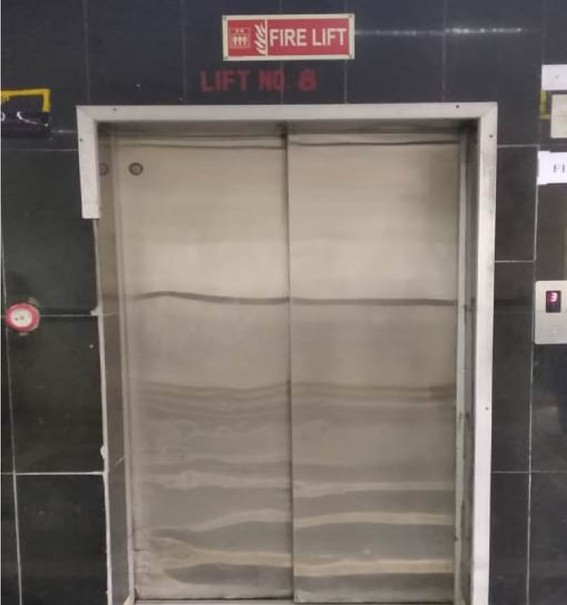
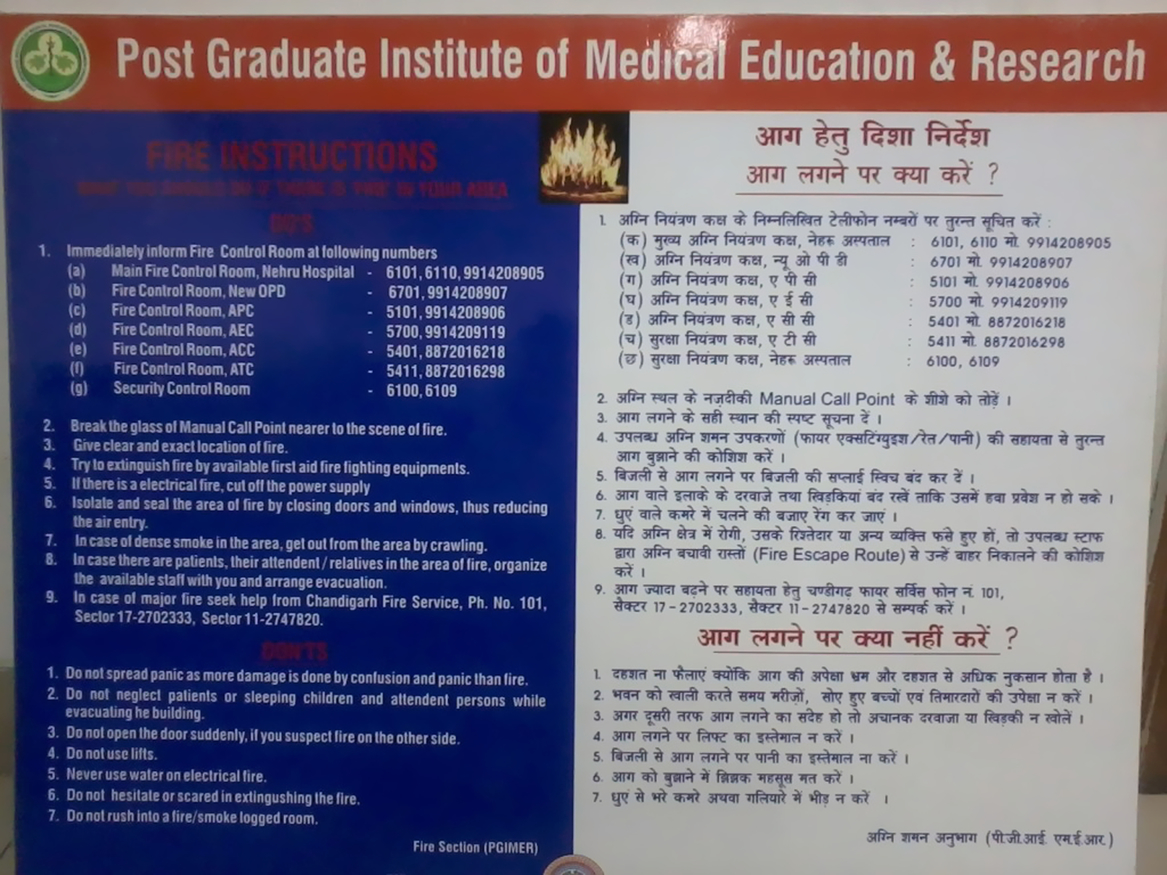
The institute has in place a robust firefighting and fire prevention system. The institute has 6 fire control rooms in each of the advanced centers; they work in coordination with the central fire control room in Nehru Hospital and are equipped with advanced firefighting equipment, self-containing breathing apparatus set, fire proximity suits, a public address system, and a smoke exhaust blower along with firefighting utilities such as heavy duty gloves, fire extinguishers, and torches. Smoke detectors, fire extinguishers, manual call points, hydrants/risers, and hose reels have been placed in appropriate areas in the building. Fire lifts are provided in advanced care centers in case of crisis situations (Figure 1). Instruction/guidelines boards (in the form of “dos and don’ts”) and emergency fire control numbers and signage have been displayed at different places for the awareness of the staff and public (Figure 2). The institute has an advanced, water mist–based fire tender equipped with water (600 L) and aqueous film–forming foam (100 L), a self-contained breathing apparatus, a fire proximity suit, and a public address system. High-rise buildings are checked periodically to ensure that they have fire escape routes and that the routes are kept clear at all times. The institute has well-trained firefighting officers who are always alert to address any such exigency and ensure strict compliance to statutory and regulatory guidelines of fire safety. Regular drills are done to ensure that the staff is fully aware of what actions to take in the event of a fire or fire alarm actuation. The engineering department has been made accountable for monitoring the general maintenance and refurbishment work and for scheduled maintenance of all of the installed electric gadgets and cables.
Fire Lift

Fire Instructions in Case of Fire Incident
On Friday, April 11, 2018, at 9:45 pm, surgical procedures were underway in 3 of the 7 ORs. Suddenly, a horrible sound and bright white fire flame burst out in one of the ORs. Horrible smoke and the smell of burning material and smoldering circuitry rapidly engulfed the whole OR. This sudden eruption required a prompt action, and, as expected, there was an instantaneous 3-pronged reaction by health care staff posted there. The required actions were immediate evacuation of patients and dousing and containment of fire and smoke. The 3 most-affected ORs were the first to be vacated, because smoke rapidly engulfed the whole area. Patients were wheeled out of the emergency OT complex immediately and were shifted to adjoining OT complexes at a distance of few meters from the emergency OT complex. The patients were actively assessed for any evidence of inhalational injury, but none of them required an additional treatment as a result of the event and they had uneventful recoveries.
The institute fire control room was contacted immediately, and fire personnel and security guards quickly rushed to the site, where thick black smoke had reduced visibility to almost zero, with all the necessary firefighting equipment. Though the fire was extinguished within 3 to 4 minutes, the whole OT complex was engulfed with smoke and dust. Heating and air conditioning (HVAC) fire/smoke sensors tripped, thereby preventing the distant spread of fire and smoke. The electrical supply of the OT complex and one of the immediate associated wards was cut off. Firefighting personnel smashed open the doors and window panes. Although doors to adjoining wards across the corridor were closed immediately to prevent smoke from circulating into other near wards and corridors, it became apparent that smoke had moved into the wards (Wards II, III, and IV) and necessitated complete evacuation of the patients, visitors, and health care staff from the building. At that time, there were approximately 98 inpatients in different wards and corridors of the first floor, while approximately 200 patients were on the ground floor. Wards II and IV were also vacated and patients were shifted to safer areas, and high-intensity smoke exhaust blowers were used to pump the smoke out of Ward III. Coincidentally, one of the wards (Ward I) had been closed 2 weeks earlier for ongoing renovation work. The patients admitted on the ground floor were also moved out to avoid any smoke inhalational injury. After 2 hours, at 11:55 pm, the fire department gave clearance and work to restart services was initiated. The OT complex was closed. The debris from the corridors and wards was removed, and the entire area was washed and cleaned and carbolisation was done. Electricity and HVAC were restored. At 1:25 am, April 12, 2018, the area was declared smoke-free and all patients were transferred back to their respective wards.
The next day, planned OT procedures were shifted to other operation theaters of the institute as an interim arrangement and OT complex repair/renovation work was started. The OT complex, which was strewn with equipment, burned materials, and shattered glass, was cleaned of the debris, washed, painted, and fogged for disinfection. Meanwhile, hospital engineers repaired and reinstalled the doors, window panes, and other structures that had been damaged or forced opened during the fire. Within 72 hours, 5 out of the 7 OTs had been made functional, while 2 OTs that were attached to each other were closed air tight for further repair and renovation. Though normal services resumed within 72 hours, recovery will not be complete until these 2 ORs become functional. A formal investigation was conducted by the committee constituted under the senior functionaries of the institute to identify the cause of the fire and to assess the losses incurred in the fire incident. It was learned that the fire occurred because of a short circuit in one piece of OT equipment.
DISCUSSION
Health care organizations are one of the most complex work environments because of patient-related issues, treatment protocols, and high-tech equipment.Reference Christian, Gustafson and Roth11 They are also very prone to hazards. Fires are one of the most important potential hazards.12 It is an established fact that for a fire to occur, all 3 components of the “fire triangle” must be present—a source of fuel, a heat source, and oxygen—and the OR is rich in these components.Reference DeVito, Zamora and Cicchillo13 In an OR, there are multiple of elements that can catch fire instantaneously (oxygen pipelines, varying types of alcohol products, etc). Hospital fires, especially in critical areas such as the OR or intensive care unit, affect the vulnerable population, since patients there are always dependent on supportive measures.
Dealing with fire events requires an appropriate risk assessment and instantaneous compliance. In the present study, health care staff were aware and alert, and an immediate response from the OT staff on duty at the time of the incident minimized the impact of the fire. It is a well-known fact that training programs, periodic drills, esprit de corps among all the health care workers, a round-the-clock functional command center, and effective communication results in improved staff response to any incident.Reference Jeffrey, Robert and Steven14 The study of Yarmohammadian et al.Reference Yarmohammadian, Alavi and Ahmadi15 also states that a sound management system based on scientific principles is always the key to prevent fire and its impacts. The evaluation and documentation of risk factors before operating room function starts provide tools to raise awareness of health care staff in critical areas and support future research and root cause analysis, thereby minimizing the risk of these unfortunate events. Though these risk reduction strategies improve safety, they cannot completely eliminate the potential.Reference DeVito, Zamora and Cicchillo13
No one ever expects these sort of disasters to occur, yet these situations occur and can occur without warning such that occupants have little time to respond either to extinguish fire or to escape. Thus, ensuring the safety and care of patients, especially in the OR and intensive care unit, is paramount.Reference DeVito, Zamora and Cicchillo16 In the present incident, the consequences were mitigated because the staff members were alert and active. Clarke et al.Reference Clarke and Bruley17 reported that a coordinated and determined team effort is very crucial whenever a fire incidence occurs; immediate actions can include extinguishing fires with water or a fire extinguisher or removing burning materials from a patient. In a crisis situation, it becomes the moral duty of health care staff to shoulder the responsibility towards the safety of hospitalized patients, as patients are neither able to respond to a crisis situation nor do they know how to respond.Reference Cybulski18 Health care staff participation in trainings and fire drills, instruction in the use of firefighting equipment, and emphasis on escape and rescue methods will definitely save valuable infrastructure and potentially save lives and emotional distress in the event of a real fire. Such internal crises are definitely more disruptive than external disasters, as they increase stress on health care organizations, which usually work beyond their capacity.
The hospital OR environment is potentially hazardous because of the presence of flammable material,Reference Aghababian19 but flames and heat are not the only hazard: smoke generated is also equally damaging. The type of smoke or products of combustion generated usually vary depending on the type of material being burnt, such as building or hospital waste or specific materials like hospital gases, drugs, or even radioactive products. Further, it is a well-known fact that smoke moves through the HVAC system and makes an impact on adjoining areas.Reference Cruickshank20 Such incidents present a potential danger, not only to the patients undergoing surgery, but also to health care staff posted there. Therefore, implementation of precautionary measures is key to mitigating such incidents.
National Building Code 2005 regulations state that at least 40% of the health care staff should be knowledgeable and trained in conducting proper evacuation exercises, in the usage of firefighting equipment and systems, and in other fire safety provisions made available in the building.21 Generally, protection of buildings from fire incidents can be approached from 2 perspectives: building design and building operations.Reference Ramli, Akasah and Masirin22 Usually, fire safety measures are not given much emphasis during building design processes and are primarily aimed at satisfying minimum of requirements for building regulations and recommendations.Reference Mydin23 Such buildings will be safe, even if poorly designed, if an alert and efficient firefighting team is put in place. On the contrary, a well-designed building, not operated by an efficient firefighting team, is more prone to have fire safety issues.Reference Ebenehi, Mohamed and Sarpin24 As in the present case scenario, an active and alert firefighting team could douse a fire quickly, thereby preventing it from spreading to adjoining operating rooms and minimizing the loss of costly equipment.
Fire safety encompasses the combination and coordination of certain activities, such as fire safety regulations, installation of fire and smoke detectors and fire alarms, staff training, and fire drill training, to mitigate fire incidents.Reference Nadzim and Taib25, Reference Howard and Kara-Zaitri26 Fire safety strategy must be an ongoing process in which fire safety systems are regularly checked, updated, and maintained, just as continuous regular trainings, open communication, and self-accountability improves the infection control and patient safety standards in hospitals.Reference Sharma, Jagota and Koushal27 In the present study, the institute has in place a well-established and robust firefighting and fire prevention system. The institute has well-trained firefighting officers who are always alert to meet any such exigency and ensure strict compliance to statutory and regulatory guidelines of fire safety round-the-clock. Regular drills are conducted for ensuring that health care staff are well versed in actions to take in the event of a fire or fire alarm actuation. Henceforth, these training programs and mock drills bestow the health care staff with the knowledge, required skills, and practice to save patients, themselves, and the health care facility in virtually any crisis.
CONCLUSION
Fire safety is not a topic on the top of most priority lists in the OR, but the occurrence of events is detrimental to patients and health care staff as well as to the entire institution. Knowledge about the occurrence of such fire incidents and assessment of risk factors involved are essential elements in successfully preventing them. Careful coordination and continuous training and regular fire drill exercises for all health care professionals can improve the overall outcome and minimize the possibility of these potentially fatal problems. In addition, proper documentation and reporting after such incidents must be done for better compliance and to make a safer health care environment for every worker and patient.