Introduction
Dementia is a terminal illness characterized by progressive impairment in cognitive function and has become a significant public health issue across the aging societies (Alzheimer's Disease International, 2015). The rapidly increasing prevalence of dementia poses a considerable healthcare challenge (Alzheimer's Disease International, 2016). Regardless of whether they live in the community or in nursing homes, people with dementia need access to acute care at some point due to physical comorbidities. Dementia is common in older people admitted to acute care hospitals (Timmons et al., Reference Timmons2015; Fogg et al., Reference Fogg, Meredith, Bridges, Gould and Griffiths2017). However, acute care is by definition driven by emergencies and an environment that is not designed to care for patients with cognitive impairment.
Physical restraints are common practice in the acute care settings (Krüger et al., Reference Krüger, Mayer, Haastert and Meyer2013). Patients with cognitive impairment have an elevated risk of physical restraint (Hofmann and Hahn, Reference Hofmann and Hahn2014), because they are likely to exhibit behaviors that are not only distressing to the patients themselves, but are challenging to the care staffs in acute care hospitals (Sampson et al., Reference Sampson2014; Hessler et al., Reference Hessler2017). However, the use of physical restraint can have a range of adverse psychological and physical effects (Castle, Reference Castle2006; Enberg et al., Reference Enberg, Castle and McCaffrey2008). Overall, physical restraints do not prevent falls (Sze et al., Reference Sze, Leng and Lin2012) and may in some cases cause death (Barnett et al., Reference Barnett, Stirling and Pandyan2012; Rakhmatullina et al., Reference Rakhmatullina, Taub and Jacob2013). Recent international dementia care recommendations include avoidance of physical restraint (van der Steen et al., Reference van der Steen2014). Although some European countries have developed an initiative to improve quality of acute care hospital in national dementia plans (Nakanishi et al., Reference Nakanishi2015), there remains an increased risk of harm during hospital admission, which needs to be addressed; therefore, restructuring of hospital and health service management is of utmost priority (Alzheimer's Disease International, 2016).
Japan has also faced up to this challenge in acute care settings because of the increasing population of people with dementia. It is estimated that persons with dementia may reach 10% of the total population by 2060 (Ministry of Health, Labour, and Welfare, 2015). The Ministry of Health, Labour and Welfare of Japan established the principle of avoidance of use of physical restraint by long-term care providers in 2001 (Ministry of Health, Labour, and Welfare, 2011) and the Elder Abuse Prevention and Caregiver Support law came into effect in April 2006 (Nakanishi et al., Reference Nakanishi, Hoshishiba, Iwama, Okada, Kato and Talahashi2009). This legislation failed to incorporate healthcare settings including primary care providers and hospitals (Nakanishi et al., Reference Nakanishi, Hirooka, Morimoto and Nishida2016). Hence, until March 2016, there was no regulation against physical restraint in general acute care settings. In April 2016, the Ministry of Health, Labour and Welfare introduced an additional benefit for dementia care in acute care hospitals (dementia care benefit) into the universal benefit schedule of public healthcare insurance program. The national government issues certificates of the dementia care benefit to a physical illness unit to receive extra-payment of up to 1,500 yen per patient per day for the management of patients with dementia in addition to the basic inpatient care benefit. The minimum requirement for the dementia care benefit were that, (1) several nurses were required to receive training for dementia care, and (2) a dementia care manual was required to guide a procedure of mechanical restraint and chemical restraint for sedation in the hospital. The benefit includes a financial disincentive to use physical restraint whereby, when physical restraint is used, the expected extra-payment becomes reduced to 60%.
However, no monitoring/surveillance system on physical restraint has been incorporated into the certification of dementia care benefit in acute hospitals. Hence, no information is available regarding the association between the financial incentive and the use of physical restraint among inpatients with dementia in acute care settings. The present study aimed to investigate the association between the dementia care benefit and the use of physical restraint among inpatients with dementia in general acute care settings.
Methods
Design
A cross-sectional study design was used to collect data on patients with dementia in acute care hospitals in Japan between February and March 2017. Unique identification numbers were assigned to the hospitals, care units and patients to preserve anonymity. The participating hospitals were not required to provide signed consent forms, as the return of the questionnaire implied consent. Informed consent was not sought from the patients. The institutional review board waived the requirement of informed consent after review of our study protocol because the study involved retrospective reviews.
Setting
Eight types of care units from acute care hospitals under the public healthcare insurance program were invited to participate in this study. By October 1, 2016, a total of 5,576 hospitals were found listed in the eight Regional Bureau of Health and Welfare databases. Of these, 3,466 hospitals that had 100 or higher number of beds were extracted for the target of this study. Because the general care settings were the focus of this study, intensive care units and long-term care units were excluded from the target care units.
Procedure
The questionnaires were administered over a 2-week period between February 13 and March 13, 2017. Targeted hospitals were randomly divided into three groups to facilitate the distribution of a set of paper questionnaires (February 13, 20, and 27). The set of paper questionnaires for the hospital, care units, and patients were then mailed to each participating hospital based on the targeted group, and completed questionnaires were returned via mail.
Each hospital was asked to respond to a hospital questionnaire, and to distribute unit and patient questionnaires to nurse managers of each care unit. The nurse managers were asked to extract inpatients with dementia, and evaluate the care given to them based on the observations noted for the survey days (February 13, 20, or 27, 2017).
The nurse managers were asked to go through the instructions questionnaire completion and complete them independently. The set of questionnaires included an introductory section, which consisted of a description of the study purpose, an explanation of the voluntary nature of participation and an assurance of anonymity for patients, responding nurses, and hospitals.
Participants
Each care unit was asked to rate patients with dementia. Dementia diagnosis or symptoms are not necessarily recognized in general hospitals (Crowther et al., Reference Crowther, Bennett and Holmes2017); hence, the dementia care benefit was applied to patients who have communication-related challenges, or who have symptoms and/or behaviors that interfere with daily life, and those who need personal care. Therefore, inpatients details were extracted if they had any signs of cognitive impairment including: (1) difficulty in living alone due to cognitive impairment, (2) one or more behaviors against treatment instruction, (3) harmful behaviors/signs observed, (4) presence of cognitive impairment based on the scale under public long-term care insurance program, or (5) three or more score in Japanese version of Functional Assessment Staging of Alzheimer's Disease (FAST) (Reiberg et al., Reference Reisberg1984; Homma et al., Reference Homma, Niina, Ishii, Hirata and Hasegawa1989).
Measurements
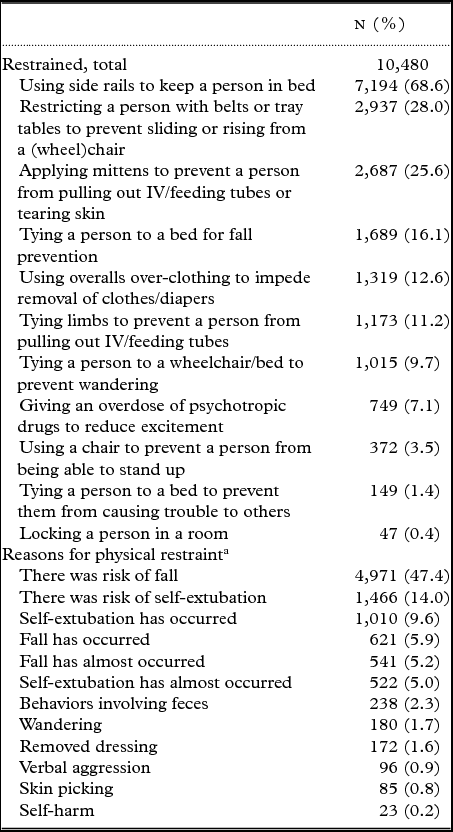
The primary outcome measure was “use of physical restraint” during the survey day. Physical restraint was defined as the use of any of the 11 means of mechanical restraint during the survey day. The 11 means of mechanical restraint were derived from the national guidelines for the prevention of physical restraint (Ministry of Health, Labour, and Welfare, 2011), and from the widespread definition of restraint used in general hospitals (All Japan Hospital Association, 2016) or, in long-term care settings (Kurata and Ojima, Reference Kurata and Ojima2014). If information indicating that a patient was restrained was obtained, the nurse manager was then asked to respond by indicating the most likely reason for the requirement of physical restraint. These reasons were classified into 12 categories developed by an expert panel that consisted of a psychiatrist (who has provided liaison-consultation services to acute hospitals), a nurse (working on persons with dementia), and a psychiatric social worker (who has experience in the prevention of abuse among the elderly in long-term care settings) (Table 1). The 12 reasons categories were based on the classifications from a previous study (Kurata and Ojima, Reference Kurata and Ojima2014) in Japanese long-term care settings, and modified to be applicable for a hospital care setting. To make our report compatible with the findings of studies in advanced countries, the prevalence of physical restraint use was determined, with the “use of mittens” excluded from the definition.
Means and reasons for physical restraint

Note: aThe most likely reason was indicated for the requirement of physical restraint per patient. For example, when nurses observed that a patient had almost fallen and then decided to implement physical restraint to the patient, the nurse manager then responded “a fall has almost occurred” but not “there was risk of fall.”
The primary exploratory variable was “unit certified for dementia care benefit.” Each unit was asked to rate whether the unit received a certification of the dementia care benefit or not.
The covariates were patients, unit, and hospital characteristics. Patient characteristics included age, sex, presence of dementia, and delirium. Presence of delirium was assessed using Japanese version of Nursing Delirium Screening Scale (Nu-DESC). The Nu-DESC is an observational 5-item scale each with a sub score of 0–2 points. A total of ≥2 points indicated the presence of a delirium (Gaudreau et al., Reference Gaudreau, Gagnon, Harel, Tremblay and Roy2005). Sufficient validity and reliability of the Japanese version of Nu-DESC has been reported (Ogawa, Reference Ogawa2015). In our sample, a Cronbach's α coefficient was moderate (0.75) for the Japanese version of Nu-DESC. The total score of Nu-DESC was significantly higher among patients in acute care units compared to those in sub-acute care units (t (17,343.8) = 7.99, p < 0.001).
Unit characteristics included nursing staff ratio per patient, number of inpatients on the date of questionnaire completion, type of care function, and type of clinical department. Type of care function was divided into acute care or sub-acute care. Type of clinical department was categorized into 43 items derived from the Survey on Medical Institutions by the Ministry of Health, Labour, and Welfare. However, care units made up 3.0% out of the 35 types of clinical departments. Therefore, to avoid the potential for bias due to a few observations (Greenland, Reference Greenland1989), the 35 types of clinical department were excluded from the analysis. The other eight (orthopedic surgery, rehabilitation, neurological surgery, cardiovascular internal medicine, gastroenterological internal medicine, respiratory internal medicine, gastroenterological surgery, and urology) were included as types of clinical departments.
Hospital characteristics included the availability of certified nurse specialists for gerontological nursing or psychiatric mental health nursing and certified nurses for dementia nursing. These certifications are accredited by the Japanese Nursing Association. Presence of psychiatrist for consultation-liaison and palliative care team were also assessed.
Ethical considerations
The study was approved by the ethics review board at the Tokyo Metropolitan Institute of Medical Science (No. 16–42, approval on November 18, 2016). The procedures followed were in accordance with the Helsinki Declaration of 1975, as revised in 2013.
Data analysis
Percentages of the five different signs of cognitive impairment used in diagnosing dementia were reported. Among patients categorized as having dementia based on the five signs above, confirmation of dementia was done. Thus, the percentages for the presence or absence of dementia confirmation, as well as the different confirmed diagnosis of dementia (Alzheimer's disease, vascular dementia, Lewy bodies, frontotemporal dementia, and unspecified dementia) were reported. Because of many patients without dementia diagnosis, absence of dementia diagnosis was included as an independent variable in the analysis.
As it has been recommended to avoid the use of bivariate analyses for selecting exploratory variables in multivariable analysis (Sun et al., Reference Sun, Shook and Kay1996), bivariate analysis according to the primary independent variable was used with reference to recent multivariable logistic analyses (Windham et al., Reference Windham2015; Chang et al., Reference Chang2016). Patient, unit, and hospital characteristics, total and with comparison between care units that received certification for the dementia care benefit and “any other” units, using t-test analyses and Mann-Whitney's U test for continuous variables and chi square (χ2) tests for categorical variables were reported. Additionally, the prevalence of patients with dementia was calculated in relation to the type of care, and the clinical department in which the care unit was situated.
A multilevel binomial logistic regression analysis was conducted using physical restraint as the dependent variable and “certification of dementia care benefit in the unit” as the independent variable. The logistic regression model included “care unit” as a random effect to account for correlations between patients within a care unit. Based on the previous findings on risk factors of physical restraint use (Krüger et al., Reference Krüger, Mayer, Haastert and Meyer2013; Hofmann and Hahn, Reference Hofmann and Hahn2014), age (40–64, 65–69, 70–74, 75–79, 80–84, 85–89, 90–94, and 95 years old or older), sex, and delirium were included as covariates. All other patients, units, and hospital characteristics were also included as covariates based on a priori clinical judgment. A sensitivity analysis was employed using the multivariable model where the use of mittens was excluded from the definition of physical restraint.
All statistical analyses were conducted using STATA SE for Windows, version 15.0 (StataCorp, College Station, Texas, USA). The two-tailed significance level was set at 0.05.
Results
Patient characteristics
Of the 3,466 hospitals meeting the inclusion criteria (with 100 or more beds) and to whom the set of questionnaires were sent, 1,187 (34.2%) responded to the written questionnaires. Those having no patients with dementia were further excluded from the 1,187 consenting hospitals. In total, 29,088 questionnaires concerning patients with dementia were collected from 2,676 care units from the 1,046 hospitals. Of the 29,088 questionnaires, 5,549 were excluded (Figure S1 available as supplementary material attached to the electronic version of this paper at http://journals.cambridge.org/jid_IPG). The final sample included in the analysis consisted of 23,539 questionnaires completed by staff from 2,355 care units from 937 hospitals.
Differences between the characteristics of the included and the excluded patients/care units/hospitals were determined. Significant differences were observed with patients’ age, sex, absence of dementia diagnosis, and presence of delirium (Table S1 available as supplementary material attached to the electronic version of this paper at http://journals.cambridge.org/jid_IPG). Among care units, significant differences occurred with acute care function while only the rehabilitation department differed significantly among clinical departments (Table S2). The presence of specialized palliative care team in hospitals also showed significant differences between included and excluded respondents (Table S3). The 937 hospitals included in the analysis had a greater mean in number of acute care beds when compared either to the 2,529 hospitals that were excluded or those who did not respond to the survey (t (1,670.95) = 5.87, p < 0.001).
Overall, the 23,539 patients with dementia had a mean of 83.1 years old (standard deviation (SD) = 9.0). There were 10,340 male patients (43.9%) and 1,015 who had delirium (4.3%; two or higher in Nu-DESC).
The sign of cognitive impairment included difficulty in living alone (n = 21,793, 92.6%), behaviors against instruction (n = 15,871, 67.4%), harmful behaviors/signs (n = 10,949, 46.5%), presence of cognitive impairment based on the scale under public long-term care insurance program (n = 21,558, 91.6%) or three or more score in FAST (n = 20,274, 86.1%).
There were 11,269 patients (47.9%) among whom the absence of dementia diagnosis was confirmed. Of the remaining 12,270 patients, dementia was diagnosed and included Alzheimer's disease (n = 3,860, 31.5%), vascular dementia (n = 2,582, 21.0%), Lewy bodies (n = 279, 2.3%), frontotemporal dementia (n = 105, 0.9%), and unspecified dementia (n = 5,032, 41.0%). Absence or presence of dementia diagnosis was not identified for the other 419 patients (3.4%).
As reported in Table 1, 10,480 (44.5%; 95% confidence interval [CI], {43.9, 45.2}) patients were restrained on the survey day. The major form of restraint consisted of bed side rails (n = 7,194, 68.6%), belt or bar in a (wheel) chair (n = 2,937, 28.0%), and mittens (n = 2,687, 25.6%). Major reasons for restraint was a risk of fall (n = 4,971, 47.4%) and risk of self-extubation (n = 1,466, 14.0%) (Table 1). When use of mittens was excluded from the definition of physical restraint, 9,643 patients remained under physical restraint (41.0%; 95%CI [40.3, 41.6]).
Unit characteristics
Of the 2,355 units in the final sample, 1,134 units were certified for the dementia care benefit (48.2%). The mean number of nurse staffing ratio per 100 inpatients was 24.6 (SD = 54.9). The median staffing ratio was 15.4; with inter quintile range (IQR) of 10.0–25.9. Types of clinical department included orthopedic surgery (n = 524, 22.3%), rehabilitation (n = 212, 9.0%), neurological surgery (n = 190, 8.1%), cardiovascular internal medicine (n = 141, 6.0%), gastroenterological internal medicine (n = 128, 5.4%), respiratory internal medicine (n = 120, 5.1%), gastroenterological surgery (n = 117, 5.0%), and urology (n = 97, 4.1%).
Patients with dementia comprised 23.2% of inpatients on the survey day in acute care units (15,938 out of 68,671), and 35.8% (7,717 out of 21,532) in sub-acute care units. The prevalence per type of clinical department was 36.9% (3,313 out of 8,982) in rehabilitation; 31.9% (2,281 out of 7,146) in neurological surgery; 25.9% (1,345 out of 5,185) in cardiovascular internal medicine; 24.4% (5,140 out of 21,042) in orthopedic surgery; 24.2% (1,102 out of 4,552) in respiratory internal medicine; 21.4% (1,041 out of 4,870) in gastroenterological internal medicine; 18.6% (664 out of 3,567) in urology; and 15.7% (708 out of 4,523) in gastroenterological surgery.
Hospital characteristics
Of the 937 hospitals, 441 had palliative care team (47.1%), 244 had consultation-liaison psychiatrists (26.0%), 201 had certified nurses for dementia nursing (21.5%), 33 had certified nurse specialists for psychiatric mental health nursing (3.5%) and 21 had gerontological nursing (2.2%).
Dementia care benefit and physical restraint
Out of the overall 23,539 patients in 2,355 units, there were 11,926 (50.7%) patients in 1,134 (48.2%) units with the dementia care benefit, while the remaining were the 11,613 patients in 1,221 units without the benefit.
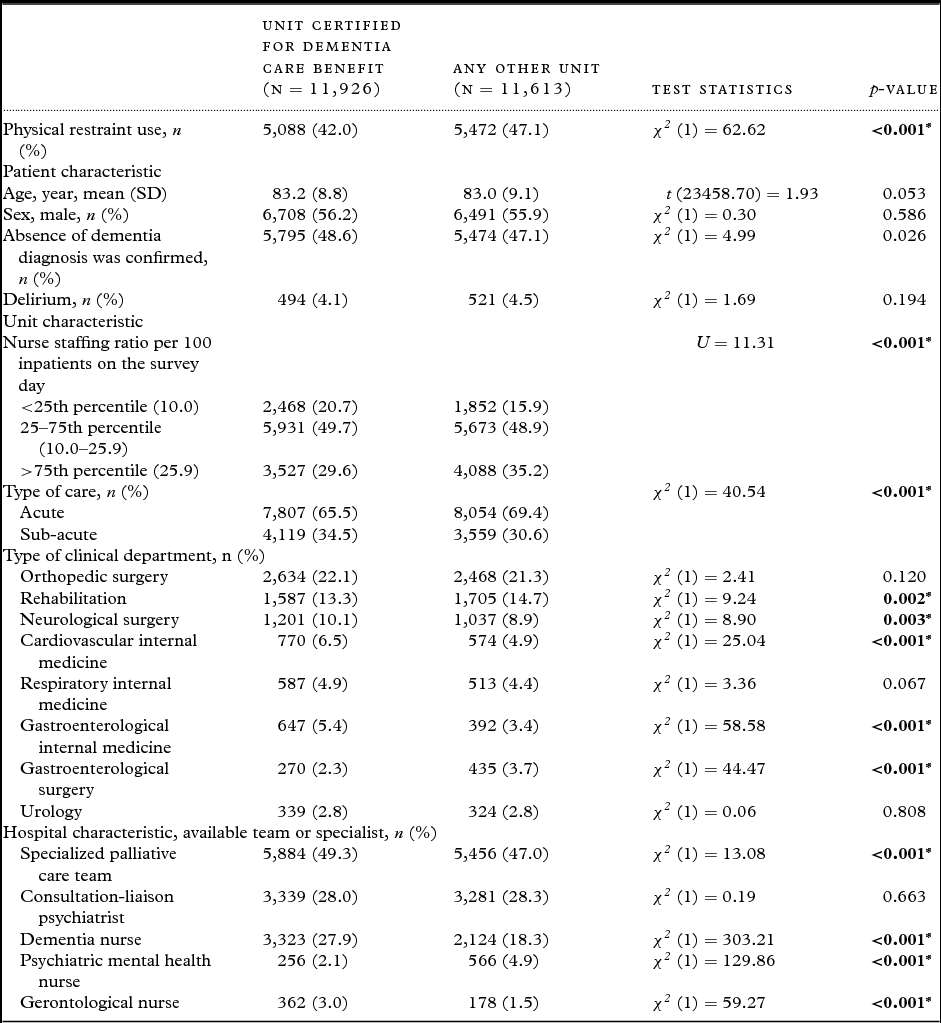
Of the 11,926 patients in units with the dementia care benefit, 5,008 (42.0%) of the patients with dementia were restrained on the survey day. After excluding “use of mittens” from the means of physical restraint, 4,574 (38.4%) patients remained restrained. In the bivariate analysis, patients in units certified for dementia care benefit were more likely to have no dementia diagnosis, if they were, in care units with smaller nursing staffing ratio per patient, in sub-acute care units, in the neurological surgery care units, cardiovascular internal medicine, and gastrological internal medicine, or in hospitals with specialized palliative care team, dementia nurse, and gerontological nurse. Patients in units with dementia care benefit were less likely to be in care units of rehabilitation and gastroenterological surgery, and in hospitals with psychiatric mental health nurse (Table 2). Because all patients with delirium were restrained, the presence of delirium was excluded from the multivariable logistic regression analysis.
Characteristics of inpatients with dementia in acute hospitals

Note: Bold, *significant at p < 0.05.
Delirium was assessed using Japanese version of Nursing Delirium Screening Scale (Nu-DESC).
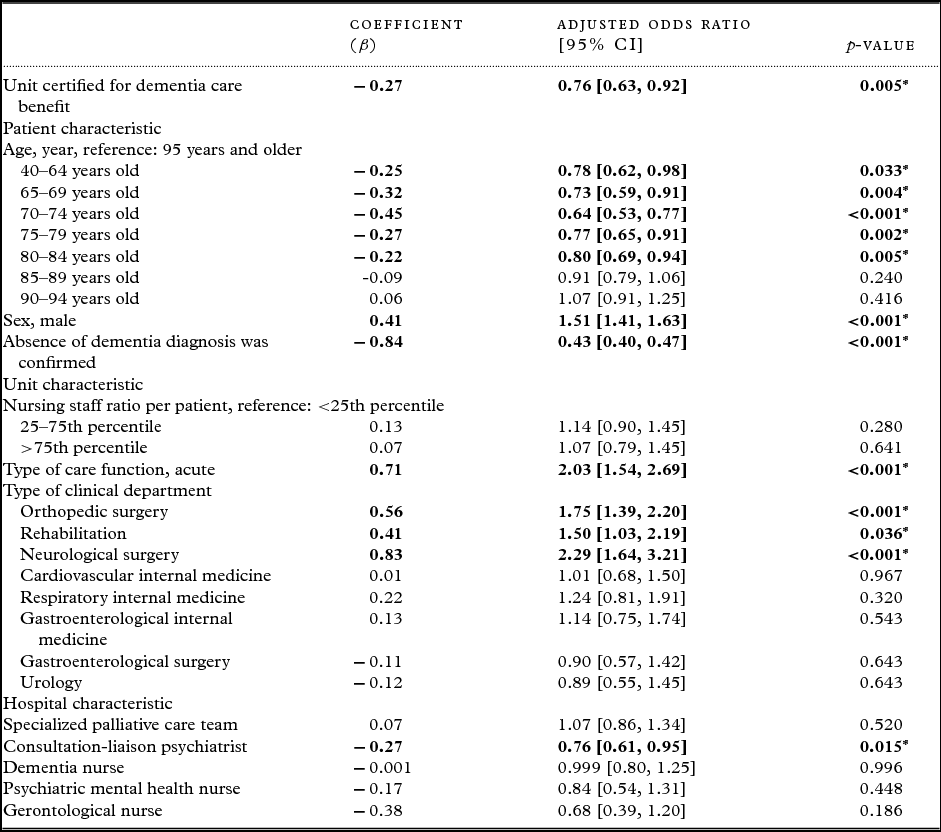
After adjustment for covariates, certification of dementia care benefit was associated with a 24% reduction in physical restraint (42.0% in units certified for dementia care benefit versus 47.1% in “any other” units; adjusted odds ratio, 0.76; 95%CI [0.63, 0.92]) (Table 3). This association was unchanged in the sensitivity analysis in which use of mitten was excluded from physical restraint means (Table). We also observed that male patients and patients in acute care functioning, orthopedic surgery, rehabilitation, and neurological surgery units were more likely to be restrained on the survey day. Patients with dementia were less likely to be restrained when they were 40–84 years old than those 95 years and older, when dementia diagnosis was absent, and when they were in hospitals with consultation-liaison psychiatrist. The random effect of care unit was 3.94 (Table 3).
Multivariable binomial logistic regression analysis of physical restraint among patients with dementia with adjusted odds ratio

Note: Bold, *significant at p < 0.05.
Multilevel binomial logistic regression analysis, χ2 (26) = 586.25, p < 0.001, random effect (care unit) = 3.94 (95%CI, [3.55, 4.36]). A likelihood-ratio test comparing the model to ordinary logistic regression: χ 2(1) = 5848.30, p < 0.001.
CI, confidence interval.
Discussion
Physical restraint
Physical restraint was common (44.5% on the survey day) in patients with dementia in acute care settings. The prevalence of physical restraint among patients with dementia was higher in acute care settings compared to that in Japanese group homes (1.8% on the survey day) (Zenkoku-Yokusei-Haishi-Kai, 2015), and in a United Kingdom acute care setting (22% during their admission) (White et al., Reference White, Leurent, Lord, Scott, Jones and Sampson2017). The overall prevalence did not change when “use of mittens” was excluded from the definition of physical restraint. The frequent reasons for restraint were a risk of fall and risk of self-extubation similar with the observed reasons in western acute care settings (Krüger et al., Reference Krüger, Mayer, Haastert and Meyer2013). Physical restraint following the occurrence of fall/self-extubation was less frequent. As the reasons for the high prevalence of physical restraint in our study population remain unclear, a larger survey, encompassing a more representative population, is required to elucidate the differences in use of physical restraint in relation to patient cognitive function and challenging behavior, and in the perspectives of the healthcare professionals toward patients with dementia.
Differences between units certified for dementia care benefit and other units
In the bivariate analyses, there were various unit and hospital characteristics with significant differences between units certified for dementia care benefit and any other units. One possible explanation for the difference is the availability of resources to fulfill the requirement for the certification of the dementia care benefit. Dementia nurses and gerontological nurses available in the hospitals could be involved in the establishment of dementia care manual that is required for the certification of dementia care benefit. Another possible explanation of the characteristics of each unit relating to the dementia care benefit is the elevated need for dementia care in some types of care units, such as sub-acute, neurological surgery, and cardiovascular internal medicine, as shown in the calculated prevalence of dementia.
Dementia care benefit and physical restraint
In the multivariable logistic regression analysis, certification of dementia care benefit in the unit was significantly associated with a lower prevalence of physical restraint among patients with dementia. This association was unchanged in the sensitivity analysis, in which the use of mittens was excluded from physical restraint means. However, there were still 42.0% (as opposed to 38.4% in sensitivity analysis) of patients with dementia restrained in the units with dementia care benefits. The dementia care benefit requires each care unit to establish a manual for mechanical and chemical restraint; it is possible that such manual enabled acute hospitals to restrain patients with dementia. In addition, the adjusted odds, when the absence of dementia diagnosis was confirmed were significantly decreased. Although we did not assess nurses’ perspectives regarding dementia, it is possible that the presence of dementia may have been taken as an indication for restraint. Therefore, an educational package should be developed to guide the dementia care approach including the need to avoid the use of physical restraint by healthcare professionals in acute care hospitals. It would be promising to improve the capacity of the staff to understand the behaviors of patients with dementia, as communication of unmet needs (Handley et al., Reference Handley, Bunn and Goodman2017).
Among the hospital characteristics, available liaison-consultation psychiatrist was significantly associated with reduced use of physical restraint in the multivariable logistic analysis. However, any nursing expertise or the palliative care team, showed no significant association with physical restraint. Nor did nursing staff ratio in the care units correlate with physical restraint use. Japanese public healthcare insurance program allows the use of specialized palliative care team at hospitals for last-stage AIDS and cancer patients only. Therefore, availability of palliative care team in the hospital may have had little relevance compared with non-specialized teams in the management of dementia in Japan. Moreover, even if healthcare professionals recognize dementia care approach, the use of physical restraint on patients may be enforced by the hospital management, on patients thus requiring hospital staff compliance (Sampson et al., Reference Sampson, Vickerstaff, Lietz and Orrell2017). Some uncontrollable environmental factors that would constraint the implementation of dementia care in acute care settings were reported, including space restrictions, and overall treatment demands on patients, (Martin et al., Reference Martin2016). Since there were correlations within patients in a care unit, observed as the random effect of care unit, organizational or cultural factors relating to physical restraint use may have remained unexplained by the unit characteristics in our model.
Limitations
Our cross-sectional study design could not be used to establish a causal model between physical restraint and the dementia care benefit. Our data lacked information on a few confounders such as the severity of physical illness, and among hospital characteristics; it also lacks information on carers with expertise in elderly care and with early diagnosis of dementia care. Moreover, our sample included older patients with diagnosis of dementia and delirium, patients in sub-acute and rehabilitation care units, and patients in hospitals with specialized palliative care team rather than those excluded from the analysis. Our results could therefore underestimate the prevalence of physical restraint. Our criteria of dementia could include patients with mental illness other than dementia. Nonetheless the findings in terms of physical restraint in acute hospitals offer a feasible insight into international ageing societies.
Conclusions
The present study is the first to indicate the association between dementia care benefit and the use of physical restraint among inpatients with dementia in a national general acute care setting. The financial incentive introduced with the dementia care benefit may have worked to reduce the use of physical restraint among patients with dementia in acute care hospitals. However, the use of physical restraint was still common among patients with dementia in units with the dementia care benefit. An educational package should be developed to guide a dementia care approach, in order to ensure that the use of physical restraint is avoided by healthcare professionals in acute hospitals.
Conflicts of interest
During the past 3 years, MN received personal fees from Eli Lilly, and grants from Pfizer Health Research Foundation, outside the submitted work. YO received personal fees from Janssen Pharmaceuticals, Inc., the Medical Technology Association, and Cando Inc., outside the submitted work. AO has no conflict of interest to declare.
Description of authors’ roles
M. Nakanishi designed the study, collected the data, conducted the statistical analysis, and wrote the paper. Y. Okumura assisted with the implementation of the survey and with writing the paper, and supervised the statistical design. A. Ogawa supervised all aspects and assisted with writing the paper.
Acknowledgments
The present study was funded by Japan Agency for Medical Research and Development, Research and Development Grants for Dementia, Grant Number 16dk0207024h0001. The funding source had no involvement in the design and conduct of the study; collection, management, analysis, and interpretation of the data; or preparation, review, or approval of the manuscript.
Supplementary material
To view supplementary material for this article, please visit https://doi.org/10.1017/S104161021700240X