Winter Storm Uri crippled the state of Texas with state power grid failures occurring in the wake of below freezing temperatures lasting several days between February 13 and 17, 2021. The Texas Freeze or Blackout, as it is otherwise known, is the costliest winter storm in US history due to higher than usual electrical consumption and associated energy blackouts as well as damages to buildings, infrastructure in general, and businesses; the entire state was placed under a state of emergency, with deaths caused from hypothermia, worsening of chronic conditions in the extreme cold, and carbon monoxide poisoning from gas powered electrical generation estimated between nearly 250 and hundreds more.Reference Senate1 Among some of the more at-risk groups during the storm were residents of nursing homes, as hundreds of such facilities lost power or access to drinking water, which compromised both COVID-19 infection control and sanitation as well as general health and safety, while many more reported other emergencies.Reference Senate1 This event was superimposed on the public health emergency resulting from COVID-19, in which nursing homes were the deadliest health care settings, particularly in the period spanning from the early pandemic into the winter surge lasting through March 2021, with reported COVID-19 mortality rates as high as 70% in some facilities.Reference Chidambaram and Neuman2
The combination of the COVID-19 pandemic and Winter Storm Uri has roused closer scrutiny of the long-term care (LTC) industry, highlighting its overall lack of preparedness for disasters. Prior to Winter Storm Uri, long-term care disaster research focused most prominently on Hurricane Katrina and the fallout of the storm in New Orleans among nursing home residents who were evacuated from facilities.Reference Dosa, Grossman and Wetle3 Following Uri, a good deal of the literature has bridged the knowledge gap regarding mortality due to extremely low temperatures as well as decreases in nursing staffing and evacuations in nursing homes during the storm.Reference Hanchey, Jiva and Bayleyegn4, Reference Jester, Peterson and Andel5 However, little research has analyzed nursing home outcomes during the disaster,Reference Jester, Peterson and Andel5 and none to our knowledge has evaluated mortality, specifically non-COVID-19 deaths in nursing homes, as a way to differentiate mortality caused by the pandemic and other causes of death.
Consequently, this report examines the differential trends of non-COVID mortality in Texas nursing homes compared to all other nursing homes in the United States during Winter Storm Uri. It has the following 2 aims. Aim 1: to test whether the timeframe during and following Winter Storm Uri was associated with an increase in non-COVID-19 nursing home mortality in Texas; and Aim 2: to evaluate whether this timeframe was associated with a change in non-COVID-19 mortality differences between nursing homes in Texas and all other states, resulting in a narrowing of deaths between an increasing Texas mortality rate in nursing homes relative to the rest of the US.
Methods
Data
This study used skilled nursing facility measures from the Centers for Medicare & Medicaid Services (CMS) Nursing Homes Including Rehab Services File, the CMS Nursing Home COVID-19 Public File, the 2021 Pandemic Vulnerability Index (PVI) dataset, and the National Centers for Environmental Information February 2021 Climate at a Glance County Minimum Temperature dataset.6-9 The CMS datasets were merged by provider, and the PVI dataset was linked to the CMS files by county FIPS code. The combined weekly dataset was limited to the weeks ending on February 14-March 14 of 2021, 4 weeks or 28 days following the beginning of Winter Storm Uri.
Outcome variable and covariates
The study outcome was weekly non-COVID-19 mortality, deaths not caused from COVID-19.
Independent variables and covariates
The 2 independent variables in this study are a dummy variable for Texas nursing homes and a panel variable representing 5 time points: February 14-March 14 2021, 4 weeks or 28 days from the beginning of Winter Storm Uri. Nursing homes from across the entire state of Texas were placed under a single categorical indicator variable, as the entire state was placed under a state of emergency by the state authorities, and because only Texas experienced such extensive effects compared to other states, many of which were also exposed to severe winter weather conditions during the timeframe of the storm.
Related covariates include ownership type, Medicaid certification, whether nursing homes were hospital-based, CMS overall quality rating, whether there was a shortage of nurses or nursing aides at the end of each week analyzed, the pandemic vulnerability index (PVI) as a county-level composite measure of social vulnerability, and each county’s lowest recorded temperature in February 2021 as a rough measure of the weather conditions surrounding nursing homes during the storm.Reference Jester, Peterson and Andel5, 9, Reference Cronin and Evans10 Additionally, the total number of occupied beds was used to normalize the count of non-COVID-19 deaths at each time point to account for patients still residing in nursing homes and those not evacuated or transferred during the storm.Reference Jester, Peterson and Andel5
Statistical Analysis
For Aims 1 and 2, a mixed-effects negative binomial spline analysis was conducted, calculating the change in non-COVID-19 deaths in Texas alone by setting Texas as the reference, as well as the change in Texas relative to nursing homes in all other states across the study’s 5 time points through an interaction parameter. A set of piecewise linear splines was specified between each time point, interacted with the Texas dummy variable to capture the linear change between each week in Texas nursing homes as well as the change in increase or decrease between Texas nursing homes and all other facilities in the United States, controlling for facility characteristics, social vulnerability, and temperature. Clustering of more than 1 observation per nursing home across the 5 time points was accounted for by a random intercept on provider number. Efforts to include an additional random intercept on county FIPS to model geographical dependence of nursing homes were confronted with convergence issues, as was the inclusion of random slopes across each of the 4 weeks of the study timeframe. A negative binomial estimator was utilized because the counts of non-COVID-19 deaths were over-dispersed. This analysis was based on de-identified, publicly available datasets and was deemed exempt from IRB review.Footnote 1
Results
As shown in Table 1, Texas nursing homes differed markedly from nursing homes in all other states at each week ending date, with the exception of Medicaid certification. Texas nursing homes experienced less non-COVID-19 mortality burden, were notably smaller in size, were more likely to be for profit or government facilities, were less likely to reside in a hospital, were less likely to experience a shortage of nursing staff or aides, had lower overall 5-Star ratings, were more vulnerable, and were in warmer climates by county compared to nursing homes in other states.
Characteristics of analytical sample of nursing homes 28 days following Winter Storm Uri by week and Texas compared to all other states

Notes: Temperature is a static measurement of the lowest observed temperature by county in February 2019, measuring the impact of the storm in mid-February and not any lingering effects into March. Time varying variables include non-COVID-19 deaths, number of residents, shortage of nursing staff, and shortage of aides. The sample at each week ending timepoint was 14 501, totaling 72 505 observations.
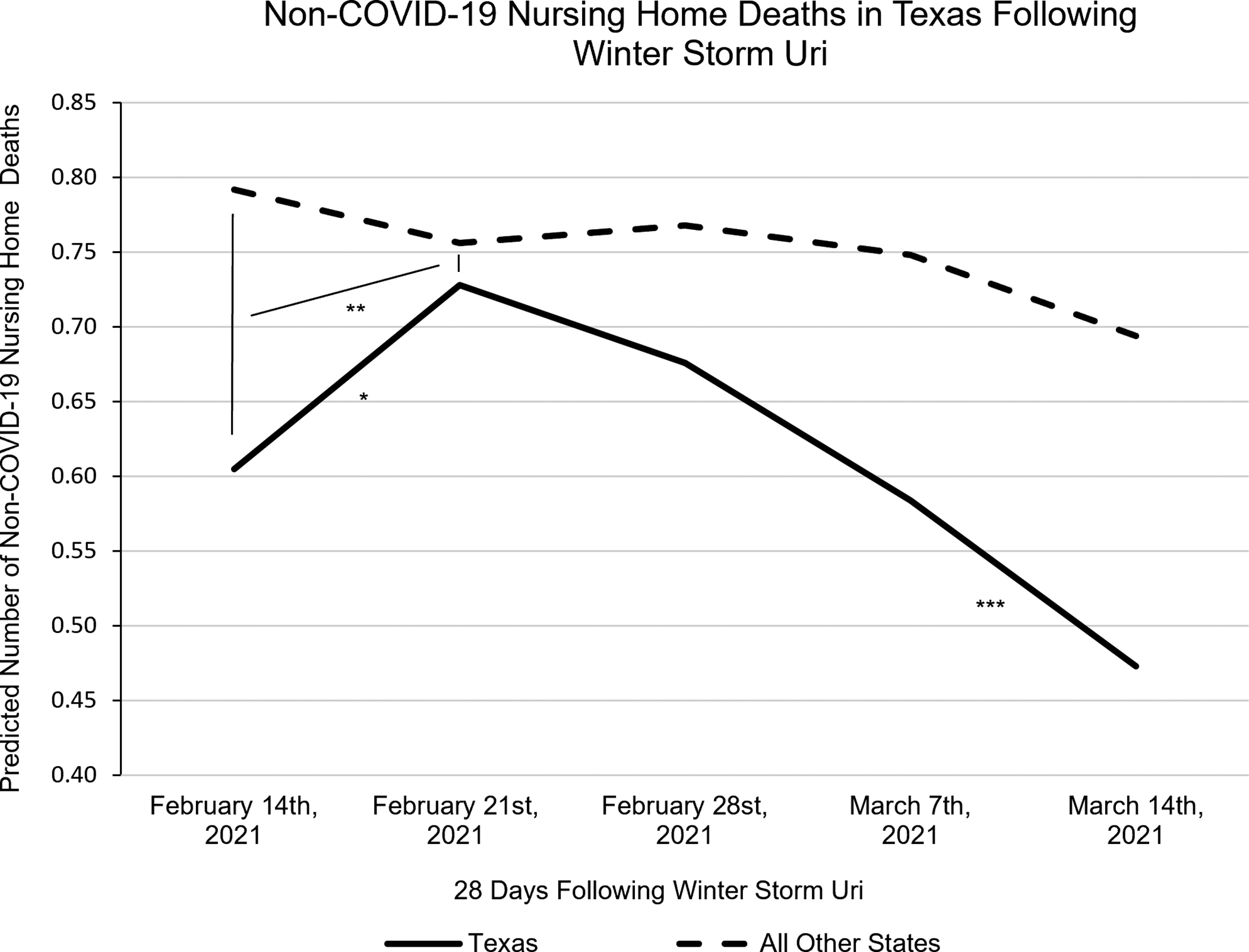
For Aim 1, non-COVID-19 deaths were regressed onto the interaction of the Texas nursing home dummy and panel variables, with Texas nursing homes as the referent to show the increase in deaths in Texas alone as well as the magnitude of change between nursing homes in Texas relative to the rest of the United States in the interaction as shown in Table 2. In the adjusted model, Texas nursing homes experienced a 20% increase in non-COVID-19 deaths from February 14-February 21, 2021, equating to a change from 0.61 to 0.73 predicted deaths, and a 19% decrease in deaths from March 7-March 14, 2021, representing a change from 0.58 to 0.47 deaths, as depicted in Figure 1. For Aim 2, the adjusted model shows a reduction in the change of deaths between nursing homes in Texas and all other states between February 14-February 21, 2021, representing a 19% decrease in the difference between the 2 during that week. Although the overall number of deaths across the timeframe was lower in Texas nursing homes compared to the rest of the United States (results from separate statistical test not shown), and was lower on February 14, March 7, and March 14, 2021, there was no statistical difference between non-COVID-19 mortality between Texas nursing homes and all other states on February 21 and February 28, 2021 directly after the storm.
Mixed-effects negative binomial spline regression of non-COVID-19 nursing home deaths in Texas following Winter Storm Uri

Notes: NH denotes nursing homes. *=P<0.05, **=P< 0.01, ***=P<0.001. Mixed-effects spline modeling based upon 14 501 complete case observations at each of 5-week ending timepoints from February 14, 2021-March 14, 2021, totaling 72 505 observations.
Predicted non-COVID-19 nursing home deaths in Texas compared to all other states during and following Winter Storm Uri. *Denotes a significant increase in deaths in Texas nursing homes from February 14-February 21, 2021. **Denotes a significant change in the increase or decrease of deaths between Texas nursing homes and all other facilities in the US. ***Denotes a significant decrease in deaths in Texas nursing homes from March 7-March 14, 2021.

As shown in the adjusted results of Table 2, in terms of covariate effects, the number of beds in nursing homes, ownership type, nursing homes residing in hospitals, shortage of nurses, CMS overall rating, and temperature were all associated with non-COVID-19 mortality. The number of beds in nursing homes, or a 1-bed increase in the size of nursing homes, was associated with a 1% increase in deaths. Non-profit nursing homes were associated with a 25% increase in deaths compared to for profit facilities. Skilled nursing facilities with Medicaid certification experienced a 33% increase in mortality. A shortage of nurses in facilities was associated with a 17% increase in deaths, while a shortage of nursing aides was linked to a 11% decrease in mortality. The CMS overall rating was associated with an increase in non-COVID-19 deaths in 3-, 4-, and 5-star facilities compared to 1-star facilities. Specifically, 3-star facilities experienced 17% more deaths than 1-star facilities, while 4-star facilities had 20% more, and 5-star facilities had 19% more. The lowest temperature in February in each US county was associated with a 1% decrease in non-COVID-19 mortality.
Discussion
Natural disasters and infectious diseases may result in both increased morbidity and mortality. Given the COVID-19 pandemic’s global scale, the co-occurrence of natural disasters such as extreme cold is inevitable. However, the impact of natural disasters on mortality during the pandemic is understudied. This study sought to address this gap by examining how Winter Storm Uri was associated with differential non-COVID-19 mortality during the pandemic among skilled nursing facilities.
Discerning the effect of living in a Texas nursing home on non-COVID-19 mortality during the first winter surge of the COVID-19 pandemic and Winter Storm Uri in February 2021, one of the coldest stretches of winter on recent record in the state, is a complicated question. The literature contains studies demonstrating somewhat counterintuitive findings when examining non-COVID-19 mortality in skilled nursing facilities. For instance, nursing homes with higher CMS overall ratings experienced elevated levels of non-COVID-19 mortality across the board during that time period, which comports with the findings of the current study, showing as many as 20% more deaths in higher rated facilities.Reference Cronin and Evans10 The existing evidence suggests isolation in more precautionary and higher rated facilities as one of the more salient predictors of non-COVID-19 mortality, especially among nursing home residents with cognitive comorbidities. In other words, there was a mixed experience of reduced COVID-19 infection and mortality in higher rated facilities due to better enforcement of quarantine protocols, but higher non-COVID-19 mortality as a result of prolonged loneliness and isolation, which were associated with malnourishment and limited interactions with health care providers in and out of these facilities.Reference Levere, Rowan and Wysocki11 Additionally, although historical trends reveal elevated levels of all-cause mortality in nursing homes in winter months, these rates are similar to those reported in other seasons, especially when set alongside the sharply differential COVID-19 mortality rates by month during the pandemic.12 These trends suggest that any excess mortality during February 2021 could be reasonably attributed to COVID-19 or other catastrophic events such as Winter Storm Uri. As demonstrated in Figure 1, between February 14 and February 21, 2021, non-COVID-19 deaths increased meaningfully during the storm in Texas, implying other forces besides the pandemic and typical causes of death.
As difficult as it is to disentangle non-COVID-19 mortality in nursing homes, evaluating these deaths during the worst natural disaster in US history by cost as well as the COVID-19 pandemic requires an even finer level of analytical interpretation. For instance, anecdotal and scientific evidence demonstrate that it was not merely a matter of extremely cold weather that made the difference but the underlying infrastructure of the individual locations and states through which the storm passed. States like Minnesota, which reported much colder weather than Texas and whose counties were overwhelmingly represented in the lowest decile of lowest recorded temperatures in February 2021 during the time period, weathered the storm with an energy system that was pressed to the limits, undergoing unprecedented hikes in natural gas costs, but that remained essentially intact.Reference Cronin and Evans10 In contrast, the state of Texas, which relies on an intra-state grid and system of electrical energy production and which limits connection to the main electrical grids serving the US, faced large scale blackouts when power failed across each type of energy production, including gas, coal, wind, solar, and nuclear technologies.Reference Senate1 As shown in this study, although an increase in the coldest temperatures in February 2021 was associated with a decrease in non-COVID-19 mortality in nursing homes throughout the US, the state of Texas experienced a significant increase in deaths as a relatively warmer climate during the storm, signaling other unobserved factors such as energy infrastructure in Texas and its nursing homes. However, as noted, Texas experienced an overall lower non-COVID-19 mortality rate in nursing homes compared to the rest of the US, even while suffering a significant increase in non-COVID-19 mortality directly after the storm.
Limitations
This study analyzes weekly data, limiting a more robust evaluation of time effects across each day of Winter Storm Uri. Longitudinal modeling evaluating the daily effect of the storm in Texas could present a more finely tuned analytical approach but is not currently feasible without more granular non-COVID-19 mortality time series data.
Conclusions
This study shows that Texas suffered a significant increase in non-COVID-19 nursing home mortality directly after Winter Storm Uri, which significantly converged with a declining rate of deaths in comparison to the rest of the country, despite experiencing an overall lower level of mortality. These findings are significant to the disaster medicine literature as they substantiate anecdotal, municipal, and regional accounts of catastrophic energy system failures in Texas, which led to higher levels of mortality in the state during February 2019. More importantly, the results add to mounting evidence, particularly following the COVID-19 pandemic, of the precarious and vulnerable nature of nursing homes, which serve some of the most at-risk adults, during crisis, urging augmented efforts in protecting these healthcare settings during overlapping disasters. Future research should investigate other geographies impacted by energy outages to better understand the storm’s broader impacts beyond Texas.
Author contribution
Stephen Frochen gathered the data, modelled the analytical dataset, and wrote the report. Debra Saliba and Aram Dobalian coauthored and edited the text and provided conceptual and analytical feedback on the methods and analysis.
Acknowledgements
This material is based upon work supported by the United States Department of Veterans Affairs. The views expressed in this report are those of the authors and do not necessarily reflect the position or policy of the US Department of Veterans Affairs or the US government.
Funding statement
This report is based upon work supported by the United States Department of Veterans Affairs, Veterans Health Administration, Office of Patient Care Services, and the Department of Veteran Affairs, Veterans Health Administration, Office of Academic Affiliations.
Competing interests
None.