Introduction
Housing and management of laying hens and their productivity have gone through periods of substantial change in the last century. Eighty years ago (around 1935), flock size was a few hundred birds maximum. Worldwide there was a large variety of breeds for egg production, with some pure layer lines and others bred for dual purposes (meat and eggs). Famous breeds were Rhode Island Red, Australorp, Sussex, Plymouth Rock and White Leghorn, but most regions had their own variety of local breeds. The hens were kept in free-range systems. Egg production averaged about 200 eggs/hen/year and mortalities of 20-30% per year were not uncommon (Ketelaars, Reference KETELAARS1992). Sixty years ago (around 1955), a rapid transformation from many breeds and more or less pure lines to hybrid hens, mainly originating from the USA, took place (Carter, Reference CARTER1964). The large variety of breeds was reduced and crosses derived from Rhode Island Red or White Leghorn have dominated ever since. Flocks became larger and closed houses without outside access were introduced (Carter, Reference CARTER1964).
Fifty years ago (around 1965), housing systems changed radically, when battery cages became the predominant housing system for laying hens. The number of hens per farm increased rapidly, because of a huge reduction in labour requirements due to the cage housing and the introduction of feeding automation, watering and collection of eggs. Forty years ago (around 1975), discussions on welfare of hens in cages was initiated by the Brambell committee (1965) among others, which became more forthright and led to a demand for alternatives, promoting barn and free-range systems. Thirty years ago (around 1985) the first alternatives to battery cages appeared in the field and were tested for animal welfare and production (Craig and Adams, 1984; Fölsch et al., Reference FÖLSCH, HUBER, BÖLTER and GOZZOLI1988). Besides barn housing which had been used from early days, aviaries were designed to utilise the vertical space and, about 20 years ago (around 1995), the first enriched and colony cages were tested. In Europe, national and international research programmes on the welfare of laying hens were set up to improve housing systems and to compare animal welfare and sustainability in different housing systems ( Laywel, 2003; Spoelstra et al., Reference SPOELSTRA, GROOT KOERKAMP, BOS, ELZEN and LEENSTRA2013). In Europe and some states in the USA, legislation with regard to housing of laying hens was put in place from the 1990's, banning traditional battery cages (European Union, 1999; USA, California, 2008; Michigan, 2009). In the EU the ban on traditional cages was effective from 2012 onwards.
The history of poultry genetics during the last century has been described by Tixier-Boichard et al. (Reference TIXIER-BOICHARD, LEENSTRA, FLOCK, HOCKING and WEIGEND2012). They focussed on classical and molecular genetics used in breeding systems for egg and meat type chickens. Neeteson-Van Nieuwenhoven et al. (Reference NEETESON-VAN NIEUWENHOVEN, KNAP and AVENDAÑO2013) described the role of sustainable commercial poultry breeding to enhance food security, while Flock et al. (Reference FLOCK, LAUGHLIN and BENTLEY2005) discussed the role of breeding and genetics in improving poultry welfare. In this paper the development of breeding and the selection of laying hens over the last few decades is reviewed, and data regarding whether different housing systems require different selection programmes are discussed along with breeding and selection of hens for the current range of housing systems.
Housing systems for laying hens
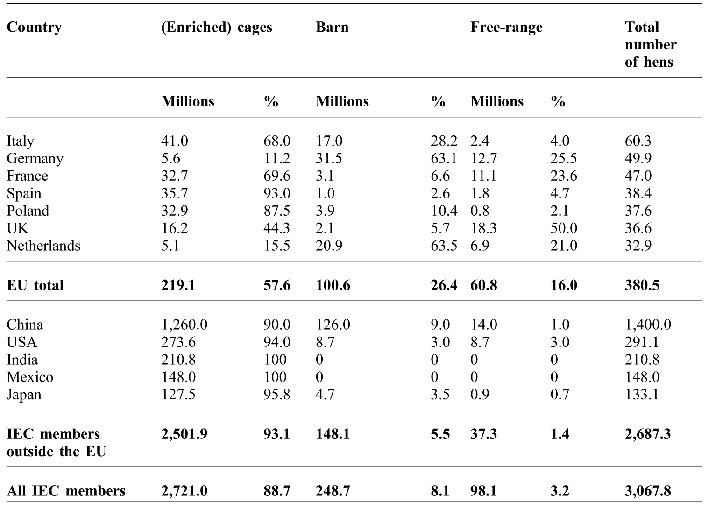
Worldwide, most hens are still kept in intensive systems with 88.7% of the hens in IEC member countries being kept in cages, which are enriched in the EU, while standard cages dominate in the rest of the world. Only 3.2% of the hens in IEC member countries are kept under free-range systems. (Table 1, Windhorst, Reference WINDHORST2015). In the EU, free-range systems are important in the UK (50% of hens), Germany, France and The Netherlands (20-25% of hens).
Housing of laying hens in large egg-producing countries in the EU, the EU in total and in large egg-producing countries outside the EU. Data from 2013, after Windhorst, Reference WINDHORST2015).

Enriched and colony cages provide the hens with more facilities to fulfil their behavioural needs (nest box, perches and dust bath), but are more or less similar to the traditional cage environment with regard to separation of hens from their droppings and group size (from 5 to 100). In non-cage systems (barns and aviaries), hens and their droppings are not fully separated, and hens have to find their way in a three-dimensional large space and flock size is large - often several thousands. Lay et al. (Reference LAY, FULTON, HESTER, KARCHER, KJAER, MENCH, MULLENS, NEWBERRY, NICOL, O'SULLIVAN and PORTER2011) compared housing systems for laying hens on a variety of welfare aspects.
Contact with soil and litter in general, and outside access more specifically, increased the variation in conditions and the risk for diseases to which hens are exposed. Several studies have indicated that mortality in litter-based systems is higher than in cage systems, and parasitic and bacterial infections have a higher prevalence (Fossum et al., Reference FOSSUM, JANSSON and ENGELSEN ETTERLIN2009; Eriksson et al., Reference ERIKSSON, NYMAN, FELLSTRÖM and WALLGREN2013). Breeding companies have to take this into account and their birds should be able to perform in such environments.
The market for hens in non-cage systems is increasing, and in Europe it is no longer a niche market with about 42% of the hens in 2013 in non-cage systems (Windhorst, Reference WINDHORST2015). Egg production systems with outside access, with its increased disease and mortality risk (Fossum et al., Reference FOSSUM, JANSSON and ENGELSEN ETTERLIN2009; Lay et al., Reference LAY, FULTON, HESTER, KARCHER, KJAER, MENCH, MULLENS, NEWBERRY, NICOL, O'SULLIVAN and PORTER2011; Eriksson et al., Reference ERIKSSON, NYMAN, FELLSTRÖM and WALLGREN2013) remains a minority, albeit a substantial one, with about 16 million hens in Europe under such systems. Outside Europe, traditional cage systems dominate. However, in the USA, Australia and New Zealand there is a tendency to move to aviaries, enriched and colony cages (Sambeek, pers. comm.)
The performance in free-range and organic systems with regard to numbers of eggs and mortality lags behind the barn and cage systems, with cage systems having the highest production, most favourable FCR and lowest mortality (Flock, Reference FLOCK2009; Leinonen et al., Reference LEINONEN, WILLIAMS, WISEMAN, GUY and KYRIAZAKIS2012), but the gap in productivity is closing (Leenstra et al., Reference LEENSTRA, MAURER, GALEA, BESTMAN, AMSLER-KEPALAITE, VISSCHER and VERMEIJ2014). Non-cage systems and outside access imply more activity among the hens, which can lead to increased energy requirements and thus a less favourable FCR.
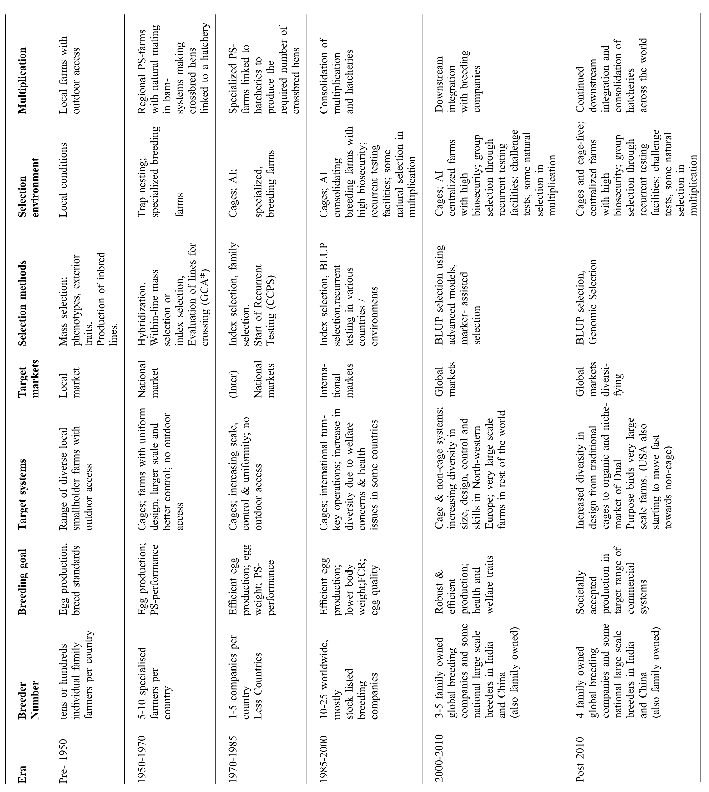
Whether, and to what extent, differences in production are a consequence of the system or are due to hens not sufficiently adapted to the housing system is not clear. The history of how poultry breeding and selection matched to production systems is summarised in Table 2.
History of matching layer production systems with the most suitable genotype.
*) GCA: General Combining Ability
Developments in poultry breeding and production
Since 1945, the layer breeding sector has changed dramatically from hundreds of small breeders per country (Carter, Reference CARTER1964) to two to three companies sharing the world market for commercial laying hens. Between 1945 and 1960, hybrid layers were introduced and the production of layers gradually shifted from the large number of local breeders with limited capacity (in fact poultry farms) to more specialised companies.
Between 1960 and 1980, breeding companies changed from regional to national scale, and international trade in stock increased. The most productive local and regional strains, based in general on the Rhode Island Red and White Leghorn types, spread across the world. At the same time, the capacity of hatcheries increased to accommodate demand. The process of consolidation in the poultry breeding sector started in the USA with specialised breeding companies in the early 1980s. This continued to reach the extend whereby most poultry breeding companies were owned by pharmaceutical companies in the mid-1990s and later by large integrations or feed companies, as general stock listed, USA-based multinationals. Thereafter, many of the brands of commercial layers commonly used in North America or Europe changed ownership through buy-outs to private north-west Europe-based companies. Currently the EW Group, Germany (which owns Lohmann, H&N and Hyline trade marks) and the Hendrix-Genetics Group in The Netherlands (which owns Bovans, Hisex, Dekalb, Babcock, ISA and Shaver trade marks) share more than 90% of the market for commercial laying hens. Tetra (a Hungarian company) and Novogen, owned by the French Grimaud family, are smaller and newer companies. The result of this consolidation process has been reduced number of breeding companies, each offering several brands or products.
Another factor affecting the structure of the poultry breeding industry has been the consolidation of the egg value chain over the years. Fewer companies are keeping more birds and the number of hatcheries is decreasing, and uniformity among laying hens in a flock has become more important. Larger commercial flocks means larger parent stock flocks. Parent stock numbers have to be large to deliver sufficient hatching eggs in one batch to allow for all-in/all-out production on commercial farms, with maximised uniformity among hens. Utilisation of hatching eggs and logistics is crucial, and breeding companies are moving downstream in the layer production chain to market commercial layers instead of parent stock. As a consequence of the increased scale in mainstream egg production, it has become more difficult to breed and produce dedicated breeds or crosses for niche markets or alternative systems. Moreover, the market for eggs is very much cost driven, while differences in eating quality and functional properties between eggs are relatively small. Although the demand for eggs from alternative systems is growing, worldwide the willingness to pay extra for eggs from such systems remains relatively small. The space for extra investments in breeding programmes for alternative productions systems is therefore limited.
Development in selection goals
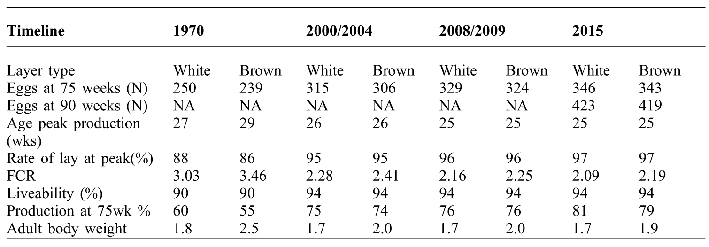
In his description of selection in laying hens, Crawford (Reference CRAWFORD1990) included production, egg weight, body weight, egg quality traits, feed efficiency, disease resistance and single gene traits as important selection criteria. The latter traits are required to sex chicks immediately after hatch. Modern hybrids have greatly improved economic traits (Van Horne et al., Reference VAN HORNE, BELL, NYBERG LARSEN and YDING2014). Data of ISA/Hendrix-Genetics, collected between 1970 and 2015, clearly illustrate this (Table 3) .
Developments in performance of laying hens (Sambeek, personal communication).
Part of this increase in productivity is due to more prolonged life in laying hens. Across the globe there is a trend towards layer farms specialising in production of table eggs or eggs for the processing industry. For table eggs, shell quality (strength, uniformity and colour) is very important, while for egg processing, eggs with a higher yield are important (percentage solids and total liquid yield). Modern dietary trends in processing currently favours eggs with a relatively high albumin yield and a relatively low yolk yield. Until recently, eggs from non-caged systems were almost exclusively used as table eggs. However, food industries are increasingly demanding egg products from non-cage systems.
Productivity traits still are important, but adequate social and nesting behaviour are additional requirements for non-cage systems (Flock, Reference FLOCK2009; Icken et al., Reference ICKEN, CAVER, SCHMUTZ and PREISINGER2012). Breeding programmes have been adapted to the new requirements from commercial stock in the field. Breeding goals have become more balanced and animal welfare traits (e.g. behaviour, liveability and feather cover) were introduced. Due to the shift to alternative housing systems, feather pecking and smothering, both typical in hens kept in large groups (barns, aviaries or free-range systems) have become apparent as important negative characteristics (Lay et al., Reference LAY, FULTON, HESTER, KARCHER, KJAER, MENCH, MULLENS, NEWBERRY, NICOL, O'SULLIVAN and PORTER2011). For non-cage systems feather cover is an important trait from the consumers’ perspective, and is essential for marketing.
Breeding companies have started breeding for more robust birds, i.e. those that are more docile, less aggressive and have optimal feed intake, but are still sufficiently active for nesting behaviour and have a high egg production with good persistency. A number of PhD studies have focussed on the genetic background of feather pecking, utilising lines of ISA that happened to have a high or a low incidence of this behaviour (Buitenhuis, Reference BUITENHUIS2003; Hierden, Reference HIERDEN2003; Riedstra, Reference RIEDSTRA2003; Rodenburg, Reference RODENBURG2003) and their results have been incorporated into various selection programmes.
Another project focussed on the robustness of ISA laying hens. In this project, rearing conditions, genomics and epigenetics were included in the research (Uitdehaag, Reference UITDEHAAG2008; Star, Reference STAR2008; Ellen, Reference ELLEN2009; Biscarini, Reference BISCARINI2010). The heritability of several important traits in cage-free systems is relatively low, and hence environment (management) has a big impact.
Developments in selection methods
Carter (Reference CARTER1964) gave an overview of the onset of selection for production in poultry in the late nineteenth century. Specialist breeders started measuring performance in individual hens and made progress, although they still paid a lot of attention to ‘breed standards’, i.e. colour of feathers, shape of comb, size of the bird and so on. Around 1900, tests were set up where breeders could compete with their flocks under similar circumstances. Around 1930, Random Sample Testing stations, as proposed by Hagedoorn (Reference HAGEDOORN1927), developed from such competitions across Europe and North America.
In the second half of the twentieth century, theory and practice in poultry breeding developed simultaneously (Hutt, Reference HUTT1949). Due to the large numbers of progeny and short generation interval, poultry breeders quickly grasped the concepts of high and low heritability, selection intensity, genetic correlations between traits (favourable and unfavourable), utilisation of information from relatives and selection from partial records. Altogether this lead to forms of index selection. The theory leading to index selection and its’ mathematical basis was developed around 1940-50 by Hazel and Lush (Reference HAZEL and LUSH1942) and Hazel (Reference HAZEL1943). This type of selection was carried out within lines or breeds. Practical applications of this method have been developed in-house by a small number of breeding companies.
Improving purebred lines using performance records of purebred and crossbred relatives was initially limited, because selection index theory only allowed the inclusion of information from direct relatives. The combination of the development of Henderson's Mixed Model type III (Henderson, Reference HENDERSON1953) and the set of rules to set up the inverse pedigree relationship matrix directly (Henderson, Reference HENDERSON1976; Quaas, Reference QUAAS1976) allowed the inclusion of information from, in principle, all relatives. This method is generally referred to as ‘best linear unbiased prediction’ (BLUP) after the statistical properties of the method. It was not until 1985 that sufficiently powerful computers were available in practice to use this method routinely. Initially, only sire models were used, but animal models became common after 1990.
For some traits, performance or progeny records have not been made available for selection candidates. DNA marker information was recognised early on as a potential means to discriminate between selection candidates for such traits. When DNA markers became available in the early 1990s, the method of choice was to identify markers with a significant impact on a trait and use this information in the selection process (marker-assisted selection). Meuwissen et al. (Reference MEUWISSEN, HAYES and GODDARD2001) proposed predicting breeding values from a very large number of DNA markers, so-called SNPs, without testing for significance. This method is generally referred to as ‘genomic selection’, and is gradually being adopted in commercial breeding programmes across various species in animal production.
Modern breeding programmes to produce commercial crossbred layers are designed to fully utilise heterosis and combining abilities. They generally involve structured crossing of three or four purebred lines that exploit sex-linked characteristics, such as colour and feather-development to facilitate sexing of day-old-chickens.
Around 1940, poultry breeders experimented with crossing of lines and showed that crossbred birds generally performed better than the parental average. For commercial poultry, this had already been observed earlier in the 20th century, but finding the right combination of parental lines was initially a matter of trial and error.
To fully utilise the potential of production with crossbred birds, two important methods were developed. The first method focussed on identifying the most suitable type of crossbred using extensive crossing schemes between a large number of lines to test for ‘general combining ability’ and with the most successful lines for ‘specific combining ability’ (Griffing, Reference GRIFFING1956). The design of the crossbreeding structure of modern breeding programmes in poultry is based on this method.
Crossbreeding as an objective in the design of the breeding programme requires that purebred lines be selected on crossbred performance. This is the objective of the second method, termed ‘Recurrent and Reciprocal Recurrent Selection’ as proposed by Comstock et al. (Reference COMSTOCK, ROBINSON and HARVEY1949) for corn and Hutt (Reference HUTT1949) for poultry. This method utilises information on crossbred relatives for genetic selection of purebred animals. It allows selection of purebred lines for specific combining abilities.
Developments in selection environments
The objective of genetic selection is to improve the suitability of birds in commercial production environments. Initially, egg production was recorded using trap nests in barn systems. This continued after birds used for commercial egg production were increasingly hybrid and genetic selection of pure lines was adopted by specialised breeding farms. Purebred selection was only moved from floor to cages in the 1970's, when AI was introduced for chicken and cages had become the dominant commercial housing system. Individual cage housing for purebred breeding stock created an enormous improvement in accuracy of measurements on egg production data and, consequently, faster genetic gains.
Breeding companies used AI and individual cage housing in the pure lines to facilitate pedigree recording and individual testing. This, however, caused the purebred selection environment to be very different from commercial farms. From the late 1970's onwards, the (Reciprocal) Recurrent Testing was introduced to test crossbred offspring in practical commercial conditions. Data collected in these field tests now receive more priority in selection indices than ever before, including group testing for mortality, pecking and feather cover.
The concept of four-way crosses implies that there are at least two multiplication steps: to produce parents and to produce the commercial four-way cross. In these multiplication steps, ‘natural’ selection takes place, i.e. birds that do not perform well, will be less represented in the next generation than birds that ‘fit in the system’. In these multiplication steps the hens and cockerels mate naturally and are kept in large groups in barn-housing. Birds that cannot survive in such an environment will not be represented in the next generation. The same is true for hens that do not lay their eggs in the nests, as floor eggs are not used as hatching eggs. If the two multiplication steps take place in target production environments, natural selection for suitability in e.g. floor systems with litter and large groups, takes place. Moreover, it provides breeding companies with a means to continuously monitor whether specific pure lines or crosses perform below expectation in those systems, express behavioural problems, such as feather pecking, smothering or avoid using nest boxes.
Since about 2005, the diversity of production environments and the dynamics within production environments have been increasing more rapidly than before. Whereas, in the past, breeding candidates were mostly kept in environments comparable to commercial conditions, in the last few decades the environment of selection reflects the environment less, calling for testing under various production circumstances. This includes data of multiple production environments and novel methods to breed for resilience (Mulder et al., Reference MULDER, HILL, VEREIJKEN and VEERKAMP2009) allow genetic selection for relative trouble-free production across a wider range of management systems and environments.
More recently, methods such as group selection have been developed to select for suitability in the social environment of commercial production farms (Muir et al., Reference MUIR, WONG, ZHANG, WANG, GROENEN, CROOIJMANS and CHENG2008; Ellen, Reference ELLEN2009). The next step will include further development of identification, tracking and tracing systems that facilitate registration of individual behaviour and performance in group housing. Electronic trap nests and similar systems to register use of outdoor areas by individually labelled hens are already available for flocks up to a few hundred birds. It can be expected that this technology will be available for larger groups in the near future (Thurner et al., Reference THURNER, WENDL and PREISINGER2006; Icken et al., Reference ICKEN, CAVER, SCHMUTZ and PREISINGER2012). Breeding companies have to consider how to introduce the technology and the floor housing systems in the high biosecurity environment of pure line selection.
Performance in alternative systems
During the transition from cage to alternative systems, including free-range and organic farming, there has been a search for alternative genotypes for many years, with the intention to breed more robust layers. Poultry farmers have been known to change every other flock to another breed in order to optimise the technical and economic performance of layers in alternative systems (Sambeek, personal communication).
In Europe and North America the general public associate brown shelled eggs as ‘free-range’ or ‘barn’, while white shelled eggs were associated with cage production. Consequently, most birds housed in free-range systems were hens laying brown shelled eggs. Production in these environments lagged behind that in battery cages and thus different crosses were tried: not only the standard cross where hens are brown and cockerels white, but also the reverse cross, giving white feathered birds laying brown shelled eggs. In cage-systems, these so-called ‘Silver’ or ‘Amberlink’ birds had high egg production, small egg size and better feather cover. Based on this data, Silver and Amberlink birds have been chosen by quite a large number of farmers with free-range or organic systems. However, these types turned out to have insurmountable problems in these systems, whereby smothering behaviour in particular resulted in unpredictable, high mortality (Bright and Johnson, Reference BRIGHT and JOHNSON2011; Sambeek, personal communication; Leenstra et al., Reference LEENSTRA, MAURER, BESTMAN, VAN SAMBEEK, ZELTNER, REUVEKAMP and GALEA2012). Poultry farmers could not tolerate such losses and breeding companies were unable to correct it. As a result, Silver and Amberlink breeds have disappeared from the free-range and organic market.
Knowledge and experience with management of non-cage flocks has continued to develop. Over the years, huge improvements have been made in housing design, nutrition, vaccination-programmes and poultry-management tools. Probably the biggest improvement has come from matching rearing systems and management with the production environment, including better transition from rearing to the laying house. Because of such improvements, regular Brown and White hybrids are used more in free-range and organic production. Simultaneously, the gap in productivity and mortality between cage systems and non-cage systems has closed (Leenstra et al., Reference LEENSTRA, MAURER, GALEA, BESTMAN, AMSLER-KEPALAITE, VISSCHER and VERMEIJ2014).
Originally White Leghorn type birds were thought to be too nervous for non-cage systems. Based on experiences in Sweden, white leghorns were gradually introduced into cage-free and free-range housing. Sweden is a 100% white egg market, and banned cages earlier than most European countries. On the random sample testing station at Kitzingen in Germany using barn housing, white birds tended to produce more egg mass and have a better feather score than brown birds, both with trimmed beaks (Damme et al., Reference DAMME, URSELMANS, SCHNEIDER and HILDEBRAND2010) and intact beaks (Damme et al., Reference DAMME, URSELMANS, SCHNEIDER and HILDEBRAND2010; Reference DAMME, URSELMANS, SCHNEIDER and HILDEBRAND2014). When comparing results from free-range and organic farms in Switzerland and the Netherlands, Leenstra et al. (Reference LEENSTRA, MAURER, BESTMAN, VAN SAMBEEK, ZELTNER, REUVEKAMP and GALEA2012), found lower mortality and higher egg production for farms with white leghorn type birds compared to farms with RIR type birds. White leghorn hens are not particularly nervous, but in fact are rather active, which is a prerequisite for aviaries and free-range systems, as a hen should move through the system and actively search for a laying nest. Brown hens tend to be too docile and are more prone to laying floor eggs. When comparing two brown and one white strain in caged and floor systems, Icken et al. (Reference ICKEN, CAVER, SCHMUTZ and PREISINGER2012) found that white hens tend to lay in a more synchronised manner and occupied nests for longer, which could have consequences for laying nest capacity per hen. The white birds function well in non-caged systems, so more White Leghorn birds are used in alternative and free-range systems in countries with a preference for brown-shelled eggs (Sambeek, personal communication; see also Leenstra et al., Reference LEENSTRA, MAURER, BESTMAN, VAN SAMBEEK, ZELTNER, REUVEKAMP and GALEA2012).
In 80 years of development hen housing systems have moved from extensive to intensive (cages), and in western countries such as in Europe, has moved back to more animal-friendly (extensive) housing systems. History is repeating itself. During these changes, both breeds and breeding programmes have changed from a large number of pure lines to a few types of hybrid layers, from white to brown and back to white breeds. The poultry breeding sector has consolidated, with only a few main layer breeding companies remaining. The hatchery sector in most countries has also consolidated, and breeding companies have gone downstream into mature markets. In such markets the logistics of all in all out, biosecurity and cost/price focus dictate production and distribution structure, which makes it difficult to have many small scale breeds in the market.
The layer breeding companies have moved selection goals from production and efficiency only, to production, efficiency, egg quality, health and animal welfare traits, and have adapted to new situations of flock management, nutrition and different rearing systems. The fact that rearing has received more attention and has been adapted to the production environment has had the biggest impact on layer performance (Sambeek, personal communication).
Although during the 1990s and early 2000s different breeds were trialled in free-range and organic systems, in the end none of these specific breeds were suitable to replace regular commercial breeds. In parallel, it is clear that, in developed markets, more White Leghorns producing white eggs are used in these systems, as they are better adapted to the new environments and show favourable behaviour and efficiency. Depending on the distinctiveness of the alternative production systems and the magnitude of genotype by environment interaction, one can distinguish four approaches to optimal genetic improvement in suitability for efficient egg production in these systems.
For systems that are very different from cage systems and vary considerably from farm to farm, it may be possible to design a genetic programme using on-farm selection. Only birds with a proven record of suitability for the actual production system are selected as parents or grandparents of the next generation. The role of the breeding organisation is to provide services for data recording and breeding value estimation and facilitate in avoiding inbreeding.
In practice, it is very difficult to consistently obtain genetic improvements with such a genetic programme, as it depends heavily on the quality of data collection and selection decisions on individual farms. It is not likely that cage housing will be applied and consequently it is difficult to collect individual performance records. Small farms will only be able to keep one of the pure lines sustainably. Batches of eggs for hatching will be very small, which means that all-in-all-out production is difficult to implement. This approach is likely to increase the cost of production substantially due to inefficiencies in the production of young layers, a lower health status and inferior genetic progress.
For production systems that are very different from cage systems, but which are nevertheless quite similar from farm to farm, it may be possible to develop a cross from existing or dedicated lines. In this case, the ranking of breeding stock differs considerably between cage systems and non-cage systems. The breeding company is best equipped for identifying the most suitable type of crossbred for alternative production systems and developing purebred lines. The cost of producing a young layer will be higher with this approach due to inefficiencies of small scale.
If the change in ranking of breeding stock between cage systems and non-cage systems is relatively small or only due to one or two characteristics that affect the suitability for one of the types, it may be possible to include suitability for the alternative production systems in the breeding objectives of existing lines and crosses. It means that the breeding company must include performance of existing types of crossbreds in the alternative production systems within the breeding value estimation (Reciprocal Recurrent Testing) and evaluate whether additional characteristics should be added to the breeding objectives. The cost of producing a young layer will be slightly higher for all systems due to the extension of the data collection to include the alternative production systems, but efficiency of scale in supplying replacement layers is retained.
If there is no change in ranking of breeding stock between production systems, it may not be necessary to change the genetic programme to accommodate selection for suitability in the new range of production systems. As a precaution, it may be desirable to allow natural selection in the multiplication steps by excluding the most poorly adapted birds from producing hatching eggs. This approach has the least impact on the cost of producing a layer line, but it may affect the cost of production in the alternative production systems if the assumption of lack of genotype by environment interaction does not hold.
From a historical perspective, poultry breeding programmes have been adapted to changes in the dominant type of production system at the introduction of cage systems, the increase in space allocation in cage systems and the introduction of barns and aviaries. None of these changes in the past required a complete re-design of the crossbred layers for new production environments. Although dedicated crosses of existing lines have been introduced for specific production environments, few of them remain. In general, poultry breeding adapted to changes in production environments by including data from the new environments and breeding for robust layers that are not dependent on a specific environment.
Evidence for genotype by housing system interaction
There are no studies in literature on genotype by housing system interaction within lines or crossbreds. Studies comparing the performance of various strains of layers in cage systems versus floor housing systems did not find any evidence of large strain x housing system interactions for traits relevant for sustainable egg production (Elwinger et al., Reference ELWINGER, TUFVESSON, LAGERKVIST and TAUSON2008; Singh et al., Reference SINGH, CHENG and SILVERSIDES2009; Tůmova et al., Reference TŮMOVA, ENGLMAIEROVA, LEDVINKA and CHARVATOVA2011). Singh et al. (Reference SINGH, CHENG and SILVERSIDES2009) reported small, but significant interactions in floor eggs, number of eggs between week 20 and 30 of age, body weight in the laying period, yolk weight and albumen height and rearing mortality. Leyendecker et al. (Reference LEYENDECKER, HAMANN, HARTUNG, KAMPHUES, RING, GLUNDER, AHLERS, SANDER, NEUMANN and DISTL2001) reported small significant differences between a white and a brown line that were dependent on the housing system in egg number, egg weight, food consumption and mortality rate. Tůmova et al. (Reference TŮMOVA, ENGLMAIEROVA, LEDVINKA and CHARVATOVA2011) reported significant interactions between genotype and housing systems for various egg quality traits. Icken et al. (Reference ICKEN, CAVER, SCHMUTZ and PREISINGER2012) tested two brown and one white layer strain in single cages and in group housing with electronic trap nests. The genetic correlation between number of saleable eggs per hen housed in single cages versus group housing depended on strain and was positive, but relatively low for egg number at peak production, suggesting that genotype x environment interactions might exist, and the heritability of number of saleable eggs differed between the two housing systems. Yet, evidence in the literature for genotype x environment interactions does not suggest that selection in one environment is detrimental for performance in another, so performance in both environments can be improved simultaneously.
Conclusions
A broader breeding objective in existing lines to produce a crossbred bird that is suitable for commercial production in a range of housing systems appears to be the best approach to genetic improvement for commercial egg production across the world.
Acknowledgements
The authors gratefully acknowledge co-funding from the European Commission, under the Seventh Framework Programme for Research and Technological Development, for the Collaborative Project LowInputBreeds (Grant agreement No 222623).
The work of Wageningen LR was partly funded by the Dutch Ministry of Economic Affairs.