INTRODUCTION
Most metalinguistic skills emerge developmentally when a child is in the early elementary school grades. However, it has been shown that a number of metalinguistic skills, including phonological awareness and judgments of well-formedness and reference, can be taught before they arise developmentally. This study tested the hypothesis that the ability to judge the ambiguity of homophones and of sentences containing homophones can be taught to kindergarten children. Ambiguity detection is the ability to determine that some words and sentences have more than one meaning (e.g. I see the bat ). The metalinguistic skill of phonological awareness was of great interest because it is a precursor to the ability to decode, a crucial requirement for literacy acquisition. We were particularly interested in ambiguity detection because it, too, has been shown to be a predictor of early reading comprehension ability. If it is, indeed, teachable, this may enhance reading readiness. The first step, then, is to determine whether it can be taught.
Development of ambiguity detection skills
The developmental sequence of ambiguity detection abilities has been studied by a few researchers. Doherty (Reference Doherty2000) demonstrated that children between the ages of three and four are beginning to recognize two different meanings of one word. Preschoolers (age 4;4) are beginning to report that two words sound alike (e.g. bat/bat; Peters & Zaidel, Reference Peters and Zaidel1980). Four- and five-year-olds are virtually unable to report the ambiguity of lexically (e.g. The children saw the bat near the fence) or structurally (e.g. The chicken is ready to eat) ambiguous sentences. (The latter are sentences that contain no ambiguous words but have dual meanings based on their structural organization.) Cairns, Waltzman, and Schlisselberg (Reference Cairns, Waltzman and Schlisselberg2004) found that six-year-old prereaders, beginning first grade, can detect some lexically ambiguous sentences, but no structural ones. (This confirmed an early study by Shultz and Pilon, Reference Shultz and Pilon1973, which reported that lexical ambiguities are easier to detect than structural ambiguities.) By the second grade, children are able to detect some structural ambiguities, but lexical scores were still higher.
Ambiguity detection and reading skills
To comprehend what has been decoded, the reader must possess vocabulary knowledge, as well as be flexible in language use (Zipke, Reference Zipke2008). Ambiguity detection results from this flexible interpretation of language and is predictive of reading comprehension (Zipke, Reference Zipke2008, Reference Zipke2011). Cairns et al. (Reference Cairns, Waltzman and Schlisselberg2004) demonstrated that six-year-olds’ lexical ambiguity detection scores correlated highly with their Slingerland (Reference Slingerland1977) reading readiness scores. These children's first-grade ambiguity detection scores accounted for half the variance in their reading scores in second grade. Both lexical and structural ambiguity detection scores were significant predictors of the children's third-grade reading scores. Zipke (Reference Zipke2007b) demonstrated that sixth- and seventh-graders’ (11;1–14;10) ambiguity detection skills significantly correlated with their reading comprehension skills.
Zipke (Reference Zipke2007a) and Cairns et al. (Reference Cairns, Waltzman and Schlisselberg2004) differed in their explanation for the relationship between ambiguity detection skill and reading ability. Cairns et al. (Reference Cairns, Waltzman and Schlisselberg2004) argued that ambiguity detection is underlain by the lexical and structural psycholinguistic processes that operate in the comprehension of both spoken and written language. Zipke (Reference Zipke2007a) claimed that, as a metalinguistic skill, ambiguity detection is symptomatic of children's ability to deal with language consciously and to manipulate linguistic meaning. Addressing this question, Wankoff and Cairns (Reference Wankoff and Cairns2009) administered two tests to first- and second-grade children, one of which (a test of conservation) addressed the metalinguistic aspect of ambiguity detection, and another (a test of the ability to switch lexical meanings in response to context) that addressed the psycholinguistic processing aspect of ambiguity detection. They found that both make independent contributions to ambiguity detection, and that ambiguity detection is a highly significant and unique predictor of reading comprehension.
Ambiguity detection training
The zone of proximal development refers to the window of time between which a skill begins to emerge and when it is mastered. It determines which language skills can be enhanced through training and at what point in development (Vygotsky, Reference Vygotsky1978). There is a small, but encouraging, literature reporting that children can be taught some linguistic and metalinguistic skills before the age at which those skills would typically develop (e.g. Roth, Reference Roth1984). Some evidence demonstrates that training results in improved related reading abilities (Yuill, Reference Yuill1998; Zipke, Reference Zipke2007a; Zipke, Ehri & Cairns, 2009).
Yuill (Reference Yuill1998) successfully trained seven- and eight-year-olds with reading comprehension difficulty, specifically focusing on ambiguities, and found that reading comprehension skills improved. Zipke (Reference Zipke2007a, Reference Zipke2011) and Zipke et al. (Reference Zipke, Ehri and Cairns2009) successfully trained third-graders to not only identify, but also define, homophones and ambiguous sentences. Children in the experimental group improved significantly more than did the control group on a standardized reading comprehension test, as well as the homonym definition and ambiguous sentence tasks. Zipke (Reference Zipke2011) aimed to determine if metalinguistic training would lead to younger students in first grade (mean age of 6;6) learning to be more flexible in their thinking. Findings demonstrated that training improved first graders’ abilities to identify and define homophones but not lexically ambiguous sentences.
In summary, Wankoff and Cairns (Reference Wankoff and Cairns2009) conclude that the ability to detect lexical ambiguities reflects not only an ability to apply language knowledge to linguistic tasks, such as reading, but also reflects flexible and automatic language processing (Zipke, Reference Zipke2008). These skills begin to emerge in preschool and continue to develop through grade school. These metalinguistic and psycholinguistic processing skills are highly predictive of reading comprehension ability. Studies have demonstrated that children can be trained to accelerate these skills, within the zone of proximal development, some of which have resulted in improved reading skills (Zipke, Reference Zipke2007a; Zipke et al., Reference Zipke, Ehri and Cairns2009).
Purpose
The present study was designed to assess the effects of training on kindergarteners’ lexical detection skills. Based on previous studies, we assume that children in kindergarten have already entered the zone of proximal development for homophone detection and are about to enter the zone of proximal development for lexically ambiguous sentence detection.
Homophone detection is an important skill, but language, and ultimately reading, requires that children learn to integrate word meaning with the sentence context (Tunmer & Bowey, Reference Tunmer, Bowey, Pratt, Tunmer and Herriman1984). Cairns et al. (Reference Cairns, Waltzman and Schlisselberg2004) predicted that there would be a period during which a child would be able to report the dual meaning of homophones, but would not be able to perceive the ambiguity of lexically ambiguous sentences containing those homophones. This should be the case because the ability to perceive the ambiguity of lexically ambiguous sentences relies on psycholinguistic sentence processing operations, beyond the ability to perceive the ambiguity of homophones (see Zipke, Reference Zipke2011). Separate studies have tested children's abilities to detect homophones and lexically ambiguous sentences, but a study that compares individual performance on both tasks, and with the same homophones, does not exist.
Performance on detecting noun/verb homophones (e.g. rock) has never been compared to performance on detecting noun/noun homophones (e.g. bat). The English language contains more nouns than verbs, nouns are typically acquired earlier than verbs, and kindergarteners have a larger vocabulary inventory of nouns than verbs (Leonard, Camarata, Rowan & Chapman, Reference Leonard, Camarata, Rowan, Chapman and Leonard1982; Leonard, Reference Leonard2002).
To address the issues we have identified, we designed a training study that aimed to improve metalinguistic and psycholinguistic sentence processing skills. Children in kindergarten (mean age of 6;0) were tested before and after explicit training to detect the dual meanings of homophones and lexically ambiguous sentences (that contain the noun/noun homophones). Noun/verb homophones were tested and analyzed separately. The goal was to take the first step in a research program designed to show that improved ambiguity detection abilities result in improved reading performance, specifically reading comprehension abilities.
Our predictions were the following:
-
1. Prior to training, some children will demonstrate understanding of the dual meaning of homophones without being able to perceive the ambiguity of sentences containing those homophones.
-
2. Children who receive ambiguity detection training will improve from pre-test to post-test, but children in an untrained control group will not.
METHODS
Participants
Thirty-four kindergarteners (aged 5;5 to 6;6, m = 6;0) were recruited from a public school within a middle-class New Jersey neighborhood. Parents gave consent and filled out a short questionnaire about languages spoken at home and their child's language development. One child was excluded from analyses because she was not a native speaker of English; another opted not to participate after the pre-test. All thirty-two participating children, sixteen males and sixteen females (Caucasian, n = 29; African American, n = 1; and Hispanic, n = 2) were fluent speakers of English (all but one child were monolingual), determined to be typically developing, (based on parental report), and without hearing difficulties (as reported by the school nurse). Each child, including those who did not complete training (n = 34), was given a prize packet for participating.
Materials and procedures
Pre-test
Pre-testing consisted of an individual session that lasted about 40 minutes. The session included administration of the Peabody Picture Vocabulary Test, Third Edition (PPVT III; Dunn & Dunn, Reference Dunn and Dunn1997), Picture Matching Test (PMT), Homophone Detection Task (HDT), and Lexical Ambiguity Detection Task (LADT). The PPVT III was administered to ensure that all participants scored within normal limits. The PMT was administered to ensure that all children knew both meanings of the homophones used in the study and the pictures that depicted them. Thirty-two plates of four pictures each depicted the eight noun/noun and eight noun/verb homophones. All children performed appropriately. This test was not scored.
Next, the HDT and LADT were presented. These are the two tests that determine the children's ambiguity detection skills. Similar tests constitute the post-test, which evaluated the effects of training. The scoring system was modeled after that used initially by Peters and Zaidel (Reference Peters and Zaidel1980) and then by other ambiguity detection studies (e.g. Cairns et al., Reference Cairns, Waltzman and Schlisselberg2004; Wankoff & Cairns, 2009). The total scores for each set of homophones (noun/noun and noun/verb) and sentences (see ‘Appendix’) could range from 0 to 32 points.
In the HDT, each child was presented with sixteen plates of four pictures each and asked if the names of two of the pictures sounded alike. Eight plates depicted noun/noun homophones and the other eight depicted noun/verb homophones. The child received 4 points if s/he answered correctly without prompts, 3 points if s/he answered correctly with one verbal prompt (“Are there any two pictures that sound exactly alike?”), and 2 points if s/he answered correctly with a second verbal prompt (the experimenter labeled each picture and re-asked the question). Zero points were awarded if the homophones were not identified.
The LADT, modeled after Cairns et al. (Reference Cairns, Waltzman and Schlisselberg2004), was administered last. Two ambiguous and two unambiguous practice sentences preceded the LADT. The experimenter read each practice sentence and asked if the sentence had one or two meanings. Two line drawings (Cairns et al., Reference Cairns, Waltzman and Schlisselberg2004) were provided, regardless of the child's answer, and the child was asked to point to the picture(s) depicting the meaning(s) of the sentence. If the sentence was ambiguous, the two pictures depicted the two meanings. If the sentence was unambiguous, one picture depicted the meaning (e.g. “The cup is on the table”), and the other picture was identical except for one detail (e.g. the table with nothing on it). The experimenter reviewed each picture, and presented the next practice sentence only after the child correctly described the meaning(s) of the sentence.
Presentation of sixteen sentences (without pictures) followed. Eight contained one of the noun/noun homophones presented during the PMT and HDT, and eight were unambiguous. Points were awarded for each sentence based on level of ambiguity detection with or without verbal prompts. Unambiguous sentences were not scored. When an ambiguous sentence was presented, and the child answered that it had two meanings, the experimenter asked the child to describe what the [homophone] looked like. If the child correctly identified the two meanings, s/he was given credit (4 points) for spontaneous ambiguity detection. If the child could only describe one meaning of the sentence, the experimenter gave verbal prompts to help him/her describe the other meaning of the sentence. Three points were given if the child could explain both meanings of the sentence with the first verbal prompt (“Is there any other kind of [homophone]?”). If the child could explain both meanings with a second verbal prompt (experimenter described the other possible meaning of the homophone), two points were awarded. If the child could not describe a second meaning of the sentence after prompting, no points were awarded. Children were rewarded with stickers throughout testing.
Training
After pre-testing, children were divided into training (n = 16) and control groups (n = 16). Groups did not differ significantly on the pre-test noun/noun HDT (t(30) = 1·92, n.s.), noun/verb HDT (t(30) = 0·98, n.s.), LADT (t(30) = 1·26, n.s.). In addition, the groups had similar reading unit scores administered by the kindergarten teachers, age ranges, and equal numbers of boys and girls.
The children in the training group were explicitly trained to detect dual meanings of homophones and lexically ambiguous sentences introduced during pre-testing. The children in the control group were exposed to vocabulary training for unambiguous words. Children met in small groups for 20-minute sessions, twice a week, for four weeks. Attendance and participation were recorded to ensure that all children had equal opportunity to participate.
For homophone training, a bingo game was devised, using 4 × 4 grids depicting pairs of homophones. Noun/noun and noun/verb homophones were presented separately. The experimenter (during initial sessions) or children (during subsequent sessions) called out the name of a picture, and a child was selected to explain its dual meanings and identify the corresponding pictures. The boards differed across sessions, and were specifically designed to scaffold the presentation and difficulty of identifying the words with two meanings.Footnote 1
Following the bingo activity, the groups of children voted on whether sentences read by the experimenter had one meaning or two. Children were called on to explain the two meanings of the ambiguous sentences.
The control group reviewed vocabulary words without dual meanings. The homophones presented during pre-testing were not reviewed. First, the children played a similarly designed bingo game. After bingo, the experimenter read part of a story (Burton, Reference Burton1942; Dr Seuss, Reference Seuss1990; Mosel, Reference Mosel1968; McGuirk, Reference McGuirk1999), and new words from the story were discussed.
Post-test
The procedures for the post-test sessions were similar to those used during pre-testing, except that the PPVT III (Dunn & Dunn, Reference Dunn and Dunn1997) was not administered, and new homophones and sentences were introduced. Children met for an individual session that lasted approximately 25 minutes. The presentation of the new homophones was identical to pre-testing (i.e. a child presented with noun/noun homophones first during pre-testing was also presented with noun/noun homophones first during post-testing). The sentences presented during the post-test LADT contained the new noun/noun homophones.
RESULTS
The tested hypotheses and obtained results are as follows:
1. Prior to testing, some children will demonstrate understanding of the dual meaning of homophones without being able to perceive the ambiguity of sentences containing those homophones
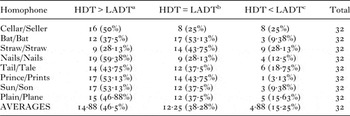
On average, children in both groups did indeed perform better on the homophone detection tasks compared to the lexical ambiguity detection task prior to training. Performance on each pre-test noun/noun homophone was compared to performance on the lexically ambiguous sentence containing that homophone (see Table 1). Nearly half (46·5%) of all thirty-two children during pre-testing demonstrated knowledge of a noun/noun homophone without demonstrating the ability to judge the ambiguity of the sentence containing that homophone.
Number of participants who performed better on the pre-test noun/noun homophone detection task (HDT) vs. pre-test lexical ambiguity detection task (LADT)

notes: Total refers to number of participants included in analyses.
a: HDT > LADT refers to the number of participants who received a higher score on the noun/noun homophone detection task for that word compared to the corresponding ambiguous sentence in the lexical ambiguity detection task.
b: HDT = LADT refers to the number of participants who received the same score on the noun/noun homophone detection task and the corresponding ambiguous sentence in the lexical ambiguity detection task for that word.
c: HDT < LADT refers to the number of participants who received a lower score on the noun/noun homophone detection task for that word compared to the corresponding ambiguous sentence in the lexical ambiguity detection task.
2. Children who receive ambiguity detection training will improve from pre-test to post-test, but children in an untrained control group will not
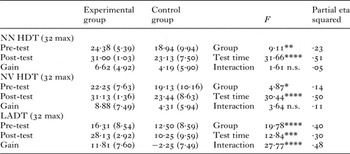
Table 2 presents the pre- and post-test means for both groups on all three tasks. It shows that the effects of training on the detection of lexically ambiguous sentences were significant. Additionally, the development of homophone detection abilities, but not lexical ambiguity detection abilities, spontaneously begins to appear at the end of kindergarten. For each of the three tasks, a 2 (Groups: Experimental and Control) × 2 (Test time: Pre- and Post-test) ANOVA was performed with one between-groups variable (Groups) and one repeated-measures variable (Test Time). Results for each task will be addressed below.
Comparisons of mean (SD in parentheses) performance of training group and control group on pre- and post-test noun/noun homophone detection task (NNHDT), noun/verb homophone detection task (NVHDT), and lexical ambiguity detection task (LADT)

notes: *p < ·05; **p < ·01; ***p < ·001; ****p < ·0001; n.s. = not statistically significant.
Noun/noun HDT
Main effects of both Groups (F(1,30) = 9·11, p = ·005) and Test time (F(1,30) = 31·66, p < ·0001) were significant. The interaction, however, was not (F(1,30) = 1·61, n.s.). To test the effects of training, which constituted a prior hypothesis, t-tests were performed. There was no difference between the groups at pre-test (t(30) = 1·92, n.s., d = 0·68), but a highly significant difference at post-test (t(30) = 4·16, p < ·0001, d = 1·47). As predicted, the experimental group differed from pre- to post-test (t(15) = 5·38, p < ·0001). Surprisingly, the control group also improved from pre- to post-test (t(15) = 2·84, p = ·012). Despite the improvement, the children in the control group did not perform as well as the experimental group on the post-test noun/noun HDT (4/16 of the control group and 15/16 of the experimental group scored > 30, the median of all 32 participants; Fisher Exact Test, p = ·00017).
Noun/verb HDT
Similar to the noun/noun HDT, main effects of both Groups (F(1,30) = 4·87, p = ·035) and Test time (F(1,30) = 30·44, p < ·0001) were significant, but the interaction (F(1,30) = 3·64, p = ·066) was not significant. To test the effects of training, which constituted a prior hypothesis, t-tests were performed. There was no difference between the groups at pre-test (t(30) = 0·98, n.s., d = 0·37), but there was a significant difference at post-test (t(30) = 3·52, p = ·003, d = 1·24). As predicted, the experimental group differed from pre- to post-test (t(15) = 4·74, p < ·0001). The control group also improved from pre- to post-test (t(15) = 2·90, p = ·011). Despite the improvement, the children in the control group did not perform as well as the experimental group on the post-test noun/verb HDT (4/16 of the control group and 13/16 of the experimental group scored >31, the median of all 32 participants; Fisher Exact Test, p = ·004).
Noun/noun versus noun/verb HDTs
We compared the detection of noun/noun and noun/verb homophones to determine whether one would be more easily detectable than the other, before and after training. There was, however, no difference between the two types on either the pre-test (t(31) = 1·08, n.s.) or the post-test (t(31) = 0·78, n.s.) for both groups.
LADT
Main effects of both Groups (F(1,30) = 19·78, p < ·0001) and Test time (F(1,30) = 12·84, p = ·001) were significant. The interaction was also highly significant (F(1,30) = 27·76, p < ·0001). To explore the interaction, t-tests were performed. There was no difference between the groups at pre-test (t(30) = 1·26, n.s., d = 0·44), but there was a highly significant difference at post-test (t(30) = 7·13, p < ·0001, d = 2·52). As predicted, the experimental group differed significantly from pre- to post-test (t(15) = 6·21, p < ·0001). The control group, on the other hand, showed no difference from pre- to post-test (t(15) = –1·20, n.s.).
Item analyses
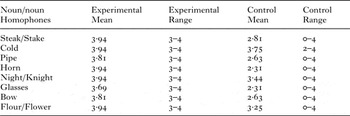
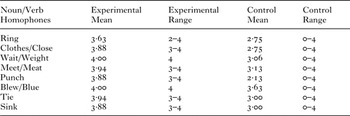
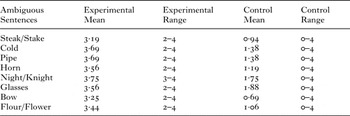
Tables 3a, 3b, and 3c present item analyses for the noun/noun homophones, noun/verb homophones, and lexically ambiguous sentences on the post-tests, respectively. Scores for each word and sentence ranged from 0 to 4. The experimental group performed better than the control group for each of the noun/noun homophones, noun/verb homophones, and sentences. Post-test performance of the experimental group was consistent across items and nearly perfect. Although there were individual differences on each of the pre-tests, there were consistently high performance levels on the post-test noun/noun and noun/verb HDT and LADT for the experimental group. This was not true for the control group.
Post-test scores of experimental and control groups
a. Noun/noun homophone detection task (highest possible score = 4)

Noun/verb homophone detection task (highest possible score = 4)

Lexical ambiguity detection task (highest possible score = 4)

DISCUSSION
The results of this study demonstrate that homophone detection is not sufficient for the detection of a lexically ambiguous sentence containing that same homophone. Children at the end of kindergarten are developing the ability to detect two meanings of a homophone, and training can accelerate this trajectory. They have not yet developed the ability to detect lexically ambiguous sentences, and training significantly accelerates this trajectory. Finally, we learned that there is no difference in the detectability of noun/noun and noun/verb homophones. We address each of these findings below.
Homophone detection vs. lexical ambiguity detection
The present study confirmed the hypothesis of Cairns et al. (Reference Cairns, Waltzman and Schlisselberg2004) that the ability to detect a homophone would not be sufficient to detect the ambiguity of a sentence in which it appeared. This result adds additional weight to the theory that the detection of the dual meanings of an ambiguous sentence is more difficult than detecting the dual meanings of homophones, and requires a level of skill and flexibility in sentence processing. To detect both meanings of an ambiguous sentence, one must realize that an ambiguity exists after processing the sentence once, and then reprocess the sentence with the alternative form, keeping the initial processing in working memory (Cairns et al., Reference Cairns, Waltzman and Schlisselberg2004; Zipke, Reference Zipke2007a, Reference Zipke2007b, Reference Zipke2011; Zipke et al., Reference Zipke, Ehri and Cairns2009).
Homophone detection
Children at the end of their kindergarten year are developing the skill of homophone detection, and training seems to accelerate this progression. Children in the experimental and control groups significantly improved their abilities to detect homophones, although the improvement in the experimental group was greater. These findings are similar to the outcomes of Zipke's (Reference Zipke2011) study with first-graders, who were slightly older (6;6).
Lexical ambiguity detection
Children at the end of kindergarten are not yet able to detect and report the two meanings of a lexically ambiguous sentence, even if the sentence contains a familiar homophone. These findings are consistent with the work of others who separately determined the development of homophone and lexical ambiguity detection (see Shultz & Pilon, 1973; Peters & Zaidel, Reference Peters and Zaidel1980; Cairns et al., Reference Cairns, Waltzman and Schlisselberg2004).
Children in the experimental group improved dramatically in their abilities to detect the dual meanings of lexically ambiguous sentences, even if one meaning was preferred. Those in the control group, despite their improved post-test homophone detection scores, failed to improve in lexical ambiguity detection; in fact, their average score declined slightly. The findings of this study suggest that the explicit training influences children's abilities to think flexibly about language (Zipke, Reference Zipke2008) and enhances both skills studied by Wankoff and Cairns (Reference Wankoff and Cairns2009): sentence processing and metalinguistic skills.
CONCLUSIONS
This study provides evidence that homophone detection abilities spontaneously begin to develop at the end of kindergarten, and kindergartners, at this time, have entered the zone of proximal development for lexical ambiguity detection abilities. Like many other metalinguistic skills, lexical ambiguity detection skills of kindergarteners can be enhanced through training. Homophone detection requires metalinguistic awareness and the psycholinguistic processing skill of lexical access, which precedes the metalinguistic and sentence processing components of detecting lexically ambiguous sentences. Furthermore, homophone detection is not sufficient for ambiguous sentence detection. There is no difference in performance of detecting both meanings of noun/noun homophones compared to noun/verb homophones.
The ability to construct two meanings of an ambiguous sentence requires efficient and flexible processing abilities. The children of the experimental group became more flexible linguistically and were able to judge utterances for the presence of multiple interpretations after training, compared to their peers who did not receive training. The task demands of the sentence test compared to the homophone test are greater, but are not sufficient to explain the difference between the two.
Future research
Ambiguity detection is one of many different predictors of later reading abilities (Nation, Cocksey, Taylor & Bishop, Reference Nation, Cocksey, Taylor and Bishop2010). The direct effects of improved ambiguity detection on reading readiness and later long-tem reading abilities remain to be seen. The effects of training in typically developing populations, those with language disorders, and those at risk for reading difficulty will be addressed in future studies.
The current study demonstrated that ambiguity detection is a trainable metalinguistic skill. However, the exact nature of the instruction must be analyzed more closely to determine what aspects of training help young children to become more flexible language users. Clearly, components of the separate trainings administered to kindergarteners (in this study), first-graders (Zipke, Reference Zipke2011), and third-graders (Zipke, Reference Zipke2007a) have strengths. As noted by Zipke (Reference Zipke2011), all results are based on experimenter-created or modified protocols (Peters & Zaidel, Reference Peters and Zaidel1980; Cairns et al., Reference Cairns, Waltzman and Schlisselberg2004). Future research in our program will consider differences and similarities in training paradigms and scoring procedures in relation to age groups. Additionally, a larger, more diverse population would be desirable.
Appendix
Homophones

Practice pre-test sentences
The cup is on the table.
The woman sat on the trunk.
The lady's shoes were on the couch.
He felt terrible after the punch.
Ambiguous pre-test sentences
The cellar/seller was cold.
The children saw a bat lying by the fence.
The kids showed the man the straw.
The man's nails were very sharp.
The long tale/tail frightened the boy.
The man saw the prints/prince in the desert.
The man and lady wanted a bright son/sun.
The cowboy was on the plane/plain.
Practice post-test sentences
The woman sat on the trunk.
The train stopped near a tree.
The turtles had spots on their shells.
He felt terrible after the punch.
Ambiguous post-test sentences
The man went to the store to buy a steak/stake.
The cold made Betty feel terrible.
The man held the pipe.
The children touched the horn.
The night/knight came quickly.
The glasses fell on the floor and broke.
The boy picked up the bow.
The lady put the flour/flower on the table.