As major global challenges such as conflict, disease, environmental degradation and poverty continue and – in some cases – intensify in the twenty-first century, which domestic institutions will best enable countries to take decisive and positive action? Scholars and policy makers have long held that ‘democracy’Footnote 1 is the best route to socially desirable policies, by obliging leaders to be responsive and giving citizens multiple avenues through which to hold governments to account (Bollyky et al. Reference Bollyky2019; Bueno de Mesquita et al. Reference Bueno de Mesquita2005; Lake and Baum Reference Lake and Baum2001). Others are more skeptical that democratic institutions are necessary or even desirable. Authoritarians, whether combatting the spread of contagious disease or environmental disaster, may in fact be better placed to take rapid, decisive and possibly unpopular action (Beeson Reference Beeson2018; Frey, Presidente and Chen Reference Frey, Presidente and Chen2020; Gilley Reference Gilley2012).
This article focuses on these questions in the environmental arena – one that many see as particularly urgent in light of recent scientific assessments that climate change is already having serious impacts that will leave some populations with no choice but to adapt (IPCC 2014; IPCC 2018). As citizens become more alarmed by adverse climate events, worsening air quality and other environmental problems, the argument goes, leaders who are held to account will respond in ecologically responsible ways; citizens who have the right to voice their dismay will successfully push for better policy; and governments that are constrained will be obliged to embrace pro-environment action (Looney Reference Looney2016).
Others disagree sharply. Some now echo earlier arguments (Heilbroner Reference Heilbroner1974) that the gravity of many environmental problems requires the opposite of democracy. Democratic politics involves deliberation (Dryzek Reference Dryzek2002), which requires time we no longer have. It obliges leaders to be responsive to citizen demands that might undercut environmental objectives (Jamieson Reference Jamieson2014). Some look to China'sFootnote 2 recent climate change policies – which involve top-down edicts, limited consultation and personal liberties restrictions that Westerners would find unacceptable – and conclude that ‘authoritarian environmentalism’ might provide a more viable way forward, enabling quick and decisive action (Beeson Reference Beeson2018; Gilley Reference Gilley2012; Shearman and Smith Reference Shearman and Smith2007).
These debates extend far beyond academic circles. Indeed, the 1992 Rio Declaration enshrines the idea that citizen involvement and accountable domestic institutions are crucial to sustainability, stating, ‘environmental issues are best handled with the participation of all concerned citizens’, who should have access to information, the opportunity to participate in decision making and effective access to redress (UNEP 1992). Others place far less faith in democratic institutions. Scientist-turned-activist James Lovelock (Reference Lovelock2010) laments the environmental impacts of a ‘cheeky, egalitarian world where everyone can have their say’. We may, he says, have to ‘put democracy on hold for a while’, instead adopting a system in which a few trusted authorities make eco-decisions.
Existing answers to the question of whether there is a ‘democratic advantage’ when it comes to environmental protection have been mixed, for three main reasons. First, as is common among scholars and in public discourse more broadly, the term democracy often means different things to different people. Secondly, existing accounts often overlook important nuance in how domestic institutions lead to policy outcomes. Finally, quantitatively oriented studies have, until recently,Footnote 3 typically relied on measures that are too general to gauge the specific mechanism, and/or do not control for competing institutional explanations. Consequently, we are not really certain whether, or how, democracy ‘matters’.
This article overcomes these limitations in three chief ways. First, it unpacks the main mechanisms behind the idea that democracy affects environmental outcomes, exploring nuance and, at times, indeterminacy, in expectations. I discuss three mechanisms that underpin the democracy–environment link: (1) electoral accountability incentivizes leaders to be responsive to demands for eco-friendly policy; (2) the protection of civil liberties/societyFootnote 4 ensures environmental awareness and learning as well as successful environmental activism and (3) political constraints provide a check on majority will and limit individual government actors' ability to unilaterally define policy, thereby entrenching good environmental policy. Each is a distinct story about how institutions drive environmental outcomes; each has caveats that deserve consideration.
Secondly, I argue that we need a more nuanced set of expectations about how ‘democracy’ affects environmental outcomes. First, I suggest that the link between electorally accountability and eco-friendly outcomes hinges on whether or not citizens privilege environmental protection as a policy objective. Put simply, if electoral accountability is indeed about translating citizens' preferences into policy, then we need to consider not only whether elections are free and fair, but also what citizens want. Secondly, the relationship between civil liberties protections and sustainable policy depends on which actors in society hold power. Indeed, while these safeguards can give a voice to those who care about the environment, they can also provide a platform for those who favor objectives that lead to environmental degradation. Finally, political constraints make policy changes harder. Hence, I argue, if existing policy is eco-friendly, political constraints are beneficial to the planet; but if existing policy is not eco-friendly, these same institutions are harmful to the planet.
My third contribution is empirical: having articulated the arguments behind the idea that democratic institutions ‘matter’ and explained why we need nuance, I put these ideas to the test. I focus on a wide range of problematic environmental practices: emissions of harmful gases, energy consumption and conservation failures. Several findings emerge. First, support for the ‘baseline’ set of expectations is very mixed: civil liberties are associated with better environmental outcomes, but free/fair elections appear to be bad for the environment, and political constraints generally have no impact. Secondly, support for two of the more nuanced expectations is strong. Across five of the six outcomes explored here, I find robust evidence that the relationship between civil liberties protections and environmentalism depends on which actors in society hold power. Evidence that supports my conjectures about the relationship between elections and citizen support for eco-friendly policy holds across a majority of outcomes. In contrast, support for the idea that political constraints stymie environmental policy change is far more limited.
Collectively, the environmental outcomes examined in this article account for a huge portion of human damage to the ecosystem. Hence, one reason these findings are important is that the outcomes are broad in scope. They also have flow-on effects that extend far beyond the ecosystem: to human health (Pope et al. Reference Pope2002), the economy (Hsiang et al. Reference Hsiang2017) and even civil conflict (Hsiang, Meng and Cane Reference Hsiang, Meng and Cane2011). Additionally, this article's findings speak to broader, unrelated, challenges that governments, activists and citizens will face well into the future. Indeed, these questions about whether democratic or autocratic governments are best equipped are highly relevant to current debates about broader global challenges, as is evident in the context of the COVID-19 pandemic (Smith and Cheeseman Reference Smith and Cheeseman2020). While it is far too early to draw definitive conclusions about the current pandemic, the Conclusion lays out some tentative expectations.
Democratic Politics, Autocratic Politics and Environmental Protection: Unpacking the Mechanisms
This section argues that rather than thinking about eco-outcomes in terms of what ‘democracies’ do vs. what ‘autocracies’ do, we should unpack the processes behind the idea that there is a democratic advantage in environmentalism.Footnote 5 I focus on the three most prevalent and plausible processes: electoral accountability, civil liberties and constraints.Footnote 6
Electoral Accountability
Electoral accountability is core to most theories of democratic governance: democracy is a system ‘in which rulers are held accountable for their actions in the public realm by citizens, acting indirectly through the competition and cooperation of their elected representatives’ (Schmitter and Karl Reference Schmitter and Karl1991, 76). Full electoral democracies like those described by Schmitter and Karl lie on one side of the spectrum. On the opposite side lies ‘pure’ authoritarianism, in which elections are either not held or involve no serious contestation. In between, there is great variation in how competitive elections truly are (Hyde and Marinov Reference Hyde and Marinov2012). ‘Competitive’ electoral authoritarians hold elections that are regular, involve opposition candidates and are usually devoid of massive fraud. However, they are not truly open, free or fair, because incumbents take actions often/severely enough that the playing field is not even (Levitsky and Way Reference Levitsky and Way2020). This key feature distinguishes them from truly electorally accountable countries.
Scholars have long linked electoral accountability and public goods provision across a range of policy areas (Downs Reference Downs1957; Lake and Baum Reference Lake and Baum2001; Mani and Mukand Reference Mani and Mukand2007; Neumayer Reference Neumayer2002). One line of thinking, grounded in the median voter theorem, argues that electorally accountable politicians will supply public goods to satisfy the demands of the median voter in order to maintain office (Downs Reference Downs1957; Soroka and Wlezien Reference Soroka and Wlezien2010). Where governments are not electorally accountable, leaders have much stronger incentives to enrich themselves and, if necessary, to court elites' support (McGuire and Olson Reference McGuire and Olson1996).
A second variant comes from Bueno de Mesquita et al. (Reference Bueno de Mesquita2005), who assume that policy choices under all government types aim to promote the interests of elite groups. Leaders in any political system prefer to provide the desired goods to the subset of people whose support they need in order to stay in power – the minimum winning coalition. But this is an expensive proposition in democracies because the minimum winning coalition is so large. Consequently, and because all/most citizens in electoral democracies have a say in who governs, it is more efficient in these countries to provide beneficial policies to everyone (the selectorate) rather than privately to the minimum winning coalition (Bueno de Mesquita et al. Reference Bueno de Mesquita2005; Lake and Baum Reference Lake and Baum2001). In countries without free/fair elections, the minimum winning coalition and the selectorate are smaller (although the size of the former can vary considerably from country to country). There, the incentives to furnish public goods are more limited, so leaders instead tend to provide private or group-specific goods (Frantz Reference Frantz2019, Geddes, Wright and Frantz Reference Geddes, Wright and Frantz2018).
Both variants discussed above expect electorally accountable leaders to provide more public goods. Like most initial public goods research, the majority of empirical studies of this proposition in the environmental context have relied heavily on Polity's democracy–autocracy index (Marshall et al. Reference Marshall, Gurr and Jaggers2017). They find fairly consistent evidence that countries with higher scores have better environmental outcomes, across many outcomes, including air pollution, water pollution, lead in gasoline, land degradation, energy efficiency, use of renewables, and forest and land protection (Bayulgen and Ladewig Reference Bayulgen and Ladewig2017; Deacon Reference Deacon2009; Farzin and Bond Reference Farzin and Bond2006; Li and Reuveny Reference Li and Reuveny2006; Wurster Reference Wurster2013). As I discuss in greater detail below, two key limitations of these studies are (1) the index measures more than electoral accountability per se and (2) relatedly, these studies do not typically control for other factors like civil society and political constraints. As a result, it is hard to know whether electoral accountability is truly responsible for superior environmental outcomes.
Some research has used more refined measures, for instance by testing selectorate theory. Consistent with this theory's proposition that systems with larger winning coalitions are better at providing public goods, presidential democracies outperform their parliamentary counterparts in air pollution control (Bernauer and Koubi Reference Bernauer and Koubi2009) and nature protection (Wurster Reference Wurster2013). Cao and Ward (Reference Cao and Ward2015) find support for a more contingent model: a large winning coalition improves air pollution only if states have the capacity to implement policy and a sufficiently long time horizon.Footnote 7 Other evidence is less conclusive (Wurster Reference Wurster2013) and occasionally runs counter to expectations (Fredriksson and Wollscheid Reference Fredriksson and Wollscheid2007; Ward Reference Ward2008).
Two key questions or caveats are worth exploring here. First, if electoral accountability is indeed about translating citizens' preferences into policy, then what citizens want is crucially important. If people privilege goals that undercut sustainability, electoral accountability can be a net harm to the environment (Jamieson Reference Jamieson2014). Relatedly, even if a majority of citizens has green preferences, the hurdles associated with translating those into policy can be notable: citizens have to know about environmental degradation, be willing to absorb the costs of greener policies and make their voting decisions based on such policies (Bakaki, Böhmelt and Ward Reference Bakaki, Böhmelt and Ward2019; Stadelmann-Steffen Reference Stadelmann-Steffen2011).Footnote 8 That is a high bar. Some research shows that it is nonetheless attainable: two studies with a relatively restricted geographic focus report that citizens want more environmentally friendly policies and that governments are responsive to these desires (Anderson, Böhmelt and Ward Reference Anderson, Böhmelt and Ward2017; Bakaki, Böhmelt and Ward Reference Bakaki, Böhmelt and Ward2019). There is, however, very little cross-national research on this idea beyond Europe.
Secondly, some question the logic that competitive elections are a sufficient or even a necessary condition of responsive, public-goods oriented policy. Bayer and Urpelainen (Reference Bayer and Urpelainen2016) argue that electoral accountability provides motives for leaders to embrace policies whose benefits can be redistributed to key supporters. Hence, electoral accountability is good for the planet if the benefits of green policy can be redistributed to politically powerful actors in electorally attractive ways, but otherwise it is bad or neutral for the planet (Hughes and Urpelainen Reference Hughes and Urpelainen2015). Others question whether (competitive) elections are even a requisite of responsive policy. Miller (Reference Miller2015), for instance, argues that non-competitive elections enable citizens to signal their dissatisfaction with the regime, thereby creating incentives for leaders to provide public goods. Some push this logic further, arguing that even unelected leaders have reasons to be responsive, not because they face electoral reprisal, but because they worry about maintaining control and avoiding social upheaval (Duckett and Wang Reference Duckett and Wang G2017). This argument is frequently made in relation to China, where the Party leadership is concerned with and responsive to–a variety of matters (even if imperfectly), ranging from air pollution to tainted vaccines to COVID-19 containment.Footnote 9
Civil Liberties/Society
Other research emphasizes the link between the protection of civil liberties and environmentalism (Barrett and Graddy Reference Barrett and Graddy2000; Böhmelt, Koubi and Bernauer Reference Böhmelt, Koubi and Bernauer2014; Escher and Walter-Rogg Reference Escher and Walter-Rogg2018; Farzin and Bond Reference Farzin and Bond2006; Li and Reuveny Reference Li and Reuveny2006; Payne Reference Payne1995). Two core ideas are at play here. First, these entitlements help ensure that citizens can gather and disseminate accurate information, which can promote learning (Midlarsky Reference Midlarksy1998) and improve public awareness (Payne Reference Payne1995). In contrast, when people are fearful of or prevented from voicing opinions or providing expertise, they do not give the kind of honest, critical, feedback that enables others to establish informed views – and leaders to make well-founded decisions (Shahar Reference Shahar2015). Instead, a dearth of accurate information might enable administrators to ignore problems, lock themselves into narrow ways of thinking (Shahar Reference Shahar2015), or cover up poor performance (Wurster Reference Wurster2013). These ideas are by no means limited to the environment. Farber (Reference Farber1991), for instance, emphasizes that although free speech enables people to disseminate both good information and misinformation, on balance, the former prevails. This makes individuals more knowledgeable and policy makers better informed, which improves welfare in various arenas.
Secondly, as policy makers regularly emphasize (UNEP 2019), civil society protections including the right to form associations, which helps to ensure successful environmental activism (Böhmelt, Koubi and Bernauer Reference Böhmelt, Koubi and Bernauer2014; Sonnenfeld and Taylor Reference Sonnenfeld and Taylor2018). In addition to the attributes discussed above, civil society involvement improves transparency and enhances representation by empowering affected groups (Bernauer and Gampfer Reference Bernauer and Gempfer2013).Footnote 10 Consistent with these ideas, Bernauer and Gampfer (Reference Bernauer and Gempfer2013) show that adding civil society groups to global climate governance makes people believe the process is more transparent and representative, and better equipped to solve problems. Civil society protections also aid in policy implementation. In biodiversity and carbon credit schemes, for example, it is more cost effective for governments to outsource implementation to civil society (Bernauer and Betzold Reference Bernauer and Betzold2012).
Several studies have uncovered an empirical link between civil liberties and environmental outcomes. Barrett and Graddy (Reference Barrett and Graddy2000) report that civil and political liberties improve environmental outcomes that relate directly to human health, but do not affect several other environmental outcomes. Torras and Boyce (Reference Torras and Boyce1998) find even stronger evidence in low-income countries: there, civil liberties are associated with significant improvements in SO2, smoke, heavy particles, dissolved oxygen and fecal coliform. More recently, Escher and Walter-Rogg (Reference Escher and Walter-Rogg2018) find that robust civil society protections make countries substantially more likely to join international climate change agreements.
There is important nuance to add to the picture here. Allowing multiple ‘stakeholders’ to express views and to be involved means giving a voice to diverse goals, which may undercut or promote sustainability, depending on who prevails (Baber and Bartlett 2018). If industry or actors with anti-eco agendas dominate, it may be difficult for environmental groups to gain a seat at the table even if they have the right (in theory) to be there (Dryzek Reference Dryzek2002). Mildenberger (Reference Mildenberger2020) documents this challenge, showing how the interests of carbon-intensive business and labor actors in countries like the United States and Australia have systematically stymied environmental groups' efforts and undermined the development of sustainable climate change policy. Other studies echo these insights: countries with strong labor unions have inferior air quality (Bernauer and Koubi Reference Bernauer and Koubi2009), and those with stronger automotive lobbies have less stringent gasoline standards (Fredriksson et al. Reference Fredriksson2004). However, when civil society groups with pro-environment agendas are sufficiently powerful, they can positively affect environmental outcomes. Those with stronger green parties have better air quality (Bernauer and Koubi Reference Bernauer and Koubi2009) and a smaller environmental footprint (Ward Reference Ward2008); those with more environmental non-governmental organizations (NGOs) tend to have cleaner gasoline (Fredriksson et al. Reference Fredriksson2004). A key insight, then, is that in assessing the impact of civil liberties, we need to account for which societal actors hold power and influence.
The proposition that protecting civil liberties yields better environmental policy falls under fire on two key dimensions. First, some question whether these protections are indeed necessary for grassroots groups to have a meaningful policy impact. Pointing to an ‘associational revolution’ (Spires, Tao and Chan Reference Spires, Tao and Chan2014, 65) in Yunnan, Guangdong and Beijing, some argue that Chinese grassroots organizations have scope to exert influence environmental outcomes (Dai and Spires Reference Dai and Spires2016). However, I join others in being skeptical that these groups can do much more than implement government priorities when their civil liberties are circumscribed. In Iran, for instance, the government has deliberately encouraged green NGOs, but insists that their work be apolitical and aligned with state objectives (Doyle and Simpson Reference Doyle and Simpson2006). The result is a state-dominated ‘civil society’ that has successfully implemented government-approved green policies, but faces crushing backlash when activists fail to toe the government line (Human Rights Watch 2019). Others echo this sentiment with regard to Chinese grassroots organizations (Moore 2004; Tang and Zhan Reference Tang and Zhan2008).Footnote 11 There has been very little cross-national research on this question. This article helps bridge that gap.
Secondly, some argue that solving some of the world's most challenging problems requires serious restrictions on personal liberties. In the environmental arena, Hardin (Reference Hardin1968, 1,244) argued long ago that solving the tragedy of the commons requires us to ‘reexamine our individual freedoms to see which ones are defensible’ and concluded that we must forgo our right to breed. Other Neo-Malthusians make similar arguments (c.f., Heilbroner Reference Heilbroner1974 and Ophuls Reference Ophuls1977). Less radically, driving bans can help curb pollution, yet these would be difficult to implement (other than voluntarily) in countries that enshrine the freedom of movement. This potential tension between civil liberties and public goods extends to other areas. Public health is a highly salient example, with countries around the world enacting far-reaching civil liberties restrictions in an effort to combat COVID-19. I return to this question in the Conclusion.
(Political) Constraints
As Madison noted in The Federalist Papers #51 (1788), the fundamental challenge of framing a government administered by people, over people, is that the government must be able to control both the governed and itself. Even with electoral accountability, a well-functioning system requires institutions to place a check on majority will, and limits on individual government actors' ability to unilaterally formulate/change policy. The constant goal ‘is to divide and arrange the several offices in such a manner as that each may be a check on the other that the private interest of every individual may be a sentinel over public rights’ (Madison Reference Madison1788).
Restrictions on one actor's ability to unilaterally define policy are not, of course, unique to the United States. Such restrictions have various names: checks and balances, political constraints, veto players and horizontal accountability.Footnote 12 Requiring the consent of multiple actors (with potentially divergent interests) makes it harder to change policy. Policy makers are motivated to design political institutions in this manner for a variety of reasons. The most obvious is that political constraints enhance policy stability (Tsbelis Reference Tsebelis2002), but these institutions can also be particularly useful when leaders struggle to make their commitments credible, such as monetary policy (Keefer and Stasavage Reference Keefer and Stasavage2003) or pension guarantees (Besley and Prat Reference Besley and Prat2005).
Even more so than for electoral accountability or civil liberties, there is deep disagreement about whether constraints are good or bad for environmental protection. Some view them as beneficial: exploring differences within the United States at the state level, Daley, Haider-Markel and Whitford (Reference Daley, Haider-Markel and Whitford2007) argue that these checks help reduce environmental compliance costs by (1) enhancing regulated parties' expectations that policy will be stable and (2) increasing incentives to implement policy efficiently. Similarly, Fredriksson and Neumayer (Reference Fredriksson and Neumayer2013) find that countries with a long history of such constraints have superior climate change policies.
Others make the opposite argument – that the severity and intractability of environmental problems call for drastic measures that are difficult to achieve if multiple actors' consent is required (Ophuls Reference Ophuls1977). Eco-authoritarianism – the idea that the solution to today's environmental challenges might lie in governments or experts having the power to unilaterally do whatever is necessary to mitigate disaster – has gained notable traction (Beeson Reference Beeson2018; Gilley Reference Gilley2012; Shearman and Smith Reference Shearman and Smith2007). Pointing to environmental successes in East Asia, some argue that a strong and relatively unconstrained central state has made it possible to implement sustainability measures that would be far more challenging in systems with multiple veto points (Beeson Reference Beeson2018; Gilley Reference Gilley2012).
We can make sense of this ambiguityFootnote 13 by returning to the core insight of Madison (Reference Madison1788), Tsebelis (Reference Tsebelis2002) and others: political constraints make policy change harder. Hence, they can be beneficial to the environment if existing policy is eco-friendly, but harmful if existing policy is eco-unfriendly. Consider the EU's ‘Packaging and Waste’ Directive, for which the UK, despite facing steeper adjustment costs, passed legislation more quickly than Germany. Unlike their British counterparts, German lawmakers faced intense scrutiny from key veto players (Börzel and Buzogán Reference Börzel and Buzogán2019, Haverland Reference Haverland2000). Large-N studies echo this notion that political constraints are problematic if policy change is necessary to protect the environment: they impede the phasing out of lead from gasoline (Deacon Reference Deacon2009), slow the transition to renewable energy production (Bayulgen and Ladewig Reference Bayulgen and Ladewig2017) and stymie climate policy adoption (Madden Reference Madden2014). These ideas find support in a wide array of other policy areas, including budget deficits, monetary policy and trade agreements (Keefer and Stasavage Reference Keefer and Stasavage2003; Tsebelis Reference Tsebelis2002).
In contrast, a lack of institutional checks makes policy pendulum swings more likely. For instance, a key Sinai protection scheme initially came into existence and thrived under former Egyptian President Mubarak because authority was concentrated in a few executive institutions, whose members had an interest in it. But this lack of constraints enabled the scheme's rapid deterioration when the leadership's interest shifted (Sowers Reference Sowers2007). Morocco offers another example. In the 1990s and 2000s, reforms to its electoral system were meager at best (Maghraoui Reference Maghraoui2001). Yet the creation of a bicameral legislature in 1996, and the opposition party's victory in 1997, enabled the first gouvernement d'alternance (change of government) since 1960. The result was more heterogeneous preferences and greater constraints in the country's governing institutions (Sater Reference Sater2000). Despite a growing demand for renewable energy from Europe, environmental policy remained largely unchanged. Ultimately, it was the demise of alternance that enabled policy change: with a technocrat taking over in 2002, and monarchists in the majority in 2007, the king soon launched a ‘pet project’ to create the world's largest solar power facility. Despite its complex socio-economic implications, the project has moved forward with great expediency, facing limited legislative hurdles (Cantoni and Rignall Reference Cantoni and Rignall2019).
To summarize, the key theoretical contribution of my approach is not to offer a ‘new’ theory of how domestic institutions affect environmental policy. We already have many such theories. Instead, I have offered two theoretical contributions here. First, I have identified three core mechanisms behind the idea that ‘democratic’ institutions matter for environmental governance. Whereas most research conflates aspects of these three concepts or, conversely, considers one in isolation, I argue that they are theoretically distinct and should be tested against each other. A baseline set of expectations is that electoral accountability, civil society protections and political constraints yield superior environmental outcomes. However – and this takes us to my second contribution – I have laid out why those hypotheses likely provide an incomplete picture of the pathways between domestic institutions and eco-protection. A more nuanced and compelling set of hypotheses is as follows. First, elections should induce more sustainable policy if this is what citizens want. Secondly, civil liberties protections should yield more eco-friendly outcomes if civil society actors with pro-environment preferences are powerful. In contrast, these very protections may exacerbate outcomes if private actors with anti-environmental preferences hold more power. Finally, political constraints should make changes in environmental policy less prevalent.
Measuring the Key Variables
Electoral Accountability, Civil Liberties/Society and Constraints
Previous studies of democracy and sustainability have relied chiefly on data from Polity (Marshall et al. Reference Marshall, Gurr and Jaggers2017) or Freedom House (various years). These have been useful for moving a burgeoning literature forward, but they do not necessarily test the mechanism scholars intended them to (Cao et al. Reference Cao2014). This article joins other recent studies that aim to hone in on the specific story/ies or mechanisms at play, through the use of more refined data (c.f., Bakaki, Böhmelt and Ward Reference Bakaki, Böhmelt and Ward2019; Bayulgen and Ladewig Reference Bayulgen and Ladewig2017; Cao and Ward Reference Cao and Ward2015; Escher and Walter-Rogg Reference Escher and Walter-Rogg2018; Madden Reference Madden2014). This approach is well underway in other areas such as public health (Bollyky et al. Reference Bollyky2019) and government repression (Cope, Crabtree and Fariss Reference Cope, Crabtree and Fariss2020).
To gauge whether/how electoral accountability Footnote 14 affects environmental protection, I use V-Dem's Clean Elections Index, which measures the presence of ‘registration fraud, systematic irregularities, government intimidation of the opposition, vote buying, and election violence’ (Coppedge et al. Reference Coppedge2018, 44). Operationalizing civil liberties is complex because there are actually two mechanisms at play (free expression/ association, and civil society protections). For the sake of parsimony, I use one measure – Core Civil Society – which gauges the robustness of civil society, defined as one that ‘enjoys autonomy from the state and in which citizens freely and actively pursue their political and civic goals’ (Coppedge et al. Reference Coppedge2018, 237). For constraints, I use Henisz's (Reference Henisz2017) Political Constraints variable, which measures the feasibility of policy change, given ‘the structure of a nation's political institutions … and the preferences of the actors that inhibit them’.
Nuance: Citizen Preferences and Civil Society Actors
I argued in the previous section that a more nuanced understanding of how domestic institutions affect environmental outcomes requires us to identify three key contingencies. First, I suggested that the link between electoral accountability and eco-policy hinges on what citizens want. Ideally, we would identify this using a cross-national, multi-decade survey of public attitudes on environmental policy. However, no such data exist.Footnote 15 Instead, I follow Farzin and Bond (Reference Farzin and Bond2006), who use wealth as a proxy for citizens' preferences for environmentalism. In the initial states of economic development, citizens privilege economic growth over environmentalism. Eventually, a ‘tipping point’ is reached, at which citizens are wealthy enough to begin to privilege environmental protection.Footnote 16 Following this logic, there is an inverted-U relationship between wealth and citizen preferences toward environmental degradation (Farzin and Bond Reference Farzin and Bond2006). If electorally accountable systems are indeed better at translating citizens' preferences into outcomes, we should expect this inverted-U relationship between wealth and environmental protection to strengthen as electoral accountability increases.Footnote 17
Secondly, I argued that when assessing the impact of civil liberties protections, we need to account for which societal actors hold power and influence. It is difficult to gauge pro-environmental interests and influence within civil society. One option is to use the number of environmental NGOs as a proxy. However, this approach is problematic for two reasons. First, these organizations' very existence is highly likely to be endogenous to civil society protections. Secondly, using existing data (Böhmelt, Bernauer and Koubi Reference Böhmelt, Bernauer and Koubi2015) would result in significant data loss (up to 45 per cent) due to differences in the time periods covered.Footnote 18 Given these limitations, I instead focus on the extent to which actors with objectives that lead to environmental degradation wield power and influence, which I proxy using manufacturing as a percentage of GDP.Footnote 19 As discussed above, I expect that civil liberties protections will enhance environmental outcomes when manufacturing interests wield limited power in society, but that they will contribute to degradation when these interests are sufficiently influential.
Other Independent Variables
I include several additional control variables in the analyses. These draw heavily from previous studies, so I do not discuss them further here.
Environmental Protection
Beyond greenhouse gas emissions, there is little agreement on what global eco-challenges are the most important for policy makers and scholars to understand. I take a broad approach, focusing on three core categories of environmental degradation: pollution, energy consumption and (non)conservation. Combined, these are by far the most prevalent in the literature on domestic politics and environmental degradation, and account for the lion's share of damage to the global ecosystem.
I analyze three main pollutants. The first is greenhouse gases, which include CO2, methane (CH4) and nitrous oxide (N2O) (Janssens-Maenhout et al. Reference Janssens-Maenhout2017). Readers are no doubt aware of how these gases harm the earth's climate system, with consequences too numerous to list here. Secondly, I examine SO2, a key air toxin that causes acid raid. Thirdly, I look at NOx, a family of compounds that forms an air pollutant itself, and also reacts in the atmosphere to form fine particles, harmful ground-level ozone and acid rain (Environmental Protection Agency 1999). SO2 and NOx contribute to respiratory, heart and lung disease (Pope et al. Reference Pope2002), and the acid rain they create harms vegetation, lakes, buildings and agricultural production (Bernauer and Koubi Reference Bernauer and Koubi2009).
Energy consumption is at the core of many current environmental challenges (Bayer and Urpelainen Reference Bayer and Urpelainen2016). Following much of the literature (Harrison and Kostka Reference Harrison and Kostka2014; Wurster Reference Wurster2013), I focus on two aspects of this question. First, I look at per capita energy consumption, since this is one of the core mechanisms through which humans cause environmental harm. Secondly, I look at the use of renewable sources in energy production, such as geothermal, hydro, solar and wind power, and biomass. Renewables are key to many countries' efforts to tackle climate change (Harrison and Kostka Reference Harrison and Kostka2014).Footnote 20 Finally, I look at conservation efforts. Ideally, one would assess the various efforts to preserve and shelter the ecosystem. In practice, it is difficult to obtain reliable data for a sufficient number of countries and years for most conservation efforts. Following others (Wurster Reference Wurster2013), I employ a measure of land protection, which provides the best coverage across time and space (World Database on Protected Areas various years).
Quantitative Analyses
It is well known that time-series-cross-sectional (TSCS) data like those used here violate classical regression assumptions – particularly heteroskedasticity, serial correlation and contemporaneous correlation. Following Beck and Katz (Reference Beck and Katz2007), Shor et al. (Reference Shor2007), Western (Reference Western1998) and others, I use a mixed-effects model, using R's lme4 package (Bates et al. Reference Bates2015). These models have a long history in other fields, but their use in political science has been more sporadic historically (Beck and Katz Reference Beck and Katz2007). They present a richer picture of causal heterogeneity, and provide a more realistic accounting of uncertainty (Western Reference Western1998), as well as greater flexibility in modeling complex error structures (Bell and Jones Reference Bell and Jones2015; Shor et al. Reference Shor2007). TSCS data can readily lend themselves to hierarchical modeling, as time periods are nested within countries, which in turn are nested in regions or other units of interest (Bell and Jones Reference Bell and Jones2015; Franzese Reference Franzese2005). Bayulgen and Ladewig (Reference Bayulgen and Ladewig2017) and Povitkina (Reference Povitkina2018) provide similar recent applications.
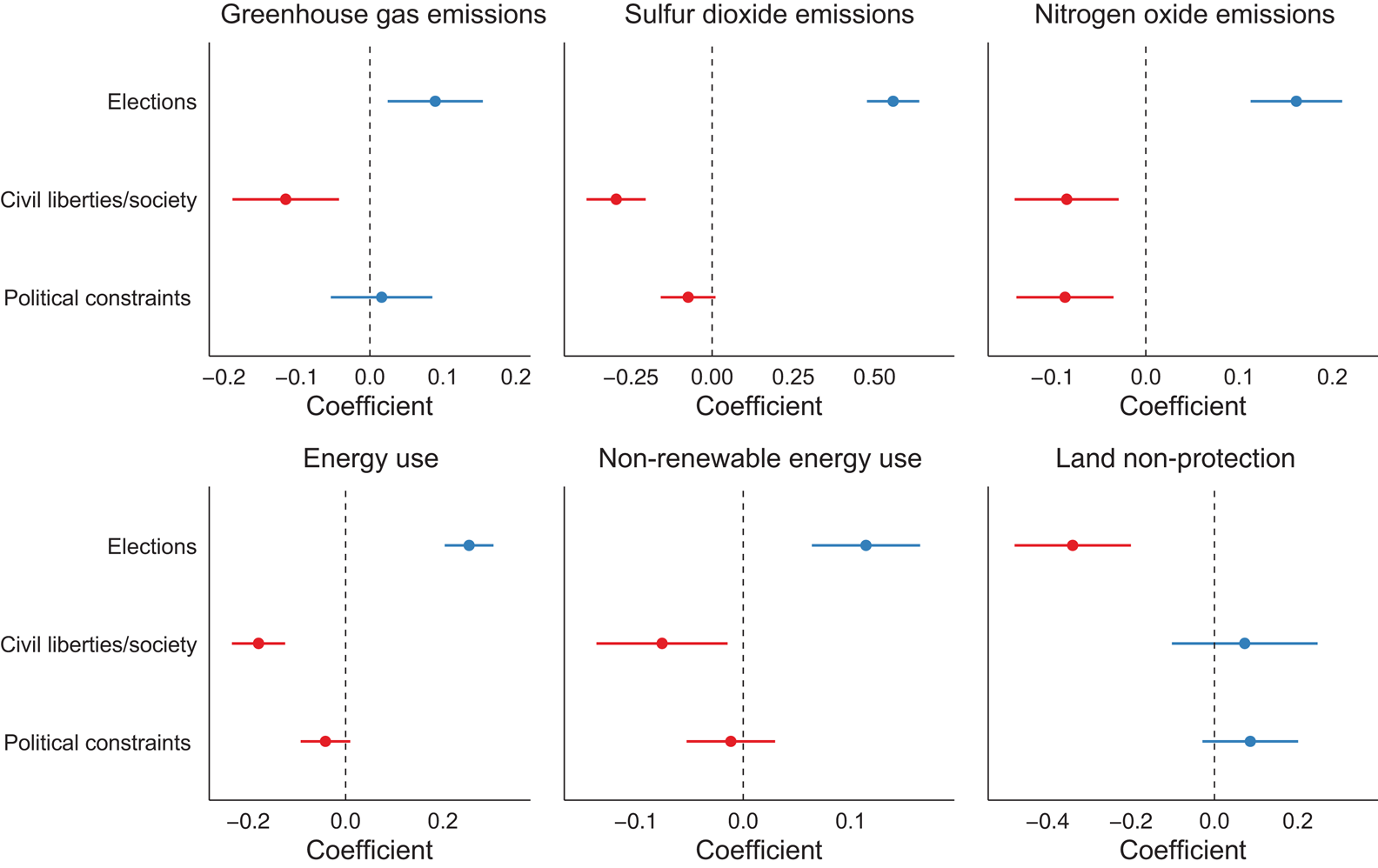
I begin by estimating each environmental degradation outcome as a function of free/fair elections, civil liberties, political constraints and several other commonly used variables.Footnote 21 Following standard practice, I lag each independent variable by one year to avoid the risk of simultaneity bias. Figure 1 displays coefficient plots for our main variables of interest; Appendix Table 1A and Figure 1A provide the full results. Four main findings emerge. First, countries with free and fair elections have significantly higher emissions of all types, consume more energy and rely more heavily on non-renewables. Secondly, in contrast, countries with robust civil societies fare significantly better on all of those outcomes. Thirdly, in some cases, political constraints appear to be linked to less environmental harm, but this is only reliably the case for nitrogen oxide emissions. Finally, land non-protection looks different from the other five models. There, it is countries with free/fair elections that have the most responsible practices. Neither civil society nor political constraints have reliable effects.
Elections, civil liberties/society and political constraints: impacts on environmental degradation
Note: coefficient plots with 95 per cent confidence intervals based on results presented in Table 1A. See the Appendix for full results.

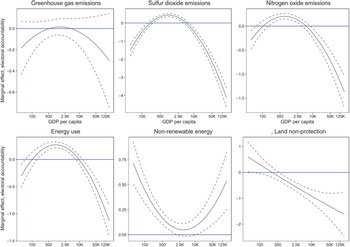
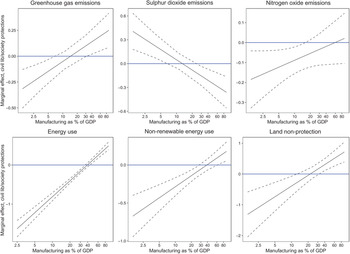
Overall, the results in Figure 1 provide very mixed support for the ‘baseline’ expectations that free/fair elections, civil liberties and political constraints are good for the environment. My finding that civil liberties protections are linked to better outcomes is consistent with expectations. Yet there is also evidence that elections are bad for the environment, and that political constraints generally have no impact. To shed more light on this puzzle, I now turn to the more nuanced ideas that I advanced above. To do that, I interact free/fair elections with GDP per capita and GDP per capita2 – recall that I use wealth as a proxy for pro-environmental preferences, that is, that citizens initially privilege economic growth over environmentalism, but eventually reach a wealth ‘tipping point’ at which environmental objectives are valued. Additionally, I interact civil liberties with manufacturing as a percentage of GDP – recall that the latter is a proxy for anti-environmental interests/influence in society. (Testing the ‘nuanced’ political constraints hypothesis requires a different modeling approach, which I present later). Because the results involve interaction terms, the most intuitive way to present them involves simulating the impact of a one-standard-deviation increase around the mean of electoral accountability and civil liberties, respectively. Figures 2 and 3 display the main results, and Appendix Table 2A and Figure 2A provide the full results.
Electoral accountability and wealth: impacts on environmental degradation
Note: simulated marginal effect of a one-standard-deviation change around the mean of electoral accountability. Solid lines indicate marginal effects; dashed lines indicate 95 per cent confidence intervals. Results based on estimates from Appendix Table 2A.

Civil liberties/society protections and manufacturing influence: impacts on environmental degradation
Note: simulated marginal effect of a one-standard-deviation change around the mean of electoral accountability. Solid lines indicate marginal effects; dashed lines indicate 95 per cent confidence intervals. Results based on estimates from Appendix Table 2A.

Figure 2 shows that there is an inverted-U relationship between wealth, electoral accountability, and all three air pollutants as well as energy use.Footnote 22 This provides support for the idea that the impact of electoral accountability depends on whether citizens favor eco-friendly policies or not.
Free/fair elections are also linked to better land protection efforts when citizens are sufficiently wealthy. However, there is no environmental Kuznets curve here: instead, electoral accountability's impact is strictly increasing – toward more protection – in wealth.Footnote 23 One explanation for this difference may lie in the economics of land protection compared to other environmental practices. For very poor countries relying on subsistence agriculture, turning productive land into conservation space may be a very unattractive proposition: this would explain why poor countries with electorally accountable leaders are more likely to refrain from protection efforts than those with unaccountable leaders. Figure 2 (and related tables/figures) also unearths one case where the findings are contrary to expectations: there is a U-shaped relationship between non-renewables, electoral accountability and wealth. Additional analyses suggest that modeling/data problems are not to blame (see Appendix Section II). The reasons for these findings are unclear, but may relate to the redistributional attributes of non-renewables (Bayer and Urpelainen Reference Bayer and Urpelainen2016).
Figure 3 displays the impact of an increase in civil liberties protections across various values of manufacturing as a percentage of GDP. Across five of the six environmental outcomes, civil liberties protections yield significant eco-improvements when manufacturing influence is sufficiently low. However, these same protections are linked to inferior environmental outcomes when manufacturing is powerful.Footnote 24 As posited above, then, the impact of civil liberties protections on environmental outcomes depends largely on which interests prevail in society.
The only exception to this is sulfur dioxide, for which civil liberties improvements are linked to higher (lower) emissions when manufacturing is relatively powerless (powerful). In some ways, the finding that civil liberties improve outcomes even when groups in society with anti-environmental interests are strong is precisely what environmental activists would want the world to look like. After all, in an ideal world, civil liberties protections are supposed to give a voice to the weak and the powerless. This is possibly what has happened with regard to SO2 emissions, although this does not explain why civil liberties would be linked to increased pollution when manufacturing is weak (see Appendix Figure 2 and Section II). In future work, it would be useful to investigate this finding more fully.
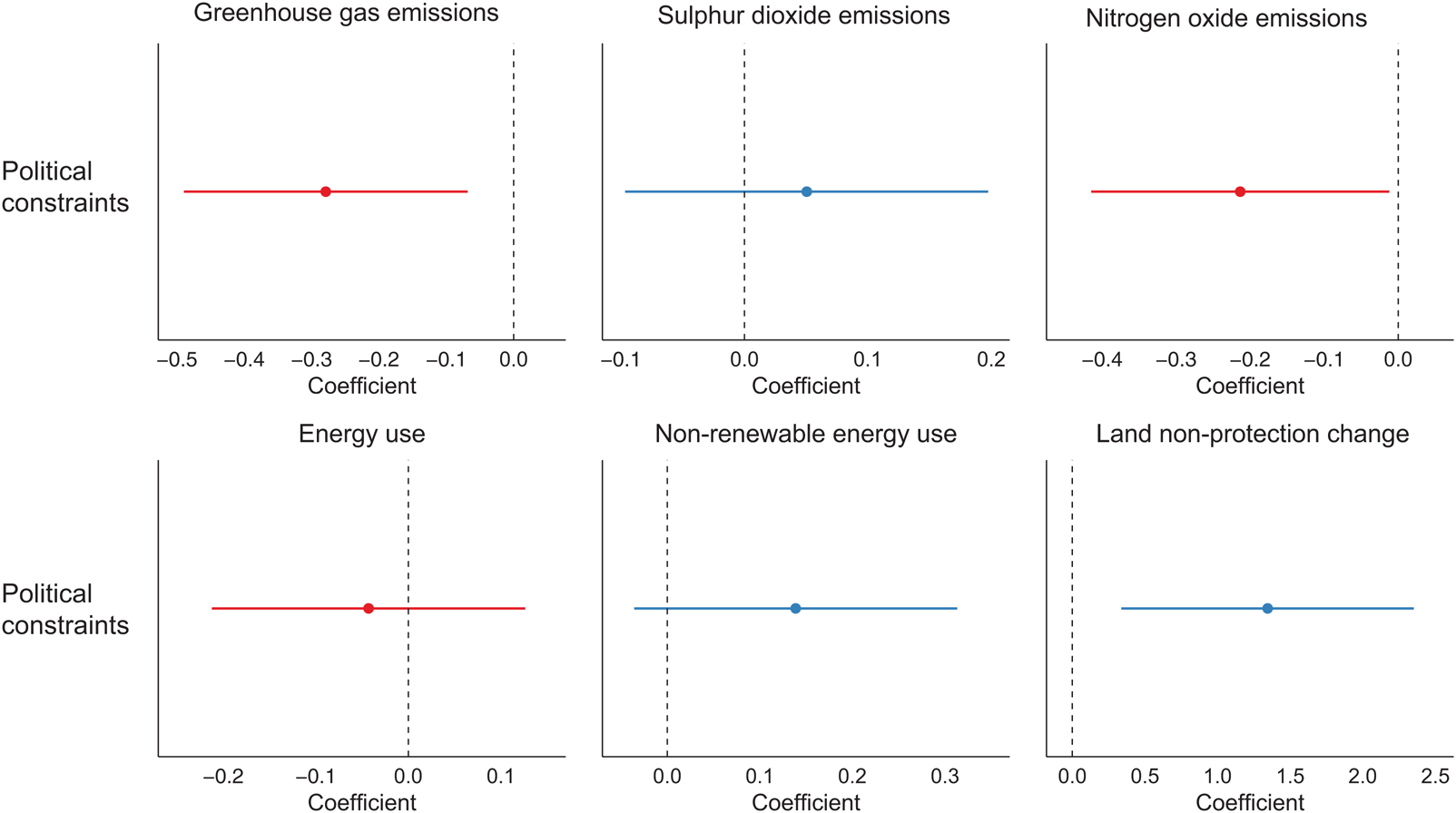
I now turn to political constraints. As discussed earlier, a more nuanced expectation than the baseline is that constraints should make it harder for leaders to modify existing policy – be it eco-friendly or eco-unfriendly. This calls for a different dependent variable that gauges changes rather than levels. To do this, I calculate the percentage change in each environmental outcome from year to year. I then take the absolute value since the theory I wish to test is about change, whether positive or negative. I once again use a mixed-effects model, for the same reasons identified at the beginning of this section. Appendix Section 2 discusses the robustness checks. Figure 4 displays coefficient plots only for the political constraints variable; the full model results appear in Appendix Table 3A and Figure 3A.
Political constraints and environmental policy change
Note: coefficient plots with 95 per cent confidence intervals based on results presented in Table 3A. See the Appendix for full results.

Figure 4 shows, consistent with the more nuanced expectations laid out above, that political constraints stymie environmental policy change for half of the outcomes – reliably so for greenhouse gases and nitrogen oxides, but not for energy use. For the other three outcomes, political constraints appear to make environmental policy change more likely, at standard levels of statistical significance for land non-protection and marginally so for non-renewables (p = 0.119). Hence, while there is some evidence that constraints lock in some types of environmental policy, there is also evidence that they make other types of policy more volatile. Support for the idea that political constraints systematically stymie environmental policy is very mixed.
Taken as a whole, the results provide support for the more nuanced expectations about the relationship between democracy and environmental outcomes for both elections and civil liberties. Evidence in favor of the idea that political constraints stymie environmental policy change is far weaker. Turning briefly to the control variables, countries that trade more have poorer environmental practices across all outcomes except land non-protection, which is consistent with Bayer and Urpelainen's (Reference Bayer and Urpelainen2016) findings as well as some others' (for example, Li and Reuveny Reference Li and Reuveny2006).Footnote 25 More densely populated countries have lower greenhouse gas and NOx emissions, which is sensible to the extent that these areas rely more heavily on public transportation rather than cars (Li and Reuveny Reference Li and Reuveny2006). Conversely, these areas have higher SO2 emissions, consume more energy, depend more extensively on non-renewables and have inferior land protection. This variability in findings is present in other studies that explore the impact of population density on environmental outcomes as well (c.f., Li and Reuveny Reference Li and Reuveny2006; Povitkina Reference Povitkina2018; Wurster Reference Wurster2013).
There are, of course, drawbacks to my empirical approach. Identifying a clear causal link is arguably the most challenging. In future research, it would no doubt be useful to identify possible experimental approaches to these questions. For instance, a natural experiment in which only one institutional feature changed, while the others remained constant, could be very powerful. While not easy to find (given that institutional changes are often multidimensional), if identified, this would offer a much ‘cleaner’ causal test than what is currently available.
Conclusion
Do democratic institutions enhance or impede governments’ ability to tackle the global challenges of the twenty-first century? I have explored this question in the context of environmental degradation, arguably one of the most pressing policy problems we face today. While a baseline expectation is that electoral accountability, civil liberties protections and political constraints enhance eco-outcomes, I argue that we need a more nuanced understanding of these processes. First, I maintain that the relationship between electoral accountability and eco-friendly outcomes hinges on whether citizens privilege environmental protection as a policy objective. Secondly, I argue, the link between civil liberties protections and sustainable policy depends on which actors in society hold power. Finally, I posit that political constraints are a double-edged sword: if existing policy is eco-friendly, these institutions are beneficial to the planet, but if existing policy is eco-unfriendly, they entrench harmful practices. The empirical findings are consistent with these expectations for civil liberties and elections, but much more mixed for political constraints.
This article has focused on environmental harm, but the insights are relevant to other global challenges including poverty, conflict and disease, to name a few. Indeed, debates about which political institutions are best suited to provide decisive action have erupted in the context of the COVID-19 epidemic.Footnote 26 Proponents of democratic institutions emphasize many of the themes explored here – free/fair elections incentivizing responsiveness; civil liberties enhancing feedback, debate and information sharing, etc. (Bollyky et al. Reference Bollyky2019; Smith and Cheeseman Reference Smith and Cheeseman2020). Some argue that China's prohibitions on free speech – which led to censorship and punishment of whistleblower doctors and prevented the transparent dissemination of information – transformed a containable disease into a global pandemic (Yu Reference Yu2020). Yet, as others point out, authoritarians can be just that – authoritative. Recent evidence suggests that these countries have been more adept at taking decisive policy actions such as strict lockdowns and privacy-intrusive contact tracing (Frey, Presidente and Chen Reference Frey, Presidente and Chen2020).
This study's findings suggest that there are important contingencies to identify as we think about the current pandemic as well as other global challenges. My results imply that electoral democracies’ ability to implement policies that prevent the spread of disease will depend on citizens’ support for these policies. In this sense, given that citizen support for lockdowns and similar measures is likely to wane over time, leaders who are not electorally accountable may be at an advantage. My findings also suggest that the ability of countries with robust civil liberties to sustain these policies and/or to develop new responses will depend on the preferences and power balance of groups in society. These protections encourage information transparency and empower nurses, doctors, journalists and others to bring policy failures into the public eye, but they also provide a voice to business owners, officials and citizens, who – for various reasons – favor removing restrictions. Finally, in theory, policy changes should be more likely when leaders are unconstrained. While it is too early to draw any definitive conclusions from the current pandemic, this article's findings provide useful insight into this and other global challenges.
Supplementary material
Online appendices are available at https://doi.org/10.1017/S000712342000054X.
Acknowledgements
I would like to express my sincere gratitude to Ashley Bloomfield, Svitlana Chernykh, Quynh Nguyen, Ian McAllister, Patrick Leslie, Zoë Robinson, Jill Sheppard and Johannes Urpelainen.
Financial support
I thank the Research School of Social Sciences and the School of Politics and International Relations for their support of this research.
Data availability statement
Data replication sets are available in Harvard Davaterse at: https://doi.org/10.7910/DVN/GGJWZJ.