1. Introduction
The ideals of democracy and of (classical) liberalism do not appear to co-exist in easy harmony with each other. Advocates of liberalism emphasize the need to impose strict limitations on the authority of government in order to safeguard individual liberty, and they tend to look with suspicion at the tendency of democratic politics to extend the power of the state at the expense of the ‘private autonomy’ of its citizens. Advocates of democracy, on the other hand, emphasize the priority of the principle of popular sovereignty, and they tend to regard liberal demands for the limitation of governmental authority as illegitimate attempts to pre-empt what should be rightly decided by the democratic process.
Even though neither theoretical arguments nor historical evidence provide reasons to believe that the ideals of liberalism may be better preserved by non-democratic regimes, one cannot overlook the fact that the growth of the modern democratic welfare state has been accompanied by growing restrictions on individual liberty. And even though the historical record unambiguously shows that democratic institutions have prospered much more under the liberal rule of law than under alternative political regimes, liberal principles are often perceived as inimical to democratic rule. Does one have to conclude from such observations that the ideals of the democracy and liberalism are difficult to reconcile or, as it has been put, that there is a ‘dichotomy between liberalism and democracy’ (Samet and Schmeidler, Reference Samet and Schmeidler2003: 214)?
Friedrich A. Hayek (Reference Hayek and Hayek1978c: 142f., Reference Hayek1960: 103, 164f., Reference Hayek and Hayek1967: 161) has sought to clarify the relation between the ‘two doctrines’ by pointing to the fact that they are concerned with different questions. And, indeed, if one divides into two main sub-questions the issues that an inquiry into matters of politics may address; namely, first, what government should do and what its limits should be and, second, how government should be organized, it is quite apparent that the advocates of liberalism have traditionally focused their attention on the first issue while advocates of democracy have been primarily concerned with the second. This difference may indeed account for the divergences between the two doctrines. Yet, as I aim to show in this paper, the liberal ideal would surely be interpreted in a too narrow sense if it were thought to be not concerned at all with the issue of how government should be organized, just as the democratic ideal would surely be interpreted in a too narrow sense if it were thought to entirely neglect the issue of what limits to put on the powers of government. In fact, taking my lead from F.A. Hayek's and James M. Buchanan's thoughts on the subject, the argument that I shall seek to support in this paper is that the basic normative premises on which the ideals of liberalism and democracy are based have clear implications for both of the issues noted, implications furthermore that are in harmony with each other. More specifically, I shall argue that both ideals are founded ultimately on the same normative premise, the principle of individual sovereignty, and that their respective institutional recommendations can be interpreted as complementary applications of that premise.
2. Liberalism and private autonomy
When J.M. Buchanan (Reference Buchanan1995/96: 267) identifies ‘the liberty and sovereignty of individuals’ as the fundamental value premises of liberalism, he thereby intends to indicate that individual liberty and individual sovereignty should be regarded as separate and distinguishable normative principles. As I suppose, and as I shall explain in more detail below, it is the very failure to carefully distinguish between the two principles, and to realize that both are constitutive for a consistent liberal outlook at politics, that has obfuscated the close relation between the ideals of liberalism and of democracy.
Advocates of liberalism have generally focused on the ideal of individual liberty as ‘freedom under the law’ (Hayek, Reference Hayek1960: 153), an ideal that is captured by the concept of private autonomy. This concept implies the notion of ‘an assured free sphere’ (ibid.: 139) within which individuals are free to choose and to act and to engage in voluntary contractual relations with each other as equally free persons. Understood as private autonomy individual liberty means, as Hayek (Reference Hayek1960: 155) puts it, ‘that what we may do . . . is limited only by the same abstract rules that apply equally to all’.
Private autonomy is individual liberty from politics. It finds its limits where the domain of politics begins, i.e. the domain where individuals are not free to choose separately and individually but are subject to collective political choice. Politics is, as Buchanan (Reference Buchanan1995/96: 260) notes, ‘by its nature . . . coercive; all members of a political unit must be subjected to the same decision’. It is this inherently coercive nature of politics that lets a liberalism that concentrates on the ideal of private autonomy naturally focus on the issue of how the political domain may be minimized in the sense of being limited to its essential functions, even if they may not agree on what should be counted among government's essential functions. Liberals who focus on the issue of ‘how much government’ tend to pay little attention to the issue of how government, whatever its functions, should be organized. And they do the less so, the fewer ‘essential functions’ they recognize. At the extreme end of the spectrum are anarcho-libertarians who carry the goal of minimizing government to its logical conclusion.Footnote 1 As they do not recognize any legitimate role of government, they, naturally, do not address the issue of how, from a liberal perspective, government should be organized.Footnote 2
Private autonomy means individual liberty within a framework of rules that must be defined and enforced ‘by some authority that has the necessary power’ (Hayek, Reference Hayek1960: 139). It is constituted, and at the same time limited, by an effectively enforced legal framework (ibid.: 144f.) or, more specifically, by the rules of private or civil law that constitute the Privatrechtsgesellschaft (Böhm, Reference Böhm and Böhm1980, Reference Böhm, Peacock and Willgerodt1989), the civil law society.Footnote 3 Private autonomy means autonomy of the individual within the limits of the rules of law, rules that define the content of property rights and that set limits to the freedom of contract. Because systems of private law do change over time and differ in the specific ways in which they define the content of property rights and set limits to the freedom of contract, what ‘private autonomy’ specifically means varies over time and across legal systems (Hayek, Reference Hayek1960: 229, Reference Hayek1948: 19). This raises the question of which criterion ought to be used for evaluating the suitability or adequacy of potential alternative legal rules. Evidently, such a criterion cannot be derived from the principle of private autonomy itself, because, as noted above, the notion of private autonomy has meaning only relative to a given system of rules. It can, therefore, not serve as a standard against which the system of rules that define it can itself be judged.
Furthermore, private autonomy is not only defined and limited by the rules of private or civil law. It finds its limits as well at the demarcation line that separates the ‘private’ from the ‘public’ realm or, in other words, the civil law society from the state as the domain of collective political choice. This demarcation line may also be drawn in different ways, raising the question again of which criterion should be used for judging where, exactly, the line should be properly drawn. And here, too, the ideal of private autonomy cannot by itself provide such a criterion, even if it implies a general preference for a wide range of individual liberty.
3. Constitutional liberalism and individual sovereignty
The essence of the liberal ideal of private autonomy is the notion that voluntary agreement among the parties involved should be the principal mode of social coordination. It is this very notion that legitimacy in social matters derives from voluntary agreement among the participating individuals that must, I submit, be regarded as the fundamental norm on which the ideal of liberalism rests. The principle of private autonomy specifies this norm with regard to the internal functioning of the private law society. In its more general interpretation, the notion of the legitimizing role of voluntary agreement can, however, also provide us with a criterion for evaluating the legitimacy of the rules of private law (that constitute private autonomy) as well as with a criterion for judging the appropriateness of the demarcation line between the civil law society and the state. Looked at in this way, the ideal of private autonomy is simply a specification of the more general normative principle of individual sovereignty, the principle that legitimacy in social matters, including the legitimacy of the rules of private law themselves, derives only and exclusively from voluntary agreement among the persons involved.
The interpretation suggested here may draw support from J.M. Buchanan's above-mentioned distinction between ‘individual liberty’ and ‘individual sovereignty’, a distinction on which Buchanan (Reference Buchanan1995/96: 267f.) comments:
What is the ultimate maximand when the individual considers the organization of the political structure? . . . (T)his maximand cannot be summarized as the maximization of (equal) individual liberty from political-collective action . . . A more meaningful maximand is summarized as the maximization of (equal) individual sovereignty. This objective allows for the establishment of political-collective institutions, but implies that these institutions be organized so as to minimize political coercion of the individual . . . So long as one's agreement to such political action is voluntary, the individual's sovereignty is protected even though liberty is restricted.Footnote 4
If, as I suppose, the principle of individual sovereignty must be regarded as the fundamental normative premise of the liberal ideal, a consistent ‘liberalism’ must be more than a ‘private law liberalism’ or ‘free market liberalism’. It must include a constitutional liberalism (Vanberg, Reference Vanberg and Vanberg2001b), Reference Vanberg, Smelser and Baltesa liberalism that views individual persons not only as sovereigns within the legal framework of the private law society, but no less so as sovereigns at the antecedent, constitutional level of choice at which the ‘rules of the game’ are chosen. Just as voluntary agreement legitimizes social transactions and corporate arrangements within the private law society, voluntary agreement among the parties involved must be considered the ultimate source of legitimacy of the legal framework within which individuals exercise their private autonomy. From the perspective of a constitutional liberalism, the questions of what are the appropriate rules for a private law society and how the demarcation line between the civil society and the state should be drawn cannot be answered by recourse to criteria that are external to or independent of the preferences of the individuals concerned, but only in terms of what sovereign individuals voluntarily agree upon (Buchanan, Reference Buchanan1999a: 288). Constitutional liberalism is, in this sense, naturally ‘democratic’ (Buchanan, Reference Buchanan1999b: 392).
With its contractarian approach to the issue of constitutional choice a constitutional liberalism draws attention to the difference between private autonomy that is exercised at the sub-constitutional level, within a private law framework, and individuals' freedom of choice at the constitutional level, where the framework itself is to be defined. It seeks to work out the implications of the notion of individual voluntary choice with regards to the – explicit or implicit – political-constitutional contract among individuals who establish among themselves a self-governing political community by which they organize the (re-)defining and enforcing of the ‘rules of the game’ under which they wish to live.
To be sure, as Hayek has stressed time and againFootnote 5 – long before people organized into political communities and began to deliberately shape the ‘rules of the game’ under which they lived – rules of conduct had evolved that provided the foundation on which governmental enforcement and deliberate legislation were to build. And communities may well continue to exist as ‘ordered anarchies’ without a governmental apparatus (Benson, Reference Benson1990). Yet, for ‘evolved’ rules, the question of from what source they derive their legitimacy can be asked no less than for deliberately chosen rules. From the perspective of constitutional liberalism there is a clear answer, namely that among free individuals the ultimate source of legitimacy in constitutional matters must be found in their – explicit or tacit – voluntary agreement on the rules to which they are subject.
A liberalism that consistently adheres to the principle of individual sovereignty must regard as ‘legitimate’ at the political-constitutional level no less than at the sub-constitutional level of market choices whatever the individuals involved voluntarily agree upon. To be sure, the test of ‘voluntariness’ cannot be quite the same at both levels, at the level of private autonomy and at the level of constitutional choice. In the realm of private autonomy, the rules of law imply a definition of what counts as ‘voluntary’, a definition that can be adjudicated. At the constitutional level, the relevant meaning of ‘voluntary contracting’ is clearly more difficult to specify. This does not alter the fact, however, that a consistent liberalism must consider voluntary agreement as the legitimizing principle at the level of constitutional choice – whether this ‘choice’ is the product of a spontaneous process or of deliberate, legislative procedure – no less than at the level of private autonomy. The challenge to a consistent liberalism is to give an answer to the question of how – in recognition of the factual difficulties that, due to the nature of things, exist at this level – voluntariness in constitutional contracting can be defined in the most meaningful way, and be secured most effectively, given the inherent constraints that are unavoidably present at this level.
4. F.A. Hayek on democracy and liberalism
The relationship of liberalism and democracy is one of the central themes in F.A. Hayek's works. The Constitution of Liberty (Reference Hayek1960) devotes special attention to it; it is at the center of the third volume of his trilogy Law, Legislation, and Liberty (Reference Hayek1979); and it is the principal subject of a series of articles published in the 1950s, 1960s, and 1970s. According to Hayek, liberalism is ‘the same as the demand for the rule of law in the classical sense of the term’ (Reference Hayek and Hayek1967: 165), namely the demand to limit the coercive power of government to the enforcement of universal rules that apply to everyone in the same manner, ‘protecting a recognizable private domain’ (ibid.: 162).Footnote 6 Hayek emphasizes in particular that the liberal principle is based on the ideal of a non-discriminating, privilege-free order.Footnote 7
‘By the insistence on a law which is the same for all and the consequent opposition to all legal privilege’ liberalism was, as Hayek (Reference Hayek and Hayek1978b: 142) explains, originally closely allied with the democratic movement and its demand for equal political participation rights.Footnote 8 And he adds that in ‘the struggle for constitutional government in the nineteenth century, the liberal, and the democratic movements indeed were often undistinguishable’ (ibid.). In Hayek's account the ideals of liberalism and democracy came only to appear to be in conflict with each other when the victory of democracy over authoritarian regimes led to the false belief that ‘the safeguards men once painfully devised to prevent abuse of government power are all unnecessary once that power has been placed in the hands of the majority of the people’ (1978c: 96).Footnote 9 It was this erroneous belief, he argues, that fostered a perception of democracy which he criticizes as ‘doctrinaire’ and ‘dogmatic’ (1960: 105f.), a perception that regards ‘current majority opinion as the only criterion of the legitimacy of the powers of government’ (1978c: 143), and according to which ‘this same majority must also be entitled to determine what it is competent to do’ (1960: 107).
As Hayek (Reference Hayek and Hayek1978b: 107) emphasizes, it is not the original ideal of democracy but its currently predominant interpretation that is to blame for promoting ‘the particular form of democratic organization, now regarded as the only possible form of democracy’ (Reference Hayek and Hayek1978b: 107), a form that he describes as unlimited democracy, and which he charges with producing ‘a progressive expansion of government control of economic life’ (ibid.). Hayek expressly does not want his critique of the democratic contemporary institutions to be understood as a critique of the ‘basic ideal of democracy’ (1979: 1),Footnote 10 but instead as a plea for institutional reform towards an effectively constrained democracy (1960: 403, 1979: 11, 98). He insists that we must distinguish between the ‘basic principle of democracy’ (1979: 4), namely that all political power originates from the people (2001: 84) and the now prevailing institutional realization of this principle, namely unrestricted majority rule.
The liberal ideal of ‘freedom under the law’ (1960: 153) and the principle, derived from this ideal, ‘of the necessary limitation of all power by requiring the legislature to commit itself to general rules’ (1978b: 108)Footnote 11 are, in his view, not threatened by the ideal of democracy as such but solely by the erroneous belief that the ‘omnipotence of the representative legislature is a necessary attribute of democracy’ (ibid.).Footnote 12 The target of his objections is not the principle of the sovereignty of the people, understood as the principle ‘that whatever power there is should be in the hands of the people’ (1979: 33). Rather, what he objects to is the ‘constructivist superstition of sovereignty’ (ibid.), the belief that the representative legislature operating under majority rule should enjoy unlimited power (1960: 103f., 106f., 1978b: 142f.).
5. Democracy: majority rule and citizen sovereignty
While he explicitly distinguishes between the ‘true content of the democratic ideal’ (Hayek, Reference Hayek1979: 5) and ‘the particular institutions which have long been accepted as its embodiment’ (ibid.: 1f.), Hayek is not entirely unambiguous about what he regards as part of the ‘true ideal’ and what as part of the ‘institutional embodiment’. In particular, his comments on the status of the majority rule are somewhat ambiguous in this regard. Sometimes he seems to imply that the majority principle is a definitional attribute of democracy, on other occasions he clearly sees it as a contingent institutional feature of democratic rule (1948: 29, 1960: 103, 1979: 4, 6).
In The Calculus of Consent (1962), James M. Buchanan and Gordon Tullock have developed an argument that helps to clarify the status of the majority principle. They have detailed the reasons why, from an individualistic perspective, the majority principle must be regarded as a particular institutional realization of the ideal of democracy and not be confused with the ideal itself. As they argue, in a free society, as in any association of free people, the majority rule cannot be considered an a priori legitimate or self-legitimizing decision rule. Rather, it must be regarded as a rule that can derive its legitimacy solely from the fact that the members of the association voluntarily agree, explicitly or implicitly, to decide their common affairs by this rule.Footnote 13 In this sense, as an institutional feature of democracy, the majority principle is indirectly legitimized by the more fundamental normative principle that, in associations of free individuals, voluntary consent among the participants is the ultimate source of legitimacy.
Implicit in Buchanan and Tullock's ‘contractarian exercise of legitimization or justification for politics’ (Buchanan and Congleton, Reference Buchanan and Congleton1998: 18) is the concept of ‘politics as exchange’.Footnote 14 This is the notion that, as in ordinary market exchange, it is the prospect of mutual gains that provides the rationale for free individuals to engage in collective political action and that, as in ordinary market exchange, voluntary agreement among the participants is the relevant test of mutual advantage (Buchanan, Reference Buchanan1999b: 389, Reference Buchanan1999c: 461). It is the voluntary exchange of commitments at the constitutional level that, in terms of the ‘politics as exchange’ paradigm, provides legitimacy to the coercive elements that are necessarily present in collective political action.Footnote 15
The exchange perspective on politics has apparent affinities to the notion of a democratic polity as a citizens' co-operative, a notion that John Rawls (Reference Rawls1971: 84) employs when he speaks of a democratic society ‘as a cooperative venture for mutual advantage’.Footnote 16 Even though a detailed discussion of Rawls' contractarian approach is beyond the scope and purpose of this paper, it is instructive to take at least a brief look at some of his arguments. In Rawls' account ‘the fair terms of social cooperation are conceived as agreed to by those engaged in it . . . by free and equal citizens’ (Rawls, Reference Rawls1993: 23). In order to carry legitimizing force the agreement ‘must be entered under appropriate conditions’ (ibid.), conditions that Rawls specifies in hypothetical terms with his notion of the ‘original position’,Footnote 17 and in more pragmatic, procedural terms as provisions that exclude ‘threats of force and coercion, deception and fraud’ (ibid.) and that constitute a ‘public forum of political discussion’ (ibid.: 165) in which claims must be argued in terms of ‘public reason’.Footnote 18
Central to Rawls' contractarian outlook at ‘the ideal of constitutional democracy’ (ibid.: 214) is the systematic distinction between the procedural issue of what makes for a ‘valid agreement’ (ibid.: 23) and the issue of what it is, in substantive terms, that ‘free and equal citizens’ (ibid.) agree upon. The legitimacy of the social-constitutional contract is not judged by its content per se but in terms of procedural criteria that are internal to the group of contracting parties. Where contracts are entered into under ‘appropriate conditions’, i.e. ‘conditions of fair agreement . . . between free and equal persons’ (ibid.), that ‘what is just is specified by the outcome of the procedure, whatever it may be’ (ibid.: 73). There is, as Rawls insists, ‘no prior and already given criterion against which the outcome is checked’ (ibid.).Footnote 19
The procedural logic of Rawls' approach would seem to suggest that providing ‘appropriate conditions’ for justice in constitutional contracts means, in particular, to establish institutional provisions that ensure voluntary (absence of coercion and fraud) and informed (public reason) agreement. There are components in Rawls's argument, though, that are at odds with a purely procedural logic. As a further condition for a fair agreement, he requires an elimination of ‘the bargaining advantages that inevitably arise within the background institutions of any society from cumulative social, historical, and natural tendencies’ (ibid.: 23). It is difficult to see, and Rawls does not specify, by what kinds of institutional-procedural provisions this requirement might be met in an ongoing socio-political process.Footnote 20
Another component that is even more at odds with a purely procedural reading of Rawls' contractarianism is the ‘difference principle’ which Rawls defines as the requirement ‘that social and economic inequalities work for the greatest benefit of the least advantaged’ (ibid.: 261). Quite obviously, the difference principle is not about the procedure by which free and equal persons come to an agreement but about the content of their social contract. If it is to be consistent with a procedural perspective that regards as just what results from a fair procedure, ‘whatever it may be’ (ibid.: 73), the difference principle cannot be more than Rawls' conjecture about what free and equal persons are likely to agree upon. If, as Rawls' arguments appear to suggest and are generally understood, it is meant to constitute an additional, substantive criterion for what may count as a just contract, it represents a ‘prior and already given criterion’ (ibid.) that is inconsistent with a purely procedural logic.
For the purposes of the present analysis, the noted problems in the interpretation of Rawls' approach do not diminish the significance of his notion of a democratic polity as a ‘cooperative venture for mutual advantage’. It suggests that, in analogy to ordinary co-operative enterprises or voluntary associations, democratic polities can be viewed as member-owned organizations. Like the members of ordinary cooperative enterprises, citizens jointly ‘own’ the polity as a territorial organization. They are the ‘sovereigns’ with whom the ultimate authority to decide on the polity's affairs resides. To be sure, drawing an analogy between democratic polities and ‘ordinary’ co-operative enterprises or voluntary associations is not meant to deny the important differences that set polities as territorial and intergenerational organizations apart. These differences do not alter the fact, however, that for a democratic polity. no less than for any other co-operative enterprise. the consent of its members is the crucial test for the ultimate legitimacy of its constitution, i.e. of the rules of its internal operation.Footnote 21 It only means that how, at this level, voluntary consent can be operationally defined and meaningfully tested are much more complex matters.
The view of the democratic state as a member-owned, co-operative enterprise or, in short, as a citizens' co-operative Footnote 22 allows for a clear distinction between, on the one hand, the issue of what must be regarded as the fundamental ideal of democracy, and, on the other hand, the issue of which procedural rules or ‘institutional embodiments’ can be expected, under real-world constraints, to serve this ideal best. If democratic polities, as ‘cooperative ventures for mutual advantage’, are to serve their members' common interests, they must, as a matter of principle, be organized in ways that best insure responsiveness to citizens' common interests.Footnote 23 This ideal I propose to call citizen sovereignty, in analogy to the concept of consumer sovereignty by which we refer to the responsiveness of producers in markets to consumer preferences. Identifying the specific set of institutions that are best suited to serve the ideal of citizen sovereignty is a matter of prudence, in the same sense in which the issue of what market-institutions serve best to advance consumer sovereignty is a matter of prudence. Actual and potential alternative democratic constitutions can, as institutional embodiments of the ideal of citizen sovereignty, be compared in terms of how well they are suited to promote citizens' common interests.
In requiring that the ultimate source of democratic legitimacy must be located in citizens' voluntary agreement to the polity's constitution, the principle of citizen sovereignty rests on a still more fundamental normative premise, the ideal of individual sovereignty, or the principle of normative individualism. As Buchanan and Tullock have shown, the principle of citizen sovereignty does not rule out that citizens may, for prudential reasons, voluntarily agree on giving up unanimity as a decision rule and on deciding, instead, their ongoing common affairs by majority rule or even on delegating decision-making authority to representatives. It is important, therefore, to distinguish carefully between unanimity as the ultimate legitimizing principle in democratic polities and unanimity as a decision rule for policy choices. The first is, in light of the fundamental ideal of democracy, a matter of principle; whether the second is practiced or not is a matter of prudence.
The above interpretation of the majority rule as a procedural principle that is secondary to the more fundamental democratic ideal of citizen sovereignty, and is legitimized only by agreement on the constitutional level, is fully compatible with the general thrust of Hayek's outlook at the ideal of democracy and its institutional ‘embodiments’. Hayek expressly emphasizes that all democratic power is based on ‘the consent of the people’ (1979: 3, 4, 6), that legitimacy rests ‘in the last resort on the approval by the people at large of certain fundamental principles underlying and limiting all government’ (ibid.: 35). As he emphasizes, to the liberal ‘it is not from a mere act of will of the momentary majority but from a wider agreement on common principles that majority decision derives its authority’ (1960: 106).Footnote 24
Hayek's emphasis on the legitimizing role of agreement is somewhat in contrast to his critique of social contract theories à la Hobbes and Rousseau (Reference Hayek1973: 10, Reference Hayek and Hayek1978e: 256f.). Yet, his disagreement with the social contract notion is clearly not about the idea that legitimacy in social affairs derives from the voluntary consent of the individuals involved. What he objects to is, instead, the rationalist constructivism implied ‘in the conception of the formation of society by a social contract’ (1973: 10). Such rationalist constructivist uses of the social contract notion (ibid.: 33, 1978c: 120) can, however, surely be separated from its interpretation as a normative account of the ultimate source from which the rules of the game to which people are subject derive their legitimacy. The latter is perfectly compatible with Hayek's insistence on the evolutionary origins of social institutions as well as with his insight that ‘no group is likely to agree on articulated rules unless its members already hold opinions that coincide in some degree’, and that ‘such coincidence of opinion will thus have to precede explicit agreement on articulated rules of just conduct’ (1973: 95).
6. Individual sovereignty: the normative foundation of liberalism and democracy
In the previous section, I have argued that a distinction should be made between two concepts of democracy, namely between the popular definition of democracy as majority rule and the ‘generic’ definition of democracy as citizen sovereignty. I have argued that it is not the principle of majority rule but the norm of citizen sovereignty that captures the fundamental ideal of democracy. The majority principle represents a particular institutional feature of democracy that sovereign citizens have prudential reasons to adopt, but that is not itself an essential ingredient of the fundamental ideal. Earlier, in Section 3, I argued that, in a quite similar way, a distinction can be drawn between two concepts of liberalism or between two readings of the ideal of liberalism, namely, on the one hand, as the ideal of individual liberty in the sense of ‘private autonomy’ (Privatautonomie) and, on the other hand, as the ideal of individual sovereignty. Both distinctions are in need of further specification.
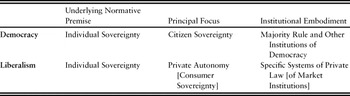
In contrasting the democratic principles of majority rule and citizen sovereignty on the one side and the liberal principles of private autonomy and individual sovereignty on the other, I made it appear as if both distinctions are at the same level of generality. A more accurate analysis must distinguish, though, between three levels at which liberalism and democracy can be compared, namely the level of their ‘institutional embodiments’, the level of their principal focus, and the level of their underlying normative premise. In terms of this three-level-distinction, democracy can be characterized by majority rule as part of its institutional embodiment, by citizen sovereignty as its principal focus, and by individual sovereignty as its underlying normative premise. Liberalism can be characterized, in reverse order, by individual sovereignty as its underlying normative premise, by private autonomy as its principal focus, while its ‘institutional embodiment’ is the specific systems of rules that constitute existing private law systems and market economies. Table 1 summarizes this threefold classification.
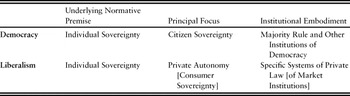
In terms of their underlying normative premise, democracy and liberalism can be said to be equally based on the principle of individual sovereignty.Footnote 25 In terms of their principal ideals, namely citizen sovereignty and private autonomy, they can be said to complement each other in the sense explained above. It is at the level of their respective institutional embodiments that liberalism and democracy have come to appear as different and even conflicting concepts. Yet, this is the essential thrust of my argument, the particular institutional embodiments of the ideals of liberalism and democracy should not be confused with the ideals themselves. Nor should the apparent differences in their institutional embodiments detract attention from the fact that their principal ideals are rooted in the same fundamental normative premise.
An implication of the above ‘refined’ distinction between different levels at which the ideals of liberalism and democracy can be compared is that, in the case of liberalism no less than in the case of democracy, the choice of their respective institutional embodiments should be regarded as a matter of prudence rather than a matter of principle. The question of what specific democratic procedures and institutions promise to serve the ideal of citizen sovereignty best is a factual matter. It is not pre-answered by the fundamental ideal of democracy itself, but is a matter of prudent institutional choice. Likewise, the question of how exactly the rules of the private law society should be defined, and where specifically the demarcation line between the ‘private’ and the ‘public’ realm ought to be drawn, is not pre-answered by the fundamental ideal of liberalism. It is a matter of prudent constitutional choice of sovereign individuals.
When Hayek argues that ‘the problem of whether or not it is desirable to extend collective control must be decided on other grounds than the principle of democracy itself’ (1960: 106), this is surely not meant to imply that liberalism can offer a criterion for determining the appropriate demarcation line between the civil law society and the state that is external to, or independent of, the interests and preferences of the individuals concerned. In the context in which the quoted statement appears, the term ‘principle of democracy’ is clearly meant to point to the limits of majority rule as a particular institutional feature of democracy, but not to question the fundamental democratic ideal of citizens' sovereignty (ibid.: 106f.). A consistent advocate of the democratic ideal of citizen sovereignty would have to agree no less, though, that it is not the majority rule per se, but only the voluntary consent of the persons involved that provides the ultimate measuring rod for what may be regarded as ‘the desirable extent of collective control’. The logic of both ideals, of the liberal ideal of individual sovereignty and of the democratic ideal of citizen sovereignty, cannot but lead to the same conclusion, namely that, ultimately, there can be no other criterion for determining the desirable demarcation line between the private and the public sphere than voluntary agreement among the individuals concerned. Likewise, the two ideals must lead to the same conclusion in regard to the question of how the content of the rules of civil law and, by implication, of private autonomy should be defined, namely that, here too, voluntary agreement is the ultimate source of legitimacy.
7. The liberal and democratic ideal of a privilege-free order
Hayek's critique of democracy in its prevailing institutional form centers around the charge that the absence of effective limitations to majority rule inevitably results in a policy that, instead of serving the common interests of the citizenry, gets entrapped in what may justly be called the dilemma of privilege granting or, in the terminology of public choice theory, the rent-seeking dilemma. It is, as Hayek (Reference Hayek1979: 128) argues, the very lack of effective limitations on its rule that forces the presently governing majority, in order to stay in power, to grant privileges to those groups on whose support it depends. It is this very fact that, according to Hayek, presents the principal threat to liberty, namely the fact ‘that unlimited democracy will abandon liberal principles in favor of discriminatory measures benefiting the various groups supporting the majority’ (Reference Hayek and Hayek1978c: 143).Footnote 26
The granting of privileges to some at the expense of other members of the polity is, however, not only in evident conflict with the liberal principle of non-discrimination, it is equally in conflict with the ideal of citizen sovereignty as the fundamental normative principle of democracy as a citizens' co-operative. In this sense, Hayek's liberal critique of unlimited democracy can be said to imply that the absence of effective limits to the power of majorities not only violates liberal ideals but is in conflict with the fundamental democratic ideal as well.Footnote 27 Instead of serving the common interests of all members of the citizens' co-operative, an unlimited democracy is bound to become an instrument in the service of special interests (Hayek, Reference Hayek and Hayek1978a: 96).
To critics who accuse modern democracy for being a ‘mass democracy’ Hayek (Reference Hayek1979: 99) responds: ‘But if democratic government were really bound to what the masses agree upon there would be little to object to.’ What, in his view, deserves to be rightly criticized is, instead, the fact that what is called ‘the will of the majority’ has in reality little resemblance to what might justly be called the ‘common will’ (1979: 1). The so-called ‘will of the majority’ is, in Hayek's verdict, ‘really an artifact of the existing institutions’ (1978b: 108), of institutions that create conditions under which ‘even a statesman wholly devoted to the common interest of all citizens will be under the constant necessity of satisfying special interests’ (ibid).
In the sense explained, Hayek's demand that the power of the majority must be limited by general rules does not only reflect the liberal ideal of safeguarding individual freedom, it can be argued to be equally in line with the democratic ideal of safeguarding citizen sovereignty. This argument is indeed implied when Hayek points out that effectively denying government and legislator the power to grant privileges is not only an essential means for securing individual liberty, but also a pre-condition for ‘the power of the state to be freed up again for those tasks that are in fact in the common interest’.Footnote 28
To be sure, as Hayek (Reference Hayek1960: 154f) recognizes, depriving government and legislator of the power to grant privileges does not eliminate every threat to individual liberty. Yet, so he argues, even though liberty may also be severely limited by general rules that are equally applicable to all, an important ‘primary precaution’ against this threat is provided by the requirement ‘that the rules must apply to those who lay them down and those who apply them . . . and that nobody has the power to grant exceptions’ (ibid.: 155).Footnote 29 In Hayek's account, to limit the power of government and legislator in such manner does not mean to weaken the effective power of the democratic state but does, on the contrary, strengthen its ability to devote its powers to its true task, namely to advance the common interests of its citizens. ‘The reason is’, as he notes, ‘that democratic government, if nominally omnipotent, becomes as a result of its unlimited powers exceedingly weak, the playball of all the separate interests it has to satisfy to secure majority support’ (1979: 99).Footnote 30
What is at stake here is not a demand to impose, as an ‘external’ constraint, preconceived ‘liberal’ principles on how sovereign citizens of democratic polities are to govern their own affairs. Rather, the purpose is to point to the need to submit the democratic decision-making process to rules that promise to serve the citizens' common interests (Hayek, Reference Hayek and Hayek1978c: 143f.).Footnote 31 In other words, the demand for constitutional constraints on government power can be made on behalf of the democratic ideal of citizen sovereignty no less than on behalf of the liberal ideal of securing individual liberty. Or, as Hayek (Reference Hayek1960: 115) puts it: ‘The liberal believes that the limits that he wants democracy to impose upon itself are also the limits within which it can work effectively and within which the majority can truly direct and control the actions of government.’
8. Improving democracy: Hayek's proposal for institutional reform
‘Many of the gravest defects of contemporary government, widely recognized and deplored but believed to be inevitable consequences of democracy, are in fact the consequences only of the unlimited character of present democracy’ (Hayek, Reference Hayek1979: 143). In thus summarizing his own diagnosis of the deficiencies of contemporary democracy Hayek points out the direction that institutional reforms must take if democracy is not only to safeguard the liberal ideal of individual liberty but also to live up to its own ideal of citizen sovereignty. According to what has been argued above, the main focus of such reforms must be provisions that aim at preventing discriminatory politics by restricting the power of government and legislator to grant special privileges.Footnote 32
Hayek's own proposal for reforming the institutions of democracy is explicitly aimed at this goal. It can be read as a recommendation to the citizens of democratic polities for how they may improve the capacity of the democratic decision-making process to advance their genuine common interests and to limit the scope for a policy of privilege granting that can only work to their mutual detriment.Footnote 33 In Hayek's account, the principal defect in the prevailing institutional structure of democracy must be seen in the fact that one and the same representative body, the parliament, has been entrusted with two fundamentally different tasks. The one task is making the general laws on which the democratic society is based, comprising the laws for the ‘private realm’ – i.e. the rules of the private law society – as well as the laws for the ‘public realm’ – i.e. the rules of politics. And the other task is to monitor and direct the day-to-day activities of the current government.Footnote 34 As Hayek argues, the inevitable effect of the bundling of these two tasks in one and the same assembly has been ‘that the supreme governmental authority became free to give itself currently whatever laws helped it best to achieve the particular purposes of the moment’ (Reference Hayek1979: 101). An assembly that is entrusted with both tasks will be under the constant temptation to use its legislative authority in the service of short-term interests of the current administration, at the expense of the true task of legislation, which is to choose, with a long-term perspective, rules of the game that, if applied over an extended period of time, serve the common interests of the citizenry best (Hayek, Reference Hayek1972a: 73). Its short-term approach to legislation is, as Hayek charges, the principal reason why such an assembly must become the target of the pressures of interest groups, and will be forced to ‘use its powers to satisfy the demands of sectional interests’ (1978b: 115).
There exists, in Hayek's diagnosis, only one effective remedy to the noted structural defect in modern democratic institutions, namely to strictly separate the genuine task of legislation from the task of directing the day-to-day operation of government, and to entrust the two tasks to two distinct assemblies (ibid.). In order to achieve the intended purpose, adequate institutional precautions must be taken to ensure an effective rather than a purely formal separation of the legislative assembly from the governmental assembly. As Hayek (Reference Hayek and Hayek1978d: 160) puts it, the separation must be institutionalized in a manner that can effectively ‘prevent collusion of the legislative with a similarly composed governmental assembly, for which it would be likely to provide the laws which that assembly needed for its particular purpose’.Footnote 35
Hayek (Reference Hayek1979: chap. 17) has worked out quite detailed institutional suggestions for how an effective separation between legislative and governmental assembly may be achieved, and much of the discussion on, and critique of, his proposal for reform has focused on these specific suggestions rather than on the principal thrust of his argument.Footnote 36 Indeed, with his ambition to come up with a specific ‘institutional invention’ (1973: 3) Hayek may have, in effect, done a disservice to his principal cause. By inviting critics to focus on the entirely secondary issue of institutional specifics he drew attention away from the essential and primary issue, namely how legislation, i.e. the choice of the ‘rules of the game’, can be prevented from becoming subservient to the short-term interests of day-to-day government. If Hayek is right, as in my view he surely is, with his diagnosis that the insufficient separation between legislative and governmental functions is at the root of major defects in the currently prevailing form of democracy, the challenge is to find effective institutional remedies. How the separation of legislative and governmental functions that Hayek calls for can be best institutionalized is an issue that a liberal theory of democracy must carefully explore, just as it must explore potential other institutional provisions by which the generality or non-discrimination constraint may be more effectively implemented.Footnote 37
9. Conclusion
The principal claim of this paper is that liberalism and democracy should be viewed not only as compatible ideals, as Hayek has suggested, but as complementary ideals. I have based my argument on a distinction between three different levels at which liberalism and democracy can be compared, the level of their specific ‘institutional embodiment’, the level of their principal focus, and the level of their underlying normative premise. I have argued that liberalism and democracy share as their common normative foundation the ideal of individual sovereignty, and that their respective main foci, the liberal principle of private autonomy and the democratic principle of citizen sovereignty, can be best understood as applications of the ideal of individual sovereignty to the realm of the private law society on the one side and to the ‘public’ realm of collective-political choice on the other.
That individuals should be free to choose, separately and jointly, how they wish to live in mutually compatible ways with each other must, in terms of their fundamental normative premise, be a matter of principle for advocates of democracy no less than for advocates of liberalism. By contrast, the question of what kinds of rules and institutional provisions are best suited to allow individuals freely to choose how they wish to live, separately and jointly, in mutually compatible ways, is, in terms of the liberal as well as the democratic ideal, a matter of prudence.Footnote 38 It is a question that must be answered in terms of our knowledge of the factual working properties of potential alternative institutional regimes and in light of what the individuals involved actually wish for themselves. In answering this question, liberalism's traditional focus has been on the rules of the private law society, while democracy's focus has been on the rules of the public realm.
Clearly to distinguish between the fundamental normative premise of individual sovereignty and its institutional embodiment, in the private law arena as well as in politics, cannot only help to avoid misconceptions that have unnecessarily burdened the discourse between advocates of liberalism and advocates of democracy, it can also help to clarify the relation between value judgments and theoretical or ‘scientific’ conjectures within the liberal doctrine.Footnote 39 Liberalism, over its long tradition, has accumulated a rich body of insights on how different kinds of institutions work, and which are more conducive to human welfare than others. This body of insights provides the intellectual foundation on which liberals can, with great confidence, recommend market-type institutions as providing superior solutions to most of the problems that men face in their social life. Yet, one must not forget that the institutional recommendations that liberals make are based not only on ‘scientific’ arguments about the working properties of institutions but also on the normative premise of individual sovereignty. In other words, they are made under the presumption that the measuring rod for the ‘goodness’ of institutions are the wants – or, more, precisely, the constitutional interests (Vanberg, Reference Vanberg Viktor2005) – of the individuals who are to live with them. The arguments that liberals employ in support of their institutional recommendations are prudential arguments that can help sovereign individuals to make better-informed institutional choices, not arguments that would allow one to determine the ‘adequate’ constitutional structure independently of the institutional preferences – or constitutional interests – that these sovereign individuals may have.