Many preschool-age children meet criteria for psychiatric disorders (Lavigne et al. Reference Lavigne, Gibbons, Christoffel, Arend, Rosenbaum and Binns1996, Reference Lavigne, LeBailly, Hopkins, Gouze and Binns2009; Keenan et al. Reference Keenan, Shaw, Walsh, Delliquadri and Giovannelli1997; Egger et al. Reference Egger, Erkanli, Keeler, Potts, Walter and Angold2006; Bufferd et al. Reference Bufferd, Dougherty, Carlson and Klein2011), and rates approach those observed in later childhood and adolescence (Egger & Angold, Reference Egger and Angold2006). However, there is a paucity of longitudinal research examining outcomes of preschool diagnoses. Research in this area is challenging due to developmental differences in clinical presentation and the possibility that preschool disorders reflect transient effects of environmental contexts or normative developmental changes (Carter et al. Reference Carter, Briggs-Gowan and Davis2004). While most preschool psychiatric diagnoses persist over shorter periods (Lavigne et al. Reference Lavigne, Arend, Rosenbaum, Binns, Christoffel and Gibbons1998; Bufferd et al. Reference Bufferd, Dougherty, Carlson, Rose and Klein2012), and specific disorders over longer periods (Speltz et al. Reference Speltz, Mcclellan, Deklen and Jones1999; Lavigne et al. Reference Lavigne, Cicchetti, Gibbons, Binns, Larsen and Vito2001; Lahey et al. Reference Lahey, Pelham, Loney, Kipp, Ehrhardt and Lee2004; Harvey et al. Reference Harvey, Youngwirth, Thakar and Errazuriz2009; Keenan et al. Reference Keenan, Boeldt, Chen, Coyne, Duax and Hart2011; Wichstrøm et al. Reference Wichstrøm, Belsky and Berg-Nielsen2013; Luby et al. Reference Luby, Gaffrey, Tillman, April and Belden2014), few studies examine how a range of very early common psychiatric diagnoses relate to later clinical outcomes during both middle childhood and early adolescence.
Given the better established validity of psychiatric disorders at later developmental periods, evidence of stability, or homotypic continuity, from preschool age through middle childhood and early adolescence would support the predictive validity of early childhood psychopathology. Heterotypic continuity may also support the validity of broader diagnostic constructs, as associations between different disorders across time may represent varied phases or expressions of a single disorder or a common liability (Rutter et al. Reference Rutter, Kim-Cohen and Maughan2006). Discontinuities and changes in disorder expression may alternatively represent causal influences, as in cases when one disorder disrupts adaptive development and thereby confers risk for a separate disorder, or may suggest that conceptualizations and boundaries of very early childhood psychiatric disorders need to be refined.
The current study prospectively examines the continuity of preschool psychiatric disorders in a community sample using semi-structured diagnostic interviews. Psychopathology was assessed using the Preschool Age Psychiatric Assessment (PAPA; Egger et al. Reference Egger, Ascher and Angold1999) when children were 3 years old, and using the Kiddie Schedule for Affective Disorders and Schizophrenia (K-SADS) when children were 9 and 12 years old (Kaufman et al. Reference Kaufman, Birmaher, Brent, Rao, Flynn and Moreci1997). The PAPA and K-SADS are based on the same diagnostic criteria, which include impairment. In a study using both interviews with the same sample of preschoolers, few differences were found in rates of disorders and the same children were identified by both interviews as meeting criteria for psychiatric diagnoses (Birmaher et al. Reference Birmaher, Ehmann, Axelson, Goldstein, Monk and Kalas2009).
A number of previous studies examine continuity of symptoms and problem behaviors in young children using parent or teacher rating scales (Egeland et al. Reference Egeland, Kalkoske, Gottesman and Erickson1990; Owens & Shaw, Reference Owens and Shaw2004; Briggs-Gowan et al. Reference Briggs-Gowan, Carter, Bosson-Heenan, Guyer and Horwitz2006; Mian et al. Reference Mian, Wainwright, Briggs-Gowan and Carter2011; Basten et al. Reference Basten, Tiemeier, Althoff, van de Schoot, Jaddoe and Hofman2016; Carbonneau et al. Reference Carbonneau, Boivin, Brendgen, Nagin and Tremblay2016). However, these measures are limited compared to semi-structured diagnostic interviews in capturing the clinical significance, severity, and duration of symptoms. In addition, many previous studies use clinical or high-risk samples (Speltz et al. Reference Speltz, Mcclellan, Deklen and Jones1999; Lavigne et al. Reference Lavigne, Cicchetti, Gibbons, Binns, Larsen and Vito2001; Lahey et al. Reference Lahey, Pelham, Loney, Kipp, Ehrhardt and Lee2004; Keenan et al. Reference Keenan, Boeldt, Chen, Coyne, Duax and Hart2011), which limits generalizability. Furthermore, previous work often focuses on a small number of diagnoses, typically externalizing (Speltz et al. Reference Speltz, Mcclellan, Deklen and Jones1999; Lavigne et al. Reference Lavigne, Cicchetti, Gibbons, Binns, Larsen and Vito2001; Lahey et al. Reference Lahey, Pelham, Loney, Kipp, Ehrhardt and Lee2004; Harvey et al. Reference Harvey, Youngwirth, Thakar and Errazuriz2009; Keenan et al. Reference Keenan, Boeldt, Chen, Coyne, Duax and Hart2011), with only two studies on internalizing (Wichstrøm et al. Reference Wichstrøm, Belsky and Berg-Nielsen2013; Luby et al. Reference Luby, Gaffrey, Tillman, April and Belden2014), rather than on the full range of common disorders. Finally, several previous studies examine continuity of psychopathology from preschool through the transition into kindergarten or elementary school (Speltz et al. Reference Speltz, Mcclellan, Deklen and Jones1999; Lahey et al. Reference Lahey, Pelham, Loney, Kipp, Ehrhardt and Lee2004; Owens & Shaw, Reference Owens and Shaw2004; Briggs-Gowan et al. Reference Briggs-Gowan, Carter, Bosson-Heenan, Guyer and Horwitz2006; Harvey et al. Reference Harvey, Youngwirth, Thakar and Errazuriz2009; Keenan et al. Reference Keenan, Boeldt, Chen, Coyne, Duax and Hart2011; Wichstrøm et al. Reference Wichstrøm, Belsky and Berg-Nielsen2013; Basten et al. Reference Basten, Tiemeier, Althoff, van de Schoot, Jaddoe and Hofman2016; Carbonneau et al. Reference Carbonneau, Boivin, Brendgen, Nagin and Tremblay2016), but there is a paucity of longer term follow-ups.
We previously reported on rates and continuity of diagnoses from preschool to age 6 (Bufferd et al. Reference Bufferd, Dougherty, Carlson, Rose and Klein2012). Rates were similar at both ages, and children who met criteria for a preschool diagnosis were nearly five times more likely to meet criteria at age 6. Homotypic continuity was present for anxiety disorders, attention-deficit/hyperactivity disorder (ADHD), and oppositional defiant disorder (ODD), and heterotypic continuity was present between depression and anxiety, anxiety and ODD, and ADHD and ODD. This paper extends our previous work by describing continuity through middle childhood and early adolescence.
Method
Participants
Families with a 3-year-old child living within 20 miles of Stony Brook, NY were eligible for a larger study of risk and psychopathology (Dougherty et al. Reference Dougherty, Bufferd, Carlson, Dyson, Olino and Durbin2011); children with significant medical or developmental disorders were excluded (see Bufferd et al. Reference Bufferd, Dougherty, Carlson, Rose and Klein2012 for details about recruitment, enrollment, and study approval).
Parents serving as primary caretakers were interviewed regarding their 3-year-old children (N = 541, the effective sample for this study). Parents and children were both interviewed when children were 9 (443; 81.9%) and 12 (434; 80.2%) years old.
The mean ages of the children at each assessment were 3.6 years (s.d. = 0.27; range 3.0–4.2), 9.3 years (s.d. = 0.43; range 8.8–11.0), and 12.8 years (s.d. = 0.45; range 11.9–14.2), respectively. Of the children, 248 (45.8%) were female, 511 (94.5%) were white, and 50 (9.2%) were Hispanic. Approximately half of parents (295 [55.0%] mothers; 231 [47.1%] fathers) had graduated from college at the initial assessment. At the age 9 and age 12 assessments, the majority of children were in third (261; 59.0%) and seventh grade (250; 57.7%), respectively. Most children lived with both biological parents at age 3 (513; 95.0%), age 9 (373; 84.2%), and age 12 (366; 84.3%). The sample's demographic characteristics were fairly representative of the surrounding county, as detailed in previous work (Bufferd et al. Reference Bufferd, Dougherty, Carlson and Klein2011).
Children with an interview at age 3 and at least one later time point were compared to children with only the initial interview on all age 3 demographic, diagnostic, and dimensional symptom variables. Children with multiple interviews were slightly but significantly younger at the initial assessment (M = 3.62, s.d. = 0.26) than children with age 3 data only (M = 3.70, s.d. = 0.29; t(539) = 2.49, p = 0.01) and had higher dimensional ODD scores (M = 2.36, s.d. = 0.26) than children with age 3 data only (M = 1.49, s.d. = 0.29; t(111) = −2.51, p = 0.01; df adjusted due to unequal variances).
Measures
Preschool psychopathology
The PAPA (Egger et al. Reference Egger, Ascher and Angold1999) is the first published diagnostic interview designed to assess a comprehensive range of DSM-IV-TR disorders in children 2–5 years old, and was the only published interview for preschoolers when the study began. Parents are interviewed about children's symptoms during the preceding 3 months. DSM-IV-TR diagnoses were derived using algorithms created by the instrument's developers. The PAPA has good test–retest inter-rater reliability that is comparable to other semi-structured diagnostic interviews for children and adults (Egger et al. Reference Egger, Erkanli, Keeler, Potts, Walter and Angold2006).
PAPA interviews were conducted by advanced clinical psychology graduate students trained by an experienced interviewer from the group that developed the interview. Assessments lasted for approximately one to two hours and were conducted by telephone. Interviews with parents about children's psychopathology conducted in person and by phone yield similar results (Lyneham & Rapee, Reference Lyneham and Rapee2005). A second rater from the pool of interviewers independently rated 21 randomly selected audiotaped interviews, oversampling participants with psychopathology. The κ values were 1.00 for all diagnoses. Intraclass correlation coefficients (ICCs) for dimensional scores ranged from 0.98–1.00.
The following diagnoses were used at age 3: depressive disorders (major depressive disorder, dysthymic disorder, depressive disorder not otherwise specified [NOS]), anxiety disorders (specific phobia, social phobia, separation anxiety, generalized anxiety, and panic/agoraphobia), ADHD, and disruptive behavior disorders (DBD; consists of ODD only at age 3). Dimensional scores were created by summing relevant endorsed symptoms.
Parents also completed the ADHD and ODD sections of the Early Childhood Inventory-4 (ECI-4; Gadow & Sprafkin, Reference Gadow and Sprafkin2000). This parent-rated scale screens for DSM-IV disorders in 3–6 year olds. Coefficient αs were 0.79 for ADHD-inattention, 0.82 for ADHD-hyperactivity/impulsivity, and 0.85 for ODD. Because of concerns about the time required to administer the PAPA, the ADHD and ODD scales of the ECI-4 were used in the first 60% of the sample (n = 324) to help determine whether to complete these sections of the PAPA. If no more than one to two mild symptoms were endorsed, the interviewer confirmed the absence of significant symptomatology and skipped the relevant section(s) of the interview. In the remaining 40% of the sample (n = 217), the ADHD and ODD sections of the PAPA were administered to all parents. Rates of ADHD and ODD in the 60% of the sample that could be screened out of these sections (ADHD: 8/324 [2.5%]; ODD: 30/324 [9.3%]) did not differ from rates in the 40% that completed these sections regardless of screener scores (ADHD: 3/217 [1.4%], χ2 (1, N = 541) = 0.770, p = 0.38; ODD: 21/217 [9.7%], and χ2 (1, N = 541) = 0.27, p = 0.87).
Middle childhood and adolescent psychopathology
The K-SADS Present and Lifetime Version (K-SADS-PL) was developed for children ages 6–18 years as a downward extension of the Schedule for Affective Disorders and Schizophrenia (Endicott & Spitzer, Reference Endicott and Spitzer1978; Kaufman et al. Reference Kaufman, Birmaher, Brent, Rao, Flynn and Moreci1997). Parents and children are interviewed separately, and diagnoses reflect DSM-IV criteria. The K-SADS has good-to-excellent test–retest inter-rater reliability for all diagnoses (Kaufman et al. Reference Kaufman, Birmaher, Brent, Rao, Flynn and Moreci1997). We chose the K-SADS, rather than the Child and Adolescent Psychiatric Assessment (CAPA; Angold et al. Reference Angold, Prendergast, Cox, Harrington, Simonoff and Rutter1995), which is similar to the PAPA but for older youth, because we wanted to assess psychopathology occurring at any point during the intervals, rather than obtain ‘snapshots’ of psychopathology during the 3 months before assessments. At age 9, the assessment interval was from age 6 to the age 9 interview, and at age 12, the period since the age 9 assessment.
At the age 9 and age 12 assessments, interviews were conducted by advanced clinical psychology graduate students and a masters-level clinician and supervised by an experienced child psychiatrist and clinical psychologist. Interviewers administered the K-SADS separately to parents and children. Further information was obtained to reconcile discrepancies as needed, and the interviewer made final ratings based on the combination of reports. To assess inter-rater reliability, a second rater independently rated videotapes for 74 participants. The κ values for diagnoses ranged from 0.58 to 0.85 (median = 0.73). ICCs for dimensional scores ranged from 0.76 to 0.97 (median = 0.85).
The following diagnoses were used at ages 9 and 12: depressive disorders (major depressive disorder, dysthymic disorder, depressive disorder NOS), anxiety disorders (specific phobia, social phobia, separation anxiety disorder, generalized anxiety disorder, panic/agoraphobia, anxiety disorder NOS), DBD (ODD, conduct disorder [CD], DBD-NOS), and ADHD (ADHD-inattentive, -hyperactive, or -combined type, ADHD-NOS). Dimensional scores were created by summing relevant symptoms present in the month before the interview. These current symptoms, as opposed to symptoms present at any point during the intervals, were used because ages of onset and durations were not recorded for individual symptoms.
Because of differences between interviews and disorder presentations across development, the diagnoses included in the broader categories differed somewhat across assessments. Specifically, NOS diagnoses were included for anxiety disorders, ADHD, and DBD at ages 9 and 12 only, because the PAPA does not provide NOS diagnoses for these disorders. Additionally, because CD is viewed as a part of the natural history of DBD, CD cases were also included in the DBD category at ages 9 and 12, but not at age 3. We repeated all analyses using ODD only at ages 9 and 12; results were highly similar, so we only report analyses using the broader DBD category.
Data analysis
To compare rates of disorders in preschool versus middle childhood and early adolescence, McNemar's tests for paired proportions were conducted (R Core Team, 2016; version 3.1.1). To test continuity of diagnoses, middle childhood diagnoses were regressed on preschool diagnoses, and early adolescent diagnoses were regressed on preschool diagnoses, in logistic regression models. Odds ratios (ORs) and 95% confidence intervals (CIs) were computed. ORs from diagnosis models represent the increased likelihood of having a disorder at the later time point for preschoolers with versus without a diagnosis.
Additionally, negative binomial regression models were estimated to test the continuity of dimensional symptom scores, and incidence rate ratios (IRRs) and 95% CIs were computed. IRRs from dimensional models represent the relative increase in risk for an additional symptom at the later assessment associated with a one-symptom increase in preschool. Negative binomial models were used because, unlike linear regression models, they produce only plausible, non-negative predicted values (Gardner et al. Reference Gardner, Mulvey and Shaw1995). Furthermore, negative binomial models account for the higher variance typically observed at higher values in count data, whereas linear regression assumes homoscedasticity of variance; violating this assumption can bias standard error estimates. More restrictive Poisson regression models were inappropriate because of overdispersion in the dependent variables.
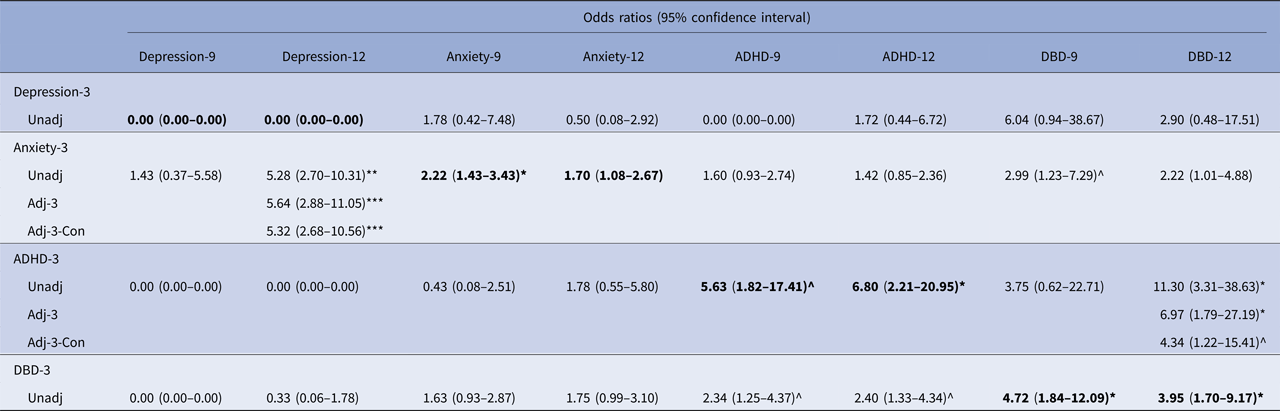
When a heterotypic association was significant in the unadjusted omnibus model testing only a single predictor (e.g. preschool anxiety predicting middle childhood depression; denoted ‘Unadj’ in Table 1), a model also including the preschool disorder corresponding to the outcome disorder was conducted as a follow-up test (e.g. preschool anxiety and depression predicting middle childhood depression; denoted ‘Adj-3’). If the heterotypic association continued to be significant, another follow-up model adjusting for both the preschool version of the outcome disorder and the concurrent version of the preschool predictor was tested (e.g. preschool anxiety and depression and middle childhood anxiety predicting middle childhood depression; denoted ‘Adj-3-con’).
Odds ratios from logistic regression models testing homotypic and heterotypic relationships between diagnoses in preschool and in middle childhood and early adolescence (N = 541)

ADHD = attention-deficit/hyperactivity disorder; DBD = disruptive behavior disorder; -3 denotes age 3 (preschool), -9 denotes age 9 (middle childhood), and -12 denotes age 12 (early adolescence); Unadj, unadjusted; Adj-3, adjusted for corresponding age 3 diagnosis; Adj-3-Con, adjusted for corresponding age 3 diagnosis and concurrent diagnosis. Homotypic continuity estimates in bold. For unadjusted models (Unadj), ^p < 0.05; *p < 0.01; **p < 0.001. For adjusted models (Adj-3, Adj-3-con), ^p < 0.10; *p < 0.05; **p < 0.01; ***p < 0.001. Follow-up Adj-3 models are only reported if Unadj models are significant at *p < 0.01. Follow-up Adj-3-con models are only reported if Adj-3 models are significant at *p < 0.05.
To correct for multiple tests, we set α at p < 0.01 for unadjusted models; trends at α of p < 0.05 are also noted. For follow-up models testing heterotypic associations while adjusting for comorbidity, we use p < 0.05. All regression models were estimated in Mplus (Muthén & Muthén, 2012; version 7.31) using robust standard errors and full-information maximum likelihood to handle missing data at the later assessments.
Results
Rates of disorders
Diagnoses
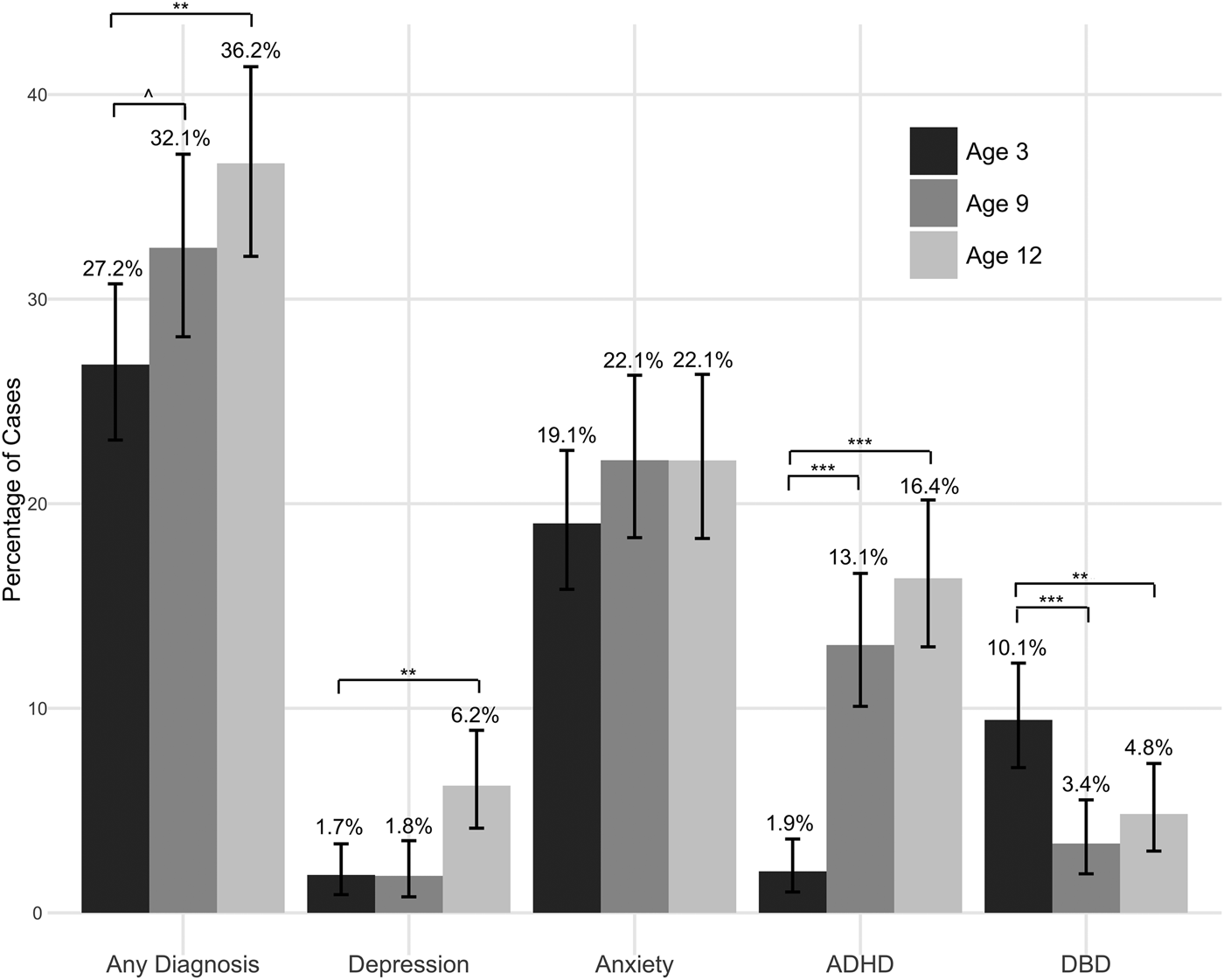
The prevalence of any psychiatric disorder in preschool and middle childhood did not differ, whereas the prevalence of any psychiatric disorder was significantly higher in early adolescence than it was in preschool (χ2 (1, N = 434) = 5.46, p = 0.002) (Fig. 1). Of preschoolers who met criteria for a diagnosis, 45.8% (55/120) had a diagnosis in middle childhood, and 47.5% (56/118) had a diagnosis in early adolescence. Conversely, of children who met criteria for a diagnosis in middle childhood and early adolescence, 38.2% (55/144) and 37.8% (56/148), respectively, also had a diagnosis in preschool. Considering the entire sample, 12.4% (55/443) of all children met criteria for a disorder in preschool and middle childhood, 12.9% (56/434) in preschool and early adolescence, and 9.0% (37/410) at all three time points.
Differences in rates of disorders from preschool to middle childhood (n = 443) and early adolescence (n = 434) tested using McNemar's tests. ADHD, attention-deficit/hyperactivity disorder; DBD = disruptive behavior disorder. Rates in middle childhood and early adolescence were compared to rates in preschool only. Rates in preschool depicted in the graph reflect the sample used for comparisons with rates in middle childhood; preschool rates are highly similar across the two samples. Error bars reflect 95% confidence intervals. *p < 0.05; **p < 0.01; ***p < 0.001.

Rates of DBD decreased from preschool to middle childhood (χ2 (1, N = 443) = 17.65, p < 0.001) and early adolescence (χ2 (1, N = 434) = 12.50, p < 0.001), while rates of ADHD increased (middle childhood: χ2 (1, N = 443) = 39.05, p < 0.001; early adolescence: χ2 (1, N = 434) = 43.35, p < 0.001) (Fig. 1). Rates of depression increased from preschool to early adolescence (χ2 (1, N = 434) = 9.25, p = 0.02).
Homotypic continuity
Diagnoses
Having a psychiatric disorder in preschool was associated with more than a two-fold increase in risk for a diagnosis in middle childhood (OR 2.23, p < 0.001, 95% CI 1.55–3.20) and early adolescence (OR 2.16, p < 0.001, 95% CI 1.50–3.10). Homotypic continuity was present for anxiety disorders from preschool to middle childhood, ADHD from preschool to early adolescence, and DBD from preschool to both later periods (Table 1). There were no overlapping cases of depressive disorders in preschool and middle childhood or early adolescence (see online Supplement 1 for cross-tabs of rates).
Dimensional scores
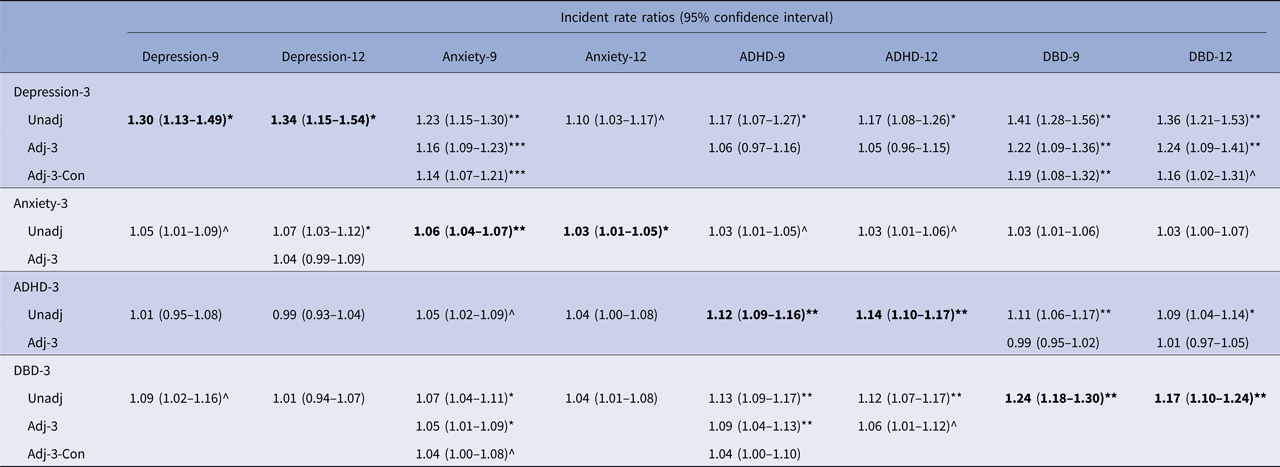
Depression, anxiety, ADHD, and DBD symptom scores all showed significant homotypic continuity from preschool to middle childhood and early adolescence (Table 2).
Incident rate ratios from negative binomial models for homotypic and heterotypic relationships between dimensional scores in preschool and in middle childhood and early adolescence (N = 541)

ADHD = attention deficit/hyperactivity disorder; DBD = disruptive behavior disorder; -3 denotes age 3 (preschool), -9 denotes age 9 (middle childhood), and -12 denotes age 12 (early adolescence); Unadj, unadjusted; Adj-3, adjusted for corresponding age 3 diagnosis; Adj-3-Con, adjusted for corresponding age 3 diagnosis and concurrent diagnosis. Homotypic continuity estimates in bold. For unadjusted models (Unadj), ^p < 0.05; *p < 0.01; **p < 0.001. For adjusted models (Adj-3, Adj-3-con), ^p < 0.10; *p < 0.05; **p < 0.01; ***p < 0.001. Follow-up Adj-3 models are only reported if Unadj models are significant at *p < 0.01. Follow-up Adj-3-con models are only reported if Adj-3 models are significant at *p < 0.05.
Heterotypic continuity
Diagnoses
Heterotypic continuity was present between preschool anxiety and early adolescent depressive disorders; this association remained significant after adjusting for preschool depressive disorders and further for adolescent anxiety disorders (Table 1).
Preschool ADHD was associated with DBD in early adolescence; the association remained significant after adjusting for preschool DBD, but was reduced to a trend level after further adjusting for adolescent ADHD.
Dimensional scores
Preschool depressive symptom scores showed significant heterotypic associations with anxiety symptoms in middle childhood (Table 2). The association remained significant in models adjusting for both preschool anxiety and middle childhood depressive symptoms. Preschool depressive symptoms were associated in unadjusted models with ADHD in middle childhood and early adolescence, but the associations were no longer significant after adjusting for preschool ADHD symptoms. Finally, preschool depressive symptoms were associated with DBD symptoms in both middle childhood and early adolescence. The association between preschool depressive symptoms and DBD symptoms in middle childhood remained significant in models adjusting for both preschool DBD and concurrent depressive symptoms, while the association between preschool depressive symptoms and DBD symptoms in early adolescence was significant in the model adjusting for preschool DBD symptoms only.
A significant heterotypic relationship was also present between anxiety symptoms in preschool and depressive symptoms in early adolescence. However, the association was not significant after adjusting for preschool depressive symptoms.
Preschool ADHD symptoms were significantly associated with DBD symptoms at both later assessments; these associations were not significant after adjusting for preschool DBD symptoms.
Heterotypic relationships were also present between DBD symptoms in preschool and anxiety symptoms in middle childhood; this relationship remained significant after adjusting for preschool anxiety symptoms, but not after also adjusting for concurrent DBD symptoms. Finally, preschool DBD symptoms were associated with ADHD symptoms at both later waves. After adjusting for preschool ADHD symptoms, preschool DBD symptoms continued to predict ADHD symptoms in middle childhood, but not in early adolescence. The association between preschool DBD and ADHD symptoms in middle childhood was no longer significant after adjusting for later DBD symptoms.
Discussion
This is the first study to prospectively examine patterns of continuity of the range of common psychiatric disorders at the levels of both diagnoses and symptom scores from preschool to middle childhood and early adolescence. Nearly half of preschoolers with a diagnosis also had a psychiatric disorder in middle childhood or early adolescence, illustrating both considerable continuity and change, and replicating previous work at later developmental periods (Costello et al. Reference Costello, Mustillo, Erkanli, Keeler and Angold2003; Maughan & Kim-Cohen, Reference Maughan and Kim-Cohen2005; Rutter et al. Reference Rutter, Kim-Cohen and Maughan2006; Copeland et al. Reference Copeland, Adair, Smetanin, Stiff, Briante and Colman2013; Ford et al. Reference Ford, Macdiarmid, Russell, Racey and Goodman2017). Preschoolers who met criteria for a diagnosis were over twice as likely as other preschoolers to meet criteria for a diagnosis at the later periods. This suggests that psychiatric disorders in preschoolers are not transient in a substantial number of cases. Additionally, over a third of school-age children and early adolescents with psychiatric disorders already met criteria for diagnoses in early childhood, indicating that common forms of pediatric psychopathology are often detectable at an early age. However, the degrees of continuity from early childhood to middle childhood and early adolescence were lower than observed in this sample between ages 3 and 6 using a repeated administration of the PAPA (Bufferd et al. Reference Bufferd, Dougherty, Carlson, Rose and Klein2012), perhaps due to developmental changes, the longer follow-up periods, and/or differences between the PAPA and K-SADS interviews.
Rates of disorders
Compared with the rate of any psychiatric disorder in preschool, the rate was similar in middle childhood, but increased significantly in early adolescence. Although conclusions must be qualified due to the different assessment time frames and interviews, these results are consistent with previous cross-sectional studies of separate samples of preschoolers and school-age children suggesting comparable rates of psychiatric disorders in these two developmental periods (Egger & Angold, Reference Egger and Angold2006), and with studies describing an increase in rates of disorders from middle childhood to adolescence (Costello et al. Reference Costello, Copeland and Angold2011).
The increase in ADHD may indicate that children's attentional and impulsivity problems become more apparent and impairing as they transition to classroom settings. The decline in rates of DBD may suggest that clinically significant disruptive behavior problems decrease with age, or that it is difficult to distinguish normative, developmentally limited oppositional behavior from psychopathology in preschoolers (Wakschlag et al. Reference Wakschlag, Choi, Carter, Hullsiek, Burns and McCarthy2012; Bufferd et al. Reference Bufferd, Dyson, Hernandez, Wakschlag and Cicchetti2016).
In other studies, the prevalence of depression in adolescence is comparable to levels observed in adulthood (Kessler et al. Reference Kessler, Mcgonagle, Zhao, Nelson, Hughes and Eshleman1994; Avenevoli et al. Reference Avenevoli, Swendsen, He, Burstein and Merikangas2015). Our study suggests that this increase starts just before or during the earliest part of adolescence, around age 12–13, which is somewhat earlier than reported in previous work (e.g. Hankin et al. Reference Hankin, Young, Abela, Smolen, Jenness and Gulley2015).
Homotypic continuity
Overall, the degree of homotypic continuity was higher for externalizing compared with internalizing disorders, extending similar findings in previous studies of continuity of disorders from childhood to adolescence that also suggest a gradient of stability (Copeland et al. Reference Copeland, Adair, Smetanin, Stiff, Briante and Colman2013).
The discontinuity of depressive disorders from preschool to middle childhood and early adolescence is likely due to the low prevalence of depression in our unselected sample and contrasts with previous work with depressed preschoolers (Luby et al. Reference Luby, Gaffrey, Tillman, April and Belden2014). Indeed, dimensional depressive scores, which are more sensitive to milder manifestations of psychopathology, showed homotypic continuity through both developmental periods. With the exceptions of anxiety disorders through early adolescence and ADHD through middle childhood, we observed homotypic continuity for symptoms and diagnoses for anxiety disorders, ADHD, and DBD through both later periods. This continuity replicates previous work in clinical samples from preschool through middle childhood (Lahey et al. Reference Lahey, Pelham, Loney, Kipp, Ehrhardt and Lee2004; Luby et al. Reference Luby, Gaffrey, Tillman, April and Belden2014) and in older children (Copeland et al. Reference Copeland, Adair, Smetanin, Stiff, Briante and Colman2013).
Heterotypic continuity
Preschool anxiety disorders predicted depressive disorders in early adolescence, even after accounting for preschool depression and adolescent anxiety, while even the unadjusted association was not significant for middle childhood. The risk that early anxiety disorders confer for later depressive disorders may not manifest until adolescence, perhaps due to the unique maturational processes and psychosocial challenges associated with this period of development (Silberg et al. Reference Silberg, Rutter and Eaves2001; Walker et al. Reference Walker, Sabuwalla and Huot2004; Rutter et al. Reference Rutter, Kim-Cohen and Maughan2006). Anxiety and depression may also be conceptualized as age-dependent manifestations of the same underlying disorder (Weissman et al. Reference Weissman, Wickramaratne, Nomura, Warner, Verdeli and Pilowsky2005), a notion supported by longitudinal twin study data indicating that the genetic influences on anxiety and depression are independent in childhood but shared in adolescence (Waszczuk et al. Reference Waszczuk, Zavos, Gregory and Eley2014).
We also observed a heterotypic relationship between preschool ADHD and DBD in early adolescence, but not middle childhood. The model adjusted for both preschool DBD and ADHD in early adolescence suggests the association is due, at least in part, to the co-occurrence of disorders at each time point.
Dimensional measures of psychopathology showed more unadjusted heterotypic relationships (11/24; 45.8%) than did diagnoses (2/24; 8.3%). However, the majority of heterotypic associations between dimensional scores were attenuated in models adjusted for comorbid preschool and concurrent symptoms; indeed, 45.4% (5/11) of the significant heterotypic associations continued to be significant in models adjusted for preschool comorbidity, and only 18.2% (2/11) continued to be significant in models adjusted for both preschool and later comorbidity. Thus, in most cases, heterotypic continuity of symptoms likely reflects continuity of comorbid psychopathology.
Notably, although preschool depressive disorders did not predict any disorder at either later assessment, with the exception of early adolescent anxiety symptoms, depressive symptoms were related to all other symptoms at both waves. Moreover, the associations with anxiety and DBD in middle childhood persisted after adjusting for comorbidity. Thus, depressive symptoms in early childhood appear to be risk factors for myriad other symptoms, often independently of early and persisting comorbidity. Conversely, preschool anxiety symptoms predicted only depressive symptoms in early adolescence, and the effects appear to be accounted for by comorbidity.
DBD symptoms predicted anxiety symptoms in middle childhood only, independently of preschool comorbidity. It may be that some preschoolers’ anxiety symptoms reflect oppositionality in the service of avoidance. By late childhood, these children may be able to express their anxiety, and by early adolescence, cope with it effectively. There were also reciprocal relationships between DBD and ADHD. However, given that most of these heterotypic associations were no longer significant after adjusting for comorbidity, these effects appear to be due to overlapping variance among the comorbid diagnoses.
One factor that may explain many of these heterotypic relationships is the symptom of irritability, which is a diagnostic feature of DBD, depression in youth, and some anxiety disorders, and predicts internalizing and externalizing psychopathology (Dougherty et al. Reference Dougherty, Smith, Bufferd, Kessel, Carlson and Klein2015; Vidal-Ribas et al. Reference Vidal-Ribas, Brotman, Valdivieso, Leibenluft and Stringaris2016). Irritability may contribute to many of the heterotypic pathways observed in this study.
Alternatively, the high rates of heterotypic associations may be evidence of a general psychopathology factor (Caspi et al. Reference Caspi, Houts, Belsky and Goldman-Mellor2014; Lahey et al. Reference Lahey, Rathouz, Keenan, Stepp, Loeber and Hipwell2015), which is hypothesized to underlie or give rise to specific disorders and account for comorbidity. However, formal tests of this hypothesis to explain sequential comorbidity from preschool to later developmental periods are needed.
Limitations
The results should be considered in light of the study's limitations. Attrition ranged from 18% to 20%; however, this is fairly low over 6 and 9 year follow-ups. We also used different interviews in different developmental periods. While a previous study suggests that the results of the two interviews are comparable (Birmaher et al. Reference Birmaher, Ehmann, Axelson, Goldstein, Monk and Kalas2009), this may still account for some of the differences in rates and attenuate homotypic continuity. Furthermore, preschool diagnoses were necessarily based on parent reports, while diagnoses at later periods included children's perspectives. The addition of children's reports likely enhanced the validity of the assessments, but may have reduced continuity. Preschool interviews were also conducted over the phone due to time constraints, which may affect the validity of the diagnostic assessment. However, previous work indicates that interviews in person and by phone with parents about children's psychopathology yield similar results (Lyneham & Rapee, Reference Lyneham and Rapee2005). The assessment time frames also differed, although the most common disorders tend to be persistent, which would limit the effects of this difference. Moreover, participants are more likely to recall psychopathology that is closer in time to the assessment (Moffitt et al. Reference Moffitt, Caspi, Taylor, Kokaua, Milne and Polanczyk2010). In addition, including additional diagnoses (i.e. NOS, CD) in disorder categories at the later points may have introduced heterogeneity; however, this was done because the PAPA does not assess NOS cases except depression (which was included), and to account for differences in the nature of disorders over development. The κ value for DBD at age 9 was also rather low (0.58), but the reliability for the dimensional DBD score was high (ICC = 0.93), suggesting that disagreements were generally around the threshold for diagnosis. Finally, our sample size was modest and participants were from the community and predominantly white and middle class, which limits the generalizability of the findings, particularly because of evidence that race and ethnicity influence diagnoses and clinical characteristics in children (e.g. Nguyen et al. Reference Nguyen, Huang, Arganza and Liao2007).
Implications and conclusions
This study provides moderate support for the continuity of psychiatric disorders in preschoolers. The presence of psychopathology in preschool is a significant risk factor for psychiatric disorders during middle childhood and early adolescence, but there is also considerable discontinuity over time. Homotypic continuity for diagnoses was observed in half of the models (4/8), which suggests that diagnostic thresholds and categories in preschool may need refining. On the other hand, homotypic continuity was present for dimensional scores of all four disorders at both time points, likely due to the greater information, and hence greater reliability, inherent in dimensional compared with categorical measures. The relatively large number of heterotypic associations between symptoms suggests that preschool symptoms show high fluidity over time, or, alternatively, have low specificity. Additionally, there were differences in disorder continuity from preschool to middle childhood versus early adolescence, suggesting that maturation and challenges associated with certain developmental periods may impact the expression of psychopathology across time. Our results highlight the need to further refine the conceptualization and assessment of preschool psychopathology, and to identify moderators that can predict which preschoolers with psychiatric diagnoses will continue to exhibit psychopathology later in life.
Supplementary material
The supplementary material for this article can be found at https://doi.org/10.1017/S0033291717003646.
Acknowledgements
This work was supported by NIMH Grant: R01MH069942 to DNK and NSF Graduate Research Fellowship: 2015201335 to MCF.
Disclosures
The authors report no financial relationships with commercial interests.