Introduction
Cryopreservation of gametes has become a routine technique for germplasm preservation and oocyte cryopreservation is becoming indispensable for the preservation of fertility. Oocyte vitrification is a simpler and more convenient strategy that has marked improved cryopreservation outcomes in several species, including mice (Choi et al., Reference Choi, Huang and He2015), rabbits (Jiménez-Trigos et al., Reference Jiménez-Trigos, Vicente and Marco-Jiménez2014), cows (Ezoe et al., Reference Ezoe, Yabuuchi, Tani, Mori, Miki, Takayama, Beyhan, Kato, Okuno, Kobayashi and Kato2015), and humans (Shanshan et al., Reference Shanshan, Mei, Keliang, Yan, Rong and Zi-Jiang2015). However, the adverse effects of oocyte vitrification, including spindle confusion, zona pellucida (ZP) hardening, aneuploidy formation, and cytoplasm degeneration, are well known. Adverse effects are related to the duration of equilibration in the cryoprotective agent (CPA) and the speed of temperature decrease to –196°C in liquid nitrogen. In particular, the large size of oocytes (–80 to 120 μm) renders them more susceptible to damage of cellular genetic material in response to temperature changes and chemical reagents. Vitrification alters the spindle structure (Tamura et al., Reference Tamura, Huang and Marikawa2013), including microfilaments (Ci et al., Reference Ci, Li, Zhang, Ma, Gao and Shi2014), but this damage can be repaired within 3 h after thawing (Ci et al., Reference Ci, Li, Zhang, Ma, Gao and Shi2014). A recent study (Zhou et al., Reference Zhou, Wang, Niu, Kong, Li, Ren, Zhou, Lu, Zhao and Liang2016) systematically investigated the effects of duration and temperature of oocyte exposure to vitrification and thawing solutions on the oocyte survival rate and fertilization rates and demonstrated that the presence of cumulus cells surrounding the cryopreserved oocytes could be beneficial to the in vitro fertilization of these oocytes. These observations indicated that vitrification could be improved by modifying the procedure.
Therefore, in this study we conducted two different parallel vitrification protocols (droplet merge and multi-gradient equilibration) each with five types of oocyte loading (2, 4, 6, 8 or 10 oocytes each carrier once). After thawing, the oocyte survival rates, fertilization rates, and blastocyst development were assessed, and Oct-positive cells in the blastocyst were compared between the two protocols. Additionally, we also evaluated spindle integrity and chromosomes of vitrified–thawed oocytes.
Materials and methods
Humane care and use of animals
Here, 8-week-old female and 10-week-old male BDF1 mice were used for the experiments. All mice were bred and maintained under controlled temperature (∼22°C) with a 14-h light and 10-h dark cycle at the Animal Center, Guangdong Second Provincial General Hospital, Guangzhou, Guangdong. All animal procedures were approved by the Animal Center. All animal procedures in this study were performed in compliance with the Guide for Care and Use of Laboratory Animals of Guangdong Second Provincial General Hospital (No. 2014-KYLLM-065).
Collection of metaphase II (MII) oocytes in mice
Mice were administered intraperitoneal injections of 7.5 IU pregnant mare serum gonadotrophin (PMSG; Ningbo Sansheng Hormone Factory, Ninbo, China) followed by intraperitoneal injection of 7.5 IU human chorionic gonadotrophin (hCG; Ningbo Sansheng) 48 h later. The mice were euthanized by cervical dislocation 13–14 h after the hCG injection, and the oviducts were excised and placed in 1 ml of M2 medium (Sigma-Aldrich Chemical Co. St. Louis, MO, USA). Cumulus–oocyte complexes (COCs) were released by tearing the ampullae of the oviducts. The cumulus cells were enzymatically removed by treatment with 80 IU/ml hyaluronidase (Sigma-Aldrich) and mechanically dissociated with a glass pipette. Only morphologically normal mature MII oocytes, as determined by the presence of a first polar body, were used.
Routine droplet merge equilibration and vitrification of oocytes
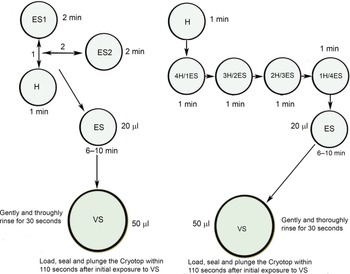
In total, 2, 4, 6, 8 or 10 MII oocytes were classified to DM2, DM4. DM6, DM8 or DM10 groups, respectively, were placed into the holding medium (H) and left undisturbed for 1 min. The holding medium was mixed with equilibration solution 1 (ES1) using the tip of a transfer pipette, and two droplets were spontaneously mixed for 2 min. Then ES2 was merged with the holding medium + ES1, and the two droplets were spontaneously mixed for 2 min. The oocytes from the merged drop were transferred to ES3 and exposed undisturbed for 6–10 min. Then, oocyte(s) from ES3 were transferred to a vitrification solution (VS) for 90 s before they were loaded. The oocytes were gently but thoroughly pipetted in a VS drop to ensure a complete rinse. Different numbers of oocytes were loaded onto the tips of a Cryotop (Kuwayama et al., Reference Kuwayama, Vajta, Ieda and Kato2005a, Reference Kuwayama, Vajta, Kato and Leibo2005b; Kitazato Co., Minato-ku, Japan) within 90 s, taking care not to exceed 110 s following the initial exposure to the VS. Finally, once the vitrification was complete, the Cryotop was immediately capped and dropped into liquid nitrogen for storage (Figure 1A). The vitrification and thawing kits were purchased from Irvine Scientific Inc. (Santa Ana, CA). Procedures were performed strictly according to the manufacturer’s instruction manual.
Schematic diagram of droplet merge and multi-gradient equilibration vitrification protocols. Mature mouse oocytes were transferred into holding medium (H) for a duration of 1 min and equilibrated through two different methods in equilibration solution (ES) or ES/H mixture, and treated with vitrification solution (VS) for 90 s. After the oocytes were loaded onto a Cryotop, they were immersed in liquid nitrogen. (A) Routine droplet merge and vitrification. (B) Modified multi-gradient equilibration and vitrification.

Modified multi-gradient equilibration and vitrification of oocytes
In total, 2, 4, 6, 8 or 10 oocytes were classified into MG2, MG4. MG6, MG8 or MG10 groups, respectively, and were suspended in holding medium (H), 4H1ES [80% H + 20% equilibration solution (ES)], 3H2ES (60% H + 40% ES), 2H3ES (40% H + 60% ES), and 1H4ES (20% H + 80% ES), respectively, for 1 min each, then transferred to ES and incubated for 6–10 min. The oocytes were then transferred to VS and incubated for 90 s (<110 s) at room temperature. The oocytes were loaded onto the tip of a Cryotop (Kitazato, Japan), capped, and immediately dropped into liquid nitrogen for storage (Figure 1B). All the oocytes were cryopreserved until they were thawed for analysis. Each vitrification via this protocol was repeated 25 times, similar to the droplet merge vitrification method.
Thawing of oocytes
Oocytes were thawed by direct immersion of the Cryotop in pre-warmed TS1 solution at 37°C for 1 min. The warmed oocytes were sequentially transferred to TS2 for 3 min each, washed twice with TS3 medium, and finally transferred to human tubal fluid (HTF) medium (Millipore Co., Billerica, MA, USA). They were incubated at 37°C in 5% CO2 in humidified air for 2 h. The survival of oocytes was assessed by morphological analysis, which involved examining the integrity of the plasma membrane and the discoloration of ooplasm after the thawed oocytes were recovered. The oocytes that survived were inseminated by intracytoplasmic injection of spermatozoa.
Intracytoplasmic spermatozoa injection (ICSI) of oocytes
Epididymal spermatozoa were collected from the cauda epididymis of 8-week-old to 10-week-old BDF1 mice and incubated in HTF medium for 30 min at 37°C in air containing 5% CO2. Then, 1 µl of spermatozoa suspension was mixed with 10 µl of 10% polyvinyl pyrrolidone (PVP)–HEPES-buffered CZB medium in a ICSI manipulation chamber. ICSI was performed as described previously (Jiang et al., Reference Jiang, Zhu, Zhu, Sun and Chen2005) with a minor modification. Briefly, the sperm head was separated from the tail by piezo pulses at the neck region, and the head was immediately injected into a thawed oocyte. After 10 min of recovery at room temperature, the oocytes were washed at least three times and then placed into KSOMaa medium (Millipore Co.). Fertilization was evaluated by observing the formation of two pronuclei (2PN) 5 h after ICSI. The rates of embryos developed to the blastocyst were assessed on day 3.5 after insemination.
Oct4 staining and cell counting of blastocysts
The thawed blastocysts from both vitrification protocols were fixed and treated as previously described (Kong et al., Reference Kong, Zhu, Wang, Li, Chen and Jiang2013; Zhu et al., Reference Zhu, Jiang, He, Zhang, Sun, Jiang and Wang2015). Briefly, blastocysts were fixed in 4% (w/v) paraformaldehyde in phosphate-buffered saline (PBS) for 40 min at room temperature. Fixed samples were stored in 0.3% (w/v) bovine serum albumin (BSA)/PBS for 1 week at 4°C for further analysis. For immunofluorescence, samples were permeabilized in 0.1% Triton X-100 and 0.3% BSA in PBS (w/v) at 37°C for 30 min. The samples were washed at least three times with 0.01% Triton X-100/ PBS, and then were incubated in blocking solution (150 mM glycine and 0.3% BSA in PBS) for ∼30 min at 37°C. Then, the samples were treated with primary rabbit anti-Oct4 antibodies (H-134, 1:50, Santa Cruz Biotechnology, Santa Cruz, CA, USA) and FITC-labelled chicken anti-rabbit antibodies (1:100; Invitrogen, Grand Island, NY, USA), and diluted in blocking solution for 30–40 min each at 37°C or overnight at 4°C. After three washes (each time for 5 min), the nucleus was stained with 10 μg/ml 4′-6-diamidino-2-phenylindole (DAPI). The samples were then mounted on slides with anti-fade mounting medium, and examined under a laser-scanning confocal microscope (Zeiss LSM 510 Meta; Carl Zeiss AG, Oberkochen, Germany). Blastomeres expressing positive Oct4 showed green fluorescence and intact nuclei were blue. The ratio of blastomeres expressing green fluorescence to the total blastomeres with blue nuclei was considered the Oct4-positive rate (Figure 4A). The images shown in the Results section are representative of at least 30 samples from more than 25 experimental replicates.
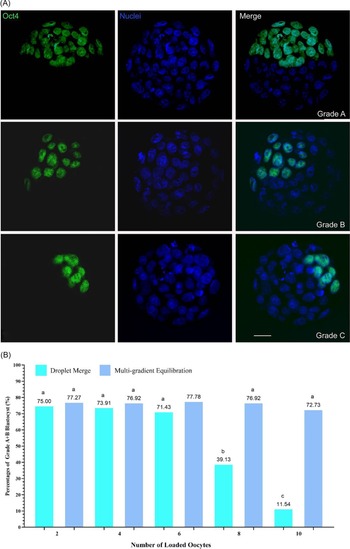
Based on the results of the number of Oct4-positive blastomeres, blastocysts were graded as Grade A, B, or C. Blastocysts with more than 15 Oct4-positive blastomeres were classified as Grade A blastocysts; those with 8–15 Oct-positive blastomeres were classified as Grade B blastocysts; and those with 0–8 blastomeres were classified as Grade C blastocysts. Blastocysts of grades A and B were considered to be good-quality embryos.
Meiotic spindle and chromosome evaluation of oocytes
Microtubules of oocytes were analyzed as described previously with minor modifications (Zhu et al., Reference Zhu, Chen, Li, Lian, Lei, Han and Sun2003, Reference Zhu, Jiang, He, Zhang, Sun, Jiang and Wang2015) in two vitrification protocols. In brief, after vitrification and thawing, the oocytes were incubated in HTF medium at 37°C for 2 h in an atmosphere containing 5.0% CO2 and then fixed in 4% paraformaldehyde for 10 min. Then the oocytes were washed in PBS and transferred to 0.25% Triton X-100/ PBS (w/v) for 10 min at room temperature. The oocytes were washed twice for 5 min each and blocked for 1 h at room temperature with 2% BSA in PBS. After washing twice with PBS, the oocytes were incubated with fluorescein isothiocyanate (FITC)-labelled mouse monoclonal antibodies against α-tubulin (Sigma-Aldrich Co.), and diluted with blocking solution (1:100) for 30–40 min at 37°C or overnight at 4°C. After washing three times for 5 min each time, the nuclei were stained with 10 µg/ml DAPI (Sigma-Aldrich Co.). Finally, the samples were mounted in an antifluorescence-fade medium (DABCO, Sigma-Aldrich Co.) on slides. They were then observed under a laser-scanning confocal microscope (Zeiss LSM 510 Meta). Typical barrel-shaped microtubules traversing the two poles and centrally aligned chromosomes were considered normal. Images shown in the Results are representatives of at least 20 samples from each group.
Statistical analysis
Data were analyzed using Prism 6.0 (GraphPad Software Inc., La Jolla, CA, USA). The survival rates and fertilization rates were compared using one-way analysis of variance (ANOVA) from Prism 6.0. The proportions of oocytes with normal spindle, blastocyst rates and proportions of good-quality blastocyst were compared using chi-squared test. A P-value of <0.05 was considered statistically significant.
Results
Effects of different vitrification protocols on oocyte survival, fertilization, and blastocyst formation
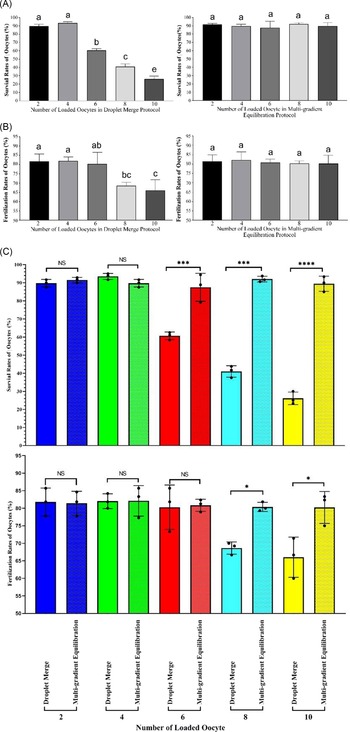
The multi-gradient equilibration vitrification protocol displayed higher survival (Figure 2, Table S1), fertilization rates (Figure 2, Table S2), and blastocyst rates (Table 1) compared with the droplet merge vitrification protocol, regardless of the number of oocytes loaded onto each Cryotop (P > 0.05).
Survival rates of oocytes and fertilization rates of droplet merge and multi-gradient equilibration vitrification protocols. (A) Oocyte survival rates achieved using the droplet merge and multi-gradient equilibration vitrification protocols. (B) Fertilization rates achieved using the droplet merge and multi-gradient equilibration vitrification protocols. (C) Comparison of survival and fertilization rates between droplet merge and multi-gradient equilibration vitrification protocols when the number of loaded oocytes is the same. Different superscript letters on the bars in (A) and (B) indicate P < 0.05. Asterisks *** and **** on the columns in (C) indicate P < 0.05, 0.001 and 0.0001. NS: No significant difference.

Blastocyst rates between droplet merge and multi-gradient equilibration vitrification protocols

Values with different superscripts within columns are significantly different at P < 0.05 (chi-squared test).
However, the droplet merge vitrification protocol showed a reduced survival rate, fertilization rate and blastocyst formation rate (Figure 2 and Table 1). Lower survival rates (Figure 2) were observed when the loading number exceeded six oocytes, and the fertilization rates (Fig 2) and blastocyst formation (Table 1) rates decreased when the loading number exceeded eight. There were significant differences in the oocyte survival rates between the two protocols when more than six oocytes were loaded (P < 0.001). Additionally, the fertilization rates (P < 0.05) and blastocyst formation rates (P < 0.05) did significantly differ between the two protocols when eight oocytes were loaded onto the Cryotops (Figure 2, Table 1).
In addition, we also found significant differences in oocyte survival rates for 6–10 oocytes loaded onto each Cryotop (P < 0.001, Figure 2), but not for 2–4 oocytes. Furthermore, there were differences in oocyte fertilization rates when the loading number exceeded six (P < 0.05, Figure 2).
Modified vitrification maintains oocytes with normal spindle morphology
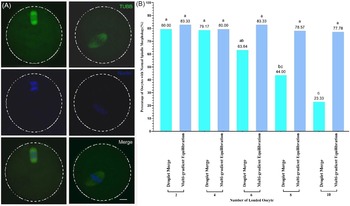
After thawing and incubation in HTF medium for 2 h, the proportion of oocytes with normal spindles significantly decreased with an increase in the number of oocytes loaded onto a Cryotop in the droplet merge vitrification protocol. Significant differences were observed when the number of loaded oocytes ranged from 8–10 (P < 0.05; Figure 3B; Table S3). Conversely, no similar results were observed with the multi-gradient equilibration vitrification protocol, regardless of the number of oocytes loaded onto the Cryotop (P > 0.05; Figure 3B; Table S). These results indicate that the modified multi-gradient equilibration vitrification protocol is a more stable procedure, resulting in a higher percentage of oocytes with normal spindles compared with the routine droplet merge vitrification.
Spindle morphology of oocytes after thawing of droplet merge and multi-gradient equilibration vitrification protocols. (A) Representative images of oocyte spindles from droplet merge or multi-gradient equilibration and vitrification protocols. Green: TUBB (tubulin); Blue: Nuclei; Merge: overlay of TUBB and nuclei. Scale bar, 10 μm. (B) Differences in the percentage of oocytes exhibiting normal spindle morphology between droplet merge and multi-gradient equilibration vitrification protocols when the number of loaded oocytes was the same. Different letters on the bars in (B) indicate P < 0.05.

Oct4 expression and its positive percentage in expanded blastocysts of droplet merge and multi-gradient equilibration vitrification protocols. (A) Representative images of Oct4 expression in expanded mouse blastocysts derived from two vitrification protocols. Upper panels show an example of a Grade A blastocyst with more than 15 Oct4-positive blastomeres. Middle panels show an example of Grade B blastocysts with 8–15 Oct4-positive blastomeres, and lower panels show an example of Grade C blastocysts with <8 Oct4-positive blastomeres. Oct4 expression is shown in green and 4′-6-diamidino-2-phenylindole (DAPI)-stained nuclei are shown in blue. Scale bar: 20 μm. (B) Proportions of Grade A+B blastocysts are shown for each protocol. Different letters on the bars indicate P < 0.05.

Additionally, we found that the spindle morphology was significantly altered with 8–10 oocytes per Cryotop (P < 0.05, Figure 3B), but not with 2–6 oocytes per Cryotop (P > 0. 05; Figure 3B).
Effects of different vitrification protocols and oocyte loading number on Oct4 expression in expanded blastocysts
When 2, 4, 6, 8 or 10 oocytes were loaded in the droplet merge vitrification protocol, the percentages of good-quality blastocysts (grade A+B) obtained were 75.00%, 73.91%, 71.43%, 39.13%, and 11.54%, respectively. Conversely, for the multi-gradient equilibration vitrification protocol, the percentages of good-quality blastocysts obtained were 77.27%, 76.92%, 77.78%, 76.92%, and 72.73% when 2, 4, 6, 8, and 10 oocytes were loaded onto the Cryotop, respectively (Figure 4; Table S4). These results indicated that there was a significant difference in the percentage of good-quality blastocysts (grades A and B) between the droplet merge and multi-gradient equilibration vitrification protocols (P < 0.05; Figure 4B) when the number of oocytes loaded onto the Cryotop was between 8 and 10. It is evident that multi-gradient equilibration vitrification is more beneficial for embryonic development.
Discussion
Oocyte cryopreservation is an important fertility preservation technique in humans and various animal species. Cryopreservation of human oocytes holds great promise for preserving fertility in cancer patients who must undergo radiation or chemotherapy and can also be used for oocyte donation programmes (Huang et al., Reference Huang, Buckett, Gilbert, Tan and Chian2007), and it is a promising technique for preserving female fertility in failed testicular sperm extraction cycles (Song et al., Reference Song, Sun, Jin, Xin, Su, Guo and Chen2010). Mouse oocyte cryopreservation is important as it provides preliminary data that may indirectly be applicable to human oocyte cryopreservation, and these oocyte cryopreservation techniques can be used to preserve invaluable genetic resources or endangered species.
Vitrification is an alternative to traditional cryopreservation methods (slow freezing) to avoid chilling injury and ice crystal formation (Rall and Fahy, Reference Rall and Fahy1985; Gupta et al., Reference Gupta, Uhm and Lee2007). Some studies have shown the success of cryopreserving mature bovine oocytes using very rapid cooling methods and brief exposure to vitrification solutions (Martino et al., Reference Martino, Songsasen and Leibo1996; Vajta et al., Reference Vajta, Holm, Kuwayama, Booth, Jacobsen, Greve and Callesen1998). Kuleshova et al. (Reference Kuleshova, Gianaroli, Magli, Ferraretti and Trounson1999) recently reported the first case of birth from vitrified human oocytes. At present, oocytes are mainly vitrified using single-step (ultra-rapid) and stepwise protocols in animal studies and for human clinical applications, but these protocols were unsatisfactory and appeared to need more improvements.
In our present study, mouse MII oocytes were cryopreserved using the routine droplet merge vitrification protocol according to the manual of oocyte vitrification kits (Figure 1A), and multi-gradient equilibration vitrification that was modified from the droplet merge vitrification protocol (Figure 1B).
Our results from the routine droplet merge vitrification showed that the survival rates, fertilization rates, and blastocyst rates of thawed oocytes significantly decreased with an increase in the number of oocytes loaded per Cryotop. Additionally, morphological analysis of the oocyte spindle revealed an increased proportion of oocytes with abnormal spindle morphology as the number of oocytes loaded increased. In contrast, the multi-gradient equilibration vitrification exhibited higher survival rates (Figure 2A) and blastocyst rates (Table 1), regardless of the oocyte loading number. These findings suggest that the droplet merge vitrification is not suitable for simultaneous cryopreservation of a large number of oocytes. Therefore, the multi-gradient equilibration vitrification method is more suitable for the simultaneous cryopreservation of a greater number of oocytes. This suggests that, if our intention is to cryopreserve a larger quantity of oocytes at once, the multi-gradient equilibration vitrification approach may be a preferable option.
Oocyte cryopreservation could lead to ZP hardening (Johnson et al., Reference Johnson, Pickering and George1988); therefore, conventional IVF is unsuccessful due to ZP modifications, necessitating ICSI for fertilization. Moreover, the cytoskeletal structure is very sensitive to temperature changes (Tamura et al., Reference Tamura, Huang and Marikawa2013). Both are not conducive to sperm penetration into oocytes and fertilization. Many studies have demonstrated that incubating oocytes in a fertilization medium for 15 min to several hours after freezing could rescue cytoskeletal disruption, which benefits fertilization and embryo development (Eroglu et al., Reference Eroglu, Toner, Leykin and Toth1998). In our study, oocytes that were inseminated by ICSI after incubation in HTF for 2 h showed higher rates of fertilization and embryo development. Another study (Chang et al., Reference Chang, Lin, Sung, Kort, Tian and Nagy2011) showed that phase transition and low temperature caused little effect on the mouse oocyte spindle morphology during the vitrification and warming process, as a result of which the oocyte spindle was able to recover immediately after warming. However, in our study, we found some oocytes with abnormal spindle morphology even after the oocytes were allowed to recover for 2 h; therefore, we proposed that recovery in fertilization medium for adequate time before fertilization allows the reorganization of tubulin and microfilament components inside oocytes, which in turn leads to improved fertilization and embryo development. Similar to our results, some studies in humans reported that oocyte spindles that were allowed to recover for a period of time after vitrification resulted in improved embryonic development (Rienzi et al., Reference Rienzi, Martinez, Ubaldi, Minasi, Iacobelli, Tesarik and Greco2004; Gao et al., Reference Gao, Li, Gao, Hu, Yang and Chen2009) and this recovery may result in comparable cleavage time, cell number, and DNA methylation patterns between fresh and vitrified oocytes (De Munck et al., Reference De Munck, Petrussa, Verheyen, Staessen, Vandeskelde, Sterckx, Bocken, Jacobs, Stoop, De Rycke and Van de Velde2015).
Oct4 is a specific gene marker for the inner cell mass (ICM) at the expanded blastocyst stage. The expanded blastocysts were categorized into three grades based on the number of Oct4-positive cells to assess blastocyst quality (Figure 4A). To evaluate the quality of embryos derived from cryopreserved-thawed oocytes, we specifically examined the relationship between vitrification protocols and Oct4 expression in expanded blastocysts. Our results showed that embryos derived from the modified protocol had a higher percentage of pluripotent cells in the ICM, as evidenced by Oct4 expression, and a higher blastocyst development rate. Blastocysts from the multi-gradient equilibration vitrification protocol exhibited superior quality compared with those from the droplet merge vitrification method. These findings provide clear evidence that the utilization of the multi-gradient vitrification protocol results in significantly higher quality blastocysts, further supporting its suitability for oocyte cryopreservation.
In summary, routine droplet merge vitrification offers certain advantages for human oocyte cryopreservation, including high survival and fertilization rates. However, it is limited to vitrifying only 2–4 oocytes at a time. In particular, this procedure is time-consuming for animal oocyte cryopreservation, results in cryocarrier wastage, and requires significant storage space. Consequently, the droplet merge vitrification has clear drawbacks and is unsuitable for freezing a larger number of oocytes at one time or establishing an oocyte bank. Conversely, multi-gradient equilibration vitrification can be used to freeze ∼10 oocytes at a time, and the oocyte survival rates, proportions with normal spindle morphology, fertilization rates and high-quality blastocyst rates obtained using this protocol are markedly high. Additionally, this multi-gradient equilibration vitrification has some advantages in reducing the total time of vitrification, minimizing the number of cryocarriers, and saving storage space. Therefore, it is recommended for use in establishing human oocyte banks and preserving valuable animal resources.
Supplementary material
To view supplementary material for this article, please visit https://doi.org/10.1017/S0967199423000540
Acknowledgements
This work was supported by grants from the Guangdong Science and Technology Project funds (2017A020214019), the Guangzhou Science and Technology Project fund (Grant number 201904010058) and the introduction of talent scientific research start-up fund of Guangdong Second Provincial General Hospital (grant number no. YY2017–003).
Competing financial interests
The authors declare no competing financial interests.