The diamond-shaped squid, Thysanoteuthis rhombus Troschel, 1857, a large, muscular cephalopod—~100 cm mantle length (ML) maximum—is a cosmopolitan species distributed in warm and temperate waters of the world's oceans (Clarke, Reference Clarke1966; Young & Vecchione, Reference Young and Vecchione1996). It is an epipelagic oceanic squid that spends its whole life in the water column.
In the Mediterranean Sea egg-masses, paralarvae, juveniles, subadults, and pairs of adults have been collected and recorded, which represents sound evidence that T. rhombus completes its whole life cycle in this sea; see Bello (Reference Bello1999) for a concise review of previous literature and Guerra et al. (Reference Guerra, González, Rocha, Sagarminaga and Cañadas2002), Salman et al. (Reference Salman, Katağan and Benli2003), Marčić et al. (Reference Marčić, Ćaleta, Buj, Mrakovčić, Mustafić, Zanella and Dulčić2009), and Biagi & Bello (in press) for more recent references. Incidentally, this squid is the only cephalopod known to form pairs lasting from before sexual maturation throughout the whole multiple-spawning reproductive period (Arkhipkin et al., Reference Arkhipkin, Nigmatullin, Sabirov, Shilin, Storabogatov and Nesis1983; Nigmatullin et al., Reference Nigmatullin, Arkhipkin and Sabirov1995).
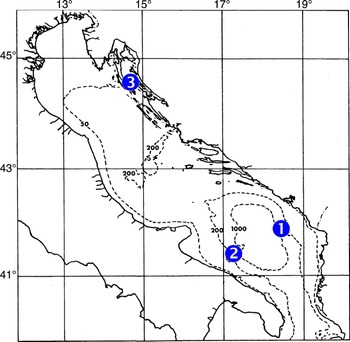
As for the Adriatic Sea, three occurrences of the diamond-shaped squid have been reported in the literature (Figure 1):
1. A pair of mandibles (beaks) retrieved from the stomach contents of a swordfish, Xiphias gladius Linnaeus, 1758, caught in the south-eastern Adriatic Sea on 23 January 1993; estimated ML = 14.2 cm, estimated weight (W) = 222 g (Bello, Reference Bello1999). The perfect conditions of both beaks (i.e. their transparent, delicate parts were not yet attacked by the digestion processes) indicate that the squid had been ingested just hours before the swordfish capture.
2. A pair of large living individuals (estimated total length = 1.5 m) closely observed in the south-western Adriatic Sea on 25 October 1998 (Bello, Reference Bello1999) by an experienced amateur marine biologist.
3. A subadult male (ML = 34.6 cm; W = 1272 g) collected near the islands of Rab and Pag (Croatia) on 26 December 2006; it was caught by squid jig quite close to the coast in shallow waters (–10 m) (Marčić et al., Reference Marčić, Ćaleta, Buj, Mrakovčić, Mustafić, Zanella and Dulčić2009). These authors report that this is the northernmost Mediterranean record for T. rhombus. They also consider it the first record of the species in the Adriatic Sea, on the basis that the find of beaks from a swordfish stomach reported by Bello (Reference Bello1999) ‘could not be treated as the valid record or confirmation of presence of this species in the Adriatic Sea, since the swordfish is highly migratory species which could enter the Adriatic Sea from the Ionian or Aegean Sea’ (Marčić et al., Reference Marčić, Ćaleta, Buj, Mrakovčić, Mustafić, Zanella and Dulčić2009: 2).
Sites of Thysanoteuthis rhombus finds in the Adriatic Sea.

Most probably Marčić et al. (Reference Marčić, Ćaleta, Buj, Mrakovčić, Mustafić, Zanella and Dulčić2009), while claiming that the find of the diamond-shaped squid off the Croatian coast in December 2006 is the first valid Adriatic record, had overlooked the report of the pair of living individuals in Bello (Reference Bello1999), which indeed was described in a ‘Note added in press’.
The find reported by Marčić et al. (Reference Marčić, Ćaleta, Buj, Mrakovčić, Mustafić, Zanella and Dulčić2009) confirms that T. rhombus occurs in the Adriatic Sea. However, it is not known whether it is a stable inhabitant of this sea or just an occasional visitor. In fact, no indication has arisen up to now that this squid completes its life cycle in the Adriatic Sea, viz. neither egg-masses, nor paralarvae, nor early juveniles of the species were ever collected there. The smallest recorded specimen is the one whose remains were found in the swordfish stomach—estimated age: about 4 months (Bello, Reference Bello1999)—and which probably entered the Adriatic Sea along its eastern coast following the north-west inflow through the Strait of Otranto, according to the general Adriatic water circulation, governed by a cyclonic gyre (Zore-Armanda, Reference Zore-Armanda1981). Such a hypothesis is also put forth by Marčić et al. (Reference Marčić, Ćaleta, Buj, Mrakovčić, Mustafić, Zanella and Dulčić2009) for their specimen (incidentally, this hypothesis is further corroborated by the occurrence of many more finds of alien fish along the eastern Adriatic coast than the western one; see Dulčić et al., Reference Dulčić, Grbec and Lipej1999). On the contrary, the presence of a pair of adults in October (Bello, Reference Bello1999), a month that falls within the spawning season of this cephalopod (summer and early autumn in peripheral distribution regions; Nigmatullin et al., Reference Nigmatullin, Arkhipkin and Sabirov1995), might indicate that T. rhombus occasionally reproduces in the Adriatic Sea.
According to Guerra et al. (Reference Guerra, González, Rocha, Sagarminaga and Cañadas2002) T. rhombus females lay their eggs in waters with strong currents, which assumption is supported by Miyahara et al. (Reference Miyahara, Ota, Goto and Gorie2006b). Biagi & Bello (in press) assert that the availability of adequate quantities of food for paralarvae is an important factor too in the selection of the spawning sites (see also Miyahara et al., Reference Miyahara, Fukui, Ota and Minami2006a). Positive spawning grounds may be recognized by the occurrence of either egg-masses (for the Mediterranean Sea see reviews in Guerra et al., Reference Guerra, González, Rocha, Sagarminaga and Cañadas2002; Biagi & Bello, in press) or paralarvae. Mediterranean finds of early juvenile stages were recently reported by Salman et al. (Reference Salman, Katağan and Benli2003) in the northern Aegean Sea (one specimen, ML = 2.5 mm) and by Balducci & Piccinetti (in press) in the eastern basin and the southern Tyrrhenian Sea (six specimens, ML range = 2.8–8.0 mm). Moreover Ezzedine-Najai (Reference Ezzedine-Najai, Oloriz and Rodriguez-Tovar1996) reported the capture of several adult diamond-shaped squid in Tunisian waters.
To sum up, this cephalopod has been recorded in all the geographical districts of the Mediterranean, including the Aegean and Adriatic Seas—no finds in these seas were known at the time of Mangold & Boletzky's (Reference Mangold, Boletzky, Fischer, Bauchot and Schneider1987) synopsis—although it appears that the reproduction of the Mediterranean population seemingly takes place only in the southern areas of the basin. Accordingly the Adriatic Sea probably is not part of its spawning range.
Lastly, one may hypothesize that the new generation members of T. rhombus spread out throughout the Mediterranean and, when approaching the spawning season, form pairs and accomplish genetic migrations towards the reproductive areas.
ACKNOWLEDGEMENTS
I am pleased to thank Angel Guerra (Vigo, Spain) for suggesting and providing some reference papers and an anonymous referee for his/her advice.